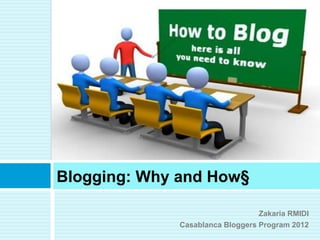
Blogging: Why and How§

                                  Zakaria RMIDI
              Casablanca Bloggers Program 2012
OUTLINE
   What is a blog?
   Where to find blogs?
        Blogs’ Search Engines.
        Blogs’ Communities.
        Web-based Blogging Platforms.
        Social networks.
     Create a blog
        Blogging platforms
     Writing for the web
        The Inverted Pyramid
What is a blog?
What is a blog?


   Blog a contraction of the term   "web
    log".

   Blogger is the person producing the blog.

   Blogging is when you create the blog by
    posting an entry.
What is a blog?


   A blog tends to be a website.
   Usually maintained by an individual but
    sometimes by a group of people.
   Posts are usually displayed in reverse-
    chronological order.
    Entries includes text, images, videos and
    audio material.
Where to find blogs?

   You can find blogs you want in:
     1.   Blogs’ Search Engines.
     2.   Blogs’ Communities.
     3.   Web-based Blogging Platforms.
     4.   Social networks.
Blogs’ search ingines


 Technorati http://www.technorati.com/
 Google Blog Search http://blogsearch.google.com/
 BlogScope http://www.blogscope.net/
 IceRocket http://www.icerocket.com/
Blogs Communities

   Blogs’ communities are usually web-based
    platforms where thousands of blogs exist.
   These blogs are classified in term of
    categories: culture, politics, media, life style,
    literature, tourism, religion …etc.
   These categories connect blogs and bloggers
    who share the same interest together.
Blogs Communities


   Blog Catalog http://www.blogcatalog.com/
   Blog Top Sites http://www.blogtopsites.com/
   Bloggapedia http://www.bloggapedia.com/
   Blogged http://www.blogged.com/
   Bloggernity http://www.bloggernity.com/
Web-based Blogging
Platforms
   Dozens of Blogs’ platforms are available online, for
    free, where you can:

     Find blogs you like.
     Interact with blog authors.
     Share articles, pictures, videos…etc.
     Create your own blog.


    - Blogger http://www.blogger.com/
    - Bloglines http://www.bloglines.com/
    - LiveJournal http://www.livejournal.com/
    - WordPress http://wordpress.com/
    - Over-Blog http://www.over-blog.com/
    - Xanga http://www.xanga.com/
Social Networks
   You can also find blogs on social networks site
    such as:
     Facebook

     Twitter

     MySpace

     StumbleUpon

     Digg
Create a blog
   To have a successful blog, think about:

    1.   The type of the content you want to deal with,
         the way it is exposed, references and sources.
    2.   One main theme and focus on it.
    3.   The type of blog whether it is individual or
         collective.
    4.   An appropriate platform.
    5.   An appropriate name for the blog.
    6.   An appropriate design for the blog.
    7.   A target audience to address.
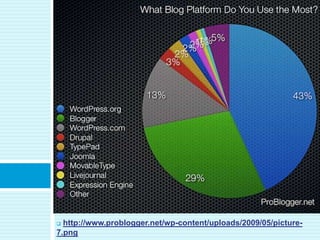
 http://www.problogger.net/wp-content/uploads/2009/05/picture-
7.png
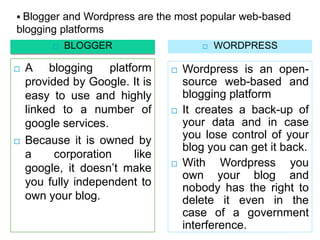
 Blogger and Wordpress are the most popular web-based
blogging platforms
            BLOGGER                      WORDPRESS

   A blogging platform            Wordpress is an open-
    provided by Google. It is       source web-based and
    easy to use and highly          blogging platform
    linked to a number of          It creates a back-up of
    google services.                your data and in case
   Because it is owned by          you lose control of your
                                    blog you can get it back.
    a     corporation   like
    google, it doesn’t make        With Wordpress you
                                    own your blog and
    you fully independent to        nobody has the right to
    own your blog.                  delete it even in the
                                    case of a government
                                    interference.
Writing for the
      web
The Structure of Story-telling
   Traditional Media:

   The traditional journalistic writing is based on a
    linear story-telling. It is often called “The
    Inverted Pyramid”.

   This structure of story-telling gives to the
    reader a summary lead and details in
    descending order of importance.
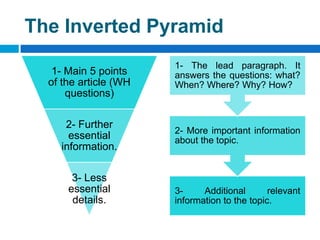
The Inverted Pyramid
                       1- The lead paragraph. It
   1- Main 5 points    answers the questions: what?
  of the article (WH   When? Where? Why? How?
      questions)

     2- Further
                       2- More important information
      essential        about the topic.
    information.

       3- Less
      essential        3-     Additional       relevant
       details.        information to the topic.
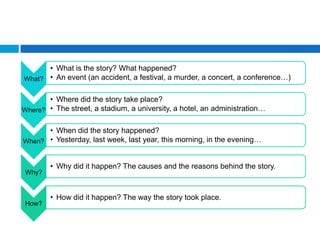
• What is the story? What happened?
What? • An event (an accident, a festival, a murder, a concert, a conference…)


       • Where did the story take place?
Where? • The street, a stadium, a university, a hotel, an administration…


      • When did the story happened?
When? • Yesterday, last week, last year, this morning, in the evening…


        • Why did it happen? The causes and the reasons behind the story.
Why?


        • How did it happen? The way the story took place.
How?
The Structure of Story-telling
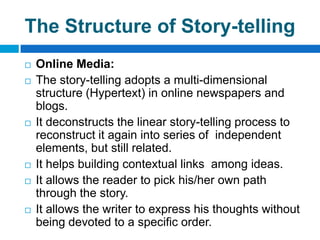
   Online Media:
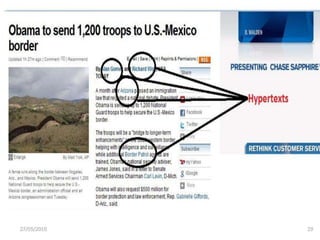
   The story-telling adopts a multi-dimensional
    structure (Hypertext) in online newspapers and
    blogs.
   It deconstructs the linear story-telling process to
    reconstruct it again into series of independent
    elements, but still related.
   It helps building contextual links among ideas.
   It allows the reader to pick his/her own path
    through the story.
   It allows the writer to express his thoughts without
    being devoted to a specific order.
The Structure of Story-telling


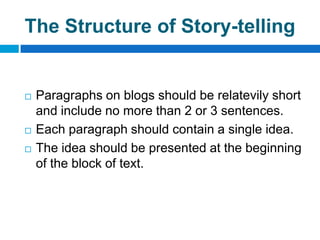
   Paragraphs on blogs should be relatevily short
    and include no more than 2 or 3 sentences.
   Each paragraph should contain a single idea.
   The idea should be presented at the beginning
    of the block of text.
THANK
 YOU

Blogging

  • 1.
    Blogging: Why andHow§ Zakaria RMIDI Casablanca Bloggers Program 2012
  • 2.
    OUTLINE  What is a blog?  Where to find blogs?  Blogs’ Search Engines.  Blogs’ Communities.  Web-based Blogging Platforms.  Social networks.  Create a blog  Blogging platforms  Writing for the web  The Inverted Pyramid
  • 3.
    What is ablog?
  • 4.
    What is ablog?  Blog a contraction of the term "web log".  Blogger is the person producing the blog.  Blogging is when you create the blog by posting an entry.
  • 5.
    What is ablog?  A blog tends to be a website.  Usually maintained by an individual but sometimes by a group of people.  Posts are usually displayed in reverse- chronological order.  Entries includes text, images, videos and audio material.
  • 6.
    Where to findblogs?  You can find blogs you want in: 1. Blogs’ Search Engines. 2. Blogs’ Communities. 3. Web-based Blogging Platforms. 4. Social networks.
  • 7.
    Blogs’ search ingines Technorati http://www.technorati.com/ Google Blog Search http://blogsearch.google.com/ BlogScope http://www.blogscope.net/ IceRocket http://www.icerocket.com/
  • 8.
    Blogs Communities  Blogs’ communities are usually web-based platforms where thousands of blogs exist.  These blogs are classified in term of categories: culture, politics, media, life style, literature, tourism, religion …etc.  These categories connect blogs and bloggers who share the same interest together.
  • 9.
    Blogs Communities  Blog Catalog http://www.blogcatalog.com/  Blog Top Sites http://www.blogtopsites.com/  Bloggapedia http://www.bloggapedia.com/  Blogged http://www.blogged.com/  Bloggernity http://www.bloggernity.com/
  • 10.
    Web-based Blogging Platforms  Dozens of Blogs’ platforms are available online, for free, where you can:  Find blogs you like.  Interact with blog authors.  Share articles, pictures, videos…etc.  Create your own blog. - Blogger http://www.blogger.com/ - Bloglines http://www.bloglines.com/ - LiveJournal http://www.livejournal.com/ - WordPress http://wordpress.com/ - Over-Blog http://www.over-blog.com/ - Xanga http://www.xanga.com/
  • 11.
    Social Networks  You can also find blogs on social networks site such as:  Facebook  Twitter  MySpace  StumbleUpon  Digg
  • 12.
    Create a blog  To have a successful blog, think about: 1. The type of the content you want to deal with, the way it is exposed, references and sources. 2. One main theme and focus on it. 3. The type of blog whether it is individual or collective. 4. An appropriate platform. 5. An appropriate name for the blog. 6. An appropriate design for the blog. 7. A target audience to address.
  • 13.
  • 14.
     Blogger andWordpress are the most popular web-based blogging platforms  BLOGGER  WORDPRESS  A blogging platform  Wordpress is an open- provided by Google. It is source web-based and easy to use and highly blogging platform linked to a number of  It creates a back-up of google services. your data and in case  Because it is owned by you lose control of your blog you can get it back. a corporation like google, it doesn’t make  With Wordpress you own your blog and you fully independent to nobody has the right to own your blog. delete it even in the case of a government interference.
  • 15.
  • 16.
    The Structure ofStory-telling  Traditional Media:  The traditional journalistic writing is based on a linear story-telling. It is often called “The Inverted Pyramid”.  This structure of story-telling gives to the reader a summary lead and details in descending order of importance.
  • 17.
    The Inverted Pyramid 1- The lead paragraph. It 1- Main 5 points answers the questions: what? of the article (WH When? Where? Why? How? questions) 2- Further 2- More important information essential about the topic. information. 3- Less essential 3- Additional relevant details. information to the topic.
  • 18.
    • What isthe story? What happened? What? • An event (an accident, a festival, a murder, a concert, a conference…) • Where did the story take place? Where? • The street, a stadium, a university, a hotel, an administration… • When did the story happened? When? • Yesterday, last week, last year, this morning, in the evening… • Why did it happen? The causes and the reasons behind the story. Why? • How did it happen? The way the story took place. How?
  • 19.
    The Structure ofStory-telling  Online Media:  The story-telling adopts a multi-dimensional structure (Hypertext) in online newspapers and blogs.  It deconstructs the linear story-telling process to reconstruct it again into series of independent elements, but still related.  It helps building contextual links among ideas.  It allows the reader to pick his/her own path through the story.  It allows the writer to express his thoughts without being devoted to a specific order.
  • 20.
    The Structure ofStory-telling  Paragraphs on blogs should be relatevily short and include no more than 2 or 3 sentences.  Each paragraph should contain a single idea.  The idea should be presented at the beginning of the block of text.
  • 22.