Globalizing the world: Supply Chain and the
IBM Blockchain Platform
Lennart Frantzell
IBM Developer Advocate
San Francisco
alf@us.ibm.com
June 21 2019
Blockchain Explored Series
IBM Blockchain Platform Explored
Fabric Explored
Composer Explored
What’s New
Architectures Explored
Or what is the Blockchain good for?
A new area in business computing started
during the global financial crisis in
October 2008
2
With Satoshi Nakamoto’s eight page paper: Bitcoin: A Peer-to-Peer
Electronic Cash System
He proposed a purely peer-to-peer version of electronic
cash without the need to go through financial institutions.
https://bitcoin.org/bitcoin.pdf g/
3
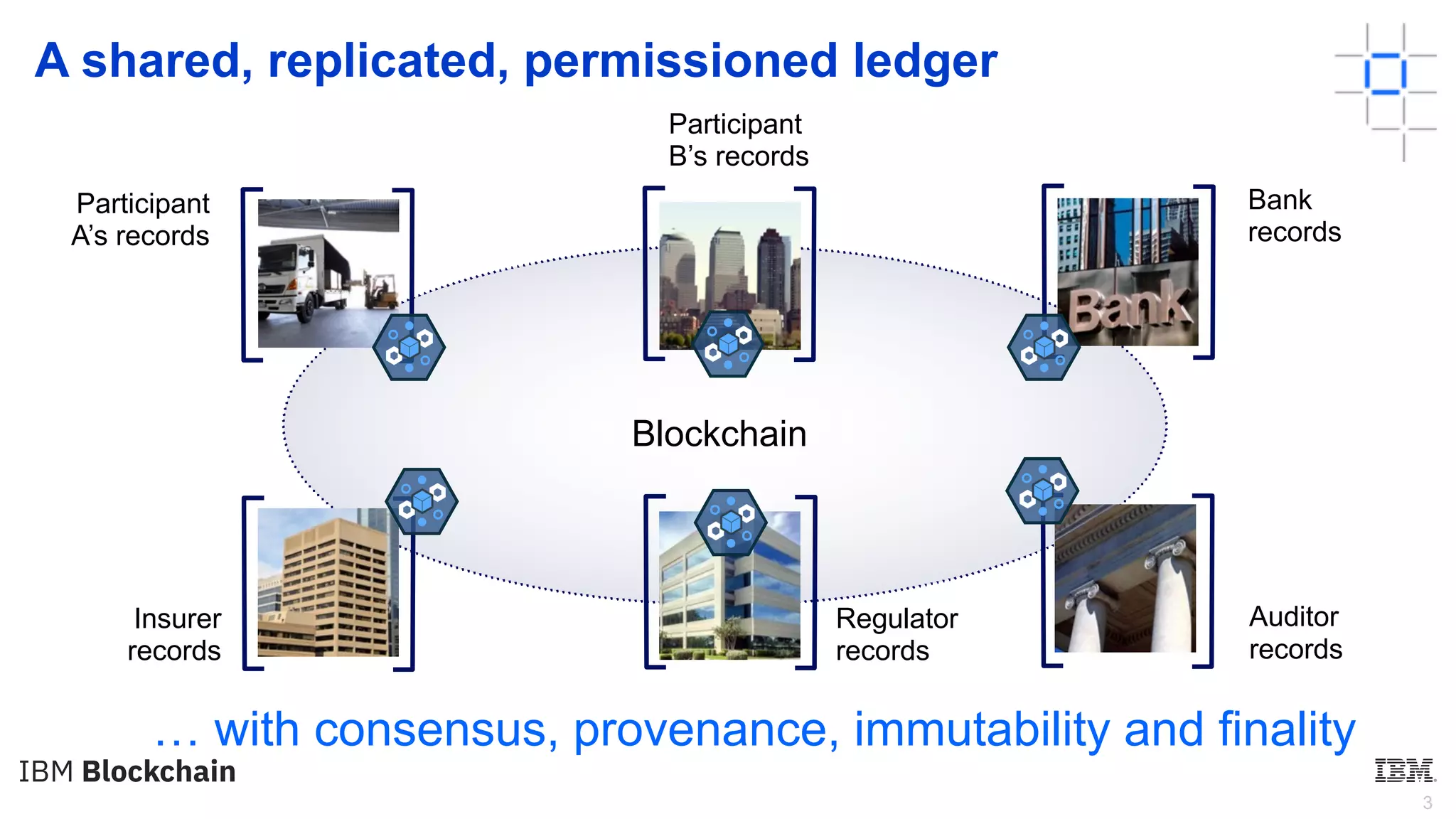
… with consensus, provenance, immutability and finality
Bank
records
Participant
B’s records
Auditor
records
Regulator
records
Blockchain
Insurer
records
Participant
A’s records
A shared, replicated, permissioned ledger
4
No trusted third party
No need for reconciliation
between ledgers
5
Satoshi Nakamoto’s Blockchain promised to
disrupt the world’s business systems
6
Many
7
So 10 years later, where is
the Blockchain Revolution?
Has the Blockchain Revolution Failed to Take
off Ten Years on?
8
Everyone, even the biggest skeptics of Bitcoin and other cryptocurrencies have all
had their positives to say about the underpinning Blockchain technology which has
the potential to change the world. However, it has been 10 years since Blockchain
technology came into the open, and yet we still don’t really have a major use for
it.it.
https://cointelegraph.com/news/has-the-blockchain-revolution-failed-
to-take-off-10-years-on
9
Cryptocurrencies Have Failed, And
Blockchain Still Has Yet To Be Proven
Useful
https://www.forbes.com/sites/yuwahedrickwong/2018/11/11/cryptocurrencies-
have-failed-and-blockchain-still-has-yet-to-find-its-use/#4a99f7a0406c
10
Blockchain companies go silent
when their tech promises fall
short, research group finds
https://www.marketwatch.com/story/blockchain-companies-go-silent-when-their-
tech-promises-fall-short-research-group-finds-2018-12-04
https://www.coindesk.com/0-success-why-blockchain-apps-just-arent-taking-off
11
‘0% Success’: Why Blockchain Apps Just Aren’t
Taking Off
12
Is the bubble bursting?
13
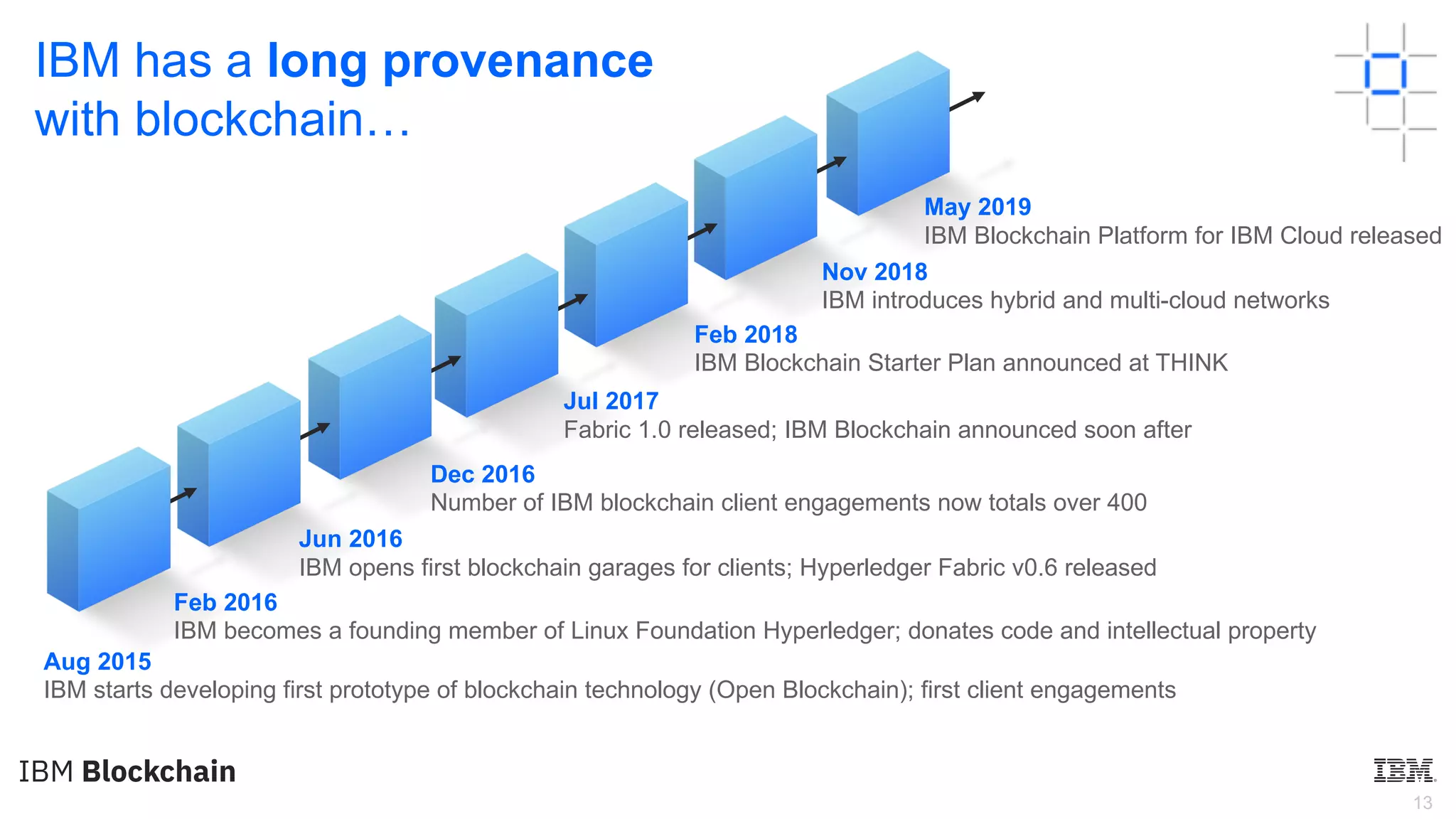
IBM has a long provenance
with blockchain…
Aug 2015
IBM starts developing first prototype of blockchain technology (Open Blockchain); first client engagements
Feb 2016
IBM becomes a founding member of Linux Foundation Hyperledger; donates code and intellectual property
Jun 2016
IBM opens first blockchain garages for clients; Hyperledger Fabric v0.6 released
Dec 2016
Number of IBM blockchain client engagements now totals over 400
Feb 2018
IBM Blockchain Starter Plan announced at THINK
Jul 2017
Fabric 1.0 released; IBM Blockchain announced soon after
Nov 2018
IBM introduces hybrid and multi-cloud networks
May 2019
IBM Blockchain Platform for IBM Cloud released
14
So what is Blockchain good
for?
15
Supply Chain!
• Global supply chains underpin the global economy
• They are usually large scale
• But are still largely run on paper records
16
17
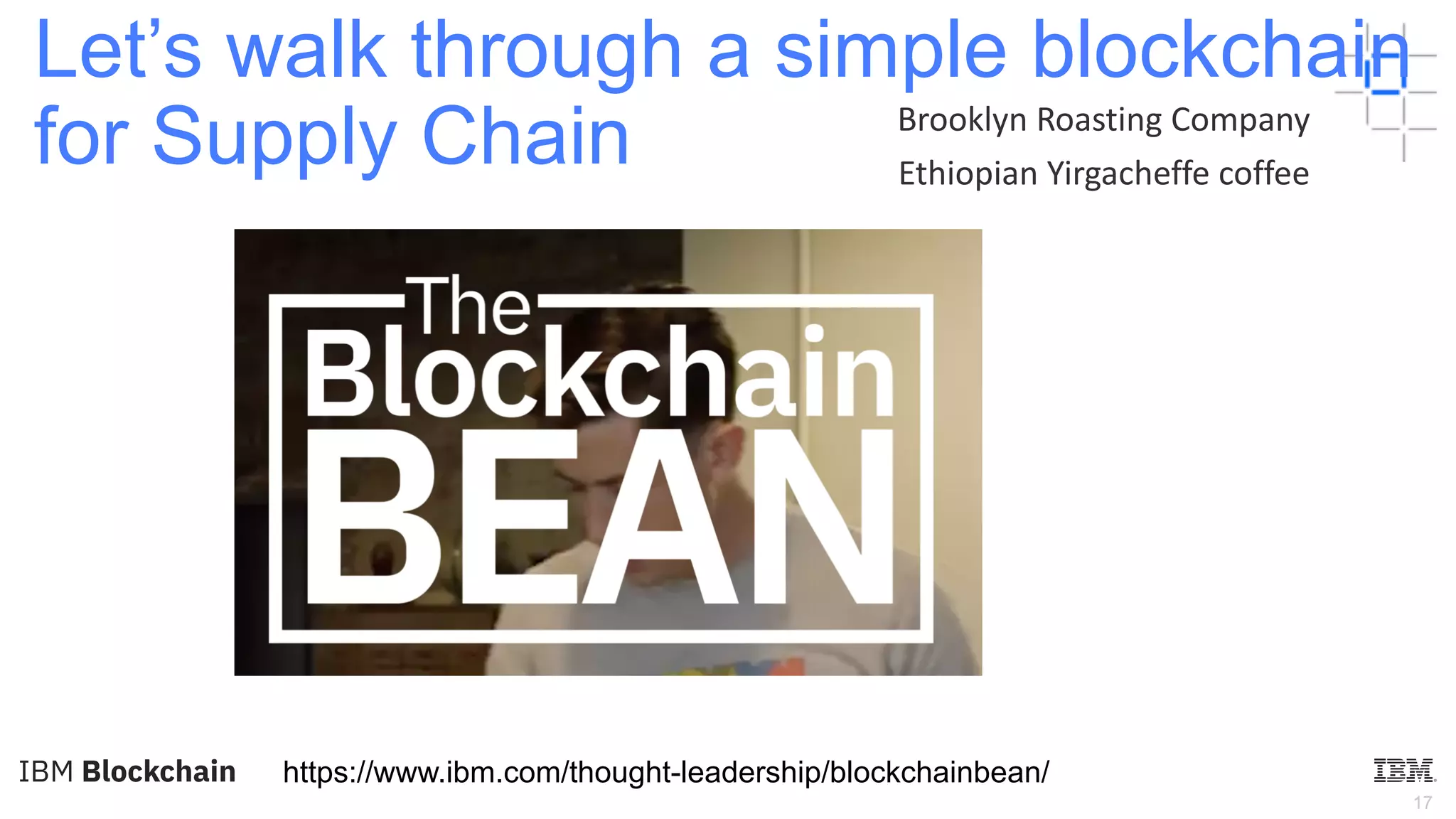
Let’s walk through a simple blockchain
for Supply Chain
https://www.ibm.com/thought-leadership/blockchainbean/
Brooklyn Roasting Company
Ethiopian Yirgacheffe coffee
18
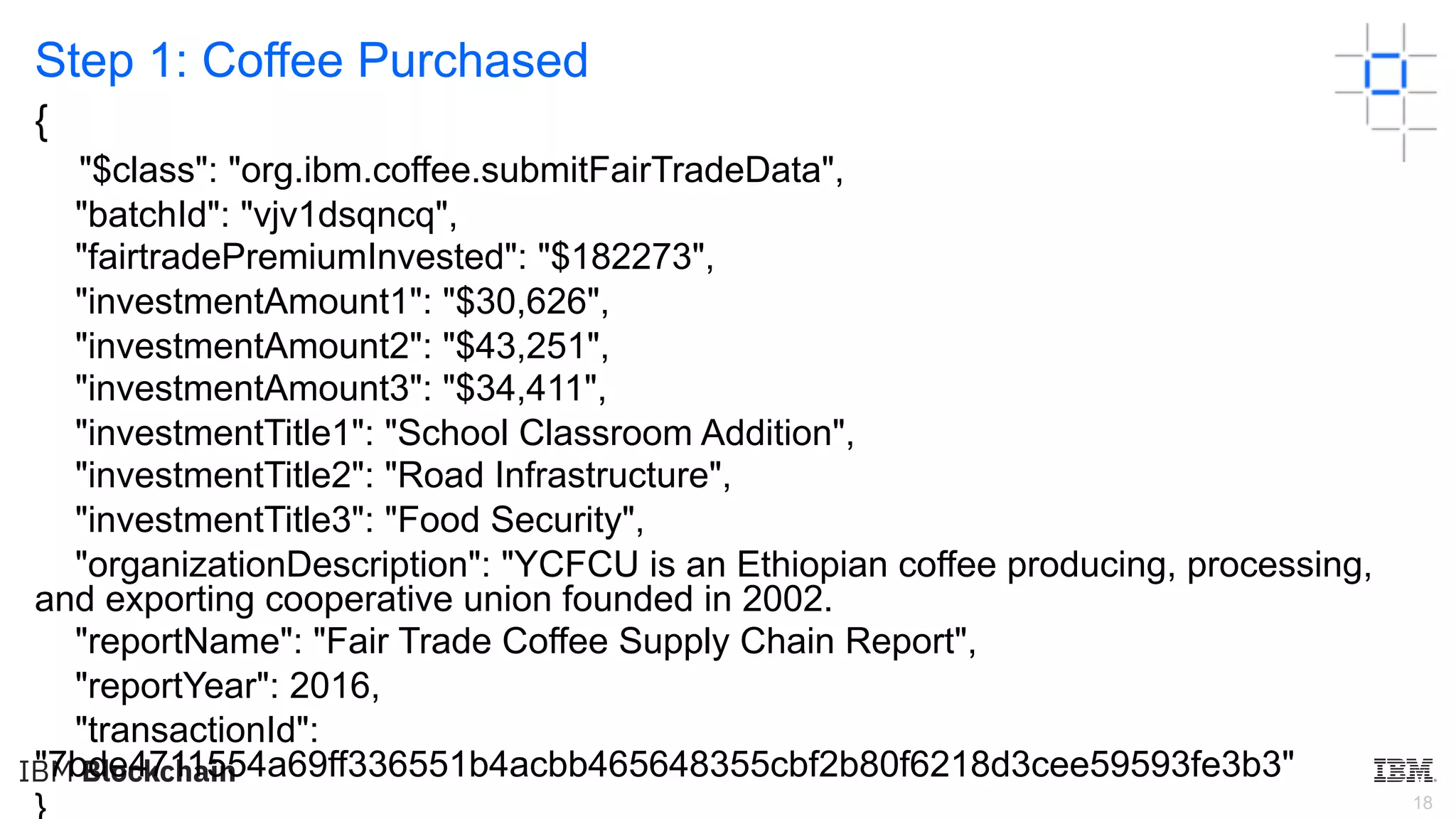
Step 1: Coffee Purchased
{
"$class": "org.ibm.coffee.submitFairTradeData",
"batchId": "vjv1dsqncq",
"fairtradePremiumInvested": "$182273",
"investmentAmount1": "$30,626",
"investmentAmount2": "$43,251",
"investmentAmount3": "$34,411",
"investmentTitle1": "School Classroom Addition",
"investmentTitle2": "Road Infrastructure",
"investmentTitle3": "Food Security",
"organizationDescription": "YCFCU is an Ethiopian coffee producing, processing,
and exporting cooperative union founded in 2002.
"reportName": "Fair Trade Coffee Supply Chain Report",
"reportYear": 2016,
"transactionId":
"7bde4711554a69ff336551b4acbb465648355cbf2b80f6218d3cee59593fe3b3"
19
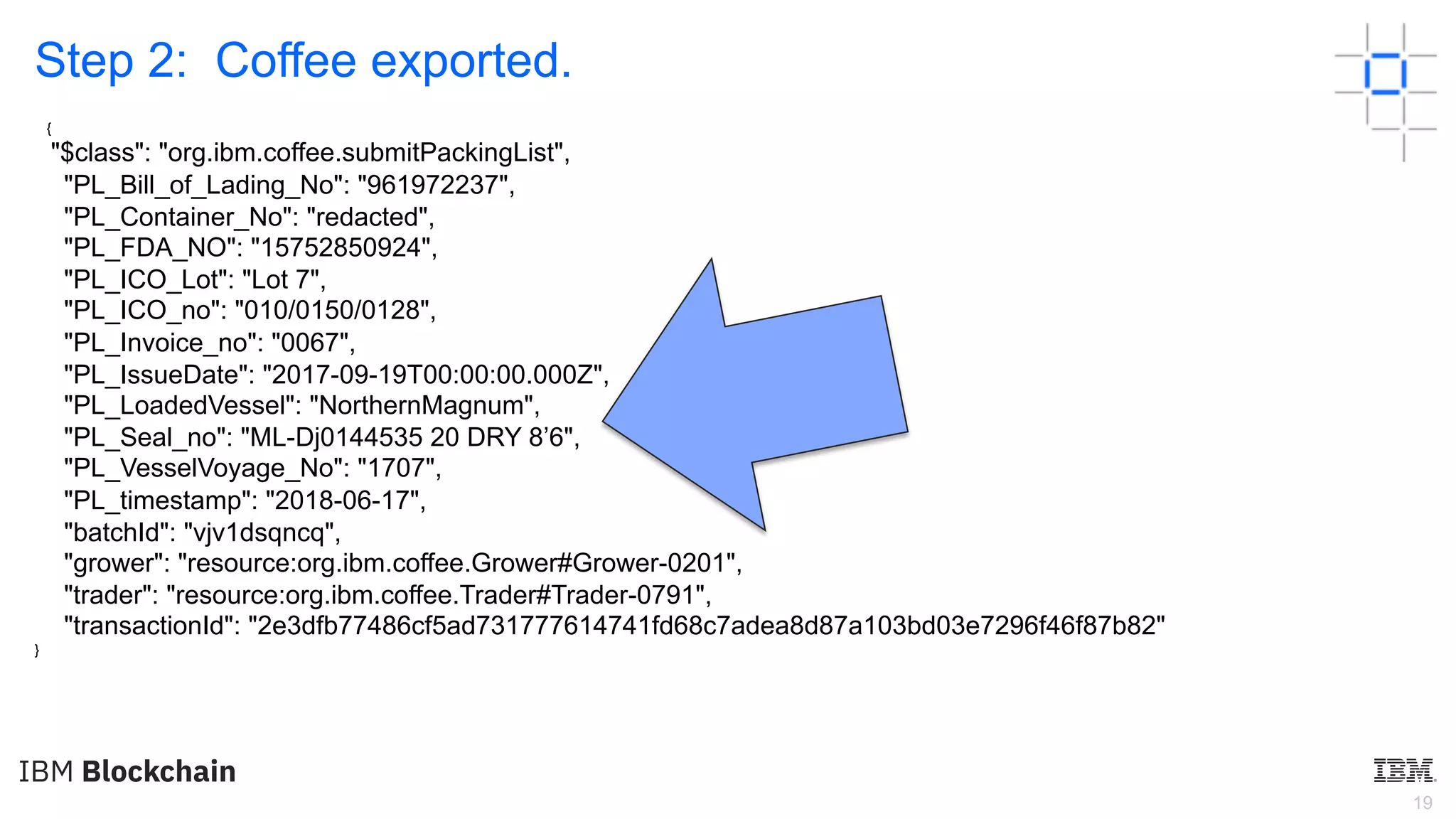
Step 2: Coffee exported.
{
"$class": "org.ibm.coffee.submitPackingList",
"PL_Bill_of_Lading_No": "961972237",
"PL_Container_No": "redacted",
"PL_FDA_NO": "15752850924",
"PL_ICO_Lot": "Lot 7",
"PL_ICO_no": "010/0150/0128",
"PL_Invoice_no": "0067",
"PL_IssueDate": "2017-09-19T00:00:00.000Z",
"PL_LoadedVessel": "NorthernMagnum",
"PL_Seal_no": "ML-Dj0144535 20 DRY 8’6",
"PL_VesselVoyage_No": "1707",
"PL_timestamp": "2018-06-17",
"batchId": "vjv1dsqncq",
"grower": "resource:org.ibm.coffee.Grower#Grower-0201",
"trader": "resource:org.ibm.coffee.Trader#Trader-0791",
"transactionId": "2e3dfb77486cf5ad731777614741fd68c7adea8d87a103bd03e7296f46f87b82"
}
20
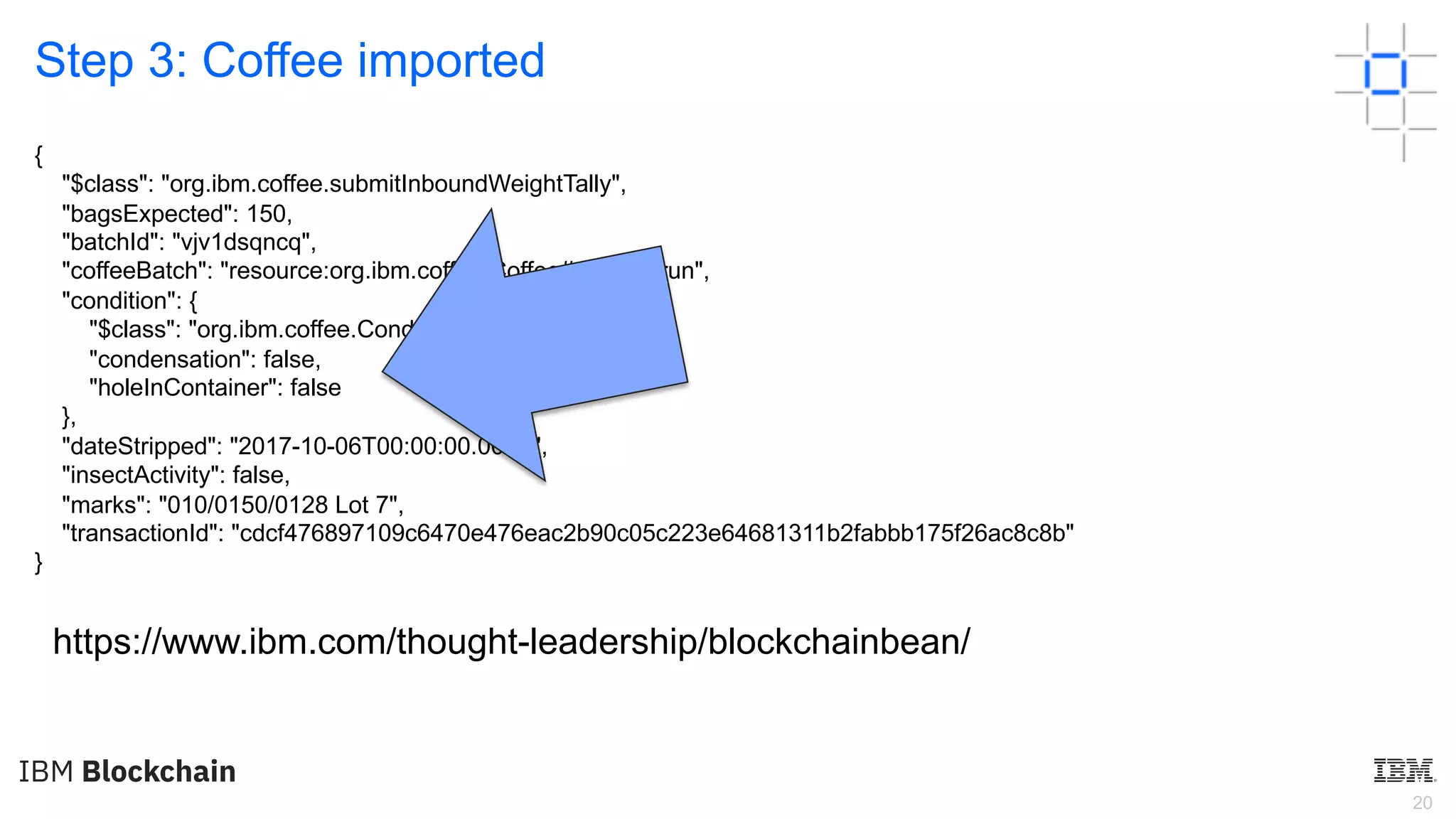
Step 3: Coffee imported
{
"$class": "org.ibm.coffee.submitInboundWeightTally",
"bagsExpected": 150,
"batchId": "vjv1dsqncq",
"coffeeBatch": "resource:org.ibm.coffee.Coffee#u94sf62run",
"condition": {
"$class": "org.ibm.coffee.Condition",
"condensation": false,
"holeInContainer": false
},
"dateStripped": "2017-10-06T00:00:00.000Z",
"insectActivity": false,
"marks": "010/0150/0128 Lot 7",
"transactionId": "cdcf476897109c6470e476eac2b90c05c223e64681311b2fabbb175f26ac8c8b"
}
https://www.ibm.com/thought-leadership/blockchainbean/
21
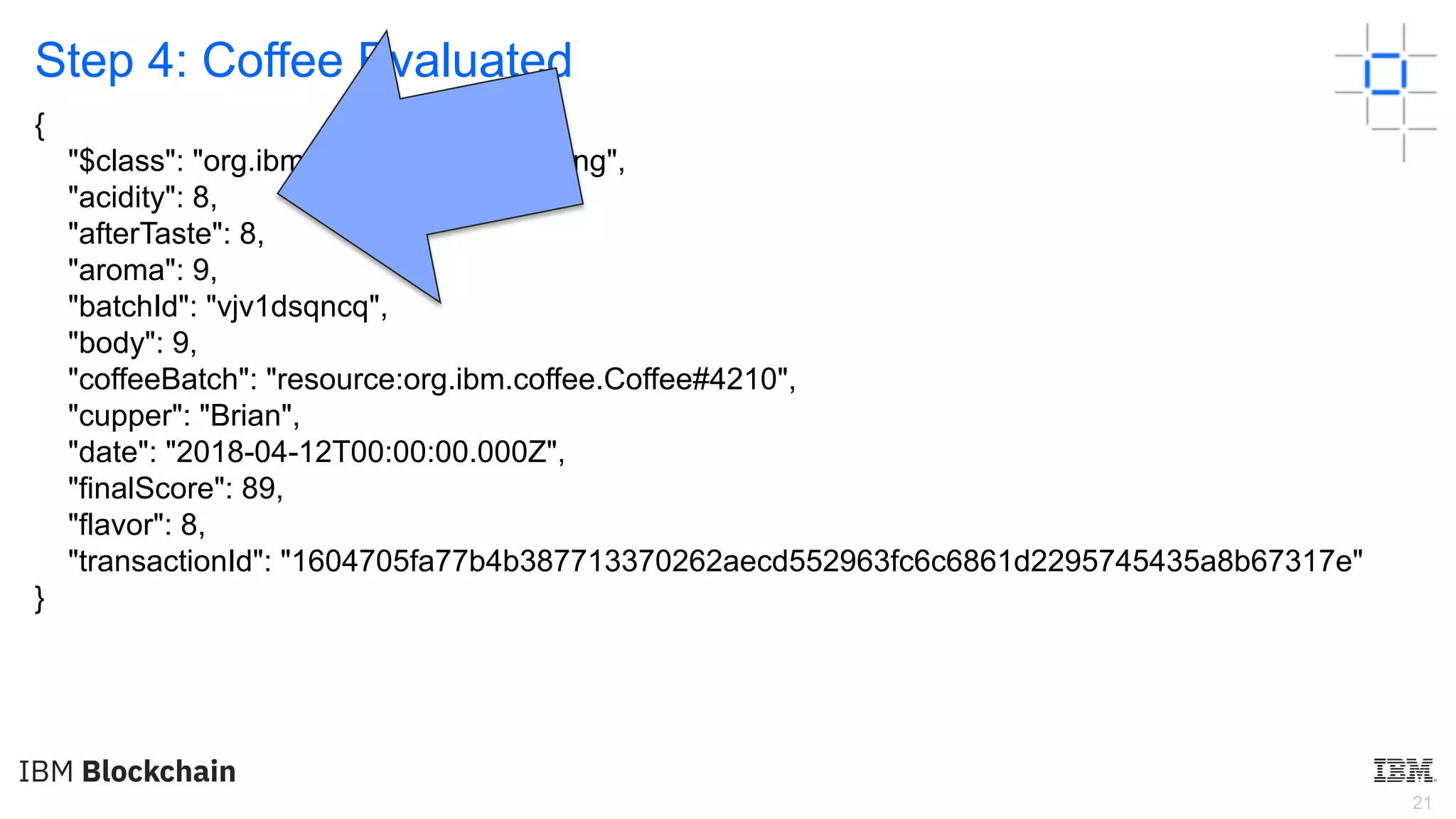
Step 4: Coffee Evaluated
{
"$class": "org.ibm.coffee.submitCupping",
"acidity": 8,
"afterTaste": 8,
"aroma": 9,
"batchId": "vjv1dsqncq",
"body": 9,
"coffeeBatch": "resource:org.ibm.coffee.Coffee#4210",
"cupper": "Brian",
"date": "2018-04-12T00:00:00.000Z",
"finalScore": 89,
"flavor": 8,
"transactionId": "1604705fa77b4b387713370262aecd552963fc6c6861d2295745435a8b67317e"
}
22
23
Blockchain and Supply chain
It is not about writing from
scratch, it’s all about Frameworks
24
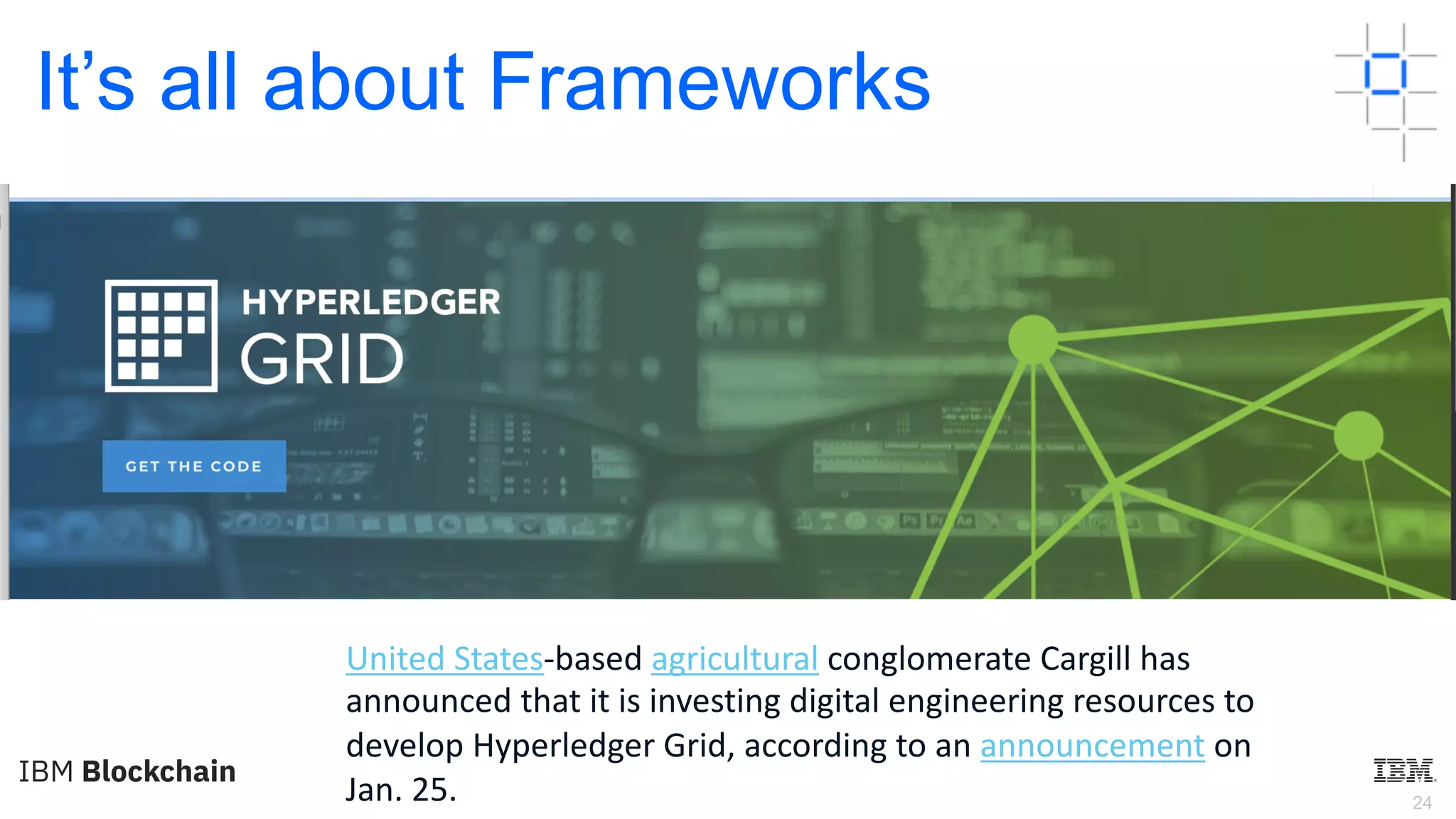
It’s all about Frameworks
•
United States-based agricultural conglomerate Cargill has
announced that it is investing digital engineering resources to
develop Hyperledger Grid, according to an announcement on
Jan. 25.
25
Hyperledger Grid is a framework. It’s not a blockchain and it’s
not an application. Grid is an ecosystem of technologies,
frameworks, and libraries that work together, letting application
developers make the choice as to which components are most
appropriate for their industry or market model.
26
Some Supply Chain frameworks
27
Food Trust
28
Introducing IBM Food Trust
TM
built on Blockchain technology
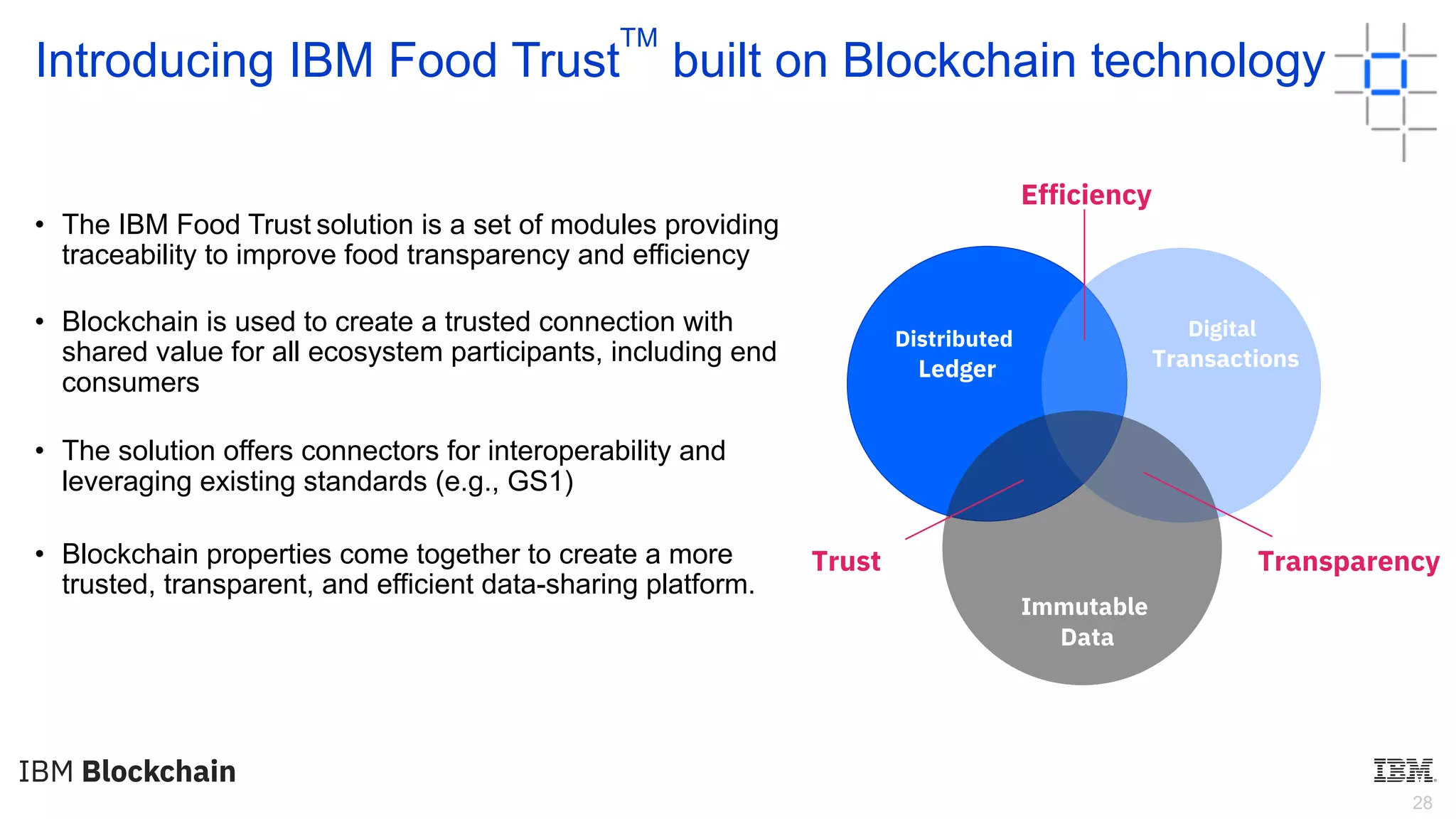
• The IBM Food Trust solution is a set of modules providing
traceability to improve food transparency and efficiency
• Blockchain is used to create a trusted connection with
shared value for all ecosystem participants, including end
consumers
• The solution offers connectors for interoperability and
leveraging existing standards (e.g., GS1)
• Blockchain properties come together to create a more
trusted, transparent, and efficient data-sharing platform.
Distributed
Ledger
Digital
Transactions
Immutable
Data
Efficiency
Trust Transparency
29
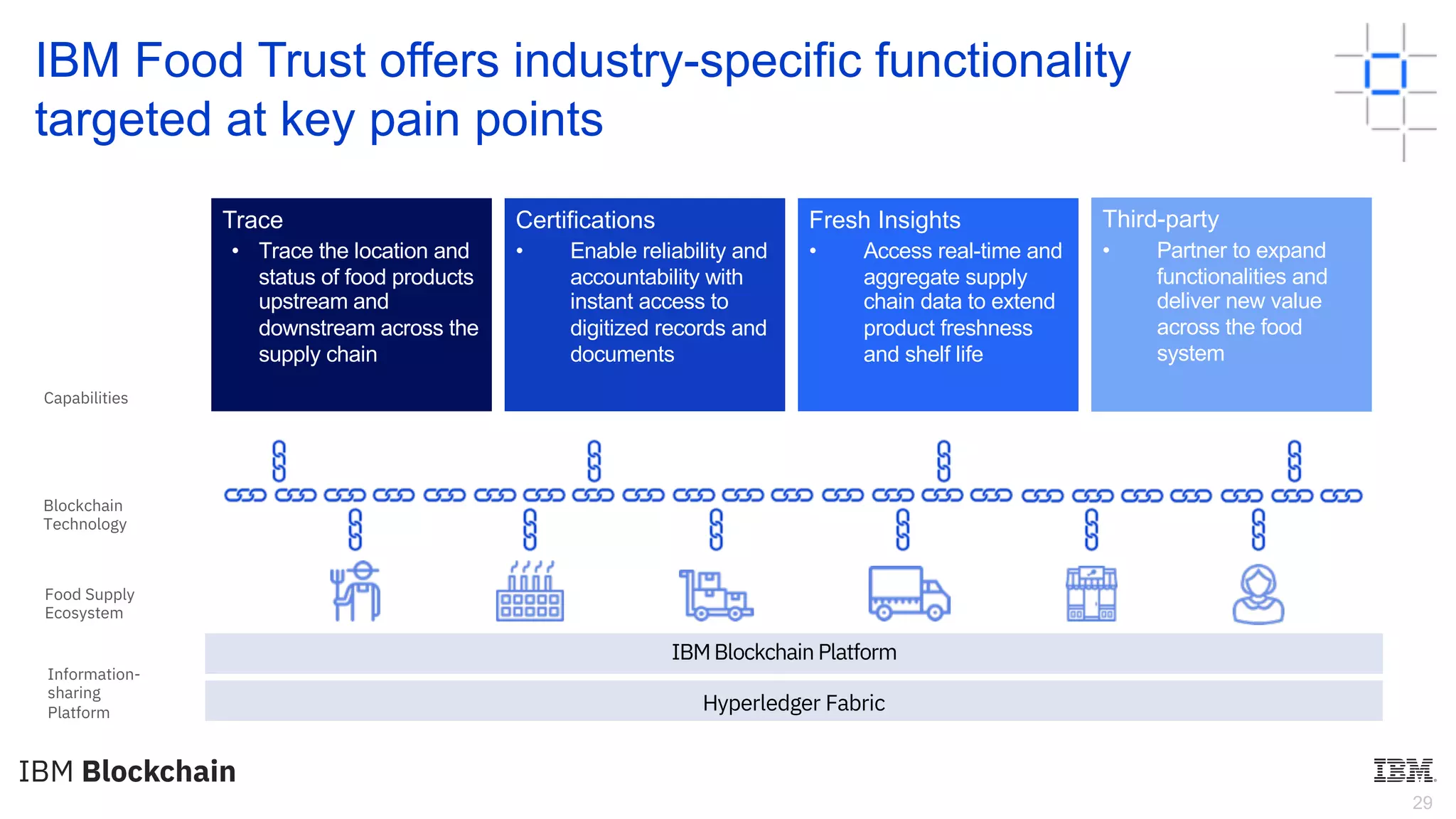
IBM Food Trust offers industry-specific functionality
targeted at key pain points
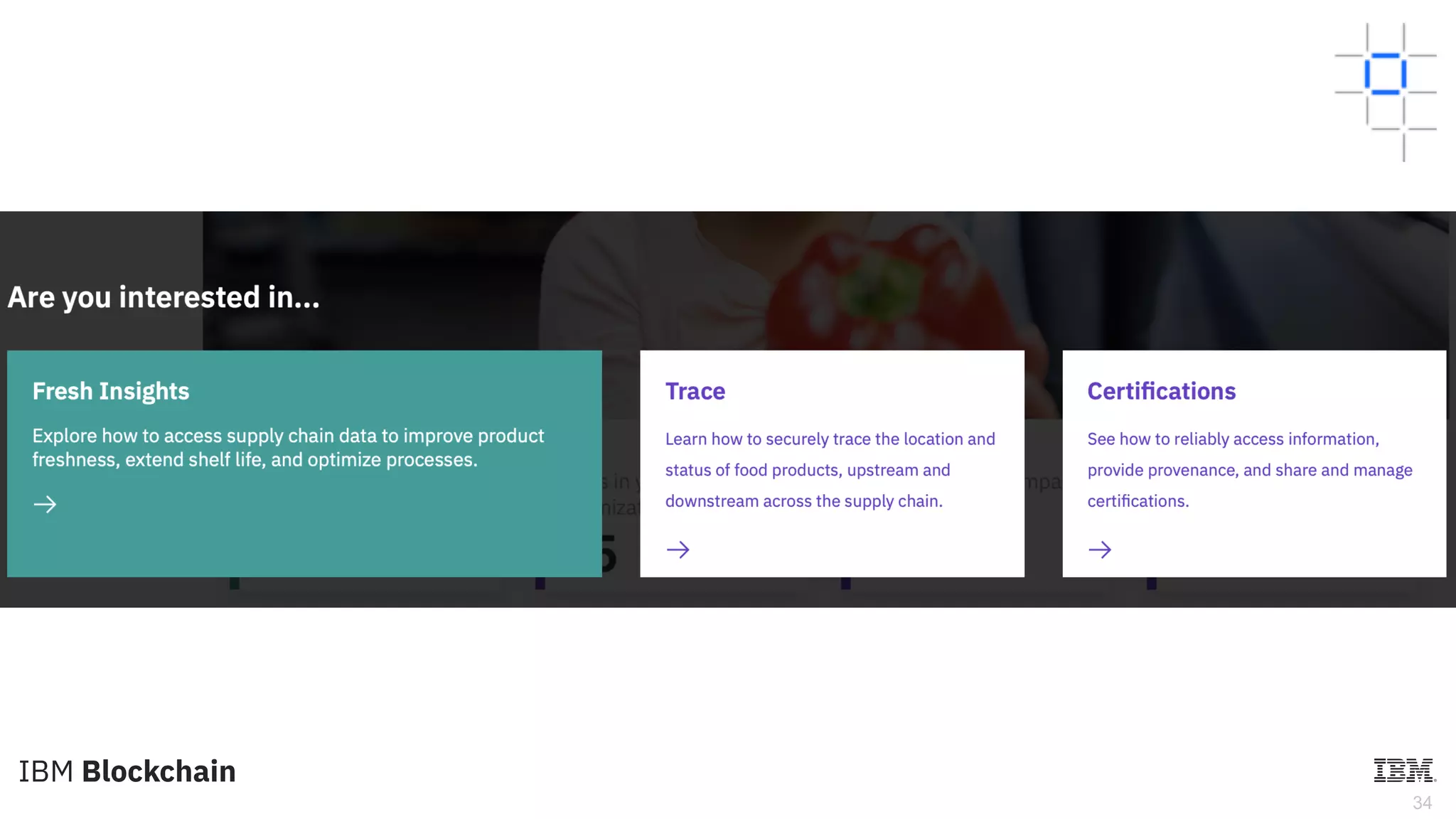
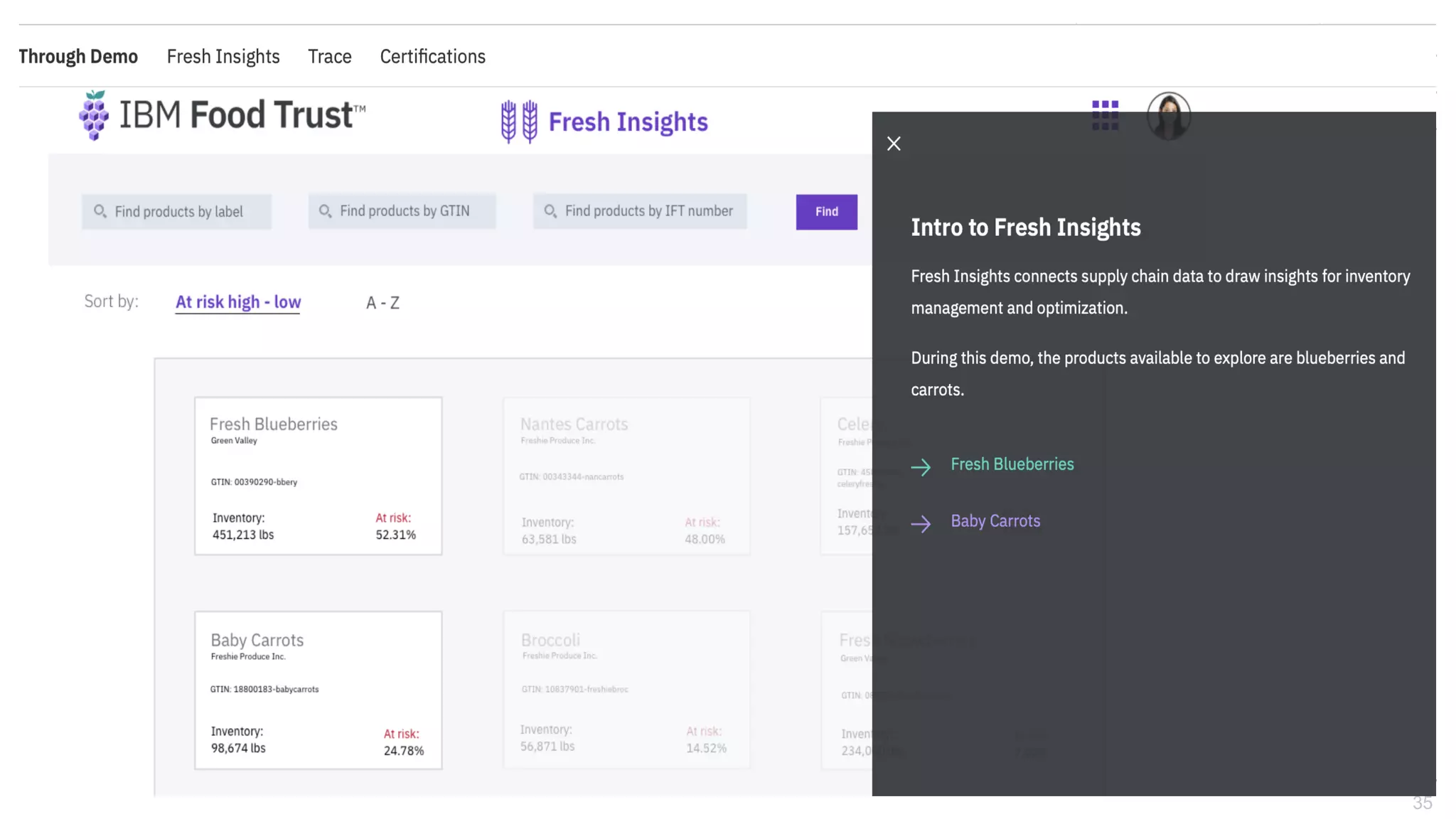
Fresh Insights
• Access real-time and
aggregate supply
chain data to extend
product freshness
and shelf life
Trace
• Trace the location and
status of food products
upstream and
downstream across the
supply chain
Certifications
• Enable reliability and
accountability with
instant access to
digitized records and
documents
Third-party
• Partner to expand
functionalities and
deliver new value
across the food
system
Food Supply
Ecosystem
Blockchain
Technology
IBMBlockchain Platform
Hyperledger Fabric
Capabilities
Information-
sharing
Platform
• Text or image• Text or image • Text or image• Text or image
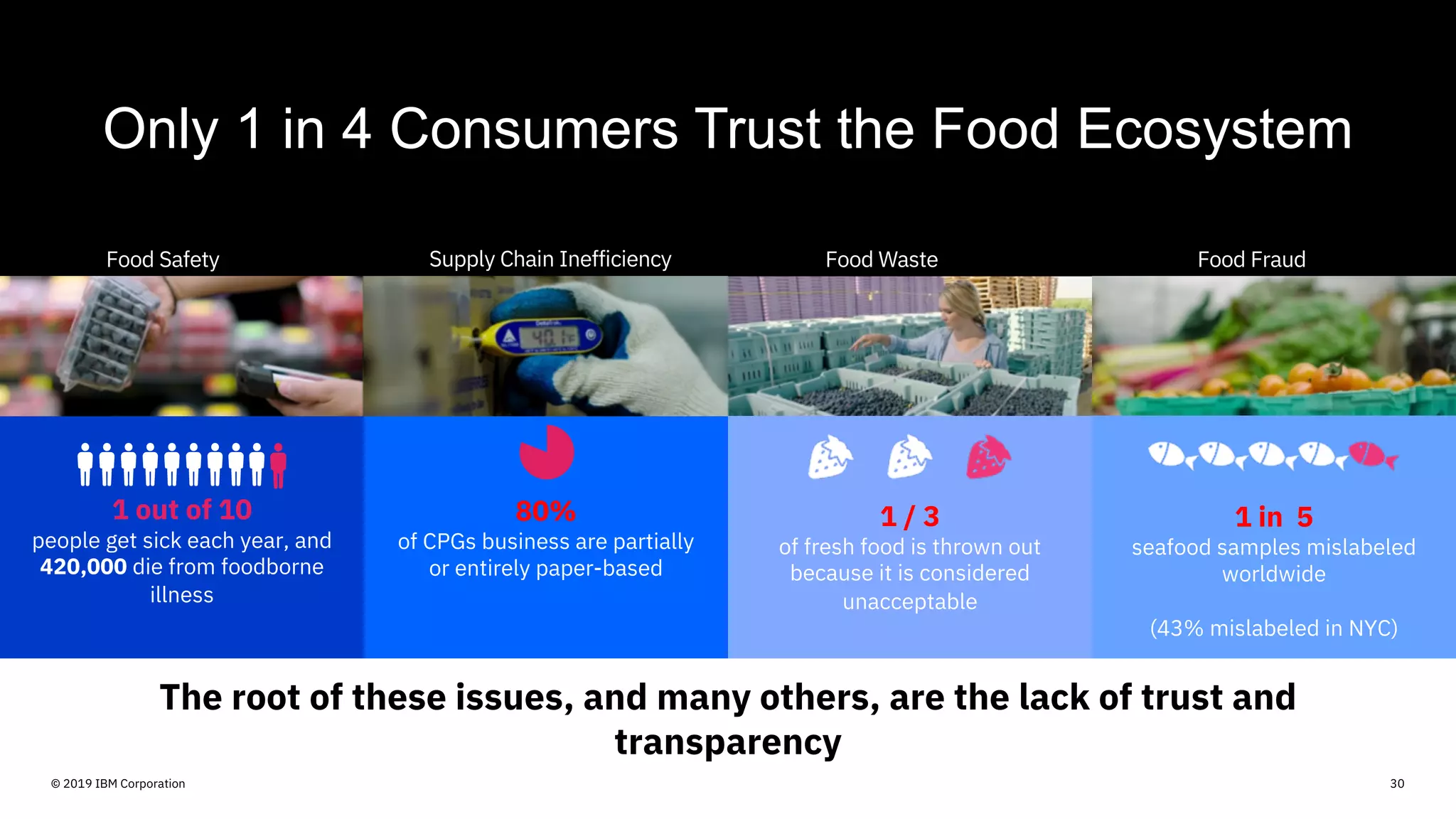
Only 1 in 4 Consumers Trust the Food Ecosystem
1 out of 10
people get sick each year, and
420,000 die from foodborne
illness
80%
of CPGs business are partially
or entirely paper-based
1 / 3
of fresh food is thrown out
because it is considered
unacceptable
1 in 5
seafood samples mislabeled
worldwide
(43% mislabeled in NYC)
30© 2019 IBM Corporation
The root of these issues, and many others, are the lack of trust and
transparency
Food Safety Supply Chain Inefficiency Food Waste Food Fraud
31
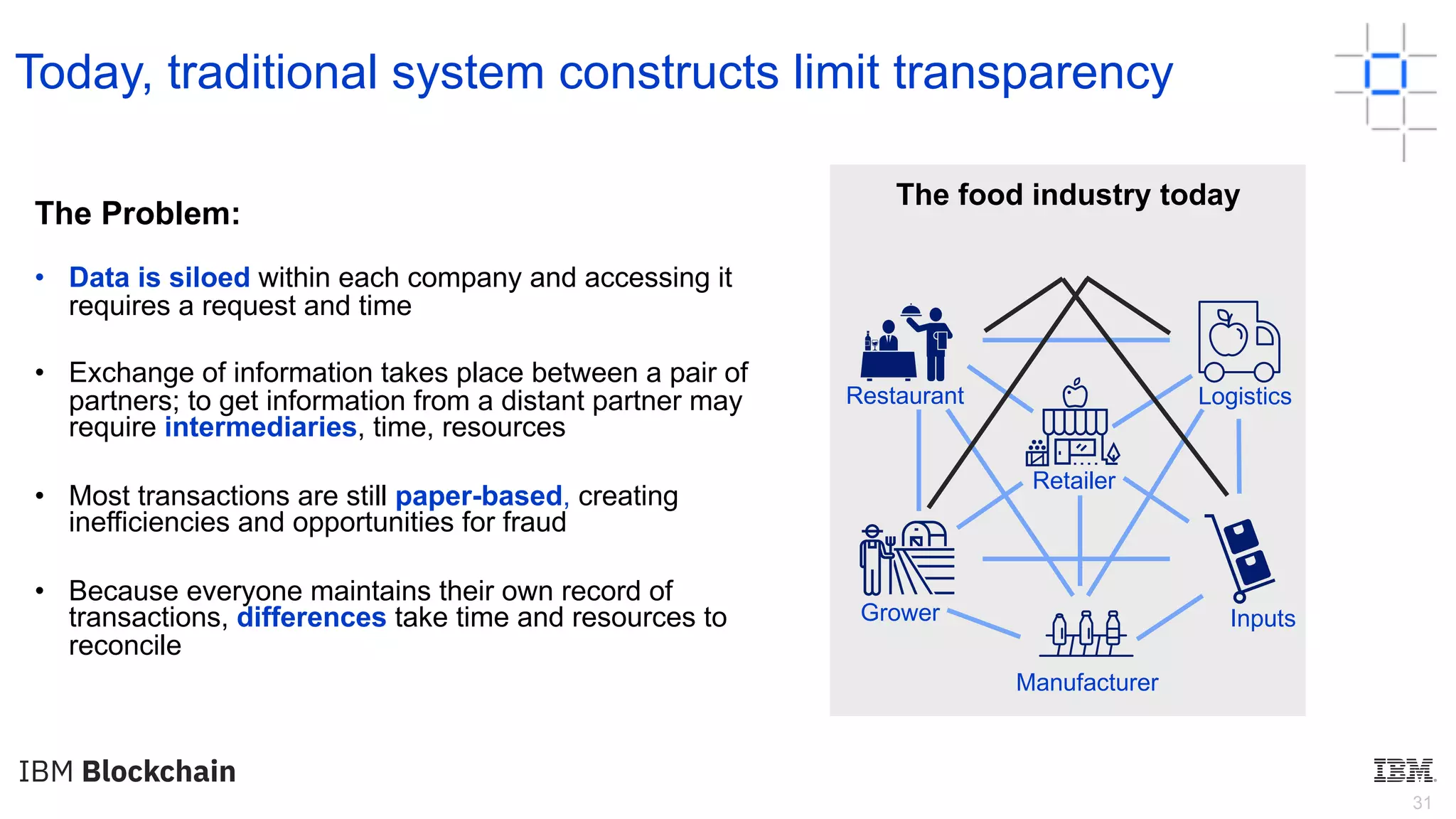
The Problem:
• Data is siloed within each company and accessing it
requires a request and time
• Exchange of information takes place between a pair of
partners; to get information from a distant partner may
require intermediaries, time, resources
• Most transactions are still paper-based, creating
inefficiencies and opportunities for fraud
• Because everyone maintains their own record of
transactions, differences take time and resources to
reconcile
Today, traditional system constructs limit transparency
The food industry today
Grower
Manufacturer
Retailer
Restaurant Logistics
Inputs
32
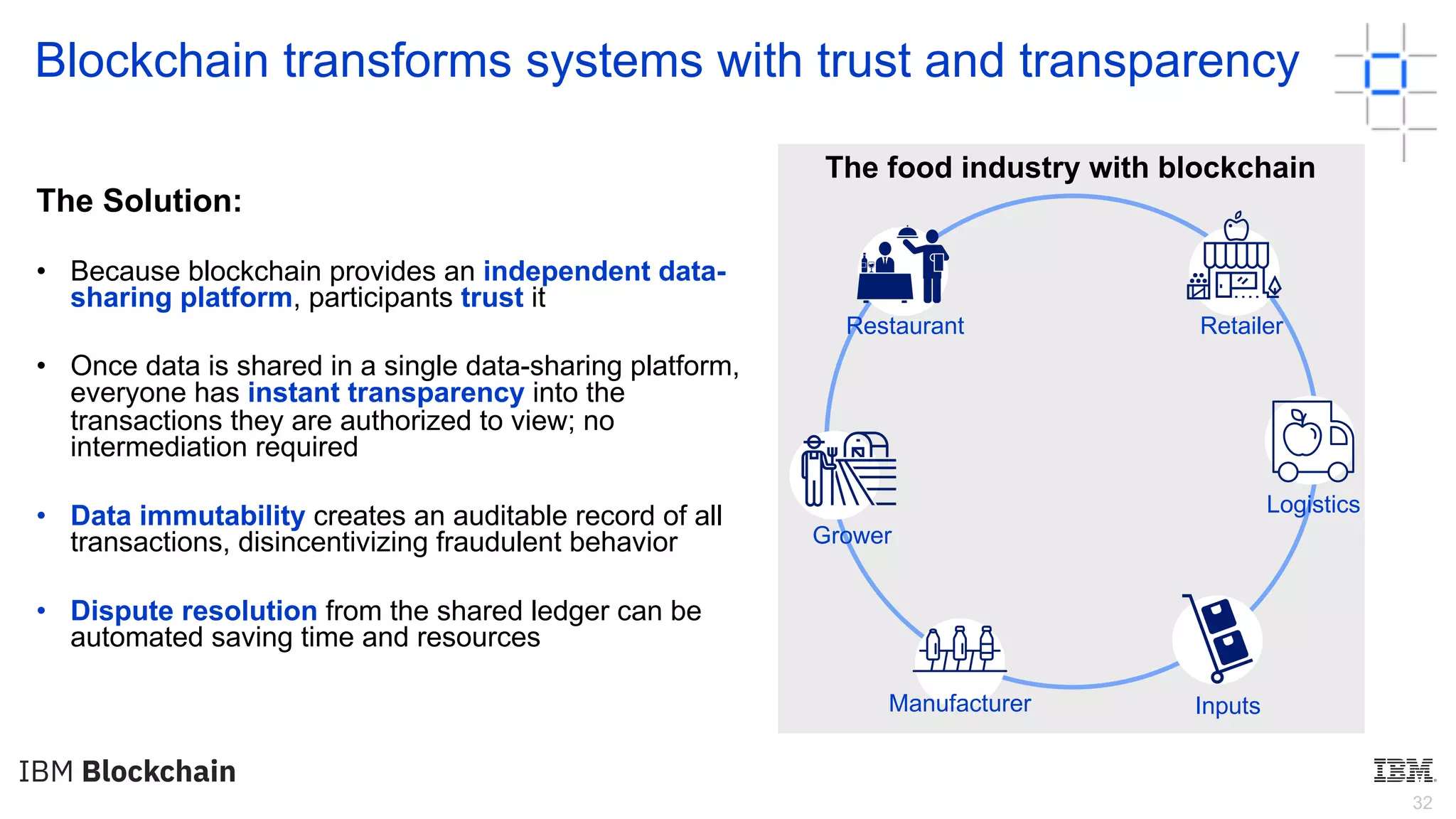
Blockchain transforms systems with trust and transparency
The Solution:
• Because blockchain provides an independent data-
sharing platform, participants trust it
• Once data is shared in a single data-sharing platform,
everyone has instant transparency into the
transactions they are authorized to view; no
intermediation required
• Data immutability creates an auditable record of all
transactions, disincentivizing fraudulent behavior
• Dispute resolution from the shared ledger can be
automated saving time and resources
The food industry with blockchain
Grower
Manufacturer
RetailerRestaurant
Logistics
Inputs
33
34
35
36
37
38
39
40
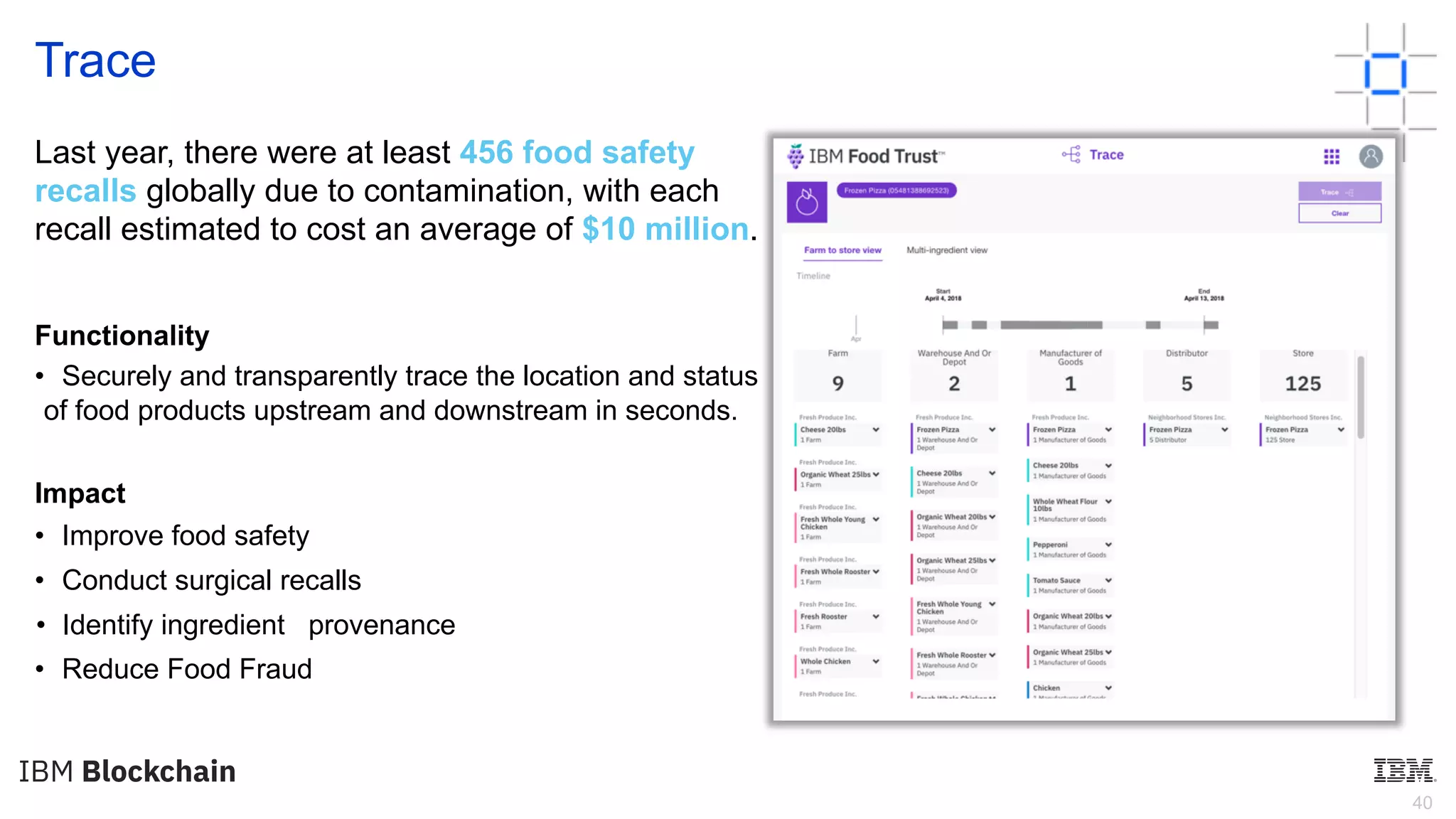
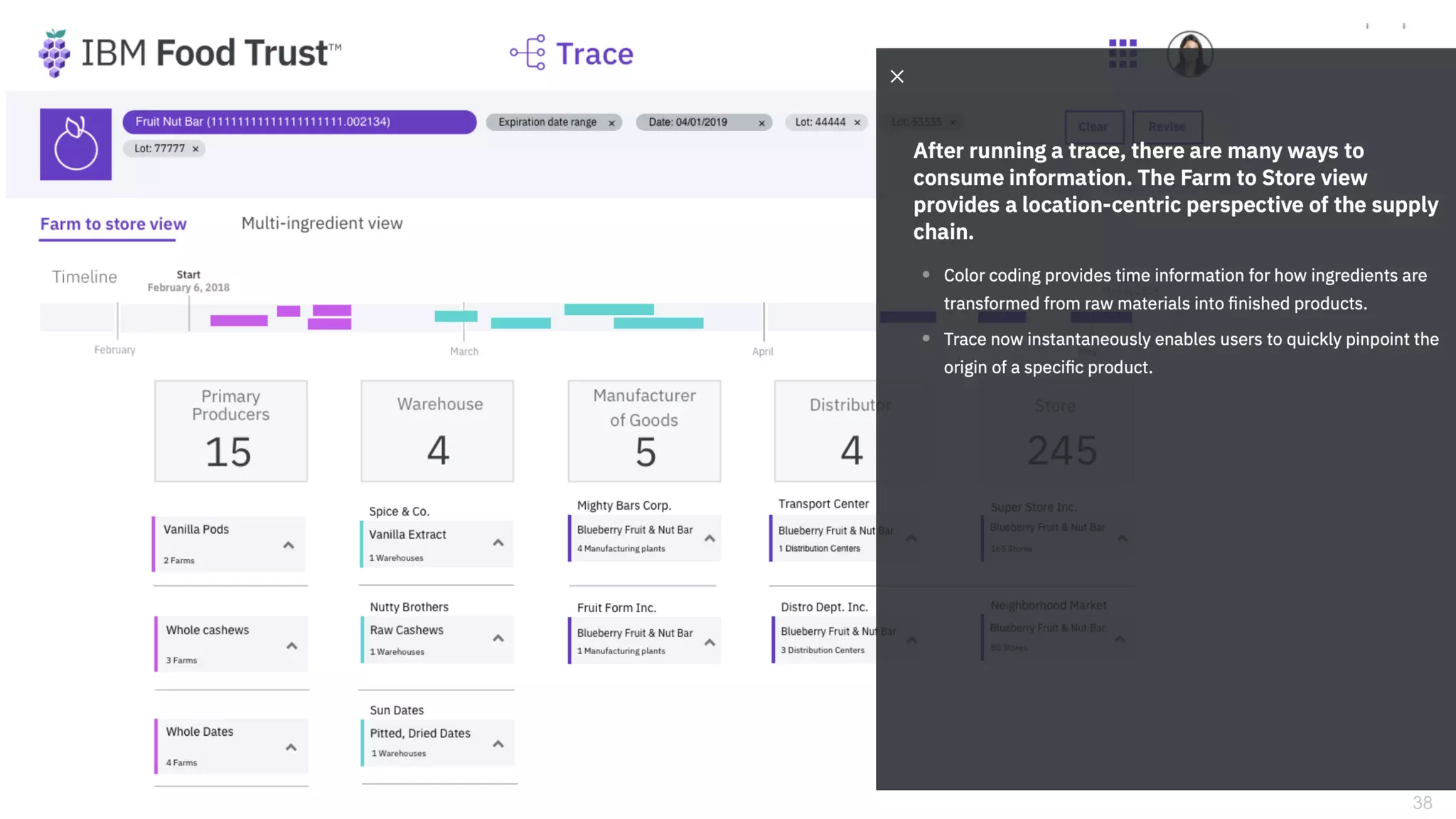
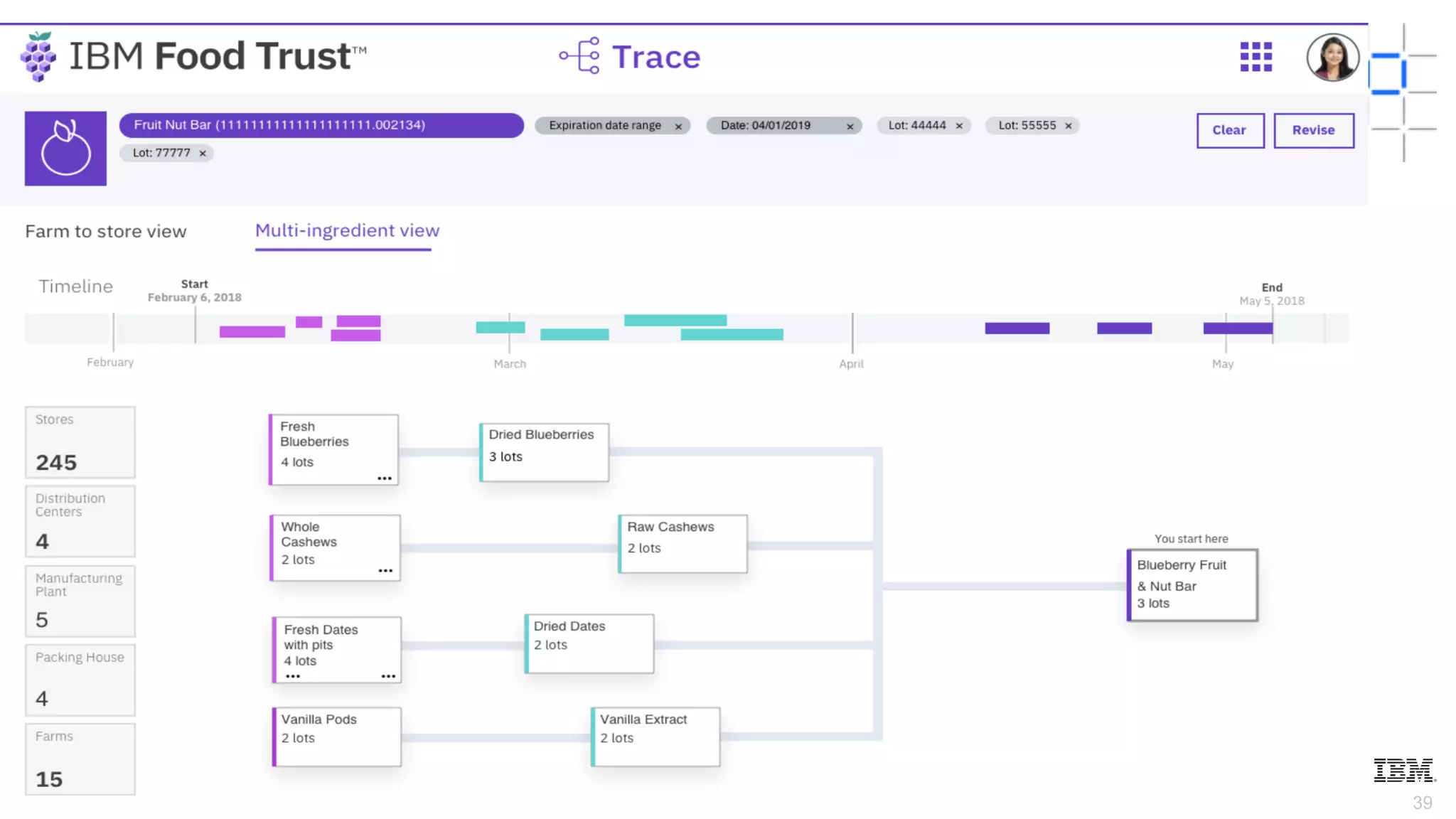
Trace
Last year, there were at least 456 food safety
recalls globally due to contamination, with each
recall estimated to cost an average of $10 million.
Functionality
• Securely and transparently trace the location and status
of food products upstream and downstream in seconds.
Impact
• Improve food safety
• Conduct surgical recalls
• Identify ingredient provenance
• Reduce Food Fraud
41
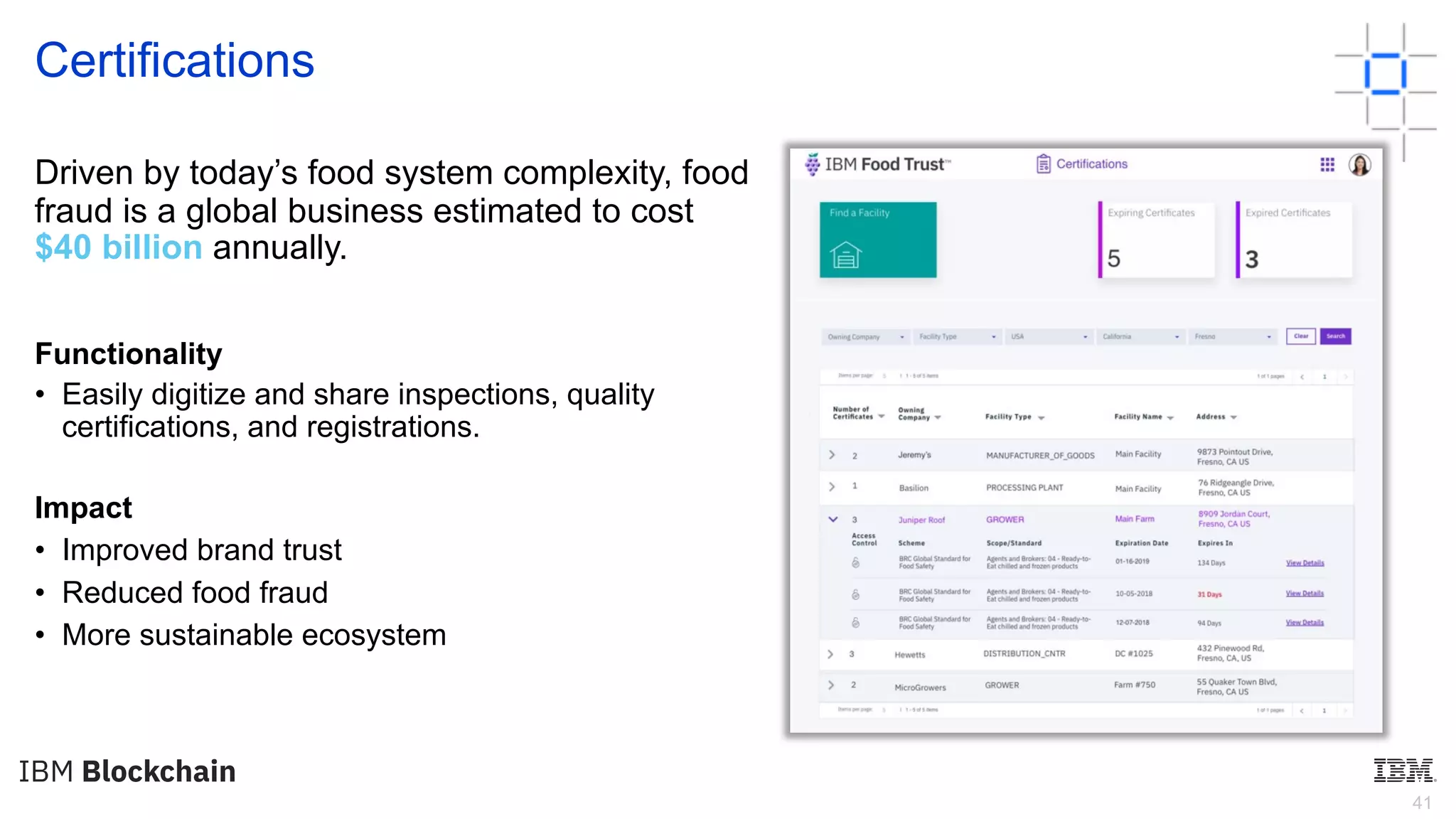
Certifications
Driven by today’s food system complexity, food
fraud is a global business estimated to cost
$40 billion annually.
Functionality
• Easily digitize and share inspections, quality
certifications, and registrations.
Impact
• Improved brand trust
• Reduced food fraud
• More sustainable ecosystem
42
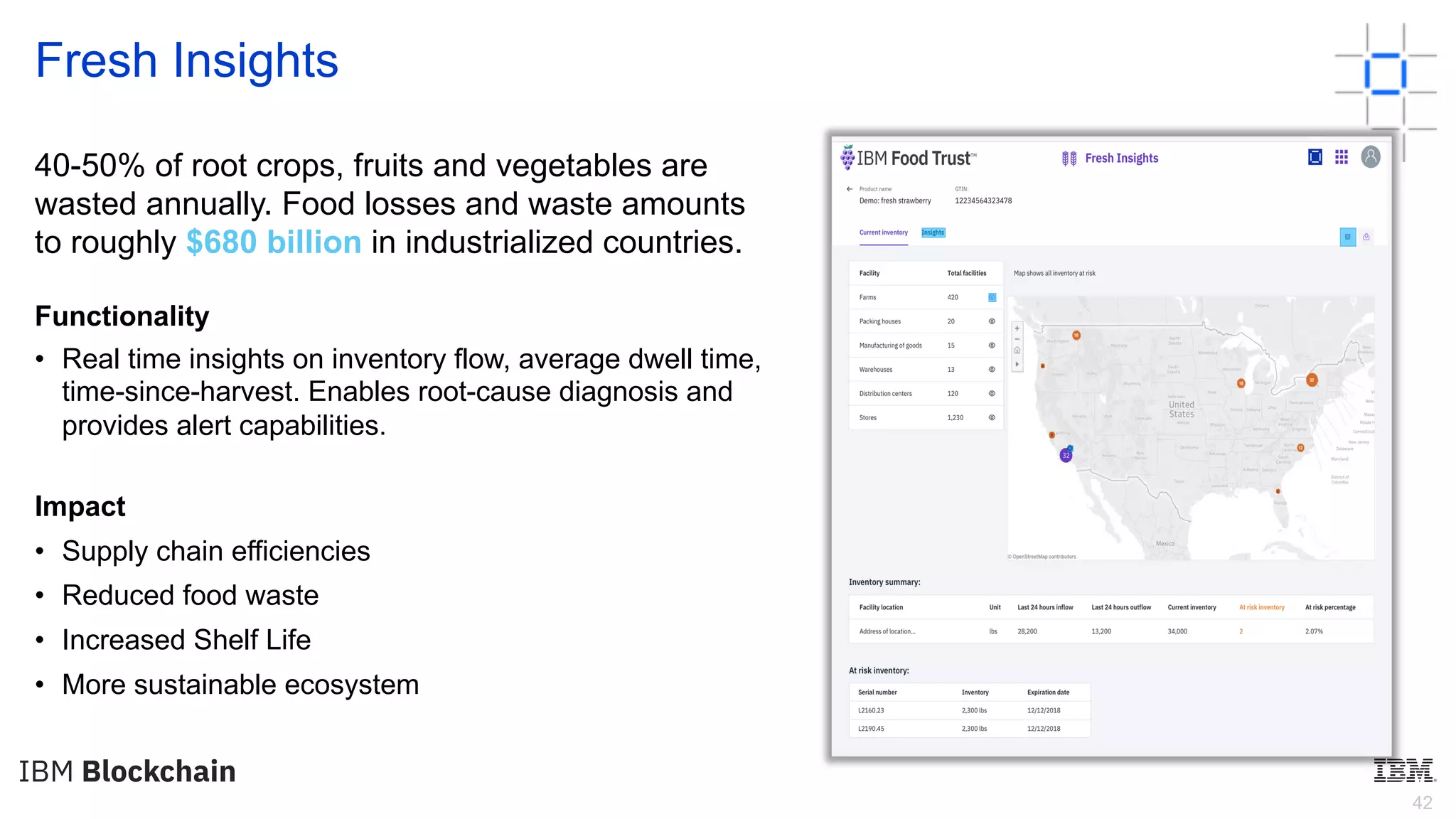
Fresh Insights
40-50% of root crops, fruits and vegetables are
wasted annually. Food losses and waste amounts
to roughly $680 billion in industrialized countries.
Functionality
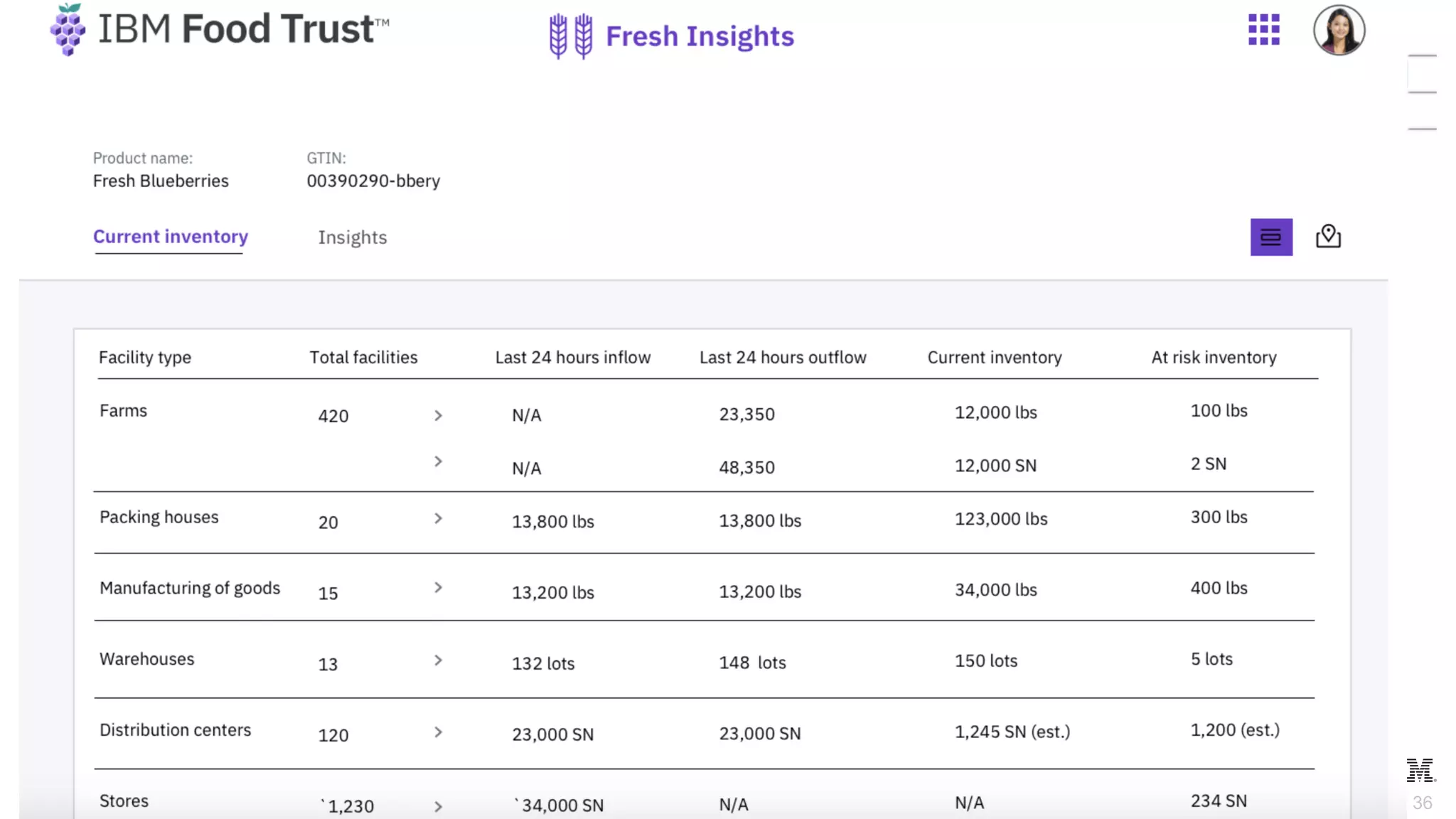
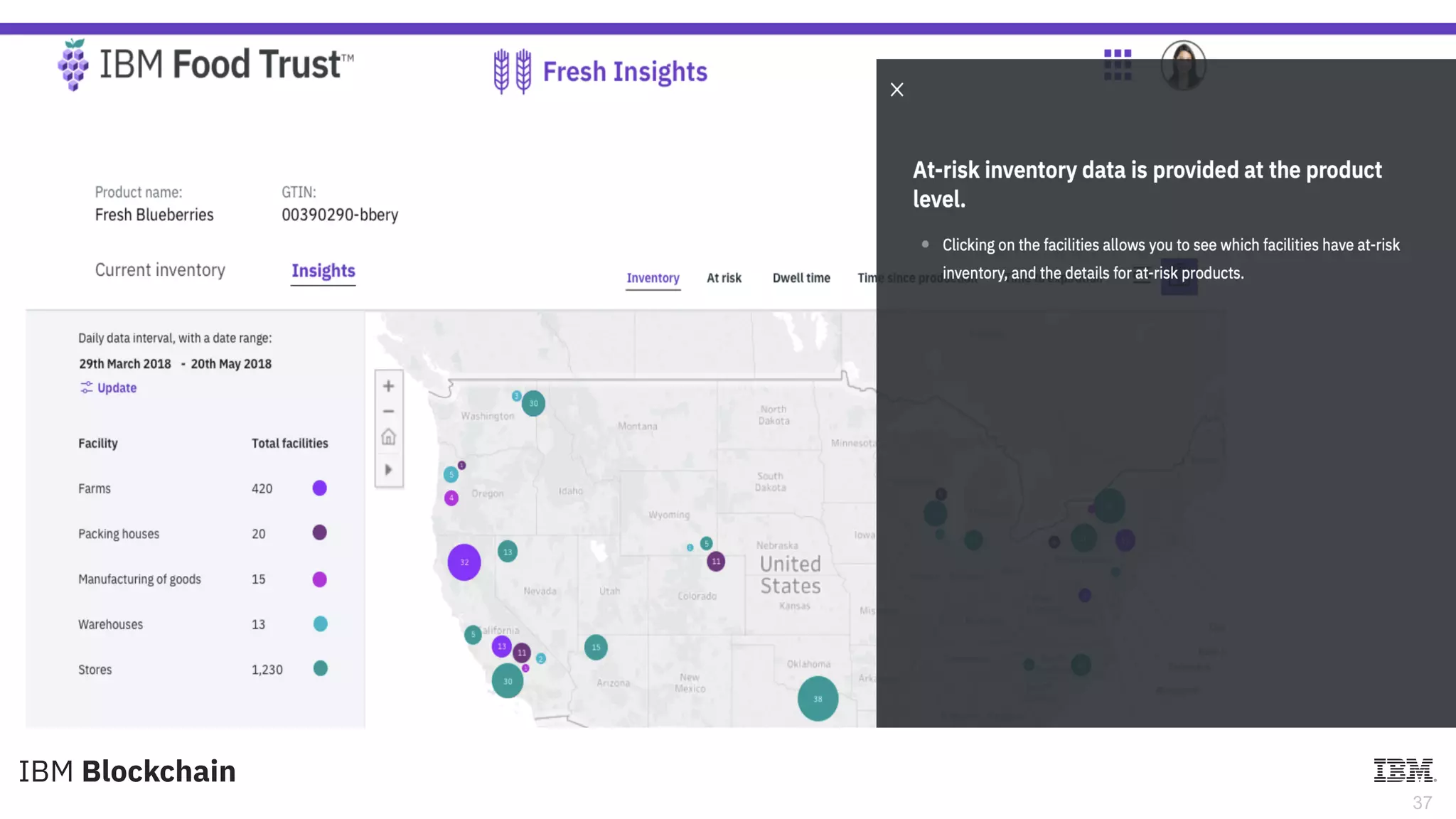
• Real time insights on inventory flow, average dwell time,
time-since-harvest. Enables root-cause diagnosis and
provides alert capabilities.
Impact
• Supply chain efficiencies
• Reduced food waste
• Increased Shelf Life
• More sustainable ecosystem
43
44
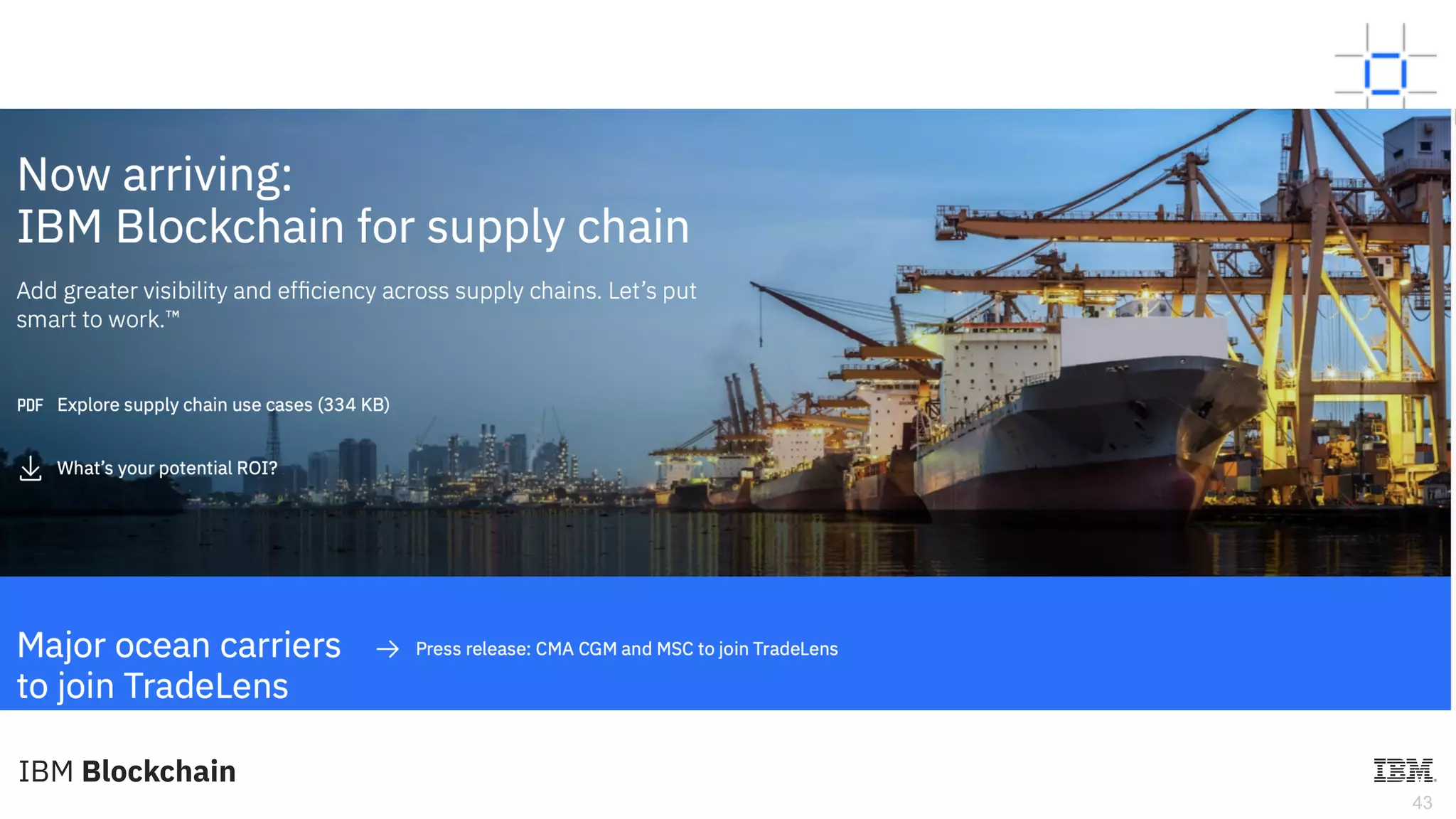
TradeLens
45
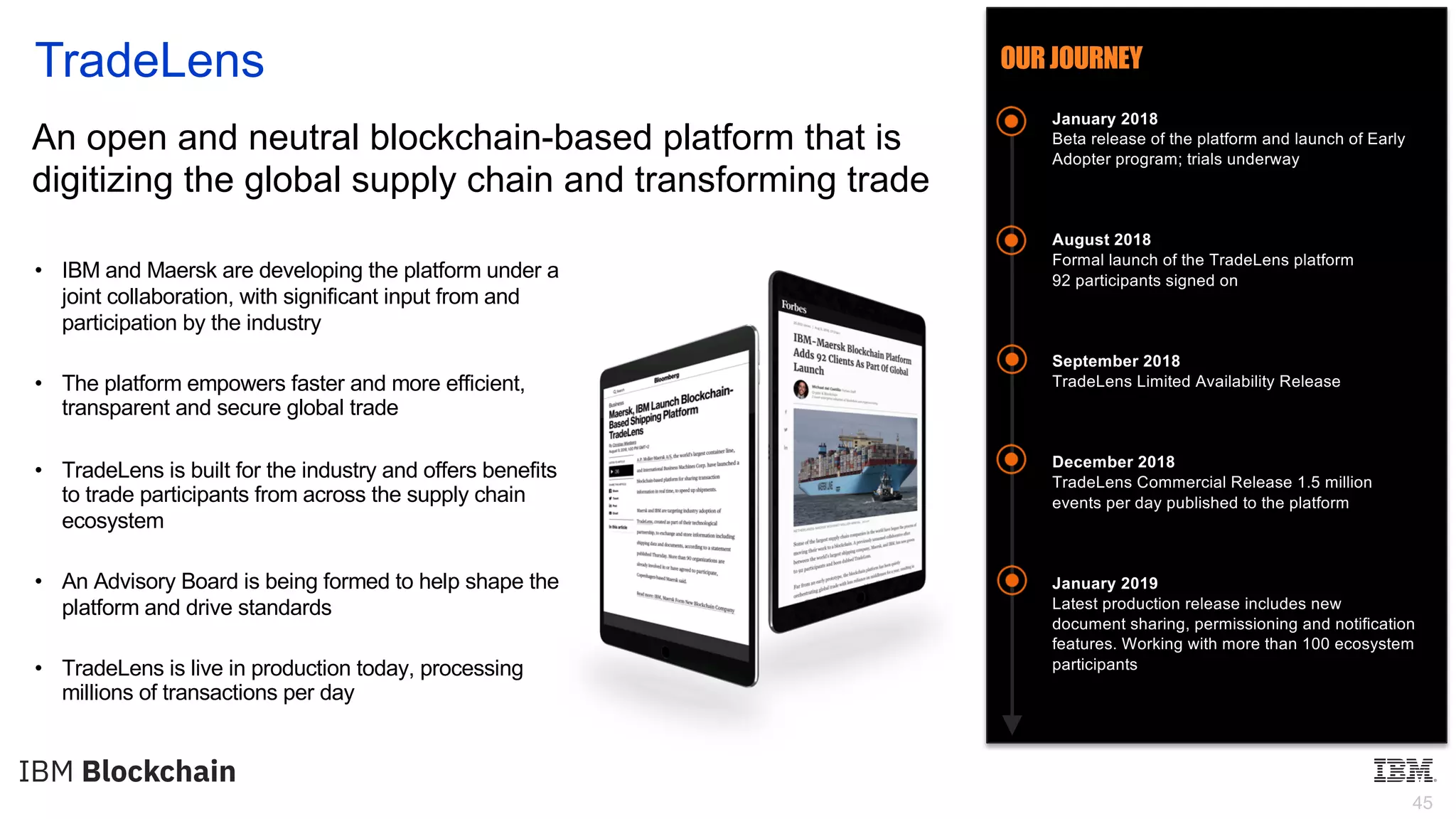
• IBM and Maersk are developing the platform under a
joint collaboration, with significant input from and
participation by the industry
• The platform empowers faster and more efficient,
transparent and secure global trade
• TradeLens is built for the industry and offers benefits
to trade participants from across the supply chain
ecosystem
• An Advisory Board is being formed to help shape the
platform and drive standards
• TradeLens is live in production today, processing
millions of transactions per day
An open and neutral blockchain-based platform that is
digitizing the global supply chain and transforming trade
September 2018
TradeLens Limited Availability Release
December 2018
TradeLens Commercial Release 1.5 million
events per day published to the platform
January 2019
Latest production release includes new
document sharing, permissioning and notification
features. Working with more than 100 ecosystem
participants
August 2018
Formal launch of the TradeLens platform
92 participants signed on
January 2018
Beta release of the platform and launch of Early
Adopter program; trials underway
OURJOURNEYTradeLens
46
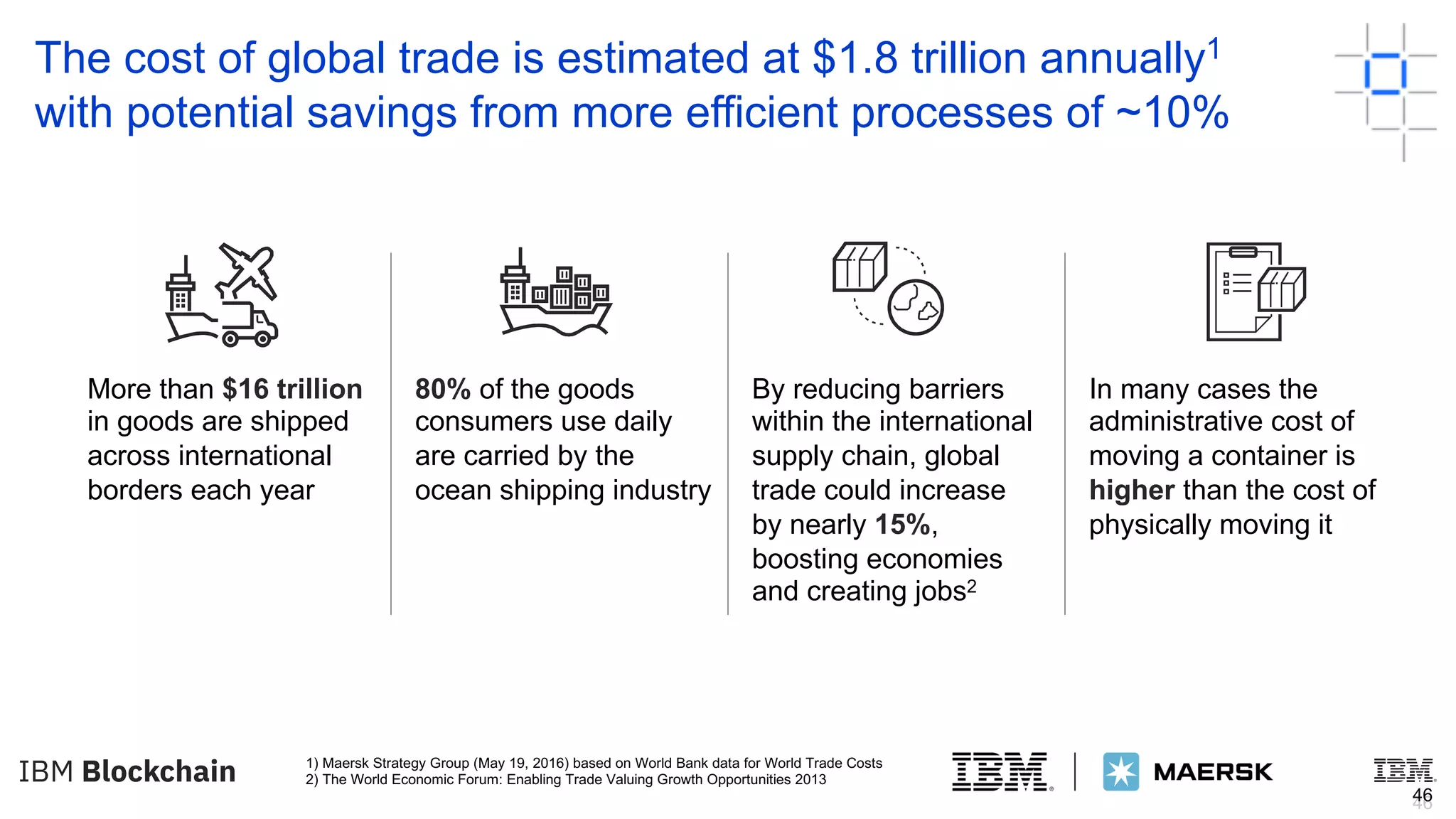
The cost of global trade is estimated at $1.8 trillion annually1
with potential savings from more efficient processes of ~10%
46
More than $16 trillion
in goods are shipped
across international
borders each year
80% of the goods
consumers use daily
are carried by the
ocean shipping industry
By reducing barriers
within the international
supply chain, global
trade could increase
by nearly 15%,
boosting economies
and creating jobs2
In many cases the
administrative cost of
moving a container is
higher than the cost of
physically moving it
1) Maersk Strategy Group (May 19, 2016) based on World Bank data for World Trade Costs
2) The World Economic Forum: Enabling Trade Valuing Growth Opportunities 2013
47
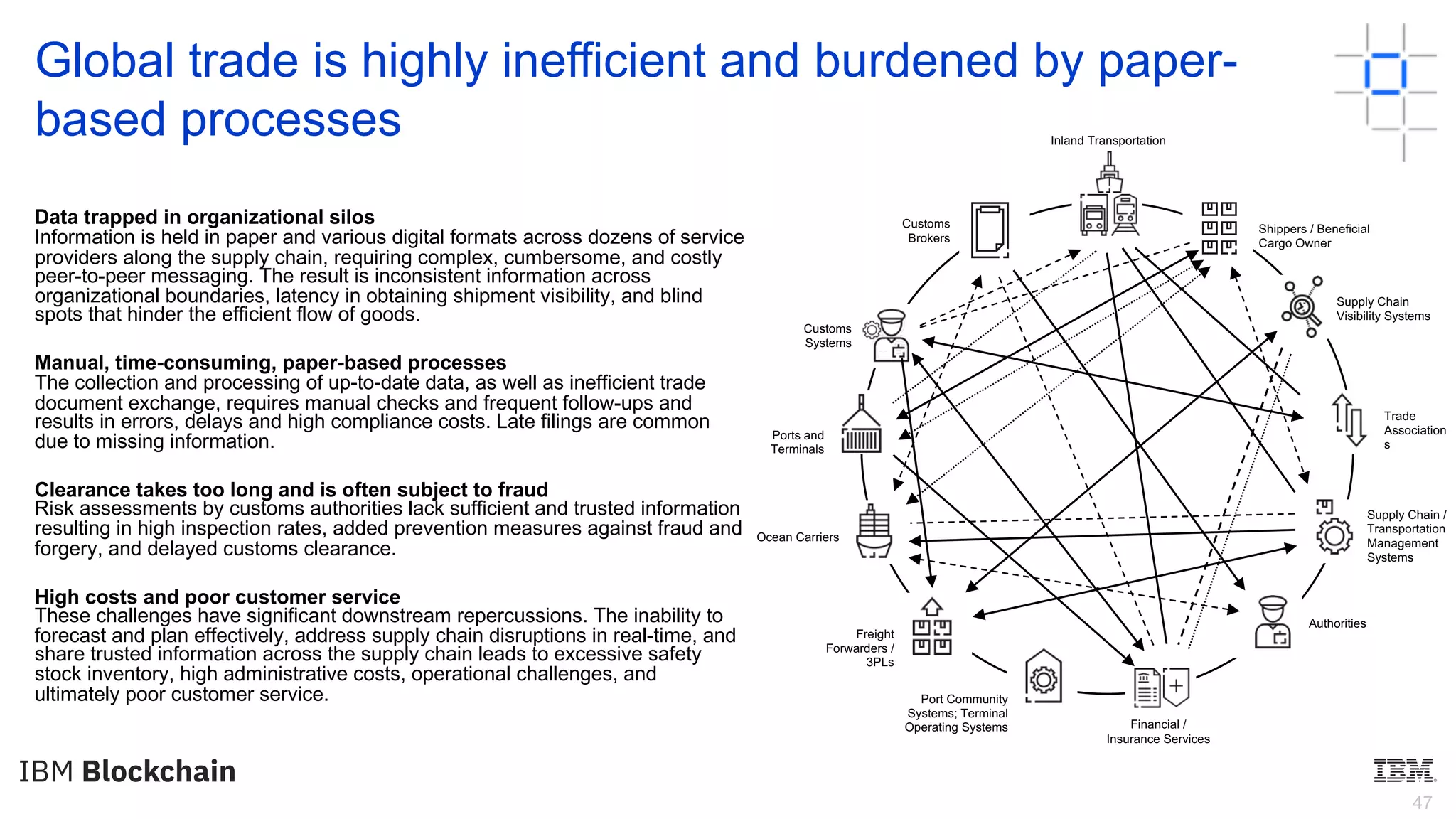
Global trade is highly inefficient and burdened by paper-
based processes
Data trapped in organizational silos
Information is held in paper and various digital formats across dozens of service
providers along the supply chain, requiring complex, cumbersome, and costly
peer-to-peer messaging. The result is inconsistent information across
organizational boundaries, latency in obtaining shipment visibility, and blind
spots that hinder the efficient flow of goods.
Manual, time-consuming, paper-based processes
The collection and processing of up-to-date data, as well as inefficient trade
document exchange, requires manual checks and frequent follow-ups and
results in errors, delays and high compliance costs. Late filings are common
due to missing information.
Clearance takes too long and is often subject to fraud
Risk assessments by customs authorities lack sufficient and trusted information
resulting in high inspection rates, added prevention measures against fraud and
forgery, and delayed customs clearance.
High costs and poor customer service
These challenges have significant downstream repercussions. The inability to
forecast and plan effectively, address supply chain disruptions in real-time, and
share trusted information across the supply chain leads to excessive safety
stock inventory, high administrative costs, operational challenges, and
ultimately poor customer service.
Inland Transportation
Shippers / Beneficial
Cargo Owner
Supply Chain
Visibility Systems
Trade
Association
s
Supply Chain /
Transportation
Management
Systems
Authorities
Financial /
Insurance Services
Port Community
Systems; Terminal
Operating Systems
Ports and
Terminals
Freight
Forwarders /
3PLs
Customs
Systems
Ocean Carriers
Customs
Brokers
48
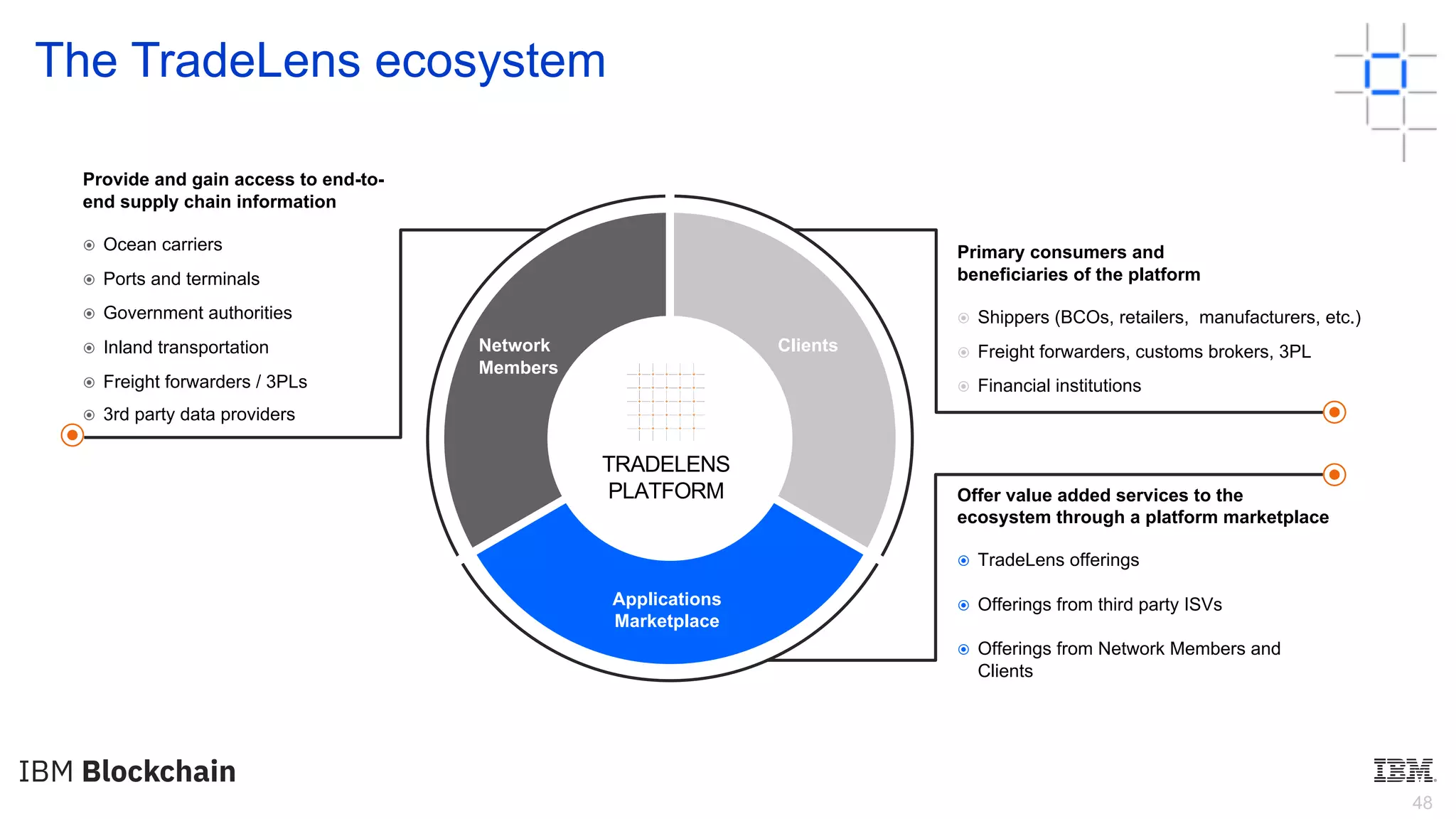
The TradeLens ecosystem
Primary consumers and
beneficiaries of the platform
⦿ Shippers (BCOs, retailers, manufacturers, etc.)
⦿ Freight forwarders, customs brokers, 3PL
⦿ Financial institutions
TRADELENS
PLATFORM
Clients
Applications
Marketplace
Network
Members
Provide and gain access to end-to-
end supply chain information
⦿ Ocean carriers
⦿ Ports and terminals
⦿ Government authorities
⦿ Inland transportation
⦿ Freight forwarders / 3PLs
⦿ 3rd party data providers
Offer value added services to the
ecosystem through a platform marketplace
⦿ TradeLens offerings
⦿ Offerings from third party ISVs
⦿ Offerings from Network Members and
Clients
49
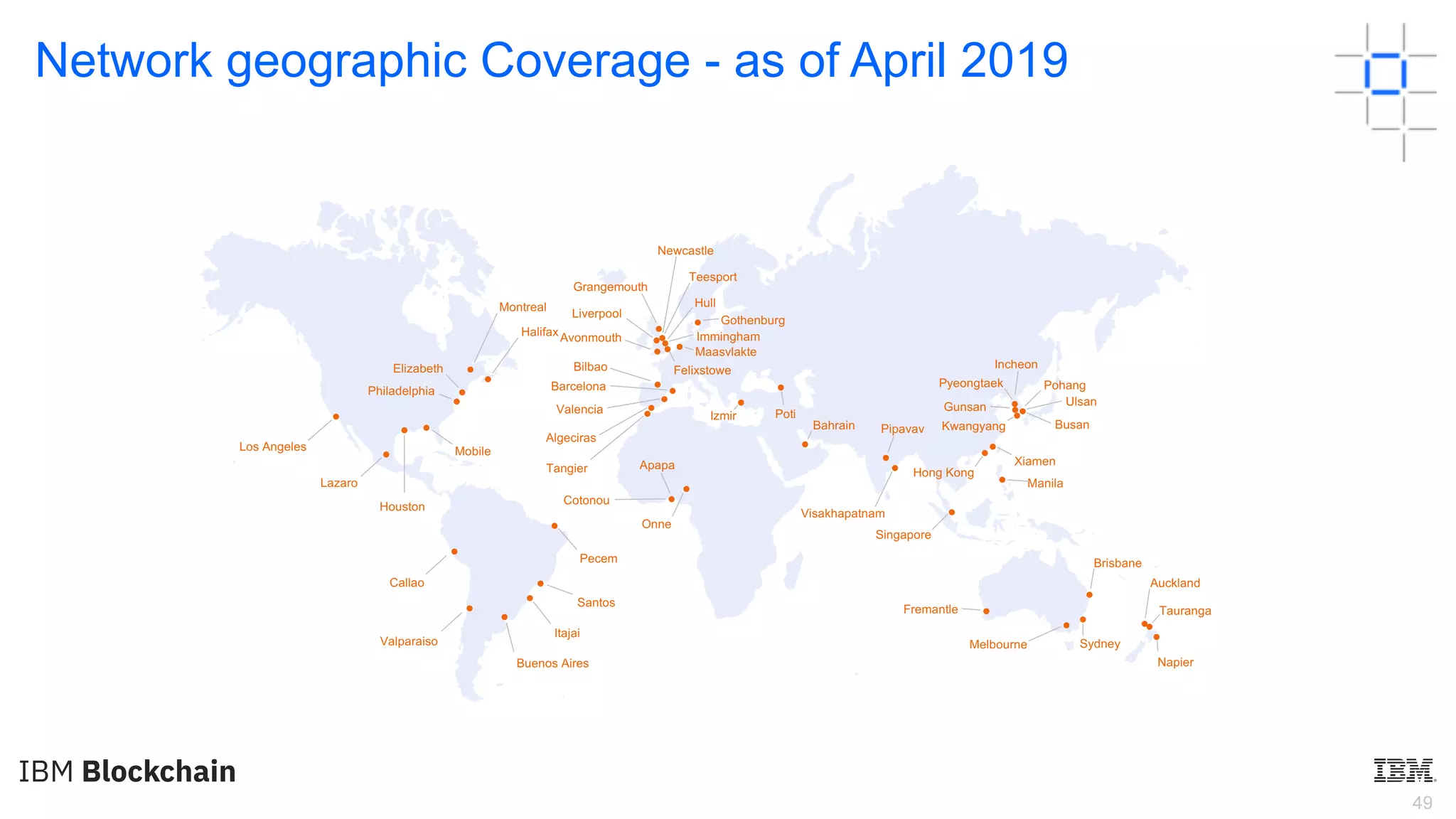
Network geographic Coverage - as of April 2019
•
••
•
•
•
•
•
•
••
• •
•
• ••
•••
•
•
•
•
•
••
•
•
•
••
•
•
• •
••
•
••
Los Angeles
Lazaro
Callao
Valparaiso
Montreal
Houston
Mobile
Philadelphia
Halifax
Elizabeth
Buenos Aires
Itajai
Santos
Pecem
Onne
Cotonou
Tangier
•
Algeciras
Valencia
Barcelona
Bilbao
Grangemouth
Liverpool
Avonmouth •
Newcastle
Immingham
Maasvlakte
Felixstowe
•
Izmir
Gothenburg
•
Poti
Bahrain Pipavav
Visakhapatnam
Singapore
Hong Kong
Manila
Fremantle
Melbourne
Brisbane
Auckland
Tauranga
Napier
•
Sydney
••
Pyeongtaek
Gunsan
Kwangyang
Pohang
Incheon
Busan
Ulsan
Apapa
Hull
Teesport
• Xiamen
50
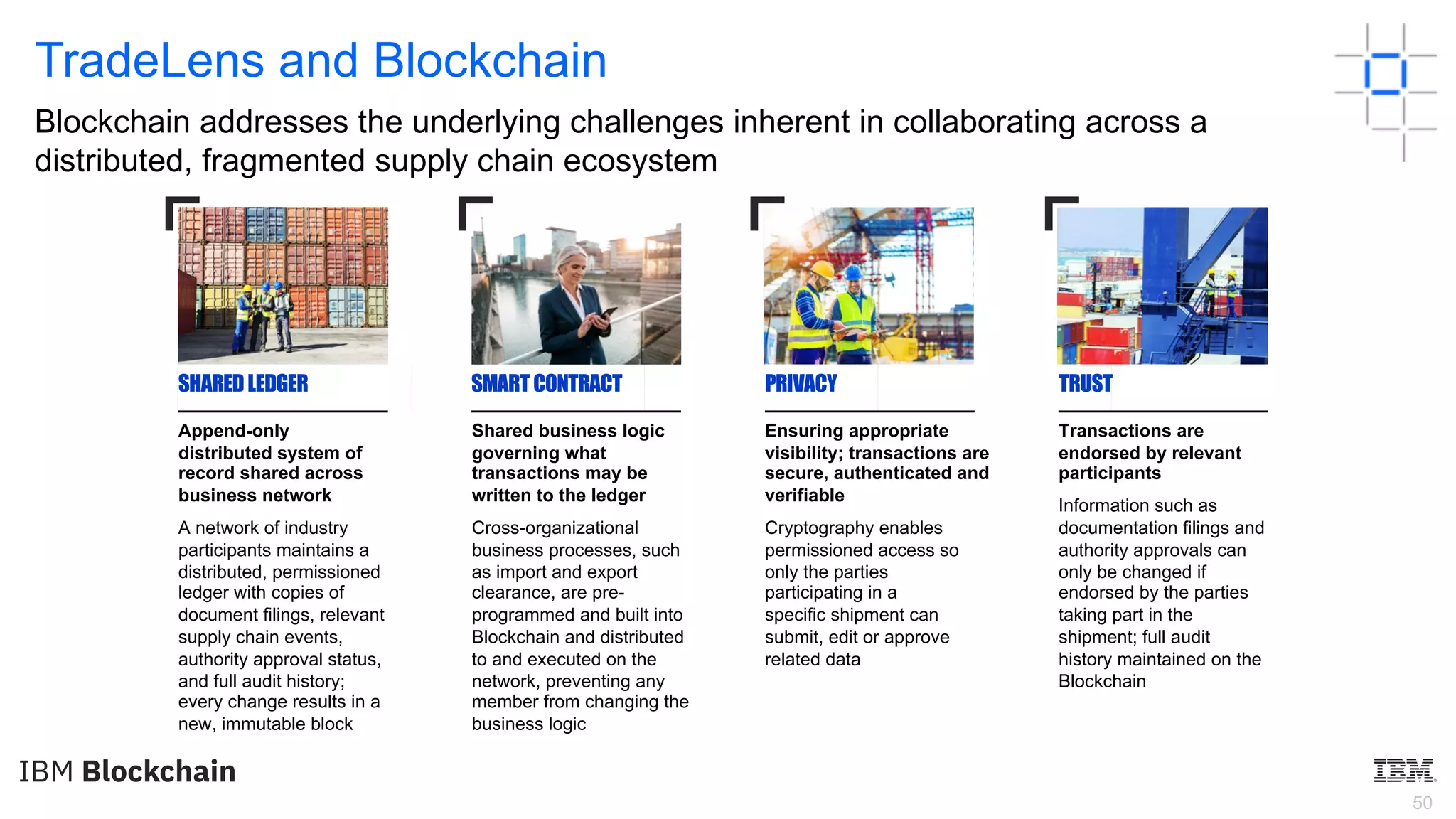
Append-only
distributed system of
record shared across
business network
A network of industry
participants maintains a
distributed, permissioned
ledger with copies of
document filings, relevant
supply chain events,
authority approval status,
and full audit history;
every change results in a
new, immutable block
Shared business logic
governing what
transactions may be
written to the ledger
Cross-organizational
business processes, such
as import and export
clearance, are pre-
programmed and built into
Blockchain and distributed
to and executed on the
network, preventing any
member from changing the
business logic
Ensuring appropriate
visibility; transactions are
secure, authenticated and
verifiable
Cryptography enables
permissioned access so
only the parties
participating in a
specific shipment can
submit, edit or approve
related data
Transactions are
endorsed by relevant
participants
Information such as
documentation filings and
authority approvals can
only be changed if
endorsed by the parties
taking part in the
shipment; full audit
history maintained on the
Blockchain
TradeLens and Blockchain
SHAREDLEDGER SMART CONTRACT PRIVACY TRUST
Blockchain addresses the underlying challenges inherent in collaborating across a
distributed, fragmented supply chain ecosystem
51
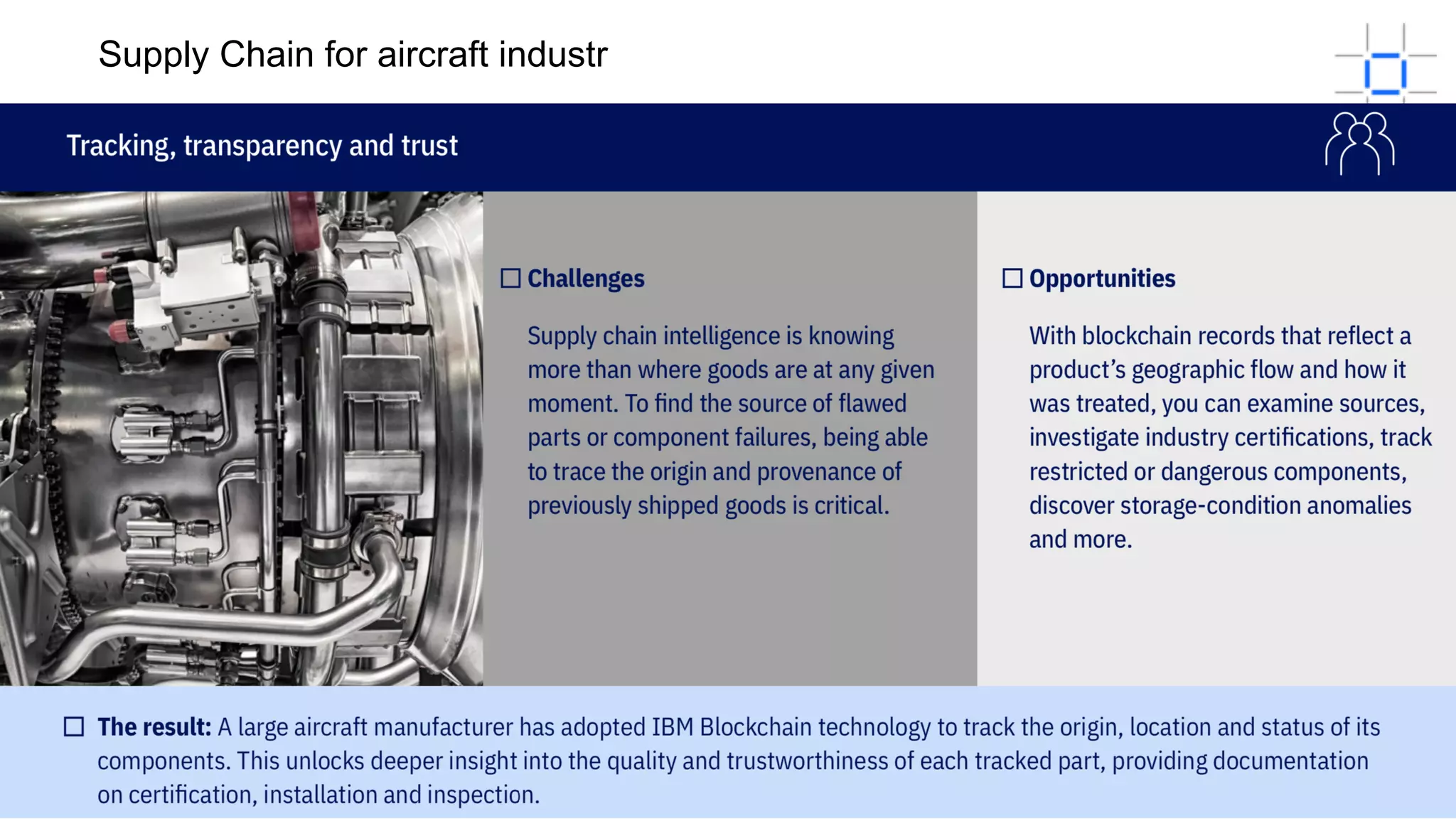
Supply Chain for aircraft industr
52
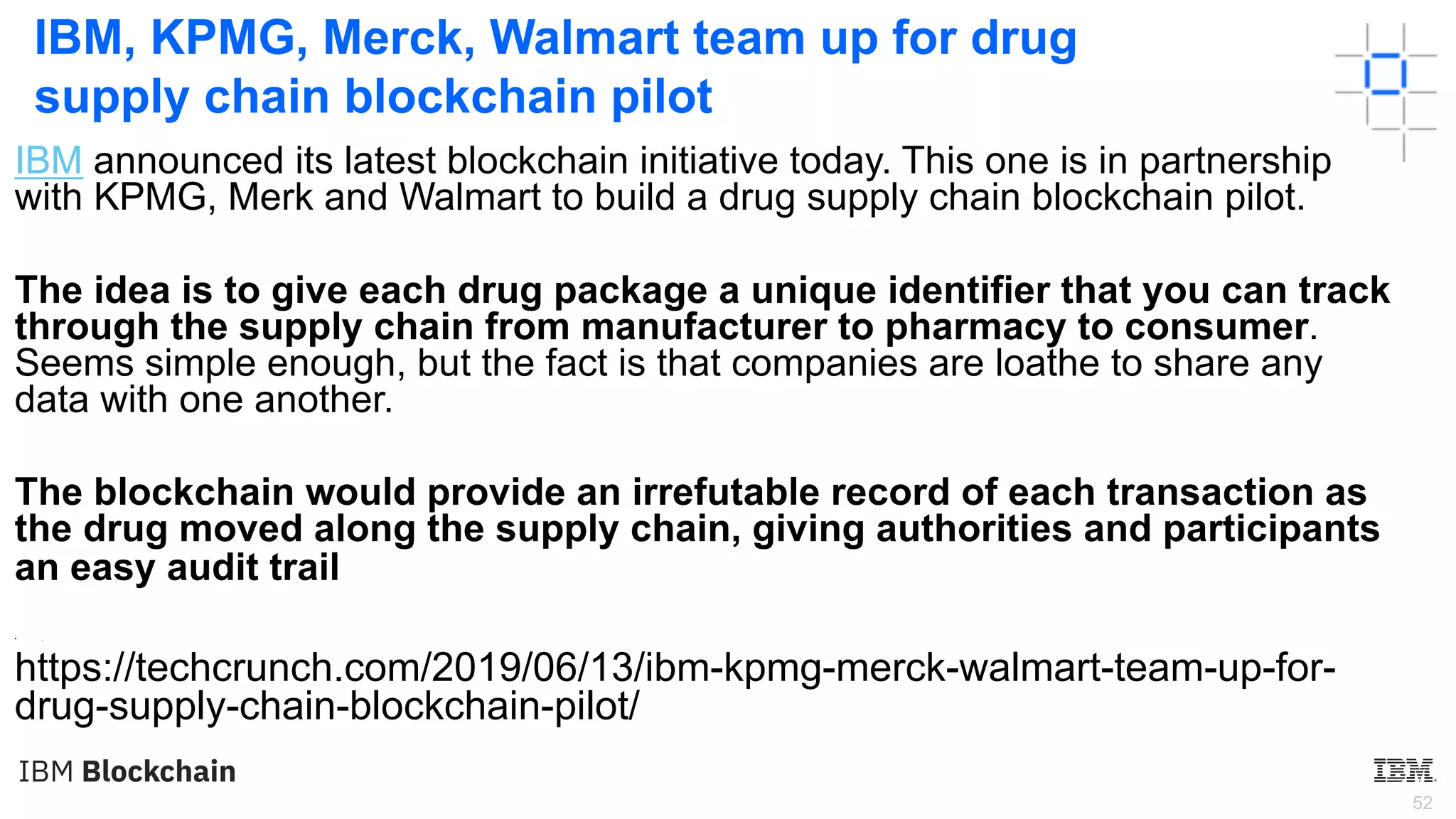
IBM, KPMG, Merck, Walmart team up for drug
supply chain blockchain pilot
IBM announced its latest blockchain initiative today. This one is in partnership
with KPMG, Merk and Walmart to build a drug supply chain blockchain pilot.
The idea is to give each drug package a unique identifier that you can track
through the supply chain from manufacturer to pharmacy to consumer.
Seems simple enough, but the fact is that companies are loathe to share any
data with one another.
The blockchain would provide an irrefutable record of each transaction as
the drug moved along the supply chain, giving authorities and participants
an easy audit trail
• .
https://techcrunch.com/2019/06/13/ibm-kpmg-merck-walmart-team-up-for-
drug-supply-chain-blockchain-pilot/
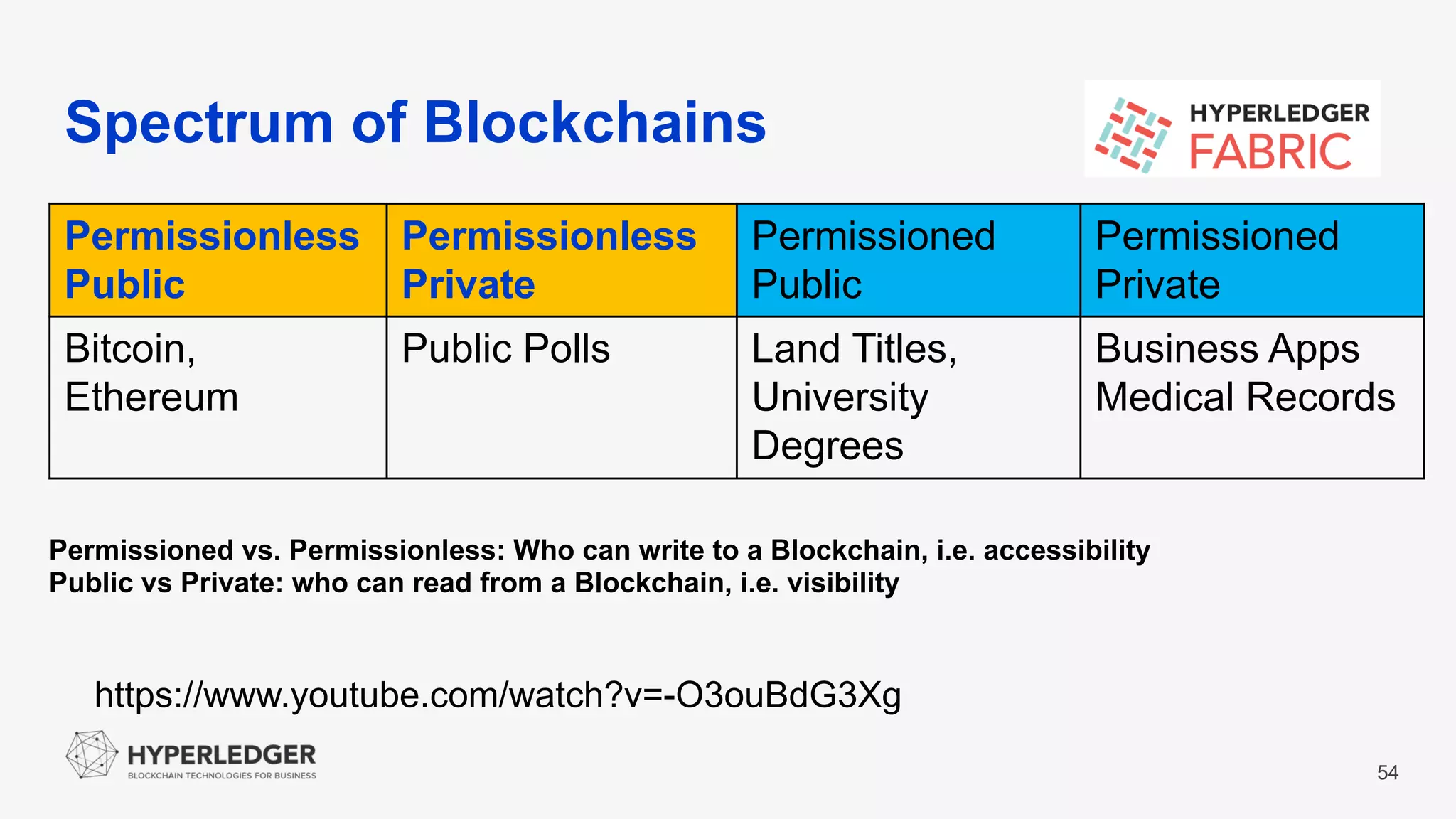
Spectrum of Blockchains
54
Permissionless
Public
Permissionless
Private
Permissioned
Public
Permissioned
Private
Bitcoin,
Ethereum
Public Polls Land Titles,
University
Degrees
Business Apps
Medical Records
Permissioned vs. Permissionless: Who can write to a Blockchain, i.e. accessibility
Public vs Private: who can read from a Blockchain, i.e. visibility
https://www.youtube.com/watch?v=-O3ouBdG3Xg

Globalizing the world supply chain and the ibm blockchain platform v.2

  • 1.
    Globalizing the world:Supply Chain and the IBM Blockchain Platform Lennart Frantzell IBM Developer Advocate San Francisco alf@us.ibm.com June 21 2019 Blockchain Explored Series IBM Blockchain Platform Explored Fabric Explored Composer Explored What’s New Architectures Explored Or what is the Blockchain good for?
  • 2.
    A new areain business computing started during the global financial crisis in October 2008 2 With Satoshi Nakamoto’s eight page paper: Bitcoin: A Peer-to-Peer Electronic Cash System He proposed a purely peer-to-peer version of electronic cash without the need to go through financial institutions. https://bitcoin.org/bitcoin.pdf g/
  • 3.
    3 … with consensus,provenance, immutability and finality Bank records Participant B’s records Auditor records Regulator records Blockchain Insurer records Participant A’s records A shared, replicated, permissioned ledger
  • 4.
    4 No trusted thirdparty No need for reconciliation between ledgers
  • 5.
  • 6.
    Satoshi Nakamoto’s Blockchainpromised to disrupt the world’s business systems 6 Many
  • 7.
    7 So 10 yearslater, where is the Blockchain Revolution?
  • 8.
    Has the BlockchainRevolution Failed to Take off Ten Years on? 8 Everyone, even the biggest skeptics of Bitcoin and other cryptocurrencies have all had their positives to say about the underpinning Blockchain technology which has the potential to change the world. However, it has been 10 years since Blockchain technology came into the open, and yet we still don’t really have a major use for it.it. https://cointelegraph.com/news/has-the-blockchain-revolution-failed- to-take-off-10-years-on
  • 9.
    9 Cryptocurrencies Have Failed,And Blockchain Still Has Yet To Be Proven Useful https://www.forbes.com/sites/yuwahedrickwong/2018/11/11/cryptocurrencies- have-failed-and-blockchain-still-has-yet-to-find-its-use/#4a99f7a0406c
  • 10.
    10 Blockchain companies gosilent when their tech promises fall short, research group finds https://www.marketwatch.com/story/blockchain-companies-go-silent-when-their- tech-promises-fall-short-research-group-finds-2018-12-04
  • 11.
  • 12.
  • 13.
    13 IBM has along provenance with blockchain… Aug 2015 IBM starts developing first prototype of blockchain technology (Open Blockchain); first client engagements Feb 2016 IBM becomes a founding member of Linux Foundation Hyperledger; donates code and intellectual property Jun 2016 IBM opens first blockchain garages for clients; Hyperledger Fabric v0.6 released Dec 2016 Number of IBM blockchain client engagements now totals over 400 Feb 2018 IBM Blockchain Starter Plan announced at THINK Jul 2017 Fabric 1.0 released; IBM Blockchain announced soon after Nov 2018 IBM introduces hybrid and multi-cloud networks May 2019 IBM Blockchain Platform for IBM Cloud released
  • 14.
    14 So what isBlockchain good for?
  • 15.
    15 Supply Chain! • Globalsupply chains underpin the global economy • They are usually large scale • But are still largely run on paper records
  • 16.
  • 17.
    17 Let’s walk througha simple blockchain for Supply Chain https://www.ibm.com/thought-leadership/blockchainbean/ Brooklyn Roasting Company Ethiopian Yirgacheffe coffee
  • 18.
    18 Step 1: CoffeePurchased { "$class": "org.ibm.coffee.submitFairTradeData", "batchId": "vjv1dsqncq", "fairtradePremiumInvested": "$182273", "investmentAmount1": "$30,626", "investmentAmount2": "$43,251", "investmentAmount3": "$34,411", "investmentTitle1": "School Classroom Addition", "investmentTitle2": "Road Infrastructure", "investmentTitle3": "Food Security", "organizationDescription": "YCFCU is an Ethiopian coffee producing, processing, and exporting cooperative union founded in 2002. "reportName": "Fair Trade Coffee Supply Chain Report", "reportYear": 2016, "transactionId": "7bde4711554a69ff336551b4acbb465648355cbf2b80f6218d3cee59593fe3b3"
  • 19.
    19 Step 2: Coffeeexported. { "$class": "org.ibm.coffee.submitPackingList", "PL_Bill_of_Lading_No": "961972237", "PL_Container_No": "redacted", "PL_FDA_NO": "15752850924", "PL_ICO_Lot": "Lot 7", "PL_ICO_no": "010/0150/0128", "PL_Invoice_no": "0067", "PL_IssueDate": "2017-09-19T00:00:00.000Z", "PL_LoadedVessel": "NorthernMagnum", "PL_Seal_no": "ML-Dj0144535 20 DRY 8’6", "PL_VesselVoyage_No": "1707", "PL_timestamp": "2018-06-17", "batchId": "vjv1dsqncq", "grower": "resource:org.ibm.coffee.Grower#Grower-0201", "trader": "resource:org.ibm.coffee.Trader#Trader-0791", "transactionId": "2e3dfb77486cf5ad731777614741fd68c7adea8d87a103bd03e7296f46f87b82" }
  • 20.
    20 Step 3: Coffeeimported { "$class": "org.ibm.coffee.submitInboundWeightTally", "bagsExpected": 150, "batchId": "vjv1dsqncq", "coffeeBatch": "resource:org.ibm.coffee.Coffee#u94sf62run", "condition": { "$class": "org.ibm.coffee.Condition", "condensation": false, "holeInContainer": false }, "dateStripped": "2017-10-06T00:00:00.000Z", "insectActivity": false, "marks": "010/0150/0128 Lot 7", "transactionId": "cdcf476897109c6470e476eac2b90c05c223e64681311b2fabbb175f26ac8c8b" } https://www.ibm.com/thought-leadership/blockchainbean/
  • 21.
    21 Step 4: CoffeeEvaluated { "$class": "org.ibm.coffee.submitCupping", "acidity": 8, "afterTaste": 8, "aroma": 9, "batchId": "vjv1dsqncq", "body": 9, "coffeeBatch": "resource:org.ibm.coffee.Coffee#4210", "cupper": "Brian", "date": "2018-04-12T00:00:00.000Z", "finalScore": 89, "flavor": 8, "transactionId": "1604705fa77b4b387713370262aecd552963fc6c6861d2295745435a8b67317e" }
  • 22.
  • 23.
    23 Blockchain and Supplychain It is not about writing from scratch, it’s all about Frameworks
  • 24.
    24 It’s all aboutFrameworks • United States-based agricultural conglomerate Cargill has announced that it is investing digital engineering resources to develop Hyperledger Grid, according to an announcement on Jan. 25.
  • 25.
    25 Hyperledger Grid isa framework. It’s not a blockchain and it’s not an application. Grid is an ecosystem of technologies, frameworks, and libraries that work together, letting application developers make the choice as to which components are most appropriate for their industry or market model.
  • 26.
  • 27.
  • 28.
    28 Introducing IBM FoodTrust TM built on Blockchain technology • The IBM Food Trust solution is a set of modules providing traceability to improve food transparency and efficiency • Blockchain is used to create a trusted connection with shared value for all ecosystem participants, including end consumers • The solution offers connectors for interoperability and leveraging existing standards (e.g., GS1) • Blockchain properties come together to create a more trusted, transparent, and efficient data-sharing platform. Distributed Ledger Digital Transactions Immutable Data Efficiency Trust Transparency
  • 29.
    29 IBM Food Trustoffers industry-specific functionality targeted at key pain points Fresh Insights • Access real-time and aggregate supply chain data to extend product freshness and shelf life Trace • Trace the location and status of food products upstream and downstream across the supply chain Certifications • Enable reliability and accountability with instant access to digitized records and documents Third-party • Partner to expand functionalities and deliver new value across the food system Food Supply Ecosystem Blockchain Technology IBMBlockchain Platform Hyperledger Fabric Capabilities Information- sharing Platform
  • 30.
    • Text orimage• Text or image • Text or image• Text or image Only 1 in 4 Consumers Trust the Food Ecosystem 1 out of 10 people get sick each year, and 420,000 die from foodborne illness 80% of CPGs business are partially or entirely paper-based 1 / 3 of fresh food is thrown out because it is considered unacceptable 1 in 5 seafood samples mislabeled worldwide (43% mislabeled in NYC) 30© 2019 IBM Corporation The root of these issues, and many others, are the lack of trust and transparency Food Safety Supply Chain Inefficiency Food Waste Food Fraud
  • 31.
    31 The Problem: • Datais siloed within each company and accessing it requires a request and time • Exchange of information takes place between a pair of partners; to get information from a distant partner may require intermediaries, time, resources • Most transactions are still paper-based, creating inefficiencies and opportunities for fraud • Because everyone maintains their own record of transactions, differences take time and resources to reconcile Today, traditional system constructs limit transparency The food industry today Grower Manufacturer Retailer Restaurant Logistics Inputs
  • 32.
    32 Blockchain transforms systemswith trust and transparency The Solution: • Because blockchain provides an independent data- sharing platform, participants trust it • Once data is shared in a single data-sharing platform, everyone has instant transparency into the transactions they are authorized to view; no intermediation required • Data immutability creates an auditable record of all transactions, disincentivizing fraudulent behavior • Dispute resolution from the shared ledger can be automated saving time and resources The food industry with blockchain Grower Manufacturer RetailerRestaurant Logistics Inputs
  • 33.
  • 34.
  • 35.
  • 36.
  • 37.
  • 38.
  • 39.
  • 40.
    40 Trace Last year, therewere at least 456 food safety recalls globally due to contamination, with each recall estimated to cost an average of $10 million. Functionality • Securely and transparently trace the location and status of food products upstream and downstream in seconds. Impact • Improve food safety • Conduct surgical recalls • Identify ingredient provenance • Reduce Food Fraud
  • 41.
    41 Certifications Driven by today’sfood system complexity, food fraud is a global business estimated to cost $40 billion annually. Functionality • Easily digitize and share inspections, quality certifications, and registrations. Impact • Improved brand trust • Reduced food fraud • More sustainable ecosystem
  • 42.
    42 Fresh Insights 40-50% ofroot crops, fruits and vegetables are wasted annually. Food losses and waste amounts to roughly $680 billion in industrialized countries. Functionality • Real time insights on inventory flow, average dwell time, time-since-harvest. Enables root-cause diagnosis and provides alert capabilities. Impact • Supply chain efficiencies • Reduced food waste • Increased Shelf Life • More sustainable ecosystem
  • 43.
  • 44.
  • 45.
    45 • IBM andMaersk are developing the platform under a joint collaboration, with significant input from and participation by the industry • The platform empowers faster and more efficient, transparent and secure global trade • TradeLens is built for the industry and offers benefits to trade participants from across the supply chain ecosystem • An Advisory Board is being formed to help shape the platform and drive standards • TradeLens is live in production today, processing millions of transactions per day An open and neutral blockchain-based platform that is digitizing the global supply chain and transforming trade September 2018 TradeLens Limited Availability Release December 2018 TradeLens Commercial Release 1.5 million events per day published to the platform January 2019 Latest production release includes new document sharing, permissioning and notification features. Working with more than 100 ecosystem participants August 2018 Formal launch of the TradeLens platform 92 participants signed on January 2018 Beta release of the platform and launch of Early Adopter program; trials underway OURJOURNEYTradeLens
  • 46.
    46 The cost ofglobal trade is estimated at $1.8 trillion annually1 with potential savings from more efficient processes of ~10% 46 More than $16 trillion in goods are shipped across international borders each year 80% of the goods consumers use daily are carried by the ocean shipping industry By reducing barriers within the international supply chain, global trade could increase by nearly 15%, boosting economies and creating jobs2 In many cases the administrative cost of moving a container is higher than the cost of physically moving it 1) Maersk Strategy Group (May 19, 2016) based on World Bank data for World Trade Costs 2) The World Economic Forum: Enabling Trade Valuing Growth Opportunities 2013
  • 47.
    47 Global trade ishighly inefficient and burdened by paper- based processes Data trapped in organizational silos Information is held in paper and various digital formats across dozens of service providers along the supply chain, requiring complex, cumbersome, and costly peer-to-peer messaging. The result is inconsistent information across organizational boundaries, latency in obtaining shipment visibility, and blind spots that hinder the efficient flow of goods. Manual, time-consuming, paper-based processes The collection and processing of up-to-date data, as well as inefficient trade document exchange, requires manual checks and frequent follow-ups and results in errors, delays and high compliance costs. Late filings are common due to missing information. Clearance takes too long and is often subject to fraud Risk assessments by customs authorities lack sufficient and trusted information resulting in high inspection rates, added prevention measures against fraud and forgery, and delayed customs clearance. High costs and poor customer service These challenges have significant downstream repercussions. The inability to forecast and plan effectively, address supply chain disruptions in real-time, and share trusted information across the supply chain leads to excessive safety stock inventory, high administrative costs, operational challenges, and ultimately poor customer service. Inland Transportation Shippers / Beneficial Cargo Owner Supply Chain Visibility Systems Trade Association s Supply Chain / Transportation Management Systems Authorities Financial / Insurance Services Port Community Systems; Terminal Operating Systems Ports and Terminals Freight Forwarders / 3PLs Customs Systems Ocean Carriers Customs Brokers
  • 48.
    48 The TradeLens ecosystem Primaryconsumers and beneficiaries of the platform ⦿ Shippers (BCOs, retailers, manufacturers, etc.) ⦿ Freight forwarders, customs brokers, 3PL ⦿ Financial institutions TRADELENS PLATFORM Clients Applications Marketplace Network Members Provide and gain access to end-to- end supply chain information ⦿ Ocean carriers ⦿ Ports and terminals ⦿ Government authorities ⦿ Inland transportation ⦿ Freight forwarders / 3PLs ⦿ 3rd party data providers Offer value added services to the ecosystem through a platform marketplace ⦿ TradeLens offerings ⦿ Offerings from third party ISVs ⦿ Offerings from Network Members and Clients
  • 49.
    49 Network geographic Coverage- as of April 2019 • •• • • • • • • •• • • • • •• ••• • • • • • •• • • • •• • • • • •• • •• Los Angeles Lazaro Callao Valparaiso Montreal Houston Mobile Philadelphia Halifax Elizabeth Buenos Aires Itajai Santos Pecem Onne Cotonou Tangier • Algeciras Valencia Barcelona Bilbao Grangemouth Liverpool Avonmouth • Newcastle Immingham Maasvlakte Felixstowe • Izmir Gothenburg • Poti Bahrain Pipavav Visakhapatnam Singapore Hong Kong Manila Fremantle Melbourne Brisbane Auckland Tauranga Napier • Sydney •• Pyeongtaek Gunsan Kwangyang Pohang Incheon Busan Ulsan Apapa Hull Teesport • Xiamen
  • 50.
    50 Append-only distributed system of recordshared across business network A network of industry participants maintains a distributed, permissioned ledger with copies of document filings, relevant supply chain events, authority approval status, and full audit history; every change results in a new, immutable block Shared business logic governing what transactions may be written to the ledger Cross-organizational business processes, such as import and export clearance, are pre- programmed and built into Blockchain and distributed to and executed on the network, preventing any member from changing the business logic Ensuring appropriate visibility; transactions are secure, authenticated and verifiable Cryptography enables permissioned access so only the parties participating in a specific shipment can submit, edit or approve related data Transactions are endorsed by relevant participants Information such as documentation filings and authority approvals can only be changed if endorsed by the parties taking part in the shipment; full audit history maintained on the Blockchain TradeLens and Blockchain SHAREDLEDGER SMART CONTRACT PRIVACY TRUST Blockchain addresses the underlying challenges inherent in collaborating across a distributed, fragmented supply chain ecosystem
  • 51.
    51 Supply Chain foraircraft industr
  • 52.
    52 IBM, KPMG, Merck,Walmart team up for drug supply chain blockchain pilot IBM announced its latest blockchain initiative today. This one is in partnership with KPMG, Merk and Walmart to build a drug supply chain blockchain pilot. The idea is to give each drug package a unique identifier that you can track through the supply chain from manufacturer to pharmacy to consumer. Seems simple enough, but the fact is that companies are loathe to share any data with one another. The blockchain would provide an irrefutable record of each transaction as the drug moved along the supply chain, giving authorities and participants an easy audit trail • . https://techcrunch.com/2019/06/13/ibm-kpmg-merck-walmart-team-up-for- drug-supply-chain-blockchain-pilot/
  • 54.
    Spectrum of Blockchains 54 Permissionless Public Permissionless Private Permissioned Public Permissioned Private Bitcoin, Ethereum PublicPolls Land Titles, University Degrees Business Apps Medical Records Permissioned vs. Permissionless: Who can write to a Blockchain, i.e. accessibility Public vs Private: who can read from a Blockchain, i.e. visibility https://www.youtube.com/watch?v=-O3ouBdG3Xg