BLOCKCHAIN
Guaranteed
Integrity
Perfectly
Auditable
Unparalleled
Digital Security
Non-Localized
THE SOLUTION FOR
TRANSPARENCY IN PRODUCT
SUPPLY CHAINS
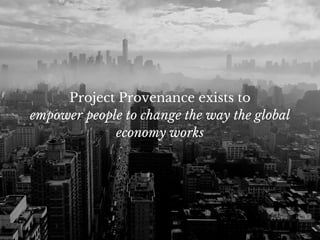
Blockchain technology will enable
transparent exchange to empower conscious
consumers and authentic brands to
change the way the global
economy works
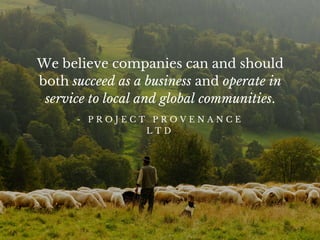
Companies can and should both
succeed as a business and operate in service to
local and global communities.
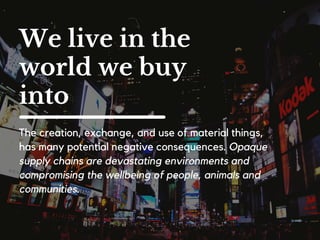
We live in the
world we buy
into
The creation, exchange, and use of material things,
has many potential negative consequences. Opaque
supply chains are devastating environments and
compromising the wellbeing of people, animals and
communities.
“WITHOUT UNDERSTANDING THE
IMPACTS OF GOODS AND SERVICES, WE
BUY INTO SYSTEMS THAT DEPLETE
NATURAL RESOURCES, WORSEN
ENVIRONMENTAL AND SOCIAL
PROBLEMS AND ENDANGER HUMANS
AND ECOSYSTEMS. SUPPLY CHAINS ARE
CONVENTIONALLY HELD SECRET,
LIMITING THE STAKEHOLDERS WHO CAN
PREVENT ENVIRONMENTAL, SOCIAL
AND HEALTH AND SAFETY PROBLEMS.”
LeonardoBonanni, FounderofSourcemap
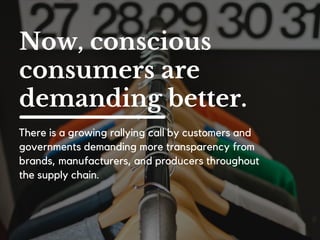
Now, conscious
consumers are
demanding better.
There is a growing rallying call by customers and
governments demanding more transparency from
brands, manufacturers, and producers throughout
the supply chain.
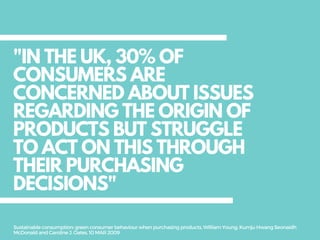
"IN THE UK, 30% OF
CONSUMERS ARE
CONCERNED ABOUT ISSUES
REGARDING THE ORIGIN OF
PRODUCTS BUT STRUGGLE
TO ACT ON THIS THROUGH
THEIR PURCHASING
DECISIONS"
Sustainableconsumption: greenconsumerbehaviourwhenpurchasingproducts, WilliamYoung, KumjuHwangSeonaidh
McDonaldandCarolineJ. Oates, 10MAR2009
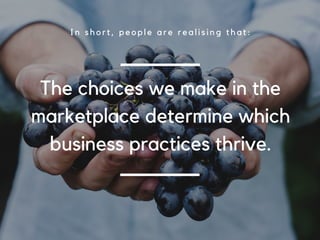
The choices we make in the
marketplace determine which
business practices thrive.
I n s h o r t , p e o p l e a r e r e a l i s i n g t h a t :
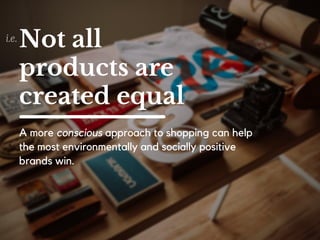
Not all
products are
created equal
A more conscious approach to shopping can help
the most environmentally and socially positive
brands win.
i.e.
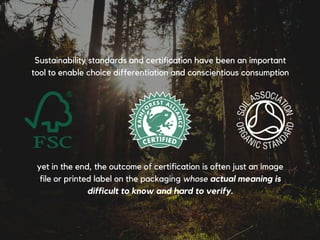
Sustainability standards and certification have been an important
tool to enable choice differentiation and conscientious consumption
yet in the end, the outcome of certification is often just an image
file or printed label on the packaging whose actual meaning is
difficult to know and hard to verify.
“NOW, IN THE
HYPER-CONNECTED
AND EVER EVOLVING
WORLD,
TRANSPARENCY IS
THE NEW POWER.”
BenjaminHerzberg, ProgramLead, PrivateSectorEngagementforGoodGovernanceattheWorldBankInstitute
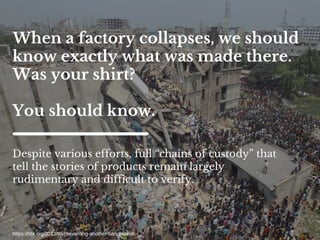
When a factory collapses, we should
know exactly what was made there.
Was your shirt?
You should know.
Despite various efforts, full “chains of custody” that
tell the stories of products remain largely
rudimentary and difficult to verify.
https://hbr.org/2013/05/preventing­another­bangladesh
NO SINGLE ORGANIZATION CAN
BE TRUSTED TO BROKER ALL
DATA ABOUT EVERY PRODUCT’S
SUPPLY CHAIN.
The idea of using a centralized system with a governing third
party was, until recently, the only conceivable way to achieve this.
The truth is that
Today, however, a new technology called
THE BLOCKCHAIN presents a whole new
approach...
“The consequences of this breakthrough are hard to overstate.”
­ Marc Andreessen, Inventor of the internet browser
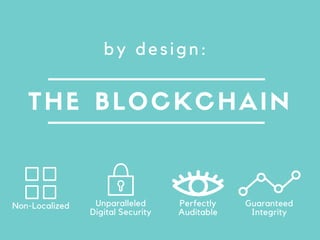
THE BLOCKCHAIN
Guaranteed
Integrity
Perfectly
Auditable
Unparalleled
Digital Security
by design:
Non-Localized
There is no single machine that governs the business
logic or the data on which a blockchain operates.
Today your data is stored in a silo. With
blockchains data will be stored (publically or pseudo
anonymously) in a shared database.
Non-Localized
Unless a user can cryptographically prove the
ownership of an account, there is no way for anybody
else to change it.
The security risk of the weakest link — in the form of
operators and IT administrators — is drastically
reduced.
Unparalleled
Digital Security
Each operation or interaction is perfectly recorded
and archived. An uninterrupted "chain of custody"
Auditing is as simple as pressing “replay"
Perfectly
Auditable
The integrity of the data (e.g., the current level of
stock or the origin of a particular certificate) is
guaranteed.
The blockchain gives us an unprecedented level of
certainty over the fidelity of the information. We can
be sure that all transfers of ownership were explicitly
authorized Not by users or authority, but by the
underlying technology.
Guaranteed
Integrity
The use of blockchain technology provides a
number of truly unprecedented breakthroughs for
certain public-interest information, such as the
supply chains of consumer products.
Learn more...
www.provenance.org/whitepaper
P R O V E N A N C E
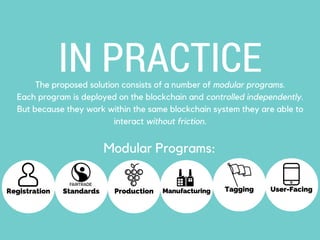
IN PRACTICEThe proposed solution consists of a number of modular programs.
Each program is deployed on the blockchain and controlled independently.
But because they work within the same blockchain system they are able to
interact without friction.
Registration Standards Production Manufacturing Tagging User-Facing
Modular Programs:
Registration
All certifiers, auditors, producers, and manufacturers request
registration - linking their real-world identity with their blockchain-based
digital identity, thus allowing them to interact with the blockchain
All other programs derive their “trustability” through their own reputation (which may be imported
through their real-world name). This program will initially be deployed by the registrar.
Programs
Registration
These programs represent the implementation of schemas for proper
recognition of a standard (e.g. no animal testing, biodynamic, fair labor)
Through these programs, standards organizations provide for the
creation of compliant production or manufacturing programs (see
below), allowing goods and materials to be added to or processed on the
blockchain.
Marques and certifications that are printed on today’s consumer products and shown at the point
of sale. On the blockchain certifications can be linked to their real meaning and information
verifying their status.
Standards
Programs
Registration
Deployed by the certifiers following successful certification, these
programs are used by producers to prove the creation of materials or
primary goods.
Since they are principally responsible for the creation of goods, producer
programs are the root for the traceability of finished goods
From cotton growers to gold miners the blockchain presents a method for securely documenting
and transferring key information about a raw material.
Production
Programs
Registration
These programs implement the transformation of input goods from
production into output goods. Input goods must be “used” for any output
to be created, just as in the physical world.
Because of its auditability, the blockchain provides the same cast-iron
guarantee as in the physical world; namely, that creation of an output
good can happen if and only if the required input is used.
Information from the producer is securely cascaded to the manufacturer on receipt.
Manufacturing
Programs
Registration
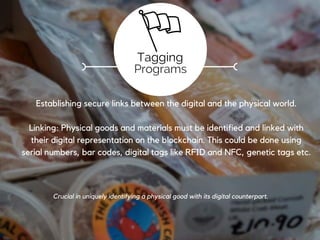
Establishing secure links between the digital and the physical world.
Linking: Physical goods and materials must be identified and linked with
their digital representation on the blockchain. This could be done using
serial numbers, bar codes, digital tags like RFID and NFC, genetic tags etc.
Crucial in uniquely identifying a physical good with its digital counterpart.
Tagging
Programs
Registration
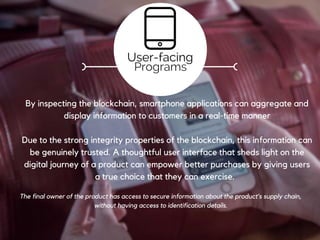
By inspecting the blockchain, smartphone applications can aggregate and
display information to customers in a real-time manner
Due to the strong integrity properties of the blockchain, this information can
be genuinely trusted. A thoughtful user interface that sheds light on the
digital journey of a product can empower better purchases by giving users
a true choice that they can exercise.
The final owner of the product has access to secure information about the product’s supply chain,
without having access to identification details.
User-facing
Programs
We believe blockchain technology can help
businesses communicate stories, prove facts and
elegantly open a window to their inner workings.
Learn more...
www.provenance.org/whitepaper
P R O V E N A N C E
Jamie Sandhu
jamiesandhu@me.com
@junkless_jamie
by

Blockchain: the solution for transparency in product supply chains

  • 1.
  • 2.
    Blockchain technology willenable transparent exchange to empower conscious consumers and authentic brands to change the way the global economy works
  • 3.
    Companies can andshould both succeed as a business and operate in service to local and global communities.
  • 4.
    We live inthe world we buy into The creation, exchange, and use of material things, has many potential negative consequences. Opaque supply chains are devastating environments and compromising the wellbeing of people, animals and communities.
  • 5.
    “WITHOUT UNDERSTANDING THE IMPACTSOF GOODS AND SERVICES, WE BUY INTO SYSTEMS THAT DEPLETE NATURAL RESOURCES, WORSEN ENVIRONMENTAL AND SOCIAL PROBLEMS AND ENDANGER HUMANS AND ECOSYSTEMS. SUPPLY CHAINS ARE CONVENTIONALLY HELD SECRET, LIMITING THE STAKEHOLDERS WHO CAN PREVENT ENVIRONMENTAL, SOCIAL AND HEALTH AND SAFETY PROBLEMS.” LeonardoBonanni, FounderofSourcemap
  • 6.
    Now, conscious consumers are demandingbetter. There is a growing rallying call by customers and governments demanding more transparency from brands, manufacturers, and producers throughout the supply chain.
  • 7.
    "IN THE UK,30% OF CONSUMERS ARE CONCERNED ABOUT ISSUES REGARDING THE ORIGIN OF PRODUCTS BUT STRUGGLE TO ACT ON THIS THROUGH THEIR PURCHASING DECISIONS" Sustainableconsumption: greenconsumerbehaviourwhenpurchasingproducts, WilliamYoung, KumjuHwangSeonaidh McDonaldandCarolineJ. Oates, 10MAR2009
  • 8.
    The choices wemake in the marketplace determine which business practices thrive. I n s h o r t , p e o p l e a r e r e a l i s i n g t h a t :
  • 9.
    Not all products are createdequal A more conscious approach to shopping can help the most environmentally and socially positive brands win. i.e.
  • 10.
    Sustainability standards andcertification have been an important tool to enable choice differentiation and conscientious consumption yet in the end, the outcome of certification is often just an image file or printed label on the packaging whose actual meaning is difficult to know and hard to verify.
  • 11.
    “NOW, IN THE HYPER-CONNECTED ANDEVER EVOLVING WORLD, TRANSPARENCY IS THE NEW POWER.” BenjaminHerzberg, ProgramLead, PrivateSectorEngagementforGoodGovernanceattheWorldBankInstitute
  • 12.
    When a factorycollapses, we should know exactly what was made there. Was your shirt? You should know. Despite various efforts, full “chains of custody” that tell the stories of products remain largely rudimentary and difficult to verify. https://hbr.org/2013/05/preventing­another­bangladesh
  • 13.
    NO SINGLE ORGANIZATIONCAN BE TRUSTED TO BROKER ALL DATA ABOUT EVERY PRODUCT’S SUPPLY CHAIN. The idea of using a centralized system with a governing third party was, until recently, the only conceivable way to achieve this. The truth is that
  • 14.
    Today, however, anew technology called THE BLOCKCHAIN presents a whole new approach... “The consequences of this breakthrough are hard to overstate.” ­ Marc Andreessen, Inventor of the internet browser
  • 15.
  • 16.
    There is nosingle machine that governs the business logic or the data on which a blockchain operates. Today your data is stored in a silo. With blockchains data will be stored (publically or pseudo anonymously) in a shared database. Non-Localized
  • 17.
    Unless a usercan cryptographically prove the ownership of an account, there is no way for anybody else to change it. The security risk of the weakest link — in the form of operators and IT administrators — is drastically reduced. Unparalleled Digital Security
  • 18.
    Each operation orinteraction is perfectly recorded and archived. An uninterrupted "chain of custody" Auditing is as simple as pressing “replay" Perfectly Auditable
  • 19.
    The integrity ofthe data (e.g., the current level of stock or the origin of a particular certificate) is guaranteed. The blockchain gives us an unprecedented level of certainty over the fidelity of the information. We can be sure that all transfers of ownership were explicitly authorized Not by users or authority, but by the underlying technology. Guaranteed Integrity
  • 20.
    The use ofblockchain technology provides a number of truly unprecedented breakthroughs for certain public-interest information, such as the supply chains of consumer products. Learn more... www.provenance.org/whitepaper P R O V E N A N C E
  • 21.
    IN PRACTICEThe proposedsolution consists of a number of modular programs. Each program is deployed on the blockchain and controlled independently. But because they work within the same blockchain system they are able to interact without friction. Registration Standards Production Manufacturing Tagging User-Facing Modular Programs:
  • 22.
    Registration All certifiers, auditors,producers, and manufacturers request registration - linking their real-world identity with their blockchain-based digital identity, thus allowing them to interact with the blockchain All other programs derive their “trustability” through their own reputation (which may be imported through their real-world name). This program will initially be deployed by the registrar. Programs
  • 23.
    Registration These programs representthe implementation of schemas for proper recognition of a standard (e.g. no animal testing, biodynamic, fair labor) Through these programs, standards organizations provide for the creation of compliant production or manufacturing programs (see below), allowing goods and materials to be added to or processed on the blockchain. Marques and certifications that are printed on today’s consumer products and shown at the point of sale. On the blockchain certifications can be linked to their real meaning and information verifying their status. Standards Programs
  • 24.
    Registration Deployed by thecertifiers following successful certification, these programs are used by producers to prove the creation of materials or primary goods. Since they are principally responsible for the creation of goods, producer programs are the root for the traceability of finished goods From cotton growers to gold miners the blockchain presents a method for securely documenting and transferring key information about a raw material. Production Programs
  • 25.
    Registration These programs implementthe transformation of input goods from production into output goods. Input goods must be “used” for any output to be created, just as in the physical world. Because of its auditability, the blockchain provides the same cast-iron guarantee as in the physical world; namely, that creation of an output good can happen if and only if the required input is used. Information from the producer is securely cascaded to the manufacturer on receipt. Manufacturing Programs
  • 26.
    Registration Establishing secure linksbetween the digital and the physical world. Linking: Physical goods and materials must be identified and linked with their digital representation on the blockchain. This could be done using serial numbers, bar codes, digital tags like RFID and NFC, genetic tags etc. Crucial in uniquely identifying a physical good with its digital counterpart. Tagging Programs
  • 27.
    Registration By inspecting theblockchain, smartphone applications can aggregate and display information to customers in a real-time manner Due to the strong integrity properties of the blockchain, this information can be genuinely trusted. A thoughtful user interface that sheds light on the digital journey of a product can empower better purchases by giving users a true choice that they can exercise. The final owner of the product has access to secure information about the product’s supply chain, without having access to identification details. User-facing Programs
  • 28.
    We believe blockchaintechnology can help businesses communicate stories, prove facts and elegantly open a window to their inner workings. Learn more... www.provenance.org/whitepaper P R O V E N A N C E
  • 29.