Solving Traceability and predictability
The Industry : Supplychain logistics
Our current supply chain is broken in several ways. Over a hundred years ago, supply chains
were relatively simple because commerce was local, but they have grown incredibly complex.
Inspite of the complexity in this supply chain industry, there have been innovations in place
and as a result, the manufacturing has become globalized.
According to Accenture, ten percent of freight invoices are problematic. These can include
duplication, wrong freight mode changes, and incorrect fees. With the complex supply
systems companies have, it take one side a while to figure out who is at fault.
Supply chain is one of the most evolving areas in business technology, with trillions of
purchase orders, invoices, certifications, and payments sent every day between companies.
• Demand for transparency is increasing in Supply chain
• A truly global computing running by consensus across
stake holders(Non-localization)
• A P2P Ledger to record transactions, Imutability of the
data.
• A report suggests that it could significantly improve
communication and understanding between supply
chain partners.
Chief Executive Officer Fred Smith said at a blockchain
conference in New York. “It’s the next frontier that’s
going to completely change worldwide supply chains.”
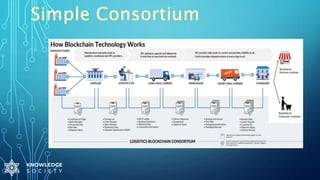
 There is not one central authority over the blockchain, and it’s extremely efficient and scalable.
Ultimately, blockchain can increase the efficiency and transparency of supply chains and
positively impact everything from warehousing to delivery to payment.
 Chain of command is essential for many things, and blockchain has the chain of command built
in.
 The Nodes can be permissioned or permission less participants based on the data shared
 Blockchain provides consensus—there is no dispute in the chain regarding transactions
because all entities on the chain have the same version of the ledger.
 Records on the blockchain cannot be erased which is important for a transparent supply chain.
 With the help of innovations in IoT & AI, Increase Efficiency, Capacity monitoring and Vehicle
to Vehicle (V2V) Communications
Opportunities For Improvement
• Supply chain complexity
• In a lot of cases, suppliers and sellers have agreements on quality, speed, service levels
and more, when one of these transactions doesn’t meet specification, it can cost both
parties time and money to figure out the problem and come up with a timely solution.
• Weak supporting systems
• It’s extremely difficult to investigate supply chains when there is suspicion of illegal or
unethical practices.
• Lack of technology on the data
• These contracts detect infractions in the supply chain and prevent the record from
being entered, thus removing the need for a party to investigate what went wrong and
how much is owed.
• No access to real-time data
• Instead of having companies send thousands of documents at each other every day, all
information can be stored on the blockchain
• Highly inefficient as vendors and suppliers try to connect the dots on who needs what,
when and how.
Opportunities For Improvement
• Transportation Payment And Dispute Resolution
• For an average invoice, a company must wait 42 days before receiving payment.
Many businesses have millions of dollars tied up in their accounts, which they
could be using to advance their business, improve delivery times and better serve
end users.
• Administrative Costs
• Processing and administration costs have risen to as high as 20 percent of
transportation’s overall costs, due to over-reliance on paper transactions.
• Transportation Of Temperature Controlled Goods
• Many valuable biopharmaceutical products never make it past customs, as they
exceed acceptable temperature ranges due to temperature deviations
Proven Examples :
In the food industry, it’s imperative to have solid records to trace each product to its source. So,
Walmart uses blockchain to keep track of its pork it sources from China and the blockchain records
where each piece of meat came from, processed, stored and its sell-by-date. Unilever, Nestle, Tyson
and Dole also use blockchain for similar purposes.
IBM and Maersk performed an experiment where the companies tracked a shipping container
of flowers from Mombasa, Kenya, to Rotterdam, the major port in the Netherlands.
They found that just a simple refrigerated shipment went through more than 30 different
organizations and required over 200 separate communications. Any lost form or delayed approval
could hold up the container in port indefinitely, or get it lost altogether.
Technology Used :
Hyperledger Platform, IOTA, NLP
Lets Stay On Top of Industry with Wide Innovation
- We understand the fundamentals of
blockchain technology by creating
industry-specific case studies as
references to use cases
- contact@ksmail.tech /
ravindran@ksmail.tech
- https://www.enactes.com
- +91 9487418239

Why Logistics use blockchain

  • 1.
  • 2.
    The Industry :Supplychain logistics Our current supply chain is broken in several ways. Over a hundred years ago, supply chains were relatively simple because commerce was local, but they have grown incredibly complex. Inspite of the complexity in this supply chain industry, there have been innovations in place and as a result, the manufacturing has become globalized. According to Accenture, ten percent of freight invoices are problematic. These can include duplication, wrong freight mode changes, and incorrect fees. With the complex supply systems companies have, it take one side a while to figure out who is at fault. Supply chain is one of the most evolving areas in business technology, with trillions of purchase orders, invoices, certifications, and payments sent every day between companies.
  • 3.
    • Demand fortransparency is increasing in Supply chain • A truly global computing running by consensus across stake holders(Non-localization) • A P2P Ledger to record transactions, Imutability of the data. • A report suggests that it could significantly improve communication and understanding between supply chain partners. Chief Executive Officer Fred Smith said at a blockchain conference in New York. “It’s the next frontier that’s going to completely change worldwide supply chains.”
  • 4.
     There isnot one central authority over the blockchain, and it’s extremely efficient and scalable. Ultimately, blockchain can increase the efficiency and transparency of supply chains and positively impact everything from warehousing to delivery to payment.  Chain of command is essential for many things, and blockchain has the chain of command built in.  The Nodes can be permissioned or permission less participants based on the data shared  Blockchain provides consensus—there is no dispute in the chain regarding transactions because all entities on the chain have the same version of the ledger.  Records on the blockchain cannot be erased which is important for a transparent supply chain.  With the help of innovations in IoT & AI, Increase Efficiency, Capacity monitoring and Vehicle to Vehicle (V2V) Communications
  • 6.
    Opportunities For Improvement •Supply chain complexity • In a lot of cases, suppliers and sellers have agreements on quality, speed, service levels and more, when one of these transactions doesn’t meet specification, it can cost both parties time and money to figure out the problem and come up with a timely solution. • Weak supporting systems • It’s extremely difficult to investigate supply chains when there is suspicion of illegal or unethical practices. • Lack of technology on the data • These contracts detect infractions in the supply chain and prevent the record from being entered, thus removing the need for a party to investigate what went wrong and how much is owed. • No access to real-time data • Instead of having companies send thousands of documents at each other every day, all information can be stored on the blockchain • Highly inefficient as vendors and suppliers try to connect the dots on who needs what, when and how.
  • 7.
    Opportunities For Improvement •Transportation Payment And Dispute Resolution • For an average invoice, a company must wait 42 days before receiving payment. Many businesses have millions of dollars tied up in their accounts, which they could be using to advance their business, improve delivery times and better serve end users. • Administrative Costs • Processing and administration costs have risen to as high as 20 percent of transportation’s overall costs, due to over-reliance on paper transactions. • Transportation Of Temperature Controlled Goods • Many valuable biopharmaceutical products never make it past customs, as they exceed acceptable temperature ranges due to temperature deviations
  • 8.
    Proven Examples : Inthe food industry, it’s imperative to have solid records to trace each product to its source. So, Walmart uses blockchain to keep track of its pork it sources from China and the blockchain records where each piece of meat came from, processed, stored and its sell-by-date. Unilever, Nestle, Tyson and Dole also use blockchain for similar purposes. IBM and Maersk performed an experiment where the companies tracked a shipping container of flowers from Mombasa, Kenya, to Rotterdam, the major port in the Netherlands. They found that just a simple refrigerated shipment went through more than 30 different organizations and required over 200 separate communications. Any lost form or delayed approval could hold up the container in port indefinitely, or get it lost altogether. Technology Used : Hyperledger Platform, IOTA, NLP
  • 9.
    Lets Stay OnTop of Industry with Wide Innovation - We understand the fundamentals of blockchain technology by creating industry-specific case studies as references to use cases - contact@ksmail.tech / ravindran@ksmail.tech - https://www.enactes.com - +91 9487418239