Blockchain. A Guide For Beginners
By Dmytro Mysak,
Software Developer
www.eliftech.com
● What Is A Blockchain. Theory
● Ordering Facts
● Blocks
● Mining
● Money and Cryptocurrencies
● Contracts
www.eliftech.com
Theory
Blockchain was created to support Bitcoin, the blockchain concept can be defined
regardless of the Bitcoin ecosystem. The literature usually defines a blockchain as
follows:
A blockchain is a ledger of facts, replicated across several computers assembled in a
peer-to-peer network. Facts can be anything from monetary transactions to content
signature. Members of the network are anonymous individuals called nodes. All
communication inside the network takes advantage of cryptography to securely
identify the sender and the receiver. When a node wants to add a fact to the ledger, a
consensus forms in the network to determine where this fact should appear in the
ledger; this consensus is called a block.
www.eliftech.com
Theory
If two incompatible facts arrive at the same time, the system must have rules to determine
which fact is considered valid.
Take for instance the double spend problem: Alice has 10$, and she sends twice 10$ to Bob
and Charlie. Who will have the 10$ eventually? To answer this question, the best way is to
order the facts. If two incompatible facts arrive in the network, the first one to be recorded
wins.
www.eliftech.com
Theory
In a P2P network, two facts sent roughly at the same time may arrive in different orders in
distant nodes. Then how can the entire network agree on the first fact? To guarantee
integrity over a P2P network, you need a way to make everyone agree on the ordering of
facts. You need a consensus system.
Consensus algorithms for distributed systems are a very active research field. You may have
heard of Paxos or Raft algorithms. The blockchain implements another algorithm, the
proof-of-work consensus, using blocks.
www.eliftech.com
Proof-of-Work (POW) System
A proof-of-work (POW) is an economic measure to deter denial of service attacks and other
service abuses such as spam on a network by requiring some work from the service
requester, usually meaning processing time by a computer.
A key feature of these schemes is their asymmetry: the work must be moderately hard on
the requester side but easy to check for the service provider. This idea is also known as a
CPU cost function, client puzzle. It is distinct from a CAPTCHA, which is intended for a
human to solve quickly, rather than a computer.
One popular system—used in Hashcash—uses partial hash inversions to prove that work
was done, as a good-will token to send an e-mail. For instance the following header
represents about 252 hash computations to send a message to calvin@comics.net on
January 19, 2038:
X-Hashcash: 1:52:380119:calvin@comics.net:::9B760005E92F0DAE
It is verified with a single computation by checking that the SHA-1 hash of the stamp
www.eliftech.com
Proof-of-Work Protocols
www.eliftech.com
Back to Blockchain theory. Blocks
Blocks are a smart trick to order facts in a network of non-trusted peers. The idea is simple:
facts are grouped in blocks, and there is only a single chain of blocks, replicated in the entire
network. Each block references the previous one. So if fact A is in block 21, and fact B is in
block 22, then fact C is considered by the entire network to be posterior to fact A. Before
being added to a block, facts are pending, i.e. unconfirmed.
www.eliftech.com
The Theory. Mining
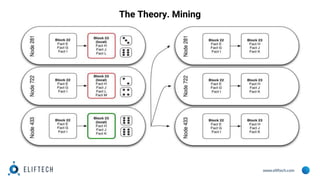
Some nodes in the chain create a new local block with pending facts. They compete to see if
their local block is going to become the next block in the chain for the entire network, by
rolling dice. If a node makes a double six, then it earns the ability to publish their local block,
and all facts in this block become confirmed. This block is sent to all other nodes in the
network. All nodes check that the block is correct, add it to their copy of the chain, and try
to build a new block with new pending facts.
www.eliftech.com
The Theory. Mining
www.eliftech.com
The Theory. Mining
But nodes don't just roll a couple dice. Blockchain challenges imply rolling a huge number of
dice. Finding the random key to validate a block is very unlikely, by design. This prevents
fraud, and makes the network safe (unless a malicious user owns more than half of the
nodes in the network). As a consequence, new blocks gets published to the chain at a fixed
time interval. In Bitcoin, blocks are published every 10 minutes on average.
In Bitcoin, the challenge involves a double SHA-256 hash of a string made of the pending
facts, the identifier of the previous block, and a random string. A node wins if their hash
contains at least n leading zeroes.
www.eliftech.com
The Theory. Money and Cryptocurrencies
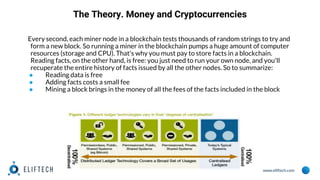
Every second, each miner node in a blockchain tests thousands of random strings to try and
form a new block. So running a miner in the blockchain pumps a huge amount of computer
resources (storage and CPU). That's why you must pay to store facts in a blockchain.
Reading facts, on the other hand, is free: you just need to run your own node, and you'll
recuperate the entire history of facts issued by all the other nodes. So to summarize:
● Reading data is free
● Adding facts costs a small fee
● Mining a block brings in the money of all the fees of the facts included in the block
www.eliftech.com
The Theory. Money and Cryptocurrencies
We're not talking about real money here. In fact, each blockchain has its own (crypto-
)currency. It's called Bitcoin (BTC) in the Bitcoin network, Ether (ETH) on the Ethereum
network, etc. To make a payment in the Bitcoin network, you must pay a small fee in
Bitcoins - just like you would pay a fee to a bank. But then, where do the first coins come
from?
www.eliftech.com
The Theory. Money and Cryptocurrencies
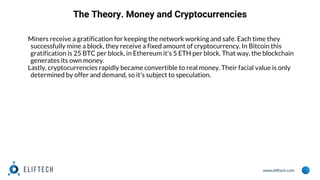
Miners receive a gratification for keeping the network working and safe. Each time they
successfully mine a block, they receive a fixed amount of cryptocurrency. In Bitcoin this
gratification is 25 BTC per block, in Ethereum it's 5 ETH per block. That way, the blockchain
generates its own money.
Lastly, cryptocurrencies rapidly became convertible to real money. Their facial value is only
determined by offer and demand, so it's subject to speculation.
www.eliftech.com
The Theory. Money and Cryptocurrencies
www.eliftech.com
The Theory. Contracts
So far we've mostly mentioned facts storage, but a blockchain can also execute programs.
Some blockchains allow each fact to contain a mini program. Such programs are replicated
together with the facts, and every node executes them when receiving the facts. In bitcoin,
this can be used to make a transaction conditional: Bob will receive 100 BTC from Alice if
and only if today is February 29th.
A contract is a promise that signing parties agree to make legally-enforceable. A smart
contract is the same, except with the word "technically-" instead of "legally-". This removes
the need for a judge, or any authority acknowledged by both parties.
www.eliftech.com
The Theory. Contract example
HOUSE RENT EXAMPLE
www.eliftech.com
Conclusion
What it does A blockchain allows to securely share and/or process data between multiple
parties over a network on non-trusted peers. Data can be anything, but most interesting
uses concern information that currently require a trusted third-party to exchange.
Examples include money (requires a bank), a proof or property (requires a lawyer), a loan
certificate, etc. In essence, the blockchain removes the need for a trusted third party.
How it works From a technical point of view, the blockchain is an innovation relying on
three concepts: peer-to-peer networks, public-key cryptography, and distributed
consensus based on the resolution of a random mathematical challenge. None of there
concepts are new. It's their combination that allows a breakthrough in computing. If you
don't understand it all, don't worry: very few people know enough to be able to develop a
blockchain on their own (which is a problem). But not understanding the blockchain doesn't
prevent you from using it, just like you can build web apps without knowing about TCP slow
start and Certificate Authorities.
www.eliftech.com
Conclusion
What it compares to See the blockchain as a database replicated as many times as there are
nodes and (loosely) synchronized, or as a supercomputer formed by the combination of the
CPUs/GPUs of all its nodes. You can use this supercomputer to store and process data, just
like you would with a remote API. Except you don't need to own the backend, and you can
be sure the data is safe and processed properly by the network.
www.eliftech.com
Links
▪ https://bitsonblocks.net/2015/09/09/a-gentle-introduction-to-blockchain-technology/
▪ https://bitcoin.org/en/how-it-works
▪ https://marmelab.com/blog/2016/05/20/blockchain-for-web-developers-in-
practice.html
▪ http://www.doc.ic.ac.uk/~ma7614/topics_website/tech.html
▪ https://geektimes.ru/post/294611/.com
▪ https://habrahabr.ru/company/microsoft/blog/342364/
▪ https://www.coindesk.com/information/what-is-blockchain-technology/
▪ https://www.brookings.edu/blog/techtank/2015/01/13/the-blockchain-what-it-is-
and-why-it-matters/
▪ http://www.businessinsider.com/what-is-blockchain-2016-10
www.eliftech.com
Thank you for reading!
Find us at eliftech.com
Have a question? Contact us:
info@eliftech.com

Blockchain. A Guide For Beginners

  • 1.
    Blockchain. A GuideFor Beginners By Dmytro Mysak, Software Developer
  • 2.
    www.eliftech.com ● What IsA Blockchain. Theory ● Ordering Facts ● Blocks ● Mining ● Money and Cryptocurrencies ● Contracts
  • 3.
    www.eliftech.com Theory Blockchain was createdto support Bitcoin, the blockchain concept can be defined regardless of the Bitcoin ecosystem. The literature usually defines a blockchain as follows: A blockchain is a ledger of facts, replicated across several computers assembled in a peer-to-peer network. Facts can be anything from monetary transactions to content signature. Members of the network are anonymous individuals called nodes. All communication inside the network takes advantage of cryptography to securely identify the sender and the receiver. When a node wants to add a fact to the ledger, a consensus forms in the network to determine where this fact should appear in the ledger; this consensus is called a block.
  • 4.
    www.eliftech.com Theory If two incompatiblefacts arrive at the same time, the system must have rules to determine which fact is considered valid. Take for instance the double spend problem: Alice has 10$, and she sends twice 10$ to Bob and Charlie. Who will have the 10$ eventually? To answer this question, the best way is to order the facts. If two incompatible facts arrive in the network, the first one to be recorded wins.
  • 5.
    www.eliftech.com Theory In a P2Pnetwork, two facts sent roughly at the same time may arrive in different orders in distant nodes. Then how can the entire network agree on the first fact? To guarantee integrity over a P2P network, you need a way to make everyone agree on the ordering of facts. You need a consensus system. Consensus algorithms for distributed systems are a very active research field. You may have heard of Paxos or Raft algorithms. The blockchain implements another algorithm, the proof-of-work consensus, using blocks.
  • 6.
    www.eliftech.com Proof-of-Work (POW) System Aproof-of-work (POW) is an economic measure to deter denial of service attacks and other service abuses such as spam on a network by requiring some work from the service requester, usually meaning processing time by a computer. A key feature of these schemes is their asymmetry: the work must be moderately hard on the requester side but easy to check for the service provider. This idea is also known as a CPU cost function, client puzzle. It is distinct from a CAPTCHA, which is intended for a human to solve quickly, rather than a computer. One popular system—used in Hashcash—uses partial hash inversions to prove that work was done, as a good-will token to send an e-mail. For instance the following header represents about 252 hash computations to send a message to calvin@comics.net on January 19, 2038: X-Hashcash: 1:52:380119:calvin@comics.net:::9B760005E92F0DAE It is verified with a single computation by checking that the SHA-1 hash of the stamp
  • 7.
  • 8.
    www.eliftech.com Back to Blockchaintheory. Blocks Blocks are a smart trick to order facts in a network of non-trusted peers. The idea is simple: facts are grouped in blocks, and there is only a single chain of blocks, replicated in the entire network. Each block references the previous one. So if fact A is in block 21, and fact B is in block 22, then fact C is considered by the entire network to be posterior to fact A. Before being added to a block, facts are pending, i.e. unconfirmed.
  • 9.
    www.eliftech.com The Theory. Mining Somenodes in the chain create a new local block with pending facts. They compete to see if their local block is going to become the next block in the chain for the entire network, by rolling dice. If a node makes a double six, then it earns the ability to publish their local block, and all facts in this block become confirmed. This block is sent to all other nodes in the network. All nodes check that the block is correct, add it to their copy of the chain, and try to build a new block with new pending facts.
  • 10.
  • 11.
    www.eliftech.com The Theory. Mining Butnodes don't just roll a couple dice. Blockchain challenges imply rolling a huge number of dice. Finding the random key to validate a block is very unlikely, by design. This prevents fraud, and makes the network safe (unless a malicious user owns more than half of the nodes in the network). As a consequence, new blocks gets published to the chain at a fixed time interval. In Bitcoin, blocks are published every 10 minutes on average. In Bitcoin, the challenge involves a double SHA-256 hash of a string made of the pending facts, the identifier of the previous block, and a random string. A node wins if their hash contains at least n leading zeroes.
  • 12.
    www.eliftech.com The Theory. Moneyand Cryptocurrencies Every second, each miner node in a blockchain tests thousands of random strings to try and form a new block. So running a miner in the blockchain pumps a huge amount of computer resources (storage and CPU). That's why you must pay to store facts in a blockchain. Reading facts, on the other hand, is free: you just need to run your own node, and you'll recuperate the entire history of facts issued by all the other nodes. So to summarize: ● Reading data is free ● Adding facts costs a small fee ● Mining a block brings in the money of all the fees of the facts included in the block
  • 13.
    www.eliftech.com The Theory. Moneyand Cryptocurrencies We're not talking about real money here. In fact, each blockchain has its own (crypto- )currency. It's called Bitcoin (BTC) in the Bitcoin network, Ether (ETH) on the Ethereum network, etc. To make a payment in the Bitcoin network, you must pay a small fee in Bitcoins - just like you would pay a fee to a bank. But then, where do the first coins come from?
  • 14.
    www.eliftech.com The Theory. Moneyand Cryptocurrencies Miners receive a gratification for keeping the network working and safe. Each time they successfully mine a block, they receive a fixed amount of cryptocurrency. In Bitcoin this gratification is 25 BTC per block, in Ethereum it's 5 ETH per block. That way, the blockchain generates its own money. Lastly, cryptocurrencies rapidly became convertible to real money. Their facial value is only determined by offer and demand, so it's subject to speculation.
  • 15.
  • 16.
    www.eliftech.com The Theory. Contracts Sofar we've mostly mentioned facts storage, but a blockchain can also execute programs. Some blockchains allow each fact to contain a mini program. Such programs are replicated together with the facts, and every node executes them when receiving the facts. In bitcoin, this can be used to make a transaction conditional: Bob will receive 100 BTC from Alice if and only if today is February 29th. A contract is a promise that signing parties agree to make legally-enforceable. A smart contract is the same, except with the word "technically-" instead of "legally-". This removes the need for a judge, or any authority acknowledged by both parties.
  • 17.
    www.eliftech.com The Theory. Contractexample HOUSE RENT EXAMPLE
  • 18.
    www.eliftech.com Conclusion What it doesA blockchain allows to securely share and/or process data between multiple parties over a network on non-trusted peers. Data can be anything, but most interesting uses concern information that currently require a trusted third-party to exchange. Examples include money (requires a bank), a proof or property (requires a lawyer), a loan certificate, etc. In essence, the blockchain removes the need for a trusted third party. How it works From a technical point of view, the blockchain is an innovation relying on three concepts: peer-to-peer networks, public-key cryptography, and distributed consensus based on the resolution of a random mathematical challenge. None of there concepts are new. It's their combination that allows a breakthrough in computing. If you don't understand it all, don't worry: very few people know enough to be able to develop a blockchain on their own (which is a problem). But not understanding the blockchain doesn't prevent you from using it, just like you can build web apps without knowing about TCP slow start and Certificate Authorities.
  • 19.
    www.eliftech.com Conclusion What it comparesto See the blockchain as a database replicated as many times as there are nodes and (loosely) synchronized, or as a supercomputer formed by the combination of the CPUs/GPUs of all its nodes. You can use this supercomputer to store and process data, just like you would with a remote API. Except you don't need to own the backend, and you can be sure the data is safe and processed properly by the network.
  • 20.
    www.eliftech.com Links ▪ https://bitsonblocks.net/2015/09/09/a-gentle-introduction-to-blockchain-technology/ ▪ https://bitcoin.org/en/how-it-works ▪https://marmelab.com/blog/2016/05/20/blockchain-for-web-developers-in- practice.html ▪ http://www.doc.ic.ac.uk/~ma7614/topics_website/tech.html ▪ https://geektimes.ru/post/294611/.com ▪ https://habrahabr.ru/company/microsoft/blog/342364/ ▪ https://www.coindesk.com/information/what-is-blockchain-technology/ ▪ https://www.brookings.edu/blog/techtank/2015/01/13/the-blockchain-what-it-is- and-why-it-matters/ ▪ http://www.businessinsider.com/what-is-blockchain-2016-10
  • 21.
    www.eliftech.com Thank you forreading! Find us at eliftech.com Have a question? Contact us: info@eliftech.com