SUBMITTED BY:-
ABHISHEK JAISWAL
C.S.E(3rd YEAR)
150203 1
OVERVIEW
 What is Blockchain?
 Structure of Blockchain
 How Blockchain works?
 Blockchain mining and Proof of work
 Main Technologies behind Blockchain
 Types of blockchain
 Blockchain use cases
 Advantages of Blockchain
 Disadvantages of Blockchain
 Tangle
 Conclusion
 References
2
3
WHAT IS BLOCKCHAIN?
 Technically, A blockchain is a distributed database that
maintains a continuously growing list of records called blocks,
which are linked and secured using crptography.
 Business-wise, the blockchain is an exchange network for
moving transactions, value, assets between peers, without
the assistance of intermediaries.
HISTORY
 The first blockchain was conceptualized by a person known
as Satoshi Nakamoto in 2008.
 Through the use of a blockchain, bitcoin became the first
digital currency to solve the double spending problem
without requiring a trusted authority where it serves as the
public ledger for all transactions on the network.
4
5
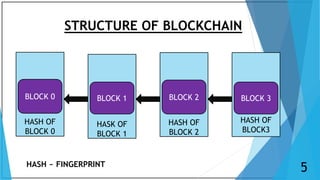
STRUCTURE OF BLOCKCHAIN
HASH OF
BLOCK 0
HASK OF
BLOCK 1
HASH OF
BLOCK 2
HASH OF
BLOCK3
BLOCK 0 BLOCK 1 BLOCK 2 BLOCK 3
HASH ~ FINGERPRINT
6
 The blockchain data structure is an ordered, back-
linked list of blocks of transactions.
 Transaction data is permanently recorded in files called
blocks.
 Every block contains data, hash (or unique key) and a
hash of the previous block.
 New transactions are constantly being processes by
miners into new blocks which are added to the end of
the chain and can never be changed or removed once
accepted by the network.
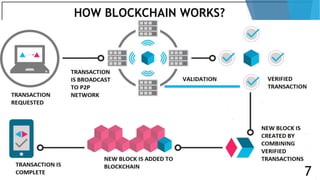
HOW BLOCKCHAIN WORKS?
7
8
 When an individual intends to send money (bitcoins) to
anyone, he sort of announces the transaction to the entire
network.
 These transactions are validated by the nodes on the
network, called miners, based on some of the math born in
cryptography.
 When a miner is successful in solving the math puzzle and
creating a new block, all the nodes in the network verify the
block and add it to their chains. Miners also get monetary
rewards for solving the puzzle
BLOCKCHAIN MINING & PROOF OF WORK
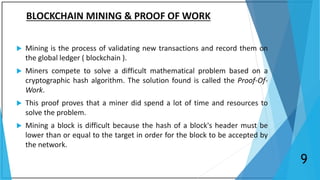
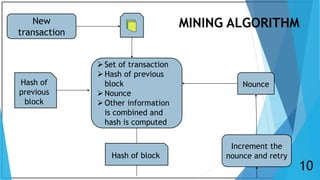
 Mining is the process of validating new transactions and record them on
the global ledger ( blockchain ).
 Miners compete to solve a difficult mathematical problem based on a
cryptographic hash algorithm. The solution found is called the Proof-Of-
Work.
 This proof proves that a miner did spend a lot of time and resources to
solve the problem.
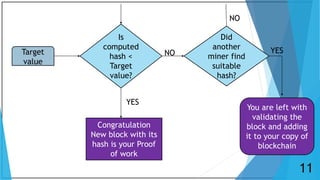
 Mining a block is difficult because the hash of a block's header must be
lower than or equal to the target in order for the block to be accepted by
the network.
9
10
New
transaction
Set of transaction
Hash of previous
block
Nounce
Other information
is combined and
hash is computed
NounceHash of
previous
block
Hash of block
Increment the
nounce and retry
MINING ALGORITHM
Is
computed
hash <
Target
value?
Target
value
Did
another
miner find
suitable
hash?
You are left with
validating the
block and adding
it to your copy of
blockchain
Congratulation
New block with its
hash is your Proof
of work
YES
NO YES
NO
11
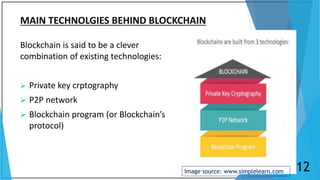
MAIN TECHNOLGIES BEHIND BLOCKCHAIN
Blockchain is said to be a clever
combination of existing technologies:
 Private key crptography
 P2P network
 Blockchain program (or Blockchain’s
protocol)
12Image source: www.simplelearn.com
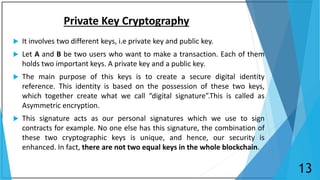
Private Key Cryptography
 It involves two different keys, i.e private key and public key.
 Let A and B be two users who want to make a transaction. Each of them
holds two important keys. A private key and a public key.
 The main purpose of this keys is to create a secure digital identity
reference. This identity is based on the possession of these two keys,
which together create what we call “digital signature”.This is called as
Asymmetric encryption.
 This signature acts as our personal signatures which we use to sign
contracts for example. No one else has this signature, the combination of
these two cryptographic keys is unique, and hence, our security is
enhanced. In fact, there are not two equal keys in the whole blockchain.
13
P2P NETWORK
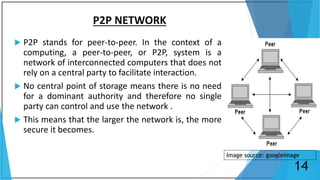
 P2P stands for peer-to-peer. In the context of a
computing, a peer-to-peer, or P2P, system is a
network of interconnected computers that does not
rely on a central party to facilitate interaction.
 No central point of storage means there is no need
for a dominant authority and therefore no single
party can control and use the network .
 This means that the larger the network is, the more
secure it becomes.
14
Image source: googleimage
BLOCKCHAIN PROGRAM (OR PROTOCOL)
Network servicing protocol:-
 A specific set of rules that nodes on the network will ensure
a block follows when validating that block and the
transactions within it.
 Blockchain is a concept and can be implemented by any
language. Solidity is the most preferred default for writing
programs in blockchain.
15
TYPES OF BLOCKCHAIN
1. PUBLIC BLOCKCHAIN
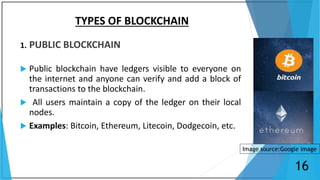
 Public blockchain have ledgers visible to everyone on
the internet and anyone can verify and add a block of
transactions to the blockchain.
 All users maintain a copy of the ledger on their local
nodes.
 Examples: Bitcoin, Ethereum, Litecoin, Dodgecoin, etc.
16
Image source:Google image
2.PRIVATE BLOCKCHAIN
 Private Blockchain allows only specific people in the
organization to verify and add transaction blocks but
everyone on the internet is generally allowed to
view.
 Transactions are faster, since they only need to be
verified by a few nodes.
 Examples: MONAX, Multichain.
17
Image source: Google image
3.CONSORTIUM BLOCKCHAIN
 Here, only group of organizations (such as banks) can
verify and add transactions but the ledger can be
open or restricted to selected groups.
 Consortium Blockchains are faster (higher scalability)
and provide more transaction privacy.
 Example: R3 (Banks), EWF (Energy), B3i
(Insurance), Corda.
18
Image source: Google image
BLOCKCHAIN USE CASES
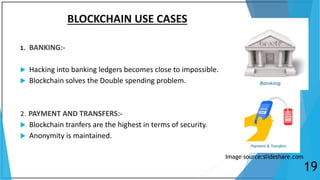
1. BANKING:-
 Hacking into banking ledgers becomes close to impossible.
 Blockchain solves the Double spending problem.
2. PAYMENT AND TRANSFERS:-
 Blockchain tranfers are the highest in terms of security.
 Anonymity is maintained.
19
Image source:slideshare.com
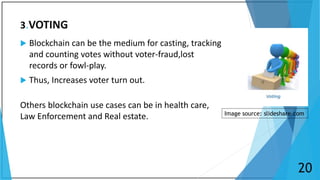
3.VOTING
 Blockchain can be the medium for casting, tracking
and counting votes without voter-fraud,lost
records or fowl-play.
 Thus, Increases voter turn out.
Others blockchain use cases can be in health care,
Law Enforcement and Real estate.
20
Image source: slideshare.com
ADVANTAGES OF BLOCKCHAIN
 Security
 Transparency
 Decentralization
 Applications in various sectors
21
HOW BLOCKCHAIN IS SECURE
 By storing financial information across a network of computers, the
task of compromising data becomes much more difficult for hackers.
 Instead of having to breach just one server, falsifying a balance or
making a fraudulent transaction on a blockchain can only be achieved
if the majority of the network is compromised.
 Being able to compromise enough servers to falsify records on the
blockchain is practically impossible, especially as hackers would need
to breach each node simultaneously.
 The high level of security afforded by distributed ledger system makes
them particularly attractive to financial institutions.
22
DISADVANTAGES OF BLOCKCHAIN
 Speed of transaction
 Large energy consumption
 Transaction is irreversible and immutable
 Blockchain concept is complex and difficult to
implement.
 Many people are currently employed in institutions that
serves as intermediaries, so there will certainly be a lot
of resistance to it.
23
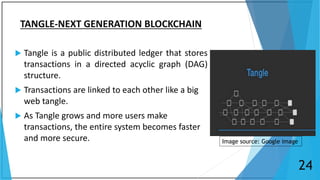
TANGLE-NEXT GENERATION BLOCKCHAIN
 Tangle is a public distributed ledger that stores
transactions in a directed acyclic graph (DAG)
structure.
 Transactions are linked to each other like a big
web tangle.
 As Tangle grows and more users make
transactions, the entire system becomes faster
and more secure.
24
Image source: Google image
DIFFERENCE
BLOCKCHAIN
 It requires miners to validate
the transactions.
 Miners take some rewards or
transaction fees for mining.
 Speed of transaction is slow.
TANGLE
 It does not require miners.
 There is no transaction fees in
it.
 Speed of transaction is more
than blockchain.
25
CONCLUSION
 There seems to be a great potential in Blockchain that it
can make a big change in life.
 Since it is not well known, nor a mature thing yet,
everyone is trying to see what can be done with it.
 Blockchain will be a big revolution in the field of
technology if it can able to handle some of its demerits.
26
REFERENCES
 https://en.wikipedia.org/wiki/Blockchain
 https://www.investopedia.com/terms/b/blockchain
 https://www.slideshare.net/Ferdinando1970/20161110
-rome-icc-intro-to-blockchain
 https://www.coindesk.com/information/applications-
use-cases-blockchains
27
28

Abhishek jaiswal blockchain

  • 1.
  • 2.
    OVERVIEW  What isBlockchain?  Structure of Blockchain  How Blockchain works?  Blockchain mining and Proof of work  Main Technologies behind Blockchain  Types of blockchain  Blockchain use cases  Advantages of Blockchain  Disadvantages of Blockchain  Tangle  Conclusion  References 2
  • 3.
    3 WHAT IS BLOCKCHAIN? Technically, A blockchain is a distributed database that maintains a continuously growing list of records called blocks, which are linked and secured using crptography.  Business-wise, the blockchain is an exchange network for moving transactions, value, assets between peers, without the assistance of intermediaries.
  • 4.
    HISTORY  The firstblockchain was conceptualized by a person known as Satoshi Nakamoto in 2008.  Through the use of a blockchain, bitcoin became the first digital currency to solve the double spending problem without requiring a trusted authority where it serves as the public ledger for all transactions on the network. 4
  • 5.
    5 STRUCTURE OF BLOCKCHAIN HASHOF BLOCK 0 HASK OF BLOCK 1 HASH OF BLOCK 2 HASH OF BLOCK3 BLOCK 0 BLOCK 1 BLOCK 2 BLOCK 3 HASH ~ FINGERPRINT
  • 6.
    6  The blockchaindata structure is an ordered, back- linked list of blocks of transactions.  Transaction data is permanently recorded in files called blocks.  Every block contains data, hash (or unique key) and a hash of the previous block.  New transactions are constantly being processes by miners into new blocks which are added to the end of the chain and can never be changed or removed once accepted by the network.
  • 7.
  • 8.
    8  When anindividual intends to send money (bitcoins) to anyone, he sort of announces the transaction to the entire network.  These transactions are validated by the nodes on the network, called miners, based on some of the math born in cryptography.  When a miner is successful in solving the math puzzle and creating a new block, all the nodes in the network verify the block and add it to their chains. Miners also get monetary rewards for solving the puzzle
  • 9.
    BLOCKCHAIN MINING &PROOF OF WORK  Mining is the process of validating new transactions and record them on the global ledger ( blockchain ).  Miners compete to solve a difficult mathematical problem based on a cryptographic hash algorithm. The solution found is called the Proof-Of- Work.  This proof proves that a miner did spend a lot of time and resources to solve the problem.  Mining a block is difficult because the hash of a block's header must be lower than or equal to the target in order for the block to be accepted by the network. 9
  • 10.
    10 New transaction Set of transaction Hashof previous block Nounce Other information is combined and hash is computed NounceHash of previous block Hash of block Increment the nounce and retry MINING ALGORITHM
  • 11.
    Is computed hash < Target value? Target value Did another miner find suitable hash? Youare left with validating the block and adding it to your copy of blockchain Congratulation New block with its hash is your Proof of work YES NO YES NO 11
  • 12.
    MAIN TECHNOLGIES BEHINDBLOCKCHAIN Blockchain is said to be a clever combination of existing technologies:  Private key crptography  P2P network  Blockchain program (or Blockchain’s protocol) 12Image source: www.simplelearn.com
  • 13.
    Private Key Cryptography It involves two different keys, i.e private key and public key.  Let A and B be two users who want to make a transaction. Each of them holds two important keys. A private key and a public key.  The main purpose of this keys is to create a secure digital identity reference. This identity is based on the possession of these two keys, which together create what we call “digital signature”.This is called as Asymmetric encryption.  This signature acts as our personal signatures which we use to sign contracts for example. No one else has this signature, the combination of these two cryptographic keys is unique, and hence, our security is enhanced. In fact, there are not two equal keys in the whole blockchain. 13
  • 14.
    P2P NETWORK  P2Pstands for peer-to-peer. In the context of a computing, a peer-to-peer, or P2P, system is a network of interconnected computers that does not rely on a central party to facilitate interaction.  No central point of storage means there is no need for a dominant authority and therefore no single party can control and use the network .  This means that the larger the network is, the more secure it becomes. 14 Image source: googleimage
  • 15.
    BLOCKCHAIN PROGRAM (ORPROTOCOL) Network servicing protocol:-  A specific set of rules that nodes on the network will ensure a block follows when validating that block and the transactions within it.  Blockchain is a concept and can be implemented by any language. Solidity is the most preferred default for writing programs in blockchain. 15
  • 16.
    TYPES OF BLOCKCHAIN 1.PUBLIC BLOCKCHAIN  Public blockchain have ledgers visible to everyone on the internet and anyone can verify and add a block of transactions to the blockchain.  All users maintain a copy of the ledger on their local nodes.  Examples: Bitcoin, Ethereum, Litecoin, Dodgecoin, etc. 16 Image source:Google image
  • 17.
    2.PRIVATE BLOCKCHAIN  PrivateBlockchain allows only specific people in the organization to verify and add transaction blocks but everyone on the internet is generally allowed to view.  Transactions are faster, since they only need to be verified by a few nodes.  Examples: MONAX, Multichain. 17 Image source: Google image
  • 18.
    3.CONSORTIUM BLOCKCHAIN  Here,only group of organizations (such as banks) can verify and add transactions but the ledger can be open or restricted to selected groups.  Consortium Blockchains are faster (higher scalability) and provide more transaction privacy.  Example: R3 (Banks), EWF (Energy), B3i (Insurance), Corda. 18 Image source: Google image
  • 19.
    BLOCKCHAIN USE CASES 1.BANKING:-  Hacking into banking ledgers becomes close to impossible.  Blockchain solves the Double spending problem. 2. PAYMENT AND TRANSFERS:-  Blockchain tranfers are the highest in terms of security.  Anonymity is maintained. 19 Image source:slideshare.com
  • 20.
    3.VOTING  Blockchain canbe the medium for casting, tracking and counting votes without voter-fraud,lost records or fowl-play.  Thus, Increases voter turn out. Others blockchain use cases can be in health care, Law Enforcement and Real estate. 20 Image source: slideshare.com
  • 21.
    ADVANTAGES OF BLOCKCHAIN Security  Transparency  Decentralization  Applications in various sectors 21
  • 22.
    HOW BLOCKCHAIN ISSECURE  By storing financial information across a network of computers, the task of compromising data becomes much more difficult for hackers.  Instead of having to breach just one server, falsifying a balance or making a fraudulent transaction on a blockchain can only be achieved if the majority of the network is compromised.  Being able to compromise enough servers to falsify records on the blockchain is practically impossible, especially as hackers would need to breach each node simultaneously.  The high level of security afforded by distributed ledger system makes them particularly attractive to financial institutions. 22
  • 23.
    DISADVANTAGES OF BLOCKCHAIN Speed of transaction  Large energy consumption  Transaction is irreversible and immutable  Blockchain concept is complex and difficult to implement.  Many people are currently employed in institutions that serves as intermediaries, so there will certainly be a lot of resistance to it. 23
  • 24.
    TANGLE-NEXT GENERATION BLOCKCHAIN Tangle is a public distributed ledger that stores transactions in a directed acyclic graph (DAG) structure.  Transactions are linked to each other like a big web tangle.  As Tangle grows and more users make transactions, the entire system becomes faster and more secure. 24 Image source: Google image
  • 25.
    DIFFERENCE BLOCKCHAIN  It requiresminers to validate the transactions.  Miners take some rewards or transaction fees for mining.  Speed of transaction is slow. TANGLE  It does not require miners.  There is no transaction fees in it.  Speed of transaction is more than blockchain. 25
  • 26.
    CONCLUSION  There seemsto be a great potential in Blockchain that it can make a big change in life.  Since it is not well known, nor a mature thing yet, everyone is trying to see what can be done with it.  Blockchain will be a big revolution in the field of technology if it can able to handle some of its demerits. 26
  • 27.
    REFERENCES  https://en.wikipedia.org/wiki/Blockchain  https://www.investopedia.com/terms/b/blockchain https://www.slideshare.net/Ferdinando1970/20161110 -rome-icc-intro-to-blockchain  https://www.coindesk.com/information/applications- use-cases-blockchains 27
  • 28.