Network Security
Elect. Codebook, Cipher Block Chaining
1
Objectives of the
Topic
• After completing this
topic, a student will
be able to
– describe electronic
codebook and
cipher block
modes.
Elect. Codebook, Cipher Block Chaining
2
Figures and material
in this topic have
been
• adapted from
“Network Security
Essentials:
Applications and
Standards”, 2014, by
William Stallings.
Elect. Codebook, Cipher Block Chaining
3
• A symmetric block
cipher processes one
block of data at a
time.
• Block length is 64 bits
for DES and 3DES
• For AES, the block
length is 128 bits.
Elect. Codebook, Cipher Block Chaining
4
• If the amount of
plaintext is greater
than b-bits, then we
can break the
plaintext up into b-bit
blocks.
• When multiple blocks
of plaintext are
encrypted using the
same key, a number of
security issues arise.
Elect. Codebook, Cipher Block Chaining
5
• Five modes of
operation have been
defined by NIST
(SP(Special
Publication) 800- 38A)
so that a block cipher
can be applied in a
variety of
applications.
Elect. Codebook, Cipher Block Chaining
6
• A mode of operation
is a technique for
enhancing the effect
of a cryptographic
algorithm or adapting
the algorithm for an
application, such as
applying a block
cipher to a sequence
of data blocks or a
data stream.
Elect. Codebook, Cipher Block Chaining
7
• Electronic Codebook
Mode (ECB)
• Cipher Block Chaining
Mode (CBC)
• Cipher Feedback
Mode (CFB)
• Output Feedback
(OFB)
• Counter Mode (CTR)
Elect. Codebook, Cipher Block Chaining
8
Electronic Codebook
Mode:
• Simplest mode
• Plaintext is handled b
bits at a time and
each block of plaintext
is encrypted using the
same key.
Elect. Codebook, Cipher Block Chaining
9
• The term codebook is
used because, for a
given key, there is a
unique ciphertext for
every b-bit block of
plaintext.
Elect. Codebook, Cipher Block Chaining
10
• We can imagine a
gigantic codebook in
which there is an
entry for every
possible b-bit
plaintext pattern
showing its
corresponding
ciphertext.
Elect. Codebook, Cipher Block Chaining
11
Elect. Codebook, Cipher Block Chaining
12
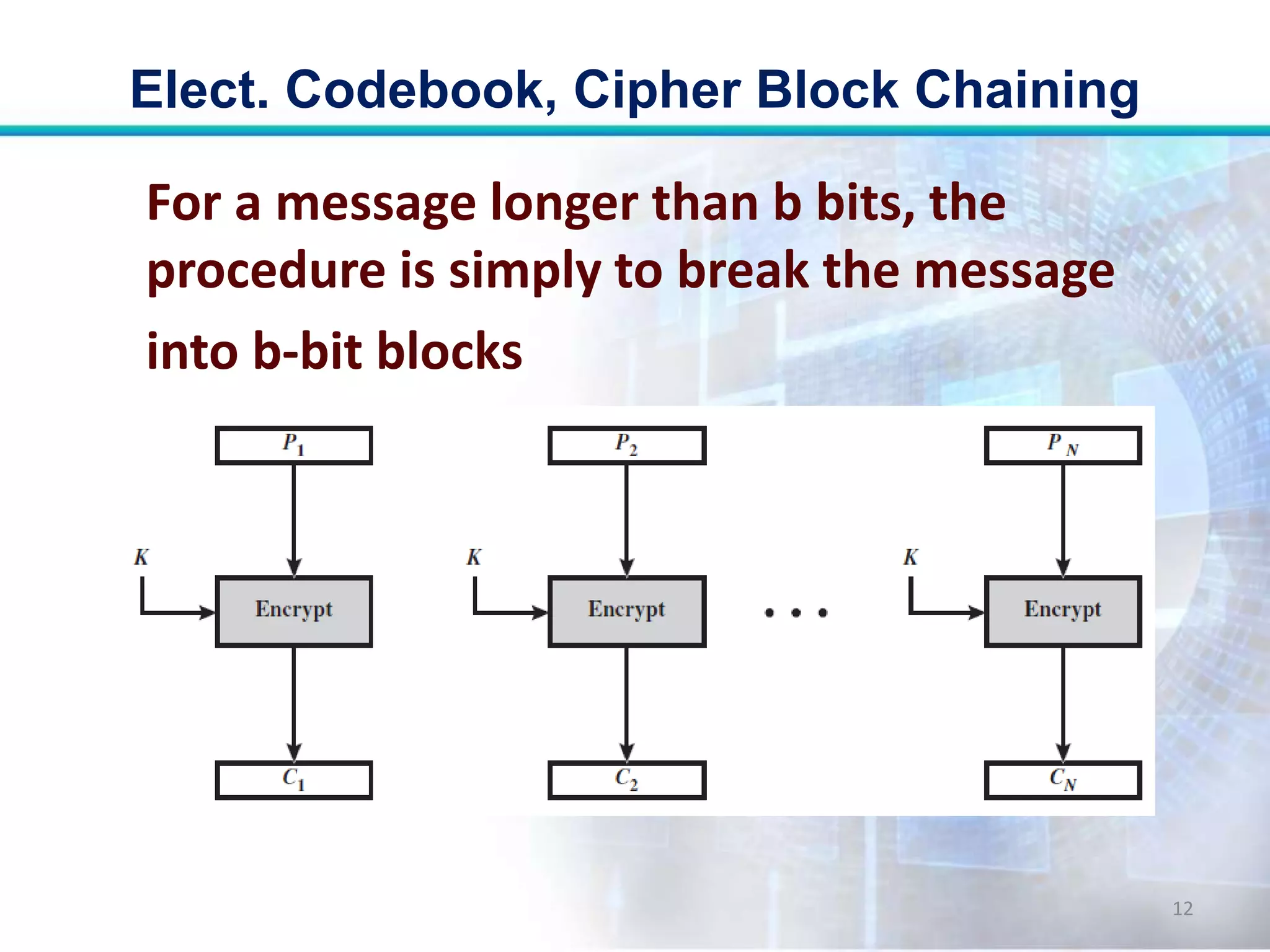
For a message longer than b bits, the
procedure is simply to break the message
into b-bit blocks
• With ECB, if the same
b-bit block of plaintext
appears more than
once in the message,
it always produces the
same ciphertext.
• Because of this, for
lengthy messages, the
ECB mode may not be
secure.
Elect. Codebook, Cipher Block Chaining
13
• If the message has
repetitive elements
with a period of
repetition a multiple of
b-bits, these elements
can be identified.
• We want to produce
different ciphertext
blocks for the same
plaintext block if
repeated .
Elect. Codebook, Cipher Block Chaining
14
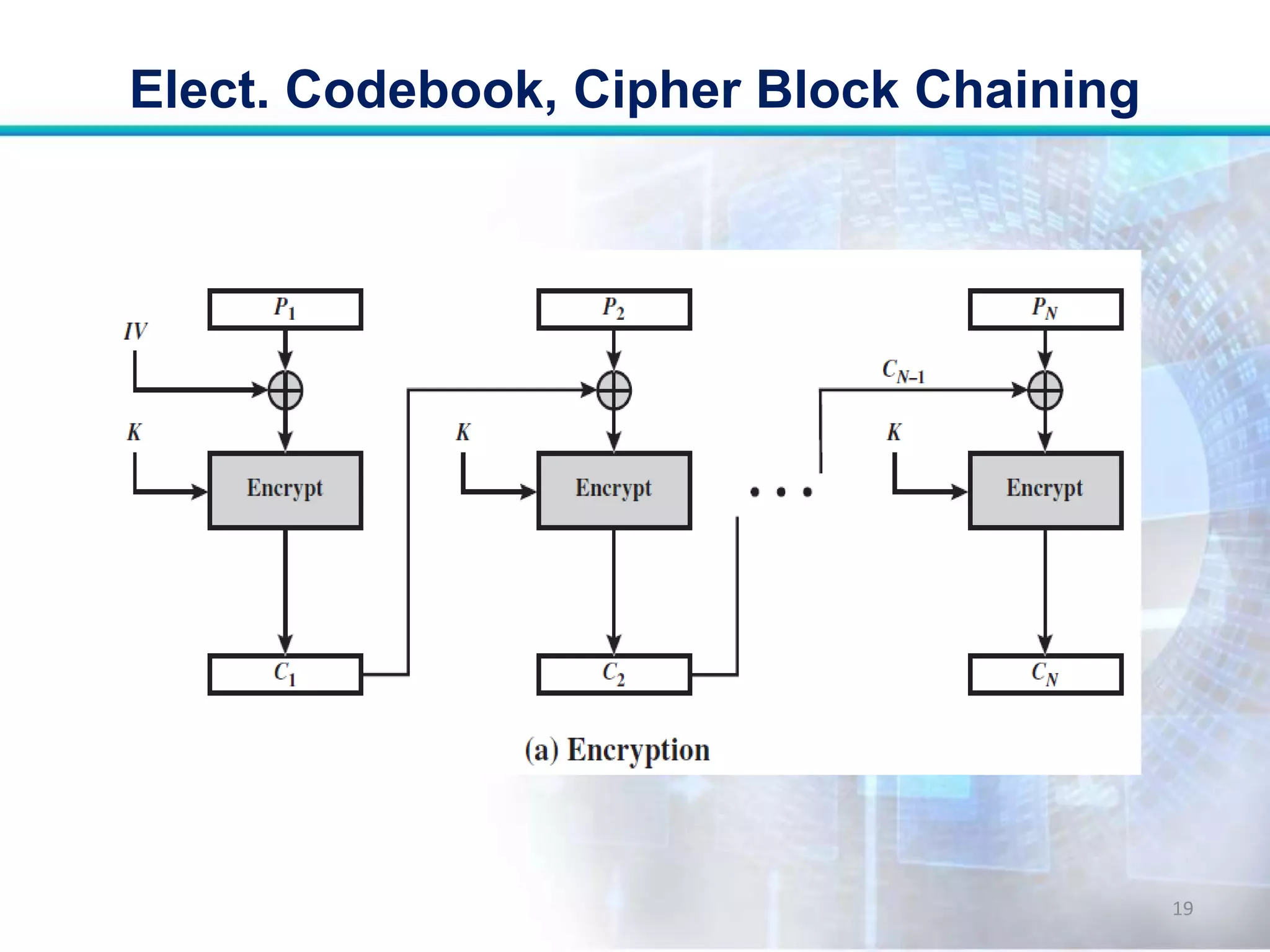
Cipher Block
Chaining Mode:
• The input to the
encryption algorithm
is the XOR of the
current plaintext block
and the preceding
ciphertext block.
• The same key is used
for each block.
Elect. Codebook, Cipher Block Chaining
15
• In effect, we have
chained together the
processing of the
sequence of plaintext
blocks.
Elect. Codebook, Cipher Block Chaining
16
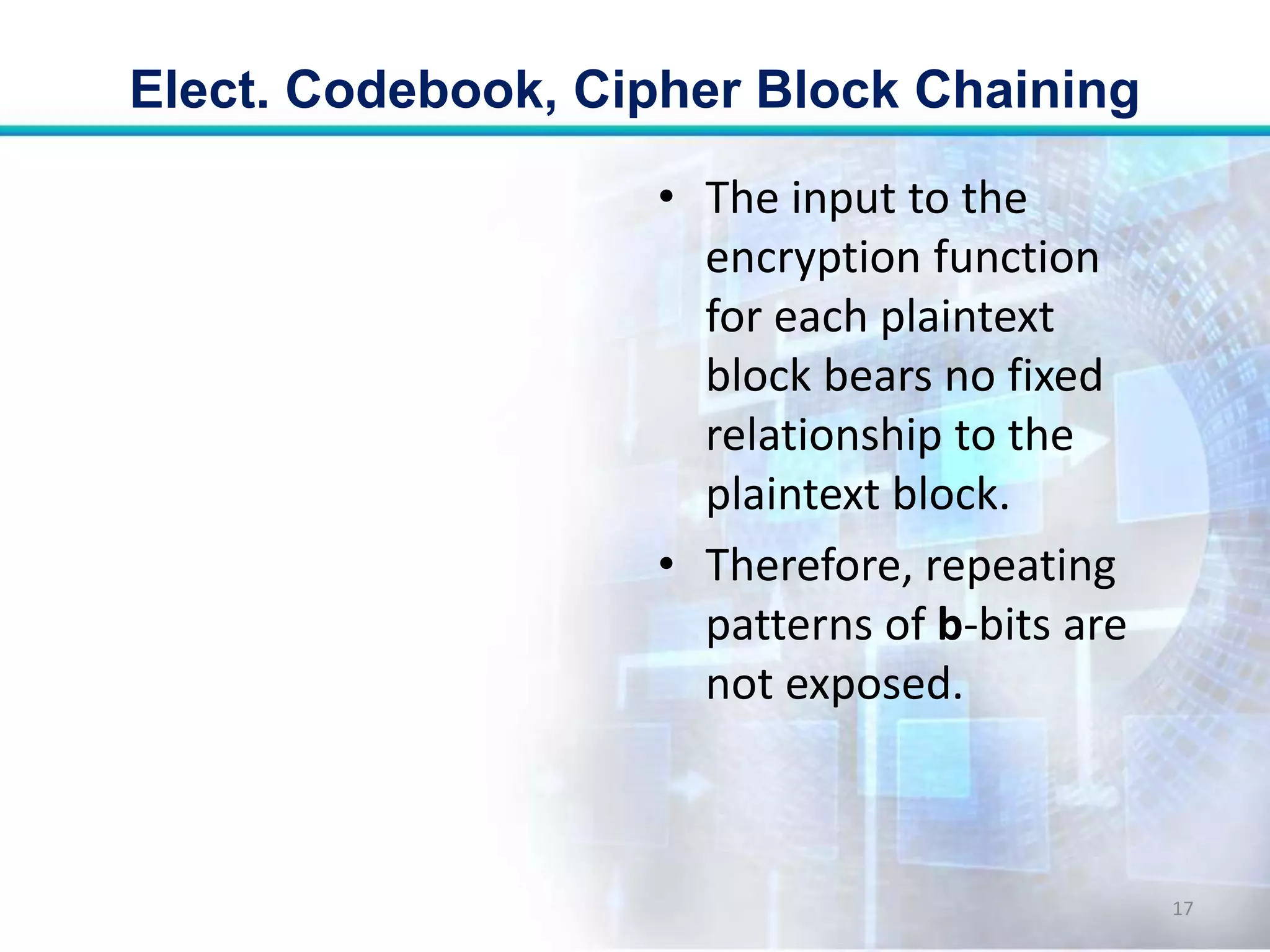
• The input to the
encryption function
for each plaintext
block bears no fixed
relationship to the
plaintext block.
• Therefore, repeating
patterns of b-bits are
not exposed.
Elect. Codebook, Cipher Block Chaining
17
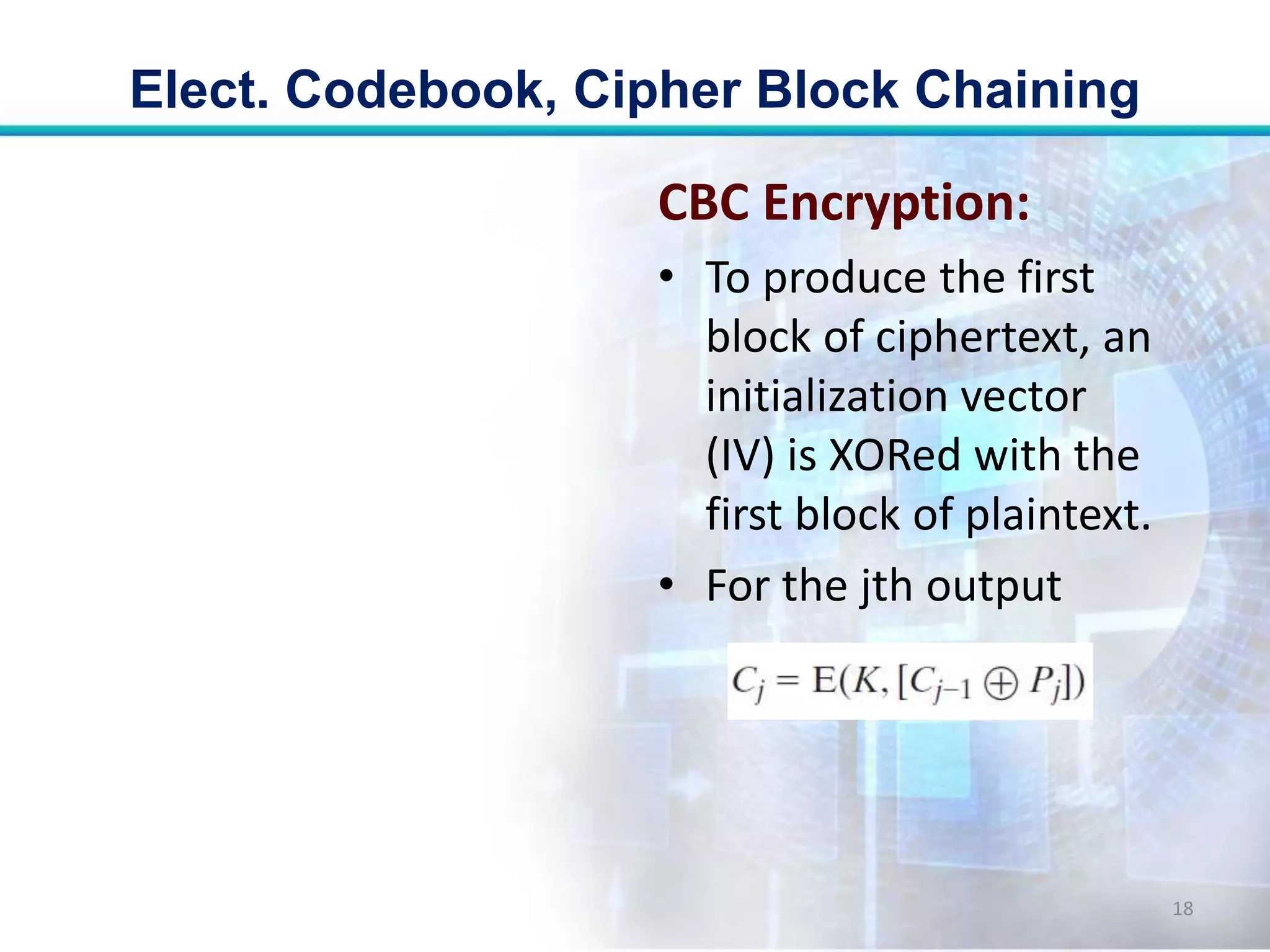
CBC Encryption:
• To produce the first
block of ciphertext, an
initialization vector
(IV) is XORed with the
first block of plaintext.
• For the jth output
Elect. Codebook, Cipher Block Chaining
18
Elect. Codebook, Cipher Block Chaining
19
• The IV must be known
to both the sender
and receiver but be
unpredictable by a
third party.
Elect. Codebook, Cipher Block Chaining
20
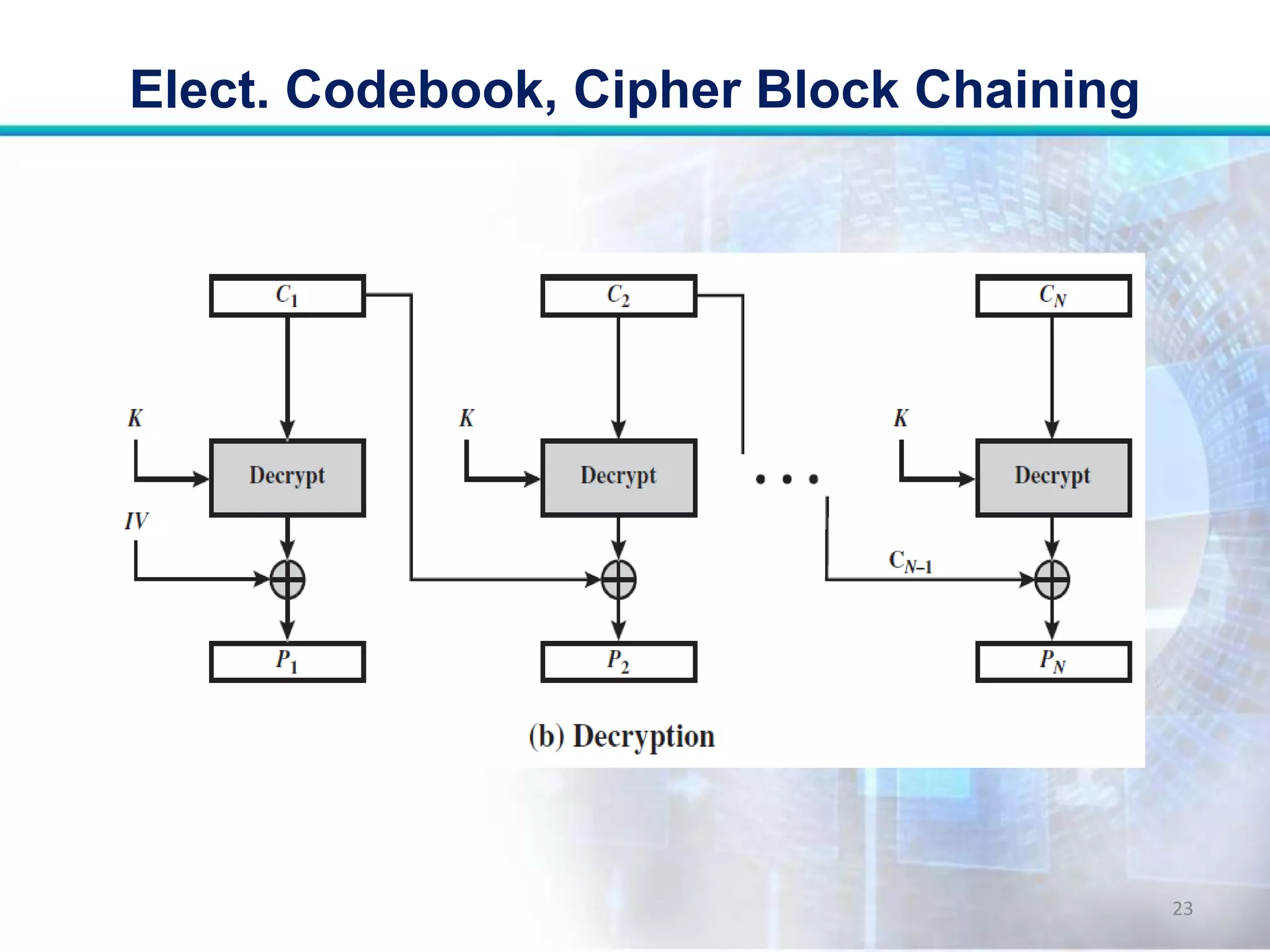
CBC Decryption:
• For decryption, each
cipher block is passed
through the
decryption algorithm.
• The result is XORed
with the preceding
ciphertext block to
produce the plaintext
block.
Elect. Codebook, Cipher Block Chaining
21
• On decryption, the IV
is XORed with the
output of the
decryption algorithm
to recover the first
block of plaintext.
Elect. Codebook, Cipher Block Chaining
22
Elect. Codebook, Cipher Block Chaining
23
• Because of the
chaining mechanism
of CBC, it is an
appropriate mode for
encrypting messages
of length greater than
b-bits.
Elect. Codebook, Cipher Block Chaining
24
End

Topic21 Elect. Codebook, Cipher Block Chaining.pptx

  • 1.
    Network Security Elect. Codebook,Cipher Block Chaining 1
  • 2.
    Objectives of the Topic •After completing this topic, a student will be able to – describe electronic codebook and cipher block modes. Elect. Codebook, Cipher Block Chaining 2
  • 3.
    Figures and material inthis topic have been • adapted from “Network Security Essentials: Applications and Standards”, 2014, by William Stallings. Elect. Codebook, Cipher Block Chaining 3
  • 4.
    • A symmetricblock cipher processes one block of data at a time. • Block length is 64 bits for DES and 3DES • For AES, the block length is 128 bits. Elect. Codebook, Cipher Block Chaining 4
  • 5.
    • If theamount of plaintext is greater than b-bits, then we can break the plaintext up into b-bit blocks. • When multiple blocks of plaintext are encrypted using the same key, a number of security issues arise. Elect. Codebook, Cipher Block Chaining 5
  • 6.
    • Five modesof operation have been defined by NIST (SP(Special Publication) 800- 38A) so that a block cipher can be applied in a variety of applications. Elect. Codebook, Cipher Block Chaining 6
  • 7.
    • A modeof operation is a technique for enhancing the effect of a cryptographic algorithm or adapting the algorithm for an application, such as applying a block cipher to a sequence of data blocks or a data stream. Elect. Codebook, Cipher Block Chaining 7
  • 8.
    • Electronic Codebook Mode(ECB) • Cipher Block Chaining Mode (CBC) • Cipher Feedback Mode (CFB) • Output Feedback (OFB) • Counter Mode (CTR) Elect. Codebook, Cipher Block Chaining 8
  • 9.
    Electronic Codebook Mode: • Simplestmode • Plaintext is handled b bits at a time and each block of plaintext is encrypted using the same key. Elect. Codebook, Cipher Block Chaining 9
  • 10.
    • The termcodebook is used because, for a given key, there is a unique ciphertext for every b-bit block of plaintext. Elect. Codebook, Cipher Block Chaining 10
  • 11.
    • We canimagine a gigantic codebook in which there is an entry for every possible b-bit plaintext pattern showing its corresponding ciphertext. Elect. Codebook, Cipher Block Chaining 11
  • 12.
    Elect. Codebook, CipherBlock Chaining 12 For a message longer than b bits, the procedure is simply to break the message into b-bit blocks
  • 13.
    • With ECB,if the same b-bit block of plaintext appears more than once in the message, it always produces the same ciphertext. • Because of this, for lengthy messages, the ECB mode may not be secure. Elect. Codebook, Cipher Block Chaining 13
  • 14.
    • If themessage has repetitive elements with a period of repetition a multiple of b-bits, these elements can be identified. • We want to produce different ciphertext blocks for the same plaintext block if repeated . Elect. Codebook, Cipher Block Chaining 14
  • 15.
    Cipher Block Chaining Mode: •The input to the encryption algorithm is the XOR of the current plaintext block and the preceding ciphertext block. • The same key is used for each block. Elect. Codebook, Cipher Block Chaining 15
  • 16.
    • In effect,we have chained together the processing of the sequence of plaintext blocks. Elect. Codebook, Cipher Block Chaining 16
  • 17.
    • The inputto the encryption function for each plaintext block bears no fixed relationship to the plaintext block. • Therefore, repeating patterns of b-bits are not exposed. Elect. Codebook, Cipher Block Chaining 17
  • 18.
    CBC Encryption: • Toproduce the first block of ciphertext, an initialization vector (IV) is XORed with the first block of plaintext. • For the jth output Elect. Codebook, Cipher Block Chaining 18
  • 19.
    Elect. Codebook, CipherBlock Chaining 19
  • 20.
    • The IVmust be known to both the sender and receiver but be unpredictable by a third party. Elect. Codebook, Cipher Block Chaining 20
  • 21.
    CBC Decryption: • Fordecryption, each cipher block is passed through the decryption algorithm. • The result is XORed with the preceding ciphertext block to produce the plaintext block. Elect. Codebook, Cipher Block Chaining 21
  • 22.
    • On decryption,the IV is XORed with the output of the decryption algorithm to recover the first block of plaintext. Elect. Codebook, Cipher Block Chaining 22
  • 23.
    Elect. Codebook, CipherBlock Chaining 23
  • 24.
    • Because ofthe chaining mechanism of CBC, it is an appropriate mode for encrypting messages of length greater than b-bits. Elect. Codebook, Cipher Block Chaining 24 End