BLIND SEPARATION OF
     IMAGE SOURCES VIA
          ADAPTIVE
    DICTIONARY LEARNING


PROJECT GUIDE         SUBMITTED BY
 Mr.R.Devaraj B.E.,    D.Mohan raj
                       D.Raja
                       A.Thangapandi
AREA OF PROJECT

• Digital Image Processing
SOFTWARE REQUIRED

• MATLAB 7.14
ABSTRACT

• we address this problem and attempt to give a
  solution via fusing the dictionary learning into the
  source separation
• We first define a cost function based on this idea and
  propose an extension of the denoising method in the
  work of Elad and Aharon to minimize it
INTRODUCTION

• A local dictionary is adaptively learned for each
  source along with separation.
• To improve the quality of source separation even in
  noisy situations
EXISTING SYSTEM

• SMICA (spectral matching Independent Component
  Analysis)
• PCA (Principal Component Analysis)
• MMCA(Multichannel Morphological Component
  Analysis)
DRAWBACKS

• to learn a specific dictionary for each source
  from a set of exemplar images
• no prior knowledge about the underlying
  sparsity domain of the sources
PROPOSED SYSTEM

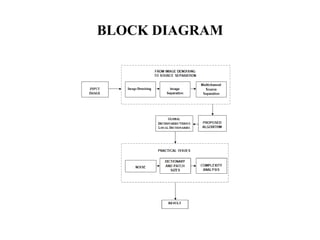
• To adaptively learn the dictionaries from the mixed
  images within the source separation process
• Hierarchical scheme such as the one in MMCA.
                   ADVANTAGES
• enhances the separability of the sources.
BLOCK DIAGRAM
FUTURE ENHANCEMENT

• we further reduce the time complexity by choose the
  different size of the patches

Blind sepreration

  • 1.
    BLIND SEPARATION OF IMAGE SOURCES VIA ADAPTIVE DICTIONARY LEARNING PROJECT GUIDE SUBMITTED BY Mr.R.Devaraj B.E., D.Mohan raj D.Raja A.Thangapandi
  • 2.
    AREA OF PROJECT •Digital Image Processing
  • 3.
  • 4.
    ABSTRACT • we addressthis problem and attempt to give a solution via fusing the dictionary learning into the source separation • We first define a cost function based on this idea and propose an extension of the denoising method in the work of Elad and Aharon to minimize it
  • 5.
    INTRODUCTION • A localdictionary is adaptively learned for each source along with separation. • To improve the quality of source separation even in noisy situations
  • 6.
    EXISTING SYSTEM • SMICA(spectral matching Independent Component Analysis) • PCA (Principal Component Analysis) • MMCA(Multichannel Morphological Component Analysis)
  • 7.
    DRAWBACKS • to learna specific dictionary for each source from a set of exemplar images • no prior knowledge about the underlying sparsity domain of the sources
  • 8.
    PROPOSED SYSTEM • Toadaptively learn the dictionaries from the mixed images within the source separation process • Hierarchical scheme such as the one in MMCA. ADVANTAGES • enhances the separability of the sources.
  • 9.
  • 10.
    FUTURE ENHANCEMENT • wefurther reduce the time complexity by choose the different size of the patches