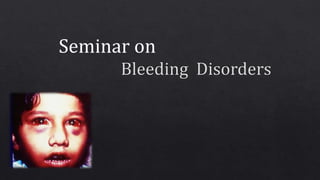
Seminar on
Findings Disorders of
Platelet
Disorders of
Coagulation
i) Petechiae
ii) Superficial
ecchymosis
iii) Deep dissecting
hematomas
iv) Haemarthrosis
v) Bleeding from the
superficial cuts &
scratches.
vi) Positive family
history
vii) Bleeding from
mucous membrane
Characteristic
Characteristic,
usually small &
multiple
Rare
Rare
Persistent often
profuse
Rare
Prominent
Rare
Common, usually
large & solitary
Characteristic
Characteristic
Minimal
Common
May occur
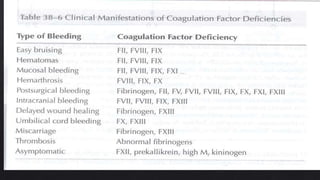
Table 118–2. Clinical Manifestations Typically Associated with Specific Hemostatic Disorders
Clinical Manifestations Hemostatic Disorders
Mucocutaneous bleeding Thrombocytopenias, platelet dysfunction, von Willebrand disease
Cephalhematomas in newborns, hemarthroses,
hematuria, and intramuscular, intracerebral, and
retroperitoneal hemorrhages
Severe hemophilias A and B, severe deficiencies of factor VII, X, or
XIII, severe type 3 von Willebrand disease, afibrinogenemia
Injury-related bleeding and mild spontaneous
bleeding
Mild and moderate hemophilias A and B, severe factor XI deficiency,
moderate deficiencies of fibrinogen and factors II, V, VII, or X,
combined factors V and VIII deficiency, 2-antiplasmin deficiency
Table 118–2. Clinical Manifestations Typically Associated with Specific Hemostatic Disorders
Bleeding from stump of umbilical cord and
habitual abortions
Afibrinogenemia, hypofibrinogenemia, dysfibrinogenemia,
factor XIII deficiency
Impaired wound healing Factor XIII deficiency
Facial purpura in newborns Glanzmann thrombasthenia, severe thrombocytopenia
Recurrent severe epistaxis and chronic iron
deficiency anemia
Hereditary hemorrhagic telangiectasias
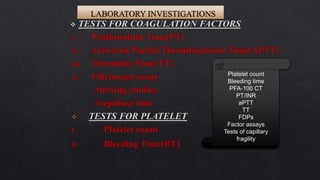
Platelet count
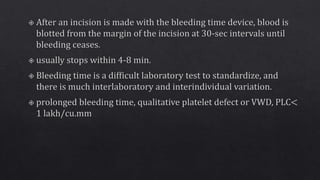
Bleeding time
PFA-100 CT
PT/INR
aPTT
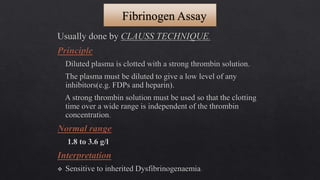
TT
FDPs
Factor assays
Tests of capillary
fragility
Hemorrhagic
stroke
Surgical/traumati
c hemorrhage
etc. may occur.
23
24

Bleeding child approach

  • 1.
  • 5.
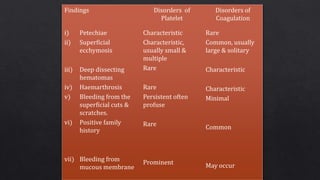
    Findings Disorders of Platelet Disordersof Coagulation i) Petechiae ii) Superficial ecchymosis iii) Deep dissecting hematomas iv) Haemarthrosis v) Bleeding from the superficial cuts & scratches. vi) Positive family history vii) Bleeding from mucous membrane Characteristic Characteristic, usually small & multiple Rare Rare Persistent often profuse Rare Prominent Rare Common, usually large & solitary Characteristic Characteristic Minimal Common May occur
  • 7.
    Table 118–2. ClinicalManifestations Typically Associated with Specific Hemostatic Disorders Clinical Manifestations Hemostatic Disorders Mucocutaneous bleeding Thrombocytopenias, platelet dysfunction, von Willebrand disease Cephalhematomas in newborns, hemarthroses, hematuria, and intramuscular, intracerebral, and retroperitoneal hemorrhages Severe hemophilias A and B, severe deficiencies of factor VII, X, or XIII, severe type 3 von Willebrand disease, afibrinogenemia Injury-related bleeding and mild spontaneous bleeding Mild and moderate hemophilias A and B, severe factor XI deficiency, moderate deficiencies of fibrinogen and factors II, V, VII, or X, combined factors V and VIII deficiency, 2-antiplasmin deficiency
  • 8.
    Table 118–2. ClinicalManifestations Typically Associated with Specific Hemostatic Disorders Bleeding from stump of umbilical cord and habitual abortions Afibrinogenemia, hypofibrinogenemia, dysfibrinogenemia, factor XIII deficiency Impaired wound healing Factor XIII deficiency Facial purpura in newborns Glanzmann thrombasthenia, severe thrombocytopenia Recurrent severe epistaxis and chronic iron deficiency anemia Hereditary hemorrhagic telangiectasias
  • 10.
    Platelet count Bleeding time PFA-100CT PT/INR aPTT TT FDPs Factor assays Tests of capillary fragility
  • 19.
  • 23.
  • 24.

Editor's Notes

  • #3 1.Clinical evaluation: History Clinical features. 2.Laboratory approach: First line screening tests. Second line specific tests.
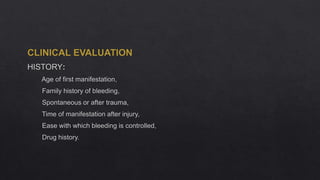
  • #4  HISTORY The history should determine; The site or sites of bleeding,the severity and duration of hemorrhage, and the age at onset. Was the bleeding spontaneous, or did it occur after trauma? Was there a previous personal or family history of similar problems? If a child or adolescent has had surgery that affects the mucosal surfaces, such as a tonsillectomy or major dental extractions, the absence of bleeding usually rules out a hereditary bleeding disorder
  • #5 1. Patients vary in their responses to hemorrhagic symptoms. Therefore, some experts believe the question "Do you bruise easily?" is virtually worthless. Women more likely respond that they have excessive bleeding or bruising than do men 2. Unprovoked hemarthroses and muscle hemorrhages suggest one of the hemophilias. mucocutaneous bleeding (epistaxis, gingival bleeding, menorrhagia) are more characteristic of patients with qualitative platelet disorders, thrombocytopenia, or von Willebrand disease. 3. Assessing the extent of hemorrhage against the background of any trauma or provocation that may have elicited the hemorrhage is important. If a patient has never had a significant hemostatic challenge (such as tooth extraction, surgery, trauma, or childbirth), the lack of a significant bleeding history is much less valuable in excluding a mild hemorrhagic disorder 4. Obtaining objective confirmation of the subjective information conveyed in the bleeding history is valuable. Objective data include (a) previous hospital or physician visits for bleeding symptoms, (b) results of previous laboratory evaluations, (c) previous transfusions of blood products for bleeding episodes, and (d) a history of anemia and/or previous treatment with iron. 5. A medication history esp. non-prescription drugs. A medication history is especially important in patients with thrombocytopenia, because drug-induced thrombocytopenia is common. Medication also may affect hemostasis through deleterious effects on the liver or kidney functions. Herbal and alternative medicines poses particular problems, because patients may not readily share information about the drug and the dose they are taking of any particular active ingredient may be difficult to determine. Ginkgo biloba and ginseng are the most commonly used herbals that can cause platelet dysfunction and induce bleeding. Other dietary supplements. 6. A nutrition history should be obtained to assess the likelihood of (a) vitamin K deficiency, especially if the patient also is taking broad-spectrum antibiotics, (b) vitamin C deficiency, especially if the patient has skin bleeding consistent with scurvy (perifollicular purpura), and (c) general malnutrition and/or malabsorption. 7. Several tissues have an increased local fibrinolytic activity. urinary tract, endometrium, and mucous membranes of the nose and oral cavity. These sites are particularly likely to have prolonged oozing of blood after trauma in patients with hemostatic abnormalities. Excessive bleeding following tooth extraction is one of the most common manifestations. 8. Bleeding isolated to a single organ or system (e.g., hematuria, hematemesis, melena, hemoptysis) is less likely to result from a hemostatic abnormality than from a local cause such as neoplasm, ulcer, or angiodysplasia. Thus, careful anatomic evaluation of the involved organ or system should be performed. 9. Bleeding may result from blood vessel disorders such as hereditary hemorrhagic telangiectasias, Cushing disease, scurvy, or Ehlers-Danlos syndrome. Many primary dermatologic disorders also have a purpuric or hemorrhagic component and must also be considered in the differential diagnosis. 10. A family history is particularly important when hereditary disorders are considered. consanguinity, genealogic tree, extending back at least two generations for genetic disorders. A sex-linked pattern hemophilia A or B An AD, most forms of vWD An AR, coagulation factor deficiencies, inherited platelet disorders, and the rare, severe, type 3 von Willebrand disease. 11. Population genetic information may be helpful; for example, the higher prevalence of factor XI deficiency in Ashkenazi Jews 12. Diseases and organs that may affect hemostasis, such as cirrhosis, renal insufficiency, myeloproliferative disorders (e.g., essential thrombocythemia), acute leukemia, myelodysplasia, systemic lupus erythematosus, and Gaucher disease.
  • #6 The P/E should focus on whether bleeding symptoms are associated primarily with the mucous membranes or skin (mucocutaneous bleeding) or with the muscles and joints(deep bleeding). The examination should determine the presence of petechiae, ecchymoses, hematomas, hemarthroses, or mucous membrane bleeding. Patients with defects in platelet-blood vessel wall interaction (VWD or platelet function defects) usually have mucocutaneous bleeding. Individuals with a clotting factor deficiency of factor VIII or IX (hemophilia A or B) have symptoms of deep bleeding into muscles and joints. Individuals with disorders of the collagen matrix and vessel wall may have loose joints and lax skin associated with easy bruising (Ehlers-Danlos syndrome).
  • #9 1. Epistaxis is one of the most common symptoms of platelet disorders & vWD. It also is the most common symptom of hereditary hemorrhagic telangiectasia. epistaxis - more severe with advancing age. Epistaxis is not uncommon in normal children, usu. resolves before puberty. Dry air heating systems can provoke epistaxis even in normal individuals. Bleeding confined to a single nostril - local vascular problem than a systemic coagulopathy. 2. Gingival hemorrhage is very common in patients with both qualitative and quantitative platelet abnormalities and von Willebrand disease. Occasional gum bleeding occurs in normal. 3. Oral mucous membrane bleeding in the form of blood blisters is a common manifestation of severe thrombocytopenia. Such bleeding usually has a predilection for sites where teeth can traumatize the inner surface of the cheek. 4. Skin hemorrhage in the form of petechiae and ecchymoses are common manifestations of hemostatic & non-hemostatic disorders. Excessive bruising is more common in women than men. Bruising varies with the phase of their menstrual cycle. Severity of skin hemorrhage include the size, the frequency, spontaneously or only with trauma, and bruises on non traumatized regions, such as the trunk and back 5. The color of the bruise Red bruises on the extensor surfaces of the arms and hands indicate loss of supporting tissues, as occurs in Cushing syndrome, glucocorticoid therapy, senile purpura, and damage from chronic sun exposure. Jet-black bruises-warfarin induced skin necrosis. Easy bruising can also occur in patients with Ehlers-Danlos syndrome manifested by distensible skin or extraordinary ligament laxness, and in patients with hyperflexibility of the thumb. 6.Tooth extractions - helpful in defining the risk of bleeding. Molar extractions >> extractions of other teeth. Objective data regarding excessive bleeding based on the need for blood products or the need to pack or suture the extraction site are valuable. 7. Excessive bleeding in response to razor nicks is common in patients with platelet disorders or von Willebrand disease. 8. Hemoptysis- never a bleeding disorder and is rare even in patients with serious bleeding disorders. However, blood-tinged sputum in association with upper respiratory tract infections may be more common in patients with hemostatic disorders. 9. Hematemesis- never a hemostatic disorder. However, a hemostatic disorder may lead to hematemesis because of an anatomic abnormality in the upper gastrointestinal tract. Some hemostatic disorders more likely result in hematemesis because of a combination of effects, such as liver disease with deficient synthesis of coagulation proteins and with esophageal varices and aspirin ingestion with gastritis. 10. Hematuria-rarely presenting c/o -exc. for the hemophilias. However, hemostatic disorders-exacerbate hematuria caused by other disorders,eg. UTI. 11. Rectal bleeding-in normal-hemorrhoids. von Willebrand disease and platelet disorders - associated with a number of different underlying causes, including diverticuli, hemorrhoids, or angiodysplasia. Melena-rarely the presenting symptom. But, repeated episodes-hemor. disorders. 12.Hemarthroses are the hallmark abnormality in the hemophiliac; severe factor VII deficiency and type 3 von Willebrand disease patients may not recognize that their symptoms (pain, swelling, and limitation of motion) are caused by bleeding into their joints. 13 Excessive hemorrhage associated with surgical procedures is common in patients with hemorrhagic disorders. Procedures involving tissues with increased local fibrinolytic activity like urinary tract, nose, tonsils and oral cavity are particularly prone to bleed. 14. Excessive bleeding following circumcision is common in males with severe hemostatic disorders such as hemophilia A, hemophilia B, or Glanzmann thromboasthenia, and often is the patient's first symptom. 15. Bleeding from the umbilical stump is characteristic of factor XIII deficiency and afibrinogenemia.
  • #13 Factor XIIa => factor XI - XIa, => factor IX to factor IXa. On the platelet phospholipid surface, factor IXa complexes with factor VIII and calcium to activate factor X (“tenase”complex). accelerated by interaction with phospholipid and calcium, involving factors V and VIII. An isolated deficiency of a single clotting factor may result in isolated prolongation of PT, PTT, or both, depending on the location of the factor in the clotting cascade. This approach is useful in determining hereditary clotting factor deficiencies; however, in acquired hemostatic disorders encountered in clinical practice, > 1 clotting factor is frequently deficient, so the relative prolongation of PT and PTT must be assessed.
  • #14 In vivo, factor VIIa activates factors IX and X, Lab.- factor VIIa => factor X only. This explain why the most severe bleeding disorders are hemophilias factor VIII & IX. In vivo, II feeds back to XI and accelerate the clotting process. PTT can be prolonged by deficiencies of factor XII, prekallikrein, and HMWK, yet NO BLEEDING