Roadmap towards future research
                Dr. Evangelos Bekiaris,
   Centre for Research & Technology Hellas (CERTH)
       Hellenic Institute of Transport (HIT)
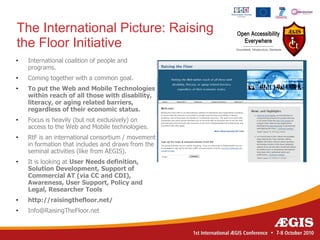
The International Picture: Raising
the Floor Initiative
•   International coalition of people and
    programs.
•   Coming together with a common goal.
•   To put the Web and Mobile Technologies
    within reach of all those with disability,
    literacy, or aging related barriers,
    regardless of their economic status.
•   Focus is heavily (but not exclusively) on
    access to the Web and Mobile technologies.
•   RtF is an international consortium / movement
    in formation that includes and draws from the
    seminal activities (like from AEGIS).
•   It is looking at User Needs definition,
    Solution Development, Support of
    Commercial AT (via CC and CDI),
    Awareness, User Support, Policy and
    Legal, Researcher Tools
•   http://raisingthefloor.net/
•   Info@RaisingTheFloor.net
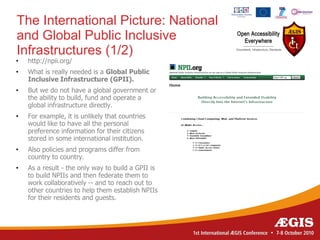
The International Picture: National
and Global Public Inclusive
Infrastructures (1/2)
•   http://npii.org/
•   What is really needed is a Global Public
    Inclusive Infrastructure (GPII).
•   But we do not have a global government or
    the ability to build, fund and operate a
    global infrastructure directly.
•   For example, it is unlikely that countries
    would like to have all the personal
    preference information for their citizens
    stored in some international institution.
•   Also policies and programs differ from
    country to country.
•   As a result - the only way to build a GPII is
    to build NPIIs and then federate them to
    work collaboratively -- and to reach out to
    other countries to help them establish NPIIs
    for their residents and guests.
The International Picture: National
and Global Public Inclusive
Infrastructures (2/2)
•   An international consortium of people and programs has begun to form
    with the intention of creating enhancements to the global broadband
    (wired and wireless) infrastructure to facilitate access by people who
    would otherwise face barriers due to disability, literacy or aging.
•   The goal of the group is to bring together cloud, web and platform
    technologies to create National and Global Public Inclusive
    Infrastructures that could make access simpler and more affordable,
    while addressing the needs of groups not adequately served today.
•   It would build up and expand what we have today and enable new
    types of accessibility and extended-usability technologies and services.
•   The NPII/GPII concept is not a wholly new concept. Rather, it is a
    combination and extension of many different existing efforts. Yet it
    brings them together in a way that has the potential to fundamentally
    change what is possible and practical.
eAccessibility in Europe
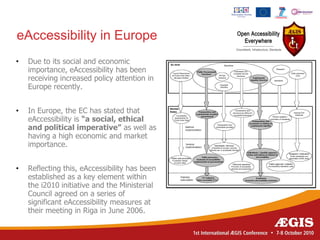
•   Due to its social and economic
    importance, eAccessibility has been
    receiving increased policy attention in
    Europe recently.


•   In Europe, the EC has stated that
    eAccessibility is “a social, ethical
    and political imperative” as well as
    having a high economic and market
    importance.


•   Reflecting this, eAccessibility has been
    established as a key element within
    the i2010 initiative and the Ministerial
    Council agreed on a series of
    significant eAccessibility measures at
    their meeting in Riga in June 2006.
i2010 - A European Information
Society for growth and employment
(1/2)
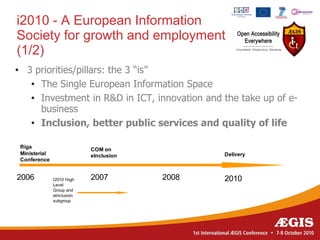
• 3 priorities/pillars: the 3 “is”
   • The Single European Information Space
   • Investment in R&D in ICT, innovation and the take up of e-
     business
   • Inclusion, better public services and quality of life

 Riga                       COM on
 Ministerial                eInclusion          Delivery
 Conference


2006           I2010 High   2007         2008   2010
               Level
               Group and
               eInclusion
               subgroup
i2010 - A European Information
Society for growth and employment
(2/2)
• 2010 Targets, including quantified targets:
   – Reduce by half differences in internet usage between
     vulnerable groups and average;
   – Broadband coverage to reach at least 90% of EU
     population;
   – Reduce by half current digital literacy gaps;
   – Ensure eAccessibility of all public websites by 2010.
Towards the Digital Agenda 2010-
2020 for Europe (1/4)
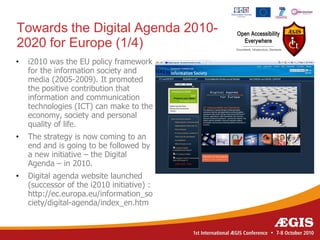
•   i2010 was the EU policy framework
    for the information society and
    media (2005-2009). It promoted
    the positive contribution that
    information and communication
    technologies (ICT) can make to the
    economy, society and personal
    quality of life.
•   The strategy is now coming to an
    end and is going to be followed by
    a new initiative – the Digital
    Agenda – in 2010.
•   Digital agenda website launched
    (successor of the i2010 initiative) :
    http://ec.europa.eu/information_so
    ciety/digital-agenda/index_en.htm
Towards the Digital Agenda 2010-
2020 for Europe (2/4)
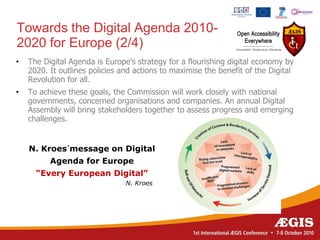
•   The Digital Agenda is Europe's strategy for a flourishing digital economy by
    2020. It outlines policies and actions to maximise the benefit of the Digital
    Revolution for all.
•   To achieve these goals, the Commission will work closely with national
    governments, concerned organisations and companies. An annual Digital
    Assembly will bring stakeholders together to assess progress and emerging
    challenges.


    N. Kroes´message on Digital
          Agenda for Europe
      “Every European Digital”
                                N. Kroes
Towards the Digital Agenda 2010-
2020 for Europe (3/4)
•   Digital Single Market: Too many barriers still block the free flow of online services and
    entertainment across national borders. The Digital Agenda will update EU Single Market rules for
    the digital era. The aims are to boost the music download business, establish a single area for
    online payments, and further protect EU consumers in cyberspace.
•   Interoperability and Standards: The internet is a great example of interoperability - numerous
    devices and applications working together anywhere in the world. Europe must ensure that new IT
    devices, applications, data repositories and services interact seamlessly anywhere – just like the
    internet. The Digital Agenda identifies improved standard-setting procedures and increased
    interoperability as the keys to success
•   Trust and Security: Only 12% of European web users feel completely safe making online
    transactions. Threats such as malicious software and online fraud unsettle consumers and dog
    efforts to promote the online economy. The Digital Agenda proposes a number of practical
    solutions, including a coordinated European response to cyber-attacks and reinforced rules on
    personal data protection.
•   Very Fast Internet: New services such as high definition television or videoconferencing need
    much faster internet access than generally available in Europe. To match world leaders like South
    Korea and Japan, Europe needs download rates of 30 Mbps for all surfers and 100 Mbps for at least
    50% of web users by 2020. The Digital Agenda aims to turn this ambition into reality by stimulating
    investments and proposing a comprehensive radio spectrum plan.
Towards the Digital Agenda 2010-
2020 for Europe (4/4)
•   Research and innovation: To attract Europe's best minds to research, world class infrastructure
    and adequate funding are crucial. The best research ideas must be turned into marketable products
    and services. Currently, EU investment in ICT research is still less than half US levels. The Digital
    Agenda seeks to maintain Europe's competitive edge through increased coordination and
    elimination of Europe's fragmented efforts.
•   Enhancing e-skills: Over 50% of Europeans use the internet daily – but 30% have never used it
    at all! Moreover, disabled persons face particular difficulties in benefiting fully from new electronic
    content and services. As ever more daily tasks are carried out online, all our people need enhanced
    digital skills to participate fully in society. The Digital Agenda tackles this unacceptable digital divide.
•   ICT for Social Challenges: Digital technologies have enormous potential to benefit our everyday
    lives and tackle social challenges. The Digital Agenda focuses on ICTs capability to reduce energy
    consumption, support ageing citizens' lives, revolutionises health services and deliver better public
    services. ICTs can also drive forward the digitisation of Europe's cultural heritage providing online
    access for all.


•   You can send your ideas at:
    http://ec.europa.eu/information_society/digital-agenda/survey/
Other project roadmaps
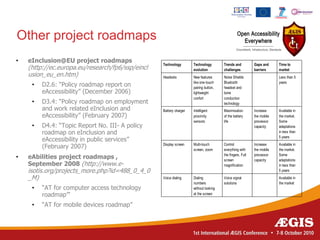
•   eInclusion@EU project roadmaps
                                                  Technology        Technology        Trends and          Gaps and     Time to
    (http://ec.europa.eu/research/fp6/ssp/eincl                     evolution         challenges          barriers     market
    usion_eu_en.htm)                              Headsets          New features      Noise Shields                    Less than 5
                                                                    like one-touch    Bluetooth                        years
     •   D2.6: “Policy roadmap report on                            pairing button,   headset and
         eAccessibility” (December 2006)                            lightweight       bone
                                                                    confort           conduction
     •   D3.4: “Policy roadmap on employment                                          technology
         and work related eInclusion and          Battery charger   Intelligent       Maximisation        Increase     Available in
         eAccessibility” (February 2007)                            proximity         of the battery      the mobile   the market.
                                                                    sensors           life                processor    Some
     •   D4.4: “Topic Report No. III- A policy                                                            capacity     adaptations
         roadmap on eInclusion and                                                                                     in less than
                                                                                                                       5 years
         eAccessibility in public services”
                                                  Display screen    Multi-touch       Control             Increase     Available in
         (February 2007)                                            screen, zoom      everything with     the mobile   the market.
                                                                                      the fingers, Full   processor    Some
•   eAbilities project roadmaps ,                                                     screen              capacity     adaptations
    September 2008 (http://www.e-                                                     magnification                    in less than
    isotis.org/projects_more.php?id=488_0_4_0                                                                          5 years

    _M)                                           Voice dialing     Dialing           Voice signal                     Available in
                                                                    numbers           solutions                        the market
     •   “AT for computer access technology                         without looking
         roadmap”'                                                  at the screen

     •   “AT for mobile devices roadmap”
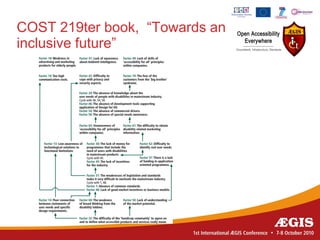
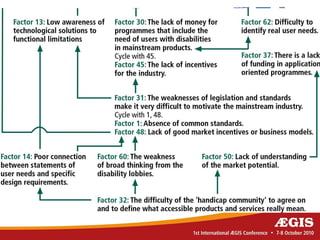
COST 219ter book, “Towards an
inclusive future”
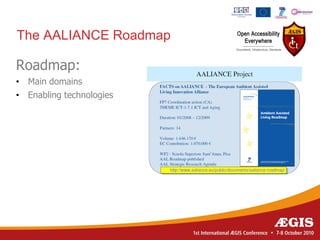
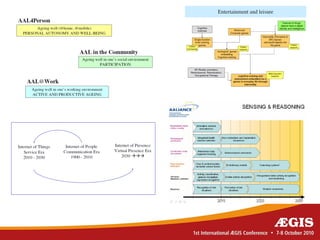
The AALIANCE Roadmap

Roadmap:
• Main domains
• Enabling technologies
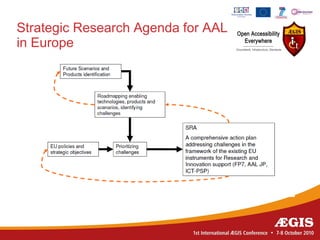
Strategic Research Agenda for AAL
in Europe
CARDIAC Coordination Action
•   www.cardiac-eu.org

•   Aiming to:
     • Consult widely with all the relevant stakeholders
     •    Identify short/medium and long term research priority areas within the context of
          ICT for independent living, inclusion and governance
     •    Produce research agenda roadmaps
•   By:
     •    Consultation

     •    Gathering of position papers

     •    Structured Dialogic Design Process (SDDP) methodology previously known as
          Interactive Management Co-Laboratory

•   Giving the floor to Mr. Patrick Roe…
To the future…

• ÆGIS Roadmap will be an amalgam of all roadmaps and
  political initiatives in the eInclusion area.

• Focus will be on the Open Source Accessibility,
  emphasizing on mobile, RIA and desktop accessible
  solutions, tools and AT.

• With the help of our Advisory Group (where Mr. Patrick
  Roe and Mr. Gregg Vanderheiden participate...).
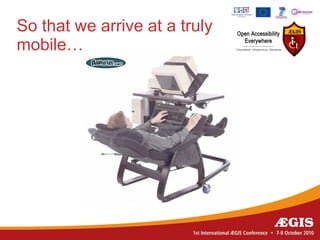
So that we arrive at a truly
mobile…
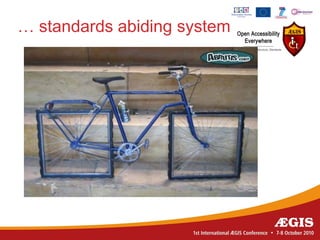
… standards abiding system

Roadmap for building a global public inclusive infrastructure

  • 1.
    Roadmap towards futureresearch Dr. Evangelos Bekiaris, Centre for Research & Technology Hellas (CERTH) Hellenic Institute of Transport (HIT)
  • 2.
    The International Picture:Raising the Floor Initiative • International coalition of people and programs. • Coming together with a common goal. • To put the Web and Mobile Technologies within reach of all those with disability, literacy, or aging related barriers, regardless of their economic status. • Focus is heavily (but not exclusively) on access to the Web and Mobile technologies. • RtF is an international consortium / movement in formation that includes and draws from the seminal activities (like from AEGIS). • It is looking at User Needs definition, Solution Development, Support of Commercial AT (via CC and CDI), Awareness, User Support, Policy and Legal, Researcher Tools • http://raisingthefloor.net/ • Info@RaisingTheFloor.net
  • 3.
    The International Picture:National and Global Public Inclusive Infrastructures (1/2) • http://npii.org/ • What is really needed is a Global Public Inclusive Infrastructure (GPII). • But we do not have a global government or the ability to build, fund and operate a global infrastructure directly. • For example, it is unlikely that countries would like to have all the personal preference information for their citizens stored in some international institution. • Also policies and programs differ from country to country. • As a result - the only way to build a GPII is to build NPIIs and then federate them to work collaboratively -- and to reach out to other countries to help them establish NPIIs for their residents and guests.
  • 4.
    The International Picture:National and Global Public Inclusive Infrastructures (2/2) • An international consortium of people and programs has begun to form with the intention of creating enhancements to the global broadband (wired and wireless) infrastructure to facilitate access by people who would otherwise face barriers due to disability, literacy or aging. • The goal of the group is to bring together cloud, web and platform technologies to create National and Global Public Inclusive Infrastructures that could make access simpler and more affordable, while addressing the needs of groups not adequately served today. • It would build up and expand what we have today and enable new types of accessibility and extended-usability technologies and services. • The NPII/GPII concept is not a wholly new concept. Rather, it is a combination and extension of many different existing efforts. Yet it brings them together in a way that has the potential to fundamentally change what is possible and practical.
  • 5.
    eAccessibility in Europe • Due to its social and economic importance, eAccessibility has been receiving increased policy attention in Europe recently. • In Europe, the EC has stated that eAccessibility is “a social, ethical and political imperative” as well as having a high economic and market importance. • Reflecting this, eAccessibility has been established as a key element within the i2010 initiative and the Ministerial Council agreed on a series of significant eAccessibility measures at their meeting in Riga in June 2006.
  • 6.
    i2010 - AEuropean Information Society for growth and employment (1/2) • 3 priorities/pillars: the 3 “is” • The Single European Information Space • Investment in R&D in ICT, innovation and the take up of e- business • Inclusion, better public services and quality of life Riga COM on Ministerial eInclusion Delivery Conference 2006 I2010 High 2007 2008 2010 Level Group and eInclusion subgroup
  • 7.
    i2010 - AEuropean Information Society for growth and employment (2/2) • 2010 Targets, including quantified targets: – Reduce by half differences in internet usage between vulnerable groups and average; – Broadband coverage to reach at least 90% of EU population; – Reduce by half current digital literacy gaps; – Ensure eAccessibility of all public websites by 2010.
  • 8.
    Towards the DigitalAgenda 2010- 2020 for Europe (1/4) • i2010 was the EU policy framework for the information society and media (2005-2009). It promoted the positive contribution that information and communication technologies (ICT) can make to the economy, society and personal quality of life. • The strategy is now coming to an end and is going to be followed by a new initiative – the Digital Agenda – in 2010. • Digital agenda website launched (successor of the i2010 initiative) : http://ec.europa.eu/information_so ciety/digital-agenda/index_en.htm
  • 9.
    Towards the DigitalAgenda 2010- 2020 for Europe (2/4) • The Digital Agenda is Europe's strategy for a flourishing digital economy by 2020. It outlines policies and actions to maximise the benefit of the Digital Revolution for all. • To achieve these goals, the Commission will work closely with national governments, concerned organisations and companies. An annual Digital Assembly will bring stakeholders together to assess progress and emerging challenges. N. Kroes´message on Digital Agenda for Europe “Every European Digital” N. Kroes
  • 10.
    Towards the DigitalAgenda 2010- 2020 for Europe (3/4) • Digital Single Market: Too many barriers still block the free flow of online services and entertainment across national borders. The Digital Agenda will update EU Single Market rules for the digital era. The aims are to boost the music download business, establish a single area for online payments, and further protect EU consumers in cyberspace. • Interoperability and Standards: The internet is a great example of interoperability - numerous devices and applications working together anywhere in the world. Europe must ensure that new IT devices, applications, data repositories and services interact seamlessly anywhere – just like the internet. The Digital Agenda identifies improved standard-setting procedures and increased interoperability as the keys to success • Trust and Security: Only 12% of European web users feel completely safe making online transactions. Threats such as malicious software and online fraud unsettle consumers and dog efforts to promote the online economy. The Digital Agenda proposes a number of practical solutions, including a coordinated European response to cyber-attacks and reinforced rules on personal data protection. • Very Fast Internet: New services such as high definition television or videoconferencing need much faster internet access than generally available in Europe. To match world leaders like South Korea and Japan, Europe needs download rates of 30 Mbps for all surfers and 100 Mbps for at least 50% of web users by 2020. The Digital Agenda aims to turn this ambition into reality by stimulating investments and proposing a comprehensive radio spectrum plan.
  • 11.
    Towards the DigitalAgenda 2010- 2020 for Europe (4/4) • Research and innovation: To attract Europe's best minds to research, world class infrastructure and adequate funding are crucial. The best research ideas must be turned into marketable products and services. Currently, EU investment in ICT research is still less than half US levels. The Digital Agenda seeks to maintain Europe's competitive edge through increased coordination and elimination of Europe's fragmented efforts. • Enhancing e-skills: Over 50% of Europeans use the internet daily – but 30% have never used it at all! Moreover, disabled persons face particular difficulties in benefiting fully from new electronic content and services. As ever more daily tasks are carried out online, all our people need enhanced digital skills to participate fully in society. The Digital Agenda tackles this unacceptable digital divide. • ICT for Social Challenges: Digital technologies have enormous potential to benefit our everyday lives and tackle social challenges. The Digital Agenda focuses on ICTs capability to reduce energy consumption, support ageing citizens' lives, revolutionises health services and deliver better public services. ICTs can also drive forward the digitisation of Europe's cultural heritage providing online access for all. • You can send your ideas at: http://ec.europa.eu/information_society/digital-agenda/survey/
  • 12.
    Other project roadmaps • eInclusion@EU project roadmaps Technology Technology Trends and Gaps and Time to (http://ec.europa.eu/research/fp6/ssp/eincl evolution challenges barriers market usion_eu_en.htm) Headsets New features Noise Shields Less than 5 like one-touch Bluetooth years • D2.6: “Policy roadmap report on pairing button, headset and eAccessibility” (December 2006) lightweight bone confort conduction • D3.4: “Policy roadmap on employment technology and work related eInclusion and Battery charger Intelligent Maximisation Increase Available in eAccessibility” (February 2007) proximity of the battery the mobile the market. sensors life processor Some • D4.4: “Topic Report No. III- A policy capacity adaptations roadmap on eInclusion and in less than 5 years eAccessibility in public services” Display screen Multi-touch Control Increase Available in (February 2007) screen, zoom everything with the mobile the market. the fingers, Full processor Some • eAbilities project roadmaps , screen capacity adaptations September 2008 (http://www.e- magnification in less than isotis.org/projects_more.php?id=488_0_4_0 5 years _M) Voice dialing Dialing Voice signal Available in numbers solutions the market • “AT for computer access technology without looking roadmap”' at the screen • “AT for mobile devices roadmap”
  • 13.
    COST 219ter book,“Towards an inclusive future”
  • 15.
    The AALIANCE Roadmap Roadmap: •Main domains • Enabling technologies
  • 17.
    Strategic Research Agendafor AAL in Europe
  • 18.
    CARDIAC Coordination Action • www.cardiac-eu.org • Aiming to: • Consult widely with all the relevant stakeholders • Identify short/medium and long term research priority areas within the context of ICT for independent living, inclusion and governance • Produce research agenda roadmaps • By: • Consultation • Gathering of position papers • Structured Dialogic Design Process (SDDP) methodology previously known as Interactive Management Co-Laboratory • Giving the floor to Mr. Patrick Roe…
  • 19.
    To the future… •ÆGIS Roadmap will be an amalgam of all roadmaps and political initiatives in the eInclusion area. • Focus will be on the Open Source Accessibility, emphasizing on mobile, RIA and desktop accessible solutions, tools and AT. • With the help of our Advisory Group (where Mr. Patrick Roe and Mr. Gregg Vanderheiden participate...).
  • 20.
    So that wearrive at a truly mobile…
  • 21.