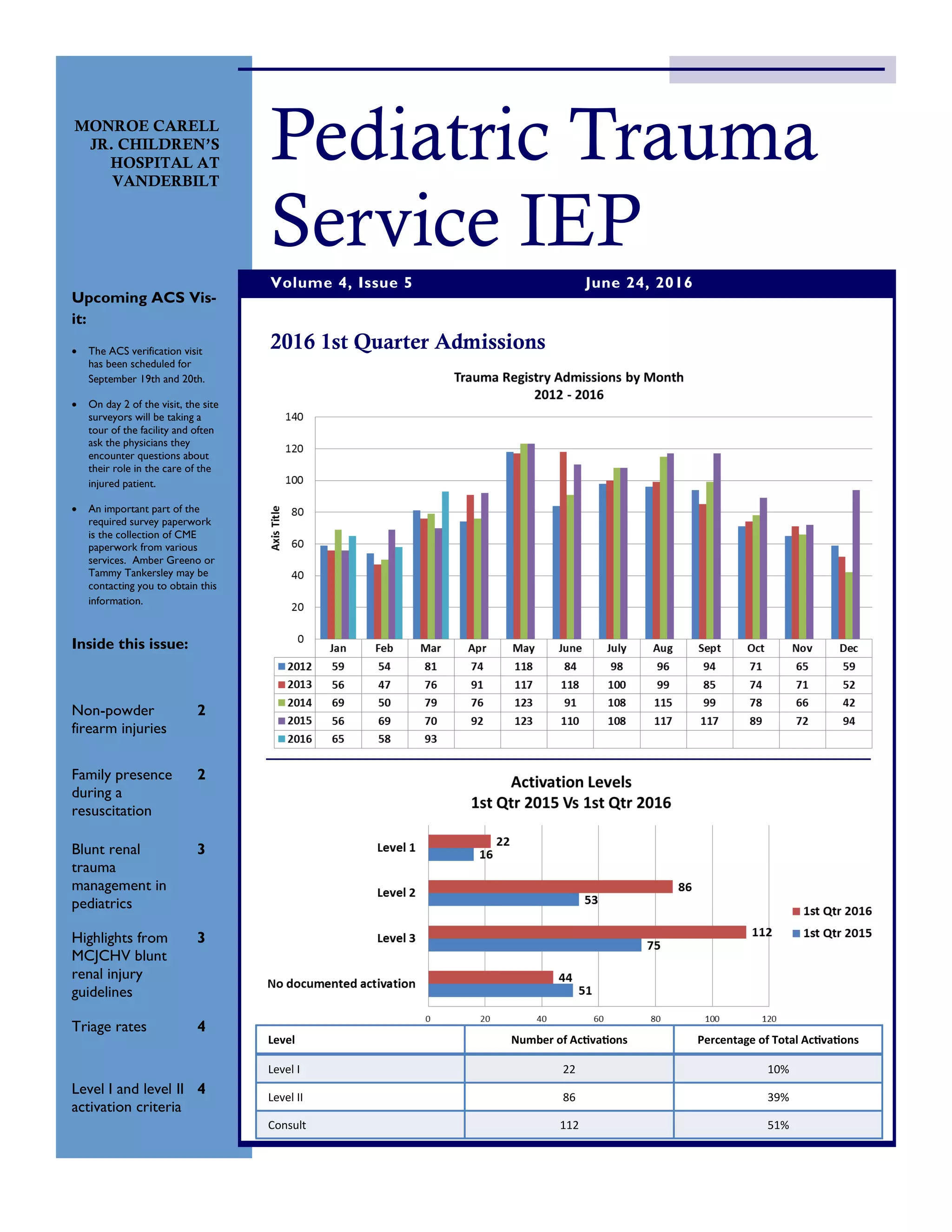
2016 1st Quarter Admissions
MONROE CARELL
JR. CHILDREN’S
HOSPITAL AT
VANDERBILT
June 24, 2016Volume 4, Issue 5
Pediatric Trauma
Service IEP
Upcoming ACS Vis-
it:
 The ACS verification visit
has been scheduled for
September 19th and 20th.
 On day 2 of the visit, the site
surveyors will be taking a
tour of the facility and often
ask the physicians they
encounter questions about
their role in the care of the
injured patient.
 An important part of the
required survey paperwork
is the collection of CME
paperwork from various
services. Amber Greeno or
Tammy Tankersley may be
contacting you to obtain this
information.
Inside this issue:
Non-powder
firearm injuries
2
Family presence
during a
resuscitation
2
Blunt renal
trauma
management in
pediatrics
3
Highlights from
MCJCHV blunt
renal injury
guidelines
3
Triage rates 4
Level I and level II
activation criteria
4
Level Number of Activations Percentage of Total Activations
Level I 22 10%
Level II 86 39%
Consult 112 51%
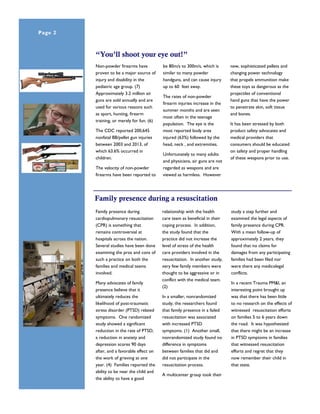
Non-powder firearms have
proven to be a major source of
injury and disability in the
pediatric age group. (7)
Approximately 3.2 million air
guns are sold annually and are
used for various reasons such
as sport, hunting, firearm
training, or merely for fun. (6)
The CDC reported 200,645
nonfatal BB/pellet gun injuries
between 2003 and 2013, of
which 63.6% occurred in
children.
The velocity of non-powder
firearms have been reported to
be 80m/s to 300m/s, which is
similar to many powder
handguns, and can cause injury
up to 60 feet away.
The rates of non-powder
firearm injuries increase in the
summer months and are seen
most often in the teenage
population. The eye is the
most reported body area
injured (63%) followed by the
head, neck , and extremities.
Unfortunately to many adults
and physicians, air guns are not
regarded as weapons and are
viewed as harmless. However
new, sophisticated pellets and
changing power technology
that propels ammunition make
these toys as dangerous as the
projectiles of conventional
hand guns that have the power
to penetrate skin, soft tissue
and bones.
It has been stressed by both
product safety advocates and
medical providers that
consumers should be educated
on safety and proper handling
of these weapons prior to use.
“You’ll shoot your eye out!”
Family presence during a resuscitation
relationship with the health
care team as beneficial in their
coping process. In addition,
the study found that the
practice did not increase the
level of stress of the health
care providers involved in the
resuscitation. In another study,
very few family members were
thought to be aggressive or in
conflict with the medical team.
(2)
In a smaller, nonrandomized
study, the researchers found
that family presence in a failed
resuscitation was associated
with increased PTSD
symptoms. (1) Another small,
nonrandomized study found no
difference in symptoms
between families that did and
did not participate in the
resuscitation process.
A multicenter group took their
study a step further and
examined the legal aspects of
family presence during CPR.
With a mean follow-up of
approximately 2 years, they
found that no claims for
damages from any participating
families had been filed nor
were there any medicolegal
conflicts.
In a recent Trauma PM&I, an
interesting point brought up
was that there has been little
to no research on the effects of
witnessed resuscitation efforts
on families 5 to 6 years down
the road. It was hypothesized
that there might be an increase
in PTSD symptoms in families
that witnessed resuscitation
efforts and regret that they
now remember their child in
that state.
Family presence during
cardiopulmonary resuscitation
(CPR) is something that
remains controversial at
hospitals across the nation.
Several studies have been done
examining the pros and cons of
such a practice on both the
families and medical teams
involved.
Many advocates of family
presence believe that it
ultimately reduces the
likelihood of post-traumatic
stress disorder (PTSD) related
symptoms. One randomized
study showed a significant
reduction in the rate of PTSD,
a reduction in anxiety and
depression scores 90 days
after, and a favorable effect on
the work of grieving at one
year. (4) Families reported the
ability to be near the child and
the ability to have a good
Page 2 Pediatric Trauma Service IEP
Due to the anatomic features
of pediatric patients, renal
injuries are more likely to
occur in their population then
their adult counterparts.
According to the national
trauma data bank (NTDB),
more than 18,000 pediatric
renal injuries occurred over a 5
year period. (5) In a review of
the literature, all pediatric
studies support some
combination of frequent VS,
HCT checks, serial abdominal
exams, and IV fluid
resuscitation. Beyond those
items, most protocols have
some variation.
Bed rest
Most literature regarding
conservative management
report the need for bedrest in
patients with renal injuries.
Although most studies did not
report the duration of bed rest,
typically, bed rest was
maintained until resolution of
gross hematuria. One study
challenged the need for bedrest
and instead advocated for early
mobilization. (3) Although this
protocol led to a reduction in
LOS from a mean of 6.6 days
to 2.9 days after it was applied,
it is notable that this study
addressed a population with
greater than 50%low-grade
injuries with fewer than four
patients (5%) with Grade V
injury. In addition, five patients
(7%) required readmission,
although follow-up US results
were normal.
ICU admission
Admission to and duration of
stay in the PICU varied
considerably among the
protocols reviewed. Duration
of PICU stay was
recommended as 24 hours to 1
week. In protocols with longer
ICU LOS, an overall increase in
total HD were noted. Most of
the studies with minimal ICU
LOS consisted of mainly lower
grade injuries.
Empiric antibiotics
Empiric antibiotics were used
in 6 studies with grade 4/5
renal injuries. (5)
Foley catheters
Foley catheter insertion was
recommended by two studies
for bladder decompression,
close monitoring of hematuria
and to encourage bedrest.
One specifically did not use
foleys unless unable to void,
but this was also the protocol
that encouraged early
ambulance despite grade and
no minimal amount of HDs. (3)
Serial imaging
Guidelines for serial imaging is
somewhat inconsistent in the
literature. A few studies
recommended repeat imaging
within 24-72 hours while one
recommended daily bedside US
for grade 5 injuries. One study
was much more conservative
and strictly utilized US for
evaluation of clinical changes
and only used repeat CT if US
was ineffective.
Blunt renal trauma management in pediatrics
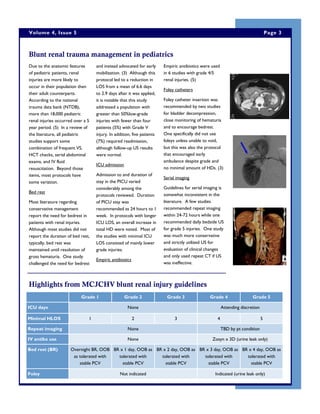
Highlights from MCJCHV blunt renal injury guidelines
Page 3Volume 4, Issue 5
Grade 1 Grade 2 Grade 3 Grade 4 Grade 5
ICU days None Attending discretion
Minimal HLOS 1 2 3 4 5
Repeat imaging None TBD by pt condition
IV antibx use None Zosyn x 3D (urine leak only)
Bed rest (BR) Overnight BR, OOB
as tolerated with
stable PCV
BR x 1 day, OOB as
tolerated with
stable PCV
BR x 2 day, OOB as
tolerated with
stable PCV
BR x 3 day, OOB as
tolerated with
stable PCV
BR x 4 day, OOB as
tolerated with
stable PCV
Foley Not indicated Indicated (urine leak only)
MONROE CARELL
JR. CHILDREN’S
HOSPITAL AT
VANDERBILT
Level I Activation Criteria
 Any intubated patient
 Unstable airway:
 Significant facial or neck injury causing
airway compromise
 Respiratory distress/ compromise:
increased work of breathing
 Any episode of sustained tachycardia OR
hypotension
 Cardiac arrest/CPR (in field or en route)
 Blood transfusion en route
 Significant blood loss or hemorrhage
 Penetrating injury (head, neck, torso or
proximal extremity)
 Excludes any penetrating
injury isolated to the eye
 Amputation, near-amputation, de-
gloving, crush injury proximal to wrist/
ankle
 Extremity with no pulse, duskiness,
cyanosis, or paralysis
 GCS ≤ 8 or “P” or “U”
 Worsening neurological exam: decline in
GCS by ≥2, decline in AVPU by letter
 Paralysis, motor weakness, decreased
sensation, or signs of spinal cord injury
 2nd and/or 3rd degree thermal burns
≥30% TBSA and/or chemical or
electrical burns
 ED physician discretion
Level II Activation Criteria
 Suspected smoke inhalation injury
 Sub-Q emphysema of chest and above
 Suspected/confirmed pulmonary contusions/ rib
fractures or pneumo/hemothorax
 Suspected chest trauma with NRB necessary to
maintain saturations >93%
 Controlled arterial bleeding, stable VS
 Two or more proximal long bone fractures
 Femur fracture with significant mechanism
 Pelvic fractures
 Amputation, crush injury, or degloving distal to
wrist/ankle to exclude digits
 Penetrating injury distal extremities (not digits)
 GCS 9-13 or “V”
 Open or depressed skull fracture
 Confirmed but “stable” EDH, SDH, SAH
 Closed head injury with +SZ
 LOC >5 minutes
 Suspected/confirmed cervical spine or spinal cord
injury without or resolved motor/sensory deficit
 Suspected/confirmed intra-abdominal injury
 MVC with: rollover, ejection, death of passenger,
significant damage/intrusion, or spider windshield
 MCC, ATV with rollover, ejection
 Fall >20 feet (2nd story)
 Struck, dragged, or run over by vehicle
 Penetrating injury isolated to the eye
 2nd and/or 3rd degree thermal burns 15-29% TBSA
 ED physician discretion
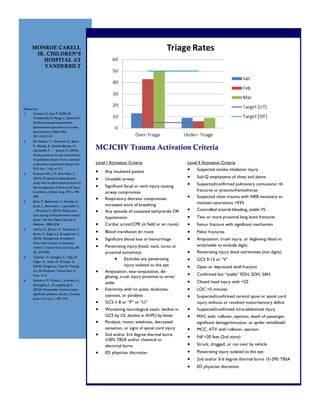
MCJCHV Trauma Activation Criteria
Resources:
1. Compton S, Levy P, Griffin M,
Waselewsky D, Mango L, Zalenski R.
Family-witnessed resuscitation:
bereavement outcomes in an urban
environment. J Palliat Med
2011;14:715-21.
2. De Stefano, C., Normand, D., Jabre,
P., Aloulay, E., Kentish-Barnes, N.,
Lapostolle, F., . . . Javaud, N. (2016).
Family presence during resuscitation:
A qualitative analysis from a national
multicenter randomized clinical trial.
PLoS One, 11(6), e1-12.
2. Graziano KD, J. D., & St Peter, S.
(2014). Prospective observational
study with an abbreviated protocol in
the management of blunt renal injury
in children. J Pediatr Surg, 49(1), 198-
200.
3. Jabre, P., Belpomme, V., Azoulay, E.,
Jacob, L., Bertrand, L., Lapostolle, F., .
. . Brouche, C. (2013). Family pres-
ence during cardiopulmonary resusci-
tation. The New England Journal of
Medicine, 1008-1018.
4. LeeVan, E., Zmora, O., Cazzulino, F.,
Burke, R., Zagory, J., & Upperman, J.
(2016). Management of pediatric
blunt renal trauma: A systematic
review. J Trauma Acute Care Surg, 80
(3), 519-528.
5. Taskinlar, H., Erdogen, C., Yigit, D.,
Ozgur, A., Avlan, D., & Nayci, A.
(2016). Dangerous Toys for Teenag-
ers: AirWeapons. Trauma Mon. In
Press, e1-5.
6. Veenstra, M., Prasad, J., Schaewe, H.,
Donoghue, L., & Langenburg, S.
(2015). Nonpowder firearms cause
significant pediatric injuries. J Trauma
Acute Care Surg, 1138-1142.

June 2016 IEP

  • 1.
    2016 1st QuarterAdmissions MONROE CARELL JR. CHILDREN’S HOSPITAL AT VANDERBILT June 24, 2016Volume 4, Issue 5 Pediatric Trauma Service IEP Upcoming ACS Vis- it:  The ACS verification visit has been scheduled for September 19th and 20th.  On day 2 of the visit, the site surveyors will be taking a tour of the facility and often ask the physicians they encounter questions about their role in the care of the injured patient.  An important part of the required survey paperwork is the collection of CME paperwork from various services. Amber Greeno or Tammy Tankersley may be contacting you to obtain this information. Inside this issue: Non-powder firearm injuries 2 Family presence during a resuscitation 2 Blunt renal trauma management in pediatrics 3 Highlights from MCJCHV blunt renal injury guidelines 3 Triage rates 4 Level I and level II activation criteria 4 Level Number of Activations Percentage of Total Activations Level I 22 10% Level II 86 39% Consult 112 51%
  • 2.
    Non-powder firearms have provento be a major source of injury and disability in the pediatric age group. (7) Approximately 3.2 million air guns are sold annually and are used for various reasons such as sport, hunting, firearm training, or merely for fun. (6) The CDC reported 200,645 nonfatal BB/pellet gun injuries between 2003 and 2013, of which 63.6% occurred in children. The velocity of non-powder firearms have been reported to be 80m/s to 300m/s, which is similar to many powder handguns, and can cause injury up to 60 feet away. The rates of non-powder firearm injuries increase in the summer months and are seen most often in the teenage population. The eye is the most reported body area injured (63%) followed by the head, neck , and extremities. Unfortunately to many adults and physicians, air guns are not regarded as weapons and are viewed as harmless. However new, sophisticated pellets and changing power technology that propels ammunition make these toys as dangerous as the projectiles of conventional hand guns that have the power to penetrate skin, soft tissue and bones. It has been stressed by both product safety advocates and medical providers that consumers should be educated on safety and proper handling of these weapons prior to use. “You’ll shoot your eye out!” Family presence during a resuscitation relationship with the health care team as beneficial in their coping process. In addition, the study found that the practice did not increase the level of stress of the health care providers involved in the resuscitation. In another study, very few family members were thought to be aggressive or in conflict with the medical team. (2) In a smaller, nonrandomized study, the researchers found that family presence in a failed resuscitation was associated with increased PTSD symptoms. (1) Another small, nonrandomized study found no difference in symptoms between families that did and did not participate in the resuscitation process. A multicenter group took their study a step further and examined the legal aspects of family presence during CPR. With a mean follow-up of approximately 2 years, they found that no claims for damages from any participating families had been filed nor were there any medicolegal conflicts. In a recent Trauma PM&I, an interesting point brought up was that there has been little to no research on the effects of witnessed resuscitation efforts on families 5 to 6 years down the road. It was hypothesized that there might be an increase in PTSD symptoms in families that witnessed resuscitation efforts and regret that they now remember their child in that state. Family presence during cardiopulmonary resuscitation (CPR) is something that remains controversial at hospitals across the nation. Several studies have been done examining the pros and cons of such a practice on both the families and medical teams involved. Many advocates of family presence believe that it ultimately reduces the likelihood of post-traumatic stress disorder (PTSD) related symptoms. One randomized study showed a significant reduction in the rate of PTSD, a reduction in anxiety and depression scores 90 days after, and a favorable effect on the work of grieving at one year. (4) Families reported the ability to be near the child and the ability to have a good Page 2 Pediatric Trauma Service IEP
  • 3.
    Due to theanatomic features of pediatric patients, renal injuries are more likely to occur in their population then their adult counterparts. According to the national trauma data bank (NTDB), more than 18,000 pediatric renal injuries occurred over a 5 year period. (5) In a review of the literature, all pediatric studies support some combination of frequent VS, HCT checks, serial abdominal exams, and IV fluid resuscitation. Beyond those items, most protocols have some variation. Bed rest Most literature regarding conservative management report the need for bedrest in patients with renal injuries. Although most studies did not report the duration of bed rest, typically, bed rest was maintained until resolution of gross hematuria. One study challenged the need for bedrest and instead advocated for early mobilization. (3) Although this protocol led to a reduction in LOS from a mean of 6.6 days to 2.9 days after it was applied, it is notable that this study addressed a population with greater than 50%low-grade injuries with fewer than four patients (5%) with Grade V injury. In addition, five patients (7%) required readmission, although follow-up US results were normal. ICU admission Admission to and duration of stay in the PICU varied considerably among the protocols reviewed. Duration of PICU stay was recommended as 24 hours to 1 week. In protocols with longer ICU LOS, an overall increase in total HD were noted. Most of the studies with minimal ICU LOS consisted of mainly lower grade injuries. Empiric antibiotics Empiric antibiotics were used in 6 studies with grade 4/5 renal injuries. (5) Foley catheters Foley catheter insertion was recommended by two studies for bladder decompression, close monitoring of hematuria and to encourage bedrest. One specifically did not use foleys unless unable to void, but this was also the protocol that encouraged early ambulance despite grade and no minimal amount of HDs. (3) Serial imaging Guidelines for serial imaging is somewhat inconsistent in the literature. A few studies recommended repeat imaging within 24-72 hours while one recommended daily bedside US for grade 5 injuries. One study was much more conservative and strictly utilized US for evaluation of clinical changes and only used repeat CT if US was ineffective. Blunt renal trauma management in pediatrics Highlights from MCJCHV blunt renal injury guidelines Page 3Volume 4, Issue 5 Grade 1 Grade 2 Grade 3 Grade 4 Grade 5 ICU days None Attending discretion Minimal HLOS 1 2 3 4 5 Repeat imaging None TBD by pt condition IV antibx use None Zosyn x 3D (urine leak only) Bed rest (BR) Overnight BR, OOB as tolerated with stable PCV BR x 1 day, OOB as tolerated with stable PCV BR x 2 day, OOB as tolerated with stable PCV BR x 3 day, OOB as tolerated with stable PCV BR x 4 day, OOB as tolerated with stable PCV Foley Not indicated Indicated (urine leak only)
  • 4.
    MONROE CARELL JR. CHILDREN’S HOSPITALAT VANDERBILT Level I Activation Criteria  Any intubated patient  Unstable airway:  Significant facial or neck injury causing airway compromise  Respiratory distress/ compromise: increased work of breathing  Any episode of sustained tachycardia OR hypotension  Cardiac arrest/CPR (in field or en route)  Blood transfusion en route  Significant blood loss or hemorrhage  Penetrating injury (head, neck, torso or proximal extremity)  Excludes any penetrating injury isolated to the eye  Amputation, near-amputation, de- gloving, crush injury proximal to wrist/ ankle  Extremity with no pulse, duskiness, cyanosis, or paralysis  GCS ≤ 8 or “P” or “U”  Worsening neurological exam: decline in GCS by ≥2, decline in AVPU by letter  Paralysis, motor weakness, decreased sensation, or signs of spinal cord injury  2nd and/or 3rd degree thermal burns ≥30% TBSA and/or chemical or electrical burns  ED physician discretion Level II Activation Criteria  Suspected smoke inhalation injury  Sub-Q emphysema of chest and above  Suspected/confirmed pulmonary contusions/ rib fractures or pneumo/hemothorax  Suspected chest trauma with NRB necessary to maintain saturations >93%  Controlled arterial bleeding, stable VS  Two or more proximal long bone fractures  Femur fracture with significant mechanism  Pelvic fractures  Amputation, crush injury, or degloving distal to wrist/ankle to exclude digits  Penetrating injury distal extremities (not digits)  GCS 9-13 or “V”  Open or depressed skull fracture  Confirmed but “stable” EDH, SDH, SAH  Closed head injury with +SZ  LOC >5 minutes  Suspected/confirmed cervical spine or spinal cord injury without or resolved motor/sensory deficit  Suspected/confirmed intra-abdominal injury  MVC with: rollover, ejection, death of passenger, significant damage/intrusion, or spider windshield  MCC, ATV with rollover, ejection  Fall >20 feet (2nd story)  Struck, dragged, or run over by vehicle  Penetrating injury isolated to the eye  2nd and/or 3rd degree thermal burns 15-29% TBSA  ED physician discretion MCJCHV Trauma Activation Criteria Resources: 1. Compton S, Levy P, Griffin M, Waselewsky D, Mango L, Zalenski R. Family-witnessed resuscitation: bereavement outcomes in an urban environment. J Palliat Med 2011;14:715-21. 2. De Stefano, C., Normand, D., Jabre, P., Aloulay, E., Kentish-Barnes, N., Lapostolle, F., . . . Javaud, N. (2016). Family presence during resuscitation: A qualitative analysis from a national multicenter randomized clinical trial. PLoS One, 11(6), e1-12. 2. Graziano KD, J. D., & St Peter, S. (2014). Prospective observational study with an abbreviated protocol in the management of blunt renal injury in children. J Pediatr Surg, 49(1), 198- 200. 3. Jabre, P., Belpomme, V., Azoulay, E., Jacob, L., Bertrand, L., Lapostolle, F., . . . Brouche, C. (2013). Family pres- ence during cardiopulmonary resusci- tation. The New England Journal of Medicine, 1008-1018. 4. LeeVan, E., Zmora, O., Cazzulino, F., Burke, R., Zagory, J., & Upperman, J. (2016). Management of pediatric blunt renal trauma: A systematic review. J Trauma Acute Care Surg, 80 (3), 519-528. 5. Taskinlar, H., Erdogen, C., Yigit, D., Ozgur, A., Avlan, D., & Nayci, A. (2016). Dangerous Toys for Teenag- ers: AirWeapons. Trauma Mon. In Press, e1-5. 6. Veenstra, M., Prasad, J., Schaewe, H., Donoghue, L., & Langenburg, S. (2015). Nonpowder firearms cause significant pediatric injuries. J Trauma Acute Care Surg, 1138-1142.