Because "use urandom" isn’t everything: a deep dive into
CSPRNGs in Operating Systems & Programming Languages
Aaron Zauner
azet@azet.org
lambda.co.at:
Highly-Available, Scalable & Secure Distributed Systems
SHA2017 - 06/08/2017
Why do we need Random Numbers?
randomize stuff in your operating system / language
man rand
Python: os.urandom
TLS session cookies
Key generation (e.g. RSA / Diffie-Hellman)
TCP SYN cookies
Bash: ${RANDOM} :)
SHA2017 - 06/08/2017 Because "use urandom" isn’t everything: a deep dive into CSPRNGs in Operating Systems & Programming Languages
Aaron Zauner 1/1
CSPRNG i
“Cryptographically Secure Pseudo Random Number Generator”
aka “RNG”, “Random number generator”..
Crypto nerds tend to call them “CSPRNGs” you may call them RNG or whatever, I don’t
care that much as long as it’s secure!
SHA2017 - 06/08/2017 Because "use urandom" isn’t everything: a deep dive into CSPRNGs in Operating Systems & Programming Languages
Aaron Zauner 2/1
CSPRNG ii
Widely implemented in OS kernels
Linux: /dev/urandom
1. manpage man random has been wrong for years
2. many myths about kernel entropy
FreeBSD: /dev/*random
1.
2. Replace the RC4 algorithm for generating in-kernel secure random numbers with Chacha20. Keep
the API, though, as that is what the other *BSD’s have done. Use the boot-time entropy stash (if
present) to bootstrap the in-kernel entropy source.
(https://svnweb.freebsd.org/base?view=revision&revision=317015 - Sun Apr 16 09:11:02 2017 UTC)
Windows: RtlGenRandom()
..and in programming languages
(i.e. Python os.urandom, PHP rand(),..)
some had really bad bugs for a long time (i.e. debian predictable SSH keys: CVE-2008-0166)
many use the kernel provided CSPRNG, others use OpenSSL or custom RNGs - which is BAD!
OpenSSL provides a user-space RNG many link to or make use of (don’t!)
Whoops: CVE-2017-11671: GCC generates incorrect code for RDRAND/RDSEED
intrinsics (recent)SHA2017 - 06/08/2017 Because "use urandom" isn’t everything: a deep dive into CSPRNGs in Operating Systems & Programming Languages
Aaron Zauner 3/1
Some History
the /dev/random and /dev/urandom devices used to be really old code (mid-90ties)
originated from Ted Tso and a few others
the manpage for them was wrong until fixed in late last december!
you don’t have to worry about kernel entropy - this is a myth!
HAVEGE won’t save you! it can make things worse (See:
https://blog.cr.yp.to/20140205-entropy.html)
SHA2017 - 06/08/2017 Because "use urandom" isn’t everything: a deep dive into CSPRNGs in Operating Systems & Programming Languages
Aaron Zauner 4/1
Old Linux Kernel implementation 0.x>4.x
mixing different pools of interrupts
quite complicated to understand even for well versed C programmers
it worked without larger incidents - probably pure luck and researchers unable to read
char device code
old design described well here:
Blog Post: https://pthree.org/2014/07/21/the-linux-random-number-generator/
Academic: https://eprint.iacr.org/2012/251.pdf
SHA2017 - 06/08/2017 Because "use urandom" isn’t everything: a deep dive into CSPRNGs in Operating Systems & Programming Languages
Aaron Zauner 5/1
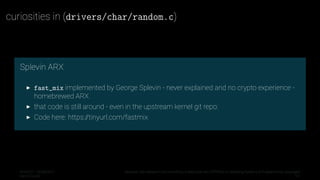
curiosities in (drivers/char/random.c)
Splevin ARX
fast_mix implemented by George Splevin - never explained and no crypto experience -
homebrewed ARX
that code is still around - even in the upstream kernel git repo:
Code here: https://tinyurl.com/fastmix
SHA2017 - 06/08/2017 Because "use urandom" isn’t everything: a deep dive into CSPRNGs in Operating Systems & Programming Languages
Aaron Zauner 6/1
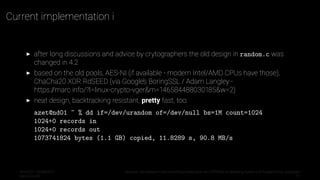
Current implementation i
after long discussions and advice by crytographers the old design in random.c was
changed in 4.2
based on the old pools, AES-NI (if available - modern Intel/AMD CPUs have those),
ChaCha20 XOR RdSEED (via Google’s BoringSSL / Adam Langley -
https://marc.info/?l=linux-crypto-vger&m=146584488030185&w=2)
neat design, backtracking resistant, pretty fast, too:
azet@nd01 ~ % dd if=/dev/urandom of=/dev/null bs=1M count=1024
1024+0 records in
1024+0 records out
1073741824 bytes (1.1 GB) copied, 11.8289 s, 90.8 MB/s
SHA2017 - 06/08/2017 Because "use urandom" isn’t everything: a deep dive into CSPRNGs in Operating Systems & Programming Languages
Aaron Zauner 7/1
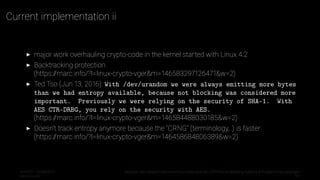
Current implementation ii
major work overhauling crypto-code in the kernel started with Linux 4.2
Backtracking protection
(https://marc.info/?l=linux-crypto-vger&m=146583297126471&w=2)
Ted Tso (Jun 13, 2016): With /dev/urandom we were always emitting more bytes
than we had entropy available, because not blocking was considered more
important. Previously we were relying on the security of SHA-1. With
AES CTR-DRBG, you rely on the security with AES.
(https://marc.info/?l=linux-crypto-vger&m=146584488030185&w=2)
Doesn’t track entropy anymore because the “CRNG” (terminology,..) is faster
(https://marc.info/?l=linux-crypto-vger&m=146458684806389&w=2)
SHA2017 - 06/08/2017 Because "use urandom" isn’t everything: a deep dive into CSPRNGs in Operating Systems & Programming Languages
Aaron Zauner 8/1
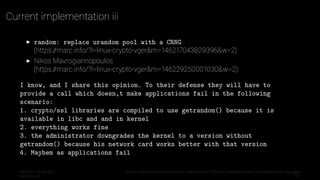
Current implementation iii
random: replace urandom pool with a CRNG
(https://marc.info/?l=linux-crypto-vger&m=146217043829396&w=2)
Nikos Mavrogiannopoulos
(https://marc.info/?l=linux-crypto-vger&m=146229250001030&w=2):
I know, and I share this opinion. To their defense they will have to
provide a call which doesn‚t make applications fail in the following
scenario:
1. crypto/ssl libraries are compiled to use getrandom() because it is
available in libc and and in kernel
2. everything works fine
3. the administrator downgrades the kernel to a version without
getrandom() because his network card works better with that version
4. Mayhem as applications fail
SHA2017 - 06/08/2017 Because "use urandom" isn’t everything: a deep dive into CSPRNGs in Operating Systems & Programming Languages
Aaron Zauner 9/1
Current implementation iv
random: make /dev/urandom scalable for silly userspace programs
(https://marc.info/?l=linux-crypto-vger&m=146583311726544&w=2):
On a system with a 4 socket (NUMA) system where a large number of
application threads were all trying to read from /dev/urandom, this
can result in the system spending 80% of its time contending on the
global urandom spinlock. The application should have used its own
PRNG, but let‚s try to help it from running, lemming-like, straight
over the locking cliff.
SHA2017 - 06/08/2017 Because "use urandom" isn’t everything: a deep dive into CSPRNGs in Operating Systems & Programming Languages
Aaron Zauner 10/1
Current implementation v
Myths and lies in man 4 random finally corrected:
https://bugzilla.kernel.org/show_bug.cgi?id=71211&utm_content=buffer1d02b
this took years of convincing the original upstream authors etc.
had a huge impact on use of RNGs in programming languages etc.
SHA2017 - 06/08/2017 Because "use urandom" isn’t everything: a deep dive into CSPRNGs in Operating Systems & Programming Languages
Aaron Zauner 11/1
Language issues: Ruby
using OpenSSL RNG designed for fast TLS use, not general purpose
multiple security engineers and cryptographers tried to convince them to switch to
/dev/urandom
took more than a year but finally they implemented a similar design to libsodium (I’ve
made a T-Shirt!)
SecureRandom without OpenSSL (or compatible alternatives) is nonsense.
Please don't rude.
Legendary bug: https://bugs.ruby-lang.org/issues/9569
Tony Arcieri (@bascule) wrote a wrapper for the time being:
https://github.com/cryptosphere/sysrandom
SHA2017 - 06/08/2017 Because "use urandom" isn’t everything: a deep dive into CSPRNGs in Operating Systems & Programming Languages
Aaron Zauner 12/1
Language issues: Node.js
similar story to Ruby
lots of input from normal users (useless)
https://github.com/nodejs/node/issues/5798 (endless thread)
Latest comment: ‘Note that OpenSSL has just landed a commit to use DRGB with
AES-CTR of NIST SP 800-90A as openssl/openssl@75e2c87. We can use it with the
os-specific seeding source (e.g. /dev/urandom) by a default define flag of
OPENSSL_RAND_SEED_OS. I think it is best for us to wait for the next release of
OpenSSL-1.1.1.“
SHA2017 - 06/08/2017 Because "use urandom" isn’t everything: a deep dive into CSPRNGs in Operating Systems & Programming Languages
Aaron Zauner 13/1
Language issues: Erlang
same as Ruby and Node.js
https://github.com/erlang/otp/blob/maint/lib/crypto/c_src/crypto.c
SHA2017 - 06/08/2017 Because "use urandom" isn’t everything: a deep dive into CSPRNGs in Operating Systems & Programming Languages
Aaron Zauner 14/1
Python imrprovement
warns if there’re insecure values: https://bugs.python.org/issue27292
SHA2017 - 06/08/2017 Because "use urandom" isn’t everything: a deep dive into CSPRNGs in Operating Systems & Programming Languages
Aaron Zauner 15/1
OpenSSL
Not thread safe - userspace - prone to bugs
https://github.com/openssl/openssl/issues/898
https://wiki.openssl.org/index.php/Random_Numbers
Not even recommended by OpenSSL to use it as non-TLS CSPRNG
SHA2017 - 06/08/2017 Because "use urandom" isn’t everything: a deep dive into CSPRNGs in Operating Systems & Programming Languages
Aaron Zauner 16/1
‘ HAVEGE
dangerous to use!
not maintained in more than 10yrs
no current contacts / security audits except by the original authors
doesn’t improve security!
SHA2017 - 06/08/2017 Because "use urandom" isn’t everything: a deep dive into CSPRNGs in Operating Systems & Programming Languages
Aaron Zauner 17/1
Parting words
...
SHA2017 - 06/08/2017 Because "use urandom" isn’t everything: a deep dive into CSPRNGs in Operating Systems & Programming Languages
Aaron Zauner 18/1
THANKS FOR YOUR PATIENCE. ARE THERE ANY QUESTIONS?
Twitter:
@a_z_e_t
E-Mail:
azet@azet.org
XMPP:
azet@jabber.ccc.de
GitHub:
https://github.com/azet
GPG Fingerprint:
7CB6 197E 385A 02DC 15D8 E223 E4DB 6492 FDB9 B5D5
SHA2017 - 06/08/2017 Because "use urandom" isn’t everything: a deep dive into CSPRNGs in Operating Systems & Programming Languages
Aaron Zauner 19/1

Because "use urandom" isn't everything: a deep dive into CSPRNGs in Operating Systems & Programming Languages

  • 1.
    Because "use urandom"isn’t everything: a deep dive into CSPRNGs in Operating Systems & Programming Languages Aaron Zauner azet@azet.org lambda.co.at: Highly-Available, Scalable & Secure Distributed Systems SHA2017 - 06/08/2017
  • 3.
    Why do weneed Random Numbers? randomize stuff in your operating system / language man rand Python: os.urandom TLS session cookies Key generation (e.g. RSA / Diffie-Hellman) TCP SYN cookies Bash: ${RANDOM} :) SHA2017 - 06/08/2017 Because "use urandom" isn’t everything: a deep dive into CSPRNGs in Operating Systems & Programming Languages Aaron Zauner 1/1
  • 4.
    CSPRNG i “Cryptographically SecurePseudo Random Number Generator” aka “RNG”, “Random number generator”.. Crypto nerds tend to call them “CSPRNGs” you may call them RNG or whatever, I don’t care that much as long as it’s secure! SHA2017 - 06/08/2017 Because "use urandom" isn’t everything: a deep dive into CSPRNGs in Operating Systems & Programming Languages Aaron Zauner 2/1
  • 5.
    CSPRNG ii Widely implementedin OS kernels Linux: /dev/urandom 1. manpage man random has been wrong for years 2. many myths about kernel entropy FreeBSD: /dev/*random 1. 2. Replace the RC4 algorithm for generating in-kernel secure random numbers with Chacha20. Keep the API, though, as that is what the other *BSD’s have done. Use the boot-time entropy stash (if present) to bootstrap the in-kernel entropy source. (https://svnweb.freebsd.org/base?view=revision&revision=317015 - Sun Apr 16 09:11:02 2017 UTC) Windows: RtlGenRandom() ..and in programming languages (i.e. Python os.urandom, PHP rand(),..) some had really bad bugs for a long time (i.e. debian predictable SSH keys: CVE-2008-0166) many use the kernel provided CSPRNG, others use OpenSSL or custom RNGs - which is BAD! OpenSSL provides a user-space RNG many link to or make use of (don’t!) Whoops: CVE-2017-11671: GCC generates incorrect code for RDRAND/RDSEED intrinsics (recent)SHA2017 - 06/08/2017 Because "use urandom" isn’t everything: a deep dive into CSPRNGs in Operating Systems & Programming Languages Aaron Zauner 3/1
  • 6.
    Some History the /dev/randomand /dev/urandom devices used to be really old code (mid-90ties) originated from Ted Tso and a few others the manpage for them was wrong until fixed in late last december! you don’t have to worry about kernel entropy - this is a myth! HAVEGE won’t save you! it can make things worse (See: https://blog.cr.yp.to/20140205-entropy.html) SHA2017 - 06/08/2017 Because "use urandom" isn’t everything: a deep dive into CSPRNGs in Operating Systems & Programming Languages Aaron Zauner 4/1
  • 7.
    Old Linux Kernelimplementation 0.x>4.x mixing different pools of interrupts quite complicated to understand even for well versed C programmers it worked without larger incidents - probably pure luck and researchers unable to read char device code old design described well here: Blog Post: https://pthree.org/2014/07/21/the-linux-random-number-generator/ Academic: https://eprint.iacr.org/2012/251.pdf SHA2017 - 06/08/2017 Because "use urandom" isn’t everything: a deep dive into CSPRNGs in Operating Systems & Programming Languages Aaron Zauner 5/1
  • 8.
    curiosities in (drivers/char/random.c) SplevinARX fast_mix implemented by George Splevin - never explained and no crypto experience - homebrewed ARX that code is still around - even in the upstream kernel git repo: Code here: https://tinyurl.com/fastmix SHA2017 - 06/08/2017 Because "use urandom" isn’t everything: a deep dive into CSPRNGs in Operating Systems & Programming Languages Aaron Zauner 6/1
  • 9.
    Current implementation i afterlong discussions and advice by crytographers the old design in random.c was changed in 4.2 based on the old pools, AES-NI (if available - modern Intel/AMD CPUs have those), ChaCha20 XOR RdSEED (via Google’s BoringSSL / Adam Langley - https://marc.info/?l=linux-crypto-vger&m=146584488030185&w=2) neat design, backtracking resistant, pretty fast, too: azet@nd01 ~ % dd if=/dev/urandom of=/dev/null bs=1M count=1024 1024+0 records in 1024+0 records out 1073741824 bytes (1.1 GB) copied, 11.8289 s, 90.8 MB/s SHA2017 - 06/08/2017 Because "use urandom" isn’t everything: a deep dive into CSPRNGs in Operating Systems & Programming Languages Aaron Zauner 7/1
  • 10.
    Current implementation ii majorwork overhauling crypto-code in the kernel started with Linux 4.2 Backtracking protection (https://marc.info/?l=linux-crypto-vger&m=146583297126471&w=2) Ted Tso (Jun 13, 2016): With /dev/urandom we were always emitting more bytes than we had entropy available, because not blocking was considered more important. Previously we were relying on the security of SHA-1. With AES CTR-DRBG, you rely on the security with AES. (https://marc.info/?l=linux-crypto-vger&m=146584488030185&w=2) Doesn’t track entropy anymore because the “CRNG” (terminology,..) is faster (https://marc.info/?l=linux-crypto-vger&m=146458684806389&w=2) SHA2017 - 06/08/2017 Because "use urandom" isn’t everything: a deep dive into CSPRNGs in Operating Systems & Programming Languages Aaron Zauner 8/1
  • 11.
    Current implementation iii random:replace urandom pool with a CRNG (https://marc.info/?l=linux-crypto-vger&m=146217043829396&w=2) Nikos Mavrogiannopoulos (https://marc.info/?l=linux-crypto-vger&m=146229250001030&w=2): I know, and I share this opinion. To their defense they will have to provide a call which doesn‚t make applications fail in the following scenario: 1. crypto/ssl libraries are compiled to use getrandom() because it is available in libc and and in kernel 2. everything works fine 3. the administrator downgrades the kernel to a version without getrandom() because his network card works better with that version 4. Mayhem as applications fail SHA2017 - 06/08/2017 Because "use urandom" isn’t everything: a deep dive into CSPRNGs in Operating Systems & Programming Languages Aaron Zauner 9/1
  • 12.
    Current implementation iv random:make /dev/urandom scalable for silly userspace programs (https://marc.info/?l=linux-crypto-vger&m=146583311726544&w=2): On a system with a 4 socket (NUMA) system where a large number of application threads were all trying to read from /dev/urandom, this can result in the system spending 80% of its time contending on the global urandom spinlock. The application should have used its own PRNG, but let‚s try to help it from running, lemming-like, straight over the locking cliff. SHA2017 - 06/08/2017 Because "use urandom" isn’t everything: a deep dive into CSPRNGs in Operating Systems & Programming Languages Aaron Zauner 10/1
  • 13.
    Current implementation v Mythsand lies in man 4 random finally corrected: https://bugzilla.kernel.org/show_bug.cgi?id=71211&utm_content=buffer1d02b this took years of convincing the original upstream authors etc. had a huge impact on use of RNGs in programming languages etc. SHA2017 - 06/08/2017 Because "use urandom" isn’t everything: a deep dive into CSPRNGs in Operating Systems & Programming Languages Aaron Zauner 11/1
  • 14.
    Language issues: Ruby usingOpenSSL RNG designed for fast TLS use, not general purpose multiple security engineers and cryptographers tried to convince them to switch to /dev/urandom took more than a year but finally they implemented a similar design to libsodium (I’ve made a T-Shirt!) SecureRandom without OpenSSL (or compatible alternatives) is nonsense. Please don't rude. Legendary bug: https://bugs.ruby-lang.org/issues/9569 Tony Arcieri (@bascule) wrote a wrapper for the time being: https://github.com/cryptosphere/sysrandom SHA2017 - 06/08/2017 Because "use urandom" isn’t everything: a deep dive into CSPRNGs in Operating Systems & Programming Languages Aaron Zauner 12/1
  • 15.
    Language issues: Node.js similarstory to Ruby lots of input from normal users (useless) https://github.com/nodejs/node/issues/5798 (endless thread) Latest comment: ‘Note that OpenSSL has just landed a commit to use DRGB with AES-CTR of NIST SP 800-90A as openssl/openssl@75e2c87. We can use it with the os-specific seeding source (e.g. /dev/urandom) by a default define flag of OPENSSL_RAND_SEED_OS. I think it is best for us to wait for the next release of OpenSSL-1.1.1.“ SHA2017 - 06/08/2017 Because "use urandom" isn’t everything: a deep dive into CSPRNGs in Operating Systems & Programming Languages Aaron Zauner 13/1
  • 16.
    Language issues: Erlang sameas Ruby and Node.js https://github.com/erlang/otp/blob/maint/lib/crypto/c_src/crypto.c SHA2017 - 06/08/2017 Because "use urandom" isn’t everything: a deep dive into CSPRNGs in Operating Systems & Programming Languages Aaron Zauner 14/1
  • 17.
    Python imrprovement warns ifthere’re insecure values: https://bugs.python.org/issue27292 SHA2017 - 06/08/2017 Because "use urandom" isn’t everything: a deep dive into CSPRNGs in Operating Systems & Programming Languages Aaron Zauner 15/1
  • 18.
    OpenSSL Not thread safe- userspace - prone to bugs https://github.com/openssl/openssl/issues/898 https://wiki.openssl.org/index.php/Random_Numbers Not even recommended by OpenSSL to use it as non-TLS CSPRNG SHA2017 - 06/08/2017 Because "use urandom" isn’t everything: a deep dive into CSPRNGs in Operating Systems & Programming Languages Aaron Zauner 16/1
  • 19.
    ‘ HAVEGE dangerous touse! not maintained in more than 10yrs no current contacts / security audits except by the original authors doesn’t improve security! SHA2017 - 06/08/2017 Because "use urandom" isn’t everything: a deep dive into CSPRNGs in Operating Systems & Programming Languages Aaron Zauner 17/1
  • 20.
    Parting words ... SHA2017 -06/08/2017 Because "use urandom" isn’t everything: a deep dive into CSPRNGs in Operating Systems & Programming Languages Aaron Zauner 18/1
  • 21.
    THANKS FOR YOURPATIENCE. ARE THERE ANY QUESTIONS? Twitter: @a_z_e_t E-Mail: azet@azet.org XMPP: azet@jabber.ccc.de GitHub: https://github.com/azet GPG Fingerprint: 7CB6 197E 385A 02DC 15D8 E223 E4DB 6492 FDB9 B5D5 SHA2017 - 06/08/2017 Because "use urandom" isn’t everything: a deep dive into CSPRNGs in Operating Systems & Programming Languages Aaron Zauner 19/1