Learning Objectives Testing What is testing? Why test? How testing increase our confidence in program correctness? When to test? What to test? How to test? Different types of testing How to assess test adequacy?
Testing When should we test? Separate phase for testing?  OR At the end of every phase?  OR During each phase, simultaneously with all development and maintenance activities
Terminology Program -  Sort Specification Input : p - array of n integers, n > 0 Output : q - array of n integers such that q[0]    q[1]    …    q[n] Elements in q are a permutation of elements in p, which are unchanged Description of requirements of a program
Tests Test input (Test case) A set of values given as input to a program Includes environment variables {2, 3, 6, 5, 4} Test set A set of test cases { {0}, {9, 8, 7, 6, 5}, {1, 3, 4, 5}, {2, 1, 2, 3} }
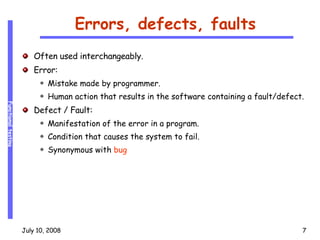
Oracle Function that determines whether or not the results of executing a program under test is as per the program’s specifications Software Under Test Oracle Test Cases output output Failure? Success? Compare Problems Correctness of Oracle Correctness of specs Generation of Oracle Need more formal specs
Correctness Program Correctness A program P is considered  with respect to a specification  S, if and only if: For each valid input, the output of P is in accordance with the specification S What if the specifications are themselves incorrect?
Errors, defects, faults Often used interchangeably. Error:  Mistake made by programmer. Human action that results in the software containing a fault/defect. Defect / Fault: Manifestation of the error in a program. Condition that causes the system to fail. Synonymous with  bug
Failure Incorrect program behavior due to a fault in the program. Failure can be determined only with respect to a set of requirement specs. For failure to occur, the testing of the program should force the erroneous portion of the program to be executed.
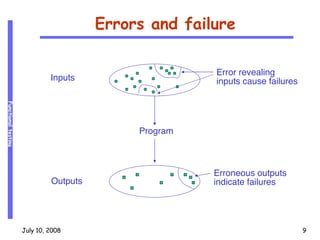
Errors and failure Inputs Outputs Error revealing inputs cause failures Erroneous outputs indicate failures Program
Nonexecution-Based Testing Person creating a product should not be the only one responsible for reviewing it. A document is is checked by a team of software professionals with a range of skills. Increases chances of finding a fault. Types of reviews Walkthroughs Inspections
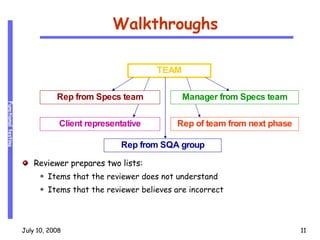
Walkthroughs Reviewer prepares two lists: Items that the reviewer does not understand Items that the reviewer believes are incorrect TEAM Client representative Rep of team from next phase Rep from SQA group Rep from Specs team Manager from Specs team
Managing walkthroughs Distribute material for walkthrough in advance. Includes senior technical staff. Chaired by the SQA representative. Task is to record fault for  later  correction Not much time to fix it during walkthrough Other individuals are trained to fix it better Cost of 1  team  vs cost of 1  person Not all faults need to be fixed as not all “faults” flagged are incorrect
Managing walkthroughs (contd.) Two ways of doing walkthroughs Participant driven Present lists of unclear items and incorrect items Rep from specs team responds to each query Document driven Person responsible for document walks the participants through the document Reviewers interrupt with prepared comments or comments triggered by the presentation Interactive process Not to be used for the evaluation of participants
Inspections Proposed by Fagan for testing  designs code An inspection goes beyond a walkthrough Five formal stages Stage 1 -  Overview Overview document (specs/design/code/ plan) to be prepared by person responsible for producing the product. Document is distributed to participants.
Inspections (contd.) Stage 2 -  Preparation Understand the document in detail. List of fault types found in inspections ranked by frequency used for concentrating efforts. Stage 3 -  Inspection Walk through the document and ensure that Each item is covered Every branch is taken at least once Find faults and document them (don’t correct) Leader (moderator) produces a written report
Inspections (contd.) Stage 4 -  Rework Resolve all faults and problems Stage 5 -  Follow-up Moderator must ensure that every issue has been resolved in some way Team Moderator-manager, leader of inspection team Designer - team responsible for current phase Implementer - team responsible for next phase Tester - preferably from SQA team
What to look for in inspections Is each item in a specs doc adequately and correctly addressed? Do actual and formal parameters match? Error handling mechanisms identified? Design compatible with hardware resources? What about with software resources?
What to record in inspections Record fault statistics Categorize by severity, fault type Compare # faults with average # faults in same stage of development Find disproportionate # in some modules, then begin checking other modules Too many faults => redesign the module Information on fault types will help in code inspection in the same module
Pros and cons of inspection High number of faults found even before testing (design and code inspections) Higher programmer productivity, less time on module testing Fewer faults found in product that was inspected before If faults are detected early in the process there is a huge savings What if walkthroughs are used for performance appraisal?
Execution-based testing Execution-based testing is a process of  inferring  certain behavioral properties of a product, based, in part, on the results of executing the product in a  known environment  with  selected inputs . Depends on environment and inputs How well do we know the environment? How much control do we have over test inputs? Real time systems
Reliability Probability of failure-free operation of a product for a given time duration How often does the product fail? mean time between failures How bad are the effects? How long does it take to repair it? mean time to repair Failure behavior controlled by Number of faults Operational profile of execution
Robustness How well does the product behave with range of operating conditions possibility of unacceptable results with valid input? possibility of unacceptable results with invalid input? Should not crash even when  not  used under permissible conditions
Performance To what extent does the product meet its requirements with regard to  response time space requirements What if there are too many clients/ processes, etc...
Levels of testing Unit testing Integration testing System testing Acceptance testing
Functional testing Learning objectives What is functional testing? How to perform functional testing? What are clues, test requirements, and test specifications? How to generate test inputs?  What are equivalence partitioning, boundary value testing, domain testing, state testing, and decision table testing?
What is functional testing? When test inputs are generated using program specifications, we say that we are doing  functional testing . Functional testing tests how well a program meets the  functionality  requirements.
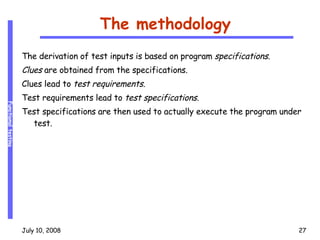
The methodology The derivation of test inputs is based on program  specifications . Clues  are obtained from the specifications. Clues lead to  test requirements . Test requirements lead to  test specifications . Test specifications are then used to actually execute the program under test.
Specifications-continued Two types of pre-conditions are considered: Validated : those that are required to be validated by the program under test and an error action is required to be performed if the condition is not true.  Assumed : those that are assumed to be true and not checked by the program under test.
Preconditions for  sort Validated: N >0 On failure return -1; sorting considered unsuccessful. Assumed: The input sequence contains  N  integers. The output area has space for at least  N  integers.
Post-conditions A post-condition specifies a property of the output of a program. The general format of a post-condition is: if  condition  then  effect-1 { else  effect-2} Example: For the sort program a post-condition is: if   N >0  then  {the output sequence has the same elements as in the input sequence and in ascending order.}
Incompleteness of specifications Specifications may be  incomplete  or  ambiguous . Example post-condition:  if  user places cursor on the name field  then  read a string  This post-condition does not specify any limit on the length of the input string hence is  incomplete .
Ambiguous specifications It also does not make it clear as to whether a string should be input only after the user has placed the cursor on the name field  and  clicked the mouse or simply placed the cursor on the name field. and hence is  ambiguous.
Clues: summary Clues are: Pre-conditions Post-conditions Variables ,  e.g. A is a length implying thereby that its value cannot be negative. Operations , e.g. “search a list of names” or “find the average of total scores” Definitions, e.g. “filename(name) is a name with no spaces.”
Clues-continued Ideally  variables, operations  and  definitions  should be a part of at least one pre- or post-condition. However, this may not be the case as specifications are not always written formally. Hence look out for variables, operations, and definitions within a specification!
Test requirements checklist Obtaining clues and deriving test requirements can become a tedious task. To keep it from overwhelming us it is a good idea to make a checklist of clues. This checklist is then transformed into a checklist of test requirements by going through each clue and deriving test requirements from it.
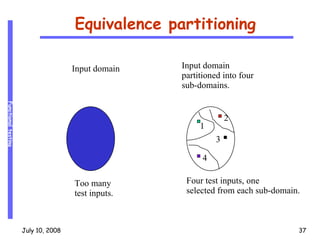
Equivalence partitioning The input domain is usually too large for exhaustive testing. It is therefore partitioned into a finite number of sub-domains for the selection of test inputs. Each sub-domain is known as an equivalence class and serves as a source of at least one  test input.
Equivalence partitioning Too many test inputs. Four test inputs, one  selected from each sub-domain. Input domain 1 2 3 4 Input domain  partitioned into four  sub-domains.
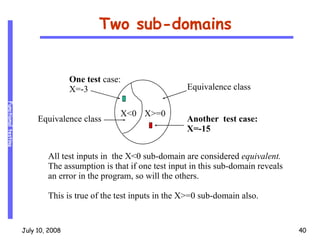
How to partition? Inputs to a program provide clues to partitioning. Example 1: Suppose that program P takes an input X, X being an integer. For X<0 the program is required to perform task T1 and for X>=0  task T2.
How to partition?-continued The input domain is prohibitively large because X can assume a large number of values. However, we expect P to behave the same way for all X<0.  Similarly, we expect P to perform the same way for all values of X>=0.  We therefore partition the input domain of P into two sub-domains.
Two sub-domains All test inputs in  the X<0 sub-domain are considered  equivalent. The assumption is that if one test input in this sub-domain reveals an error in the program, so will the others.  This is true of the test inputs in the X>=0 sub-domain also. One test  case: X=-3 Another  test case: X=-15 X<0 X>=0 Equivalence class Equivalence class
Non-overlapping partitions In the previous example, the two equivalence classes are non-overlapping. In other words the two sub-domains are disjoint. When the sub-domains are disjoint, it is sufficient to pick one test input from each equivalence class to test the program.
Non-overlapping partitions An equivalence class is considered  covered  when at least one test has been selected from it. In partition testing our goal is to cover all equivalence classes.
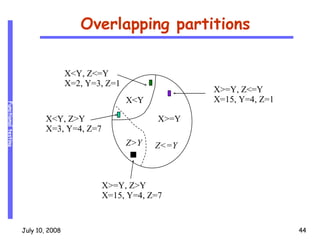
Overlapping partitions Example 2: Suppose that program P takes three integers  X, Y and Z. It is known that: X<Y  Z>Y
Overlapping partitions X<Y X>=Y Z>Y Z<=Y X<Y, Z>Y X=3, Y=4, Z=7 X<Y, Z<=Y X=2, Y=3, Z=1 X>=Y, Z>Y X=15, Y=4, Z=7 X>=Y, Z<=Y X=15, Y=4, Z=1
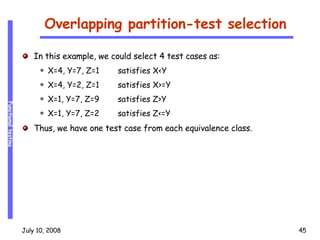
Overlapping partition-test selection In this example, we could select 4 test cases as: X=4, Y=7, Z=1 satisfies X<Y X=4, Y=2, Z=1 satisfies X>=Y X=1, Y=7, Z=9 satisfies Z>Y X=1, Y=7, Z=2 satisfies Z<=Y Thus, we have one test case from each equivalence class.
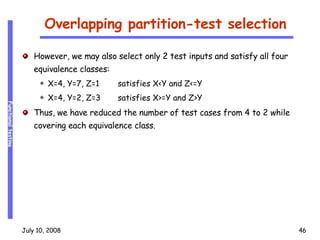
Overlapping partition-test selection However, we may also select only 2 test inputs and satisfy all four equivalence classes: X=4, Y=7, Z=1 satisfies X<Y and Z<=Y X=4, Y=2, Z=3 satisfies X>=Y and Z>Y Thus, we have reduced the number of test cases from 4 to 2 while covering each equivalence class.
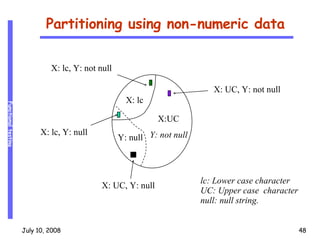
Partitioning using non-numeric data In the previous two examples the inputs were integers. One can derive equivalence classes for other types of data also. Example 3: Suppose that program P takes one character X and one string Y as inputs. P performs task T1 for all lower case characters and T2 for upper case characters. Also, it performs task T3 for the  null  string and T4 for all other strings.
Partitioning using non-numeric data lc: Lower case character UC: Upper case  character null: null string. X: lc X:UC Y: null Y: not null X: lc, Y: null X: lc, Y: not null X: UC, Y: null X: UC, Y: not null
Non-numeric data Once again we have overlapping partitions. We can select only 2 test inputs to cover all four equivalence classes. These are: X: lower case, Y: null string X: upper case, Y: not a null string
Guidelines for equivalence partitioning Input condition specifies a range : create one for the valid case and two for the invalid cases. e.g. for a<=X<=b the classes are  a<=X<=b  (valid case) X<a and X>b (the invalid cases)
Guidelines-continued Input condition specifies a value : create one for the valid value and two for incorrect values (below and above the valid value). This may not be possible for certain data types, e.g. for  boolean . Input condition specifies a member of a set : create one for the valid value and one for the invalid (not in the set) value.
Sufficiency of partitions In the previous examples we derived equivalence classes based on the conditions satisfied by the input data. Then we selected just enough tests to cover each partition. Think of the advantages and disadvantages of this approach !
Boundary value analysis (BVA) Another way to generate test cases is to look for boundary values. Suppose a program takes an integer X as input. In the absence of any information, we assume that X=0 is a boundary. Inputs to the program might lie on the boundary or on either side of the boundary.
BVA: continued This leads to 3 test inputs: X=0, X=-20, and X=14. Note that the values -20 and 14 are on either side of the boundary and are chosen arbitrarily. Notice that using BVA we get 3 equivalence classes. One of these three classes contains only one value (X=0), the other two  are large!
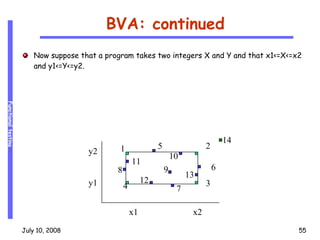
BVA: continued Now suppose that a program takes two integers X and Y and that x1<=X<=x2 and y1<=Y<=y2.  x1 x2 y2 y1 1 2 3 4 5 6 7 8 10 9 11 12 13 14
BVA-continued In this case the four sides of the rectangle represent the boundary. The heuristic for test selection in this case is: Select one test  at  each corner (1, 2, 3, 4). Select one test  just outside  of each of the four sides of the boundary (5, 6, 7, 8)
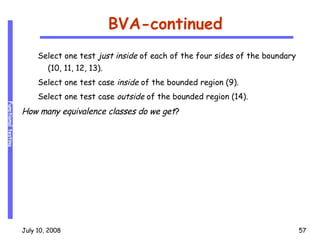
BVA-continued Select one test  just inside  of each of the four sides of the boundary (10, 11, 12, 13). Select one test case  inside  of the bounded region (9). Select one test case  outside  of the bounded region (14). How many equivalence classes do we get ?
BVA -continued In the previous examples we considered only numeric data. BVA can be done on any type of data. For example, suppose that a program takes a string S and an integer X as inputs. The constraints on inputs are: length(S)<=100  and a<=X<=b Can you derive the test cases using BVA?
BVA applied to output variables Just as we applied BVA to input data, we can apply it to output data. Doing so gives us equivalence classes for the output domain. We then try to find test inputs that will cover each output equivalence class.
Summary Specifications, pre-conditions, and post-conditions. Clues, test requirements, and test specifications. Clues from code. Test requirements catalog. Equivalence partitioning and boundary value analysis.

Testing

  • 1.
    Learning Objectives TestingWhat is testing? Why test? How testing increase our confidence in program correctness? When to test? What to test? How to test? Different types of testing How to assess test adequacy?
  • 2.
    Testing When shouldwe test? Separate phase for testing? OR At the end of every phase? OR During each phase, simultaneously with all development and maintenance activities
  • 3.
    Terminology Program - Sort Specification Input : p - array of n integers, n > 0 Output : q - array of n integers such that q[0]  q[1]  …  q[n] Elements in q are a permutation of elements in p, which are unchanged Description of requirements of a program
  • 4.
    Tests Test input(Test case) A set of values given as input to a program Includes environment variables {2, 3, 6, 5, 4} Test set A set of test cases { {0}, {9, 8, 7, 6, 5}, {1, 3, 4, 5}, {2, 1, 2, 3} }
  • 5.
    Oracle Function thatdetermines whether or not the results of executing a program under test is as per the program’s specifications Software Under Test Oracle Test Cases output output Failure? Success? Compare Problems Correctness of Oracle Correctness of specs Generation of Oracle Need more formal specs
  • 6.
    Correctness Program CorrectnessA program P is considered with respect to a specification S, if and only if: For each valid input, the output of P is in accordance with the specification S What if the specifications are themselves incorrect?
  • 7.
    Errors, defects, faultsOften used interchangeably. Error: Mistake made by programmer. Human action that results in the software containing a fault/defect. Defect / Fault: Manifestation of the error in a program. Condition that causes the system to fail. Synonymous with bug
  • 8.
    Failure Incorrect programbehavior due to a fault in the program. Failure can be determined only with respect to a set of requirement specs. For failure to occur, the testing of the program should force the erroneous portion of the program to be executed.
  • 9.
    Errors and failureInputs Outputs Error revealing inputs cause failures Erroneous outputs indicate failures Program
  • 10.
    Nonexecution-Based Testing Personcreating a product should not be the only one responsible for reviewing it. A document is is checked by a team of software professionals with a range of skills. Increases chances of finding a fault. Types of reviews Walkthroughs Inspections
  • 11.
    Walkthroughs Reviewer preparestwo lists: Items that the reviewer does not understand Items that the reviewer believes are incorrect TEAM Client representative Rep of team from next phase Rep from SQA group Rep from Specs team Manager from Specs team
  • 12.
    Managing walkthroughs Distributematerial for walkthrough in advance. Includes senior technical staff. Chaired by the SQA representative. Task is to record fault for later correction Not much time to fix it during walkthrough Other individuals are trained to fix it better Cost of 1 team vs cost of 1 person Not all faults need to be fixed as not all “faults” flagged are incorrect
  • 13.
    Managing walkthroughs (contd.)Two ways of doing walkthroughs Participant driven Present lists of unclear items and incorrect items Rep from specs team responds to each query Document driven Person responsible for document walks the participants through the document Reviewers interrupt with prepared comments or comments triggered by the presentation Interactive process Not to be used for the evaluation of participants
  • 14.
    Inspections Proposed byFagan for testing designs code An inspection goes beyond a walkthrough Five formal stages Stage 1 - Overview Overview document (specs/design/code/ plan) to be prepared by person responsible for producing the product. Document is distributed to participants.
  • 15.
    Inspections (contd.) Stage2 - Preparation Understand the document in detail. List of fault types found in inspections ranked by frequency used for concentrating efforts. Stage 3 - Inspection Walk through the document and ensure that Each item is covered Every branch is taken at least once Find faults and document them (don’t correct) Leader (moderator) produces a written report
  • 16.
    Inspections (contd.) Stage4 - Rework Resolve all faults and problems Stage 5 - Follow-up Moderator must ensure that every issue has been resolved in some way Team Moderator-manager, leader of inspection team Designer - team responsible for current phase Implementer - team responsible for next phase Tester - preferably from SQA team
  • 17.
    What to lookfor in inspections Is each item in a specs doc adequately and correctly addressed? Do actual and formal parameters match? Error handling mechanisms identified? Design compatible with hardware resources? What about with software resources?
  • 18.
    What to recordin inspections Record fault statistics Categorize by severity, fault type Compare # faults with average # faults in same stage of development Find disproportionate # in some modules, then begin checking other modules Too many faults => redesign the module Information on fault types will help in code inspection in the same module
  • 19.
    Pros and consof inspection High number of faults found even before testing (design and code inspections) Higher programmer productivity, less time on module testing Fewer faults found in product that was inspected before If faults are detected early in the process there is a huge savings What if walkthroughs are used for performance appraisal?
  • 20.
    Execution-based testing Execution-basedtesting is a process of inferring certain behavioral properties of a product, based, in part, on the results of executing the product in a known environment with selected inputs . Depends on environment and inputs How well do we know the environment? How much control do we have over test inputs? Real time systems
  • 21.
    Reliability Probability offailure-free operation of a product for a given time duration How often does the product fail? mean time between failures How bad are the effects? How long does it take to repair it? mean time to repair Failure behavior controlled by Number of faults Operational profile of execution
  • 22.
    Robustness How welldoes the product behave with range of operating conditions possibility of unacceptable results with valid input? possibility of unacceptable results with invalid input? Should not crash even when not used under permissible conditions
  • 23.
    Performance To whatextent does the product meet its requirements with regard to response time space requirements What if there are too many clients/ processes, etc...
  • 24.
    Levels of testingUnit testing Integration testing System testing Acceptance testing
  • 25.
    Functional testing Learningobjectives What is functional testing? How to perform functional testing? What are clues, test requirements, and test specifications? How to generate test inputs? What are equivalence partitioning, boundary value testing, domain testing, state testing, and decision table testing?
  • 26.
    What is functionaltesting? When test inputs are generated using program specifications, we say that we are doing functional testing . Functional testing tests how well a program meets the functionality requirements.
  • 27.
    The methodology Thederivation of test inputs is based on program specifications . Clues are obtained from the specifications. Clues lead to test requirements . Test requirements lead to test specifications . Test specifications are then used to actually execute the program under test.
  • 28.
    Specifications-continued Two typesof pre-conditions are considered: Validated : those that are required to be validated by the program under test and an error action is required to be performed if the condition is not true. Assumed : those that are assumed to be true and not checked by the program under test.
  • 29.
    Preconditions for sort Validated: N >0 On failure return -1; sorting considered unsuccessful. Assumed: The input sequence contains N integers. The output area has space for at least N integers.
  • 30.
    Post-conditions A post-conditionspecifies a property of the output of a program. The general format of a post-condition is: if condition then effect-1 { else effect-2} Example: For the sort program a post-condition is: if N >0 then {the output sequence has the same elements as in the input sequence and in ascending order.}
  • 31.
    Incompleteness of specificationsSpecifications may be incomplete or ambiguous . Example post-condition: if user places cursor on the name field then read a string This post-condition does not specify any limit on the length of the input string hence is incomplete .
  • 32.
    Ambiguous specifications Italso does not make it clear as to whether a string should be input only after the user has placed the cursor on the name field and clicked the mouse or simply placed the cursor on the name field. and hence is ambiguous.
  • 33.
    Clues: summary Cluesare: Pre-conditions Post-conditions Variables , e.g. A is a length implying thereby that its value cannot be negative. Operations , e.g. “search a list of names” or “find the average of total scores” Definitions, e.g. “filename(name) is a name with no spaces.”
  • 34.
    Clues-continued Ideally variables, operations and definitions should be a part of at least one pre- or post-condition. However, this may not be the case as specifications are not always written formally. Hence look out for variables, operations, and definitions within a specification!
  • 35.
    Test requirements checklistObtaining clues and deriving test requirements can become a tedious task. To keep it from overwhelming us it is a good idea to make a checklist of clues. This checklist is then transformed into a checklist of test requirements by going through each clue and deriving test requirements from it.
  • 36.
    Equivalence partitioning Theinput domain is usually too large for exhaustive testing. It is therefore partitioned into a finite number of sub-domains for the selection of test inputs. Each sub-domain is known as an equivalence class and serves as a source of at least one test input.
  • 37.
    Equivalence partitioning Toomany test inputs. Four test inputs, one selected from each sub-domain. Input domain 1 2 3 4 Input domain partitioned into four sub-domains.
  • 38.
    How to partition?Inputs to a program provide clues to partitioning. Example 1: Suppose that program P takes an input X, X being an integer. For X<0 the program is required to perform task T1 and for X>=0 task T2.
  • 39.
    How to partition?-continuedThe input domain is prohibitively large because X can assume a large number of values. However, we expect P to behave the same way for all X<0. Similarly, we expect P to perform the same way for all values of X>=0. We therefore partition the input domain of P into two sub-domains.
  • 40.
    Two sub-domains Alltest inputs in the X<0 sub-domain are considered equivalent. The assumption is that if one test input in this sub-domain reveals an error in the program, so will the others. This is true of the test inputs in the X>=0 sub-domain also. One test case: X=-3 Another test case: X=-15 X<0 X>=0 Equivalence class Equivalence class
  • 41.
    Non-overlapping partitions Inthe previous example, the two equivalence classes are non-overlapping. In other words the two sub-domains are disjoint. When the sub-domains are disjoint, it is sufficient to pick one test input from each equivalence class to test the program.
  • 42.
    Non-overlapping partitions Anequivalence class is considered covered when at least one test has been selected from it. In partition testing our goal is to cover all equivalence classes.
  • 43.
    Overlapping partitions Example2: Suppose that program P takes three integers X, Y and Z. It is known that: X<Y Z>Y
  • 44.
    Overlapping partitions X<YX>=Y Z>Y Z<=Y X<Y, Z>Y X=3, Y=4, Z=7 X<Y, Z<=Y X=2, Y=3, Z=1 X>=Y, Z>Y X=15, Y=4, Z=7 X>=Y, Z<=Y X=15, Y=4, Z=1
  • 45.
    Overlapping partition-test selectionIn this example, we could select 4 test cases as: X=4, Y=7, Z=1 satisfies X<Y X=4, Y=2, Z=1 satisfies X>=Y X=1, Y=7, Z=9 satisfies Z>Y X=1, Y=7, Z=2 satisfies Z<=Y Thus, we have one test case from each equivalence class.
  • 46.
    Overlapping partition-test selectionHowever, we may also select only 2 test inputs and satisfy all four equivalence classes: X=4, Y=7, Z=1 satisfies X<Y and Z<=Y X=4, Y=2, Z=3 satisfies X>=Y and Z>Y Thus, we have reduced the number of test cases from 4 to 2 while covering each equivalence class.
  • 47.
    Partitioning using non-numericdata In the previous two examples the inputs were integers. One can derive equivalence classes for other types of data also. Example 3: Suppose that program P takes one character X and one string Y as inputs. P performs task T1 for all lower case characters and T2 for upper case characters. Also, it performs task T3 for the null string and T4 for all other strings.
  • 48.
    Partitioning using non-numericdata lc: Lower case character UC: Upper case character null: null string. X: lc X:UC Y: null Y: not null X: lc, Y: null X: lc, Y: not null X: UC, Y: null X: UC, Y: not null
  • 49.
    Non-numeric data Onceagain we have overlapping partitions. We can select only 2 test inputs to cover all four equivalence classes. These are: X: lower case, Y: null string X: upper case, Y: not a null string
  • 50.
    Guidelines for equivalencepartitioning Input condition specifies a range : create one for the valid case and two for the invalid cases. e.g. for a<=X<=b the classes are a<=X<=b (valid case) X<a and X>b (the invalid cases)
  • 51.
    Guidelines-continued Input conditionspecifies a value : create one for the valid value and two for incorrect values (below and above the valid value). This may not be possible for certain data types, e.g. for boolean . Input condition specifies a member of a set : create one for the valid value and one for the invalid (not in the set) value.
  • 52.
    Sufficiency of partitionsIn the previous examples we derived equivalence classes based on the conditions satisfied by the input data. Then we selected just enough tests to cover each partition. Think of the advantages and disadvantages of this approach !
  • 53.
    Boundary value analysis(BVA) Another way to generate test cases is to look for boundary values. Suppose a program takes an integer X as input. In the absence of any information, we assume that X=0 is a boundary. Inputs to the program might lie on the boundary or on either side of the boundary.
  • 54.
    BVA: continued Thisleads to 3 test inputs: X=0, X=-20, and X=14. Note that the values -20 and 14 are on either side of the boundary and are chosen arbitrarily. Notice that using BVA we get 3 equivalence classes. One of these three classes contains only one value (X=0), the other two are large!
  • 55.
    BVA: continued Nowsuppose that a program takes two integers X and Y and that x1<=X<=x2 and y1<=Y<=y2. x1 x2 y2 y1 1 2 3 4 5 6 7 8 10 9 11 12 13 14
  • 56.
    BVA-continued In thiscase the four sides of the rectangle represent the boundary. The heuristic for test selection in this case is: Select one test at each corner (1, 2, 3, 4). Select one test just outside of each of the four sides of the boundary (5, 6, 7, 8)
  • 57.
    BVA-continued Select onetest just inside of each of the four sides of the boundary (10, 11, 12, 13). Select one test case inside of the bounded region (9). Select one test case outside of the bounded region (14). How many equivalence classes do we get ?
  • 58.
    BVA -continued Inthe previous examples we considered only numeric data. BVA can be done on any type of data. For example, suppose that a program takes a string S and an integer X as inputs. The constraints on inputs are: length(S)<=100 and a<=X<=b Can you derive the test cases using BVA?
  • 59.
    BVA applied tooutput variables Just as we applied BVA to input data, we can apply it to output data. Doing so gives us equivalence classes for the output domain. We then try to find test inputs that will cover each output equivalence class.
  • 60.
    Summary Specifications, pre-conditions,and post-conditions. Clues, test requirements, and test specifications. Clues from code. Test requirements catalog. Equivalence partitioning and boundary value analysis.