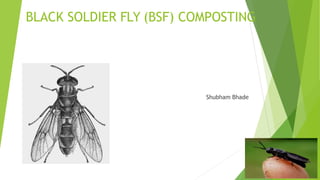
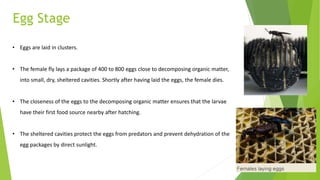
BLACK SOLDIER FLY (BSF) COMPOSTING
Shubham Bhade
Taxonomy
Scientific name - Hermetia illucens
Family - Stratiomyidae
Order - Diptera
Lifecycle
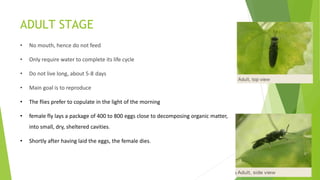
Egg Stage
• Eggs are laid in clusters.
• The female fly lays a package of 400 to 800 eggs close to decomposing organic matter,
into small, dry, sheltered cavities. Shortly after having laid the eggs, the female dies.
• The closeness of the eggs to the decomposing organic matter ensures that the larvae
have their first food source nearby after hatching.
• The sheltered cavities protect the eggs from predators and prevent dehydration of the
egg packages by direct sunlight.
LARVAL STAGE
• live long, feed for ~2 weeks
• can eat twice their body weight daily
• grow from a few millimetres size to around 2.5 cm length and 0.5 cm width
• Cream colour with darker rings around the body segments
• as they mature they become a dark grayish brown
• five larval stages
• 43% protein and 35% fat
Pupal stage
• Pupation takes around two to three weeks and ends when
the fly emerges from its pupa shell.
• environmental conditions- warm, dry and shaded.
• fly breaks open the part of the pupa that used to be the
head section, crawl out, dry and then spread its wings and
fly off.
Pre-pupal stage
• final larval stage
• larva replaces its mouthpart with a hook-shaped structure
and becomes dark brown to charcoal grey in colour.
• It uses this hook to easily move out and away from the food
source towards a nearby dry, humus-like, shaded and
protected environment that it deems safe from predators
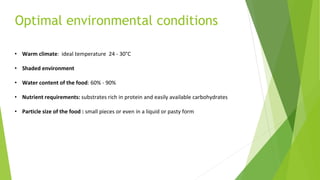
ADULT STAGE
• No mouth, hence do not feed
• Only require water to complete its life cycle
• Do not live long, about 5-8 days
• Main goal is to reproduce
• The flies prefer to copulate in the light of the morning
• female fly lays a package of 400 to 800 eggs close to decomposing organic matter,
into small, dry, sheltered cavities.
• Shortly after having laid the eggs, the female dies.
Optimal environmental conditions
• Warm climate: ideal temperature 24 - 30°C
• Shaded environment
• Water content of the food: 60% - 90%
• Nutrient requirements: substrates rich in protein and easily available carbohydrates
• Particle size of the food : small pieces or even in a liquid or pasty form
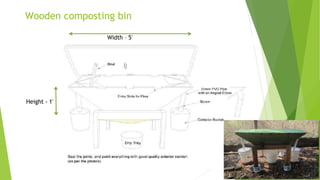
Wooden composting bin
Width – 5'
Height - 1'
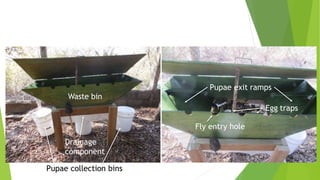
Waste bin
Drainage
component
Pupae collection bins
Pupae exit ramps
Egg traps
Fly entry hole
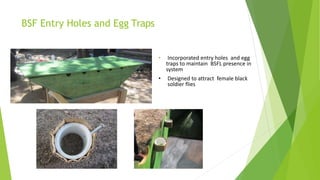
BSF Entry Holes and Egg Traps
• Incorporated entry holes and egg
traps to maintain BSFL presence in
system
• Designed to attract female black
soldier flies
Eliminating Ants and Preventing Infestations
• Emptied and rinsed out bin
• Added bleach buckets
Plastic drum composting bin
Plastic container composting bin
Commercial BSF treatment facility
Benefits
• High waste-to-biomass conversion rate of up to 25% on wet weight basis
• Waste reduction of up to 80% on wet weight basis
• There is no need for sophisticated high-end technology
• Suitable for low-income settings that rely mostly on simple technology and unskilled labour.
• The residue, a substance similar to compost, contains nutrients and organic matter and, when used in
agriculture, helps to reduce soil depletion.
• Feeding waste to larvae has been shown to inactivate disease transmitting bacteria, such as Salmonella spp.
Refrences
• Black Soldier Fly Biowaste Process manual - eawag aquatic research
• https://en.wikipedia.org/wiki/Hermetia_illucens
• Performance of black soldier fly larvae (Diptera: Stratiomyidae) for
manure composting and production of cleaner compost – ScienceDirect
• https://www.sciencedirect.com/science/article/pii/S0301479719313118

Black soldier fly composting

  • 1.
    BLACK SOLDIER FLY(BSF) COMPOSTING Shubham Bhade
  • 2.
    Taxonomy Scientific name -Hermetia illucens Family - Stratiomyidae Order - Diptera Lifecycle
  • 3.
    Egg Stage • Eggsare laid in clusters. • The female fly lays a package of 400 to 800 eggs close to decomposing organic matter, into small, dry, sheltered cavities. Shortly after having laid the eggs, the female dies. • The closeness of the eggs to the decomposing organic matter ensures that the larvae have their first food source nearby after hatching. • The sheltered cavities protect the eggs from predators and prevent dehydration of the egg packages by direct sunlight.
  • 4.
    LARVAL STAGE • livelong, feed for ~2 weeks • can eat twice their body weight daily • grow from a few millimetres size to around 2.5 cm length and 0.5 cm width • Cream colour with darker rings around the body segments • as they mature they become a dark grayish brown • five larval stages • 43% protein and 35% fat
  • 5.
    Pupal stage • Pupationtakes around two to three weeks and ends when the fly emerges from its pupa shell. • environmental conditions- warm, dry and shaded. • fly breaks open the part of the pupa that used to be the head section, crawl out, dry and then spread its wings and fly off. Pre-pupal stage • final larval stage • larva replaces its mouthpart with a hook-shaped structure and becomes dark brown to charcoal grey in colour. • It uses this hook to easily move out and away from the food source towards a nearby dry, humus-like, shaded and protected environment that it deems safe from predators
  • 6.
    ADULT STAGE • Nomouth, hence do not feed • Only require water to complete its life cycle • Do not live long, about 5-8 days • Main goal is to reproduce • The flies prefer to copulate in the light of the morning • female fly lays a package of 400 to 800 eggs close to decomposing organic matter, into small, dry, sheltered cavities. • Shortly after having laid the eggs, the female dies.
  • 7.
    Optimal environmental conditions •Warm climate: ideal temperature 24 - 30°C • Shaded environment • Water content of the food: 60% - 90% • Nutrient requirements: substrates rich in protein and easily available carbohydrates • Particle size of the food : small pieces or even in a liquid or pasty form
  • 8.
    Wooden composting bin Width– 5' Height - 1'
  • 9.
    Waste bin Drainage component Pupae collectionbins Pupae exit ramps Egg traps Fly entry hole
  • 10.
    BSF Entry Holesand Egg Traps • Incorporated entry holes and egg traps to maintain BSFL presence in system • Designed to attract female black soldier flies
  • 11.
    Eliminating Ants andPreventing Infestations • Emptied and rinsed out bin • Added bleach buckets
  • 12.
  • 13.
  • 15.
  • 16.
    Benefits • High waste-to-biomassconversion rate of up to 25% on wet weight basis • Waste reduction of up to 80% on wet weight basis • There is no need for sophisticated high-end technology • Suitable for low-income settings that rely mostly on simple technology and unskilled labour. • The residue, a substance similar to compost, contains nutrients and organic matter and, when used in agriculture, helps to reduce soil depletion. • Feeding waste to larvae has been shown to inactivate disease transmitting bacteria, such as Salmonella spp.
  • 17.
    Refrences • Black SoldierFly Biowaste Process manual - eawag aquatic research • https://en.wikipedia.org/wiki/Hermetia_illucens • Performance of black soldier fly larvae (Diptera: Stratiomyidae) for manure composting and production of cleaner compost – ScienceDirect • https://www.sciencedirect.com/science/article/pii/S0301479719313118