PRESENTED BY
JASNA RANI BEHERA
M.SC.NSG 2nd YEAR
ROLL-1888008
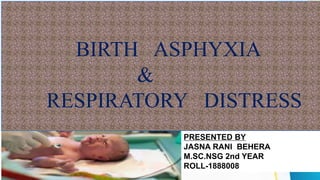
BIRTH ASPHYXIA
&
RESPIRATORY DISTRESS
1. Birth Asphyxia
introduction ,defintion
risk factors,pathophysiology
clinical features,management
2. Respiratory distress
 introduction,causes,clinical features
 diagnostic evaluation and management
• To define birth asphyxia and respiratory distress.
• To know causes ,sign and symptoms.
• To apply the knowledge to manage in preventing the
birth asphyxia and respiratory distress in newborn.
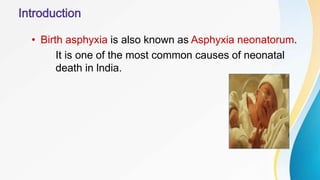
• Birth asphyxia is also known as Asphyxia neonatorum.
It is one of the most common causes of neonatal
death in lndia.
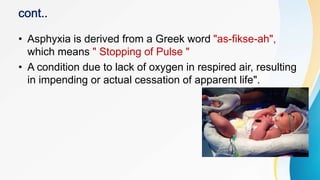
• Asphyxia is derived from a Greek word "as-fikse-ah",
which means " Stopping of Pulse "
• A condition due to lack of oxygen in respired air, resulting
in impending or actual cessation of apparent life".
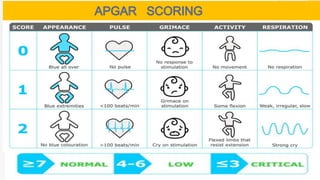
• Perinatal asphyxia is defined by following criteria:
1. Apgar score of 3 or less at 5 min.
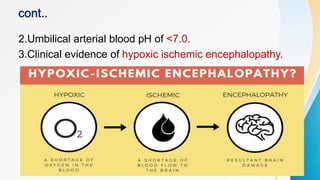
2.Umbilical arterial blood pH of <7.0.
3.Clinical evidence of hypoxic ischemic encephalopathy.
4.Evidence of multi-organ system dysfunction.
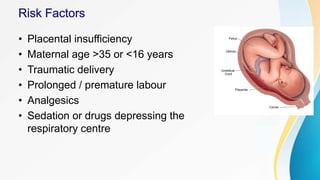
• Placental insufficiency
• Maternal age >35 or <16 years
• Traumatic delivery
• Prolonged / premature labour
• Analgesics
• Sedation or drugs depressing the
respiratory centre
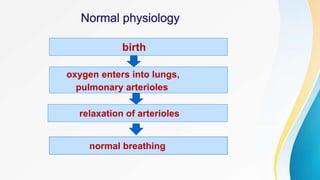
birth
oxygen enters into lungs,
pulmonary arterioles
normal breathing
relaxation of arterioles
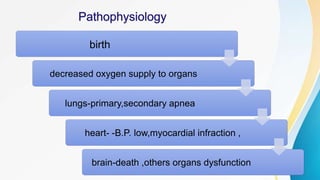
birth
decreased oxygen supply to organs
lungs-primary,secondary apnea
heart- -B.P. low,myocardial infraction ,
brain-death ,others organs dysfunction
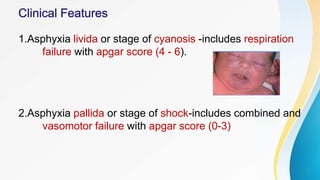
1.Asphyxia livida or stage of cyanosis -includes respiration
failure with apgar score (4 - 6).
2.Asphyxia pallida or stage of shock-includes combined and
vasomotor failure with apgar score (0-3)
• Immediate Management-neonatal resuscitation
• Post asphyxial Management
• pre requisities:
room and environment
equipment
prepartion of staff as well receving of baby after birth
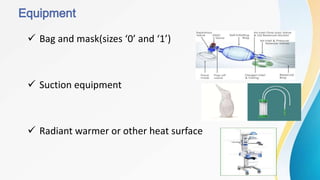
 Bag and mask(sizes ‘0’ and ‘1’)
 Suction equipment
 Radiant warmer or other heat surface
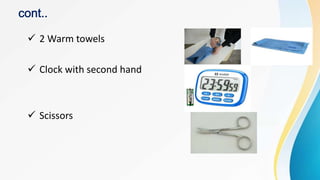
 2 Warm towels
 Clock with second hand
 Scissors
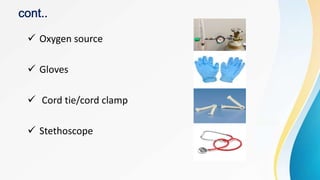
 Oxygen source
 Gloves
 Cord tie/cord clamp
 Stethoscope
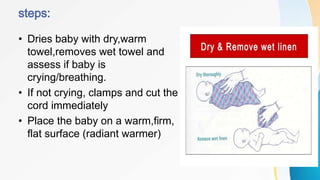
• Dries baby with dry,warm
towel,removes wet towel and
assess if baby is
crying/breathing.
• If not crying, clamps and cut the
cord immediately
• Place the baby on a warm,firm,
flat surface (radiant warmer)
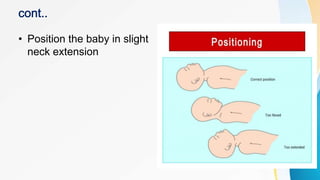
• Position the baby in slight
neck extension
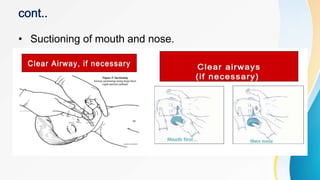
• Suctioning of mouth and nose.
• Stimulates the baby by gently rubbing .
• Re-positions the head.
• Assesses breathing
• If breathing well-provides observational care with
mother
If not breathing well-
Applies appropriately sized mask correctly
Initiate bag and mask ventilation using room air .
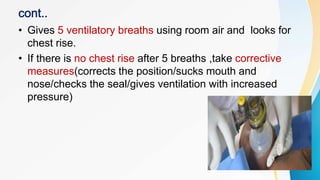
• Gives 5 ventilatory breaths using room air and looks for
chest rise.
• If there is no chest rise after 5 breaths ,take corrective
measures(corrects the position/sucks mouth and
nose/checks the seal/gives ventilation with increased
pressure)
• If there is adequate chest rise, continues bag and ,mask
ventilation for 30 seconds(Breath -2-3)
• Reassesses the breathing after 30 seconds of
ventilation.
• If still not breathing calls for help. Continues bag and
masks ventilation and asks for trained help .
• If heart rate is <100/min and baby is still not breathing
, continue bag and mask ventilation and connects
oxygen.
• If help available- chest compression, intubation and
medication by trained person.
• If not - baby not breathing,
refers to higher centre immediately.
• If heart rate is ≥100 and baby is breathing well or at any
point, if baby starts breathing, provides observational care
with mother.
Goals of management are:
- To evaluate and monitor injury to various organs
- To prevent secondary brain injury
- To document prognostic indicators
• Thermal control: radiant warmer,
(Core temperature 36-37 ℃, skin temperature 36.0 -36.3℃ ).
• Respiratory support: supplemental oxygen,Ventilation
in case of severe encephalopathy.
• Cardiovascular support:-10ml/kg of saline to maintain
CVP-5-8 cm if no response than ionotropes etc..
• Seizure control:-anticonvulasnat drugs
• Cerebral edema management: mannitol,corticosteriods etc..
Prognosis
Neonates with multisystem failure often die in neonatal
period.survivours may have long term neurodevelopmental
problems .
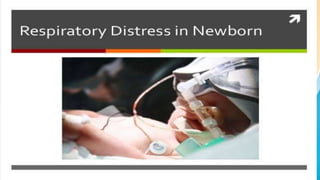
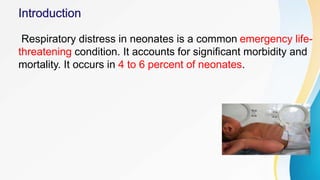
Respiratory distress in neonates is a common emergency life-
threatening condition. It accounts for significant morbidity and
mortality. It occurs in 4 to 6 percent of neonates.
• Pulmonary causes:
• Nonpulmonary causes:
• Respiratory distress syndrome (RDS) or hyaline
membrane disease (HMD)
• meconium aspiration syndrome (MAS)
• pleural effusion
• congenital malformations like tracheoesophageal fistula
with esophageal atresia (TEF with EA),
:
• Perinatal asphyxia
• metabolic acidosis
• cerebral edema
• neurological disorders
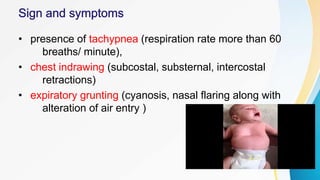
• presence of tachypnea (respiration rate more than 60
breaths/ minute),
• chest indrawing (subcostal, substernal, intercostal
retractions)
• expiratory grunting (cyanosis, nasal flaring along with
alteration of air entry )
• Antenatal and perinatal history-
 gestational age
 prolonged rupture of membrane more than 24 hours,
 presence of asphyxia
• Examination
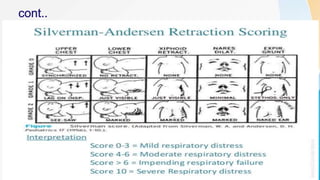
 Silverman -Anderson scoring
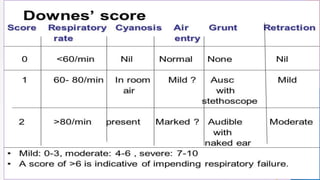
 Downes score
• Chest X-ray
• thermoneutral environment- to keep the baby warm with
normal body temperature.
• clear airway - removal of secretions by suctioning.
• oxygen administration- term neonates- 90 to 93%
preterm neonates -88 to 92%.
• Continuous monitoring -general condition, respiratory status
(respiration rate, retractions, grunting, cyanosis, nasal flaring),
heart rate. , body temperature and other parameters.
• IV fluid therapy-
• normal blood glucose and calcium level.
• Antibiotic therapy- to treat sepsis, if present.
• Surfactant therapy -preterm , RDS.
• routine care ,infection control measures.
Antenatal corticosteroid therapy -Preterm Neonates ,
preterm labor or APH, before 34 weeks of pregnancy
Injection betamethasone -12 mg IM every 24 hours with two
doses
or
injection dexamethasone -6 mg IM every 12 hours with four
doses.
• Prognosis of this condition depends upon early
identification of problems, cause of respiratory distress
and the time of initiation of treatment.
• 1.Achar.“Textbook of paediatrics.edited by Swarana rekha Bhatt”.4th edition.university
press pp-265-268
• 2.Assuma Beebi “Text book of paediatric Nursing”.2016,Elsevier publishers
Haryana.pp-294-297
• 3.Manoj yadav.“Child health nirsing.(with procedures)”.edition 2016.pee vee
publishers.pp-619-622
• 4.Parul datta.“Pediatric nursing.2 nd edition.jaypee publishers.pp-346-348
• 5.Rimple sharma.“Essential of pediatric nursing.2013”.jaypee publishers.pp-539-545
• 6.Suraj Gupte.“The short textbook of Pediatrics”.11th edition.jaypee publishers.PP-
535-540..
• 7.https://www.slideshare.net/aftabasiddiqui18/respiratory-distress-in-newborn-final
• 8.https://www.slideshare.net/SUDESHNABANERJEE10/neonatal-respiratory-distress-
syndrome
BIRTH ASPXIA, RDS.pptx

BIRTH ASPXIA, RDS.pptx

  • 2.
    PRESENTED BY JASNA RANIBEHERA M.SC.NSG 2nd YEAR ROLL-1888008 BIRTH ASPHYXIA & RESPIRATORY DISTRESS
  • 3.
    1. Birth Asphyxia introduction,defintion risk factors,pathophysiology clinical features,management 2. Respiratory distress  introduction,causes,clinical features  diagnostic evaluation and management
  • 4.
    • To definebirth asphyxia and respiratory distress. • To know causes ,sign and symptoms. • To apply the knowledge to manage in preventing the birth asphyxia and respiratory distress in newborn.
  • 5.
    • Birth asphyxiais also known as Asphyxia neonatorum. It is one of the most common causes of neonatal death in lndia.
  • 6.
    • Asphyxia isderived from a Greek word "as-fikse-ah", which means " Stopping of Pulse " • A condition due to lack of oxygen in respired air, resulting in impending or actual cessation of apparent life".
  • 8.
    • Perinatal asphyxiais defined by following criteria: 1. Apgar score of 3 or less at 5 min.
  • 10.
    2.Umbilical arterial bloodpH of <7.0. 3.Clinical evidence of hypoxic ischemic encephalopathy.
  • 11.
    4.Evidence of multi-organsystem dysfunction.
  • 12.
    • Placental insufficiency •Maternal age >35 or <16 years • Traumatic delivery • Prolonged / premature labour • Analgesics • Sedation or drugs depressing the respiratory centre
  • 13.
    birth oxygen enters intolungs, pulmonary arterioles normal breathing relaxation of arterioles
  • 14.
    birth decreased oxygen supplyto organs lungs-primary,secondary apnea heart- -B.P. low,myocardial infraction , brain-death ,others organs dysfunction
  • 15.
    1.Asphyxia livida orstage of cyanosis -includes respiration failure with apgar score (4 - 6). 2.Asphyxia pallida or stage of shock-includes combined and vasomotor failure with apgar score (0-3)
  • 16.
    • Immediate Management-neonatalresuscitation • Post asphyxial Management
  • 17.
    • pre requisities: roomand environment equipment prepartion of staff as well receving of baby after birth
  • 18.
     Bag andmask(sizes ‘0’ and ‘1’)  Suction equipment  Radiant warmer or other heat surface
  • 19.
     2 Warmtowels  Clock with second hand  Scissors
  • 20.
     Oxygen source Gloves  Cord tie/cord clamp  Stethoscope
  • 21.
    • Dries babywith dry,warm towel,removes wet towel and assess if baby is crying/breathing. • If not crying, clamps and cut the cord immediately • Place the baby on a warm,firm, flat surface (radiant warmer)
  • 22.
    • Position thebaby in slight neck extension
  • 23.
    • Suctioning ofmouth and nose.
  • 24.
    • Stimulates thebaby by gently rubbing . • Re-positions the head. • Assesses breathing • If breathing well-provides observational care with mother If not breathing well- Applies appropriately sized mask correctly Initiate bag and mask ventilation using room air .
  • 25.
    • Gives 5ventilatory breaths using room air and looks for chest rise. • If there is no chest rise after 5 breaths ,take corrective measures(corrects the position/sucks mouth and nose/checks the seal/gives ventilation with increased pressure)
  • 26.
    • If thereis adequate chest rise, continues bag and ,mask ventilation for 30 seconds(Breath -2-3) • Reassesses the breathing after 30 seconds of ventilation. • If still not breathing calls for help. Continues bag and masks ventilation and asks for trained help .
  • 27.
    • If heartrate is <100/min and baby is still not breathing , continue bag and mask ventilation and connects oxygen. • If help available- chest compression, intubation and medication by trained person. • If not - baby not breathing, refers to higher centre immediately.
  • 28.
    • If heartrate is ≥100 and baby is breathing well or at any point, if baby starts breathing, provides observational care with mother.
  • 29.
    Goals of managementare: - To evaluate and monitor injury to various organs - To prevent secondary brain injury - To document prognostic indicators
  • 30.
    • Thermal control:radiant warmer, (Core temperature 36-37 ℃, skin temperature 36.0 -36.3℃ ). • Respiratory support: supplemental oxygen,Ventilation in case of severe encephalopathy. • Cardiovascular support:-10ml/kg of saline to maintain CVP-5-8 cm if no response than ionotropes etc.. • Seizure control:-anticonvulasnat drugs • Cerebral edema management: mannitol,corticosteriods etc..
  • 31.
    Prognosis Neonates with multisystemfailure often die in neonatal period.survivours may have long term neurodevelopmental problems .
  • 33.
    Respiratory distress inneonates is a common emergency life- threatening condition. It accounts for significant morbidity and mortality. It occurs in 4 to 6 percent of neonates.
  • 34.
    • Pulmonary causes: •Nonpulmonary causes:
  • 35.
    • Respiratory distresssyndrome (RDS) or hyaline membrane disease (HMD) • meconium aspiration syndrome (MAS) • pleural effusion • congenital malformations like tracheoesophageal fistula with esophageal atresia (TEF with EA),
  • 36.
    : • Perinatal asphyxia •metabolic acidosis • cerebral edema • neurological disorders
  • 37.
    • presence oftachypnea (respiration rate more than 60 breaths/ minute), • chest indrawing (subcostal, substernal, intercostal retractions) • expiratory grunting (cyanosis, nasal flaring along with alteration of air entry )
  • 38.
    • Antenatal andperinatal history-  gestational age  prolonged rupture of membrane more than 24 hours,  presence of asphyxia • Examination  Silverman -Anderson scoring  Downes score • Chest X-ray
  • 41.
    • thermoneutral environment-to keep the baby warm with normal body temperature. • clear airway - removal of secretions by suctioning. • oxygen administration- term neonates- 90 to 93% preterm neonates -88 to 92%.
  • 42.
    • Continuous monitoring-general condition, respiratory status (respiration rate, retractions, grunting, cyanosis, nasal flaring), heart rate. , body temperature and other parameters. • IV fluid therapy- • normal blood glucose and calcium level.
  • 43.
    • Antibiotic therapy-to treat sepsis, if present. • Surfactant therapy -preterm , RDS. • routine care ,infection control measures.
  • 44.
    Antenatal corticosteroid therapy-Preterm Neonates , preterm labor or APH, before 34 weeks of pregnancy Injection betamethasone -12 mg IM every 24 hours with two doses or injection dexamethasone -6 mg IM every 12 hours with four doses.
  • 45.
    • Prognosis ofthis condition depends upon early identification of problems, cause of respiratory distress and the time of initiation of treatment.
  • 49.
    • 1.Achar.“Textbook ofpaediatrics.edited by Swarana rekha Bhatt”.4th edition.university press pp-265-268 • 2.Assuma Beebi “Text book of paediatric Nursing”.2016,Elsevier publishers Haryana.pp-294-297 • 3.Manoj yadav.“Child health nirsing.(with procedures)”.edition 2016.pee vee publishers.pp-619-622 • 4.Parul datta.“Pediatric nursing.2 nd edition.jaypee publishers.pp-346-348 • 5.Rimple sharma.“Essential of pediatric nursing.2013”.jaypee publishers.pp-539-545 • 6.Suraj Gupte.“The short textbook of Pediatrics”.11th edition.jaypee publishers.PP- 535-540.. • 7.https://www.slideshare.net/aftabasiddiqui18/respiratory-distress-in-newborn-final • 8.https://www.slideshare.net/SUDESHNABANERJEE10/neonatal-respiratory-distress- syndrome