Bipolar Disorder:
A complex diagnosis
E Timuçin Oral, MD
Prof Psychiatry
Istanbul Commerce University

Department of Psychology
X Galen
X Soranus
X Hippocrates

X Aretaeus
Aretaeus of Cappadocia (AD 81–138)

Early description of complex conditions

Named diseases:
– Diabetes (“a flowing through a siphon”)
– Heterocrania/hemicrania (“half skull”)
– Koiliakos (“coeliac disease”)
!
! Defined phenomena:
– Mania-melancholia
– Bronchospasm
– Asthma
!

Marneros & Goodwin,Cambridge University Press, 2005.
Aydemir & Malhi, Acta Neuropsychiatrica. 2007:19;62
Aretaeus of Cappadocia (AD 81–138)
‘‘I think that melancholia is the
beginning and a part of mania… 

The development of mania is really
a worsening of the disease rather
than a change into another... 

The symptoms [of melancholia] are not
unclear: [the melancholics] are
either quiet or dysphoric, sad or
apathetic. Additionally, they could
be angry without reason and
suddenly awake in panic”
Marneros & Goodwin,Cambridge University Press, 2005

ARETAEUS of Cappadocia (fl. ca A.D. 50). Libri septem - RUFUS of Ephesus (fl. 1st century A.D.) De corporis humani
partium appellationbus libri tres. in Latin by Junius Paulus Crassus (ca 1500-75). Venice: Giunta Press, 1552.
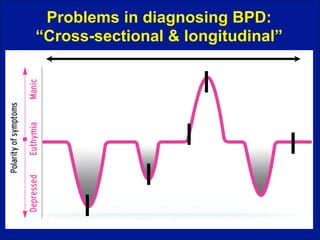
Problems in diagnosing BPD: 

“Cross-sectional & longitudinal”
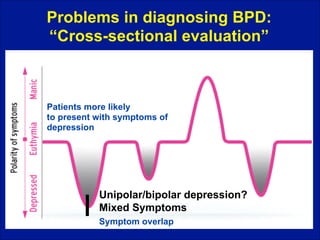
Problems in diagnosing BPD: 

“Cross-sectional evaluation”

Patients more likely

to present with symptoms of
depression

Unipolar/bipolar depression?
Mixed Symptoms
Symptom overlap
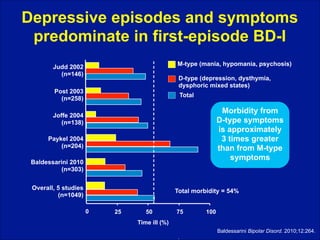
Depressive episodes and symptoms
predominate in first-episode BD-I
M-type (mania, hypomania, psychosis)

Judd 2002

(n=146)

D-type (depression, dysthymia,

dysphoric mixed states)

Post 2003

(n=258)

Total

Morbidity from 

D-type symptoms
is approximately 

3 times greater
than from M-type
symptoms

Joffe 2004

(n=138)
Paykel 2004

(n=204)
Baldessarini 2010

(n=303)
Overall, 5 studies

(n=1049)

Total morbidity = 54%
0

25

50

75

100

Time ill (%)
Baldessarini Bipolar Disord. 2010;12:264.
.
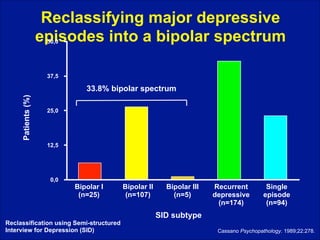
Reclassifying major depressive

episodes into a bipolar spectrum
50,0

37,5

Patients (%)

33.8% bipolar spectrum
25,0

12,5

0,0

Bipolar I

(n=25)

Reclassification using Semi-structured 

Interview for Depression (SID)

Bipolar II

(n=107)

Bipolar III

(n=5)

Recurrent
depressive

(n=174)

Single
episode

(n=94)

SID subtype
Cassano Psychopathology. 1989;22:278.
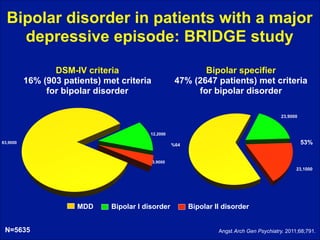
Bipolar disorder in patients with a major
depressive episode: BRIDGE study
DSM-IV criteria

16% (903 patients) met criteria
for bipolar disorder

Bipolar specifier 

47% (2647 patients) met criteria
for bipolar disorder

53%

MDD
N=5635

Bipolar I disorder

Bipolar II disorder
Angst Arch Gen Psychiatry. 2011;68;791.
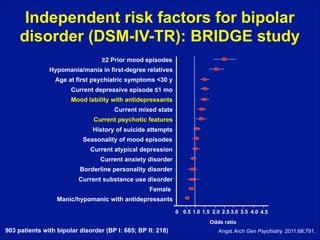
Independent risk factors for bipolar
disorder (DSM-IV-TR): BRIDGE study
≥2 Prior mood episodes
Hypomania/mania in first-degree relatives
Age at first psychiatric symptoms <30 y
Current depressive episode ≤1 mo
Mood lability with antidepressants
Current mixed state
Current psychotic features
History of suicide attempts
Seasonality of mood episodes
Current atypical depression
Current anxiety disorder
Borderline personality disorder
Current substance use disorder
Female
Manic/hypomanic with antidepressants
0 0.5 1.0 1.5 2.0 2.5 3.0 3.5 4.0 4.5
Odds ratio

903 patients with bipolar disorder (BP I: 685; BP II: 218)

Angst Arch Gen Psychiatry. 2011;68;791.
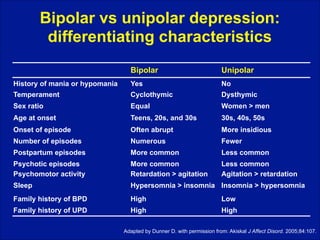
Bipolar vs unipolar depression:

differentiating characteristics
Bipolar

Unipolar

History of mania or hypomania

Yes

No

Temperament

Cyclothymic

Dysthymic

Sex ratio

Equal

Women > men

Age at onset

Teens, 20s, and 30s

30s, 40s, 50s

Onset of episode

Often abrupt

More insidious

Number of episodes

Numerous

Fewer

Postpartum episodes

More common

Less common

Psychotic episodes
Psychomotor activity

More common
Retardation > agitation

Less common
Agitation > retardation

Sleep

Hypersomnia > insomnia Insomnia > hypersomnia

Family history of BPD

High

Low

Family history of UPD

High

High

Adapted by Dunner D. with permission from: Akiskal J Affect Disord. 2005;84:107.
Melancholia, by Dürer

Melancholia, by Cranach
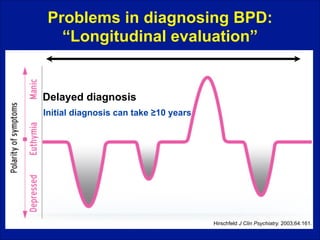
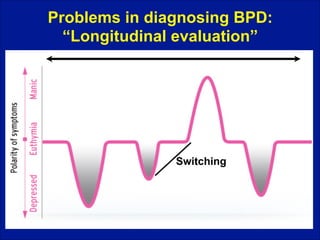
Problems in diagnosing BPD:
“Longitudinal evaluation”

Delayed diagnosis
Initial diagnosis can take ≥10 years

Hirschfeld J Clin Psychiatry. 2003;64:161.
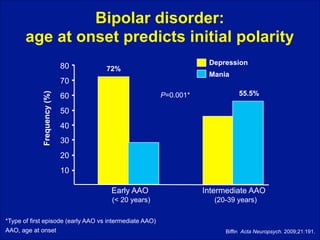
Bipolar disorder: 

age at onset predicts initial polarity
80

Depression

72%

Mania

Frequency (%)

70
P=0.001*

60

55.5%

50
40
30
20
10
Early AAO

Intermediate AAO

(< 20 years)

(20-39 years)

*Type of first episode (early AAO vs intermediate AAO)
AAO, age at onset


Biffin Acta Neuropsych. 2009;21:191.
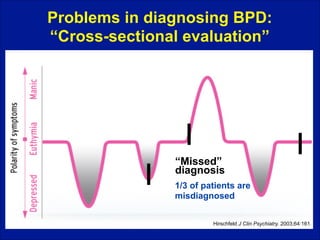
Problems in diagnosing BPD: 

“Cross-sectional evaluation”

“Missed”
diagnosis
1/3 of patients are
misdiagnosed
Hirschfeld J Clin Psychiatry. 2003;64:161.
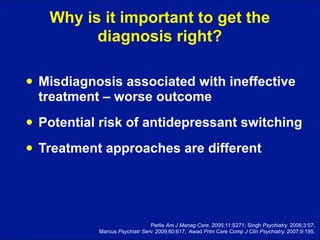
Why is it important to get the

diagnosis right?
!

Misdiagnosis associated with ineffective
treatment – worse outcome

!

Potential risk of antidepressant switching

!

Treatment approaches are different


 Perlis Am J Manag Care. 2005;11:S271; Singh Psychiatry. 2006;3:57; 

Marcus Psychiatr Serv. 2009;60:617; Awad Prim Care Comp J Clin Psychiatry. 2007;9:195.

!
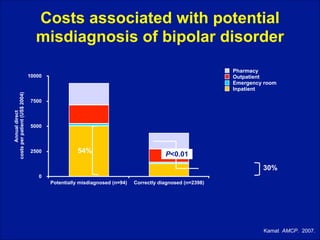
Costs associated with potential
misdiagnosis of bipolar disorder
Pharmacy
Outpatient
Emergency room
Inpatient

Annual direct
costs per patient (US$ 2004)

10000

7500

5000

2500

54%

P<0.01
30%

0
Potentially misdiagnosed (n=94)

Correctly diagnosed (n=2398)

Kamat AMCP. 2007.
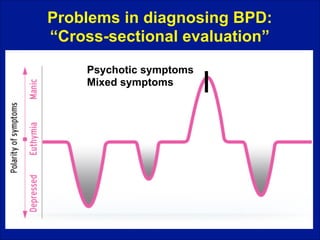
Problems in diagnosing BPD: 

“Cross-sectional evaluation”
Psychotic symptoms
Mixed symptoms
Proposed three-dimensional model of
mood-psychotic disorders
Lifetime Mania
Bipolar II

Bipolar I

Schizoaffective disorder,
Bipolar

Cyclothymia
Schizophrenia
Subclinical BP

Lifetime
Psychosis
Minor depression
Schizophrenia

Lifetime
Depression

Major depression
Schizoaffective disorder,
Depressive

Altınbaş Nöropsikiyatri Arşivi. 2011;48:167.
Painting “Mania"

Florencio Yllana
Rybakowski J Affect Disord. 2011;128:319.
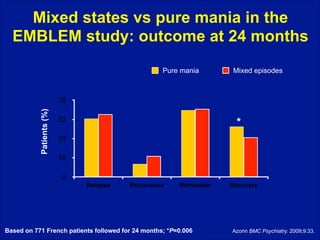
Mixed states vs pure mania in the
EMBLEM study: outcome at 24 months
Pure mania

Mixed episodes

Patients (%)

70
53

*

35
18
0
Relapse

Recurrence

Remission

Based on 771 French patients followed for 24 months; *P=0.006

Recovery

Azorin BMC Psychiatry. 2009;9:33.
Problems in diagnosing BPD: 

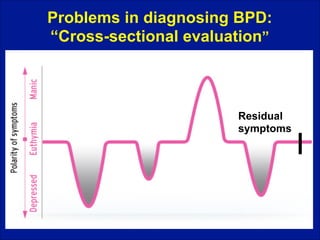
“Cross-sectional evaluation”

Residual 

symptoms
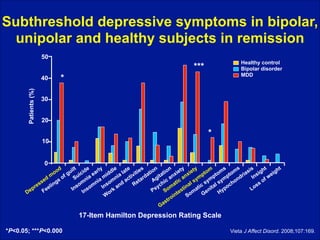
Subthreshold depressive symptoms in bipolar,
unipolar and healthy subjects in remission
50

Healthy control
Bipolar disorder
MDD

***
Patients (%)

40

*

30
20

*
10
0

d
le
te
ilt
es tion tion iety iety tom ms ms asis ight ight
de arly
oo
dd ia la iviti
gu uici
x
x
to
i
e
a
to
p
ri Ins
ta
m
we
m
of
n act tard
ia
S
gi c an c an sym ymp ymp ond
d
n
e
s
A hi
ia om d
of
ti
s
s
l
h
ss ling
Re
om mn Ins an
ss
re
yc oma tina atic ital poc
o
e
ns
s S
p
Lo
s
I
e
k
n
s
P
F
In
m Ge
Hy
De
or
te
W
in
So
tro
as
G

17-Item Hamilton Depression Rating Scale
*P<0.05; ***P<0.000

Vieta J Affect Disord. 2008;107:169.
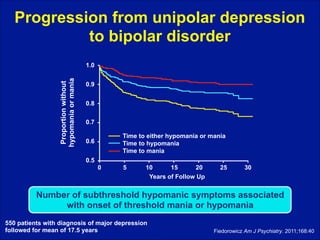
Progression from unipolar depression
to bipolar disorder
Proportion without
hypomania or mania

1.0
0.9
0.8
0.7
Time to either hypomania or mania
Time to hypomania
Time to mania

0.6
0.5
0

5

10
15
20
Years of Follow Up

25

30

Number of subthreshold hypomanic symptoms associated
with onset of threshold mania or hypomania
550 patients with diagnosis of major depression 

followed for mean of 17.5 years

Fiedorowicz Am J Psychiatry. 2011;168:40
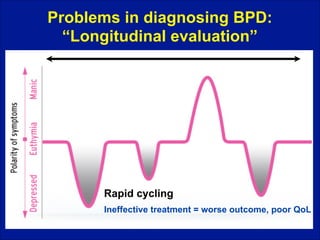
Problems in diagnosing BPD:
“Longitudinal evaluation”

Rapid cycling
Ineffective treatment = worse outcome, poor QoL
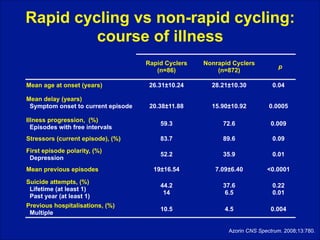
Rapid cycling vs non-rapid cycling:
course of illness
Rapid Cyclers

(n=86)

Nonrapid Cyclers

(n=872)

p

Mean age at onset (years)

26.31±10.24

28.21±10.30

0.04

Mean delay (years) 

Symptom onset to current episode


20.38±11.88


15.90±10.92


0.0005

Illness progression, (%) 

Episodes with free intervals

59.3

72.6

0.009

Stressors (current episode), (%)

83.7

89.6

0.09

First episode polarity, (%) 

Depression

52.2

35.9

0.01

19±16.54

7.09±6.40

<0.0001

44.2
14

37.6
6.5

0.22
0.01

10.5

4.5

0.004

Mean previous episodes
Suicide attempts, (%)
Lifetime (at least 1)
Past year (at least 1)


Previous hospitalisations, (%) 

Multiple


Azorin CNS Spectrum. 2008;13:780.
“Tree of Life”

by Selen Şanlı
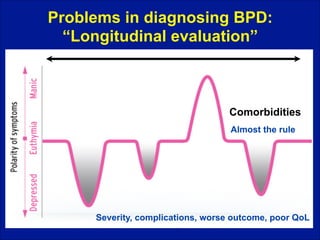
Problems in diagnosing BPD:
“Longitudinal evaluation”

Comorbidities
Almost the rule

Severity, complications, worse outcome, poor QoL
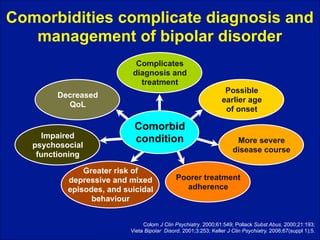
Comorbidities complicate diagnosis and
management of bipolar disorder
Complicates
diagnosis and
treatment
Decreased
QoL

Impaired
psychosocial
functioning

Comorbid
condition

Greater risk of
depressive and mixed
episodes, and suicidal
behaviour

Possible
earlier age 

of onset

More severe
disease course

Poorer treatment
adherence

Colom J Clin Psychiatry. 2000;61:549; Pollack Subst Abus. 2000;21:193; 

Vieta Bipolar Disord. 2001;3:253; Keller J Clin Psychiatry. 2006;67(suppl 1);5.
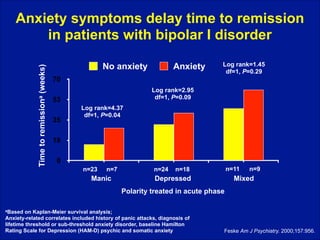
Time to remissiona (weeks)

Anxiety symptoms delay time to remission
in patients with bipolar I disorder
No anxiety

Anxiety

Log rank=1.45 

df=1, P=0.29

70
Log rank=2.95

df=1, P=0.09

53
35

Log rank=4.37

df=1, P=0.04

18
0
n=23

n=7

Manic

n=24

n=11

n=18

Depressed

n=9

Mixed

Polarity treated in acute phase
aBased

on Kaplan-Meier survival analysis;
Anxiety-related correlates included history of panic attacks, diagnosis of
lifetime threshold or sub-threshold anxiety disorder, baseline Hamilton
Rating Scale for Depression (HAM-D) psychic and somatic anxiety

Feske Am J Psychiatry. 2000;157:956.
Problems in diagnosing BPD:
“Longitudinal evaluation”

Switching
“Illusion of Rising”

by Tamer Ertuna
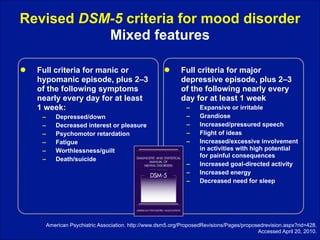
Revised DSM-5 criteria for mood disorder 

Mixed features
!

Full criteria for manic or
hypomanic episode, plus 2–3
of the following symptoms
nearly every day for at least

1 week:
–
–
–
–
–
–

Depressed/down
Decreased interest or pleasure
Psychomotor retardation
Fatigue
Worthlessness/guilt
Death/suicide

!

Full criteria for major
depressive episode, plus 2–3
of the following nearly every
day for at least 1 week
–
–
–
–
–

–
–
–

Expansive or irritable
Grandiose
Increased/pressured speech
Flight of ideas
Increased/excessive involvement
in activities with high potential
for painful consequences
Increased goal-directed activity
Increased energy
Decreased need for sleep

American Psychiatric Association. http://www.dsm5.org/ProposedRevisions/Pages/proposedrevision.aspx?rid=428. 

Accessed April 20, 2010.
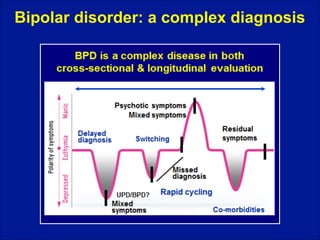
Bipolar disorder: a complex diagnosis
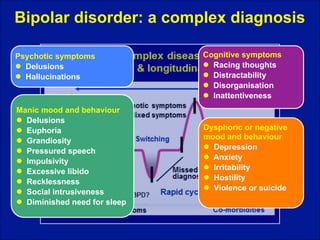
Psychotic symptoms
! Delusions
! Hallucinations

Manic mood and behaviour
! Delusions
! Euphoria
! Grandiosity
! Pressured speech
! Impulsivity
! Excessive libido
! Recklessness
! Social intrusiveness
! Diminished need for sleep

Cognitive symptoms
! Racing thoughts
! Distractability
! Disorganisation
! Inattentiveness

Dysphoric or negative

mood and behaviour
! Depression
! Anxiety
! Irritability
! Hostility
! Violence or suicide
Summary
!

Bipolar disorder is a chronic, frequent and
debilitating illness

!

Although it is one of the well- and first-known
disorders, it is still misdiagnosed frequently

!

Appropriate diagnosis is the first step in
choosing the best treatment available

!

Rational psychopharmacology is a sine qua
non for prevention and is possible
Questions?

Bipolar a complex disorder

  • 1.
    Bipolar Disorder: A complexdiagnosis E Timuçin Oral, MD Prof Psychiatry Istanbul Commerce University
 Department of Psychology
  • 2.
    X Galen X Soranus XHippocrates X Aretaeus
  • 3.
    Aretaeus of Cappadocia(AD 81–138)
 Early description of complex conditions Named diseases: – Diabetes (“a flowing through a siphon”) – Heterocrania/hemicrania (“half skull”) – Koiliakos (“coeliac disease”) ! ! Defined phenomena: – Mania-melancholia – Bronchospasm – Asthma ! Marneros & Goodwin,Cambridge University Press, 2005. Aydemir & Malhi, Acta Neuropsychiatrica. 2007:19;62
  • 4.
    Aretaeus of Cappadocia(AD 81–138) ‘‘I think that melancholia is the beginning and a part of mania… 
 The development of mania is really a worsening of the disease rather than a change into another... 
 The symptoms [of melancholia] are not unclear: [the melancholics] are either quiet or dysphoric, sad or apathetic. Additionally, they could be angry without reason and suddenly awake in panic” Marneros & Goodwin,Cambridge University Press, 2005 ARETAEUS of Cappadocia (fl. ca A.D. 50). Libri septem - RUFUS of Ephesus (fl. 1st century A.D.) De corporis humani partium appellationbus libri tres. in Latin by Junius Paulus Crassus (ca 1500-75). Venice: Giunta Press, 1552.
  • 5.
    Problems in diagnosingBPD: 
 “Cross-sectional & longitudinal”
  • 6.
    Problems in diagnosingBPD: 
 “Cross-sectional evaluation” Patients more likely
 to present with symptoms of depression Unipolar/bipolar depression? Mixed Symptoms Symptom overlap
  • 7.
    Depressive episodes andsymptoms predominate in first-episode BD-I M-type (mania, hypomania, psychosis) Judd 2002
 (n=146) D-type (depression, dysthymia,
 dysphoric mixed states) Post 2003
 (n=258) Total Morbidity from 
 D-type symptoms is approximately 
 3 times greater than from M-type symptoms Joffe 2004
 (n=138) Paykel 2004
 (n=204) Baldessarini 2010
 (n=303) Overall, 5 studies
 (n=1049) Total morbidity = 54% 0 25 50 75 100 Time ill (%) Baldessarini Bipolar Disord. 2010;12:264. .
  • 8.
    Reclassifying major depressive
 episodesinto a bipolar spectrum 50,0 37,5 Patients (%) 33.8% bipolar spectrum 25,0 12,5 0,0 Bipolar I
 (n=25) Reclassification using Semi-structured 
 Interview for Depression (SID) Bipolar II
 (n=107) Bipolar III
 (n=5) Recurrent depressive
 (n=174) Single episode
 (n=94) SID subtype Cassano Psychopathology. 1989;22:278.
  • 9.
    Bipolar disorder inpatients with a major depressive episode: BRIDGE study DSM-IV criteria
 16% (903 patients) met criteria for bipolar disorder Bipolar specifier 
 47% (2647 patients) met criteria for bipolar disorder 53% MDD N=5635 Bipolar I disorder Bipolar II disorder Angst Arch Gen Psychiatry. 2011;68;791.
  • 10.
    Independent risk factorsfor bipolar disorder (DSM-IV-TR): BRIDGE study ≥2 Prior mood episodes Hypomania/mania in first-degree relatives Age at first psychiatric symptoms <30 y Current depressive episode ≤1 mo Mood lability with antidepressants Current mixed state Current psychotic features History of suicide attempts Seasonality of mood episodes Current atypical depression Current anxiety disorder Borderline personality disorder Current substance use disorder Female Manic/hypomanic with antidepressants 0 0.5 1.0 1.5 2.0 2.5 3.0 3.5 4.0 4.5 Odds ratio 903 patients with bipolar disorder (BP I: 685; BP II: 218) Angst Arch Gen Psychiatry. 2011;68;791.
  • 11.
    Bipolar vs unipolardepression:
 differentiating characteristics Bipolar Unipolar History of mania or hypomania Yes No Temperament Cyclothymic Dysthymic Sex ratio Equal Women > men Age at onset Teens, 20s, and 30s 30s, 40s, 50s Onset of episode Often abrupt More insidious Number of episodes Numerous Fewer Postpartum episodes More common Less common Psychotic episodes Psychomotor activity More common Retardation > agitation Less common Agitation > retardation Sleep Hypersomnia > insomnia Insomnia > hypersomnia Family history of BPD High Low Family history of UPD High High Adapted by Dunner D. with permission from: Akiskal J Affect Disord. 2005;84:107.
  • 12.
  • 13.
    Problems in diagnosingBPD: “Longitudinal evaluation” Delayed diagnosis Initial diagnosis can take ≥10 years Hirschfeld J Clin Psychiatry. 2003;64:161.
  • 14.
    Bipolar disorder: 
 ageat onset predicts initial polarity 80 Depression 72% Mania Frequency (%) 70 P=0.001* 60 55.5% 50 40 30 20 10 Early AAO Intermediate AAO (< 20 years) (20-39 years) *Type of first episode (early AAO vs intermediate AAO) AAO, age at onset
 Biffin Acta Neuropsych. 2009;21:191.
  • 16.
    Problems in diagnosingBPD: 
 “Cross-sectional evaluation” “Missed” diagnosis 1/3 of patients are misdiagnosed Hirschfeld J Clin Psychiatry. 2003;64:161.
  • 17.
    Why is itimportant to get the
 diagnosis right? ! Misdiagnosis associated with ineffective treatment – worse outcome ! Potential risk of antidepressant switching ! Treatment approaches are different Perlis Am J Manag Care. 2005;11:S271; Singh Psychiatry. 2006;3:57; 
 Marcus Psychiatr Serv. 2009;60:617; Awad Prim Care Comp J Clin Psychiatry. 2007;9:195. !
  • 18.
    Costs associated withpotential misdiagnosis of bipolar disorder Pharmacy Outpatient Emergency room Inpatient Annual direct costs per patient (US$ 2004) 10000 7500 5000 2500 54% P<0.01 30% 0 Potentially misdiagnosed (n=94) Correctly diagnosed (n=2398) Kamat AMCP. 2007.
  • 19.
    Problems in diagnosingBPD: 
 “Cross-sectional evaluation” Psychotic symptoms Mixed symptoms
  • 20.
    Proposed three-dimensional modelof mood-psychotic disorders Lifetime Mania Bipolar II Bipolar I Schizoaffective disorder, Bipolar Cyclothymia Schizophrenia Subclinical BP Lifetime Psychosis Minor depression Schizophrenia Lifetime Depression Major depression Schizoaffective disorder, Depressive Altınbaş Nöropsikiyatri Arşivi. 2011;48:167.
  • 21.
    Painting “Mania" Florencio Yllana RybakowskiJ Affect Disord. 2011;128:319.
  • 22.
    Mixed states vspure mania in the EMBLEM study: outcome at 24 months Pure mania Mixed episodes Patients (%) 70 53 * 35 18 0 Relapse Recurrence Remission Based on 771 French patients followed for 24 months; *P=0.006 Recovery Azorin BMC Psychiatry. 2009;9:33.
  • 23.
    Problems in diagnosingBPD: 
 “Cross-sectional evaluation” Residual 
 symptoms
  • 24.
    Subthreshold depressive symptomsin bipolar, unipolar and healthy subjects in remission 50 Healthy control Bipolar disorder MDD *** Patients (%) 40 * 30 20 * 10 0 d le te ilt es tion tion iety iety tom ms ms asis ight ight de arly oo dd ia la iviti gu uici x x to i e a to p ri Ins ta m we m of n act tard ia S gi c an c an sym ymp ymp ond d n e s A hi ia om d of ti s s l h ss ling Re om mn Ins an ss re yc oma tina atic ital poc o e ns s S p Lo s I e k n s P F In m Ge Hy De or te W in So tro as G 17-Item Hamilton Depression Rating Scale *P<0.05; ***P<0.000 Vieta J Affect Disord. 2008;107:169.
  • 25.
    Progression from unipolardepression to bipolar disorder Proportion without hypomania or mania 1.0 0.9 0.8 0.7 Time to either hypomania or mania Time to hypomania Time to mania 0.6 0.5 0 5 10 15 20 Years of Follow Up 25 30 Number of subthreshold hypomanic symptoms associated with onset of threshold mania or hypomania 550 patients with diagnosis of major depression 
 followed for mean of 17.5 years Fiedorowicz Am J Psychiatry. 2011;168:40
  • 26.
    Problems in diagnosingBPD: “Longitudinal evaluation” Rapid cycling Ineffective treatment = worse outcome, poor QoL
  • 27.
    Rapid cycling vsnon-rapid cycling: course of illness Rapid Cyclers
 (n=86) Nonrapid Cyclers
 (n=872) p Mean age at onset (years) 26.31±10.24 28.21±10.30 0.04 Mean delay (years) 
 Symptom onset to current episode 
 20.38±11.88 
 15.90±10.92 
 0.0005 Illness progression, (%) 
 Episodes with free intervals 59.3 72.6 0.009 Stressors (current episode), (%) 83.7 89.6 0.09 First episode polarity, (%) 
 Depression 52.2 35.9 0.01 19±16.54 7.09±6.40 <0.0001 44.2 14 37.6 6.5 0.22 0.01 10.5 4.5 0.004 Mean previous episodes Suicide attempts, (%) Lifetime (at least 1) Past year (at least 1) 
 Previous hospitalisations, (%) 
 Multiple 
 Azorin CNS Spectrum. 2008;13:780.
  • 28.
  • 29.
    Problems in diagnosingBPD: “Longitudinal evaluation” Comorbidities Almost the rule Severity, complications, worse outcome, poor QoL
  • 30.
    Comorbidities complicate diagnosisand management of bipolar disorder Complicates diagnosis and treatment Decreased QoL Impaired psychosocial functioning Comorbid condition Greater risk of depressive and mixed episodes, and suicidal behaviour Possible earlier age 
 of onset More severe disease course Poorer treatment adherence Colom J Clin Psychiatry. 2000;61:549; Pollack Subst Abus. 2000;21:193; 
 Vieta Bipolar Disord. 2001;3:253; Keller J Clin Psychiatry. 2006;67(suppl 1);5.
  • 31.
    Time to remissiona(weeks) Anxiety symptoms delay time to remission in patients with bipolar I disorder No anxiety Anxiety Log rank=1.45 
 df=1, P=0.29 70 Log rank=2.95
 df=1, P=0.09 53 35 Log rank=4.37
 df=1, P=0.04 18 0 n=23 n=7 Manic n=24 n=11 n=18 Depressed n=9 Mixed Polarity treated in acute phase aBased on Kaplan-Meier survival analysis; Anxiety-related correlates included history of panic attacks, diagnosis of lifetime threshold or sub-threshold anxiety disorder, baseline Hamilton Rating Scale for Depression (HAM-D) psychic and somatic anxiety Feske Am J Psychiatry. 2000;157:956.
  • 32.
    Problems in diagnosingBPD: “Longitudinal evaluation” Switching
  • 33.
  • 34.
    Revised DSM-5 criteriafor mood disorder 
 Mixed features ! Full criteria for manic or hypomanic episode, plus 2–3 of the following symptoms nearly every day for at least
 1 week: – – – – – – Depressed/down Decreased interest or pleasure Psychomotor retardation Fatigue Worthlessness/guilt Death/suicide ! Full criteria for major depressive episode, plus 2–3 of the following nearly every day for at least 1 week – – – – – – – – Expansive or irritable Grandiose Increased/pressured speech Flight of ideas Increased/excessive involvement in activities with high potential for painful consequences Increased goal-directed activity Increased energy Decreased need for sleep American Psychiatric Association. http://www.dsm5.org/ProposedRevisions/Pages/proposedrevision.aspx?rid=428. 
 Accessed April 20, 2010.
  • 35.
    Bipolar disorder: acomplex diagnosis
  • 36.
    Bipolar disorder: acomplex diagnosis Psychotic symptoms ! Delusions ! Hallucinations Manic mood and behaviour ! Delusions ! Euphoria ! Grandiosity ! Pressured speech ! Impulsivity ! Excessive libido ! Recklessness ! Social intrusiveness ! Diminished need for sleep Cognitive symptoms ! Racing thoughts ! Distractability ! Disorganisation ! Inattentiveness Dysphoric or negative
 mood and behaviour ! Depression ! Anxiety ! Irritability ! Hostility ! Violence or suicide
  • 37.
    Summary ! Bipolar disorder isa chronic, frequent and debilitating illness ! Although it is one of the well- and first-known disorders, it is still misdiagnosed frequently ! Appropriate diagnosis is the first step in choosing the best treatment available ! Rational psychopharmacology is a sine qua non for prevention and is possible
  • 38.