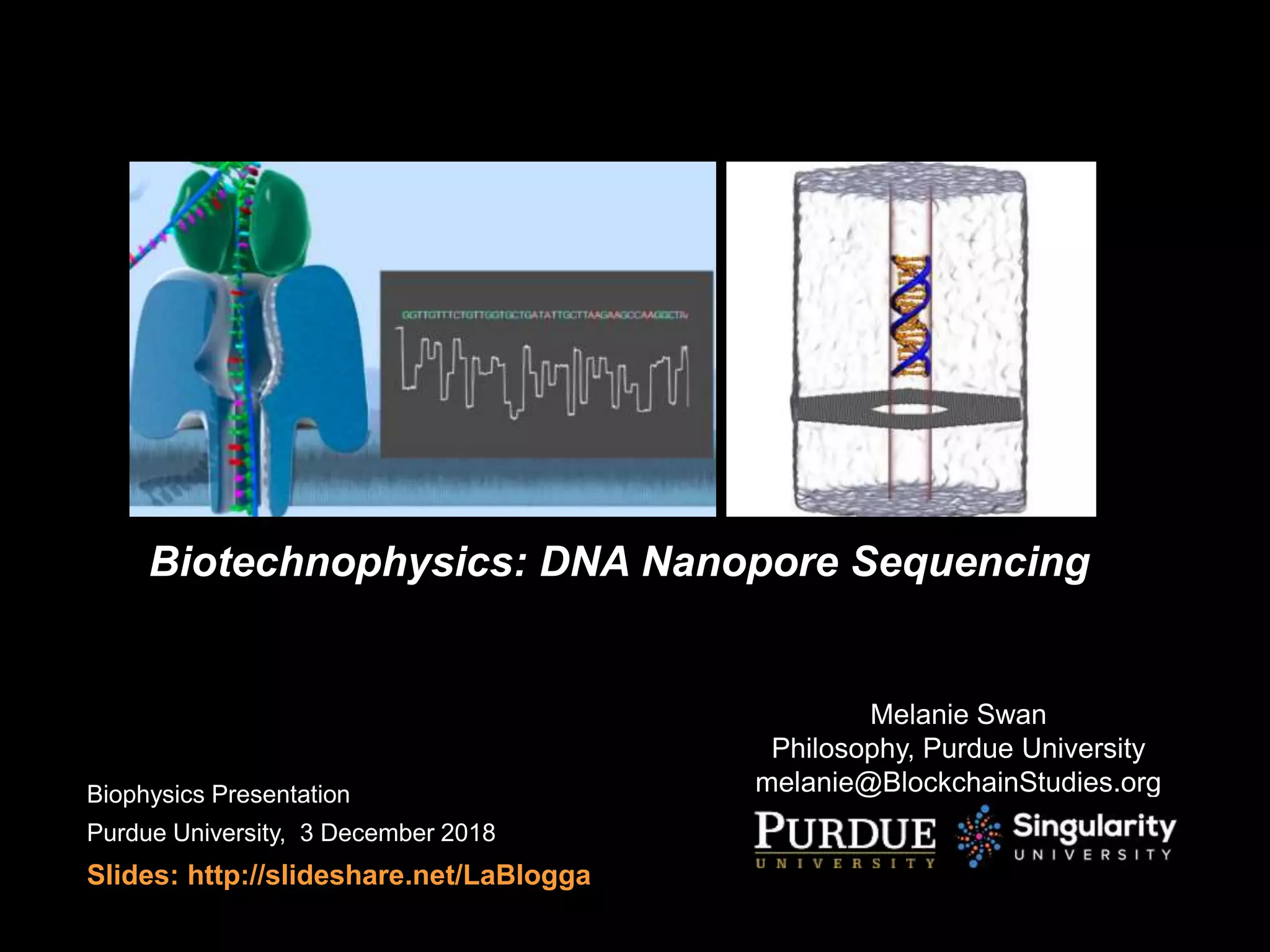
Biotechnophysics: DNA Nanopore Sequencing
Melanie Swan
Philosophy, Purdue University
melanie@BlockchainStudies.orgBiophysics Presentation
Purdue University, 3 December 2018
Slides: http://slideshare.net/LaBlogga
3 Dec 2018
Nanopore Sequencing
Biotechnophysics Thesis
1
Biophysics (not merely bioengineering) is
required to understand the fundamental
mechanisms of biology in order to make
technologies (bench and bioinformatic) for
understanding them
3 Dec 2018
Nanopore Sequencing
Biotechnophysics Definitions
2
Technophysics: the application of physics
principles to the study of technology (particularly
statistical physics, information theory, and
computational complexity); by analogy to
biophysics and econophysics
Biotechnophysics: technophysics (physics
principles applied to the study of technology) in
biological domains
Source: Swan, M. Submitted. Technophysics, Smart Health Networks, and the Bio-cryptoeconomy: Quantized Fungible Global
Health Care Equivalency Units for Health and Well-being. In Boehm, F. Ed., Nanotechnology, Nanomedicine, and AI: Toward the
Dream of Global Health Care Equivalency. Boca Raton FL: CRC Press
3 Dec 2018
Nanopore Sequencing
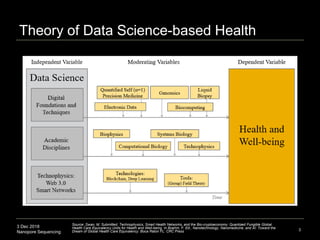
Theory of Data Science-based Health
3
Source: Swan, M. Submitted. Technophysics, Smart Health Networks, and the Bio-cryptoeconomy: Quantized Fungible Global
Health Care Equivalency Units for Health and Well-being. In Boehm, F. Ed., Nanotechnology, Nanomedicine, and AI: Toward the
Dream of Global Health Care Equivalency. Boca Raton FL: CRC Press
3 Dec 2018
Nanopore Sequencing
Agenda
 DNA Sequencing Overview
 Nanopore Sequencing Simulation Results
4
3 Dec 2018
Nanopore Sequencing
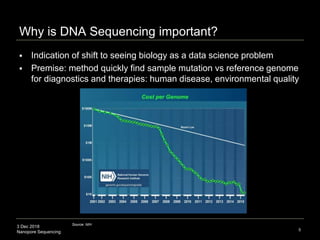
Why is DNA Sequencing important?
 Indication of shift to seeing biology as a data science problem
 Premise: method quickly find sample mutation vs reference genome
for diagnostics and therapies: human disease, environmental quality
5
Source: NIH
3 Dec 2018
Nanopore Sequencing
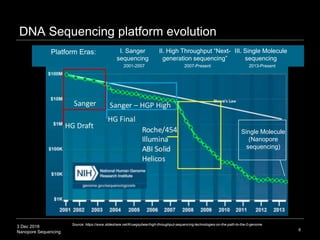
DNA Sequencing platform evolution
6
Source: https://www.slideshare.net/Kruegsybear/high-throughput-sequencing-technologies-on-the-path-to-the-0-genome
Single Molecule
(Nanopore
sequencing)
II. High Throughput “Next-
generation sequencing”
I. Sanger
sequencing
III. Single Molecule
sequencing
Platform Eras:
2001-2007 2007-Present 2013-Present
3 Dec 2018
Nanopore Sequencing 7
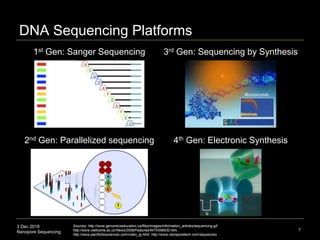
DNA Sequencing Platforms
3rd Gen: Sequencing by Synthesis
2nd Gen: Parallelized sequencing
1st Gen: Sanger Sequencing
4th Gen: Electronic Synthesis
Sources: http://www.genomicseducation.ca/files/images/information_articles/sequencing.gif,
http://www.wellcome.ac.uk/News/2009/Features/WTX056032.htm,
http://www.pacificbiosciences.com/video_lg.html, http://www.nanoporetech.com/sequences
3 Dec 2018
Nanopore Sequencing 8
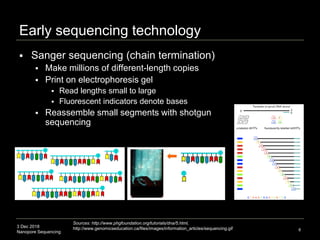
Early sequencing technology
 Sanger sequencing (chain termination)
 Make millions of different-length copies
 Print on electrophoresis gel
 Read lengths small to large
 Fluorescent indicators denote bases
 Reassemble small segments with shotgun
sequencing
Sources: http://www.phgfoundation.org/tutorials/dna/5.html,
http://www.genomicseducation.ca/files/images/information_articles/sequencing.gif
3 Dec 2018
Nanopore Sequencing 9
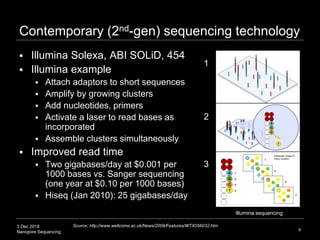
Contemporary (2nd-gen) sequencing technology
 Illumina Solexa, ABI SOLiD, 454
 Illumina example
 Attach adaptors to short sequences
 Amplify by growing clusters
 Add nucleotides, primers
 Activate a laser to read bases as
incorporated
 Assemble clusters simultaneously
 Improved read time
 Two gigabases/day at $0.001 per
1000 bases vs. Sanger sequencing
(one year at $0.10 per 1000 bases)
 Hiseq (Jan 2010): 25 gigabases/day
Source: http://www.wellcome.ac.uk/News/2009/Features/WTX056032.htm
Illumina sequencing
1
2
3
3 Dec 2018
Nanopore Sequencing 10
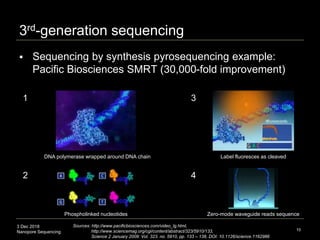
3rd-generation sequencing
 Sequencing by synthesis pyrosequencing example:
Pacific Biosciences SMRT (30,000-fold improvement)
Sources: http://www.pacificbiosciences.com/video_lg.html,
http://www.sciencemag.org/cgi/content/abstract/323/5910/133,
Science 2 January 2009: Vol. 323. no. 5910, pp. 133 – 138, DOI: 10.1126/science.1162986
Phospholinked nucleotides
DNA polymerase wrapped around DNA chain Label fluoresces as cleaved
1
2
3
Zero-mode waveguide reads sequence
4
3 Dec 2018
Nanopore Sequencing 11
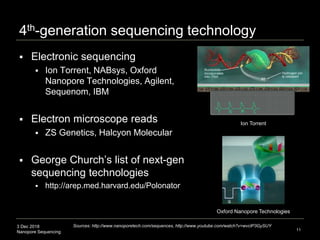
4th-generation sequencing technology
 Electronic sequencing
 Ion Torrent, NABsys, Oxford
Nanopore Technologies, Agilent,
Sequenom, IBM
 Electron microscope reads
 ZS Genetics, Halcyon Molecular
 George Church’s list of next-gen
sequencing technologies
 http://arep.med.harvard.edu/Polonator
Sources: http://www.nanoporetech.com/sequences, http://www.youtube.com/watch?v=wvclP3GySUY
Oxford Nanopore Technologies
Ion Torrent
3 Dec 2018
Nanopore Sequencing 12
DNA sequencing and genetic variation
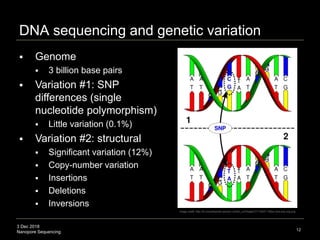
 Genome
 3 billion base pairs
 Variation #1: SNP
differences (single
nucleotide polymorphism)
 Little variation (0.1%)
 Variation #2: structural
 Significant variation (12%)
 Copy-number variation
 Insertions
 Deletions
 Inversions
Image credit: http://im.encyklopedie.seznam.cz/wiki_cz//image/27/119427-180px-dna-snp.svg.png
3 Dec 2018
Nanopore Sequencing
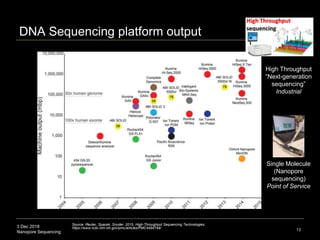
DNA Sequencing platform output
13
Source: Reuter, Spacek, Snyder, 2015, High-Throughput Sequencing Technologies,
https://www.ncbi.nlm.nih.gov/pmc/articles/PMC4494749/
Single Molecule
(Nanopore
sequencing)
Point of Service
High Throughput
“Next-generation
sequencing”
Industrial
3 Dec 2018
Nanopore Sequencing
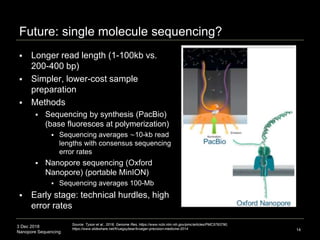
Future: single molecule sequencing?
 Longer read length (1-100kb vs.
200-400 bp)
 Simpler, lower-cost sample
preparation
 Methods
 Sequencing by synthesis (PacBio)
(base fluoresces at polymerization)
 Sequencing averages ∼10-kb read
lengths with consensus sequencing
error rates
 Nanopore sequencing (Oxford
Nanopore) (portable MinION)
 Sequencing averages 100-Mb
 Early stage: technical hurdles, high
error rates
14
Source: Tyson et al., 2018, Genome Res, https://www.ncbi.nlm.nih.gov/pmc/articles/PMC5793790,
https://www.slideshare.net/Kruegsybear/krueger-precision-medicine-2014
3 Dec 2018
Nanopore Sequencing
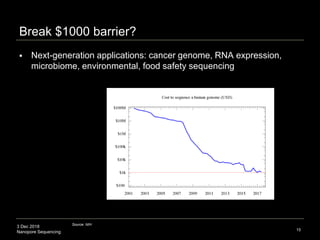
Break $1000 barrier?
 Next-generation applications: cancer genome, RNA expression,
microbiome, environmental, food safety sequencing
15
Source: NIH
3 Dec 2018
Nanopore Sequencing
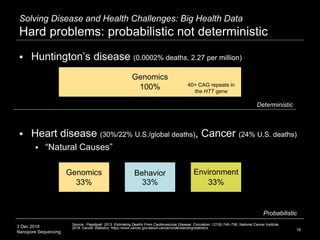
 Huntington’s disease (0.0002% deaths, 2.27 per million)
 Heart disease (30%/22% U.S./global deaths), Cancer (24% U.S. deaths)
 “Natural Causes”
16
Solving Disease and Health Challenges: Big Health Data
Hard problems: probabilistic not deterministic
Genomics
100%
Behavior
33%
Genomics
33%
Environment
33%
Source: Pagidipati. 2013. Estimating Deaths From Cardiovascular Disease. Circulation. 127(6):749–756; National Cancer Institute.
2018. Cancer Statistics. https://www.cancer.gov/about-cancer/understanding/statistics
Deterministic
Probabilistic
40+ CAG repeats in
the HTT gene
3 Dec 2018
Nanopore Sequencing
Agenda
 DNA Sequencing Overview
 Nanopore Sequencing Simulation Results
17
3 Dec 2018
Nanopore Sequencing
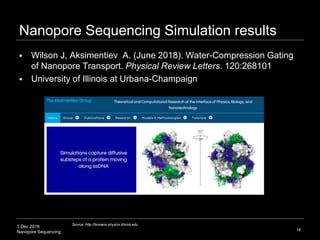
Nanopore Sequencing Simulation results
 Wilson J, Aksimentiev A. (June 2018). Water-Compression Gating
of Nanopore Transport. Physical Review Letters. 120:268101
 University of Illinois at Urbana-Champaign
18
Source: http://bionano.physics.illinois.edu
3 Dec 2018
Nanopore Sequencing
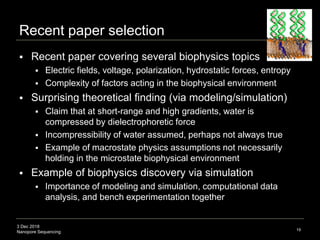
Recent paper selection
 Recent paper covering several biophysics topics
 Electric fields, voltage, polarization, hydrostatic forces, entropy
 Complexity of factors acting in the biophysical environment
 Surprising theoretical finding (via modeling/simulation)
 Claim that at short-range and high gradients, water is
compressed by dielectrophoretic force
 Incompressibility of water assumed, perhaps not always true
 Example of macrostate physics assumptions not necessarily
holding in the microstate biophysical environment
 Example of biophysics discovery via simulation
 Importance of modeling and simulation, computational data
analysis, and bench experimentation together
19
3 Dec 2018
Nanopore Sequencing
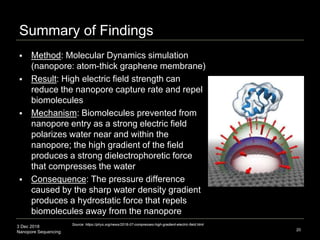
Summary of Findings
 Method: Molecular Dynamics simulation
(nanopore: atom-thick graphene membrane)
 Result: High electric field strength can
reduce the nanopore capture rate and repel
biomolecules
 Mechanism: Biomolecules prevented from
nanopore entry as a strong electric field
polarizes water near and within the
nanopore; the high gradient of the field
produces a strong dielectrophoretic force
that compresses the water
 Consequence: The pressure difference
caused by the sharp water density gradient
produces a hydrostatic force that repels
biomolecules away from the nanopore
20
Source: https://phys.org/news/2018-07-compresses-high-gradient-electric-field.html
3 Dec 2018
Nanopore Sequencing 21
Single Molecule
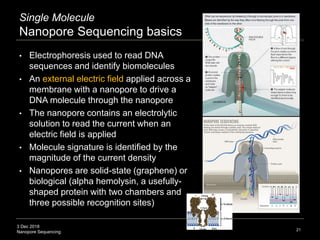
Nanopore Sequencing basics
• Electrophoresis used to read DNA
sequences and identify biomolecules
• An external electric field applied across a
membrane with a nanopore to drive a
DNA molecule through the nanopore
• The nanopore contains an electrolytic
solution to read the current when an
electric field is applied
• Molecule signature is identified by the
magnitude of the current density
• Nanopores are solid-state (graphene) or
biological (alpha hemolysin, a usefully-
shaped protein with two chambers and
three possible recognition sites)
3 Dec 2018
Nanopore Sequencing
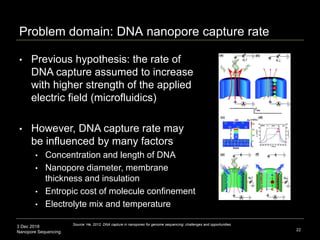
Problem domain: DNA nanopore capture rate
22
• Previous hypothesis: the rate of
DNA capture assumed to increase
with higher strength of the applied
electric field (microfluidics)
• However, DNA capture rate may
be influenced by many factors
• Concentration and length of DNA
• Nanopore diameter, membrane
thickness and insulation
• Entropic cost of molecule confinement
• Electrolyte mix and temperature
Source: He, 2012, DNA capture in nanopores for genome sequencing: challenges and opportunities
3 Dec 2018
Nanopore Sequencing
DNA nanopore capture rate (electric field)
23
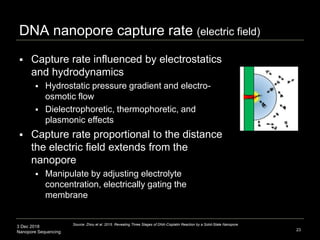
 Capture rate influenced by electrostatics
and hydrodynamics
 Hydrostatic pressure gradient and electro-
osmotic flow
 Dielectrophoretic, thermophoretic, and
plasmonic effects
 Capture rate proportional to the distance
the electric field extends from the
nanopore
 Manipulate by adjusting electrolyte
concentration, electrically gating the
membrane
Source: Zhou et al. 2015. Revealing Three Stages of DNA-Cisplatin Reaction by a Solid-State Nanopore.
3 Dec 2018
Nanopore Sequencing
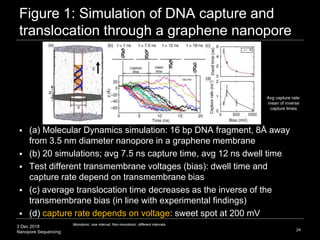
Figure 1: Simulation of DNA capture and
translocation through a graphene nanopore
 (a) Molecular Dynamics simulation: 16 bp DNA fragment, 8Å away
from 3.5 nm diameter nanopore in a graphene membrane
 (b) 20 simulations; avg 7.5 ns capture time, avg 12 ns dwell time
 Test different transmembrane voltages (bias): dwell time and
capture rate depend on transmembrane bias
 (c) average translocation time decreases as the inverse of the
transmembrane bias (in line with experimental findings)
 (d) capture rate depends on voltage: sweet spot at 200 mV
24
Avg capture rate:
mean of inverse
capture times
Monotonic: one interval; Non-monotonic: different intervals
3 Dec 2018
Nanopore Sequencing
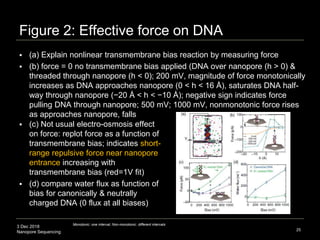
 (a) Explain nonlinear transmembrane bias reaction by measuring force
 (b) force = 0 no transmembrane bias applied (DNA over nanopore (h > 0) &
threaded through nanopore (h < 0); 200 mV, magnitude of force monotonically
increases as DNA approaches nanopore (0 < h < 16 Å), saturates DNA half-
way through nanopore (−20 Å < h < −10 Å); negative sign indicates force
pulling DNA through nanopore; 500 mV; 1000 mV, nonmonotonic force rises
as approaches nanopore, falls
Figure 2: Effective force on DNA
25
 (c) Not usual electro-osmosis effect
on force: replot force as a function of
transmembrane bias; indicates short-
range repulsive force near nanopore
entrance increasing with
transmembrane bias (red=1V fit)
 (d) compare water flux as function of
bias for canonically & neutrally
charged DNA (0 flux at all biases)
Monotonic: one interval; Non-monotonic: different intervals
3 Dec 2018
Nanopore Sequencing
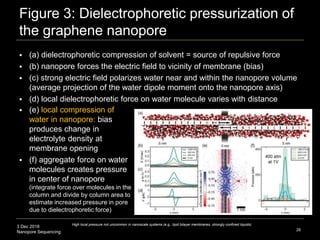
Figure 3: Dielectrophoretic pressurization of
the graphene nanopore
 (a) dielectrophoretic compression of solvent = source of repulsive force
 (b) nanopore forces the electric field to vicinity of membrane (bias)
 (c) strong electric field polarizes water near and within the nanopore volume
(average projection of the water dipole moment onto the nanopore axis)
 (d) local dielectrophoretic force on water molecule varies with distance
26
 (e) local compression of
water in nanopore: bias
produces change in
electrolyte density at
membrane opening
 (f) aggregate force on water
molecules creates pressure
in center of nanopore
(integrate force over molecules in the
column and divide by column area to
estimate increased pressure in pore
due to dielectrophoretic force)
400 atm
at 1V
High local pressure not uncommon in nanoscale systems (e.g.; lipid bilayer membranes, strongly confined liquids)
3 Dec 2018
Nanopore Sequencing
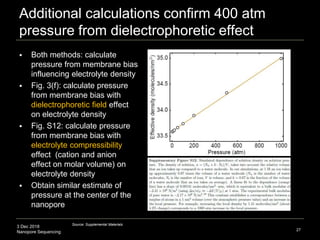
Additional calculations confirm 400 atm
pressure from dielectrophoretic effect
27
Source: Supplemental Materials
 Both methods: calculate
pressure from membrane bias
influencing electrolyte density
 Fig. 3(f): calculate pressure
from membrane bias with
dielectrophoretic field effect
on electrolyte density
 Fig. S12: calculate pressure
from membrane bias with
electrolyte compressibility
effect (cation and anion
effect on molar volume) on
electrolyte density
 Obtain similar estimate of
pressure at the center of the
nanopore
3 Dec 2018
Nanopore Sequencing
Macroscale: Low Compressibility of Water
28
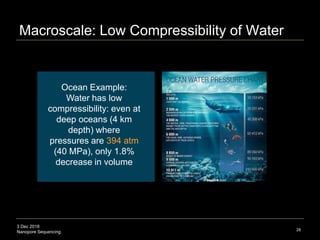
Ocean Example:
Water has low
compressibility: even at
deep oceans (4 km
depth) where
pressures are 394 atm
(40 MPa), only 1.8%
decrease in volume
3 Dec 2018
Nanopore Sequencing
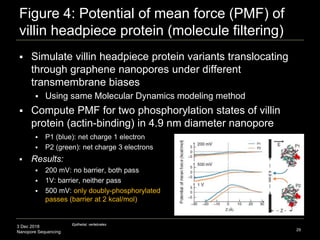
Figure 4: Potential of mean force (PMF) of
villin headpiece protein (molecule filtering)
 Simulate villin headpiece protein variants translocating
through graphene nanopores under different
transmembrane biases
 Using same Molecular Dynamics modeling method
 Compute PMF for two phosphorylation states of villin
protein (actin-binding) in 4.9 nm diameter nanopore
29
 P1 (blue): net charge 1 electron
 P2 (green): net charge 3 electrons
 Results:
 200 mV: no barrier, both pass
 1V: barrier, neither pass
 500 mV: only doubly-phosphorylated
passes (barrier at 2 kcal/mol)
Epithelial, vertebrates
3 Dec 2018
Nanopore Sequencing
Summary of Key Findings
 Dielectrophoresis (electrical charge) was previously
assumed to accelerate biomolecule transport through
nanopore, but may impede both capture and transport
 Guidance: determine optimal range of charge application
 Water was assumed to be incompressible but may be
compressed at short distances in and around nanopore
by high dielectric field gradients creating pressure
 Proposed “nanopore dielectric blockade effect” might be
used as a particle sorting mechanism based on the
charge-to-volume ratio of biomolecules
 Filter proteins in different states of phosphorylation
30
3 Dec 2018
Nanopore Sequencing
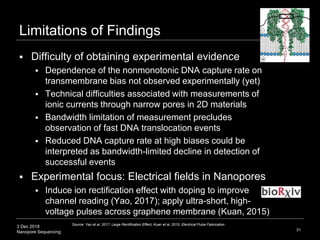
Limitations of Findings
 Difficulty of obtaining experimental evidence
 Dependence of the nonmonotonic DNA capture rate on
transmembrane bias not observed experimentally (yet)
 Technical difficulties associated with measurements of
ionic currents through narrow pores in 2D materials
 Bandwidth limitation of measurement precludes
observation of fast DNA translocation events
 Reduced DNA capture rate at high biases could be
interpreted as bandwidth-limited decline in detection of
successful events
 Experimental focus: Electrical fields in Nanopores
 Induce ion rectification effect with doping to improve
channel reading (Yao, 2017); apply ultra-short, high-
voltage pulses across graphene membrane (Kuan, 2015)
31
Source: Yao et al, 2017, Large Rectification Effect; Kuan et al, 2015, Electrical Pulse Fabrication
3 Dec 2018
Nanopore Sequencing
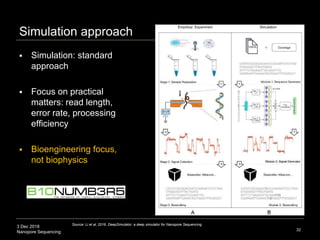
Simulation approach
 Simulation: standard
approach
 Focus on practical
matters: read length,
error rate, processing
efficiency
 Bioengineering focus,
not biophysics
32
Source: Li et al, 2016, DeepSimulator: a deep simulator for Nanopore Sequencing
3 Dec 2018
Nanopore Sequencing
Biotechnophysics Thesis
33
Biophysics (not merely bioengineering) is
required to understand the fundamental
mechanisms of biology in order to make
technologies (bench and bioinformatic) for
understanding them
Melanie Swan
Philosophy, Purdue University
melanie@BlockchainStudies.orgBiophysics Presentation
Purdue University, 3 December 2018
Slides: http://slideshare.net/LaBlogga
Thank you!
Questions?
Biotechnophysics: DNA Nanopore Sequencing

Biotechnophysics: DNA Nanopore Sequencing

  • 1.
    Biotechnophysics: DNA NanoporeSequencing Melanie Swan Philosophy, Purdue University melanie@BlockchainStudies.orgBiophysics Presentation Purdue University, 3 December 2018 Slides: http://slideshare.net/LaBlogga
  • 2.
    3 Dec 2018 NanoporeSequencing Biotechnophysics Thesis 1 Biophysics (not merely bioengineering) is required to understand the fundamental mechanisms of biology in order to make technologies (bench and bioinformatic) for understanding them
  • 3.
    3 Dec 2018 NanoporeSequencing Biotechnophysics Definitions 2 Technophysics: the application of physics principles to the study of technology (particularly statistical physics, information theory, and computational complexity); by analogy to biophysics and econophysics Biotechnophysics: technophysics (physics principles applied to the study of technology) in biological domains Source: Swan, M. Submitted. Technophysics, Smart Health Networks, and the Bio-cryptoeconomy: Quantized Fungible Global Health Care Equivalency Units for Health and Well-being. In Boehm, F. Ed., Nanotechnology, Nanomedicine, and AI: Toward the Dream of Global Health Care Equivalency. Boca Raton FL: CRC Press
  • 4.
    3 Dec 2018 NanoporeSequencing Theory of Data Science-based Health 3 Source: Swan, M. Submitted. Technophysics, Smart Health Networks, and the Bio-cryptoeconomy: Quantized Fungible Global Health Care Equivalency Units for Health and Well-being. In Boehm, F. Ed., Nanotechnology, Nanomedicine, and AI: Toward the Dream of Global Health Care Equivalency. Boca Raton FL: CRC Press
  • 5.
    3 Dec 2018 NanoporeSequencing Agenda  DNA Sequencing Overview  Nanopore Sequencing Simulation Results 4
  • 6.
    3 Dec 2018 NanoporeSequencing Why is DNA Sequencing important?  Indication of shift to seeing biology as a data science problem  Premise: method quickly find sample mutation vs reference genome for diagnostics and therapies: human disease, environmental quality 5 Source: NIH
  • 7.
    3 Dec 2018 NanoporeSequencing DNA Sequencing platform evolution 6 Source: https://www.slideshare.net/Kruegsybear/high-throughput-sequencing-technologies-on-the-path-to-the-0-genome Single Molecule (Nanopore sequencing) II. High Throughput “Next- generation sequencing” I. Sanger sequencing III. Single Molecule sequencing Platform Eras: 2001-2007 2007-Present 2013-Present
  • 8.
    3 Dec 2018 NanoporeSequencing 7 DNA Sequencing Platforms 3rd Gen: Sequencing by Synthesis 2nd Gen: Parallelized sequencing 1st Gen: Sanger Sequencing 4th Gen: Electronic Synthesis Sources: http://www.genomicseducation.ca/files/images/information_articles/sequencing.gif, http://www.wellcome.ac.uk/News/2009/Features/WTX056032.htm, http://www.pacificbiosciences.com/video_lg.html, http://www.nanoporetech.com/sequences
  • 9.
    3 Dec 2018 NanoporeSequencing 8 Early sequencing technology  Sanger sequencing (chain termination)  Make millions of different-length copies  Print on electrophoresis gel  Read lengths small to large  Fluorescent indicators denote bases  Reassemble small segments with shotgun sequencing Sources: http://www.phgfoundation.org/tutorials/dna/5.html, http://www.genomicseducation.ca/files/images/information_articles/sequencing.gif
  • 10.
    3 Dec 2018 NanoporeSequencing 9 Contemporary (2nd-gen) sequencing technology  Illumina Solexa, ABI SOLiD, 454  Illumina example  Attach adaptors to short sequences  Amplify by growing clusters  Add nucleotides, primers  Activate a laser to read bases as incorporated  Assemble clusters simultaneously  Improved read time  Two gigabases/day at $0.001 per 1000 bases vs. Sanger sequencing (one year at $0.10 per 1000 bases)  Hiseq (Jan 2010): 25 gigabases/day Source: http://www.wellcome.ac.uk/News/2009/Features/WTX056032.htm Illumina sequencing 1 2 3
  • 11.
    3 Dec 2018 NanoporeSequencing 10 3rd-generation sequencing  Sequencing by synthesis pyrosequencing example: Pacific Biosciences SMRT (30,000-fold improvement) Sources: http://www.pacificbiosciences.com/video_lg.html, http://www.sciencemag.org/cgi/content/abstract/323/5910/133, Science 2 January 2009: Vol. 323. no. 5910, pp. 133 – 138, DOI: 10.1126/science.1162986 Phospholinked nucleotides DNA polymerase wrapped around DNA chain Label fluoresces as cleaved 1 2 3 Zero-mode waveguide reads sequence 4
  • 12.
    3 Dec 2018 NanoporeSequencing 11 4th-generation sequencing technology  Electronic sequencing  Ion Torrent, NABsys, Oxford Nanopore Technologies, Agilent, Sequenom, IBM  Electron microscope reads  ZS Genetics, Halcyon Molecular  George Church’s list of next-gen sequencing technologies  http://arep.med.harvard.edu/Polonator Sources: http://www.nanoporetech.com/sequences, http://www.youtube.com/watch?v=wvclP3GySUY Oxford Nanopore Technologies Ion Torrent
  • 13.
    3 Dec 2018 NanoporeSequencing 12 DNA sequencing and genetic variation  Genome  3 billion base pairs  Variation #1: SNP differences (single nucleotide polymorphism)  Little variation (0.1%)  Variation #2: structural  Significant variation (12%)  Copy-number variation  Insertions  Deletions  Inversions Image credit: http://im.encyklopedie.seznam.cz/wiki_cz//image/27/119427-180px-dna-snp.svg.png
  • 14.
    3 Dec 2018 NanoporeSequencing DNA Sequencing platform output 13 Source: Reuter, Spacek, Snyder, 2015, High-Throughput Sequencing Technologies, https://www.ncbi.nlm.nih.gov/pmc/articles/PMC4494749/ Single Molecule (Nanopore sequencing) Point of Service High Throughput “Next-generation sequencing” Industrial
  • 15.
    3 Dec 2018 NanoporeSequencing Future: single molecule sequencing?  Longer read length (1-100kb vs. 200-400 bp)  Simpler, lower-cost sample preparation  Methods  Sequencing by synthesis (PacBio) (base fluoresces at polymerization)  Sequencing averages ∼10-kb read lengths with consensus sequencing error rates  Nanopore sequencing (Oxford Nanopore) (portable MinION)  Sequencing averages 100-Mb  Early stage: technical hurdles, high error rates 14 Source: Tyson et al., 2018, Genome Res, https://www.ncbi.nlm.nih.gov/pmc/articles/PMC5793790, https://www.slideshare.net/Kruegsybear/krueger-precision-medicine-2014
  • 16.
    3 Dec 2018 NanoporeSequencing Break $1000 barrier?  Next-generation applications: cancer genome, RNA expression, microbiome, environmental, food safety sequencing 15 Source: NIH
  • 17.
    3 Dec 2018 NanoporeSequencing  Huntington’s disease (0.0002% deaths, 2.27 per million)  Heart disease (30%/22% U.S./global deaths), Cancer (24% U.S. deaths)  “Natural Causes” 16 Solving Disease and Health Challenges: Big Health Data Hard problems: probabilistic not deterministic Genomics 100% Behavior 33% Genomics 33% Environment 33% Source: Pagidipati. 2013. Estimating Deaths From Cardiovascular Disease. Circulation. 127(6):749–756; National Cancer Institute. 2018. Cancer Statistics. https://www.cancer.gov/about-cancer/understanding/statistics Deterministic Probabilistic 40+ CAG repeats in the HTT gene
  • 18.
    3 Dec 2018 NanoporeSequencing Agenda  DNA Sequencing Overview  Nanopore Sequencing Simulation Results 17
  • 19.
    3 Dec 2018 NanoporeSequencing Nanopore Sequencing Simulation results  Wilson J, Aksimentiev A. (June 2018). Water-Compression Gating of Nanopore Transport. Physical Review Letters. 120:268101  University of Illinois at Urbana-Champaign 18 Source: http://bionano.physics.illinois.edu
  • 20.
    3 Dec 2018 NanoporeSequencing Recent paper selection  Recent paper covering several biophysics topics  Electric fields, voltage, polarization, hydrostatic forces, entropy  Complexity of factors acting in the biophysical environment  Surprising theoretical finding (via modeling/simulation)  Claim that at short-range and high gradients, water is compressed by dielectrophoretic force  Incompressibility of water assumed, perhaps not always true  Example of macrostate physics assumptions not necessarily holding in the microstate biophysical environment  Example of biophysics discovery via simulation  Importance of modeling and simulation, computational data analysis, and bench experimentation together 19
  • 21.
    3 Dec 2018 NanoporeSequencing Summary of Findings  Method: Molecular Dynamics simulation (nanopore: atom-thick graphene membrane)  Result: High electric field strength can reduce the nanopore capture rate and repel biomolecules  Mechanism: Biomolecules prevented from nanopore entry as a strong electric field polarizes water near and within the nanopore; the high gradient of the field produces a strong dielectrophoretic force that compresses the water  Consequence: The pressure difference caused by the sharp water density gradient produces a hydrostatic force that repels biomolecules away from the nanopore 20 Source: https://phys.org/news/2018-07-compresses-high-gradient-electric-field.html
  • 22.
    3 Dec 2018 NanoporeSequencing 21 Single Molecule Nanopore Sequencing basics • Electrophoresis used to read DNA sequences and identify biomolecules • An external electric field applied across a membrane with a nanopore to drive a DNA molecule through the nanopore • The nanopore contains an electrolytic solution to read the current when an electric field is applied • Molecule signature is identified by the magnitude of the current density • Nanopores are solid-state (graphene) or biological (alpha hemolysin, a usefully- shaped protein with two chambers and three possible recognition sites)
  • 23.
    3 Dec 2018 NanoporeSequencing Problem domain: DNA nanopore capture rate 22 • Previous hypothesis: the rate of DNA capture assumed to increase with higher strength of the applied electric field (microfluidics) • However, DNA capture rate may be influenced by many factors • Concentration and length of DNA • Nanopore diameter, membrane thickness and insulation • Entropic cost of molecule confinement • Electrolyte mix and temperature Source: He, 2012, DNA capture in nanopores for genome sequencing: challenges and opportunities
  • 24.
    3 Dec 2018 NanoporeSequencing DNA nanopore capture rate (electric field) 23  Capture rate influenced by electrostatics and hydrodynamics  Hydrostatic pressure gradient and electro- osmotic flow  Dielectrophoretic, thermophoretic, and plasmonic effects  Capture rate proportional to the distance the electric field extends from the nanopore  Manipulate by adjusting electrolyte concentration, electrically gating the membrane Source: Zhou et al. 2015. Revealing Three Stages of DNA-Cisplatin Reaction by a Solid-State Nanopore.
  • 25.
    3 Dec 2018 NanoporeSequencing Figure 1: Simulation of DNA capture and translocation through a graphene nanopore  (a) Molecular Dynamics simulation: 16 bp DNA fragment, 8Å away from 3.5 nm diameter nanopore in a graphene membrane  (b) 20 simulations; avg 7.5 ns capture time, avg 12 ns dwell time  Test different transmembrane voltages (bias): dwell time and capture rate depend on transmembrane bias  (c) average translocation time decreases as the inverse of the transmembrane bias (in line with experimental findings)  (d) capture rate depends on voltage: sweet spot at 200 mV 24 Avg capture rate: mean of inverse capture times Monotonic: one interval; Non-monotonic: different intervals
  • 26.
    3 Dec 2018 NanoporeSequencing  (a) Explain nonlinear transmembrane bias reaction by measuring force  (b) force = 0 no transmembrane bias applied (DNA over nanopore (h > 0) & threaded through nanopore (h < 0); 200 mV, magnitude of force monotonically increases as DNA approaches nanopore (0 < h < 16 Å), saturates DNA half- way through nanopore (−20 Å < h < −10 Å); negative sign indicates force pulling DNA through nanopore; 500 mV; 1000 mV, nonmonotonic force rises as approaches nanopore, falls Figure 2: Effective force on DNA 25  (c) Not usual electro-osmosis effect on force: replot force as a function of transmembrane bias; indicates short- range repulsive force near nanopore entrance increasing with transmembrane bias (red=1V fit)  (d) compare water flux as function of bias for canonically & neutrally charged DNA (0 flux at all biases) Monotonic: one interval; Non-monotonic: different intervals
  • 27.
    3 Dec 2018 NanoporeSequencing Figure 3: Dielectrophoretic pressurization of the graphene nanopore  (a) dielectrophoretic compression of solvent = source of repulsive force  (b) nanopore forces the electric field to vicinity of membrane (bias)  (c) strong electric field polarizes water near and within the nanopore volume (average projection of the water dipole moment onto the nanopore axis)  (d) local dielectrophoretic force on water molecule varies with distance 26  (e) local compression of water in nanopore: bias produces change in electrolyte density at membrane opening  (f) aggregate force on water molecules creates pressure in center of nanopore (integrate force over molecules in the column and divide by column area to estimate increased pressure in pore due to dielectrophoretic force) 400 atm at 1V High local pressure not uncommon in nanoscale systems (e.g.; lipid bilayer membranes, strongly confined liquids)
  • 28.
    3 Dec 2018 NanoporeSequencing Additional calculations confirm 400 atm pressure from dielectrophoretic effect 27 Source: Supplemental Materials  Both methods: calculate pressure from membrane bias influencing electrolyte density  Fig. 3(f): calculate pressure from membrane bias with dielectrophoretic field effect on electrolyte density  Fig. S12: calculate pressure from membrane bias with electrolyte compressibility effect (cation and anion effect on molar volume) on electrolyte density  Obtain similar estimate of pressure at the center of the nanopore
  • 29.
    3 Dec 2018 NanoporeSequencing Macroscale: Low Compressibility of Water 28 Ocean Example: Water has low compressibility: even at deep oceans (4 km depth) where pressures are 394 atm (40 MPa), only 1.8% decrease in volume
  • 30.
    3 Dec 2018 NanoporeSequencing Figure 4: Potential of mean force (PMF) of villin headpiece protein (molecule filtering)  Simulate villin headpiece protein variants translocating through graphene nanopores under different transmembrane biases  Using same Molecular Dynamics modeling method  Compute PMF for two phosphorylation states of villin protein (actin-binding) in 4.9 nm diameter nanopore 29  P1 (blue): net charge 1 electron  P2 (green): net charge 3 electrons  Results:  200 mV: no barrier, both pass  1V: barrier, neither pass  500 mV: only doubly-phosphorylated passes (barrier at 2 kcal/mol) Epithelial, vertebrates
  • 31.
    3 Dec 2018 NanoporeSequencing Summary of Key Findings  Dielectrophoresis (electrical charge) was previously assumed to accelerate biomolecule transport through nanopore, but may impede both capture and transport  Guidance: determine optimal range of charge application  Water was assumed to be incompressible but may be compressed at short distances in and around nanopore by high dielectric field gradients creating pressure  Proposed “nanopore dielectric blockade effect” might be used as a particle sorting mechanism based on the charge-to-volume ratio of biomolecules  Filter proteins in different states of phosphorylation 30
  • 32.
    3 Dec 2018 NanoporeSequencing Limitations of Findings  Difficulty of obtaining experimental evidence  Dependence of the nonmonotonic DNA capture rate on transmembrane bias not observed experimentally (yet)  Technical difficulties associated with measurements of ionic currents through narrow pores in 2D materials  Bandwidth limitation of measurement precludes observation of fast DNA translocation events  Reduced DNA capture rate at high biases could be interpreted as bandwidth-limited decline in detection of successful events  Experimental focus: Electrical fields in Nanopores  Induce ion rectification effect with doping to improve channel reading (Yao, 2017); apply ultra-short, high- voltage pulses across graphene membrane (Kuan, 2015) 31 Source: Yao et al, 2017, Large Rectification Effect; Kuan et al, 2015, Electrical Pulse Fabrication
  • 33.
    3 Dec 2018 NanoporeSequencing Simulation approach  Simulation: standard approach  Focus on practical matters: read length, error rate, processing efficiency  Bioengineering focus, not biophysics 32 Source: Li et al, 2016, DeepSimulator: a deep simulator for Nanopore Sequencing
  • 34.
    3 Dec 2018 NanoporeSequencing Biotechnophysics Thesis 33 Biophysics (not merely bioengineering) is required to understand the fundamental mechanisms of biology in order to make technologies (bench and bioinformatic) for understanding them
  • 35.
    Melanie Swan Philosophy, PurdueUniversity melanie@BlockchainStudies.orgBiophysics Presentation Purdue University, 3 December 2018 Slides: http://slideshare.net/LaBlogga Thank you! Questions? Biotechnophysics: DNA Nanopore Sequencing