Empirical potentials for charge transfer excitations
                                                                                        Jiahao Chen and Troy Van Voorhis, MIT Chemistry
Classical models for charge fluctuations                                                                                 Results: ground and CT excitation in LiF
 Fluctuating-charge models can describe polarization and charge transfer effects in force fields.
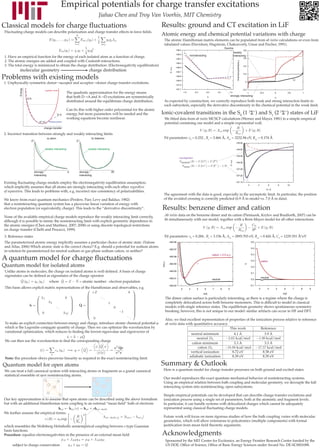
                                                                                                                         Atomic energy and chemical potential variations with charge
                                                                                                                          The atomic Hamiltonian matrix elements can be populated from ab initio calculations or even from
                                                                                                                          tabulated values (Davidson, Hagstrom, Chakravorty, Umar and Fischer, 1991).
                                                                                                                                                                       fluorine
                                                                                                                                                                                  weakly
                                                                                                                                           noninteracting                         interacting
 1. Have an empirical function for the energy of each isolated atom as a function of charge.
 2. The atomic energies are added and coupled with Coulomb interactions.                                                                                                                                        F
 3. The total energy is minimized to obtain the charge distribution. (Electronegativity equilibration)
           molecular geometry                                                   charge distribution
Problems with existing models                                                                                                                                                                                   Li
1. Unphysically symmetric donor→acceptor and acceptor→donor charge transfer excitations.
          Energy


                                       quadratic model
                                                              The quadratic approximation for the energy means
                                                              that both D→A and A→D excitations are symmetrically                                                           strongly interacting
                   DA
                   -   +

                                                              distributed around the equilibrium charge distribution.     As expected by construction, we correctly reproduce both weak and strong interaction limits in
                                                                                                                          each subsystem, especially the derivative discontinuity in the chemical potential in the weak limit.
                                                              Can fix this with higher order polynomial for the atomic
                                                     D+A-     energy, but more parameters will be needed and the         Ionic-covalent transitions in the S0 (1 1Σ+) and S1 (2 1Σ+) states of LiF
                                                              working equations become nonlinear.                         We fitted data from ab initio MCSCF calculations (Werner and Mayer, 1981) to a simple empirical
                               D A          physical system
                                                                                                                          potential containing our model and a simple exponential wall.
                                 δ+   δ-


                                      charge transfer

2. Incorrect transition between strongly and weakly interacting limits
                                           a) atom                                b) diatomic                             Fit parameters: s0 = 0.252 , Rs = 3.466 Å, Aex = 3232.94 eV, Rex = 0.174 Å
                       E                                            E


                                      weakly interacting                        weakly interacting


                                                                                                                                    asymptotes


                           strongly                           q         strongly                     ∆q
                           interacting                                  interacting

Existing fluctuating-charge models employ the electronegativity equilibration assumption,
which implicitly assumes that all atoms are strongly interacting with each other regardless
of separation. This leads to problems with, e.g. incorrect size consistency of polarizabilities.
                                                                                                                          The agreement with the data is good, especially in the asymptotic limit. In particular, the position
We know from exact quantum mechanics (Perdew, Parr, Levy and Balduz, 1982)                                                of the avoided crossing is correctly predicted (6.9 Å in model vs. 7.0 Å in data).
that a noninteracting quantum system has a piecewise linear variation of energy with
electron population (or equivalently, charge). This leads to the “derivative discontinuity”.                             Results: benzene dimer and cation
None of the available empirical charge models reproduce the weakly interacting limit correctly,                           Ab initio data on the benzene dimer and its cation (Pieniazek, Krylov and Bradforth, 2007) can be
although it is possible to mimic the noninteracting limit with explicit geometric dependence in                           fit simultaneously with our model, together with a Born-Mayer model for all other interactions.
the atomic energies (Chen and Martínez, 2007; 2008) or using discrete topological restrictions
on charge transfer (Chelli and Procacci, 1999).
3. Reference states                                                                                                       Fit parameters: s0 = 0.284 , Rs = 3.156 Å, Aex = 2895.703 eV, Rex = 0.426 Å, C6 = 1229.351 Å6.eV
The parameterized atomic energy implicitly assumes a particular choice of atomic state. (Valone
and Atlas, 2006) Which atomic state is the correct choice? E.g. should a potential for sodium atoms
in solution be parameterized for neutral sodium or gas-phase sodium cation, or neither?

A quantum model for charge fluctuations
                                                                                                                                                            cation + 0.3 a.u.

                                                                                                                                                                                                   cation
Quantum model for isolated atoms
 Unlike atoms in molecules, the charge on isolated atoms is well-defined. A basis of charge
 eigenstates can be defined as eigenstates of the charge operator                                                                                                                                  neutral
                                                                                                                                                            neutral
                                            where                       = atomic number - electron population
 This basis allows explicit matrix representations of the Hamiltonian and observables, e.g.

                                                                                                                          The dimer cation surface is particularly interesting, as there is a regime where the charge is
                                                                                                                          completely delocalized across both benzene monomers. This is difficult to model in classical
                                                                                                                          models with single reference states. The equilibrium geometry shows spontaneous symmetry
                                                                                                                          breaking; however, this is not unique to our model: similar artifacts can occur in HF and DFT.

                                                                                                                          Also, we find excellent representation of properties of the ionization process relative to reference
 To make an explicit connection between energy and charge, introduce atomic chemical potential μ                          ab initio data with quantitative accuracy.
 which is the Legendre-conjugate quantity of charge. Then we can optimize the wavefunction by
 variational optimization, which reduces to finding the lowest eigenvalue and eigenvector of

 We can then use the wavefunction to find the corresponding charge


 Note: this procedure obeys piecewise linearity as required in the exact noninteracting limit.

Quantum model for open atoms                                                                                             Summary & Outlook
 We can treat a full canonical system with interacting atoms or fragments as a grand canonical                            Here is a quantum model for charge transfer processes on both ground and excited states.
 statistical ensemble of open noninteracting atoms.
                                                                                                                          Our model reproduces the exact quantum mechanical behavior of noninteracting systems.
                                                                                                                          Using an empirical relation between bath coupling and molecular geometry, we decouple the full
                                                                                                                          interacting system into noninteracting, open subsystems.

                                                                                                                          Simple empirical potentials can be developed that can describe charge transfer excitations and
Our key approximation is to assume that open atoms can be described using the above formalism                             ionization process using a single set of parameters, both at the atomistic and fragment levels.
but with an additional Hamiltonian term coupling to an external “mean field” bath of electrons                            In particular, it can handle systems with delocalized charges which cannot be adequately
                                                                                                                          represented using classical fluctuating charge models.
We further assume the empirical forms:
                                                                                                                          Future work will focus on more rigorous studies of how the bath coupling varies with molecular
                                                                                                                          geometries, which will allow extensions to polyatomics (multiple components) with formal
which resembles the Wolfsberg-Helmholtz semiempirical coupling between s-type Gaussian                                    justification from mean field theoretic arguments.
basis functions.
Procedure: equalize electronegativities in the presence of an external mean field                                        Acknowledgments
                                                                                                                           Sponsored by the MIT Center for Excitonics, an Energy Frontier Research Center funded by the
      subject to charge conservation                                                                                       US DOE, Office of Science, Office of Basic Energy Sciences under Award No. DE-SC0001088.

ACTC 2011 poster

  • 1.
    Empirical potentials forcharge transfer excitations Jiahao Chen and Troy Van Voorhis, MIT Chemistry Classical models for charge fluctuations Results: ground and CT excitation in LiF Fluctuating-charge models can describe polarization and charge transfer effects in force fields. Atomic energy and chemical potential variations with charge The atomic Hamiltonian matrix elements can be populated from ab initio calculations or even from tabulated values (Davidson, Hagstrom, Chakravorty, Umar and Fischer, 1991). fluorine weakly noninteracting interacting 1. Have an empirical function for the energy of each isolated atom as a function of charge. 2. The atomic energies are added and coupled with Coulomb interactions. F 3. The total energy is minimized to obtain the charge distribution. (Electronegativity equilibration) molecular geometry charge distribution Problems with existing models Li 1. Unphysically symmetric donor→acceptor and acceptor→donor charge transfer excitations. Energy quadratic model The quadratic approximation for the energy means that both D→A and A→D excitations are symmetrically strongly interacting DA - + distributed around the equilibrium charge distribution. As expected by construction, we correctly reproduce both weak and strong interaction limits in each subsystem, especially the derivative discontinuity in the chemical potential in the weak limit. Can fix this with higher order polynomial for the atomic D+A- energy, but more parameters will be needed and the Ionic-covalent transitions in the S0 (1 1Σ+) and S1 (2 1Σ+) states of LiF working equations become nonlinear. We fitted data from ab initio MCSCF calculations (Werner and Mayer, 1981) to a simple empirical D A physical system potential containing our model and a simple exponential wall. δ+ δ- charge transfer 2. Incorrect transition between strongly and weakly interacting limits a) atom b) diatomic Fit parameters: s0 = 0.252 , Rs = 3.466 Å, Aex = 3232.94 eV, Rex = 0.174 Å E E weakly interacting weakly interacting asymptotes strongly q strongly ∆q interacting interacting Existing fluctuating-charge models employ the electronegativity equilibration assumption, which implicitly assumes that all atoms are strongly interacting with each other regardless of separation. This leads to problems with, e.g. incorrect size consistency of polarizabilities. The agreement with the data is good, especially in the asymptotic limit. In particular, the position We know from exact quantum mechanics (Perdew, Parr, Levy and Balduz, 1982) of the avoided crossing is correctly predicted (6.9 Å in model vs. 7.0 Å in data). that a noninteracting quantum system has a piecewise linear variation of energy with electron population (or equivalently, charge). This leads to the “derivative discontinuity”. Results: benzene dimer and cation None of the available empirical charge models reproduce the weakly interacting limit correctly, Ab initio data on the benzene dimer and its cation (Pieniazek, Krylov and Bradforth, 2007) can be although it is possible to mimic the noninteracting limit with explicit geometric dependence in fit simultaneously with our model, together with a Born-Mayer model for all other interactions. the atomic energies (Chen and Martínez, 2007; 2008) or using discrete topological restrictions on charge transfer (Chelli and Procacci, 1999). 3. Reference states Fit parameters: s0 = 0.284 , Rs = 3.156 Å, Aex = 2895.703 eV, Rex = 0.426 Å, C6 = 1229.351 Å6.eV The parameterized atomic energy implicitly assumes a particular choice of atomic state. (Valone and Atlas, 2006) Which atomic state is the correct choice? E.g. should a potential for sodium atoms in solution be parameterized for neutral sodium or gas-phase sodium cation, or neither? A quantum model for charge fluctuations cation + 0.3 a.u. cation Quantum model for isolated atoms Unlike atoms in molecules, the charge on isolated atoms is well-defined. A basis of charge eigenstates can be defined as eigenstates of the charge operator neutral neutral where = atomic number - electron population This basis allows explicit matrix representations of the Hamiltonian and observables, e.g. The dimer cation surface is particularly interesting, as there is a regime where the charge is completely delocalized across both benzene monomers. This is difficult to model in classical models with single reference states. The equilibrium geometry shows spontaneous symmetry breaking; however, this is not unique to our model: similar artifacts can occur in HF and DFT. Also, we find excellent representation of properties of the ionization process relative to reference To make an explicit connection between energy and charge, introduce atomic chemical potential μ ab initio data with quantitative accuracy. which is the Legendre-conjugate quantity of charge. Then we can optimize the wavefunction by variational optimization, which reduces to finding the lowest eigenvalue and eigenvector of We can then use the wavefunction to find the corresponding charge Note: this procedure obeys piecewise linearity as required in the exact noninteracting limit. Quantum model for open atoms Summary & Outlook We can treat a full canonical system with interacting atoms or fragments as a grand canonical Here is a quantum model for charge transfer processes on both ground and excited states. statistical ensemble of open noninteracting atoms. Our model reproduces the exact quantum mechanical behavior of noninteracting systems. Using an empirical relation between bath coupling and molecular geometry, we decouple the full interacting system into noninteracting, open subsystems. Simple empirical potentials can be developed that can describe charge transfer excitations and Our key approximation is to assume that open atoms can be described using the above formalism ionization process using a single set of parameters, both at the atomistic and fragment levels. but with an additional Hamiltonian term coupling to an external “mean field” bath of electrons In particular, it can handle systems with delocalized charges which cannot be adequately represented using classical fluctuating charge models. We further assume the empirical forms: Future work will focus on more rigorous studies of how the bath coupling varies with molecular geometries, which will allow extensions to polyatomics (multiple components) with formal which resembles the Wolfsberg-Helmholtz semiempirical coupling between s-type Gaussian justification from mean field theoretic arguments. basis functions. Procedure: equalize electronegativities in the presence of an external mean field Acknowledgments Sponsored by the MIT Center for Excitonics, an Energy Frontier Research Center funded by the subject to charge conservation US DOE, Office of Science, Office of Basic Energy Sciences under Award No. DE-SC0001088.