Neural Networks for
Chemical Simulations
A Machine Learning solution for Potential
Energy Surface Representation
Chris Handley
N8 HPC – York 8/01/16
01/27/16 © The University of Sheffield
2
Contents
• Why Machine Learning for Chemical
Simulation?
• What is a Neural Network?
• Early Applications of Neural Networks
• High Dimensional Neural Networks?
• Future Advances
01/27/16 © The University of Sheffield
3
Machine Learning
• Many methods for finding non-linear
relationships between some input and outputs.
• Used for functional form discovery –
interpolation, extrapolation.
• Also used for classification of things.
• Classic examples – optical character recognition,
speech analysis.
01/27/16 © The University of Sheffield
4
Computational Chemistry
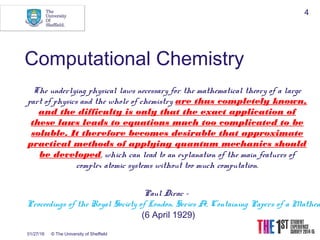
The underlying physical laws necessary for the mathematical theory of a large
part of physics and the whole of chemistry are thus completely known,
and the difficulty is only that the exact application of
these laws leads to equations much too complicated to be
soluble. It therefore becomes desirable that approximate
practical methods of applying quantum mechanics should
be developed, which can lead to an explanation of the main features of
complex atomic systems without too much computation.
Paul Dirac -
Proceedings of the Royal Society of London. Series A, Containing Papers of a Mathem
 (6 April 1929)
01/27/16 © The University of Sheffield
5
Computational Chemistry
An increase in computer power of at least two orders of magnitude
should occur over the next decade. Without further research into the
accuracy of force-field potentials, future macromolecular modeling may well be
limited more by validity of the energy functions, particularly electrostatic
terms, than by technical ability to perform the computations.
Force fields for protein simulations
JW Ponder, DA Case - Advances in protein chemistry, 2003
01/27/16 © The University of Sheffield
6
Computational Chemistry
• Ab Initio methods – Hartree Fock and post-Hartree
Fock methods, DFT. – Expensive for large
systems.
• Tight Binding, Bond Order Potentials.
• Classical “Newtonian” simulations. – Fast, deal with
larger systems, but lack of chemical realism.
The “Jacob’s Ladder” to exact chemical accuracy.
01/27/16 © The University of Sheffield
7
Classical Chemical Force Fields
• Energy is composed of;
• Bond stretching
• Angle Bending
• Torsional rotation
• Electrostatic interactions
• Lennard Jones potential to represent long range
attraction and close range repulsion
• All of these have simple functional forms
01/27/16 © The University of Sheffield
8
The ideal goal
• Ab Initio accuracy at the cost of tradition force
fields/molecular dynamics.
• Neural Networks are trained to discover the
potential energy surfaces.
• Neural Networks are presented a number of Ab
Initio training examples.
• Neural Networks are able to interpolate.
01/27/16 © The University of Sheffield
9
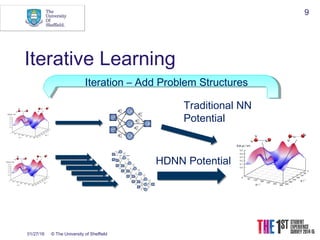
Iterative Learning
Traditional NN
Potential
HDNN Potential
Iteration – Add Problem Structures
01/27/16 © The University of Sheffield
10
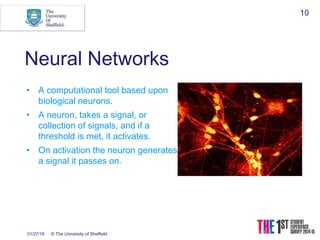
Neural Networks
• A computational tool based upon
biological neurons.
• A neuron, takes a signal, or
collection of signals, and if a
threshold is met, it activates.
• On activation the neuron generates
a signal it passes on.
01/27/16
T.B. Blank et al., J. Chem. Phys. 103, 4129 (1995).
S. Lorenz, A. Groß, and M. Scheffler, Chem. Phys. Lett. 395, 210 (2004).
Reviews: C. M. Handley, P. L. A. Popelier, J. Phys. Chem. A 114, 3371 (2010).
J. Behler, Phys. Chem. Chem. Phys. 13, 17930 (2011).
11
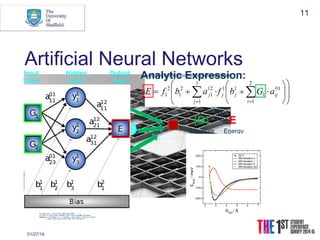
Artificial Neural Networks
Input
Layer
Hidden
Layer
Output
Layer
Analytic Expression:
{G} → E
Structure Energy
NN
01/27/16 © The University of Sheffield
12
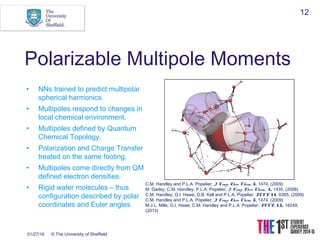
Polarizable Multipole Moments
• NNs trained to predict multipolar
spherical harmonics.
• Multipoles respond to changes in
local chemical environment.
• Multipoles defined by Quantum
Chemical Topology.
• Polarization and Charge Transfer
treated on the same footing.
• Multipoles come directly from QM
defined electron densities.
• Rigid water molecules – thus
configuration described by polar
coordinates and Euler angles
C.M. Handley and P.L.A. Popelier; J. Comp. Theo. Chem., 5, 1474, (2009)
M. Darley; C.M. Handley; P.L.A. Popelier; J. Comp. Theo. Chem., 4, 1435, (2008)
C.M. Handley; G.I. Hawe, D.B. Kell and P.L.A. Popelier; PCCP, 11, 6365, (2009)
C.M. Handley and P.L.A. Popelier; J. Comp. Theo. Chem., 5, 1474, (2009)
M.J.L. Mills; G.I. Hawe; C.M. Handley and P.L.A. Popelier; PCCP, 15, 18249,
(2013)
01/27/16 © The University of Sheffield
13
Polarizable Multipole Moments
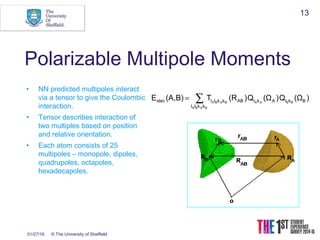
• NN predicted multipoles interact
via a tensor to give the Coulombic
interaction.
• Tensor describes interaction of
two multiples based on position
and relative orientation.
• Each atom consists of 25
multipoles – monopole, dipoles,
quadrupoles, octapoles,
hexadecapoles.
)(ΩQ)(ΩQ)(RTB)(A,E Bkl
kkll
AklABkkllelec BB
BABA
AABABA∑=
01/27/16 © The University of Sheffield
14
Polarizable Multipole Moments
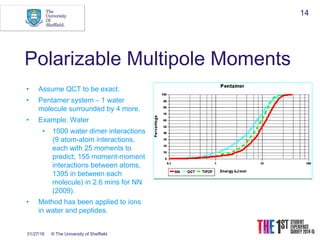
• Assume QCT to be exact.
• Pentamer system – 1 water
molecule surrounded by 4 more.
• Example: Water
• 1000 water dimer interactions
(9 atom-atom interactions,
each with 25 moments to
predict; 155 moment-moment
interactions between atoms,
1395 in between each
molecule) in 2.6 mins for NN
(2009).
• Method has been applied to ions
in water and peptides.
01/27/16 © The University of Sheffield
15
Dimensionality Problem
• Early examples used Cartesian coordinates wrt
a particular frame e.g. a surface and active site.
• Internal Coordinate can be used.
• But…. Ideally we want a method invariant to
translation, rotation, and takes advantage of the
symmetry of the system.
01/27/16 © The University of Sheffield
16
Atomic Local Frames
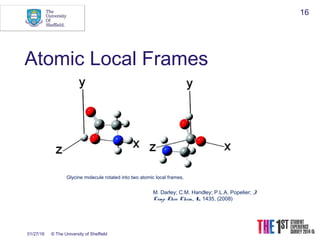
Glycine molecule rotated into two atomic local frames.
M. Darley; C.M. Handley; P.L.A. Popelier; J.
Comp. Theo. Chem., 4, 1435, (2008)
01/27/16 © The University of Sheffield
17
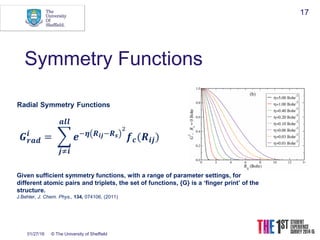
Symmetry Functions
Given sufficient symmetry functions, with a range of parameter settings, for
different atomic pairs and triplets, the set of functions, {G} is a ‘finger print’ of the
structure.
J.Behler, J. Chem. Phys., 134, 074106, (2011)
01/27/16 © The University of Sheffield
18
HDNN – High Dimensional Neural
Networks
J. Behler and M. Parrinello, Phys. Rev. Lett. 98,
146401 (2007).
J. Behler, J. Chem. Phys. 134, 074106 (2011).
N. Artrith, T. Morawietz and J. Behler, Phys. Rev. B
83, 153101 (2011).
T. Morawietz, V. Sharma and J. Behler, J. Chem.
Phys. 136, 064103 (2012).
01/27/16 © The University of Sheffield
19
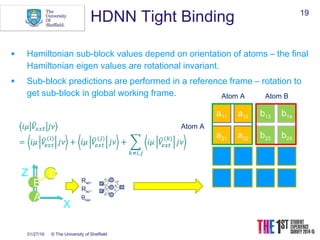
HDNN Tight Binding
• Hamiltonian sub-block values depend on orientation of atoms – the final
Hamiltonian eigen values are rotational invariant.
• Sub-block predictions are performed in a reference frame – rotation to
get sub-block in global working frame.
a11 a12
a21 a22
b13 b14
b23 b24
Atom A Atom B
Atom A
CZ
X
Rab,
Rac,
θbacA
B
01/27/16 © The University of Sheffield
20
The Future?
• PES that better retain information from the quantum
mechanical training data e.g. prediction of Tight Binding
Hamiltonians (on going at RUB).
• More powerful machine learning methods e.g. Support
Vector Machines, Gaussian Process Regression.†
• Building force fields that are able to cope with many
molecular, and solid state, systems.
† C.M. Handley and J. Behler; “Next Generation Interatomic Potentials for Condensed Phase
Systems”, The European Physical Journal B, 87, 1-16, (2014)
01/27/16 © The University of Sheffield
21
Thanks
• Popelier Group – Manchester
• Paul Popelier
• Matt Mills
• Glenn Hawe
• Behler Group – RUB, Germany
• Jörg Behler
• Nong Artrith
• Tobias Morawietz
Questions?

Neural-Networks-primer

  • 1.
    Neural Networks for ChemicalSimulations A Machine Learning solution for Potential Energy Surface Representation Chris Handley N8 HPC – York 8/01/16
  • 2.
    01/27/16 © TheUniversity of Sheffield 2 Contents • Why Machine Learning for Chemical Simulation? • What is a Neural Network? • Early Applications of Neural Networks • High Dimensional Neural Networks? • Future Advances
  • 3.
    01/27/16 © TheUniversity of Sheffield 3 Machine Learning • Many methods for finding non-linear relationships between some input and outputs. • Used for functional form discovery – interpolation, extrapolation. • Also used for classification of things. • Classic examples – optical character recognition, speech analysis.
  • 4.
    01/27/16 © TheUniversity of Sheffield 4 Computational Chemistry The underlying physical laws necessary for the mathematical theory of a large part of physics and the whole of chemistry are thus completely known, and the difficulty is only that the exact application of these laws leads to equations much too complicated to be soluble. It therefore becomes desirable that approximate practical methods of applying quantum mechanics should be developed, which can lead to an explanation of the main features of complex atomic systems without too much computation. Paul Dirac - Proceedings of the Royal Society of London. Series A, Containing Papers of a Mathem  (6 April 1929)
  • 5.
    01/27/16 © TheUniversity of Sheffield 5 Computational Chemistry An increase in computer power of at least two orders of magnitude should occur over the next decade. Without further research into the accuracy of force-field potentials, future macromolecular modeling may well be limited more by validity of the energy functions, particularly electrostatic terms, than by technical ability to perform the computations. Force fields for protein simulations JW Ponder, DA Case - Advances in protein chemistry, 2003
  • 6.
    01/27/16 © TheUniversity of Sheffield 6 Computational Chemistry • Ab Initio methods – Hartree Fock and post-Hartree Fock methods, DFT. – Expensive for large systems. • Tight Binding, Bond Order Potentials. • Classical “Newtonian” simulations. – Fast, deal with larger systems, but lack of chemical realism. The “Jacob’s Ladder” to exact chemical accuracy.
  • 7.
    01/27/16 © TheUniversity of Sheffield 7 Classical Chemical Force Fields • Energy is composed of; • Bond stretching • Angle Bending • Torsional rotation • Electrostatic interactions • Lennard Jones potential to represent long range attraction and close range repulsion • All of these have simple functional forms
  • 8.
    01/27/16 © TheUniversity of Sheffield 8 The ideal goal • Ab Initio accuracy at the cost of tradition force fields/molecular dynamics. • Neural Networks are trained to discover the potential energy surfaces. • Neural Networks are presented a number of Ab Initio training examples. • Neural Networks are able to interpolate.
  • 9.
    01/27/16 © TheUniversity of Sheffield 9 Iterative Learning Traditional NN Potential HDNN Potential Iteration – Add Problem Structures
  • 10.
    01/27/16 © TheUniversity of Sheffield 10 Neural Networks • A computational tool based upon biological neurons. • A neuron, takes a signal, or collection of signals, and if a threshold is met, it activates. • On activation the neuron generates a signal it passes on.
  • 11.
    01/27/16 T.B. Blank etal., J. Chem. Phys. 103, 4129 (1995). S. Lorenz, A. Groß, and M. Scheffler, Chem. Phys. Lett. 395, 210 (2004). Reviews: C. M. Handley, P. L. A. Popelier, J. Phys. Chem. A 114, 3371 (2010). J. Behler, Phys. Chem. Chem. Phys. 13, 17930 (2011). 11 Artificial Neural Networks Input Layer Hidden Layer Output Layer Analytic Expression: {G} → E Structure Energy NN
  • 12.
    01/27/16 © TheUniversity of Sheffield 12 Polarizable Multipole Moments • NNs trained to predict multipolar spherical harmonics. • Multipoles respond to changes in local chemical environment. • Multipoles defined by Quantum Chemical Topology. • Polarization and Charge Transfer treated on the same footing. • Multipoles come directly from QM defined electron densities. • Rigid water molecules – thus configuration described by polar coordinates and Euler angles C.M. Handley and P.L.A. Popelier; J. Comp. Theo. Chem., 5, 1474, (2009) M. Darley; C.M. Handley; P.L.A. Popelier; J. Comp. Theo. Chem., 4, 1435, (2008) C.M. Handley; G.I. Hawe, D.B. Kell and P.L.A. Popelier; PCCP, 11, 6365, (2009) C.M. Handley and P.L.A. Popelier; J. Comp. Theo. Chem., 5, 1474, (2009) M.J.L. Mills; G.I. Hawe; C.M. Handley and P.L.A. Popelier; PCCP, 15, 18249, (2013)
  • 13.
    01/27/16 © TheUniversity of Sheffield 13 Polarizable Multipole Moments • NN predicted multipoles interact via a tensor to give the Coulombic interaction. • Tensor describes interaction of two multiples based on position and relative orientation. • Each atom consists of 25 multipoles – monopole, dipoles, quadrupoles, octapoles, hexadecapoles. )(ΩQ)(ΩQ)(RTB)(A,E Bkl kkll AklABkkllelec BB BABA AABABA∑=
  • 14.
    01/27/16 © TheUniversity of Sheffield 14 Polarizable Multipole Moments • Assume QCT to be exact. • Pentamer system – 1 water molecule surrounded by 4 more. • Example: Water • 1000 water dimer interactions (9 atom-atom interactions, each with 25 moments to predict; 155 moment-moment interactions between atoms, 1395 in between each molecule) in 2.6 mins for NN (2009). • Method has been applied to ions in water and peptides.
  • 15.
    01/27/16 © TheUniversity of Sheffield 15 Dimensionality Problem • Early examples used Cartesian coordinates wrt a particular frame e.g. a surface and active site. • Internal Coordinate can be used. • But…. Ideally we want a method invariant to translation, rotation, and takes advantage of the symmetry of the system.
  • 16.
    01/27/16 © TheUniversity of Sheffield 16 Atomic Local Frames Glycine molecule rotated into two atomic local frames. M. Darley; C.M. Handley; P.L.A. Popelier; J. Comp. Theo. Chem., 4, 1435, (2008)
  • 17.
    01/27/16 © TheUniversity of Sheffield 17 Symmetry Functions Given sufficient symmetry functions, with a range of parameter settings, for different atomic pairs and triplets, the set of functions, {G} is a ‘finger print’ of the structure. J.Behler, J. Chem. Phys., 134, 074106, (2011)
  • 18.
    01/27/16 © TheUniversity of Sheffield 18 HDNN – High Dimensional Neural Networks J. Behler and M. Parrinello, Phys. Rev. Lett. 98, 146401 (2007). J. Behler, J. Chem. Phys. 134, 074106 (2011). N. Artrith, T. Morawietz and J. Behler, Phys. Rev. B 83, 153101 (2011). T. Morawietz, V. Sharma and J. Behler, J. Chem. Phys. 136, 064103 (2012).
  • 19.
    01/27/16 © TheUniversity of Sheffield 19 HDNN Tight Binding • Hamiltonian sub-block values depend on orientation of atoms – the final Hamiltonian eigen values are rotational invariant. • Sub-block predictions are performed in a reference frame – rotation to get sub-block in global working frame. a11 a12 a21 a22 b13 b14 b23 b24 Atom A Atom B Atom A CZ X Rab, Rac, θbacA B
  • 20.
    01/27/16 © TheUniversity of Sheffield 20 The Future? • PES that better retain information from the quantum mechanical training data e.g. prediction of Tight Binding Hamiltonians (on going at RUB). • More powerful machine learning methods e.g. Support Vector Machines, Gaussian Process Regression.† • Building force fields that are able to cope with many molecular, and solid state, systems. † C.M. Handley and J. Behler; “Next Generation Interatomic Potentials for Condensed Phase Systems”, The European Physical Journal B, 87, 1-16, (2014)
  • 21.
    01/27/16 © TheUniversity of Sheffield 21 Thanks • Popelier Group – Manchester • Paul Popelier • Matt Mills • Glenn Hawe • Behler Group – RUB, Germany • Jörg Behler • Nong Artrith • Tobias Morawietz
  • 22.