2
BBTS 2016 - BIOPHYSICS BY THE SEA 2016
Fluorescence Spectroscopy, Microscopy and Molecular Cell Mechanics and Theoretical Neurophysics
Scientific program
Monday 26.09.2016
15:45 - 16:00 WELCOME MESSAGE
Session: Imaging technics and applications I Chair: Jörg Enderlein
16:00 - 16:30 Markus Sauer (Julius-Maximilians-University Würzburg, Germany)
Super-resolution fluorescence imaging by dSTORM: Where next?
16:30 - 16:50 Fabian Zwettler (Julius-Maximilians-University Würzburg, Germany)
Expansion Microscopy meets dSTORM
16:50 - 17:10 Andrea Schulze (Julius-Maximilians-University Würzburg, Germany)
Local motions within the Hsp90 molecular chaperone machinery observed by fluorescence
quenching
17:10 - 17:30 Wim Vandenburg (Katholieke Universiteit Leuven, Belgium)
Enhancing the performance and applicability of SOFI using new probes and analysis strategies
17:30 - 18:00 COFFEE BREAK
Session: Imaging technics and applications II Chair: Christoph Schmidt
18:00 - 18:30 Theo Lasser (École polytechnique fédérale de Lausanne, Switzerland)
Super-resolution optical fluctuation imaging
18:30 - 18:50 Sebastian Letschert (Julius-Maximilians-University Würzburg, Germany)
Quantification of immune receptors on primary tumor cells
18:50 - 19:10 Jan Thiart (Georg-August-University Göttingen, Germany)
TrackNTrace: A simple and extendable open-source framework for developing single-molecule
localization and tracking algorithms
19:10 - 19:40 Thomas Jovin (Max Planck Institute for Biophysical Chemistry Göttingen, Germany)
Extended Excitation FLIM (eeFLIM)
19:40 – 21:00 DINNER
21:00 - … POSTER SESSION
3
BBTS 2016 - BIOPHYSICS BY THE SEA 2016
Fluorescence Spectroscopy, Microscopy and Molecular Cell Mechanics and Theoretical Neurophysics
Tuesday 27.09.2016
Session: Biophysics of the cell I Chair: Theo Lasser
9:00 - 9:30 Christoph Schmidt (Georg-August-University Göttingen, Germany)
Broken detailed balance at mesoscopic scales in active biological systems
9:30 - 9:50 Samaneh Rezvani (Georg-August-University Göttingen, Germany)
Osmosis and force fluctuation of non-adhering cells
9:50 - 10:10 Tim Meyer (UMG Georg-August-University Göttingen, Germany)
Engineered Myocardium for heart repair and Drug Screening
10:10 - 10:30 Florian Rehfeld (Georg-August-University Göttingen, Germany)
Mechanics Matters for Cells: Forces, Elasticity, and Cytoskeleton
10:30 - 11:00 COFFEE BREAK
Session: Biophysics of the cell II Chair: Markus Sauer
11:00 - 11:30 Stefan Klumpp (Georg-August-University Göttingen, Germany)
Surface motility and colony growth in bacteria
11:30 - 11:50 Dieter Klopfenstein (Georg-August-University Göttingen, Germany)
May the force be with you: how actin filaments are stabilized during muscle contraction
11:50 - 12:10 Galina Kudryasheva (Georg-August-University Göttingen, Germany)
Mechano-Sensitivity is Cell Type Specific
12:10 - 12:30 Donna Arndt - Jovin (Max Planck Institute for Biophysical Chemistry Göttingen, Germany)
Generation 3 Programmable Array Microscope (PAM) for Adaptive, high speed, large format
optical sectioning
4
BBTS 2016 - BIOPHYSICS BY THE SEA 2016
Fluorescence Spectroscopy, Microscopy and Molecular Cell Mechanics and Theoretical Neurophysics
Thursday 29.09.2016
Session: Single molecule spectroscopy and applications in biophysics I Chair: Thomas Jovin
9:00 - 9:30 Ben Schuler (University Zürich, Switzerland)
Single-molecule spectroscopy of unfolded and intrinsically disordered proteins
9:30 - 9:50 Jan Sykora (J. Heyrovsky Institute of Physical Chemistry of the CAS Prague, Czech Republic)
Are protein hydration and dynamics important factors in the enzyme kinetics? – Fluorescence
study on Haloalkane-dehalogenases
9:50 - 10:10 Roman Tsukanow (Georg-August-University Göttingen, Germany)
Investigating conformational dynamics of DNA hairpin and Holliday junction using single-
molecule fluorescence techniques
10:10 - 10:30 Erik Holmstrom (University Zürich, Switzerland)
Probing the biophysics of nucleic acids chaperones using single-photon single-molecule FRET
10:30 - 11:00 COFFEE BREAK
Session: Single molecule spectroscopy and applications in biophysics II Chair: Fred Wouters
11:10 - 11:30 Sebastian Isbaner (Georg-August-University Göttingen, Germany)
Dead-time correction of fluorescence lifetime measurements and fluorescence lifetime
imaging
11:30 - 11:50 Alexey Chizhik (Georg-August-University Göttingen, Germany)
The fluorophore out of anything
11:50 - 12:10 Ingo Gregor (Georg-August-University Göttingen, Germany)
Non-linear image scanning microscopy
12:10 - 12:30 Daja Ruhland (Georg-August-University Göttingen, Germany)
Determining absolute values of fluorescence quantum yield using a nanocavity
5
BBTS 2016 - BIOPHYSICS BY THE SEA 2016
Fluorescence Spectroscopy, Microscopy and Molecular Cell Mechanics and Theoretical Neurophysics
Friday 30.09.2016
Session: Neuroscience Chair: Dieter Klopfenstein
9:00 - 9:30 Elisha Moses (Weizmann Institute of Science, Israel)
Dynamics in Networks of Cultured Neurons
9:30 – 9:50 Andreas Neef (Max Planck Institute for Dynamics and Self-Organization Göttingen, Germany)
A slow receptor speeds up cortical processing
9:50 - 10:10 Christian Tetzlaff (Georg-August-University Göttingen, Germany)
Self-organization of computation in neural systems by interaction between homeostatic and
synaptic plasticity
10:10 - 10:40 Fred Wouters (UMG Georg-August-University Göttingen, Germany)
Light Sheet Microscopy for Clinical Histopathology
10:40 - 11:10 COFFEE BREAK
Session: Biophysics of the cell III Chair: Ingo Gregor
11:10 - 11:30 Kengo Nishi (Georg-August-University Göttingen, Germany)
New analysis method for passive microrheology
11:30 - 11:50 Moritz Kalhöfer-Köchling (Georg-August-University Göttingen, Germany)
Generic Three Dimensional Modelling of Beating Flagella and Cilia
11:50 - 12:10 Kareem Elsayad (Vienna Biocenter, Austria)
Unravelling and understanding the mechanical properties of plants using
Brillouin Light Scattering Microspectroscopy
12:10 - 12:25 CLOSING REMARKS
6
BBTS 2016 - BIOPHYSICS BY THE SEA 2016
Fluorescence Spectroscopy, Microscopy and Molecular Cell Mechanics and Theoretical Neurophysics
Abstracts oral presentations
(Listed alphabetically by last name)
7
BBTS 2016 - BIOPHYSICS BY THE SEA 2016
Fluorescence Spectroscopy, Microscopy and Molecular Cell Mechanics and Theoretical Neurophysics
The fluorophore out of anything
Alexey Chizhik
III. Institute of Physics – Biophysics, Georg-August-University Göttingen
We all, those who work in the field of fluorescence microscopy, got used to buying
fluorophores from manufacturers, which are believed to produce any kind of dye our
experiments may ever require. A couple of mouse clicks – and a vial of colorful solution is
standing on our table. The reverse of the medal is high price, often impossibility of any
chemical modification of the dye or even unknown chemical structure, and finally, sad but
true, improper characterization of the fluorophore’s physico-chemical properties.
A decade ago, in 2004, Scrivens and co-workers accidentally found a way around it, probably
even haven’t been realizing it first1. What they reported was fluorescent carbon-based
impurities, which they observed as a result of purification of carbon nanotubes. Because
“impurities” is what one normally gets for free, or even against one’s will, the publication was
followed by a tsunami of works, where researchers reported on cheap and simple synthesis
of various fluorophores that consisted mostly of carbon nanoparticles and numerous types of
surface chemical groups. It turned out that thermal treatment, or simply put, combustion of
basically any organic substance leads to generation of fluorescent carbon nanoparticles, which
have been often called “carbon dots” or “carbon nanodots”. The ways of synthesis reported
strike imagination: “carbon dots from orange juice”, ”carbon dots from milk”, “carbon dots
from waste paper”2. In recent years, a lot of efforts have been made to understand the
mechanism of their fluorescence as well as to develop more advanced ways of synthesis in
order to achieve high monodispersity of particles and homogeneity of their photophysical and
structural properties3. In this talk I am going to provide you with an overview of the most
prominent works in this field and to present you our own recent results.
1. X. Xu et al. Journal of the American Chemical Society 2004, 126, 12736-12737.
2. C. J. Reckmeier et al. Opt. Express 2016, 24, A312-A340.
3. S. Ghosh et al. Nano Letters 2014, 14, 5656-5661.
8
BBTS 2016 - BIOPHYSICS BY THE SEA 2016
Fluorescence Spectroscopy, Microscopy and Molecular Cell Mechanics and Theoretical Neurophysics
Unravelling and understanding the mechanical properties of plants using
Brillouin Light Scattering Microspectroscopy
Kareem Elsayad
Advanced Microscopy, VBCF, Vienna Biocenter, Vienna
Brillouin Light Scattering (BLS) spectroscopy is an all-optical label-free technique which allows
for the determination of the viscoelastic properties of a sample. BLS is generally a very weak
process, based on the interaction of light with thermal density fluctuations, and thus
challenging to implement for life-science/biomedical applications. Recent advances in
spectrometer and camera designs have however made it possible to perform BLS
measurements on live cells, opening the door to a new means of studing the mechanical
properties of biological systems. Here I will discuss the use of BLS Microspectroscopy and
correlative Fluorescence – BLS Microspectrocopy to map the viscoelastic properties of cells
and tissue in 3 dimensions, focusing on its use to understand the mechanical properties of
plant cells. 3 dimensional mapping of the mechanical properties of plant cells is particularly
interesting given the delicate balance between extracellular matrix (cell wall) mechanical
properties and turgor pressure involved in defining cell shape, assuring “correct”
development, for maintaining the structural integrity of the organism as a whole, and
ultimately determining their survival subject to all types of environmental perturbations.
Firstly I will give an introduction to BLS including experimental setups and the physical
principles it is based on. I will then discuss some details of the quantities that are and can be
extracted from a BLS measurement and how and to what extent they may be compared to or
compliment results obtained from alternative measurements of the mechanical properties of
and within cells - such as those obtained using microrheology and perturbation-deformation
techniques such as Atomic Force Microscopy (AFM). I then will present a series of studies on
different live plant cells and tissue we have performed focusing on the physical and biological
significance of the obtained results. Finally I will summarize the strengths of the technique, its
limitations and some of the current challenges, along with an outlook of what we are working
on, and some planned and potential future applications in biophysics research as well as
medical diagnostics.
9
BBTS 2016 - BIOPHYSICS BY THE SEA 2016
Fluorescence Spectroscopy, Microscopy and Molecular Cell Mechanics and Theoretical Neurophysics
Non-linear image scanning microscopy
1Ingo Gregor, 2Robert Ros, 1Jörg Enderlein
1III. Institute of Physics – Biophysics, Georg-August-University Göttingen
2Department of Physics and Center for Biological Physics, Arizona State University, Tempe AZ
ingo.gregor@phys.uni-goettingen.de, www.joerg-enderlein.de
Nowadays, multiphoton microscopy can be considered as a routine method for the
observation of living cells, organs, up to whole organisms. Second-harmonics generation (SHG)
imaging has evolved to a powerful qualitative and label-free method for studying fibrillar
structures, like collagen networks. However, examples of super-resolution non-linear
microscopy are rare. So far, such approaches require complex setups and advanced
synchronization of scanning elements limiting the image acquisition rates. We describe theory
and realization of a super-resolution image scanning microscope [1, 2] using two-photon
excited fluorescence as well as second-harmonic generation. It require only minor
modifications compared to a classical two-photon laser-scanning microscope and allows
image acquisition at the high frame rates of a resonant galvo-scanner. We achieve excellent
sensitivity and high frame-rate in combination with two-times improved lateral resolution. We
applied this method to fixed cells, collagen hydrogels, as well as living fly embryos. Further,
we verified the excellent image quality of our setup for deep tissue imaging.
[1] Müller C.B. and Enderlein J. (2010) Image scanning microscopy. Phys. Rev. Lett. 104(19), 198101.
[2] Sheppard C.J.R. (1988) Super-resolution in confocal imaging. Optik (Stuttg) 80 53–54.
10
BBTS 2016 - BIOPHYSICS BY THE SEA 2016
Fluorescence Spectroscopy, Microscopy and Molecular Cell Mechanics and Theoretical Neurophysics
Dead-time correction of fluorescence lifetime measurements
and fluorescence lifetime imaging
Sebastian Isbaner, Narain Karedla, Daja Ruhlandt, Simon Christoph Stein, Anna Chizhik,
Ingo Gregor, Jörg Enderlein
III. Institute of Physics – Biophysics, Georg August University, Göttingen
Dead-time artifacts can dramatically influence the shape of Time-Correlated Single Photon
Counting (TCSPC) histograms such as fluorescence lifetime curves [1]. These artifacts occur at
high count rates, which limit the acquisition speed in Fluorescence Lifetime Imaging
Microscopy (FLIM). We present an algorithm that corrects the distortions of TCSPC histograms
which are caused by constant electronics and/or detector dead-times [2]. We verified the
algorithm with Monte-Carlo simulations and fluorescence lifetime measurements.
Furthermore, we performed FLIM measurements on densely labeled cells at various excitation
powers and corrected the lifetime and intensity values for each pixel. Our correction method
is not restricted to TCSPC measurements only, but can be applied to any periodic single-event
counting or timing measurement. Since it corrects dead-time artifacts for both lifetime and
intensity, the algorithm could be beneficial for example for lidar or time-resolved fluorescence
anisotropy measurements.
[1] W. Becker, Advanced Time-Correlated Single Photon Counting Techniques (Springer, 2005).
[2] S. Isbaner, N. Karedla, D. Ruhlandt, S.C. Stein, A. Chizhik, I. Gregor, and J. Enderlein, Opt. Express 24, 9429-9445 (2016)
11
BBTS 2016 - BIOPHYSICS BY THE SEA 2016
Fluorescence Spectroscopy, Microscopy and Molecular Cell Mechanics and Theoretical Neurophysics
Generation 3 Programmable Array Microscope (PAM) for
adaptive, high speed, large format optical sectioning
Donna J. Arndt-Jovin, Anthony H. B. de Vries, Thomas M. Jovin
Laboratory of Cellular Dynamics, Max-Planck-Institute for Biophysical Chemistry, Göttingen
djovin@mpibpc.mpg.de
We report on the current version of the optical sectioning programmable array
microscope(PAM) implemented with a digital micro-mirror device (DMD) as a spatial light
modulatorutilized for both fluorescence excitation and emission detection. The PAM is based
on structured illumination [1]. A sequence of HD (1920×1080) binary patterns of excitation
light is projected into the focal plane of the microscope at the 18 kHz binary frame rate of the
TI1080p DMD. The resulting sequence of patterned emissions is captured in a single
acquisition as two distinct images: conjugate (ca. “on-focus”) consisting of signals impinging
on and deviated from the “on” elements of the DMD, and the non-conjugate (ca. “out-of-
focus”) of those falling on and deviated from the “off” elements. The sectioned image is gained
from a weighted subtraction of the conjugate and non-conjugate images. This procedure
allows for a high duty cycle (typically 30 to 50%) of on-elements in the excitation patterns and
thus functions well with low light intensities, preventing saturation of the fluorophores. The
corresponding acquisition speed is also very high, limited only by the bandwidth of the
camera(s) (100 fps full frame with the current sCMOS camera) and the optical power of the
light source (lasers, LEDS). In contrast to the static patterns typical of SIM systems, the
programmable array allows optimization of the patterns to the sample (duty cycle and feature
size), as well as enabling a wide range of microscopy applications, ranging from patterned
photobleaching, (FRAP, FLIP) and photoactivation, spatial superresolution (SIM, etc.),
automated adaptive minimized light exposure (MLE) [2], and photolithography. This work is
supported by BMBF VIP Grant 03V0441 (iPAM: "Intelligentes" Programmierbares Array
Mikroskop).
[1] de Vries, A., N. Cook, S. Kramer, D. Arndt-Jovin and T. Jovin (2015). "Generation 3 programmable array microscope (PAM) for high
speed, large format optical sectioning in fluorescence." Proc. SPIE 9376(93760C): 1-15
[2] W. Caarls; B. Rieger, A.H.B. de Vries, D.J. Arndt-Jovin, T.M. Jovin (2010). “Minimizing light exposure with the programmable array
microscope”, J. MICROSCOPY, 241, 101-110
12
BBTS 2016 - BIOPHYSICS BY THE SEA 2016
Fluorescence Spectroscopy, Microscopy and Molecular Cell Mechanics and Theoretical Neurophysics
Extended Excitation FLIM (eeFLIM)
Thomas M. Jovin, Nathan P. Cook, and Donna Arndt-Jovin
Laboratory of Cellular Dynamics, Max-Planck-Institute for Biophysical Chemistry, Göttingen
tjovin@mpibpc.mpg.de
The usual dogma in the field of time-domain fluorescence lifetime determination is that “the
shorter the excitation pulse the better”. We overcome this requirement by recording the
integrated emission of an emitting species excited with a rectangular light pulse with a
duration substantially longer than the anticipated lifetimes. Sensitive and accurate
determinations of the mean intensity-weighed lifetime are feasible. A series of successive
determinations (≥2) are taken in the region corresponding to constant excitation intensity and
at integration times > 6·the longest lifetime in the sample population. These points correspond
to a straight line, the slope and position of which are referenced to a companion measurement
of a sample with 0 lifetime (e.g. scattered excitation light) or known lifetime so as to yield the
absolute mean lifetime. That is, the displacement on the integration time (gate width) axis is
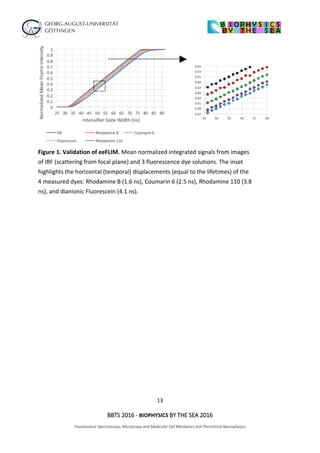
given by the lifetime (Fig. 1). The mixtures can be of arbitrary heterogeneity. For a
twocomponent system (e.g. a binding reaction), the mean lifetime can be expressed
analytically as a function of the fraction of species engaged in FRET. The mean lifetime is very
useful in numerous other applications, including single molecule determinations. We have
implemented eeFLIM in an imaging system based on the gated intensified camera PI-MAX4-
1024EMB of Princeton Instruments using laser diodes for excitation. This camera features
excellent spatial resolution and linearity (emCCD detector), and powerful software +
electronics for control of multimode acquisition and external synchronization. The system is
very sensitive and allows real-time full-field (1K×1K) FLIM at rates that can exceed 1 Hz.
Some important advantages of eeFLIM can be emphasized: (1) the rectangular excitation
pulses (e.g. 10-50 ns) are easy to generate and provide very high pulse energies and thus
intense response signals; it is anticipated that light sources based on pulsed LEDs will be more
versatile (wide spectral range, no speckle) and cost effective. (2) virtually all the light emitted
per pulse (discounting detection efficiencies) is utilized; (3) the temporal resolution is tens of
ps; long-lived emissions (delayed fluorescence, phosphorescence) can also be measured; (4)
lifetime image calculations are very fast, involving only simple, linear, noniterative
calculations. (5) eeFLIM is also applicable to single or array detectors and TCSPC detection.
13
BBTS 2016 - BIOPHYSICS BY THE SEA 2016
Fluorescence Spectroscopy, Microscopy and Molecular Cell Mechanics and Theoretical Neurophysics
Figure 1. Validation of eeFLIM. Mean normalized integrated signals from images
of IRF (scattering from focal plane) and 3 fluorescence dye solutions. The inset
highlights the horizontal (temporal) displacements (equal to the lifetimes) of the
4 measured dyes: Rhodamine B (1.6 ns), Coumarin 6 (2.5 ns), Rhodamine 110 (3.8
ns), and dianionic Fluorescein (4.1 ns).
14
BBTS 2016 - BIOPHYSICS BY THE SEA 2016
Fluorescence Spectroscopy, Microscopy and Molecular Cell Mechanics and Theoretical Neurophysics
Generic Three Dimensional Modelling of Beating Flagella and Cilia
Moritz Kalhöfer-Köchling, Steffen Mühle
III. Institute of Physics – Biophysics, Georg-August-University Göttingen
m.ka-koe@gmx.net
Flagella and cilia are motile, hairlike cell appendages, providing forces, capable of self
propulsion and transport for example of waste in the trachea. Strong effort has been put into
the elucidation of the underlying mechanisms driving the dynamics of axonemal beating, and
although the structure of flagella and cilia is well understood, they still wait to be revealed.
Most research in this field has been focused on two dimensional models, yielding an accurate
description of the typical, whip-like, beating motion of spermatozoa. Yet, also helical and
other three-dimensional movement patterns have been observed, demanding new,
augmented models. Using the natural frame as an advanced description of three-dimensional
filaments and incorporating modern operator splitting techniques for the numerical tasks, we
could model helical beating patterns on the basis of a generic and simple physical model. The
model takes anisotropic drag, internal active elements and a propelled cell body into account,
providing a formidable springboard for the implementation of further physiological concepts.
15
BBTS 2016 - BIOPHYSICS BY THE SEA 2016
Fluorescence Spectroscopy, Microscopy and Molecular Cell Mechanics and Theoretical Neurophysics
May the force be with you: how an actin binding protein stabilizes filaments
during muscle contraction
1Eugenia Butkevich, 1Kai Bodensiek, 1,4Nikta Fakhri, 1Kerstin von Roden, 1,2Iwan A. T. Schaap,
3Irina Majoul, 1Christoph F. Schmidt, 1Dieter R. Klopfenstein
1III. Institute of Physics – Biophysics, Georg-August- University Göttingen
2Center for Nanoscale Microscopy and Molecular Physiology of the Brain (CNMPB)
Göttingen
3Institute of Biology, Center for Structural and Cell Biology in Medicine, University of Lübeck,
4Department of Physics, Massachusetts Institute of Technology, Cambridge, MA
Dieter.Klopfenstein@phys.uni-goettingen.de
Actin filament organization and stability in the sarcomeres of muscle cells are critical for force
generation. We have identified and functionally characterized a C. elegans drebrin-like protein
DBN-1 as a novel constituent of the muscle-contraction machinery. In vitro, DBN-1 exhibits
actin-filament binding and bundling activity. In vivo, DBN-1 is expressed in body wall muscles
of C. elegans. During muscle contraction cycle, DBN-1 alternates location between myosin-
and actin-rich regions of the sarcomere. In contracted muscle, DBN-1 is accumulated at I-
bands where it likely regulates proper spacing of a-actinin and tropomyosin and protects actin
filaments from the interaction with ADF/cofilin. DBN-1 loss-of- function results in the partial
depolymerization of F-actin upon muscle contraction. Taken together, our data show that
DBN-1 organizes the muscle contractile apparatus maintaining the spatial relationship
between actin-binding proteins such as a-actinin, tropomyosin and ADF/cofilin and possibly
strengthening actin filaments by bundling.
16
BBTS 2016 - BIOPHYSICS BY THE SEA 2016
Fluorescence Spectroscopy, Microscopy and Molecular Cell Mechanics and Theoretical Neurophysics
Probing the biophysics of nucleic acids chaperones using
single-photon single-molecule FRET
Erik D. Holmstrom, Daniel Nettels, Benjamin Schuler.
University of Zurich
Much like proteins, nucleic acids can fold into intricate 3D structures with specific biological
functions. However, in order to do so they must avoid any potential non-functional
conformational traps that often complicate the folding process. Nucleic acid chaperones are
an emergent class of proteins that function to alleviate this notorious folding problem,
enabling efficient formation of natively folded RNAs and DNAs. These chaperones facilitate
many nucleic acid-dependent processes, including critical steps in the life cycles of many
viruses. However, a detailed mechanistic understanding of the chaperoning process has
remained elusive, especially for viral proteins that are often intrinsically disordered.
Recently, we have started to uncover some of the structural and dynamical aspects of nucleic
acid chaperone activity using a variety of single-photon single-molecule FRET techniques.
Specifically, we chose to study the interaction between a model DNA hairpin and the
nucleocapsid domain of the Hepatitis C virus core protein (HCVncd), which is a non-specific,
intrinsically-disordered nucleic acid chaperone that facilitates viral genome dimerization. By
independently observing both components of this nucleoprotein interaction with smFRET, we
have been able use single-photon analysis methods to characterize multiple structural and
dynamical changes in both the chaperone (i.e., HCVncd) and its model substrate (i.e., DNA
hairpin). These findings have been used to construct a structurally and kinetically motivated
molecular mechanism that explains this interesting biophysical process.
17
BBTS 2016 - BIOPHYSICS BY THE SEA 2016
Fluorescence Spectroscopy, Microscopy and Molecular Cell Mechanics and Theoretical Neurophysics
Surface motility and colony growth in bacteria
Stefan Klumpp
Institute for Nonlinear Dynamics, Georg-August- University Göttingen
Max-Planck-Institute of Colloids and Interfaces, Potsdam
Motile bacteria move through a variety of mechanisms, which employ different molecular
machines. Often, physical forces play a key role. I will discuss this using the role of mechanical
interactions in twitching motility as an example. Twitching motility is a mode of motion on
surfaces that is driven by the retraction of type IV pili, filamentous appendages that pull the
cell forward through cycles of growth, attachment to the surface and retraction into the cell,
driven by APTases at the base of the pili. In some bacterial species multiple pili pull the cell in
different directions simultaneously. Thus, the pili perform a two-dimensional tug-of-war.
Tugof- war-like interactions, where molecular motors exert forces on each other, were
previously studied for bidirectional cytoskeletal transport. I will review this case, which is one-
dimensional and show that the tug-of-war provides a mechanism for persistent directionality.
In the two-dimensional case, the tug-of-war is less efficient at doing so than in one dimension,
as will be shown for the case of the twitching motility of N. gonorrhoeae, where an additional
mechanisms for directional memory was predicted theoretically and confirmed
experimentally [1]. N. gonorrhoeae bacteria use twitching to find each other in order to
initiate the formation of colonies. As a second topic, I will discuss the growth of planar colonies
and its interplay with the adhesion between cells that is also mediated by the type IV pili. To
that end, a minimal model for mixed colonies of cells of different adhesion is presented [2].
The model effectively combines differential adheision with rangeexpansion-like growth.
[1] R. Marathe, C. Meel, …, B. Meier, S. Klumpp, Nature Comm. 5, 3759 (2014)
[2] J.J. Dong and S. Klumpp, unpublished
18
BBTS 2016 - BIOPHYSICS BY THE SEA 2016
Fluorescence Spectroscopy, Microscopy and Molecular Cell Mechanics and Theoretical Neurophysics
Mechano-Sensitivity is Cell Type Specific
Galina Kudryasheva, Florian Rehfeldt
III. Institute of Physics – Biophysics, Georg-August- University Göttingen
galina.kudryasheva@phys.uni-goettingen.de
Nowadays it is widely acknowledged that cellular fate is dependent on the mechanical
properties of their micro-environment. Cells sense the stiffness of their surrounding with
contractile acto-myosin stress fibers through focal adhesions and react to such physical stimuli
by altering their bio-chemical pathways. Human mesenchymal stem cells (hMSCs) are an
especially striking as their differentiation towards various cell types can be guided not only by
chemical induction, but also by tuning the extracellular matrix stiffness. While the entire
differentiation process can take several days up to weeks, the structure and dynamics of stress
fibers can be used as an early morphological marker and theoretically modelled using classical
mechanics with an active spring model [1]. We use this approach to analyze the mechanical
cell-matrix interactions of hMSCs and several types of differentiated cells.
We plated cells on elastic poly-acrylamide hydrogels covering the whole physiological range
of stiffness given by Young’s moduli E from 1 to 130 kPa. Using immunofluorescence we
visualized stress fibers and analyzed the cytoskeletal morphology [2]. Analyzing cell area and
cytoskeletal order parameter we could assign an effective cellular stiffness that shows
distinct differences during the differentiation process and for different cell types. Our
experiments show that cellular susceptibility to the substrate elasticity is highly cell type
specific and dependent on acto-myosin contractility.
[1] A. Zemel et al. Nat.Phys. 6, 468–473 (2010)
[2] B. Eltzner et al. PLoS One 10 (2015)
19
BBTS 2016 - BIOPHYSICS BY THE SEA 2016
Fluorescence Spectroscopy, Microscopy and Molecular Cell Mechanics and Theoretical Neurophysics
Super-resolution optical fluctuation imaging
1Theo Lasser, 1,5Hendrik Deschout, 1,4,5Tomas Lukes, 1Azat Sharipov, 1Daniel Szlag,
1Lely Feletti, 2Wim Vandenberg, 2Peter Dedecker, 2Johan Hofkens, 3Marcel Leutenegger,
1Arno Bouwens, 1Jochem Deen, 1Adrien Descloux, 1Aleksandra Radenovic
1Laboratory of Nanoscale Biology & Laboratoire d’Optique Biomédicale,
Ecole Polytechnique Fédérale de Lausanne
2Department of Chemistry, University of Leuven, Heverlee
3Abteilung NanoBiophotonik, Max-Planck-Institut für biophysikalische Chemie, Göttingen
4Department of Radioelectronics, FEE, Czech Technical University, Prague
theo.lasser@epfl.ch, http://lob.epfl.ch, www.voirestsavoir.ch
Super-resolution optical fluctuation imaging (SOFI) allows 3D sub-diffraction fluorescence
microscopy of living cells. When analyzing the acquired image sequence with an advanced
correlation method, i.e. high-order cross-cumulant analysis, super-resolution in all three
spatial dimensions can be achieved.
In this talk we will introduce the underlying principles of SOFI and point to its differences and
shared characteristics with prominent SMLM methods.
Novel SOFI 3D imaging for life cell imaging, a combined PALM-SOFI framework used for
imaging the dynamics of focal adhesion with additional insights into molecular parameters
will be shown to demonstrate the unique potential of SOFI.
20
BBTS 2016 - BIOPHYSICS BY THE SEA 2016
Fluorescence Spectroscopy, Microscopy and Molecular Cell Mechanics and Theoretical Neurophysics
Quantification of immune receptors on primary tumor cells
1Sebastian Letschert, 2Thomas Nerreter, 2Michael Hudecek,
2Hermann Einsele, 1Markus Sauer
1Department of Biotechnology & Biophysics, Julius-Maximilians-University Würzburg
2Department of Hematology and Medical Oncology, Medical Clinic and Policlinic II,
University Hospital Würzburg
sebastian.letschert@uni-wuerzburg.de
T-cells as an important component of everyone’s immune system are able to detect antigens
specifically on the surface of their target cells. Only few antigen molecules per cell are enough
to activate T-cells and to initiate an immune response which leads to the elimination of the
target cell. During the last 20 years this ability was utilized in cancer therapy to develop gene-
modified T-cells which specifically detect and destroy cancer cells. This was realized by
encoding and expressing a synthetic membrane receptor called CAR (chimeric antigen
receptor) in patient T-cells. CARs have the ability to bind tumor specific antigens and activate
the CAR T-cell. (1, 2)
To analyze these target molecules, fluorescence flow cytometry systems as for example FACS
are the methods of choice. However, despite its brilliant sensitivity common flow cytometry
instruments are not able to significantly distinguish between positive cells with only a few
surface molecules and the negative control. Localization based super-resolution microscopy
methods share the potential to extract single-molecule information from fluorescently labeled
cells.
In this study we present a live-cell labeling strategy for screening of antigen-positive (CD19)
cancer cells from multiple myeloma patients. Furthermore, we performed direct stochastic
optical reconstruction microscopy (dSTORM)(3, 4) of these cells in order to analyze and
quantify CD19 molecules as a possible target for a myeloma specific CAR T-cell
immunotherapy. The aim is to combine and compare the benefits of flow cytometry (high-
throughput) and dSTORM (high sensitivity, single-molecule information) to analyze and
quantify low-abundance immune receptors on cancer cells.
(1) Jensen and Riddell, Immunol Rev, 257 (2014), 127–144.
(2) Sommermeyer et al., Leukemia, 30 (2016), 492–500.
(3) Heilemann et al., Angew Chem Int Ed, 47 (2008), 6172–6176.
(4) van de Linde et al., Nat Protoc, 6 (2011), 991–1009.
21
BBTS 2016 - BIOPHYSICS BY THE SEA 2016
Fluorescence Spectroscopy, Microscopy and Molecular Cell Mechanics and Theoretical Neurophysics
Engineered Myocardium for heart repair and Drug Screening
Tim Meyer, Malte Tiburcy, Susanne Schlick, Wolfram-H. Zimmermann
Institute of Pharmacology and Toxicology, University Medical Center Göttingen
Tissue engineered organ surrogates evolve rapidly as advanced tools for safety and efficacy
screens. Human pluripotent stem cells are today available to engineer human organoids under
controlled and highly reproducible conditions. Human cardiomyocytes from embryonic and
induced pluripotent stem cells can be reconstituted in collagen-hydrogels to facilitate self-
assembly into engineered human myocardium (EHM) for applications tissue replacement
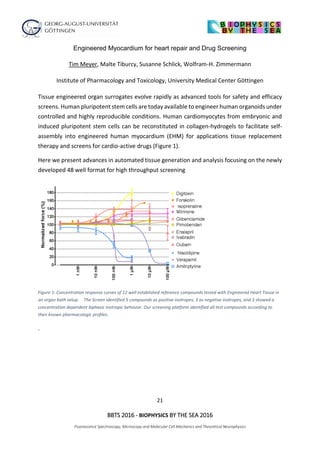
therapy and screens for cardio-active drugs (Figure 1).
Here we present advances in automated tissue generation and analysis focusing on the newly
developed 48 well format for high throughput screening
Figure 1: Concentration response curves of 12 well established reference compounds tested with Engineered Heart Tissue in
an organ bath setup. The Screen identified 5 compounds as positive inotropes, 3 as negative inotropes, and 3 showed a
concentration dependent biphasic inotropic behavior. Our screening platform identified all test compounds according to
their known pharmacologic profiles.
.
22
BBTS 2016 - BIOPHYSICS BY THE SEA 2016
Fluorescence Spectroscopy, Microscopy and Molecular Cell Mechanics and Theoretical Neurophysics
Dynamics in Networks of Cultured Neurons
Elisha Moses
Department of Physics of Complex Systems, The Weizmann Institute of Science, Rehovot
elisha.moses@weizmann.ac.il
Cultured networks of neurons from hippocampus constitute a fascinating reductionist model
for biological computation. While individual neurons retain the physiological characteristics
as in the intact brain, the structure and connectivity in the network are considerably simpler
to measure and analyze, and therefore to engineer and design. We show that disconnected
single neurons oscillate independently of each other, and that when the network is connected
they synchronize into periodic network bursts in which all neurons fire together. This behavior
is attributed to Kuramoto-Strogatz like behavior for the synchronization of pulse-coupled
oscillators. We investigate how initiation of this burst is brought about, and find that the
recruitment of a minimal cohort of firing units plays a crucial role in the process. Activation of
the whole network is well described by a theoretical model of percolation invoking the need
for ‘quorum’ decision making.
(1) Penn Y., Segal M. and Moses E. “Network synchronization in hippocampal neurons”, Proceedings of the National Academy of Sciences
USA 113 (12), 3341–3346 (2016).
(2) J. Soriano, M. Martínez-Rodríguez, T. Tlusty, E. Moses. "Development of Input Connections in Neural Cultures", The Proceedings of
the National Academy of Sciences USA 105, 13758-13763 (2008). doi: 10.1073/pnas.0707492105
(3) J.-P. Eckmann, E. Moses, O. Stetter, T. Tlusty, C. Zbinden, “Leaders of neuronal cultures in a quorum percolation model” Frontiers in
Computational Neuroscience, 4 Article 132, doi:10.3389/fncom.2010.00132 (2010).
23
BBTS 2016 - BIOPHYSICS BY THE SEA 2016
Fluorescence Spectroscopy, Microscopy and Molecular Cell Mechanics and Theoretical Neurophysics
A slow receptor speeds up cortical processing
Andreas Neef
Bernstein Center for Computational Neuroscience
Biophysics of neural information encoding
Max-Planck-Institute for Dynamics and Self-Organization, Göttingen
A population of cortical neurons encodes common input in the population firing rate. The
transfer function, input --> firing rate, is shaped by the properties of several ion channels.
However, the cut-off at high input frequencies, this is, the temporal precision encoding, is
restricted by one property of one channel type: the voltage dependence of the sodium
channels in the axon initial segment (Focault-Trocme 2005).
Several experimental studies observed that a more slowly fluctuating background input
promotes a larger bandwidth of encoding but physiological relevance and mechanistic
explanations for this observation could not be found. We studied the main gateway of sensory
information into the brain and present both, physiological relevance and mechanistic
explanation for the increased bandwidth through slow input fluctuations.
The relay cells of the cortical gateway cells utilize a very unusual NMDA receptor that is not
blocked at rest (Fleidervish 1998), this results in an unusually slowly fluctuating background
input. As a consequence the relay cells are able to transmit the sensory input without
attenuation until 200 Hz which doubles the reliability of thalamocortical spike transmission.
We found that two different potassium channel types, KCNQ and Kv1, are required to couple
the correlation time of input fluctuations to the bandwidth of information encoding and
present a mechanistic model of this coupling.
24
BBTS 2016 - BIOPHYSICS BY THE SEA 2016
Fluorescence Spectroscopy, Microscopy and Molecular Cell Mechanics and Theoretical Neurophysics
New analysis method for passive microrheology
1Kengo Nishi, 2Maria L. Kilfoil, 1Christoph F. Schmidt, 3Fred C. MacKintosh
1III. Institute of Physics - Biophysics, Georg August University Göttingen
2Univ. of Massachusetts, Amherst, MA
3Department of Physics & Astronomy, Faculty of Sciences, Vrije Universiteit Amsterdam
kengo.nishi@phys.uni-goettingen.de
Passive microrheology is an experimental technique used to measure the mechanical
response of materials from the fluctuations of micron-sized beads embedded in the medium.
Microrheology is well suited to study rheological properties of materials that are difficult to
obtain in larger amounts and also of materials inside of single cells. In one common approach,
one uses the fluctuation-dissipation theorem to obtain the imaginary part of the material
response function from the power spectral density of bead displacement fluctuations, while
the real part of the response function is calculated using a Kramers-Kronig integral. The high-
frequency cut-off of this integral strongly affects the real part of the response function in the
high frequency region. Here, we discuss how to obtain more accurate values of the real part
of the response function by an alternative method using autocorrelation functions.
[1] B. Schnurr, F. Gittes, F. C. MacKintosh, and C. F. Schmidt, Macromolecules, 1997, 70, 7781-7792.
25
BBTS 2016 - BIOPHYSICS BY THE SEA 2016
Fluorescence Spectroscopy, Microscopy and Molecular Cell Mechanics and Theoretical Neurophysics
Mechanics Matters for Cells: Forces, Elasticity, and Cytoskeleton
Florian Rehfeldt
III. Institute of Physics – Biophysics, Georg-August-University Göttingen
rehfeldt@physik3.gwdg.de, www.florian-rehfeldt.de
The mechanical properties of microenvironments in our body vary over a broad range and are
as important to cells as traditional biochemical cues. An especially striking experiment of this
mechano-sensitivity demonstrated that systematic variation of the Young’s elastic modulus E
of the substrate can direct the lineage differentiation of human mesenchymal stem cells
(hMSCs) (1).
To elucidate the complex interplay of physical and biochemical mechanisms of cellular
mechano-sensing, well-defined extracellular matrix (ECM) models are essential. While elastic
substrates made of poly-acrylamide (PA) are widely in use, they have the potential drawback
that the precursors are cytotoxic and therefore do not allow for 3D culture systems. Here, a
novel biomimetic ECM model based on hyaluronic acid (HA) was successfully established that
exhibits a widely tuneable and well-defined elasticity E, enables 2D and 3D cell culture and
enables us to mimic a variety of distinct in vivo microenvironments (2). Quantitative analysis
of the structure of acto-myosin fibers of hMSCs on elastic substrates with an order
parameter S, reveals that the stress fiber morphology is an early morphological marker of
mechano-guided differentiation and can be understood using a classical mechanics model (3-
5). Furthermore, the cytoskeleton also dictates the shape of the nucleus and lends support to
a direct mechanical matrix-myosin-nucleus pathway (6).
[1] Engler, A. J., S. Sen, H. L. Sweeney, and D. E. Discher. 2006. Matrix Elasticity Directs Stem Cell Lineage Specification. Cell 126:677-
689.
[2] Rehfeldt, F., A. E. X. Brown, M. Raab, S. Cai, A. L. Zajac, A. Zemel, and D. E. Discher. 2012. Hyaluronic acid matrices show matrix
stiffness in 2D and 3D dictates cytoskeletal order and myosin-II phosphorylation within stem cells. Integrative Biology 4:422-430.
[3] Zemel, A., F. Rehfeldt, A. E. X. Brown, D. E. Discher, and S. A. Safran. 2010. Optimal matrix rigidity for stress-fibre polarization in
stem cells. Nature Physics 6:468-473.
[4] Zemel, A., F. Rehfeldt, A. E. X. Brown, D. E. Discher, and S. A. Safran. 2010. Cell shape, spreading symmetry, and the polarization
of stress-fibers in cells. J Phys-Condens Mat 22.
[5] Paluch, E. K., C. M. Nelson, N. Biais, B. Fabry, J. Moeller, B. L. Pruitt, C. Wollnik, G. Kudryasheva, F. Rehfeldt, and W. Federle. 2015.
Mechanotransduction: use the force(s). BMC Biology 13:1-14.
[6] Swift, J., I. L. Ivanovska, A. Buxboim, T. Harada, P. C. D. P. Dingal, J. Pinter, J. D. Pajerowski, K. R. Spinler, J.-W. Shin, and M. Tewari.
2013. Nuclear Lamin-A Scales with Tissue Stiffness and Enhances Matrix-Directed Differentiation. Science 341.
26
BBTS 2016 - BIOPHYSICS BY THE SEA 2016
Fluorescence Spectroscopy, Microscopy and Molecular Cell Mechanics and Theoretical Neurophysics
Osmosis and force fluctuation of non-adhering cells
1Christoph F. Schmidt, 2Todd M. Squire, 1Samaneh Rezvani
1 III. Institute of Physics – Biophysics, Georg-August-University Göttingen
2Department of Chemical Engineering, University of California. Santa Barbara, CA
srezvani@physik3.gwdg.de
Cells sense their micro-environment through biochemical and mechanical interactions. They
can respond to stimuli by undergoing shape- and possibly volume changes. Key components
in determining the mechanical response of a cell are the viscoelastic properties of the
actomyosin cortex, effective surface tension, and the osmotic pressure. We use custom-
designed microfluidic chambers with integrated hydrogel micro windows to be able to rapidly
change solution conditions for cells without any hydrodynamic flow. We use biochemical
inhibitors and different osmolytes and investigate the immediate response of individual cells.
Using a dual optical trap makes it possible to probe suspended rounded-up cells by active and
passive microrheology to quantify the response to the various stimuli.
[1] F. Schlosser, F. Rehfeldt and C. F. Schmidt, Phil. Trans. R. Soc. B 370, 0028 (2014)
[2] Joel S. Paustian and Todd M. Squires, Phys Rev 3, 041010 (2013)
27
BBTS 2016 - BIOPHYSICS BY THE SEA 2016
Fluorescence Spectroscopy, Microscopy and Molecular Cell Mechanics and Theoretical Neurophysics
Determining absolute values of fluorescence quantum yield using a nanocavity
Daja Ruhlandt, Alexey Chizhik, Jörg Enderlein
III. Institute of Physics – Biophysics, Georg-August-University Göttingen
daja.ruhlandt@phys.uni-goettingen.de
The fluorescence quantum yield (QY), which is the ratio of the number of photons emitted by
a fluoreophore to the number of photons absorbed by it, is one of the key photophysical
properties of fluorescent species. It determines the suitability of an emitter for applications
such as labeling of biological samples, but its value is also needed for data evaluation in
techniques such as metal-induced energy transfer (MIET). There exist several methods for
determining the QY experimentally, for example by comparing the fluorescence to a
fluorescent standard of known QY, by doing a thermal lensing measurement or by using an
integrating sphere. All of these methods are either technically challenging or can suffer from
inaccuracies typically occurring in referential measurements.
We have developed a reference- and calibration-free technique for determining absolute
values of fluorescence QY using a tunable metallic nanocavity. It requires only very small
amounts of low-concentration chromophore solution and can even be used for multicolor
samples. Furthermore, we have employed the method on dyes in lipid bilayers, enabling us to
monitor changes in QY that are induced by the local chemical environment.
28
BBTS 2016 - BIOPHYSICS BY THE SEA 2016
Fluorescence Spectroscopy, Microscopy and Molecular Cell Mechanics and Theoretical Neurophysics
Super-resolution fluorescence imaging by dSTORM: Where next?
Markus Sauer
Department of Biotechnology & Biophysics, Julius-Maximilians-University Würzburg
Super-resolution microscopy by single-molecule photoactivation or photoswitching and
position determination (localization microscopy) has the potential to fundamentally
revolutionize our understanding of how cellular function is encoded at the molecular level.
Among all powerful high-resolution imaging techniques introduced in recent years localization
microscopy excels at it delivers single-molecule information about the distribution and,
adequate controls presupposed, even absolute numbers of proteins present in subcellular
compartments. This provides insights into biological systems at a level we are used to think
about and model biological interactions. We briefly introduce basic requirements of
localization microscopy, its potential use for quantitative molecular imaging, and discuss
present obstacles and ways to bypass them. We demonstrate the advantageous use of
dSTORM for quantitative imaging of synaptic proteins, the study of plasma membrane
organization, and the molecular architecture of multiprotein complexes. Finally, we outline
how dSTORM can be used advantageously to improve next generation medical therapies.
29
BBTS 2016 - BIOPHYSICS BY THE SEA 2016
Fluorescence Spectroscopy, Microscopy and Molecular Cell Mechanics and Theoretical Neurophysics
Broken detailed balance at mesoscopic scales in active biological systems
Christoph F. Schmidt
III. Institute of Physics – Biophysics, Georg-August-University Göttingen
Systems in thermodynamic equilibrium are not only characterized by time-independent
macroscopic properties, but also satisfy the principle of detailed balance in the transitions
between microscopic configurations. Living systems function out of equilibrium and are
characterized by directed fluxes through chemical states, which violate detailed balance at the
molecular scale.
I will report on a method to probe for broken detailed balance and demonstrate how such
non-equilibrium dynamics is manifest at the mesosopic scale. The periodic beating of an
isolated flagellum from Chlamydomonas reinhardtii exhibits probability flux in the phase
space of shapes. With a model, we show how the breaking of detailed balance can also be
quantified in stationary, non-equilibrium stochastic systems in the absence of periodic motion.
We further demonstrate such broken detailed balance in the non-periodic fluctuations of
primary cilia of epithelial cells. This analysis provides a general tool to identify non-equilibrium
dynamics in cells and tissues.
30
BBTS 2016 - BIOPHYSICS BY THE SEA 2016
Fluorescence Spectroscopy, Microscopy and Molecular Cell Mechanics and Theoretical Neurophysics
Single-molecule spectroscopy of unfolded and intrinsically disordered proteins
Ben Schuler
University of Zurich
Single-molecule spectroscopy provides a versatile way of probing distance distributions and
dynamics in biomolecules. We have been using these techniques extensively for probing the
physical properties of unfolded and intrinsically disordered proteins over a wide range of
conditions. For a complete picture of structure and dynamics, however, the integration with
other methods, including theory and simulations, can be essential. I will illustrate this point
with a recent example where we address a long-standing controversy regarding the
denaturant-dependent collapse of unfolded proteins
31
BBTS 2016 - BIOPHYSICS BY THE SEA 2016
Fluorescence Spectroscopy, Microscopy and Molecular Cell Mechanics and Theoretical Neurophysics
Local motions within the Hsp90 molecular chaperone machinery
observed by fluorescence quenching
1Andrea Schulze, 1Gerti Beliu, Dominic A. Helmerich, Jonathan Schubert, 2Laurence H. Pearl,
2Chrisostomos Prodromou, 1Hannes Neuweiler
1Department of Biotechnology and Biophysics, Julius-Maximilians-University Würzburg
2Genome Damage and Stability Centre, University of Sussex, Brighton
andrea.schulze@uni-wuerzburg.de
The 90-kDa heat shock protein Hsp90 is a molecular chaperone that facilitates the folding and
activation of a wide array of cellular “client” proteins essential for signal transduction. Hsp90
is frequently implicated in the formation of cancer because it stabilizes some key
oncoproteins. But the mechanism by which the chaperone works is elusive (Taipale et al.,
2010). Hsp90 undergoes large conformational rearrangements during its ATP-dependent
chaperone cycle, resembling a molecular clamp that opens and closes. Structural studies
provide snapshots of a network of distinct local conformational changes at a scale of ~1 nm
that may limit the rate constant of ATP-hydrolysis (Ali et al., 2006). For the first time, we
detected local motions site-specifically by a contact induced quenching mechanism that is
based on a photoinduced electron transfer (PET) reaction between fluorophore and
engineered tryptophan side chains (Doose et al., 2009). We could show that several specific
structural rearrangements, which are crucial for the functionality of the chaperone machinery,
appeared to cooperate. The ATPase activity of Hsp90 was reflected in the kinetics of these
local motions. We found some elements that undergo structural rearrangement to be highly
dynamic on a sub-millisecond scale already in the nucleotide-free state. The restructuring of
the ATP-lid, which folds over the bound ATP in the nucleotide-binding pocket, is a crucial step
of the ATPase cycle. We observed that this structure rearranged in a two-step process.
Furthermore the activating co-chaperone Aha1 mobilized the lid already in the nucleotide-
free state of Hsp90 (Schulze et al., 2016).
Ali, M.M.U., Roe, S.M., Vaughan, C.K., Meyer, P., Panaretou, B., Piper, P.W., Prodromou, C., and Pearl, L.H. (2006) Nature 440(7087): 1013-
1017.
Doose, S., Neuweiler, H., and Sauer, M. (2009) ChemPhysChem 10(9-10): 1389-1398.
Schulze, A., Beliu, G., Helmerich, D.A., Schubert, J., Pearl, L.H., Prodromou, C., and Neuweiler, H. (2016) Nature chemical biology 12(8): 628-
635
Taipale, M., Jarosz, D.F., and Lindquist, S. (2010) Nature Reviews Molecular Cell Biology 11(7): 515-528.
32
BBTS 2016 - BIOPHYSICS BY THE SEA 2016
Fluorescence Spectroscopy, Microscopy and Molecular Cell Mechanics and Theoretical Neurophysics
Are protein hydration and dynamics important factors in the enzyme kinetics? –
fluorescence study on Haloalkane-dehalogenases
1Jan Sýkora, 2Jan Brezovský, 1Mariana Amaro, 3Silvia Kováčová, 1Avisek Ghose,
2Zbyněk Prokop, 2Koen Beerens, 2Šárka Bidmanová, 2Radka Chaloupková, 3Kamil Paruch,
2Jiří Damborský, 1Martin Hof
1Department of Biophysical Chemistry, J. Heyrovsky Institute of Physical Chemistry,
Czech Academy of Sciences, Prague
2Loschmidt Laboratories, Department of Experimental Biology and Research Centre for Toxic
Compounds in the Environment RECETOX, Faculty of Science, Masaryk University, Brno
3Department of Chemistry, Faculty of Science, Masaryk University, Brno
jan.sykora@jh-inst.cas.cz
The hydration and mobility of proteins are believed to profoundly affect their function1.
However, only a few approaches for monitoring these characteristics within the relevant
protein regions are available. Here we describe two general methods for site-specific analysis
of the extent of hydration and degree of the mobility in enzyme Haloalkane Dehalogenase.
The first approach is based on recording „time dependent fluorescence shift“ (TDFS)2 placing
the dye in the tunnel mouth of this enzyme3,4. In the latter approach, environment sensitive
coumarin dye is inserted in the selected region employing the technology of the “unnatural
aminoacid”5. By means of the steady state spectroscopy the degree of hydration can be
determined including the presence of ‘structured water’6. Finally, the „gating“ dynamics of
the enzymes can be traced by following the photoinduced electron transfer (PET) between
the selected tryprophan and properly positioned fluorescence dye7. Both the hydration and
dynamics monitored within the biologically relevant regions of the dehalogenase enzymes is
then compared with their enzyme kinetics of various mutants, which can bring the deeper
insight into the functioning of these enzymes.
[1] Levy, Y.; Onuchic, J. N. Annu. Rev. Biophys. Biomolec. Struct. 2006, 35, 389.
[2] Horng, M. L. et al. J. Phys. Chem. 1995, 99, 17311.
[3] Amaro, M. et al. J. Phys. Chem. B 2013, 117, 7898.
[4] Sykora, J. et al. J. Nat. Chem. Biol. 2014, 10, 428.
[5] Summerer, D. et al. Proc. Natl. Acad. Sci. U. S. A. 2006, 103, 9785.
[6] Amaro, M. et al. J. Am. Chem. Soc. 2015, 137, 4988.
[7] Sauer, M.; Neuweiler, H. In Fluorescence Spectroscopy and Microscopy; Engelborghs, Y., Visser, A. J. W. G., Eds.; Humana Press: 2014;
Vol. 1076, p 597.
33
BBTS 2016 - BIOPHYSICS BY THE SEA 2016
Fluorescence Spectroscopy, Microscopy and Molecular Cell Mechanics and Theoretical Neurophysics
Self-organization of computation in neural systems by interaction between
homeostatic and synaptic plasticity
Christian Tetzlaff
III. Institute of Physics - Biophysics, Georg-August-University Göttingen
Bernstein Center for Computational Neuroscience, Georg-August-University Göttingen
Max-Planck Institute for Dynamics and Self-Organization, Göttingen
tetzlaff@phys.uni-goettingen.de
The ability to perform complex motor control tasks is essentially enabled by the nervous
system via the self-organization of large groups of neurons into coherent dynamic activity
patterns. During learning, this is brought about by synaptic plasticity, resulting in the
formation of multiple functional networks – commonly termed as ‘cell-assemblies’. A
multitude of such cell assemblies provide the requisite machinery for non-linear computations
needed for the mastery of a large number of motor skills. However, given the fact that there
exists considerable overlap between the usage of the same neurons within such assemblies,
for a wide range of motor tasks, creation and sustenance of such computationally powerful
networks posses a challenging problem. How such interwoven assembly networks self-
organize and how powerful assemblies can coexist therein, without catastrophically
interfering with each other remains largely unknown. On the one side, it is already known that
networks can be trained to perform complex nonlinear calculations [1], such that, if the
network possesses a reservoir of rich, transient dynamics, desired outputs can be extracted
from these reservoirs in order to enable motor control. On the other side, cell assemblies are
created by hebbian learning rules that strengthen a synapse if pre- and post-synaptic neurons
are co-active within a small enough time window [2]. Therefore, it appears relatively
straightforward to combine these mechanisms in order to construct powerful assembly
networks. However, given that the self-organization of neurons into cell assemblies by the
processes of synaptic plasticity induces ordered or synchronized neuronal dynamics, which
can destroy the required complexity of a reservoir network, such a combination remains a
very challenging problem [3]. Furthermore, simultaneous creation of multiple cell assemblies
can also lead to catastrophic interference if one cannot prevent them from growing into each
other. In this study, we exploit for the first time the interaction between neuronal and synaptic
processes acting on different time scales to enable, on a slow timescale, the self-organized
formation of assembly networks (Fig. 1), while on a faster timescale, to conjointly perform
several non-linear calculations needed for motor fine-control. Specifically, by the combination
34
BBTS 2016 - BIOPHYSICS BY THE SEA 2016
Fluorescence Spectroscopy, Microscopy and Molecular Cell Mechanics and Theoretical Neurophysics
of synaptic plasticity and synaptic scaling [4], as a homeostatic mechanism, we demonstrate
that such self-organization allows executing a difficult, six degrees of freedom, manipulation
task with a robot where assemblies need to learn computing complex non-linear transforms
and - for execution - must cooperate with each other without interference. This mechanism,
thus, permits for the first time, the guided self-organization of computationally powerful sub-
structures in dynamic networks for behavior control. Furthermore, comparing our assembly
network to networks with unchanging synapses ("static" networks) shows that it is indeed the
embedding of a strongly connected assembly that creates the necessary computational
power.
[1] Buonomano DV, Maass W. Nat. Rev. Neurosci 2009, 10:113-125.
[2] Palm, G. et al. Biol. Cybern., 108:559 -572, 2014.
[3] Klamp, S. and Maass, W. J. Neurosci., 33(28):11515 11529, 2013.
[4] Tetzlaff, C. et al. PLoS Comput. Biol., 9(10):e10003307, 2013.
Figure 1: Cell assembly size and
computational performance are correlated.
(A) Input driven formation of cell assemblies
brought about by the interaction long-term
potentiation (LTP) and synaptic scaling (Syn.
Sca.). (B) With more learning trials the
assembly grows and integrates more
neurons. We measure this by arbitrarily
defining assembly size by that set of neurons
connected with efficacies larger than half
the maximum weights. (C) Parallel to the
outgrowth of the cell assembly the error of the
system to perform several linear and non-linear
calculations decreases.
35
BBTS 2016 - BIOPHYSICS BY THE SEA 2016
Fluorescence Spectroscopy, Microscopy and Molecular Cell Mechanics and Theoretical Neurophysics
TrackNTrace: A simple and extendable open-source framework for
developing single-molecule localization and tracking algorithms
Jan Thiart, Simon Christoph Stein
III. Institute of Physics – Biophysics, Georg-August-University Göttingen
jthiart@phys.uni-goettingen.de, www.joerg-enderlein.de
Super-resolution localization microscopy and single particle tracking are important tools for
fluorescence microscopy. Both rely on detecting, and tracking, a large number of fluorescent
markers using increasingly sophisticated computer algorithms. However, this rise in
complexity makes it difficult to fine-tune parameters and detect inconsistencies, improve
existing routines, or develop new approaches founded on established principles. We present
an open-source MATLAB framework for single molecule localization, tracking and super-
resolution applications.
The purpose of this software is to facilitate the development, distribution, and comparison of
methods in the community by providing a unique, easily extendable plugin-based system and
combining it with a novel visualization system. This graphical interface incorporates
possibilities for quick inspection of localization and tracking results, giving direct feedback of
the quality achieved with the chosen algorithms and parameter values, as well as possible
sources for errors. This is of great importance in practical applications and even more so when
developing new techniques. The plugin system greatly simplifies the development of new
methods as well as adapting and tailoring routines towards any research problem's individual
requirements.
We demonstrate its high speed and accuracy with plugins implementing state-of-the-art
algorithms and show two biological applications.
36
BBTS 2016 - BIOPHYSICS BY THE SEA 2016
Fluorescence Spectroscopy, Microscopy and Molecular Cell Mechanics and Theoretical Neurophysics
Investigating conformational dynamics of DNA hairpin and Holliday junction using
single-molecule fluorescence techniques
1,2Roman Tsukanov, 3Menahem Pirchi, 2Toma E. Tomov, 2Yaron Berger, 2Miran Liber,
2Dinesh Khara, 2Eyal Nir, 3Gilad Haran
1III. Institute of Physics – Biophysics, Georg August University Göttingen
2Department of Chemistry and the Ilse Katz Institute for Nanoscale Science and Technology,
Ben-Gurion University of the Negev, Beer Sheva
3Chemical Physics Department, The Weizmann Institute of Science, Rehovot
DNA is a highly-designable, easily modified and cost-efficient biological molecule. DNA hairpin
and Holliday junction are responsible for genetic recombination and other important
biological processes. The interconversion rates of synthetic DNA hairpin and Holliday junction
molecules can be programmed by designing its sequence and changing the environment of
the molecule (ionic strength, temperature, viscosity, pH and etc). These properties make DNA
hairpin and Holliday junction perfect dynamic model molecules for development and
validation of single-molecule fluorescence techniques and approaches. I will discuss the
implementations of Probability Distribution Analysis and photon-by-photon Hidden Markov
Model in DNA hairpin and Holliday junction conformational dynamics study on a broad time-
scale.
(1) Benedict E. K. Snodin et al (2015), Introducing Improved Structural Properties and Salt Dependence into a Coarse-Grained Model of
DNA
(2) Tsukanov R. et al (2014) Acc. Chem. Res., 47 (6), 1789–1798.
(3) Tsukanov R. et al (2013) J. Phys. Chem. B, 117(50), 16105-09.
(4) Tsukanov R. (2013) J. Phys. Chem. B, 117(40), 11932-42
37
BBTS 2016 - BIOPHYSICS BY THE SEA 2016
Fluorescence Spectroscopy, Microscopy and Molecular Cell Mechanics and Theoretical Neurophysics
Enhancing the performance and applicability of SOFI using
new probes and analysis strategies
Wim Vandenberg, Sam Duwé, Peter Dedecker
Department of Chemistry, Katholieke Universiteit Leuven
wim.vandenberg@chem.kuleuven.be, www.chem.kuleuven.be/pd
In the past decade, one after the other, new ways of achieving super-resolution have been
thought up and implemented, targeting different niche parts of the imaging field. One of these
techniques, superresolution optical fluctuation imaging or SOFI (1) is targeting an audience
concerned with the robustness of the analysis (2). As such it’s truly in high background low-
signal situations (such as living systems) that SOFI comes in to its own. The technique is based
on a statistical analysis of several hundred images taken of a sample in which the label shows
fluorescence dynamics (blinking), the precise nature of this blinking is often irrelevant making
many different labels suitable (3,4). In the last couple of years SOFI has matured to deliver
multi-color (4) as well as 3D (5) imaging in living cells. In this contribution we will describe a
continuing focus on our part to quantify and enhance the robustness of SOFI in live cells. On
the one hand this work has focused on the development of fluorescent proteins with
increased bio-compatibility and good performance in SOFI microscopy (6). On the other hand
this work has focused on the development of a statistical framework which allows for the
model free quantification of the quality of SOFI datasets as well as an enhancement of the
SOFI analysis, allowing for the doubling of temporal resolution by using all available
information (7).
[1] Dertinger et al., “Fast, background-free, 3D super-resolution optical fluctuation imaging (SOFI)”
[2] Geissbuehler at al., "Comparison between SOFI and STORM"
[3] Dertinger et al., “Superresolution Optical Fluctuation Imaging with Organic Dyes”
[4] Dedecker et al., “Widely accessible method for superresolution fluorescence imaging of living systems”
[5] Geissbuehler at al. Live-cell multiplane three-dimensional super-resolution optical fluctuation imaging”
[6] Duwé et al., “Expression-Enhanced Fluorescent Proteins Based on Enhanced Green Fluorescent Protein for Super-resolution
Microscopy”
[7] Vandenberg et al., “Model-free uncertainty estimation in stochastical optical fluctuation imaging (SOFI) leads to a doubled temporal
resolution”
38
BBTS 2016 - BIOPHYSICS BY THE SEA 2016
Fluorescence Spectroscopy, Microscopy and Molecular Cell Mechanics and Theoretical Neurophysics
Light Sheet Microscopy for Clinical Histopathology
1,3,5Robert Ventzki, 1,3Gertrude Bunt, 2Peter Herrmann, 4Philipp Ströbel, 2Michael Quintel,
1Wolfgang Brück, 1,5Fred Wouters
1Institute for Neuropathology, University Medical Center, Göttingen
2Clinic for Anesthesiology, University Medical Center, Göttingen
3Technology Platform Clinical Optical Microscopy (CLINOMIC),
University Medical Center, Göttingen
4 Institute for Pathology, University Medical Center, Göttingen
5Laboratory for Molecular and Cellular Systems, University Medical Center, Göttingen
fred.wouters@gwdg.de
Light sheet microscopy opens a new window on pathological tissue that aids in its spatial
description and understanding in the same way radiology has transitioned from 2D X-ray
images to 3D visualization tools like CT and MRT. It offers large field-of-view tomographic
imaging possibilities at the mesoscopic scale that adds valuable consiliary information to
histological assessments of human biopsy material. Optical clinical imaging is rapidly catching
up with recent developments in microscopy.
Pathological evaluation is typically performed on thin tissue slices. Volumetric information on
pathological material widens the pathologist’s view and aids statistical conclusions. However,
pathological practice imposes real-world constraints: biopsy material is collected directly in
formalin (without washing or perfusion), tissue clearing should be quick (within a day) and
compatible with routine pathological lab workflows.
Our clinical light sheet microscope platform is based on a function-maintaining modification
of a small animal imaging system (Olympus OV100). A custom-designed breadboard holds all
components for light sheet formation and imaging. The system contains a computer-
controlled objective and filter turret, allowing imaging at different magnifications. The
microscope is used in conjunction with a new rapid and efficient clearing protocol for formalin-
stored tissue that can also be used with archival paraffin-embedded tissue blocks as starting
material.
This system is the starting point for the design of a new, simple light sheet microscope for use
in a clinical setting. We will show the utility of the light sheet microscope with representative
examples from the neuro/pathological practice.
39
BBTS 2016 - BIOPHYSICS BY THE SEA 2016
Fluorescence Spectroscopy, Microscopy and Molecular Cell Mechanics and Theoretical Neurophysics
Expansion Microscopy meets dSTORM
1Fabian Zwettler, 1Felix Rüdinger, 1Markus Sauer
1Department of Biotechnology & Biophysics, Julius-Maximilians-University Würzburg
fabian.zwettler@uni-wuerzburg.de
Single molecule localization microscopy (SMLM) and the recently developed technique
Expansion Microscopy (ExM) 1 are two different approaches that achieve the visualization and
investigation of proteins and other biological molecules with nanoscale precision. SMLM
techniques such as direct stochastic optical reconstruction microscopy (dSTORM) bypasses the
diffraction limit of light microscopy by photoswitching or –activation of a sparse subset of all
fluorophores, localization of single molecules by fitting a two dimensional Gaussian function
to the photon distribution (PSF) of single fluorophores, and reconstruction of a super-resolved
image. In contrast to this technique, ExM increases the effective resolution through physically
magnifying the specimen. Therefore the specimen is embedded in a dense swellable polymer
in which a modified fluorescent tag is targeted to a biomolecule of interest. Additionally this
label is anchored into the polymer mesh. By adding water the polymer expands isotropically
in all dimensions and enables a 4.5x magnification of the specimen. This process improves the
spatial resolution down to roughly 60-70 nm in lateral direction on a diffraction-limited
microscope. By combining dSTORM with Expansion Microscopy we are able to further improve
the spatial resolution to molecular dimensions. Our new approach is a highly promising tool
that can be used advantageously to investigate the 3D molecular architecture of biomolecular
complexes and machines.
[1] Chen, F. Tillberg, P. W. & Boyden, E. S. Expansion microscopy. SCIENCE 347, 543–548 (2015).
40
BBTS 2016 - BIOPHYSICS BY THE SEA 2016
Fluorescence Spectroscopy, Microscopy and Molecular Cell Mechanics and Theoretical Neurophysics
Abstracts poster presentations
(Listed alphabetically by last name)
41
BBTS 2016 - BIOPHYSICS BY THE SEA 2016
Fluorescence Spectroscopy, Microscopy and Molecular Cell Mechanics and Theoretical Neurophysics
Self-Organized Memory Allocation by Hebbian Cell Assemblies
Johannes M. Auth, Timo Nachstedt, Christian Tetzlaff
III. Institute of Physics – Biophysics, Georg August University Göttingen
Bernstein Center for Computational Neuroscience, Göttingen, 37077, Germany
Max Planck Institute for Dynamics and Self-Organization, Göttingen, 37077, Germany
jauth@phys.uni-goettingen.de
Declarative memory denotes the storage of facts and concepts from perceived stimuli. The
formation of such memories, in particular their allocation in neural circuits is still an
unresolved problem. In general, different stimuli to be learned have to trigger the formation
of different memory representations. In addition, each learned stimulus has to maintain its
assignment or allocation to its specifically formed memory representation. Experimental
findings imply that variations in neural excitability due to a complex cascade of proteins that
make individual neurons more susceptible form a memory representation of a new stimulus
[1]. Furthermore, the concept of synaptic tagging, which assumes cascades of plasticity-
related proteins, is assumed to locally determine the synapses involved in the memorization
process [2]. However, both ideas require complex, highly specialized cascades of several
proteins to allocate memories. Here, we show in a theoretical model that the allocation of
memory can already be solved by the self-organized dynamics of synaptic plasticity. The
system consists of three neuronal populations: an input population projects activity patterns
(stimuli) through random excitatory connections on a second, recurrently interconnected
memory population. All feed-forward as well as the recurrent synapses are adapted by a
combination of Hebbian synaptic plasticity and synaptic scaling [3]. An inhibitory population
is mutually connected to the recurrent layer to provide global competition. Interestingly, first
of all, our model successfully forms stable memory representations: presenting a given
stimulus to the recurrent layer causes a locally clustered group of neurons to become strongly
interconnected with each other (Hebbian cell assembly [4]). Furthermore, presenting another
stimulus of sufficient dissimilarity to the first one causes the formation of another memory
representation. Remarkably, if the stimuli are quite similar to each other, both are allocated
to the same memory representation. In addition, the system shows the dynamics of
competitive memory recall, i.e. differentiating recognition [5], as the activation of one
memory representation fully suppresses others. In summary, the here-presented simple but
biologically plausible concepts of stimulus-dependent self-organization of plasticity provide a
promising approach to the question of how memory allocation is coordinated in the brain.
42
BBTS 2016 - BIOPHYSICS BY THE SEA 2016
Fluorescence Spectroscopy, Microscopy and Molecular Cell Mechanics and Theoretical Neurophysics
[1] Yiu A. P. et al. Neuron 2014, 83(3): 722-735.
[2] Rogerson T. et al. Nat Rev Neuroscience 2014, 15(3): 157-169.
[3] Tetzlaff C. et al. PLoS Comput Biol 2013, 9(10):e1003307.
[4] Hebb, D. O.: The organization of behavior: A neuropsychological approach. John Wiley & Sons 1949
[5] Wills T. J. et al. Science 2005, 308(5723): 873-876.
43
BBTS 2016 - BIOPHYSICS BY THE SEA 2016
Fluorescence Spectroscopy, Microscopy and Molecular Cell Mechanics and Theoretical Neurophysics
Physarum polycephalum utilizes specialized function regions when exposed to light
Felix Bäuerle, Karen Alim
Max Planck Institute for Dynamics and Self-Organization, Göttingen
felix.baeuerle@ds.mpg.de, http://bpm.ds.mpg.de
The slime mold Physarum polycephalum is a bright spark among the amoebas. It has received
the honor of being called ‘intelligent’ multiple times: i.e. for finding the shortest path in a
maze, anticipating events in time, choosing a balanced diet, or providing a transport network
closely resembling the Tokyo subway system in efficiency. Yet, strikingly the organism - while
growing tube-like structures on centimeter sizes - is still one single cell with lack of any
centralized control system or specialized organs. How is Physarum able to adapt its entire
morphology to a complex environment while lacking any kind of nervous system? I want to
answer this question by studying its yielding reaction to light stimuli. Experiments show that
during blue illumination – a known repellent - the organism divides behaviorwise: illuminated
and non-illuminated parts change differently to facilitate mass transportation away from
illuminated regions. This happens in two distinct phases. The first acts as a rearrangement
period whereas the second constitutes the efflux peak until complete pruning. Asymmetric
contractions of the illuminated tubes may act as a driving factor to cause efflux. Meanwhile
the non-illuminated region rearranges to deposit the incoming mass in the organism’s
periphery. This in turn means that Physarum can utilize transient specialized function regions
to compensate for missing predetermined organs.
44
BBTS 2016 - BIOPHYSICS BY THE SEA 2016
Fluorescence Spectroscopy, Microscopy and Molecular Cell Mechanics and Theoretical Neurophysics
Click-PAINT with quenched tetrazine-dyes
Gerti Beliu, Andreas Kurz, Markus Sauer
Department of Biotechnology and Biophysics, Julius-Maximilians-University Würzburg
www.super-resolution.de
We observed that some fluorescent dyes are quenched efficiently when functionalized as
tetrazine derivative for covalent labeling of proteins using modified amino acids and click
chemistry. We identified electron transfer from the electron donor tetrazine to the dye’s
excited singlet state as underlying fluorescence quenching mechanism. Using steady-state and
time-resolved fluorescence spectroscopy as well as fluorescence correlation spectroscopy
(FCS) we demonstrate that tetrazine forms ground- and non-fluorescent excited state
complexes with an association constants with fluorescent dyes belonging to the class of
rhodamine and oxazine dyes such as ATTO 488, and ATTO 655, respectively, besides dynamic
collisional quenching. Upon covalent coupling to click chemistry partner amino acids the
electron donating properties of the tetrazine moiety are reduced and fluorescence is released
reflected in a 7-13 fold increase in fluorescence intensity. Here, we use this coupling-induced
de-quenching advantageously for super-resolution imaging of membrane receptors by PAINT.
Since the fluorescence increases upon binding higher probe concentrations and even epi-
illumination schemes can be used for PAINT super-resolution microscopy we termed the
method “Click-PAINT”. We validate the potential of Click-PAINT by super-resolution imaging
of three different receptors on live and fixed cells and compare the data with classical
dSTORM. The new fluorescently quenched tetrazine dyes might also be useful for intracellular
labeling of modified amino acids without washing steps.
45
BBTS 2016 - BIOPHYSICS BY THE SEA 2016
Fluorescence Spectroscopy, Microscopy and Molecular Cell Mechanics and Theoretical Neurophysics
Modelling growth-induced wrinkling of elastic biofilms
Horst-Holger Boltz, Stefan Klumpp
Institut für nichtlineare Dynamik, Georg-August-University Göttingen
Microbial biofilms, macroscopic aggregates of microorganisms, have been an important
subject of study in the recent years due to their biological, medical and technological
relevance. Planar biofilms are large multicellular structures of microorganisms adherent to a
substrate providing mechanical support as well as supply of nutrients leading to a
predominantly flat growth. The formation of these structures is usually accompanied by the
production of an extracellular matrix formed by so-called extra-cellular polymeric substances
(EPS). Thus, an elastic film is created that is growing due to the ongoing cell growth and
division as well as the continued production of EPS. This growth leads (provided sufficient
anisotropy or inhomogeneity) to residual and dynamic stresses that are relieved by a non-
planar pattern-formation (wrinkling). Apart from its high practical relevance this interplay of
growth and elasticity (morphoelasticity) poses an interesting challenge to any form of
analytical or numerical treatment. We present a coarse-grained discrete elements model with
well-defined elastic properties (suitable for any quasi-two dimensional elastic medium) as well
as locally adjustable, possibly anisotropic growth and use this to study the mechanics of this
problem numerically. We find that usually found morphotypes within rdarbiofilms (red, dry
and rough) can be explained by a somewhat minimal model of differential growth. Also, we
argue that the mechanisms leading to this pattern formation are so fundamental that they can
give a glimpse into the physical interactions of cells and extracellular matrix. Additionally, we
present molecular dynamics simulations of (inevitably small) early stage bacterial colonies
where we are particularly interested in the emergence of macroscopic an orientational (quasi-
nematic) order that could break the underlying rotational symmetry within the biofilm giving
a possible mechanism for anisotropic growth.
46
BBTS 2016 - BIOPHYSICS BY THE SEA 2016
Fluorescence Spectroscopy, Microscopy and Molecular Cell Mechanics and Theoretical Neurophysics
FRET‐based structural analysis of ion channel regulation at the nanoscale
René Ebrecht, Gertrude Bunt
Clinical Optical Microscopy, Institute of Neuropathology, University Medical Center
Göttingen
gbunt@gwdg.de
A precise and tight regulation of ion channel activity is a prerequisite for proper cellular
functioning. Regulatory mechanisms use the binding of several regulatory and modulatory
proteins to the channel, along with structural arrangements within the channel subunits.
Inhibition by Ca2+/CaM binding is one of the most important regulation mechanisms for the
voltage-dependent potassium channel eag [1]. The channel contains multiple intracellular
domains that mediate Ca2+-mediated calmodulin binding [2], but the structural mechanism
behind CaM-mediated channel inhibition is not yet fully understood. Here we show, using
FRET imaging for the binding of CaM to heag1, that the two C-terminal binding domains, BD-
C2 and BD-C1, are the predominant binding sites in the native channel. Both sites can bind
CaM independently. Deletion of the N-termini results in reduced CaM binding, however the
binding domain in the N-terminus is not involved. Here we show that the N- and C-termini of
the channel subunits, by their direct intermolecular interaction, cooperate in CaM Binding to
the C-terminal binding domains. A 'transverse' Interaction between the N- and C-terminal tails
of the channel subunits support the binding of calmoldulin to the binding sites at the C-
terminus, likely forming a structural pocket that is required for efficient binding.
(1) Schönherr et al. EMBO J. (2000), 19 (13):3263-71
(2) Ziechner et al. FEBS J. (2006), 273(5):1074-86
47
BBTS 2016 - BIOPHYSICS BY THE SEA 2016
Fluorescence Spectroscopy, Microscopy and Molecular Cell Mechanics and Theoretical Neurophysics
Single-molecule Brightness Analysis by Stroboscopic Imaging
in Nanofluidic-Channels
Hao Cheng, Simon Stein, Jan Thiart, Ingo Gregor, Jörg Enderlein
III. Institute of Physics – Biophysics, Georg-August-University Göttingen
hcheng@gwdg.de, www.joerg-enderlein.de
Molecular brightness is an essential parameter for single-molecule studies. Accurately and
quantitatively determining the brightness in solution helps to disentangle complex mixtures
of molecular species and facilitates many biomedical studies, e.g. determining molecular
stoichiometry or detecting single binding events. Previous technologies employing
fluorescence-fluctuation-spectroscopy to deduce single-molecule brightness distribution are
restricted to rigorous experimental conditions and complicated statistical model, which
achieve limited success. Here we present our progress on observing and interrogating
individual molecules during their diffusion or transportation in nanofluidic-device. Utilizing the
full-glass-chip with channels height less than 200nm, molecular movement is physically
confined to the focus plane. It enables the investigation and manipulation of fast diffusing
molecules by directly imaging, therefore we can obtain the single-molecule brightness
distribution with superb accuracy. A high-speed stroboscopic imaging method is combined
with active flow control system to produce images that can be instantly analyzed by well-
established single-molecule localization techniques. With its high-throughput, thousands of
individual molecules are investigated within only several minutes. We prove its single-
molecule sensitivity for determining molecular stoichiometry through the measurement of
multiple Atto647N-labelled short DNA fragments. Enjoying in the convergent development of
lab-on-a-chip and single-molecule approaches, our platform opens up tremendous
opportunities for further biomedical application.
48
BBTS 2016 - BIOPHYSICS BY THE SEA 2016
Fluorescence Spectroscopy, Microscopy and Molecular Cell Mechanics and Theoretical Neurophysics
Localization of cell adhesion points using dual color MIET
Anna Chizhik, Carina Wollnik, Daja Ruhlandt, Alexey Chizhik , Narain Karedla, Dirk Haehnel,
Ingo Gregor, Florian Rehfeldt, Jörg Enderlein
III. Institute of Physics – Biophysics, Georg-August-University Göttingen
anna.chizhik@uni-goettingen.de
We present the result on axial localization measurements of cell adhesion points with nm
accuracy. We used the recently developed metal-induced energy transfer (MIET) imaging,
which allows us to measure the axial localization of a fluorophore with 2-3 nm accuracy [1].
The principle of MIET imaging is based on the energy transfer between a fluorescent molecule
and a metal surface, which results in the molecules de-excitation rate acceleration and can be
observed as a shortening of the molecule’s fluorescence lifetime [1,2]. Because energy
transfer rate is monotonically dependent on the distance of a molecule from the metal layer
within near first 200 nm, the fluorescence lifetime can be directly converted into a distance
between the emitter and metal surface within this range of distances. Here, for the first time
we present the results of the dual-color MIET measurements correlated with FRET imaging
[3]. This allows us to simultaneously measure the axial localization of actin filaments and
vinculin and to monitor the areas where the distance between actin and vinculin is within
FRET-range, that is does not exceed 10 nm. By combining the realms of MIET and FRET
microscopy we achieve unprecedented axial resolution based on absolute and relative values
obtained by these methods.
[1] Chizhik, A. I. et al. Nature Photon. 8, 124-127 (2014).
[2] Karedla N. et al. ChemPhysChem, 15, 705–711 (2014).
[3] Förster, Th. Ann. Physik 437, 55-75 (1948).
49
BBTS 2016 - BIOPHYSICS BY THE SEA 2016
Fluorescence Spectroscopy, Microscopy and Molecular Cell Mechanics and Theoretical Neurophysics
Filling the usability gap: Bioinformatics solutions for Image-Scanning Microscopy,
Stochastic Optical Fluctuation Imaging, and Surface Single Molecule Experiments
Dirk Hähnel, Narain Karedla, Anna Chizhik, Alexey Chizhik, Simon Christoph Stein, Anja Huss,
Sebastian Isbaner, Qui Van, Ingo Gregor, Jörg Enderlein
III. Institute of Physics – Biophysics, Georg-August-University Göttingen
dirk.haehnel@phys.uni-goettingen.de, www.joerg-enderlein.de
Recent years have seen a tremendous increase of new and novel methods in the field of
superresolution fluorescence microscopy. Furthermore even better methods for increasing
axial resolution of fluorescence imaging have been introduced by our group very recently. Our
group has developed powerful methods: Confocal Spinning Disc Image-Scanning Microscopy
(CSDISM)1,2, Superresolution Optical Fluctuation Imaging (SOFI)3,4,5,6, and Metal Induced
Energy Transfer (MIET)7,8. However, new microscopy techniques that provide not only
enhanced image quality and resolution, but they are also simple enough for finding broad
application. To bridge the ultimate usability gap for end-users, we present simple soft- and
hardware solutions for CSDISM and SOFI which enable potential users to implement them in
an easy and straightforward way into their existing microscopy systems. In the case of CSDISM,
we have integrated the method into the environment of the widely used and popular
MicroManager Open Source Imaging platform. This allows any researcher who already has a
commercial Confocal Spinning Disk microscope to easily implement the image-scanning
option and thus to double the spatial resolution. For SOFI, we have developed a dedicated
hardware based on a Freely Programmable Gate Array (FPGA) which converts, in real time,
image movies taken by high-speed CCD systems into SOFI cumulant images. Thus, all
algorithmic complexities and numerical workload of SOFI calculations are taken care of.
Furthermore we will present our recently developed software tool for smart automated single
molecule on surface experiments termed (SIMA). This is an effective tool to save time and
enables the researcher to conduct complex measurements. SIMA increases the comparability
of single molecule measurements, and reduces bleaching to the absolute possible minimum.
[1] Müller and Enderlein, “Image Scanning Microscopy”;
[2] Schulz, Pieper, and Clever, “Resolution Doubling in Fluorescence Microscopy with Confocal Spinning-Disk Image Scanning Microscopy”;
[3] Dertinger et al., “Achieving Increased Resolution and More Pixels with Superresolution Optical Fluctuation Imaging (SOFI)”;
[4] Dertinger et al., “SOFI-Based 3D Superresolution Sectioning with a Widefield Microscope”;
[5] Dertinger et al., “Advances in Superresolution Optical Fluctuation Imaging (SOFI).”; Dertinger et al., “Fluctuation Imaging ( SOFI )”
[6] Geissbuehler et.al., “Live-cell multiplane three-dimensional super-resolution optical fluctuation imaging”;
[7] Chizhik et.al. “Metal-induced energy transfer for live cell nanoscopy”;
[8] Karedla et.al. “Single-Molecule Metal-Induced Energy Transfer (smMIET): Resolving Nanometer Distances at the Single-Molecule Level”
50
BBTS 2016 - BIOPHYSICS BY THE SEA 2016
Fluorescence Spectroscopy, Microscopy and Molecular Cell Mechanics and Theoretical Neurophysics
Long-term information storage by the collective dynamics of multi-synaptic
connections
Michael Fauth, Florentin Wörgötter, Christian Tetzlaff
1Bernstein Center for Computational Neuroscience, Göttingen
Excitatory synapses in cortex typically reside on dendritic spines. Although cortical synapses
play an important role in long-term memory, these spines undergo a remarkably high turnover
[1,2]. This poses the question how information can be stored on a variable substrate as
synapses. As a possible solution, we propose that information is stored and retained by the
collective dynamics of multiple synapses. Such a collective dynamics can already be found on
the connection between two neurons, which can consist of multiple synapses. More precisely,
the experimentally obtained distribution of the number of synapses on these connections,
which are bimodal with peaks at zero and multiple synapses, can only emerge from a collective
dynamics of the involved synapses [3]. Modelling studies showed that this collective dynamics
can emerge from the interaction of synaptic and structural plasticity [4,5] and that it can be
influenced by external stimulation such that the neurons become either unconnected or
connected with multiple synapses [5].
Here, we investigate the information storage and retention of these collective dynamics with
a simple stochastic model of structural plasticity, where synapses are created with a constant
probability and removed with a probability depending on the number of existing synapses and
the external stimulation. Using information theoretic measures, we show that the collective
dynamics yielding the bimodal distributions of the number of synapses enables information
retention on time scales orders of magnitudes longer than the typical lifetime of a synapse.
Thus, the conflict of spine turnover and long- term memory can be resolved by storing
information in the collective dynamics of multiple synapses. Yet, at different external
stimulation levels where the collective dynamics yield distributions with a single peak either
at zero or at multiple synapses, information about the initial conditions decays quickly. This,
however, implies that these stimulations can be used to learn new information orders of
magnitude faster than it is forgotten. We confirm this by using these stimulations to store an
image in a population of multi-synaptic connections. Indeed, this image can be retained orders
of magnitude longer than it took to store it. Thus, learning can be faster than forgetting, which
is also a necessary prerequisite to solve the plasticity-stability dilemma in learning and
memory on the time scale of structural changes.
51
BBTS 2016 - BIOPHYSICS BY THE SEA 2016
Fluorescence Spectroscopy, Microscopy and Molecular Cell Mechanics and Theoretical Neurophysics
[1] Yang G, Pan F, Gan WB (2009) Stably maintained dendritic spines are associated with lifelong memories. Nature 462: 920-924.
[2] Xu T, Yu X, Perlik AJ, Tobin WF, Zweig JA, et al. (2009) Rapid formation and selective stabilization of synapses for enduring motor memories.
Nature 462: 915-919
[3] Fares T, Stepanyants A (2009) Cooperative synapse formation in the neocortex. Proceedings of the National Academy of Sciences.
106:16463–16468.
[4] Deger M, Helias M, Rotter S, Diesmann M.(2012) Spike-timing dependence of structural plasticity explains cooperative synapse formation
in the neocortex. PLoS Comput Biol. 8:e1002689.
[5] Fauth M, Wörgötter F, Tetzlaff C (2015) The formation of multi-synaptic connections by the interaction of synaptic and structural plasticity
and their functional consequences, PLOS Comput Biol. 11(1):e1004031
52
BBTS 2016 - BIOPHYSICS BY THE SEA 2016
Fluorescence Spectroscopy, Microscopy and Molecular Cell Mechanics and Theoretical Neurophysics
Gating mechanosensitive channels in bacteria with an atomic force microscope.
1Renata Garces, 2Samantha Miller, 1Christoph F. Schmidt
1III. Institute of Physics – Biophysics, Georg-August-University, Göttingen
2The Institute of Medical Sciences, University of Aberdeen
The regulation of growth and integrity of bacteria is critically linked tomechanical stress.
Bacteria typically maintain a high difference of osmotic pressure (turgor pressure) with
respect to the environment. This pressure difference (on the order of 1 atm) is supported by
the cell envelope, acomposite of lipid membranes and a rigid cell wall. Turgor pressure is
controlled by the ratio of osmolytes inside and outside bacteria and thus, can abruptly
increase upon osmotic downshock. For structural integrity bacteria rely on the mechanical
stability of the cell wall and on the action of mechanosensitive (MS) channels: membrane
proteins that release solutes in response to stress in the cell envelope. We here present
experimental data on MS channels gating. We activate channels by indenting living bacteria
with the cantilever of an atomic force microscope (AFM). We compare responses of wild-type
and mutant bacteria in which some or all MS channels have been eliminated.
53
BBTS 2016 - BIOPHYSICS BY THE SEA 2016
Fluorescence Spectroscopy, Microscopy and Molecular Cell Mechanics and Theoretical Neurophysics
Functional and genetic dissection of mechanosensory organs of Drosophila
1, 2C. Guan, 1N. Scholz, 1R. J. Kittel, 1T. Langenhan
1Institute of Physiology – Neurophysiology, Julius-Maximilians-University Würzburg
2III. Institute of Physics – Biophysics, Georg-August-University Göttingen
chonglin.guan@phys.uni-goettingen.de
Larval chordotonal neurons provide fundamental sensory information as they convert
mechanical stimuli into biological responses (stretch, touch and sound). They are
monociliated, bipolar nerve cells that reveal genetic and functional parallels with inner hair
cells of the mammalian ear [1, 2]. Here we have developed a preparation to directly record
from sensory neurons of the lateral chordotonal organ (lch5) during mechanical stimulation.
This method enables to correlate the neuronal electrical output with defined mechanical
input. We have used this setup to characterize basal functional lch5 parameters including time
course of response during continuous mechanical stimulation and the recovery time between
successive bouts of stimulation.
Previously, we identified the calcium-independent receptor of α-latrotoxin
(dCIRL/Latrophilin), a member of the Adhesion class of G protein-coupled receptors (aGPCR),
as a mechanoreceptor [3]. We found that dCIRL modulates lch5 neuron activity by adjusting
the mechanogating properties of ionotropic receptors known to produce receptor potentials
that subsequently lead to the generation of nerve impulses. Furthermore, our results indicate
that the extent of the extracellular NTF of dCIRL shapes mechanosensitivity of the lch5. These
experiments provide new insights into the mechanobiology of dCIRL and establish
chordotonal organs as interesting sites to study the molecular machinery involved in the
perception of mechanical challenges.
[1] Eberl, D. F., Hardy, R. W. & Kernan, M. J. Genetically similar transduction mechanisms for touch and hearing in Drosophila. J Neurosci
20, 5981-5988 (2000)
[2] Nadrowski, B., Albert, J. T. & Gopfert, M. C. Transducer-based force generation explains active process in Drosophila hearing. Curr
Biol 18, 1365-1372, doi:10.1016/j.cub.2008.07.095 (2008)
[3] Scholz, N. et al. The Adhesion GPCR Latrophilin/CIRL Shapes Mechanosensation. Cell Rep 11, 866-874, doi:10.1016/j.celrep.2015.04.008
(2015)
54
BBTS 2016 - BIOPHYSICS BY THE SEA 2016
Fluorescence Spectroscopy, Microscopy and Molecular Cell Mechanics and Theoretical Neurophysics
The role of competition in memory organization
1Juliane Herpich, 1, 2Florentin Wörgöttier, 2Christian Tetzlaff
1
III. Institute of Physics – Biophysics, Georg August University Göttingen
2Bernstein Center for Computational Neuroscience, Göttingen
Humans are able to perform cognitive strategies to solve problems they are faced with. Thus,
they generate a huge variety of strategies which cannot all be hard wired in their neuronal
networks which consist of a finite number of neurons. One hypothesis is that neural entities
are reorganized to participate in different cognitive purposes. Therefore, different entities are
exploited, recycled, and redeployed and, thus, put to different uses without losing their
original function [1]. Given this idea, to enable an accurate reaction according to a given
situation, humans adaptively organize the learned memories of previous experienced
environmental stimuli. However, the neuronal principles for the functional reorganization of
the brain, thus, for rewiring the links between memories are still unknown.
Here, we use an adaptive neuronal network model depending on the interactions of synaptic
plasticity [2, 3] and synaptic scaling [4]. Hebbian synaptic plasticity adapts the efficacies of
synapses dependent on the corresponding neuronal activities [5]. With the intertwined
mechanism of synaptic scaling, thereby, synaptic plasticity yields the formation of strongly
interconnected subgroups of neurons (cell assemblies; CAs) [6]. These CAs serve as neuronal
representations or memories of specific environmental stimuli [5]. As we are interested in the
functional organization of the brain, we started to investigate the interaction between two
memories. We describe the dynamics for the representation of each memory by
homogeneous populations and drive the CAs with different external stimuli. It is shown that
neuronal competition (synaptic plasticity combined with synaptic scaling) is mandatory for the
formation of CAs [4, 7]. Here, we investigate the role of competition between memories for
their functional rewiring. Therefore, we combine synaptic plasticity with different generic
synaptic scaling mechanisms. Thus, we gradually increase the influence of synaptic scaling
from a constant to a more complex and activity-dependent condition. Interestingly, increased
competition between both CAs leads to the formation of different functional interactions
between them. Dependent on the external drive and the internal competition the two-
memory system is capable to build up different functional links between these memories such
as association, discrimination, and sequence [8].
This work describes different forms of functional organization of memories in the brain.
55
BBTS 2016 - BIOPHYSICS BY THE SEA 2016
Fluorescence Spectroscopy, Microscopy and Molecular Cell Mechanics and Theoretical Neurophysics
1. Anderson, M.L.: Neural reuse: A fundamental organizational principle of the brain. Behavioral and brain sciences, 33. Jg., 4:245-
266, 2010.
2. Eichenbaum H.: The cognitive neuroscience of memory: An introduction. Oxford University Press, 2012.
3. Martin S.J., Grimwood P.D., and Morris R.G.M.: Synaptic plasticity and memory: An evaluation of the hypothesis. Annual Review
Neuroscience, 23:649-711, 2000.
4. Tetzlaff C., Kolodziejski C., Timme M., and Wörgötter F.: Synaptic scaling in combination with many generic plasticity mechanisms
stabilizes circuit connectivity. Frontiers in Computational Neuroscience, 5:47, 2011.
5. Hebb D.O.: The Organization of Behaviour. Wiley, New York, 1949.
6. Turrigiano G.G., Leslie K.R., Desai N.S., Rutherford L.C., and Nelson S.B.: Activity-dependent scaling of quantal amplitude in
neocortical neurons. Nature, 391:892-896, 1998.
7. Tetzlaff, C., Kolodziejski, C., Timme, M., and Wörgötter, F.: Analysis of synaptic scaling in combination with hebbian plasticity in
several simple networks. Frontiers in computational neuroscience, 6:36, 2012.
8. Gagne, R.M.: The Conditions of Learning. Holt, Rinehart and Winston. Inc., New York, l970 (1965).
56
BBTS 2016 - BIOPHYSICS BY THE SEA 2016
Fluorescence Spectroscopy, Microscopy and Molecular Cell Mechanics and Theoretical Neurophysics
DNA-based molecular force sensors in reconstituted actin networks
Christina Jayachandran, Florian Rehfeldt, and Christoph F. Schmidt
III. Institute of Physics – Biophysics, Georg August University Göttingen
Actin is the main structural component of the cytoskeleton among the other bio-polymers
responsible for cellular shape and mechanical stability. The actin cytoskeleton which self-
assembles into networks of crosslinked filaments and bundles is responsible for a myriad of
cellular processes, ranging from migration, division, intracellular transport to cell
morphogenesis. Stresses and stress propagation in these networks are crucial for function.
We utilize dsDNA constructs as stress sensors in order to understand network mechanics. We
studied the macro- and micro-rheological properties of in vitro actin networks to test the
sensors and to analyze network failure mechanisms beyond the non-linear response.
57
BBTS 2016 - BIOPHYSICS BY THE SEA 2016
Fluorescence Spectroscopy, Microscopy and Molecular Cell Mechanics and Theoretical Neurophysics
Single-molecule Metal-Induced Energy Transfer (smMIET): resolving nanometer
distances and dynamics at single molecule level
1,2Narain Karedla, 1Arindam Ghosh, 1Sebastian Isbaner, 1Roman Tsukanov, 1Alexey I. Chizhik,
1Ingo Gregor, 1,2Jörg Enderlein
1III. Institute of Physics – Biophysics, Georg August University Göttingen
2DFG Research Center Nanoscale Microscopy and Molecular Physiology of the Brain,
Göttingen
We present a new concept for measuring distance values of single molecules from a surface
with nanometer accuracy using the energy transfer from the excited molecule to surface
plasmons of a metal film [1]. We measure the fluorescence lifetime of individual dye molecules
deposited on a dielectric spacer as a function of a spacer thickness. By using our theoretical
model [2], the lifetime values are converted into the axial distance of individual molecules.
Similar to Förster resonance energy transfer (FRET), this allow emitters to be localized with
nanometer accuracy, but in contrast to FRET the distance range at which efficient energy
transfer takes place is an order of magnitude larger. Combining orientation measurements [3],
one can potentially employ smMIET to localize single emitters with a nanometer precision
isotropically, which will facilitate intra- and intermolecular distance measurements in
biomolecules and their complexes, circumventing the requirement of the knowledge of
mutual orientations between two dipole emitters which severely limits the quantification of
such distances from a conventional single-pair FRET (spFRET) experiment. Furthermore, due
to the distance dependent fluorescence quenching, one can use smMIET to measure the
dynamics of a polymer chain or an intrinsically disordered protein (IDP) up to submicrosecond
time scales (dynaMIET). Here we explore the potential of smMIET using designed DNA
structures like hairpins and holliday junctions and randomly labeled lipid bilayers.
[1] Karedla, N., Chizhik, A.I., Gregor, I., Chizhik, A.M., Schulz, O., Enderlein, J., ChemPhysChem, 15, 705-711 (2014).
[2] Enderlein J., Biophyical Journal, 78, 2151-8 (2000).
[3] Karedla, N., Stein, S. C., Hähnel, D., Gregor, I., Chizhik, A., & Enderlein, J., Physical Review Letters, 115, 173002 (2015).
58
BBTS 2016 - BIOPHYSICS BY THE SEA 2016
Fluorescence Spectroscopy, Microscopy and Molecular Cell Mechanics and Theoretical Neurophysics
DNA binding properties of the archaeal MCM complex studies using AFM
Amna Abdalla Mohammed Khalid
III. Institute of Physics – Biophysics, Georg-August-University Göttingen
amna.abdalla-mohammed-khalid@phys.uni-goettingen.de
Understanding at the molecular level the mechanisms that govern DNA replication in
proliferating cells is fundamental to understand disease connected to genomic instabilities, as
genetic disease and cancer. A key step for DNA replication to take place, is unwinding the DNA
double helix and this carried out by proteins called helicases. We then are interested to study
helicase connected to replication process in eukaryotic: is MCM (mini chromosome
maintenance) complex, six homologous MCM proteins known as MCM2-7 [1], which form a
ring that is supposed to "load" onto the DNA using energy produced by ATP hydrolysis and
move across unwinding the double helix. In our study we usually use archaeal MCM from
Methanothermobacter thermautotrophicus as a model system [2].
Our main idea is to investigate the
conformational changes of the DNA deposited
on a mica surface upon the interaction with
MCM proteins complex by means of AFM
imaging in air and in liquid.
I will present the work done using AFM
imaging in air to understand the static
conformations of MCM-DNA interaction from
accurate analysis of AFM topographic images
and then in liquid to follow the interaction
dynamic.
MCM complex: Replication fork progression
[1] Costa A. and Onesti S. (2009) Mol. Biol. 44, 326-342.
[2] Miller, J. M. & Enemark, E. J. (2015) ARCHAEA.
59
BBTS 2016 - BIOPHYSICS BY THE SEA 2016
Fluorescence Spectroscopy, Microscopy and Molecular Cell Mechanics and Theoretical Neurophysics
Morphogenesis Control by Mechanical Stresses
Jason Khadka, Jean-Daniel Julien, Karen Alim
Max Planck Institute for Dynamics and Self-Organization, Göttingen
A major question in developmental biology is to understand how reproducible shapes arises
from collective behavior of individual cells. Here we investigate the role of physical parameters
and existence of mechanical feedback in growth of plant tissue. We are building a 3D vertex
model to represent the plant tissue and to simulate its growth. The model then will be used
to analyse the development of tissue by using mechanical stress feedback from each growth
step. We plan to study further the rules for orientation of new cell walls during cell division
and feedback between key biochemical messengers and mechanical stresses during tissue
growth using the model.
60
BBTS 2016 - BIOPHYSICS BY THE SEA 2016
Fluorescence Spectroscopy, Microscopy and Molecular Cell Mechanics and Theoretical Neurophysics
Internalization of insulin and its receptor studied by super-resolution microscopy
1Teresa Klein, 2Maja Kirkegaard Jensen, 2Anders Robert Sørensen, 2Tine Glendorf,
1Markus Sauer
1Department of Biotechnology and Biophysics, University of Würzburg
2Insulin Receptor Biology, Novo Nordisk A/S, Måløv
Insulin plays a central role in glucose metabolism which is closely related to diabetes, one of
the most common old-age diseases. Therefore understanding the mechanisms of insulin
signalling is crucial for developing effective therapeutics. Insulin is capable of eliciting a wide
range of metabolic and mitogenic responses through specific, high-affinity interactions with
the insulin and IGF1 receptor. It is believed that receptor binding is only the initial step of a
series of events leading to the cellular response. Thus, the internalization processes of insulin
and the receptor should be thought of as an integrated part of the biological response of
insulin. Despite this functional importance, very limited knowledge of insulin and insulin
receptor trafficking is available. We use super-resolution microscopy techniques to study the
fate of insulin and its receptor during internalization and trafficking processes. For this
purpose liver cells are incubated with dye-labelled insulin for different time periods. The
insulin receptor is visualized by immunofluorescence. In addition other cellular components,
e.g., lysosomes, are stained to obtain information about processes after internalization like
degradation.
61
BBTS 2016 - BIOPHYSICS BY THE SEA 2016
Fluorescence Spectroscopy, Microscopy and Molecular Cell Mechanics and Theoretical Neurophysics
Tracking of Transport Processes in Living Cells Using
Single-Walled Carbon Nanotubes
1Constantin Kohl, 2Sreenath Ravindran, 1Kengo Nishi, 2Shilpa Dilipkumer, 2Ravi Muddashetty,
2Akash Gulyani, 1Christoph F. Schmidt
1III. Institute of Physics – Biophysics, Georg August University Göttingen,
2Institute for Stem Cell Biology and Regenerative Medicine,
National Center for Biological Sciences, Bangalore
constantin.kohl@phys.uni-goettingen.de
In this study, a novel advantageous imaging method using infrared-fluorescent DNA-wrapped
single-walled carbon nanotubes (SWNT) is applied to target specific proteins and locations in
living cells. [1]
Semiconducting SWNTs are highly photostable, non-blinking and non-bleaching [2]. Hence,
using SWNTs for dynamic fluorescent tracking represents a promising approach to follow
specific dynamics in functioning cells. To observe the near-infrared fluorescence of SWNTs,
we have built a setup enabling the simultaneous use of visible and infrared wide-field
fluorescence microscopy, highspeed imaging and imaging of GFP/RFP tagged cells, in
conjunction with infrared spectroscopy [3]. We apply several methods to solubilize the
hydrophobic SWNTs in watery solutions and use biochemical linking methods to specifically
target SWNTs in the cells [1].We furthermore discuss procedures with which SWNTs can be
introduced into several cell types.
[1] Fakhri et al., Science 344, 1031-5 (2014)
[2] Boghossian et al., ChemSusChem 4, 848-863 (2011)
[3] Wessel, PhD thesis (2015)
62
BBTS 2016 - BIOPHYSICS BY THE SEA 2016
Fluorescence Spectroscopy, Microscopy and Molecular Cell Mechanics and Theoretical Neurophysics
Sequential super-resolution imaging
Lena Lauber, Natalia Wolf, Jürgen Seibel, Markus Sauer
Department of Biotechnology and Biophysics, Julius-Maximilians-University, Würzburg
Institute of Organic Chemistry, Julius-Maximilians-University, Würzburg
lena.lauber@uni-wuerzburg.de
Direct stochastic optical reconstruction microscopy (dSTORM) provides subdiffraction
resolution fluorescence imaging for biological research. The localization microscopy based
technique also allows exploring clustered and non-clustered molecules at the membrane
within single molecule precision. Our ultimate goal is to map the distribution and quantify the
spatial organization of membrane proteins. However, obtaining images of multiple cellular
target structures in a multicolour experiment remains problematic, since various organic dyes
exhibit different, environmentally sensitive photophysical characteristics resulting in different
localization probabilities. This constitutes an obstacle for reliable quantification of proteins.
We develop a new method for multidimensional super-resolution imaging that runs cycles of
fluorescence tagging and super-resolution imaging using a single fluorophore. The crucial step
in this sequential method is the quantitative removal of the fluorescing dyes before the next
sequence of fluorescence tagging and imaging. One approach includes fluorophore bleaching
with the reducing agent NaBH4. A second method relies on the photocleavage of the
fluorophore. Therefore, the fluorophore is attached to an o-Nitrobenzyl linker which can be
photolysed by irradiation with near-UV light and thus releases the fluorophore. The different
techniques for the sequential imaging are quantified using the microtubule network of cells
as reference structure.
63
BBTS 2016 - BIOPHYSICS BY THE SEA 2016
Fluorescence Spectroscopy, Microscopy and Molecular Cell Mechanics and Theoretical Neurophysics
Super-resolution microscopy in planta and of plant proteins
Julian Lehmann, Rainer Hedrich, Markus Sauer, Dietmar Geiger
Julius-von-Sachs Institute for Biosciences, Molecular Plant Physiology and Biophysics,
Julius-Maximilians-University Würzburg
Julian.Lehmann@stud-mail.uni-wuerzburg.de, www.super-resolution.de
Super-resolution and high-resolution imaging methods like direct stochastic optical
reconstruction microscopy (dSTORM) [1] or structured illumination microscopy (SIM) [2] are
major tools to determine the distribution of proteins or investigate protein-protein
interactions. Currently, most of the research is done in mammalian cells or in animal tissue.
To establish super-resolution microscopy in planta, we use Arabidopsis thaliana (AT), a model
plant, to study the slow anion channel 1 (SLAC1), its homologs (SLAH1-SLAH4) and other plant
specific proteins. The SLAC/ SLAH family is known to be addressed by a multitude of stimuli,
including stress hormones [3, 4]. Under drought S-type anion channels in guard cells are
stimulated by abscisic acid (ABA) [5], which triggers a decrease in cell volume and turgor
pressure and thereby causing stomatal closure. Although qualitatively well described [6], the
knowledge about the spatio/temporal dynamics of anion channel activation via the ABA-
receptor complex remains elusive.
By the generation of various AT mutants, expressing different proteins with fluorescent
proteins or by immuno-staining, we could analyze the distribution of these proteins and
protein-protein interactions in different plant cells. SIM measurements of SLAH1 and SLAH3
show a colocalization in AT leafs, further FRET-FLIM measurements illustrate the physical
interaction of SLAH1 and SLAH3. These results confirm previous electrophysiological
measurements of these two anion channels [7]. Particularly SLAH2 is expressed in plant roots,
where we could show the distribution of SLAH2 especially in endodermal cells and in the
pericycle. SIM imaging of PIN [8] proteins show a polar distribution in the root tip and first
dSTORM measurements of immuno-stained microtubules could be established.
1. van de Linde, S., et al., Nature Protocols, 2011. 6(7): p. 991-1009.
2. Gustafsson, M.G.L. Journal of Microscopy-Oxford, 2000. 198: p. 82-87.
3. Roelfsema, M.R.G. and R. Hedrich New Phytologist, 2005. 167(3): p. 665-691.
4. Roelfsema, M.R.G., R. Hedrich, and D. Geiger Trends in Plant Science, 2012. 17(4): p. 221-229.
5. Levchenko, V., et al. Proceedings of the National Academy of Sciences of the United States of America, 2005. 102(11): p. 4203-4208.
6. Geiger, D., et al., Proceedings of the National Academy of Sciences of the United States of America, 2009. 106(50): p. 21425-21430.
7. Cubero-Font, P. et al. Curr Biol, 2016. 26(16): p. 2213-20.
8. Krecek, P., et al. Genome Biol, 2009. 10(12): p. 249.
64
BBTS 2016 - BIOPHYSICS BY THE SEA 2016
Fluorescence Spectroscopy, Microscopy and Molecular Cell Mechanics and Theoretical Neurophysics
Differential Geometry of Filaments and Polymers
Steffen Mühle, Jörg Enderlein
III. Institute of Physics – Biophysics, Georg-August-University Göttingen
steffen.muehle@phys.uni-goettingen.de, www.joerg-enderlein.de
The motivation behind this project is to provide an analytical model concerning the dynamics
of individual freely-swimming peptides which has been measured in our group. In order to
achieve this, we make an alternative approach to full molecular dynamics simulations or
simple beads-models like the Rouse model, namely via differential geometry. The geometric
framework which was published by Goldstein et al. [1] is used as a basis for further studies.
The peptide is treated as an ideal elastic rod which can be both bent and twisted. Its dynamics
minimize a given elastic energy functional under the constraint of local inextensibility. Thus
the ideal rod relaxes towards an elastic reference state such as a straight, untwisted line. The
geometric equations are then closed by balancing the elastic force and torque densities with
linear viscous drag terms, implying zero Reynolds number in the overdamped regime. This
procedure reveals entirely intrinsic evolution equations for the rod's twist and bent densities
and quantifies the elastic interplay between them [2]. However, the described process has
been completely deterministic until now and hence the main goal of this project is to expand
the model and include thermal fluctuations. Other effects that we want to include in the
model are internal friction, hydrodynamic interactions, excluded volume effects and viscous
loads on one end of the peptide. The latter may also serve to model an experiment in which
the peptide is bound to a surface.
[1] R. E. GOLDSTEIN AND S. A. LANGER, Nonlinear Dynamics of Stiff Polymers, Physical Review Letters, 75 (1995), pp.1094–1097
[2] R. E. GOLDSTEIN, T. R. POWERS, AND C. H. WIGGINS, The Viscous Nonlinear Dynamics of Twist and Writhe, Physical Review Letters, 80
(1998), p. 9
65
BBTS 2016 - BIOPHYSICS BY THE SEA 2016
Fluorescence Spectroscopy, Microscopy and Molecular Cell Mechanics and Theoretical Neurophysics
Influence of Input Timing Variance on the Performance of Reservoir Networks
1,2Timo Nachstedt, 1,2Florentin Wörgötter, 1,2Christian Tetzlaff
1 III. Institute of Physics – Biophysics, Georg August University Göttingen
2Bernstein Center for Computational Neuroscience, Göttingen
timo.nachstedt@phys.uni-goettingen.de
Reservoir networks are a well-established model of neural networks performing complex
time-resolved computations [1]. They are a model of the processes implementing working
memory in human and animals [2]. The working principles stem from the concept of non-
autonomous and non-linear transient systems [3]. While various implementations and
applications of reservoir networks have been shown, an understanding of their abilities and
limitations is missing. Typical tasks include additive or multiplicative noise in the input signals
or within the reservoir itself. In most tasks, the timing of the input signals is very precise or
even constant. In real-world situations, a network continuously interacts with other networks,
i.e. brain areas, or the environment. The signals received via these pathways do not
necessarily exhibit a reliable timing. Here, we investigate the consequences of abolishing
precise timing of input signals. We train the network by both the Echo State Approach [4] as
well as the FORCE-method [5]. In both cases the performance of the reservoir declines with
increasing input variance. The transient storage mechanism relies on small distances between
the trajectories evoked by stimuli. Noise in the input timing affects this storage mechanism.
In order to increase the distances between trajectories additional read-out signals maintaining
relevant memory content can be introduced. This way, the originally purely transient network
is turned into a system with multiple attractor states. We propose that optimal performance
is achieved if the maintenance of memory content and the production of complex output
trajectories is separately implemented by attractor states and transients, respectively.
[1] Lukosevicius M, Jaeger H. Comput. Sci. Rev. 2009, 3(3):127-149. doi: 10.1016/j.cosrev.2009.03.005
[2] Barak O, Tsodyks M. Curr. Opin. Neurobiol. 2014, 25:20-24. doi: 10.1016/j.conb.2013.10.008
[3] Carvalho A, Langa J, Robinson J. Discrete Continuous Dyn. Syst. Ser. B 2015, 20(3): 703-747. doi: 10.3934/dcdsb.2015.20.703
[4] Jaeger H. GMD Report No. 148, German National Research Center for Information Technology. 200.
[5] Sussillo D. Neuron 2009, 63(4):544-557. doi: 10.1016/j.neuron.2009.07.018
66
BBTS 2016 - BIOPHYSICS BY THE SEA 2016
Fluorescence Spectroscopy, Microscopy and Molecular Cell Mechanics and Theoretical Neurophysics
Conformational heterogeneity in a molten globule-like protein domain leads to
distinct binding modes of its disordered ligand
Franziska Zosel, Daniel Nettels, Fabian Dingfelder, Ben Schuler
Department of Biochemistry, University of Zürich
The nuclear coactivator-binding domain of CBP (NCBD) has a multitude of ligands and lacks a
well-defined tertiary structure. It is speculated that the plasticity of the molten-globule-like
native state of NCBD allows differential binding of its protein ligands, even leading to distinct
NCBD structures in the resulting protein complexes.
In this study, we use single-molecule Förster resonance energy transfer (FRET) in combination
with microfluidic mixing and surface immobilization to investigate the conformational
heterogeneity within NCBD and demonstrate how it affects the functional interaction with
one of its binding partners. Trajectories were analyzed photon-by-photon using maximum
likelihood methods and a Viterbi algorithm. We find that NCBD lacks an energy barrier for
unfolding, but has two distinct subpopulations at equilibrium. Strikingly, both populations are
able to bind the protein ligand ACTR (the activation domain of SRC-3) with different affinities,
suggesting a new mechanism to modulate the interaction between NCBD and its multiple
binding partners.
67
BBTS 2016 - BIOPHYSICS BY THE SEA 2016
Fluorescence Spectroscopy, Microscopy and Molecular Cell Mechanics and Theoretical Neurophysics
Investigating Anti-NMDA receptor encephalitis by
super-resolution fluorescence microscopy
Franziska Neubert, Anne Burgert, Christian Werner, Markus Sauer, Christian Geis,
Sören Doose
Department of Biotechnology and Biophysics, Julius-Maximilians-University Würzburg
Hans-Berger Department of Neurology, University Hospital Jena
franziska.neubert@uni-wuerzburg.de
Anti-N-Methyl-D-aspartate receptor (NMDAR) encephalitis is a recently discovered synaptic
autoimmune disorder in which patients develop a multistage disease course with behavioral
and personality changes including psychiatric and neurological syndromes. The disorder
predominantly affects female children and young adults and occurs with or without tumor
association (usually ovarian teratoma). Anti-NMDA receptor encephalitis is associated with
auto-antibodies in serum and cerebrospinal fluid (CSF) against NMDARs, leading to their
reversible removal from the synapse surface. However, the exact molecular mechanism is still
unknown. The NMDARs are heterodimers of two NR1 subunits and two NR2 (NR2A or NR2B)
subunits and play an important role in synaptic plasticity and activation of secondary
intracellular signal cascades. The pathogenic patient auto-antibodies (IgG) are mostly directed
to the NR1 subunit and thereby decrease the surface density of NMDARs. Using super-
resolution fluorescence microscopy we investigate the binding of human pathogenic auto-
antibodies on HEK-cells and hippocampal mouse neurons. We employ direct stochastic optical
reconstruction microscopy (dSTORM) in order to investigate the influence of purified
pathogenic human IgG to the NR1 subunit on the morphological integrity and function of the
NMDAR ion channel by receiving a lateral resolution of ̴20 nm.
68
BBTS 2016 - BIOPHYSICS BY THE SEA 2016
Fluorescence Spectroscopy, Microscopy and Molecular Cell Mechanics and Theoretical Neurophysics
Complementary lipopeptides CPE and CPK induce fusion of lipid membranes:
molecular mechanism of lipopeptide – membrane interaction
1Sarka Pokorna, 1Alena Koukalova, 1Radek Sachl, 2Nestor Lopez Mora, 2Aimee Boyle,
2Alexander Kros, 1Martin Hof
1J. Heyrovský Institute of Physical Chemistry, Academy of Sciences of the Czech Republic
Prague
2Leiden Institute of Chemistry, Leiden University, Leiden
Minimal model system, inspired by molecular recognition of native SNARE proteins, comprises
of complementary lipopeptide molecules CP12K4 and CP12E4. The two lipopeptides,
embedded in distinct lipid bilayers, interact with each other via coiled-coil of their E/K
peptides, bringing the two membranes in the close contact and inducing effective fusion in
vitro. [1,2] Designing of an efficient system, which might be useful for in vivo application, e.g.
drug delivery, requires a good understanding of molecular mechanism behind the fusion
event. Assuming the fusion is triggered by coiled coil interaction of two complementary
peptides E4 and K4, the efficiency of this process might be, among others, influenced by i)
(lipo)peptide – membrane interaction and ii) homoclustering of lipopeptides incorporated in
a membrane. These two phenomena were approached using FCS and FRET techniques,
revealing strikingly different behavior of the CP12E4 and CP12K4 within the membrane.
CP12K4 was shown to laterally compress the lipid bilayer and form aggregates in higher
concentration. Moreover, its peptide moiety has the tendency to interact with the lipid
headgroups significantly. None of that was observed for CP12E4. Further, mechanism of the
initial step of the fusion event was foreshadowed, i.e. binding of peptide K4 to vesicles
containing CP12E4.
[1] H. Robson Marsden, N.A. Elbers, P.H.H. Bomans, N.A.J.M. Sommerdijk, A. Kros, A reduced SNARE model for membrane fusion., Angew.
Chem. Int. Ed. Engl. 48 (2009) 2330–3. doi:10.1002/anie.200804493.
[2] F. Versluis, J. Voskuhl, B. van Kolck, H. Zope, M. Bremmer, T. Albregtse, et al., In situ modification of plain liposomes with lipidated coiled
coil forming peptides induces membrane fusion., J. Am. Chem. Soc. 135 (2013) 8057–62. doi:10.1021/ja4031227
69
BBTS 2016 - BIOPHYSICS BY THE SEA 2016
Fluorescence Spectroscopy, Microscopy and Molecular Cell Mechanics and Theoretical Neurophysics
Mechanotransduction in the pentamere organ of the Drosophila larva
1Achintya Prahlad, 2Christian Spalthoff, 2Ben Warren, 3Deqing Kong, 3JörgGroßhans,
2Martin Göpfert, 1Christoph F. Schmidt
1 III. Institute of Physics – Biophysics, Georg August University Göttingen
2Department of Cellular Neurobiology, Schwann-Schleiden Research Centre, Göttingen
3Institute of Biochemistry and Molecular Cell Biology, University Medical Centre, Göttingen
aprahla@gwdg.de, achintya.prahlad@gmail.com
The fruit fly Drosophila melanogaster uses mechanosensation for several purposes. One class
of specialized organs are the chordotonal organs, such as the antennal auditory organ of the
adult, and the larval pentamere organ (or lch5). The sensory neurons at the core of these
organs have one dendrite, which terminates in a cilium. The cilia are believed to be the main
mechanotransducers. The lch5 organ aids in locomotion by giving feedback to the central
nervous system. We focus on this organ because its sensory neurons are well accessible to
manipulation under the microscope.
Some molecular and anatomical aspects of these organs have been studied. However, an
understanding of the internal transduction mechanics and the manner in which membrane
channels are activated upon deflection of the cilium is still elusive. We are using a preparation
of the larva under buffer solution that allows us to directly contact the sensory neurons of the
lch5. Our approach is to provide controlled mechanical stimuli to the organ and measure the
mechanical response.
Upon transverse displacement and release the organ displays a rapid snap-back, followed by
a slow long-time relaxation. In preparations of the larva where the muscles covering the lch5
organ have been excised, the slow relaxation is absent and a snap-back alone is observed, with
a shortened relaxation time. In laser ablation experiments on the lch5 organ, when the laser
is focused on the dendrites of the neurons, we find that the scolopales retract with significant
velocity but the neuronal somata remain largely fixed. This correlates well with the fact that
myosin motors are more abundant in the cap cells than in the neurons, and appears to point
to a greater role of the cap cells in the mechanics as compared to the neurons.
70
BBTS 2016 - BIOPHYSICS BY THE SEA 2016
Fluorescence Spectroscopy, Microscopy and Molecular Cell Mechanics and Theoretical Neurophysics
Combining Light-Sheet and Epi Illumination for Localization Microscopy
Felix Rüdinger, Markus Sauer
Department of Biotechnology and Biophysics, Julius-Maximilians-University Würzburg
Super-resolution microscopy such as direct stochastic optical reconstruction microscopy
(dSTORM) has been proven to be a valuable tool for many biological questions. Samples
labeled with fluorescent dyes can be imaged with a lateral resolution of typically 15 nm, far
beyond the diffraction barrier of ~200 nm. However, when it comes to imaging samples in
three dimensions, new problems arise.
When working with photoactivatable dyes such as photoactivatable silicon-containing
rhodamine, illuminating samples along the optical axis of the objective (epi illumination) will
activate dyes within the focal plane, but also above and below it. This can lead to a poor signal-
to-noise ratio and bleaching of dyes, before it is possible to detect them in a z-stack.
Light-sheet illumination can help to reduce unwanted bleaching of fluorescent dyes and has a
number of positive side effects for localization microscopy of biological samples. Here, the
illumination with a focused laser beam is scanned perpendicular to the detection objective.
The laser has a wavelength corresponding to the conversion wavelength of the fluorophore.
Consequently, fluorophores are only activated in a thin sheet around the focal plane of the
detection objective. By using light-sheet illumination to activate fluorophores and
simultaneously illuminating with the readout wavelength in epi illumination, typical
drawbacks of light-sheet illumination like shadowing can be reduced.
71
BBTS 2016 - BIOPHYSICS BY THE SEA 2016
Fluorescence Spectroscopy, Microscopy and Molecular Cell Mechanics and Theoretical Neurophysics
GPCR-mediated internalization of Channelrhodopsin enables optogenetic control of
intracellular calcium levels
1Jan Schlegel, 2Katrin Feldbauer, 2Juliane Weissbecker, 3Frank Sauer, 2Phil Wood,
2Ernst Bamberg, 1Ulrich Terpitz
1Department of Biotechnology and Biophysics, Julius-Maximilians-University Würzburg
2Department of Biophysical Chemistry, Max-Planck-Institute of Biophysics, Frankfurt /Main
3Institute for Experimental Physics I, Biological Physics Division, University of Leipzig
Calcium signals play an important role in many cellular processes and are encoded by their
amplitude, frequency, duration and spatial pattern. For a long time, the lack of appropriate
noninvasive tools for the study and control of calcium signals encumbered the detailed
investigation of their complex interaction with the cellular machinery. The development of
different optogenetic tools has paved the way for noninvasive light-triggered control over
cellular calcium concentration. Despite their high temporal resolution, their spatial impact is
usually restricted to the plasma membrane. In this work, a new intracellular optogenetic tool
is presented which allows high spatiotemporal control over cellular calcium and protons not
only close to the plasma membrane. A tandem-protein consisting of the CXCR4 chemokine
receptor and the light-gated Ca2+-permeable cation channel Channelrhodopsin-2 mutant
L132C (CatCh) was overexpressed in the hybrid mouse neuroblastoma x rat glioma cell line
NG108-15 and human embryonic kidney HEK293 cells. Upon activation with the growth factor
SDF-1, the inherent endocytic internalization pathway of CXCR4 was exploited in order to
address intracellular CatCh in the membrane of calcium loaded and acidified endosomes. The
capability of the NG108-15 cell line to perform native CXCR4 internalization was investigated
by electrorotation and patch-clamp analysis, respectively. The functionality of this tandem
protein was confirmed with the help of confocal laser scanning microscopy in conjunction with
immunocytochemistry and time-resolved patch-clamp analysis. In order to follow CatCh-
mediated increase in the cytosolic cation level, imaging with the calcium sensitive dye rhod2
was performed. This new optogenetic tandem-protein will be a helpful tool for prospective
research on the complex intracellular calcium and pH signaling cascades and will provide an
instrument to control calcium-regulated processes, e.g. apoptosis, with high spatiotemporal
resolution.
72
BBTS 2016 - BIOPHYSICS BY THE SEA 2016
Fluorescence Spectroscopy, Microscopy and Molecular Cell Mechanics and Theoretical Neurophysics
Modified Fluorescence Resonance Energy Transfer (FRET)
near metal-dielectric surfaces
12Benjamin Schreiber, 2Kareem Elsayad, 1Katrin G. Heinze
1Rudolf Virchow Center for Experimental Biomedicine, Julius-Maximilians-University,
Würzburg
2Advanced Microscopy Facility, Vienna Biocenter Core Facilities, Vienna
benjamin.schreiber@virchow.uni-wuerzburg.de
Fluorescence Resonance Energy Transfer (FRET) between two fluorescent probes is a powerful
technique to measure distances in biological systems. For donor-acceptor separations
distances below the FRET radius (typically less than 10nm) the energy transfer is efficient
enough to be detected, and with knowledge of some other geometrical parameters, it is
possible to calculate the distance between the so-called donor and acceptor molecule with a
very high accuracy. Beyond ~10nm the effect is generally too weak to be detected. For certain
research questions, however, longer “FRET distances” are desirable. It is well known that the
total emission and detected emission of emitters in the subwavelength range above metallic
surfaces and nanostructures are modified [1-3]. Several groups have been working on
exploiting these effects to enhance FRET distances and efficiencies [4-5].
Here we present preliminary data on how to amplify low FRET signals by using one particular
type of biocompatible metal and dielectric coated microscopy slides. The substrates are
designed to increase efficiency and detection range of FRET. One future key application of this
enhanced FRET technique will involve G-protein-coupled receptors (GPCRs) and their dynamic
functional behavior in membranes of cells cultured on our coated microscopy slides.
[1] Chance RR, Prock A, and Silbey R. "Molecular fluorescence and energy transfer near interfaces." Adv. Chem. Phys 37.1 (1978).
[2] Elsayad K, Urich A, Tan PS, Nemethova M, Small JV, Unterrainer K, Heinze KG, “Spectrally coded optical nanosectioning (SpecON) with
biocompatible metal-dielectric-coated substrates,” Proc Natl Acad Sci U S A 110, 20069-20074 (2013).
[3] Chizhik AI, Rother J, Gregor I, Janshoff A, Enderlein J, “Metal-induced energy transfer for live cell nanoscopy,” Nat Photonics 8, 124-127
(2014).
[4] Ghenuche P, de Torres J, Moparthi SB, Grigoriev V, Wenger J, “Nanophotonic Enhancement of the Forster Resonance Energy-Transfer
Rate with Single Nanoapertures,” Nano Lett 14, 4707-4714 (2014).
[5] Yu YC, Liu JM, Jin CJ, Wang XH, et al. "Plasmon-mediated resonance energy transfer by metallic nanorods." Nanoscale Research Letters
8:209 (2013).
73
BBTS 2016 - BIOPHYSICS BY THE SEA 2016
Fluorescence Spectroscopy, Microscopy and Molecular Cell Mechanics and Theoretical Neurophysics
Activity-induced ionotropic glutamate receptor dynamics at super-resolution in vivo
1Sina Wäldchen, 2Divya Sachidanandan, 2Nadine Ehmann, 2Robert J. Kittel, 1Markus Sauer
1Department of Biotechnology and Biophysics, Julius-Maximilians-University, Würzburg
2Institute for Physiology, Neurophysiology, Julius-Maximilians-University, Würzburg
The activity-dependent rearrangement of ionotropic glutamate receptors mediates manifold
forms of synaptic plasticity. However, fundamental principles governing receptor dynamics
remain incompletely understood. Here, we investigate how the spatial and temporal activity
patterns control the subunit-specific mobility of synaptic glutamate receptors (GluR) at the
neuromuscular junction (NMJ) of Drosophila melanogaster larvae. To do so, we use structured
illumination microscopy (SIM), as well as direct stochastic optical reconstruction microscopy
(dSTORM) and photoactivated localization microscopy (PALM) and combine these super-
resolution methods with electrophysiology. We are especially interested in the subunit
arrangement of GluRs, the quantification and positioning of GluRs as opposed to Brp clusters
across the synaptic cleft and local protein translation of BRP and/or Glutamate receptor
subunits.
74
BBTS 2016 - BIOPHYSICS BY THE SEA 2016
Fluorescence Spectroscopy, Microscopy and Molecular Cell Mechanics and Theoretical Neurophysics
Study Conformational Dynamics of Intrinsically Disordered Protein by PET-FCS
Man Zhou, Qui Van, Ingo Gregor, Jörg Enderlein
III. Institute of Physics – Biophysics, Georg-August-University Göttingen
man.zhou@phys.uni-goettingen.de, www.joerg-enderlein.de
Intrinsically disordered proteins (IDPs) are proteins which lack a well-defined three-
dimensional structure. The abundance and functional significance of IDPs has been recognized
only recently [1]. Due to their properties, IDPs play an important role in cellular functions.
They serve as flexible inter-protein linkers, and participate in molecular recognition, molecular
assembly, cellular signaling and regulation, or protein modification. Thus, genetically encoded
alterations of IDPs are involved in many diseases, such as cancer, cardiovascular disease,
amyloidosis, or neurodegeneration [2]. Therefore the study and characterization of the
conformational dynamics of IDPs are important to better understand the underlying
mechanisms which lead to various pathologies.
FG repeats, rich in phenylalanine (F) and glycine (G), are one particular type of IDPs. FG repeats
are located in the central channel of the nuclear pore complex (NPC), and they control the
molecular transport between the nucleus and the cytoplasm [3]. The way how FG repeats
form or/and function as highly selective barriers in NPCs is not clear. Here, the conformational
dynamics of the FG repeat Nsp1 is investigated by photo-induced electron-transfer
fluorescence correlation spectroscopy (PET-FCS) and molecular dynamics simulation (MD).
Combination of PET-FCS and MD simulation offers a more comprehensive understanding of
the relationship between functional mechanism and conformational dynamics of IDPs.
The results from PET-FCS measurements indicate that the N-terminus of Nsp1 tends to be
more flexible than the C-terminus. Furthermore, short Nsp1 fragments (up to 50 amino acids)
at low concentration (100 μM) do not tend to aggregate under physiological condition. These
data indicate that the interaction between short FG repeats is not strong enough to solely
generate the barrier. The data of MD simulation showed that the conformations obtained by
the force field CHARMM 22* and a charm-modified TIP3P water model agrees best with the
experimental data. These results are important for further force field developments of MD
simulation for IDPs in the future.
[1] P. Tompa, “Intrinsically disordered proteins: a 10-year recap.,” Trends Biochem. Sci., vol. 37, no. 12, pp. 509–16, Dec. 2012.
[2] P. E. Wright et al., “Intrinsically disordered proteins in cellular signalling and regulation,” Nat. Rev. Mol. Cell Biol., vol. 16, no. 1,
pp. 18–29, Dec. 2015.
[3] F. Alber et al., “The molecular architecture of the nuclear pore complex.,” Nature, vol. 450, no. 7170, pp. 695–701, Nov. 2007.
75
BBTS 2016 - BIOPHYSICS BY THE SEA 2016
Fluorescence Spectroscopy, Microscopy and Molecular Cell Mechanics and Theoretical Neurophysics
Conference information
Bus transfer Göttingen to Frankfurt Airport
 Monday, 26.09.2016
 Red arrow: Meeting point
 Bus will depart at 4.30am straight (Hans-Adolf-Krebs-Weg 1, 37077 Göttingen)
 Return: Friday, 30.09.2016, approximately 11pm
Flights:
 Frankfurt International Airport Terminal 1
 Departure flight LH1152, 26.09.2016 at 10.00 am
 Return flight LH1155, 30.09.2016 at 6.00 pm
 Luggage: 1 bag up to 23 kg and 1 cabin bag up to 8 kg (check the size!)
 Boarding pass: will be issued at the airport
76
BBTS 2016 - BIOPHYSICS BY THE SEA 2016
Fluorescence Spectroscopy, Microscopy and Molecular Cell Mechanics and Theoretical Neurophysics
Hiking:
Parc natural de S’Albufera de Mallorca:
Spectacular marsh, the everglades of Mallorca.
The S'Albufera Natural Park is possibly the most
extensive and bird-rich wetland to be found on any
mediterranean island. Its 1,646.5 ha have enjoyed
protection since 1988 and now have a visitor's
reception area, a permanent exhibition and a good
number of hides, observation platforms and marked itineraries.
Formentor: Spectacular views from high cliff. Cap de Formentor is a spectacular place, located
on the northernmost point of the Balearic Island Mallorca in Spain. Its highest point, Fumart,
is 384m above sea level. It has many associated bays, including Cala Fiquera, Cala Murta and
Cala Pi de la Posada.The 13.5 km road which runs from Port de Pollença to Cap de Formentor
was built by the Italian engineer Antonio Parietti. His masterpiece on Mallorca, however, was
the snake to Sa Calobra. Instead of being
overwhelmed by what stood in his way on the
cliffs, Parretti observed the Tramuntana winds
and understood: where the slope was too
steep, he made a curve. When he had to
remove part of the cliffs, he placed the waste
in other places where it was needed. The result
was the two roads, which are nestled together
in the mountains like abandoned silk ribbons.
77
BBTS 2016 - BIOPHYSICS BY THE SEA 2016
Fluorescence Spectroscopy, Microscopy and Molecular Cell Mechanics and Theoretical Neurophysics
Biking:
Mallorca is the winter training arena of all
professional cyclist, for the enthusiast it’s a must
cycling on their roads. If one fears the Spanish
traffic, be advised to cycle in groups.
The hotel has a huerzler.com bike station one
can rent road bikes and helmets. Please bring
your own cycling shoes and check if they fit to
the pedal system. They don’t rent out Mountain
bikes.
Go on their webpage to reserve your bike and equipment if you like.
http://www.huerzeler.com/en/cycling-stations/detailview-radsportstationen/?hID=11
Wine:
Close to the hotel is one of the most famous
vineries of the world. The vines of canvidalet
are served on pricy tables from Tokyo to Los
Angeles. One can visit the vineyard daily from
8am to 4pm, details on their webpage.
http://www.canvidalet.com
A second hint is to visit the village of
Binissalem, it’s the rising star on the vine
market, comparable to Napa valley in the
early eighties. If you are interested to go there have a look here.
http://www.wine-searcher.com/regions-binissalem-mallorca
78
BBTS 2016 - BIOPHYSICS BY THE SEA 2016
Fluorescence Spectroscopy, Microscopy and Molecular Cell Mechanics and Theoretical Neurophysics
Culture and history:
Alcudia: Visit the old roman village and historic
center of Alcudia, there will be a market every
Tuesday and Sunday morning.
Pollencia: One can combine a visit at the market,
held every Sunday morning with a walk in the
historic village.
Catamaran tour:
The port of Alcudia is the starting point to some of the
greatest catamaran tours on the island, please check
their webpage if you are interested in this water
experience.
http://www.click-mallorca.com/ausfluge-
sehenswurdigkeiten/puerto-alcudia/pollensa-
katamaran-ausflug/#.V9fJdY9OK00
79
BBTS 2016 - BIOPHYSICS BY THE SEA 2016
Fluorescence Spectroscopy, Microscopy and Molecular Cell Mechanics and Theoretical Neurophysics
All-inclusive rules
1. On arrival you will be given a card with your picture and that will be your all-inclusive-
card.
2. Please show your all-inclusive-card at Bars and restaurants of resort.
3. Your card is personal and not transferable to other guests. If you want to invite someone
you need to pay full price.
4. Your all-inclusive-card will be valid from arrival until 12:00 midday on your departure day.
You can use your all-inclusive-card from 07:30h till 24:00h.
5. Please finish your drink before ordering another.
6. Conditions: all members of the same reservation and room must have the same board
basis.
What is included?
 Breakfast buffet: from 07:30h to 10:00h in restaurants Ancora and Denario.
 Afterhours buffet: continental breakfast from 10:30h to 11:30h at the Grill Aquarius.
 Lunch: 12:00h to 16:00h in our a la carte Grill Aquarius or buffet from 12:30h till 14:00h
at restaurant Denario.
 Dinner: from 18:30h to 22:00h at buffet restaurants Denario and Ancora.
 Thematic dinner: Twice a week at buffet restaurants Denario and Ancora (Eastern, Italian,
French, Spanish, Mallorcan, etc.)
 Snacks: hot and cold snacks from 10:00h till 12:00h and 16:00h to 18:00h in restaurant
Grill Aquarius.
 Drinks: you can enjoy a good selection of drinks all day from 10:00h to 24:00h.
 In our resort all soft drinks and alcoholic beverages are served to the table.
 Bar Luna and Triton time table is from 10:00h to 24:00h.
 Mini-bar in rooms with soft drinks and beer are filled up every day.
 Free access to sauna, turkish bath, jacuzzi and gym.

Biophysics by the sea 2016 program and abstract book

  • 2.
    2 BBTS 2016 -BIOPHYSICS BY THE SEA 2016 Fluorescence Spectroscopy, Microscopy and Molecular Cell Mechanics and Theoretical Neurophysics Scientific program Monday 26.09.2016 15:45 - 16:00 WELCOME MESSAGE Session: Imaging technics and applications I Chair: Jörg Enderlein 16:00 - 16:30 Markus Sauer (Julius-Maximilians-University Würzburg, Germany) Super-resolution fluorescence imaging by dSTORM: Where next? 16:30 - 16:50 Fabian Zwettler (Julius-Maximilians-University Würzburg, Germany) Expansion Microscopy meets dSTORM 16:50 - 17:10 Andrea Schulze (Julius-Maximilians-University Würzburg, Germany) Local motions within the Hsp90 molecular chaperone machinery observed by fluorescence quenching 17:10 - 17:30 Wim Vandenburg (Katholieke Universiteit Leuven, Belgium) Enhancing the performance and applicability of SOFI using new probes and analysis strategies 17:30 - 18:00 COFFEE BREAK Session: Imaging technics and applications II Chair: Christoph Schmidt 18:00 - 18:30 Theo Lasser (École polytechnique fédérale de Lausanne, Switzerland) Super-resolution optical fluctuation imaging 18:30 - 18:50 Sebastian Letschert (Julius-Maximilians-University Würzburg, Germany) Quantification of immune receptors on primary tumor cells 18:50 - 19:10 Jan Thiart (Georg-August-University Göttingen, Germany) TrackNTrace: A simple and extendable open-source framework for developing single-molecule localization and tracking algorithms 19:10 - 19:40 Thomas Jovin (Max Planck Institute for Biophysical Chemistry Göttingen, Germany) Extended Excitation FLIM (eeFLIM) 19:40 – 21:00 DINNER 21:00 - … POSTER SESSION
  • 3.
    3 BBTS 2016 -BIOPHYSICS BY THE SEA 2016 Fluorescence Spectroscopy, Microscopy and Molecular Cell Mechanics and Theoretical Neurophysics Tuesday 27.09.2016 Session: Biophysics of the cell I Chair: Theo Lasser 9:00 - 9:30 Christoph Schmidt (Georg-August-University Göttingen, Germany) Broken detailed balance at mesoscopic scales in active biological systems 9:30 - 9:50 Samaneh Rezvani (Georg-August-University Göttingen, Germany) Osmosis and force fluctuation of non-adhering cells 9:50 - 10:10 Tim Meyer (UMG Georg-August-University Göttingen, Germany) Engineered Myocardium for heart repair and Drug Screening 10:10 - 10:30 Florian Rehfeld (Georg-August-University Göttingen, Germany) Mechanics Matters for Cells: Forces, Elasticity, and Cytoskeleton 10:30 - 11:00 COFFEE BREAK Session: Biophysics of the cell II Chair: Markus Sauer 11:00 - 11:30 Stefan Klumpp (Georg-August-University Göttingen, Germany) Surface motility and colony growth in bacteria 11:30 - 11:50 Dieter Klopfenstein (Georg-August-University Göttingen, Germany) May the force be with you: how actin filaments are stabilized during muscle contraction 11:50 - 12:10 Galina Kudryasheva (Georg-August-University Göttingen, Germany) Mechano-Sensitivity is Cell Type Specific 12:10 - 12:30 Donna Arndt - Jovin (Max Planck Institute for Biophysical Chemistry Göttingen, Germany) Generation 3 Programmable Array Microscope (PAM) for Adaptive, high speed, large format optical sectioning
  • 4.
    4 BBTS 2016 -BIOPHYSICS BY THE SEA 2016 Fluorescence Spectroscopy, Microscopy and Molecular Cell Mechanics and Theoretical Neurophysics Thursday 29.09.2016 Session: Single molecule spectroscopy and applications in biophysics I Chair: Thomas Jovin 9:00 - 9:30 Ben Schuler (University Zürich, Switzerland) Single-molecule spectroscopy of unfolded and intrinsically disordered proteins 9:30 - 9:50 Jan Sykora (J. Heyrovsky Institute of Physical Chemistry of the CAS Prague, Czech Republic) Are protein hydration and dynamics important factors in the enzyme kinetics? – Fluorescence study on Haloalkane-dehalogenases 9:50 - 10:10 Roman Tsukanow (Georg-August-University Göttingen, Germany) Investigating conformational dynamics of DNA hairpin and Holliday junction using single- molecule fluorescence techniques 10:10 - 10:30 Erik Holmstrom (University Zürich, Switzerland) Probing the biophysics of nucleic acids chaperones using single-photon single-molecule FRET 10:30 - 11:00 COFFEE BREAK Session: Single molecule spectroscopy and applications in biophysics II Chair: Fred Wouters 11:10 - 11:30 Sebastian Isbaner (Georg-August-University Göttingen, Germany) Dead-time correction of fluorescence lifetime measurements and fluorescence lifetime imaging 11:30 - 11:50 Alexey Chizhik (Georg-August-University Göttingen, Germany) The fluorophore out of anything 11:50 - 12:10 Ingo Gregor (Georg-August-University Göttingen, Germany) Non-linear image scanning microscopy 12:10 - 12:30 Daja Ruhland (Georg-August-University Göttingen, Germany) Determining absolute values of fluorescence quantum yield using a nanocavity
  • 5.
    5 BBTS 2016 -BIOPHYSICS BY THE SEA 2016 Fluorescence Spectroscopy, Microscopy and Molecular Cell Mechanics and Theoretical Neurophysics Friday 30.09.2016 Session: Neuroscience Chair: Dieter Klopfenstein 9:00 - 9:30 Elisha Moses (Weizmann Institute of Science, Israel) Dynamics in Networks of Cultured Neurons 9:30 – 9:50 Andreas Neef (Max Planck Institute for Dynamics and Self-Organization Göttingen, Germany) A slow receptor speeds up cortical processing 9:50 - 10:10 Christian Tetzlaff (Georg-August-University Göttingen, Germany) Self-organization of computation in neural systems by interaction between homeostatic and synaptic plasticity 10:10 - 10:40 Fred Wouters (UMG Georg-August-University Göttingen, Germany) Light Sheet Microscopy for Clinical Histopathology 10:40 - 11:10 COFFEE BREAK Session: Biophysics of the cell III Chair: Ingo Gregor 11:10 - 11:30 Kengo Nishi (Georg-August-University Göttingen, Germany) New analysis method for passive microrheology 11:30 - 11:50 Moritz Kalhöfer-Köchling (Georg-August-University Göttingen, Germany) Generic Three Dimensional Modelling of Beating Flagella and Cilia 11:50 - 12:10 Kareem Elsayad (Vienna Biocenter, Austria) Unravelling and understanding the mechanical properties of plants using Brillouin Light Scattering Microspectroscopy 12:10 - 12:25 CLOSING REMARKS
  • 6.
    6 BBTS 2016 -BIOPHYSICS BY THE SEA 2016 Fluorescence Spectroscopy, Microscopy and Molecular Cell Mechanics and Theoretical Neurophysics Abstracts oral presentations (Listed alphabetically by last name)
  • 7.
    7 BBTS 2016 -BIOPHYSICS BY THE SEA 2016 Fluorescence Spectroscopy, Microscopy and Molecular Cell Mechanics and Theoretical Neurophysics The fluorophore out of anything Alexey Chizhik III. Institute of Physics – Biophysics, Georg-August-University Göttingen We all, those who work in the field of fluorescence microscopy, got used to buying fluorophores from manufacturers, which are believed to produce any kind of dye our experiments may ever require. A couple of mouse clicks – and a vial of colorful solution is standing on our table. The reverse of the medal is high price, often impossibility of any chemical modification of the dye or even unknown chemical structure, and finally, sad but true, improper characterization of the fluorophore’s physico-chemical properties. A decade ago, in 2004, Scrivens and co-workers accidentally found a way around it, probably even haven’t been realizing it first1. What they reported was fluorescent carbon-based impurities, which they observed as a result of purification of carbon nanotubes. Because “impurities” is what one normally gets for free, or even against one’s will, the publication was followed by a tsunami of works, where researchers reported on cheap and simple synthesis of various fluorophores that consisted mostly of carbon nanoparticles and numerous types of surface chemical groups. It turned out that thermal treatment, or simply put, combustion of basically any organic substance leads to generation of fluorescent carbon nanoparticles, which have been often called “carbon dots” or “carbon nanodots”. The ways of synthesis reported strike imagination: “carbon dots from orange juice”, ”carbon dots from milk”, “carbon dots from waste paper”2. In recent years, a lot of efforts have been made to understand the mechanism of their fluorescence as well as to develop more advanced ways of synthesis in order to achieve high monodispersity of particles and homogeneity of their photophysical and structural properties3. In this talk I am going to provide you with an overview of the most prominent works in this field and to present you our own recent results. 1. X. Xu et al. Journal of the American Chemical Society 2004, 126, 12736-12737. 2. C. J. Reckmeier et al. Opt. Express 2016, 24, A312-A340. 3. S. Ghosh et al. Nano Letters 2014, 14, 5656-5661.
  • 8.
    8 BBTS 2016 -BIOPHYSICS BY THE SEA 2016 Fluorescence Spectroscopy, Microscopy and Molecular Cell Mechanics and Theoretical Neurophysics Unravelling and understanding the mechanical properties of plants using Brillouin Light Scattering Microspectroscopy Kareem Elsayad Advanced Microscopy, VBCF, Vienna Biocenter, Vienna Brillouin Light Scattering (BLS) spectroscopy is an all-optical label-free technique which allows for the determination of the viscoelastic properties of a sample. BLS is generally a very weak process, based on the interaction of light with thermal density fluctuations, and thus challenging to implement for life-science/biomedical applications. Recent advances in spectrometer and camera designs have however made it possible to perform BLS measurements on live cells, opening the door to a new means of studing the mechanical properties of biological systems. Here I will discuss the use of BLS Microspectroscopy and correlative Fluorescence – BLS Microspectrocopy to map the viscoelastic properties of cells and tissue in 3 dimensions, focusing on its use to understand the mechanical properties of plant cells. 3 dimensional mapping of the mechanical properties of plant cells is particularly interesting given the delicate balance between extracellular matrix (cell wall) mechanical properties and turgor pressure involved in defining cell shape, assuring “correct” development, for maintaining the structural integrity of the organism as a whole, and ultimately determining their survival subject to all types of environmental perturbations. Firstly I will give an introduction to BLS including experimental setups and the physical principles it is based on. I will then discuss some details of the quantities that are and can be extracted from a BLS measurement and how and to what extent they may be compared to or compliment results obtained from alternative measurements of the mechanical properties of and within cells - such as those obtained using microrheology and perturbation-deformation techniques such as Atomic Force Microscopy (AFM). I then will present a series of studies on different live plant cells and tissue we have performed focusing on the physical and biological significance of the obtained results. Finally I will summarize the strengths of the technique, its limitations and some of the current challenges, along with an outlook of what we are working on, and some planned and potential future applications in biophysics research as well as medical diagnostics.
  • 9.
    9 BBTS 2016 -BIOPHYSICS BY THE SEA 2016 Fluorescence Spectroscopy, Microscopy and Molecular Cell Mechanics and Theoretical Neurophysics Non-linear image scanning microscopy 1Ingo Gregor, 2Robert Ros, 1Jörg Enderlein 1III. Institute of Physics – Biophysics, Georg-August-University Göttingen 2Department of Physics and Center for Biological Physics, Arizona State University, Tempe AZ ingo.gregor@phys.uni-goettingen.de, www.joerg-enderlein.de Nowadays, multiphoton microscopy can be considered as a routine method for the observation of living cells, organs, up to whole organisms. Second-harmonics generation (SHG) imaging has evolved to a powerful qualitative and label-free method for studying fibrillar structures, like collagen networks. However, examples of super-resolution non-linear microscopy are rare. So far, such approaches require complex setups and advanced synchronization of scanning elements limiting the image acquisition rates. We describe theory and realization of a super-resolution image scanning microscope [1, 2] using two-photon excited fluorescence as well as second-harmonic generation. It require only minor modifications compared to a classical two-photon laser-scanning microscope and allows image acquisition at the high frame rates of a resonant galvo-scanner. We achieve excellent sensitivity and high frame-rate in combination with two-times improved lateral resolution. We applied this method to fixed cells, collagen hydrogels, as well as living fly embryos. Further, we verified the excellent image quality of our setup for deep tissue imaging. [1] Müller C.B. and Enderlein J. (2010) Image scanning microscopy. Phys. Rev. Lett. 104(19), 198101. [2] Sheppard C.J.R. (1988) Super-resolution in confocal imaging. Optik (Stuttg) 80 53–54.
  • 10.
    10 BBTS 2016 -BIOPHYSICS BY THE SEA 2016 Fluorescence Spectroscopy, Microscopy and Molecular Cell Mechanics and Theoretical Neurophysics Dead-time correction of fluorescence lifetime measurements and fluorescence lifetime imaging Sebastian Isbaner, Narain Karedla, Daja Ruhlandt, Simon Christoph Stein, Anna Chizhik, Ingo Gregor, Jörg Enderlein III. Institute of Physics – Biophysics, Georg August University, Göttingen Dead-time artifacts can dramatically influence the shape of Time-Correlated Single Photon Counting (TCSPC) histograms such as fluorescence lifetime curves [1]. These artifacts occur at high count rates, which limit the acquisition speed in Fluorescence Lifetime Imaging Microscopy (FLIM). We present an algorithm that corrects the distortions of TCSPC histograms which are caused by constant electronics and/or detector dead-times [2]. We verified the algorithm with Monte-Carlo simulations and fluorescence lifetime measurements. Furthermore, we performed FLIM measurements on densely labeled cells at various excitation powers and corrected the lifetime and intensity values for each pixel. Our correction method is not restricted to TCSPC measurements only, but can be applied to any periodic single-event counting or timing measurement. Since it corrects dead-time artifacts for both lifetime and intensity, the algorithm could be beneficial for example for lidar or time-resolved fluorescence anisotropy measurements. [1] W. Becker, Advanced Time-Correlated Single Photon Counting Techniques (Springer, 2005). [2] S. Isbaner, N. Karedla, D. Ruhlandt, S.C. Stein, A. Chizhik, I. Gregor, and J. Enderlein, Opt. Express 24, 9429-9445 (2016)
  • 11.
    11 BBTS 2016 -BIOPHYSICS BY THE SEA 2016 Fluorescence Spectroscopy, Microscopy and Molecular Cell Mechanics and Theoretical Neurophysics Generation 3 Programmable Array Microscope (PAM) for adaptive, high speed, large format optical sectioning Donna J. Arndt-Jovin, Anthony H. B. de Vries, Thomas M. Jovin Laboratory of Cellular Dynamics, Max-Planck-Institute for Biophysical Chemistry, Göttingen djovin@mpibpc.mpg.de We report on the current version of the optical sectioning programmable array microscope(PAM) implemented with a digital micro-mirror device (DMD) as a spatial light modulatorutilized for both fluorescence excitation and emission detection. The PAM is based on structured illumination [1]. A sequence of HD (1920×1080) binary patterns of excitation light is projected into the focal plane of the microscope at the 18 kHz binary frame rate of the TI1080p DMD. The resulting sequence of patterned emissions is captured in a single acquisition as two distinct images: conjugate (ca. “on-focus”) consisting of signals impinging on and deviated from the “on” elements of the DMD, and the non-conjugate (ca. “out-of- focus”) of those falling on and deviated from the “off” elements. The sectioned image is gained from a weighted subtraction of the conjugate and non-conjugate images. This procedure allows for a high duty cycle (typically 30 to 50%) of on-elements in the excitation patterns and thus functions well with low light intensities, preventing saturation of the fluorophores. The corresponding acquisition speed is also very high, limited only by the bandwidth of the camera(s) (100 fps full frame with the current sCMOS camera) and the optical power of the light source (lasers, LEDS). In contrast to the static patterns typical of SIM systems, the programmable array allows optimization of the patterns to the sample (duty cycle and feature size), as well as enabling a wide range of microscopy applications, ranging from patterned photobleaching, (FRAP, FLIP) and photoactivation, spatial superresolution (SIM, etc.), automated adaptive minimized light exposure (MLE) [2], and photolithography. This work is supported by BMBF VIP Grant 03V0441 (iPAM: "Intelligentes" Programmierbares Array Mikroskop). [1] de Vries, A., N. Cook, S. Kramer, D. Arndt-Jovin and T. Jovin (2015). "Generation 3 programmable array microscope (PAM) for high speed, large format optical sectioning in fluorescence." Proc. SPIE 9376(93760C): 1-15 [2] W. Caarls; B. Rieger, A.H.B. de Vries, D.J. Arndt-Jovin, T.M. Jovin (2010). “Minimizing light exposure with the programmable array microscope”, J. MICROSCOPY, 241, 101-110
  • 12.
    12 BBTS 2016 -BIOPHYSICS BY THE SEA 2016 Fluorescence Spectroscopy, Microscopy and Molecular Cell Mechanics and Theoretical Neurophysics Extended Excitation FLIM (eeFLIM) Thomas M. Jovin, Nathan P. Cook, and Donna Arndt-Jovin Laboratory of Cellular Dynamics, Max-Planck-Institute for Biophysical Chemistry, Göttingen tjovin@mpibpc.mpg.de The usual dogma in the field of time-domain fluorescence lifetime determination is that “the shorter the excitation pulse the better”. We overcome this requirement by recording the integrated emission of an emitting species excited with a rectangular light pulse with a duration substantially longer than the anticipated lifetimes. Sensitive and accurate determinations of the mean intensity-weighed lifetime are feasible. A series of successive determinations (≥2) are taken in the region corresponding to constant excitation intensity and at integration times > 6·the longest lifetime in the sample population. These points correspond to a straight line, the slope and position of which are referenced to a companion measurement of a sample with 0 lifetime (e.g. scattered excitation light) or known lifetime so as to yield the absolute mean lifetime. That is, the displacement on the integration time (gate width) axis is given by the lifetime (Fig. 1). The mixtures can be of arbitrary heterogeneity. For a twocomponent system (e.g. a binding reaction), the mean lifetime can be expressed analytically as a function of the fraction of species engaged in FRET. The mean lifetime is very useful in numerous other applications, including single molecule determinations. We have implemented eeFLIM in an imaging system based on the gated intensified camera PI-MAX4- 1024EMB of Princeton Instruments using laser diodes for excitation. This camera features excellent spatial resolution and linearity (emCCD detector), and powerful software + electronics for control of multimode acquisition and external synchronization. The system is very sensitive and allows real-time full-field (1K×1K) FLIM at rates that can exceed 1 Hz. Some important advantages of eeFLIM can be emphasized: (1) the rectangular excitation pulses (e.g. 10-50 ns) are easy to generate and provide very high pulse energies and thus intense response signals; it is anticipated that light sources based on pulsed LEDs will be more versatile (wide spectral range, no speckle) and cost effective. (2) virtually all the light emitted per pulse (discounting detection efficiencies) is utilized; (3) the temporal resolution is tens of ps; long-lived emissions (delayed fluorescence, phosphorescence) can also be measured; (4) lifetime image calculations are very fast, involving only simple, linear, noniterative calculations. (5) eeFLIM is also applicable to single or array detectors and TCSPC detection.
  • 13.
    13 BBTS 2016 -BIOPHYSICS BY THE SEA 2016 Fluorescence Spectroscopy, Microscopy and Molecular Cell Mechanics and Theoretical Neurophysics Figure 1. Validation of eeFLIM. Mean normalized integrated signals from images of IRF (scattering from focal plane) and 3 fluorescence dye solutions. The inset highlights the horizontal (temporal) displacements (equal to the lifetimes) of the 4 measured dyes: Rhodamine B (1.6 ns), Coumarin 6 (2.5 ns), Rhodamine 110 (3.8 ns), and dianionic Fluorescein (4.1 ns).
  • 14.
    14 BBTS 2016 -BIOPHYSICS BY THE SEA 2016 Fluorescence Spectroscopy, Microscopy and Molecular Cell Mechanics and Theoretical Neurophysics Generic Three Dimensional Modelling of Beating Flagella and Cilia Moritz Kalhöfer-Köchling, Steffen Mühle III. Institute of Physics – Biophysics, Georg-August-University Göttingen m.ka-koe@gmx.net Flagella and cilia are motile, hairlike cell appendages, providing forces, capable of self propulsion and transport for example of waste in the trachea. Strong effort has been put into the elucidation of the underlying mechanisms driving the dynamics of axonemal beating, and although the structure of flagella and cilia is well understood, they still wait to be revealed. Most research in this field has been focused on two dimensional models, yielding an accurate description of the typical, whip-like, beating motion of spermatozoa. Yet, also helical and other three-dimensional movement patterns have been observed, demanding new, augmented models. Using the natural frame as an advanced description of three-dimensional filaments and incorporating modern operator splitting techniques for the numerical tasks, we could model helical beating patterns on the basis of a generic and simple physical model. The model takes anisotropic drag, internal active elements and a propelled cell body into account, providing a formidable springboard for the implementation of further physiological concepts.
  • 15.
    15 BBTS 2016 -BIOPHYSICS BY THE SEA 2016 Fluorescence Spectroscopy, Microscopy and Molecular Cell Mechanics and Theoretical Neurophysics May the force be with you: how an actin binding protein stabilizes filaments during muscle contraction 1Eugenia Butkevich, 1Kai Bodensiek, 1,4Nikta Fakhri, 1Kerstin von Roden, 1,2Iwan A. T. Schaap, 3Irina Majoul, 1Christoph F. Schmidt, 1Dieter R. Klopfenstein 1III. Institute of Physics – Biophysics, Georg-August- University Göttingen 2Center for Nanoscale Microscopy and Molecular Physiology of the Brain (CNMPB) Göttingen 3Institute of Biology, Center for Structural and Cell Biology in Medicine, University of Lübeck, 4Department of Physics, Massachusetts Institute of Technology, Cambridge, MA Dieter.Klopfenstein@phys.uni-goettingen.de Actin filament organization and stability in the sarcomeres of muscle cells are critical for force generation. We have identified and functionally characterized a C. elegans drebrin-like protein DBN-1 as a novel constituent of the muscle-contraction machinery. In vitro, DBN-1 exhibits actin-filament binding and bundling activity. In vivo, DBN-1 is expressed in body wall muscles of C. elegans. During muscle contraction cycle, DBN-1 alternates location between myosin- and actin-rich regions of the sarcomere. In contracted muscle, DBN-1 is accumulated at I- bands where it likely regulates proper spacing of a-actinin and tropomyosin and protects actin filaments from the interaction with ADF/cofilin. DBN-1 loss-of- function results in the partial depolymerization of F-actin upon muscle contraction. Taken together, our data show that DBN-1 organizes the muscle contractile apparatus maintaining the spatial relationship between actin-binding proteins such as a-actinin, tropomyosin and ADF/cofilin and possibly strengthening actin filaments by bundling.
  • 16.
    16 BBTS 2016 -BIOPHYSICS BY THE SEA 2016 Fluorescence Spectroscopy, Microscopy and Molecular Cell Mechanics and Theoretical Neurophysics Probing the biophysics of nucleic acids chaperones using single-photon single-molecule FRET Erik D. Holmstrom, Daniel Nettels, Benjamin Schuler. University of Zurich Much like proteins, nucleic acids can fold into intricate 3D structures with specific biological functions. However, in order to do so they must avoid any potential non-functional conformational traps that often complicate the folding process. Nucleic acid chaperones are an emergent class of proteins that function to alleviate this notorious folding problem, enabling efficient formation of natively folded RNAs and DNAs. These chaperones facilitate many nucleic acid-dependent processes, including critical steps in the life cycles of many viruses. However, a detailed mechanistic understanding of the chaperoning process has remained elusive, especially for viral proteins that are often intrinsically disordered. Recently, we have started to uncover some of the structural and dynamical aspects of nucleic acid chaperone activity using a variety of single-photon single-molecule FRET techniques. Specifically, we chose to study the interaction between a model DNA hairpin and the nucleocapsid domain of the Hepatitis C virus core protein (HCVncd), which is a non-specific, intrinsically-disordered nucleic acid chaperone that facilitates viral genome dimerization. By independently observing both components of this nucleoprotein interaction with smFRET, we have been able use single-photon analysis methods to characterize multiple structural and dynamical changes in both the chaperone (i.e., HCVncd) and its model substrate (i.e., DNA hairpin). These findings have been used to construct a structurally and kinetically motivated molecular mechanism that explains this interesting biophysical process.
  • 17.
    17 BBTS 2016 -BIOPHYSICS BY THE SEA 2016 Fluorescence Spectroscopy, Microscopy and Molecular Cell Mechanics and Theoretical Neurophysics Surface motility and colony growth in bacteria Stefan Klumpp Institute for Nonlinear Dynamics, Georg-August- University Göttingen Max-Planck-Institute of Colloids and Interfaces, Potsdam Motile bacteria move through a variety of mechanisms, which employ different molecular machines. Often, physical forces play a key role. I will discuss this using the role of mechanical interactions in twitching motility as an example. Twitching motility is a mode of motion on surfaces that is driven by the retraction of type IV pili, filamentous appendages that pull the cell forward through cycles of growth, attachment to the surface and retraction into the cell, driven by APTases at the base of the pili. In some bacterial species multiple pili pull the cell in different directions simultaneously. Thus, the pili perform a two-dimensional tug-of-war. Tugof- war-like interactions, where molecular motors exert forces on each other, were previously studied for bidirectional cytoskeletal transport. I will review this case, which is one- dimensional and show that the tug-of-war provides a mechanism for persistent directionality. In the two-dimensional case, the tug-of-war is less efficient at doing so than in one dimension, as will be shown for the case of the twitching motility of N. gonorrhoeae, where an additional mechanisms for directional memory was predicted theoretically and confirmed experimentally [1]. N. gonorrhoeae bacteria use twitching to find each other in order to initiate the formation of colonies. As a second topic, I will discuss the growth of planar colonies and its interplay with the adhesion between cells that is also mediated by the type IV pili. To that end, a minimal model for mixed colonies of cells of different adhesion is presented [2]. The model effectively combines differential adheision with rangeexpansion-like growth. [1] R. Marathe, C. Meel, …, B. Meier, S. Klumpp, Nature Comm. 5, 3759 (2014) [2] J.J. Dong and S. Klumpp, unpublished
  • 18.
    18 BBTS 2016 -BIOPHYSICS BY THE SEA 2016 Fluorescence Spectroscopy, Microscopy and Molecular Cell Mechanics and Theoretical Neurophysics Mechano-Sensitivity is Cell Type Specific Galina Kudryasheva, Florian Rehfeldt III. Institute of Physics – Biophysics, Georg-August- University Göttingen galina.kudryasheva@phys.uni-goettingen.de Nowadays it is widely acknowledged that cellular fate is dependent on the mechanical properties of their micro-environment. Cells sense the stiffness of their surrounding with contractile acto-myosin stress fibers through focal adhesions and react to such physical stimuli by altering their bio-chemical pathways. Human mesenchymal stem cells (hMSCs) are an especially striking as their differentiation towards various cell types can be guided not only by chemical induction, but also by tuning the extracellular matrix stiffness. While the entire differentiation process can take several days up to weeks, the structure and dynamics of stress fibers can be used as an early morphological marker and theoretically modelled using classical mechanics with an active spring model [1]. We use this approach to analyze the mechanical cell-matrix interactions of hMSCs and several types of differentiated cells. We plated cells on elastic poly-acrylamide hydrogels covering the whole physiological range of stiffness given by Young’s moduli E from 1 to 130 kPa. Using immunofluorescence we visualized stress fibers and analyzed the cytoskeletal morphology [2]. Analyzing cell area and cytoskeletal order parameter we could assign an effective cellular stiffness that shows distinct differences during the differentiation process and for different cell types. Our experiments show that cellular susceptibility to the substrate elasticity is highly cell type specific and dependent on acto-myosin contractility. [1] A. Zemel et al. Nat.Phys. 6, 468–473 (2010) [2] B. Eltzner et al. PLoS One 10 (2015)
  • 19.
    19 BBTS 2016 -BIOPHYSICS BY THE SEA 2016 Fluorescence Spectroscopy, Microscopy and Molecular Cell Mechanics and Theoretical Neurophysics Super-resolution optical fluctuation imaging 1Theo Lasser, 1,5Hendrik Deschout, 1,4,5Tomas Lukes, 1Azat Sharipov, 1Daniel Szlag, 1Lely Feletti, 2Wim Vandenberg, 2Peter Dedecker, 2Johan Hofkens, 3Marcel Leutenegger, 1Arno Bouwens, 1Jochem Deen, 1Adrien Descloux, 1Aleksandra Radenovic 1Laboratory of Nanoscale Biology & Laboratoire d’Optique Biomédicale, Ecole Polytechnique Fédérale de Lausanne 2Department of Chemistry, University of Leuven, Heverlee 3Abteilung NanoBiophotonik, Max-Planck-Institut für biophysikalische Chemie, Göttingen 4Department of Radioelectronics, FEE, Czech Technical University, Prague theo.lasser@epfl.ch, http://lob.epfl.ch, www.voirestsavoir.ch Super-resolution optical fluctuation imaging (SOFI) allows 3D sub-diffraction fluorescence microscopy of living cells. When analyzing the acquired image sequence with an advanced correlation method, i.e. high-order cross-cumulant analysis, super-resolution in all three spatial dimensions can be achieved. In this talk we will introduce the underlying principles of SOFI and point to its differences and shared characteristics with prominent SMLM methods. Novel SOFI 3D imaging for life cell imaging, a combined PALM-SOFI framework used for imaging the dynamics of focal adhesion with additional insights into molecular parameters will be shown to demonstrate the unique potential of SOFI.
  • 20.
    20 BBTS 2016 -BIOPHYSICS BY THE SEA 2016 Fluorescence Spectroscopy, Microscopy and Molecular Cell Mechanics and Theoretical Neurophysics Quantification of immune receptors on primary tumor cells 1Sebastian Letschert, 2Thomas Nerreter, 2Michael Hudecek, 2Hermann Einsele, 1Markus Sauer 1Department of Biotechnology & Biophysics, Julius-Maximilians-University Würzburg 2Department of Hematology and Medical Oncology, Medical Clinic and Policlinic II, University Hospital Würzburg sebastian.letschert@uni-wuerzburg.de T-cells as an important component of everyone’s immune system are able to detect antigens specifically on the surface of their target cells. Only few antigen molecules per cell are enough to activate T-cells and to initiate an immune response which leads to the elimination of the target cell. During the last 20 years this ability was utilized in cancer therapy to develop gene- modified T-cells which specifically detect and destroy cancer cells. This was realized by encoding and expressing a synthetic membrane receptor called CAR (chimeric antigen receptor) in patient T-cells. CARs have the ability to bind tumor specific antigens and activate the CAR T-cell. (1, 2) To analyze these target molecules, fluorescence flow cytometry systems as for example FACS are the methods of choice. However, despite its brilliant sensitivity common flow cytometry instruments are not able to significantly distinguish between positive cells with only a few surface molecules and the negative control. Localization based super-resolution microscopy methods share the potential to extract single-molecule information from fluorescently labeled cells. In this study we present a live-cell labeling strategy for screening of antigen-positive (CD19) cancer cells from multiple myeloma patients. Furthermore, we performed direct stochastic optical reconstruction microscopy (dSTORM)(3, 4) of these cells in order to analyze and quantify CD19 molecules as a possible target for a myeloma specific CAR T-cell immunotherapy. The aim is to combine and compare the benefits of flow cytometry (high- throughput) and dSTORM (high sensitivity, single-molecule information) to analyze and quantify low-abundance immune receptors on cancer cells. (1) Jensen and Riddell, Immunol Rev, 257 (2014), 127–144. (2) Sommermeyer et al., Leukemia, 30 (2016), 492–500. (3) Heilemann et al., Angew Chem Int Ed, 47 (2008), 6172–6176. (4) van de Linde et al., Nat Protoc, 6 (2011), 991–1009.
  • 21.
    21 BBTS 2016 -BIOPHYSICS BY THE SEA 2016 Fluorescence Spectroscopy, Microscopy and Molecular Cell Mechanics and Theoretical Neurophysics Engineered Myocardium for heart repair and Drug Screening Tim Meyer, Malte Tiburcy, Susanne Schlick, Wolfram-H. Zimmermann Institute of Pharmacology and Toxicology, University Medical Center Göttingen Tissue engineered organ surrogates evolve rapidly as advanced tools for safety and efficacy screens. Human pluripotent stem cells are today available to engineer human organoids under controlled and highly reproducible conditions. Human cardiomyocytes from embryonic and induced pluripotent stem cells can be reconstituted in collagen-hydrogels to facilitate self- assembly into engineered human myocardium (EHM) for applications tissue replacement therapy and screens for cardio-active drugs (Figure 1). Here we present advances in automated tissue generation and analysis focusing on the newly developed 48 well format for high throughput screening Figure 1: Concentration response curves of 12 well established reference compounds tested with Engineered Heart Tissue in an organ bath setup. The Screen identified 5 compounds as positive inotropes, 3 as negative inotropes, and 3 showed a concentration dependent biphasic inotropic behavior. Our screening platform identified all test compounds according to their known pharmacologic profiles. .
  • 22.
    22 BBTS 2016 -BIOPHYSICS BY THE SEA 2016 Fluorescence Spectroscopy, Microscopy and Molecular Cell Mechanics and Theoretical Neurophysics Dynamics in Networks of Cultured Neurons Elisha Moses Department of Physics of Complex Systems, The Weizmann Institute of Science, Rehovot elisha.moses@weizmann.ac.il Cultured networks of neurons from hippocampus constitute a fascinating reductionist model for biological computation. While individual neurons retain the physiological characteristics as in the intact brain, the structure and connectivity in the network are considerably simpler to measure and analyze, and therefore to engineer and design. We show that disconnected single neurons oscillate independently of each other, and that when the network is connected they synchronize into periodic network bursts in which all neurons fire together. This behavior is attributed to Kuramoto-Strogatz like behavior for the synchronization of pulse-coupled oscillators. We investigate how initiation of this burst is brought about, and find that the recruitment of a minimal cohort of firing units plays a crucial role in the process. Activation of the whole network is well described by a theoretical model of percolation invoking the need for ‘quorum’ decision making. (1) Penn Y., Segal M. and Moses E. “Network synchronization in hippocampal neurons”, Proceedings of the National Academy of Sciences USA 113 (12), 3341–3346 (2016). (2) J. Soriano, M. Martínez-Rodríguez, T. Tlusty, E. Moses. "Development of Input Connections in Neural Cultures", The Proceedings of the National Academy of Sciences USA 105, 13758-13763 (2008). doi: 10.1073/pnas.0707492105 (3) J.-P. Eckmann, E. Moses, O. Stetter, T. Tlusty, C. Zbinden, “Leaders of neuronal cultures in a quorum percolation model” Frontiers in Computational Neuroscience, 4 Article 132, doi:10.3389/fncom.2010.00132 (2010).
  • 23.
    23 BBTS 2016 -BIOPHYSICS BY THE SEA 2016 Fluorescence Spectroscopy, Microscopy and Molecular Cell Mechanics and Theoretical Neurophysics A slow receptor speeds up cortical processing Andreas Neef Bernstein Center for Computational Neuroscience Biophysics of neural information encoding Max-Planck-Institute for Dynamics and Self-Organization, Göttingen A population of cortical neurons encodes common input in the population firing rate. The transfer function, input --> firing rate, is shaped by the properties of several ion channels. However, the cut-off at high input frequencies, this is, the temporal precision encoding, is restricted by one property of one channel type: the voltage dependence of the sodium channels in the axon initial segment (Focault-Trocme 2005). Several experimental studies observed that a more slowly fluctuating background input promotes a larger bandwidth of encoding but physiological relevance and mechanistic explanations for this observation could not be found. We studied the main gateway of sensory information into the brain and present both, physiological relevance and mechanistic explanation for the increased bandwidth through slow input fluctuations. The relay cells of the cortical gateway cells utilize a very unusual NMDA receptor that is not blocked at rest (Fleidervish 1998), this results in an unusually slowly fluctuating background input. As a consequence the relay cells are able to transmit the sensory input without attenuation until 200 Hz which doubles the reliability of thalamocortical spike transmission. We found that two different potassium channel types, KCNQ and Kv1, are required to couple the correlation time of input fluctuations to the bandwidth of information encoding and present a mechanistic model of this coupling.
  • 24.
    24 BBTS 2016 -BIOPHYSICS BY THE SEA 2016 Fluorescence Spectroscopy, Microscopy and Molecular Cell Mechanics and Theoretical Neurophysics New analysis method for passive microrheology 1Kengo Nishi, 2Maria L. Kilfoil, 1Christoph F. Schmidt, 3Fred C. MacKintosh 1III. Institute of Physics - Biophysics, Georg August University Göttingen 2Univ. of Massachusetts, Amherst, MA 3Department of Physics & Astronomy, Faculty of Sciences, Vrije Universiteit Amsterdam kengo.nishi@phys.uni-goettingen.de Passive microrheology is an experimental technique used to measure the mechanical response of materials from the fluctuations of micron-sized beads embedded in the medium. Microrheology is well suited to study rheological properties of materials that are difficult to obtain in larger amounts and also of materials inside of single cells. In one common approach, one uses the fluctuation-dissipation theorem to obtain the imaginary part of the material response function from the power spectral density of bead displacement fluctuations, while the real part of the response function is calculated using a Kramers-Kronig integral. The high- frequency cut-off of this integral strongly affects the real part of the response function in the high frequency region. Here, we discuss how to obtain more accurate values of the real part of the response function by an alternative method using autocorrelation functions. [1] B. Schnurr, F. Gittes, F. C. MacKintosh, and C. F. Schmidt, Macromolecules, 1997, 70, 7781-7792.
  • 25.
    25 BBTS 2016 -BIOPHYSICS BY THE SEA 2016 Fluorescence Spectroscopy, Microscopy and Molecular Cell Mechanics and Theoretical Neurophysics Mechanics Matters for Cells: Forces, Elasticity, and Cytoskeleton Florian Rehfeldt III. Institute of Physics – Biophysics, Georg-August-University Göttingen rehfeldt@physik3.gwdg.de, www.florian-rehfeldt.de The mechanical properties of microenvironments in our body vary over a broad range and are as important to cells as traditional biochemical cues. An especially striking experiment of this mechano-sensitivity demonstrated that systematic variation of the Young’s elastic modulus E of the substrate can direct the lineage differentiation of human mesenchymal stem cells (hMSCs) (1). To elucidate the complex interplay of physical and biochemical mechanisms of cellular mechano-sensing, well-defined extracellular matrix (ECM) models are essential. While elastic substrates made of poly-acrylamide (PA) are widely in use, they have the potential drawback that the precursors are cytotoxic and therefore do not allow for 3D culture systems. Here, a novel biomimetic ECM model based on hyaluronic acid (HA) was successfully established that exhibits a widely tuneable and well-defined elasticity E, enables 2D and 3D cell culture and enables us to mimic a variety of distinct in vivo microenvironments (2). Quantitative analysis of the structure of acto-myosin fibers of hMSCs on elastic substrates with an order parameter S, reveals that the stress fiber morphology is an early morphological marker of mechano-guided differentiation and can be understood using a classical mechanics model (3- 5). Furthermore, the cytoskeleton also dictates the shape of the nucleus and lends support to a direct mechanical matrix-myosin-nucleus pathway (6). [1] Engler, A. J., S. Sen, H. L. Sweeney, and D. E. Discher. 2006. Matrix Elasticity Directs Stem Cell Lineage Specification. Cell 126:677- 689. [2] Rehfeldt, F., A. E. X. Brown, M. Raab, S. Cai, A. L. Zajac, A. Zemel, and D. E. Discher. 2012. Hyaluronic acid matrices show matrix stiffness in 2D and 3D dictates cytoskeletal order and myosin-II phosphorylation within stem cells. Integrative Biology 4:422-430. [3] Zemel, A., F. Rehfeldt, A. E. X. Brown, D. E. Discher, and S. A. Safran. 2010. Optimal matrix rigidity for stress-fibre polarization in stem cells. Nature Physics 6:468-473. [4] Zemel, A., F. Rehfeldt, A. E. X. Brown, D. E. Discher, and S. A. Safran. 2010. Cell shape, spreading symmetry, and the polarization of stress-fibers in cells. J Phys-Condens Mat 22. [5] Paluch, E. K., C. M. Nelson, N. Biais, B. Fabry, J. Moeller, B. L. Pruitt, C. Wollnik, G. Kudryasheva, F. Rehfeldt, and W. Federle. 2015. Mechanotransduction: use the force(s). BMC Biology 13:1-14. [6] Swift, J., I. L. Ivanovska, A. Buxboim, T. Harada, P. C. D. P. Dingal, J. Pinter, J. D. Pajerowski, K. R. Spinler, J.-W. Shin, and M. Tewari. 2013. Nuclear Lamin-A Scales with Tissue Stiffness and Enhances Matrix-Directed Differentiation. Science 341.
  • 26.
    26 BBTS 2016 -BIOPHYSICS BY THE SEA 2016 Fluorescence Spectroscopy, Microscopy and Molecular Cell Mechanics and Theoretical Neurophysics Osmosis and force fluctuation of non-adhering cells 1Christoph F. Schmidt, 2Todd M. Squire, 1Samaneh Rezvani 1 III. Institute of Physics – Biophysics, Georg-August-University Göttingen 2Department of Chemical Engineering, University of California. Santa Barbara, CA srezvani@physik3.gwdg.de Cells sense their micro-environment through biochemical and mechanical interactions. They can respond to stimuli by undergoing shape- and possibly volume changes. Key components in determining the mechanical response of a cell are the viscoelastic properties of the actomyosin cortex, effective surface tension, and the osmotic pressure. We use custom- designed microfluidic chambers with integrated hydrogel micro windows to be able to rapidly change solution conditions for cells without any hydrodynamic flow. We use biochemical inhibitors and different osmolytes and investigate the immediate response of individual cells. Using a dual optical trap makes it possible to probe suspended rounded-up cells by active and passive microrheology to quantify the response to the various stimuli. [1] F. Schlosser, F. Rehfeldt and C. F. Schmidt, Phil. Trans. R. Soc. B 370, 0028 (2014) [2] Joel S. Paustian and Todd M. Squires, Phys Rev 3, 041010 (2013)
  • 27.
    27 BBTS 2016 -BIOPHYSICS BY THE SEA 2016 Fluorescence Spectroscopy, Microscopy and Molecular Cell Mechanics and Theoretical Neurophysics Determining absolute values of fluorescence quantum yield using a nanocavity Daja Ruhlandt, Alexey Chizhik, Jörg Enderlein III. Institute of Physics – Biophysics, Georg-August-University Göttingen daja.ruhlandt@phys.uni-goettingen.de The fluorescence quantum yield (QY), which is the ratio of the number of photons emitted by a fluoreophore to the number of photons absorbed by it, is one of the key photophysical properties of fluorescent species. It determines the suitability of an emitter for applications such as labeling of biological samples, but its value is also needed for data evaluation in techniques such as metal-induced energy transfer (MIET). There exist several methods for determining the QY experimentally, for example by comparing the fluorescence to a fluorescent standard of known QY, by doing a thermal lensing measurement or by using an integrating sphere. All of these methods are either technically challenging or can suffer from inaccuracies typically occurring in referential measurements. We have developed a reference- and calibration-free technique for determining absolute values of fluorescence QY using a tunable metallic nanocavity. It requires only very small amounts of low-concentration chromophore solution and can even be used for multicolor samples. Furthermore, we have employed the method on dyes in lipid bilayers, enabling us to monitor changes in QY that are induced by the local chemical environment.
  • 28.
    28 BBTS 2016 -BIOPHYSICS BY THE SEA 2016 Fluorescence Spectroscopy, Microscopy and Molecular Cell Mechanics and Theoretical Neurophysics Super-resolution fluorescence imaging by dSTORM: Where next? Markus Sauer Department of Biotechnology & Biophysics, Julius-Maximilians-University Würzburg Super-resolution microscopy by single-molecule photoactivation or photoswitching and position determination (localization microscopy) has the potential to fundamentally revolutionize our understanding of how cellular function is encoded at the molecular level. Among all powerful high-resolution imaging techniques introduced in recent years localization microscopy excels at it delivers single-molecule information about the distribution and, adequate controls presupposed, even absolute numbers of proteins present in subcellular compartments. This provides insights into biological systems at a level we are used to think about and model biological interactions. We briefly introduce basic requirements of localization microscopy, its potential use for quantitative molecular imaging, and discuss present obstacles and ways to bypass them. We demonstrate the advantageous use of dSTORM for quantitative imaging of synaptic proteins, the study of plasma membrane organization, and the molecular architecture of multiprotein complexes. Finally, we outline how dSTORM can be used advantageously to improve next generation medical therapies.
  • 29.
    29 BBTS 2016 -BIOPHYSICS BY THE SEA 2016 Fluorescence Spectroscopy, Microscopy and Molecular Cell Mechanics and Theoretical Neurophysics Broken detailed balance at mesoscopic scales in active biological systems Christoph F. Schmidt III. Institute of Physics – Biophysics, Georg-August-University Göttingen Systems in thermodynamic equilibrium are not only characterized by time-independent macroscopic properties, but also satisfy the principle of detailed balance in the transitions between microscopic configurations. Living systems function out of equilibrium and are characterized by directed fluxes through chemical states, which violate detailed balance at the molecular scale. I will report on a method to probe for broken detailed balance and demonstrate how such non-equilibrium dynamics is manifest at the mesosopic scale. The periodic beating of an isolated flagellum from Chlamydomonas reinhardtii exhibits probability flux in the phase space of shapes. With a model, we show how the breaking of detailed balance can also be quantified in stationary, non-equilibrium stochastic systems in the absence of periodic motion. We further demonstrate such broken detailed balance in the non-periodic fluctuations of primary cilia of epithelial cells. This analysis provides a general tool to identify non-equilibrium dynamics in cells and tissues.
  • 30.
    30 BBTS 2016 -BIOPHYSICS BY THE SEA 2016 Fluorescence Spectroscopy, Microscopy and Molecular Cell Mechanics and Theoretical Neurophysics Single-molecule spectroscopy of unfolded and intrinsically disordered proteins Ben Schuler University of Zurich Single-molecule spectroscopy provides a versatile way of probing distance distributions and dynamics in biomolecules. We have been using these techniques extensively for probing the physical properties of unfolded and intrinsically disordered proteins over a wide range of conditions. For a complete picture of structure and dynamics, however, the integration with other methods, including theory and simulations, can be essential. I will illustrate this point with a recent example where we address a long-standing controversy regarding the denaturant-dependent collapse of unfolded proteins
  • 31.
    31 BBTS 2016 -BIOPHYSICS BY THE SEA 2016 Fluorescence Spectroscopy, Microscopy and Molecular Cell Mechanics and Theoretical Neurophysics Local motions within the Hsp90 molecular chaperone machinery observed by fluorescence quenching 1Andrea Schulze, 1Gerti Beliu, Dominic A. Helmerich, Jonathan Schubert, 2Laurence H. Pearl, 2Chrisostomos Prodromou, 1Hannes Neuweiler 1Department of Biotechnology and Biophysics, Julius-Maximilians-University Würzburg 2Genome Damage and Stability Centre, University of Sussex, Brighton andrea.schulze@uni-wuerzburg.de The 90-kDa heat shock protein Hsp90 is a molecular chaperone that facilitates the folding and activation of a wide array of cellular “client” proteins essential for signal transduction. Hsp90 is frequently implicated in the formation of cancer because it stabilizes some key oncoproteins. But the mechanism by which the chaperone works is elusive (Taipale et al., 2010). Hsp90 undergoes large conformational rearrangements during its ATP-dependent chaperone cycle, resembling a molecular clamp that opens and closes. Structural studies provide snapshots of a network of distinct local conformational changes at a scale of ~1 nm that may limit the rate constant of ATP-hydrolysis (Ali et al., 2006). For the first time, we detected local motions site-specifically by a contact induced quenching mechanism that is based on a photoinduced electron transfer (PET) reaction between fluorophore and engineered tryptophan side chains (Doose et al., 2009). We could show that several specific structural rearrangements, which are crucial for the functionality of the chaperone machinery, appeared to cooperate. The ATPase activity of Hsp90 was reflected in the kinetics of these local motions. We found some elements that undergo structural rearrangement to be highly dynamic on a sub-millisecond scale already in the nucleotide-free state. The restructuring of the ATP-lid, which folds over the bound ATP in the nucleotide-binding pocket, is a crucial step of the ATPase cycle. We observed that this structure rearranged in a two-step process. Furthermore the activating co-chaperone Aha1 mobilized the lid already in the nucleotide- free state of Hsp90 (Schulze et al., 2016). Ali, M.M.U., Roe, S.M., Vaughan, C.K., Meyer, P., Panaretou, B., Piper, P.W., Prodromou, C., and Pearl, L.H. (2006) Nature 440(7087): 1013- 1017. Doose, S., Neuweiler, H., and Sauer, M. (2009) ChemPhysChem 10(9-10): 1389-1398. Schulze, A., Beliu, G., Helmerich, D.A., Schubert, J., Pearl, L.H., Prodromou, C., and Neuweiler, H. (2016) Nature chemical biology 12(8): 628- 635 Taipale, M., Jarosz, D.F., and Lindquist, S. (2010) Nature Reviews Molecular Cell Biology 11(7): 515-528.
  • 32.
    32 BBTS 2016 -BIOPHYSICS BY THE SEA 2016 Fluorescence Spectroscopy, Microscopy and Molecular Cell Mechanics and Theoretical Neurophysics Are protein hydration and dynamics important factors in the enzyme kinetics? – fluorescence study on Haloalkane-dehalogenases 1Jan Sýkora, 2Jan Brezovský, 1Mariana Amaro, 3Silvia Kováčová, 1Avisek Ghose, 2Zbyněk Prokop, 2Koen Beerens, 2Šárka Bidmanová, 2Radka Chaloupková, 3Kamil Paruch, 2Jiří Damborský, 1Martin Hof 1Department of Biophysical Chemistry, J. Heyrovsky Institute of Physical Chemistry, Czech Academy of Sciences, Prague 2Loschmidt Laboratories, Department of Experimental Biology and Research Centre for Toxic Compounds in the Environment RECETOX, Faculty of Science, Masaryk University, Brno 3Department of Chemistry, Faculty of Science, Masaryk University, Brno jan.sykora@jh-inst.cas.cz The hydration and mobility of proteins are believed to profoundly affect their function1. However, only a few approaches for monitoring these characteristics within the relevant protein regions are available. Here we describe two general methods for site-specific analysis of the extent of hydration and degree of the mobility in enzyme Haloalkane Dehalogenase. The first approach is based on recording „time dependent fluorescence shift“ (TDFS)2 placing the dye in the tunnel mouth of this enzyme3,4. In the latter approach, environment sensitive coumarin dye is inserted in the selected region employing the technology of the “unnatural aminoacid”5. By means of the steady state spectroscopy the degree of hydration can be determined including the presence of ‘structured water’6. Finally, the „gating“ dynamics of the enzymes can be traced by following the photoinduced electron transfer (PET) between the selected tryprophan and properly positioned fluorescence dye7. Both the hydration and dynamics monitored within the biologically relevant regions of the dehalogenase enzymes is then compared with their enzyme kinetics of various mutants, which can bring the deeper insight into the functioning of these enzymes. [1] Levy, Y.; Onuchic, J. N. Annu. Rev. Biophys. Biomolec. Struct. 2006, 35, 389. [2] Horng, M. L. et al. J. Phys. Chem. 1995, 99, 17311. [3] Amaro, M. et al. J. Phys. Chem. B 2013, 117, 7898. [4] Sykora, J. et al. J. Nat. Chem. Biol. 2014, 10, 428. [5] Summerer, D. et al. Proc. Natl. Acad. Sci. U. S. A. 2006, 103, 9785. [6] Amaro, M. et al. J. Am. Chem. Soc. 2015, 137, 4988. [7] Sauer, M.; Neuweiler, H. In Fluorescence Spectroscopy and Microscopy; Engelborghs, Y., Visser, A. J. W. G., Eds.; Humana Press: 2014; Vol. 1076, p 597.
  • 33.
    33 BBTS 2016 -BIOPHYSICS BY THE SEA 2016 Fluorescence Spectroscopy, Microscopy and Molecular Cell Mechanics and Theoretical Neurophysics Self-organization of computation in neural systems by interaction between homeostatic and synaptic plasticity Christian Tetzlaff III. Institute of Physics - Biophysics, Georg-August-University Göttingen Bernstein Center for Computational Neuroscience, Georg-August-University Göttingen Max-Planck Institute for Dynamics and Self-Organization, Göttingen tetzlaff@phys.uni-goettingen.de The ability to perform complex motor control tasks is essentially enabled by the nervous system via the self-organization of large groups of neurons into coherent dynamic activity patterns. During learning, this is brought about by synaptic plasticity, resulting in the formation of multiple functional networks – commonly termed as ‘cell-assemblies’. A multitude of such cell assemblies provide the requisite machinery for non-linear computations needed for the mastery of a large number of motor skills. However, given the fact that there exists considerable overlap between the usage of the same neurons within such assemblies, for a wide range of motor tasks, creation and sustenance of such computationally powerful networks posses a challenging problem. How such interwoven assembly networks self- organize and how powerful assemblies can coexist therein, without catastrophically interfering with each other remains largely unknown. On the one side, it is already known that networks can be trained to perform complex nonlinear calculations [1], such that, if the network possesses a reservoir of rich, transient dynamics, desired outputs can be extracted from these reservoirs in order to enable motor control. On the other side, cell assemblies are created by hebbian learning rules that strengthen a synapse if pre- and post-synaptic neurons are co-active within a small enough time window [2]. Therefore, it appears relatively straightforward to combine these mechanisms in order to construct powerful assembly networks. However, given that the self-organization of neurons into cell assemblies by the processes of synaptic plasticity induces ordered or synchronized neuronal dynamics, which can destroy the required complexity of a reservoir network, such a combination remains a very challenging problem [3]. Furthermore, simultaneous creation of multiple cell assemblies can also lead to catastrophic interference if one cannot prevent them from growing into each other. In this study, we exploit for the first time the interaction between neuronal and synaptic processes acting on different time scales to enable, on a slow timescale, the self-organized formation of assembly networks (Fig. 1), while on a faster timescale, to conjointly perform several non-linear calculations needed for motor fine-control. Specifically, by the combination
  • 34.
    34 BBTS 2016 -BIOPHYSICS BY THE SEA 2016 Fluorescence Spectroscopy, Microscopy and Molecular Cell Mechanics and Theoretical Neurophysics of synaptic plasticity and synaptic scaling [4], as a homeostatic mechanism, we demonstrate that such self-organization allows executing a difficult, six degrees of freedom, manipulation task with a robot where assemblies need to learn computing complex non-linear transforms and - for execution - must cooperate with each other without interference. This mechanism, thus, permits for the first time, the guided self-organization of computationally powerful sub- structures in dynamic networks for behavior control. Furthermore, comparing our assembly network to networks with unchanging synapses ("static" networks) shows that it is indeed the embedding of a strongly connected assembly that creates the necessary computational power. [1] Buonomano DV, Maass W. Nat. Rev. Neurosci 2009, 10:113-125. [2] Palm, G. et al. Biol. Cybern., 108:559 -572, 2014. [3] Klamp, S. and Maass, W. J. Neurosci., 33(28):11515 11529, 2013. [4] Tetzlaff, C. et al. PLoS Comput. Biol., 9(10):e10003307, 2013. Figure 1: Cell assembly size and computational performance are correlated. (A) Input driven formation of cell assemblies brought about by the interaction long-term potentiation (LTP) and synaptic scaling (Syn. Sca.). (B) With more learning trials the assembly grows and integrates more neurons. We measure this by arbitrarily defining assembly size by that set of neurons connected with efficacies larger than half the maximum weights. (C) Parallel to the outgrowth of the cell assembly the error of the system to perform several linear and non-linear calculations decreases.
  • 35.
    35 BBTS 2016 -BIOPHYSICS BY THE SEA 2016 Fluorescence Spectroscopy, Microscopy and Molecular Cell Mechanics and Theoretical Neurophysics TrackNTrace: A simple and extendable open-source framework for developing single-molecule localization and tracking algorithms Jan Thiart, Simon Christoph Stein III. Institute of Physics – Biophysics, Georg-August-University Göttingen jthiart@phys.uni-goettingen.de, www.joerg-enderlein.de Super-resolution localization microscopy and single particle tracking are important tools for fluorescence microscopy. Both rely on detecting, and tracking, a large number of fluorescent markers using increasingly sophisticated computer algorithms. However, this rise in complexity makes it difficult to fine-tune parameters and detect inconsistencies, improve existing routines, or develop new approaches founded on established principles. We present an open-source MATLAB framework for single molecule localization, tracking and super- resolution applications. The purpose of this software is to facilitate the development, distribution, and comparison of methods in the community by providing a unique, easily extendable plugin-based system and combining it with a novel visualization system. This graphical interface incorporates possibilities for quick inspection of localization and tracking results, giving direct feedback of the quality achieved with the chosen algorithms and parameter values, as well as possible sources for errors. This is of great importance in practical applications and even more so when developing new techniques. The plugin system greatly simplifies the development of new methods as well as adapting and tailoring routines towards any research problem's individual requirements. We demonstrate its high speed and accuracy with plugins implementing state-of-the-art algorithms and show two biological applications.
  • 36.
    36 BBTS 2016 -BIOPHYSICS BY THE SEA 2016 Fluorescence Spectroscopy, Microscopy and Molecular Cell Mechanics and Theoretical Neurophysics Investigating conformational dynamics of DNA hairpin and Holliday junction using single-molecule fluorescence techniques 1,2Roman Tsukanov, 3Menahem Pirchi, 2Toma E. Tomov, 2Yaron Berger, 2Miran Liber, 2Dinesh Khara, 2Eyal Nir, 3Gilad Haran 1III. Institute of Physics – Biophysics, Georg August University Göttingen 2Department of Chemistry and the Ilse Katz Institute for Nanoscale Science and Technology, Ben-Gurion University of the Negev, Beer Sheva 3Chemical Physics Department, The Weizmann Institute of Science, Rehovot DNA is a highly-designable, easily modified and cost-efficient biological molecule. DNA hairpin and Holliday junction are responsible for genetic recombination and other important biological processes. The interconversion rates of synthetic DNA hairpin and Holliday junction molecules can be programmed by designing its sequence and changing the environment of the molecule (ionic strength, temperature, viscosity, pH and etc). These properties make DNA hairpin and Holliday junction perfect dynamic model molecules for development and validation of single-molecule fluorescence techniques and approaches. I will discuss the implementations of Probability Distribution Analysis and photon-by-photon Hidden Markov Model in DNA hairpin and Holliday junction conformational dynamics study on a broad time- scale. (1) Benedict E. K. Snodin et al (2015), Introducing Improved Structural Properties and Salt Dependence into a Coarse-Grained Model of DNA (2) Tsukanov R. et al (2014) Acc. Chem. Res., 47 (6), 1789–1798. (3) Tsukanov R. et al (2013) J. Phys. Chem. B, 117(50), 16105-09. (4) Tsukanov R. (2013) J. Phys. Chem. B, 117(40), 11932-42
  • 37.
    37 BBTS 2016 -BIOPHYSICS BY THE SEA 2016 Fluorescence Spectroscopy, Microscopy and Molecular Cell Mechanics and Theoretical Neurophysics Enhancing the performance and applicability of SOFI using new probes and analysis strategies Wim Vandenberg, Sam Duwé, Peter Dedecker Department of Chemistry, Katholieke Universiteit Leuven wim.vandenberg@chem.kuleuven.be, www.chem.kuleuven.be/pd In the past decade, one after the other, new ways of achieving super-resolution have been thought up and implemented, targeting different niche parts of the imaging field. One of these techniques, superresolution optical fluctuation imaging or SOFI (1) is targeting an audience concerned with the robustness of the analysis (2). As such it’s truly in high background low- signal situations (such as living systems) that SOFI comes in to its own. The technique is based on a statistical analysis of several hundred images taken of a sample in which the label shows fluorescence dynamics (blinking), the precise nature of this blinking is often irrelevant making many different labels suitable (3,4). In the last couple of years SOFI has matured to deliver multi-color (4) as well as 3D (5) imaging in living cells. In this contribution we will describe a continuing focus on our part to quantify and enhance the robustness of SOFI in live cells. On the one hand this work has focused on the development of fluorescent proteins with increased bio-compatibility and good performance in SOFI microscopy (6). On the other hand this work has focused on the development of a statistical framework which allows for the model free quantification of the quality of SOFI datasets as well as an enhancement of the SOFI analysis, allowing for the doubling of temporal resolution by using all available information (7). [1] Dertinger et al., “Fast, background-free, 3D super-resolution optical fluctuation imaging (SOFI)” [2] Geissbuehler at al., "Comparison between SOFI and STORM" [3] Dertinger et al., “Superresolution Optical Fluctuation Imaging with Organic Dyes” [4] Dedecker et al., “Widely accessible method for superresolution fluorescence imaging of living systems” [5] Geissbuehler at al. Live-cell multiplane three-dimensional super-resolution optical fluctuation imaging” [6] Duwé et al., “Expression-Enhanced Fluorescent Proteins Based on Enhanced Green Fluorescent Protein for Super-resolution Microscopy” [7] Vandenberg et al., “Model-free uncertainty estimation in stochastical optical fluctuation imaging (SOFI) leads to a doubled temporal resolution”
  • 38.
    38 BBTS 2016 -BIOPHYSICS BY THE SEA 2016 Fluorescence Spectroscopy, Microscopy and Molecular Cell Mechanics and Theoretical Neurophysics Light Sheet Microscopy for Clinical Histopathology 1,3,5Robert Ventzki, 1,3Gertrude Bunt, 2Peter Herrmann, 4Philipp Ströbel, 2Michael Quintel, 1Wolfgang Brück, 1,5Fred Wouters 1Institute for Neuropathology, University Medical Center, Göttingen 2Clinic for Anesthesiology, University Medical Center, Göttingen 3Technology Platform Clinical Optical Microscopy (CLINOMIC), University Medical Center, Göttingen 4 Institute for Pathology, University Medical Center, Göttingen 5Laboratory for Molecular and Cellular Systems, University Medical Center, Göttingen fred.wouters@gwdg.de Light sheet microscopy opens a new window on pathological tissue that aids in its spatial description and understanding in the same way radiology has transitioned from 2D X-ray images to 3D visualization tools like CT and MRT. It offers large field-of-view tomographic imaging possibilities at the mesoscopic scale that adds valuable consiliary information to histological assessments of human biopsy material. Optical clinical imaging is rapidly catching up with recent developments in microscopy. Pathological evaluation is typically performed on thin tissue slices. Volumetric information on pathological material widens the pathologist’s view and aids statistical conclusions. However, pathological practice imposes real-world constraints: biopsy material is collected directly in formalin (without washing or perfusion), tissue clearing should be quick (within a day) and compatible with routine pathological lab workflows. Our clinical light sheet microscope platform is based on a function-maintaining modification of a small animal imaging system (Olympus OV100). A custom-designed breadboard holds all components for light sheet formation and imaging. The system contains a computer- controlled objective and filter turret, allowing imaging at different magnifications. The microscope is used in conjunction with a new rapid and efficient clearing protocol for formalin- stored tissue that can also be used with archival paraffin-embedded tissue blocks as starting material. This system is the starting point for the design of a new, simple light sheet microscope for use in a clinical setting. We will show the utility of the light sheet microscope with representative examples from the neuro/pathological practice.
  • 39.
    39 BBTS 2016 -BIOPHYSICS BY THE SEA 2016 Fluorescence Spectroscopy, Microscopy and Molecular Cell Mechanics and Theoretical Neurophysics Expansion Microscopy meets dSTORM 1Fabian Zwettler, 1Felix Rüdinger, 1Markus Sauer 1Department of Biotechnology & Biophysics, Julius-Maximilians-University Würzburg fabian.zwettler@uni-wuerzburg.de Single molecule localization microscopy (SMLM) and the recently developed technique Expansion Microscopy (ExM) 1 are two different approaches that achieve the visualization and investigation of proteins and other biological molecules with nanoscale precision. SMLM techniques such as direct stochastic optical reconstruction microscopy (dSTORM) bypasses the diffraction limit of light microscopy by photoswitching or –activation of a sparse subset of all fluorophores, localization of single molecules by fitting a two dimensional Gaussian function to the photon distribution (PSF) of single fluorophores, and reconstruction of a super-resolved image. In contrast to this technique, ExM increases the effective resolution through physically magnifying the specimen. Therefore the specimen is embedded in a dense swellable polymer in which a modified fluorescent tag is targeted to a biomolecule of interest. Additionally this label is anchored into the polymer mesh. By adding water the polymer expands isotropically in all dimensions and enables a 4.5x magnification of the specimen. This process improves the spatial resolution down to roughly 60-70 nm in lateral direction on a diffraction-limited microscope. By combining dSTORM with Expansion Microscopy we are able to further improve the spatial resolution to molecular dimensions. Our new approach is a highly promising tool that can be used advantageously to investigate the 3D molecular architecture of biomolecular complexes and machines. [1] Chen, F. Tillberg, P. W. & Boyden, E. S. Expansion microscopy. SCIENCE 347, 543–548 (2015).
  • 40.
    40 BBTS 2016 -BIOPHYSICS BY THE SEA 2016 Fluorescence Spectroscopy, Microscopy and Molecular Cell Mechanics and Theoretical Neurophysics Abstracts poster presentations (Listed alphabetically by last name)
  • 41.
    41 BBTS 2016 -BIOPHYSICS BY THE SEA 2016 Fluorescence Spectroscopy, Microscopy and Molecular Cell Mechanics and Theoretical Neurophysics Self-Organized Memory Allocation by Hebbian Cell Assemblies Johannes M. Auth, Timo Nachstedt, Christian Tetzlaff III. Institute of Physics – Biophysics, Georg August University Göttingen Bernstein Center for Computational Neuroscience, Göttingen, 37077, Germany Max Planck Institute for Dynamics and Self-Organization, Göttingen, 37077, Germany jauth@phys.uni-goettingen.de Declarative memory denotes the storage of facts and concepts from perceived stimuli. The formation of such memories, in particular their allocation in neural circuits is still an unresolved problem. In general, different stimuli to be learned have to trigger the formation of different memory representations. In addition, each learned stimulus has to maintain its assignment or allocation to its specifically formed memory representation. Experimental findings imply that variations in neural excitability due to a complex cascade of proteins that make individual neurons more susceptible form a memory representation of a new stimulus [1]. Furthermore, the concept of synaptic tagging, which assumes cascades of plasticity- related proteins, is assumed to locally determine the synapses involved in the memorization process [2]. However, both ideas require complex, highly specialized cascades of several proteins to allocate memories. Here, we show in a theoretical model that the allocation of memory can already be solved by the self-organized dynamics of synaptic plasticity. The system consists of three neuronal populations: an input population projects activity patterns (stimuli) through random excitatory connections on a second, recurrently interconnected memory population. All feed-forward as well as the recurrent synapses are adapted by a combination of Hebbian synaptic plasticity and synaptic scaling [3]. An inhibitory population is mutually connected to the recurrent layer to provide global competition. Interestingly, first of all, our model successfully forms stable memory representations: presenting a given stimulus to the recurrent layer causes a locally clustered group of neurons to become strongly interconnected with each other (Hebbian cell assembly [4]). Furthermore, presenting another stimulus of sufficient dissimilarity to the first one causes the formation of another memory representation. Remarkably, if the stimuli are quite similar to each other, both are allocated to the same memory representation. In addition, the system shows the dynamics of competitive memory recall, i.e. differentiating recognition [5], as the activation of one memory representation fully suppresses others. In summary, the here-presented simple but biologically plausible concepts of stimulus-dependent self-organization of plasticity provide a promising approach to the question of how memory allocation is coordinated in the brain.
  • 42.
    42 BBTS 2016 -BIOPHYSICS BY THE SEA 2016 Fluorescence Spectroscopy, Microscopy and Molecular Cell Mechanics and Theoretical Neurophysics [1] Yiu A. P. et al. Neuron 2014, 83(3): 722-735. [2] Rogerson T. et al. Nat Rev Neuroscience 2014, 15(3): 157-169. [3] Tetzlaff C. et al. PLoS Comput Biol 2013, 9(10):e1003307. [4] Hebb, D. O.: The organization of behavior: A neuropsychological approach. John Wiley & Sons 1949 [5] Wills T. J. et al. Science 2005, 308(5723): 873-876.
  • 43.
    43 BBTS 2016 -BIOPHYSICS BY THE SEA 2016 Fluorescence Spectroscopy, Microscopy and Molecular Cell Mechanics and Theoretical Neurophysics Physarum polycephalum utilizes specialized function regions when exposed to light Felix Bäuerle, Karen Alim Max Planck Institute for Dynamics and Self-Organization, Göttingen felix.baeuerle@ds.mpg.de, http://bpm.ds.mpg.de The slime mold Physarum polycephalum is a bright spark among the amoebas. It has received the honor of being called ‘intelligent’ multiple times: i.e. for finding the shortest path in a maze, anticipating events in time, choosing a balanced diet, or providing a transport network closely resembling the Tokyo subway system in efficiency. Yet, strikingly the organism - while growing tube-like structures on centimeter sizes - is still one single cell with lack of any centralized control system or specialized organs. How is Physarum able to adapt its entire morphology to a complex environment while lacking any kind of nervous system? I want to answer this question by studying its yielding reaction to light stimuli. Experiments show that during blue illumination – a known repellent - the organism divides behaviorwise: illuminated and non-illuminated parts change differently to facilitate mass transportation away from illuminated regions. This happens in two distinct phases. The first acts as a rearrangement period whereas the second constitutes the efflux peak until complete pruning. Asymmetric contractions of the illuminated tubes may act as a driving factor to cause efflux. Meanwhile the non-illuminated region rearranges to deposit the incoming mass in the organism’s periphery. This in turn means that Physarum can utilize transient specialized function regions to compensate for missing predetermined organs.
  • 44.
    44 BBTS 2016 -BIOPHYSICS BY THE SEA 2016 Fluorescence Spectroscopy, Microscopy and Molecular Cell Mechanics and Theoretical Neurophysics Click-PAINT with quenched tetrazine-dyes Gerti Beliu, Andreas Kurz, Markus Sauer Department of Biotechnology and Biophysics, Julius-Maximilians-University Würzburg www.super-resolution.de We observed that some fluorescent dyes are quenched efficiently when functionalized as tetrazine derivative for covalent labeling of proteins using modified amino acids and click chemistry. We identified electron transfer from the electron donor tetrazine to the dye’s excited singlet state as underlying fluorescence quenching mechanism. Using steady-state and time-resolved fluorescence spectroscopy as well as fluorescence correlation spectroscopy (FCS) we demonstrate that tetrazine forms ground- and non-fluorescent excited state complexes with an association constants with fluorescent dyes belonging to the class of rhodamine and oxazine dyes such as ATTO 488, and ATTO 655, respectively, besides dynamic collisional quenching. Upon covalent coupling to click chemistry partner amino acids the electron donating properties of the tetrazine moiety are reduced and fluorescence is released reflected in a 7-13 fold increase in fluorescence intensity. Here, we use this coupling-induced de-quenching advantageously for super-resolution imaging of membrane receptors by PAINT. Since the fluorescence increases upon binding higher probe concentrations and even epi- illumination schemes can be used for PAINT super-resolution microscopy we termed the method “Click-PAINT”. We validate the potential of Click-PAINT by super-resolution imaging of three different receptors on live and fixed cells and compare the data with classical dSTORM. The new fluorescently quenched tetrazine dyes might also be useful for intracellular labeling of modified amino acids without washing steps.
  • 45.
    45 BBTS 2016 -BIOPHYSICS BY THE SEA 2016 Fluorescence Spectroscopy, Microscopy and Molecular Cell Mechanics and Theoretical Neurophysics Modelling growth-induced wrinkling of elastic biofilms Horst-Holger Boltz, Stefan Klumpp Institut für nichtlineare Dynamik, Georg-August-University Göttingen Microbial biofilms, macroscopic aggregates of microorganisms, have been an important subject of study in the recent years due to their biological, medical and technological relevance. Planar biofilms are large multicellular structures of microorganisms adherent to a substrate providing mechanical support as well as supply of nutrients leading to a predominantly flat growth. The formation of these structures is usually accompanied by the production of an extracellular matrix formed by so-called extra-cellular polymeric substances (EPS). Thus, an elastic film is created that is growing due to the ongoing cell growth and division as well as the continued production of EPS. This growth leads (provided sufficient anisotropy or inhomogeneity) to residual and dynamic stresses that are relieved by a non- planar pattern-formation (wrinkling). Apart from its high practical relevance this interplay of growth and elasticity (morphoelasticity) poses an interesting challenge to any form of analytical or numerical treatment. We present a coarse-grained discrete elements model with well-defined elastic properties (suitable for any quasi-two dimensional elastic medium) as well as locally adjustable, possibly anisotropic growth and use this to study the mechanics of this problem numerically. We find that usually found morphotypes within rdarbiofilms (red, dry and rough) can be explained by a somewhat minimal model of differential growth. Also, we argue that the mechanisms leading to this pattern formation are so fundamental that they can give a glimpse into the physical interactions of cells and extracellular matrix. Additionally, we present molecular dynamics simulations of (inevitably small) early stage bacterial colonies where we are particularly interested in the emergence of macroscopic an orientational (quasi- nematic) order that could break the underlying rotational symmetry within the biofilm giving a possible mechanism for anisotropic growth.
  • 46.
    46 BBTS 2016 -BIOPHYSICS BY THE SEA 2016 Fluorescence Spectroscopy, Microscopy and Molecular Cell Mechanics and Theoretical Neurophysics FRET‐based structural analysis of ion channel regulation at the nanoscale René Ebrecht, Gertrude Bunt Clinical Optical Microscopy, Institute of Neuropathology, University Medical Center Göttingen gbunt@gwdg.de A precise and tight regulation of ion channel activity is a prerequisite for proper cellular functioning. Regulatory mechanisms use the binding of several regulatory and modulatory proteins to the channel, along with structural arrangements within the channel subunits. Inhibition by Ca2+/CaM binding is one of the most important regulation mechanisms for the voltage-dependent potassium channel eag [1]. The channel contains multiple intracellular domains that mediate Ca2+-mediated calmodulin binding [2], but the structural mechanism behind CaM-mediated channel inhibition is not yet fully understood. Here we show, using FRET imaging for the binding of CaM to heag1, that the two C-terminal binding domains, BD- C2 and BD-C1, are the predominant binding sites in the native channel. Both sites can bind CaM independently. Deletion of the N-termini results in reduced CaM binding, however the binding domain in the N-terminus is not involved. Here we show that the N- and C-termini of the channel subunits, by their direct intermolecular interaction, cooperate in CaM Binding to the C-terminal binding domains. A 'transverse' Interaction between the N- and C-terminal tails of the channel subunits support the binding of calmoldulin to the binding sites at the C- terminus, likely forming a structural pocket that is required for efficient binding. (1) Schönherr et al. EMBO J. (2000), 19 (13):3263-71 (2) Ziechner et al. FEBS J. (2006), 273(5):1074-86
  • 47.
    47 BBTS 2016 -BIOPHYSICS BY THE SEA 2016 Fluorescence Spectroscopy, Microscopy and Molecular Cell Mechanics and Theoretical Neurophysics Single-molecule Brightness Analysis by Stroboscopic Imaging in Nanofluidic-Channels Hao Cheng, Simon Stein, Jan Thiart, Ingo Gregor, Jörg Enderlein III. Institute of Physics – Biophysics, Georg-August-University Göttingen hcheng@gwdg.de, www.joerg-enderlein.de Molecular brightness is an essential parameter for single-molecule studies. Accurately and quantitatively determining the brightness in solution helps to disentangle complex mixtures of molecular species and facilitates many biomedical studies, e.g. determining molecular stoichiometry or detecting single binding events. Previous technologies employing fluorescence-fluctuation-spectroscopy to deduce single-molecule brightness distribution are restricted to rigorous experimental conditions and complicated statistical model, which achieve limited success. Here we present our progress on observing and interrogating individual molecules during their diffusion or transportation in nanofluidic-device. Utilizing the full-glass-chip with channels height less than 200nm, molecular movement is physically confined to the focus plane. It enables the investigation and manipulation of fast diffusing molecules by directly imaging, therefore we can obtain the single-molecule brightness distribution with superb accuracy. A high-speed stroboscopic imaging method is combined with active flow control system to produce images that can be instantly analyzed by well- established single-molecule localization techniques. With its high-throughput, thousands of individual molecules are investigated within only several minutes. We prove its single- molecule sensitivity for determining molecular stoichiometry through the measurement of multiple Atto647N-labelled short DNA fragments. Enjoying in the convergent development of lab-on-a-chip and single-molecule approaches, our platform opens up tremendous opportunities for further biomedical application.
  • 48.
    48 BBTS 2016 -BIOPHYSICS BY THE SEA 2016 Fluorescence Spectroscopy, Microscopy and Molecular Cell Mechanics and Theoretical Neurophysics Localization of cell adhesion points using dual color MIET Anna Chizhik, Carina Wollnik, Daja Ruhlandt, Alexey Chizhik , Narain Karedla, Dirk Haehnel, Ingo Gregor, Florian Rehfeldt, Jörg Enderlein III. Institute of Physics – Biophysics, Georg-August-University Göttingen anna.chizhik@uni-goettingen.de We present the result on axial localization measurements of cell adhesion points with nm accuracy. We used the recently developed metal-induced energy transfer (MIET) imaging, which allows us to measure the axial localization of a fluorophore with 2-3 nm accuracy [1]. The principle of MIET imaging is based on the energy transfer between a fluorescent molecule and a metal surface, which results in the molecules de-excitation rate acceleration and can be observed as a shortening of the molecule’s fluorescence lifetime [1,2]. Because energy transfer rate is monotonically dependent on the distance of a molecule from the metal layer within near first 200 nm, the fluorescence lifetime can be directly converted into a distance between the emitter and metal surface within this range of distances. Here, for the first time we present the results of the dual-color MIET measurements correlated with FRET imaging [3]. This allows us to simultaneously measure the axial localization of actin filaments and vinculin and to monitor the areas where the distance between actin and vinculin is within FRET-range, that is does not exceed 10 nm. By combining the realms of MIET and FRET microscopy we achieve unprecedented axial resolution based on absolute and relative values obtained by these methods. [1] Chizhik, A. I. et al. Nature Photon. 8, 124-127 (2014). [2] Karedla N. et al. ChemPhysChem, 15, 705–711 (2014). [3] Förster, Th. Ann. Physik 437, 55-75 (1948).
  • 49.
    49 BBTS 2016 -BIOPHYSICS BY THE SEA 2016 Fluorescence Spectroscopy, Microscopy and Molecular Cell Mechanics and Theoretical Neurophysics Filling the usability gap: Bioinformatics solutions for Image-Scanning Microscopy, Stochastic Optical Fluctuation Imaging, and Surface Single Molecule Experiments Dirk Hähnel, Narain Karedla, Anna Chizhik, Alexey Chizhik, Simon Christoph Stein, Anja Huss, Sebastian Isbaner, Qui Van, Ingo Gregor, Jörg Enderlein III. Institute of Physics – Biophysics, Georg-August-University Göttingen dirk.haehnel@phys.uni-goettingen.de, www.joerg-enderlein.de Recent years have seen a tremendous increase of new and novel methods in the field of superresolution fluorescence microscopy. Furthermore even better methods for increasing axial resolution of fluorescence imaging have been introduced by our group very recently. Our group has developed powerful methods: Confocal Spinning Disc Image-Scanning Microscopy (CSDISM)1,2, Superresolution Optical Fluctuation Imaging (SOFI)3,4,5,6, and Metal Induced Energy Transfer (MIET)7,8. However, new microscopy techniques that provide not only enhanced image quality and resolution, but they are also simple enough for finding broad application. To bridge the ultimate usability gap for end-users, we present simple soft- and hardware solutions for CSDISM and SOFI which enable potential users to implement them in an easy and straightforward way into their existing microscopy systems. In the case of CSDISM, we have integrated the method into the environment of the widely used and popular MicroManager Open Source Imaging platform. This allows any researcher who already has a commercial Confocal Spinning Disk microscope to easily implement the image-scanning option and thus to double the spatial resolution. For SOFI, we have developed a dedicated hardware based on a Freely Programmable Gate Array (FPGA) which converts, in real time, image movies taken by high-speed CCD systems into SOFI cumulant images. Thus, all algorithmic complexities and numerical workload of SOFI calculations are taken care of. Furthermore we will present our recently developed software tool for smart automated single molecule on surface experiments termed (SIMA). This is an effective tool to save time and enables the researcher to conduct complex measurements. SIMA increases the comparability of single molecule measurements, and reduces bleaching to the absolute possible minimum. [1] Müller and Enderlein, “Image Scanning Microscopy”; [2] Schulz, Pieper, and Clever, “Resolution Doubling in Fluorescence Microscopy with Confocal Spinning-Disk Image Scanning Microscopy”; [3] Dertinger et al., “Achieving Increased Resolution and More Pixels with Superresolution Optical Fluctuation Imaging (SOFI)”; [4] Dertinger et al., “SOFI-Based 3D Superresolution Sectioning with a Widefield Microscope”; [5] Dertinger et al., “Advances in Superresolution Optical Fluctuation Imaging (SOFI).”; Dertinger et al., “Fluctuation Imaging ( SOFI )” [6] Geissbuehler et.al., “Live-cell multiplane three-dimensional super-resolution optical fluctuation imaging”; [7] Chizhik et.al. “Metal-induced energy transfer for live cell nanoscopy”; [8] Karedla et.al. “Single-Molecule Metal-Induced Energy Transfer (smMIET): Resolving Nanometer Distances at the Single-Molecule Level”
  • 50.
    50 BBTS 2016 -BIOPHYSICS BY THE SEA 2016 Fluorescence Spectroscopy, Microscopy and Molecular Cell Mechanics and Theoretical Neurophysics Long-term information storage by the collective dynamics of multi-synaptic connections Michael Fauth, Florentin Wörgötter, Christian Tetzlaff 1Bernstein Center for Computational Neuroscience, Göttingen Excitatory synapses in cortex typically reside on dendritic spines. Although cortical synapses play an important role in long-term memory, these spines undergo a remarkably high turnover [1,2]. This poses the question how information can be stored on a variable substrate as synapses. As a possible solution, we propose that information is stored and retained by the collective dynamics of multiple synapses. Such a collective dynamics can already be found on the connection between two neurons, which can consist of multiple synapses. More precisely, the experimentally obtained distribution of the number of synapses on these connections, which are bimodal with peaks at zero and multiple synapses, can only emerge from a collective dynamics of the involved synapses [3]. Modelling studies showed that this collective dynamics can emerge from the interaction of synaptic and structural plasticity [4,5] and that it can be influenced by external stimulation such that the neurons become either unconnected or connected with multiple synapses [5]. Here, we investigate the information storage and retention of these collective dynamics with a simple stochastic model of structural plasticity, where synapses are created with a constant probability and removed with a probability depending on the number of existing synapses and the external stimulation. Using information theoretic measures, we show that the collective dynamics yielding the bimodal distributions of the number of synapses enables information retention on time scales orders of magnitudes longer than the typical lifetime of a synapse. Thus, the conflict of spine turnover and long- term memory can be resolved by storing information in the collective dynamics of multiple synapses. Yet, at different external stimulation levels where the collective dynamics yield distributions with a single peak either at zero or at multiple synapses, information about the initial conditions decays quickly. This, however, implies that these stimulations can be used to learn new information orders of magnitude faster than it is forgotten. We confirm this by using these stimulations to store an image in a population of multi-synaptic connections. Indeed, this image can be retained orders of magnitude longer than it took to store it. Thus, learning can be faster than forgetting, which is also a necessary prerequisite to solve the plasticity-stability dilemma in learning and memory on the time scale of structural changes.
  • 51.
    51 BBTS 2016 -BIOPHYSICS BY THE SEA 2016 Fluorescence Spectroscopy, Microscopy and Molecular Cell Mechanics and Theoretical Neurophysics [1] Yang G, Pan F, Gan WB (2009) Stably maintained dendritic spines are associated with lifelong memories. Nature 462: 920-924. [2] Xu T, Yu X, Perlik AJ, Tobin WF, Zweig JA, et al. (2009) Rapid formation and selective stabilization of synapses for enduring motor memories. Nature 462: 915-919 [3] Fares T, Stepanyants A (2009) Cooperative synapse formation in the neocortex. Proceedings of the National Academy of Sciences. 106:16463–16468. [4] Deger M, Helias M, Rotter S, Diesmann M.(2012) Spike-timing dependence of structural plasticity explains cooperative synapse formation in the neocortex. PLoS Comput Biol. 8:e1002689. [5] Fauth M, Wörgötter F, Tetzlaff C (2015) The formation of multi-synaptic connections by the interaction of synaptic and structural plasticity and their functional consequences, PLOS Comput Biol. 11(1):e1004031
  • 52.
    52 BBTS 2016 -BIOPHYSICS BY THE SEA 2016 Fluorescence Spectroscopy, Microscopy and Molecular Cell Mechanics and Theoretical Neurophysics Gating mechanosensitive channels in bacteria with an atomic force microscope. 1Renata Garces, 2Samantha Miller, 1Christoph F. Schmidt 1III. Institute of Physics – Biophysics, Georg-August-University, Göttingen 2The Institute of Medical Sciences, University of Aberdeen The regulation of growth and integrity of bacteria is critically linked tomechanical stress. Bacteria typically maintain a high difference of osmotic pressure (turgor pressure) with respect to the environment. This pressure difference (on the order of 1 atm) is supported by the cell envelope, acomposite of lipid membranes and a rigid cell wall. Turgor pressure is controlled by the ratio of osmolytes inside and outside bacteria and thus, can abruptly increase upon osmotic downshock. For structural integrity bacteria rely on the mechanical stability of the cell wall and on the action of mechanosensitive (MS) channels: membrane proteins that release solutes in response to stress in the cell envelope. We here present experimental data on MS channels gating. We activate channels by indenting living bacteria with the cantilever of an atomic force microscope (AFM). We compare responses of wild-type and mutant bacteria in which some or all MS channels have been eliminated.
  • 53.
    53 BBTS 2016 -BIOPHYSICS BY THE SEA 2016 Fluorescence Spectroscopy, Microscopy and Molecular Cell Mechanics and Theoretical Neurophysics Functional and genetic dissection of mechanosensory organs of Drosophila 1, 2C. Guan, 1N. Scholz, 1R. J. Kittel, 1T. Langenhan 1Institute of Physiology – Neurophysiology, Julius-Maximilians-University Würzburg 2III. Institute of Physics – Biophysics, Georg-August-University Göttingen chonglin.guan@phys.uni-goettingen.de Larval chordotonal neurons provide fundamental sensory information as they convert mechanical stimuli into biological responses (stretch, touch and sound). They are monociliated, bipolar nerve cells that reveal genetic and functional parallels with inner hair cells of the mammalian ear [1, 2]. Here we have developed a preparation to directly record from sensory neurons of the lateral chordotonal organ (lch5) during mechanical stimulation. This method enables to correlate the neuronal electrical output with defined mechanical input. We have used this setup to characterize basal functional lch5 parameters including time course of response during continuous mechanical stimulation and the recovery time between successive bouts of stimulation. Previously, we identified the calcium-independent receptor of α-latrotoxin (dCIRL/Latrophilin), a member of the Adhesion class of G protein-coupled receptors (aGPCR), as a mechanoreceptor [3]. We found that dCIRL modulates lch5 neuron activity by adjusting the mechanogating properties of ionotropic receptors known to produce receptor potentials that subsequently lead to the generation of nerve impulses. Furthermore, our results indicate that the extent of the extracellular NTF of dCIRL shapes mechanosensitivity of the lch5. These experiments provide new insights into the mechanobiology of dCIRL and establish chordotonal organs as interesting sites to study the molecular machinery involved in the perception of mechanical challenges. [1] Eberl, D. F., Hardy, R. W. & Kernan, M. J. Genetically similar transduction mechanisms for touch and hearing in Drosophila. J Neurosci 20, 5981-5988 (2000) [2] Nadrowski, B., Albert, J. T. & Gopfert, M. C. Transducer-based force generation explains active process in Drosophila hearing. Curr Biol 18, 1365-1372, doi:10.1016/j.cub.2008.07.095 (2008) [3] Scholz, N. et al. The Adhesion GPCR Latrophilin/CIRL Shapes Mechanosensation. Cell Rep 11, 866-874, doi:10.1016/j.celrep.2015.04.008 (2015)
  • 54.
    54 BBTS 2016 -BIOPHYSICS BY THE SEA 2016 Fluorescence Spectroscopy, Microscopy and Molecular Cell Mechanics and Theoretical Neurophysics The role of competition in memory organization 1Juliane Herpich, 1, 2Florentin Wörgöttier, 2Christian Tetzlaff 1 III. Institute of Physics – Biophysics, Georg August University Göttingen 2Bernstein Center for Computational Neuroscience, Göttingen Humans are able to perform cognitive strategies to solve problems they are faced with. Thus, they generate a huge variety of strategies which cannot all be hard wired in their neuronal networks which consist of a finite number of neurons. One hypothesis is that neural entities are reorganized to participate in different cognitive purposes. Therefore, different entities are exploited, recycled, and redeployed and, thus, put to different uses without losing their original function [1]. Given this idea, to enable an accurate reaction according to a given situation, humans adaptively organize the learned memories of previous experienced environmental stimuli. However, the neuronal principles for the functional reorganization of the brain, thus, for rewiring the links between memories are still unknown. Here, we use an adaptive neuronal network model depending on the interactions of synaptic plasticity [2, 3] and synaptic scaling [4]. Hebbian synaptic plasticity adapts the efficacies of synapses dependent on the corresponding neuronal activities [5]. With the intertwined mechanism of synaptic scaling, thereby, synaptic plasticity yields the formation of strongly interconnected subgroups of neurons (cell assemblies; CAs) [6]. These CAs serve as neuronal representations or memories of specific environmental stimuli [5]. As we are interested in the functional organization of the brain, we started to investigate the interaction between two memories. We describe the dynamics for the representation of each memory by homogeneous populations and drive the CAs with different external stimuli. It is shown that neuronal competition (synaptic plasticity combined with synaptic scaling) is mandatory for the formation of CAs [4, 7]. Here, we investigate the role of competition between memories for their functional rewiring. Therefore, we combine synaptic plasticity with different generic synaptic scaling mechanisms. Thus, we gradually increase the influence of synaptic scaling from a constant to a more complex and activity-dependent condition. Interestingly, increased competition between both CAs leads to the formation of different functional interactions between them. Dependent on the external drive and the internal competition the two- memory system is capable to build up different functional links between these memories such as association, discrimination, and sequence [8]. This work describes different forms of functional organization of memories in the brain.
  • 55.
    55 BBTS 2016 -BIOPHYSICS BY THE SEA 2016 Fluorescence Spectroscopy, Microscopy and Molecular Cell Mechanics and Theoretical Neurophysics 1. Anderson, M.L.: Neural reuse: A fundamental organizational principle of the brain. Behavioral and brain sciences, 33. Jg., 4:245- 266, 2010. 2. Eichenbaum H.: The cognitive neuroscience of memory: An introduction. Oxford University Press, 2012. 3. Martin S.J., Grimwood P.D., and Morris R.G.M.: Synaptic plasticity and memory: An evaluation of the hypothesis. Annual Review Neuroscience, 23:649-711, 2000. 4. Tetzlaff C., Kolodziejski C., Timme M., and Wörgötter F.: Synaptic scaling in combination with many generic plasticity mechanisms stabilizes circuit connectivity. Frontiers in Computational Neuroscience, 5:47, 2011. 5. Hebb D.O.: The Organization of Behaviour. Wiley, New York, 1949. 6. Turrigiano G.G., Leslie K.R., Desai N.S., Rutherford L.C., and Nelson S.B.: Activity-dependent scaling of quantal amplitude in neocortical neurons. Nature, 391:892-896, 1998. 7. Tetzlaff, C., Kolodziejski, C., Timme, M., and Wörgötter, F.: Analysis of synaptic scaling in combination with hebbian plasticity in several simple networks. Frontiers in computational neuroscience, 6:36, 2012. 8. Gagne, R.M.: The Conditions of Learning. Holt, Rinehart and Winston. Inc., New York, l970 (1965).
  • 56.
    56 BBTS 2016 -BIOPHYSICS BY THE SEA 2016 Fluorescence Spectroscopy, Microscopy and Molecular Cell Mechanics and Theoretical Neurophysics DNA-based molecular force sensors in reconstituted actin networks Christina Jayachandran, Florian Rehfeldt, and Christoph F. Schmidt III. Institute of Physics – Biophysics, Georg August University Göttingen Actin is the main structural component of the cytoskeleton among the other bio-polymers responsible for cellular shape and mechanical stability. The actin cytoskeleton which self- assembles into networks of crosslinked filaments and bundles is responsible for a myriad of cellular processes, ranging from migration, division, intracellular transport to cell morphogenesis. Stresses and stress propagation in these networks are crucial for function. We utilize dsDNA constructs as stress sensors in order to understand network mechanics. We studied the macro- and micro-rheological properties of in vitro actin networks to test the sensors and to analyze network failure mechanisms beyond the non-linear response.
  • 57.
    57 BBTS 2016 -BIOPHYSICS BY THE SEA 2016 Fluorescence Spectroscopy, Microscopy and Molecular Cell Mechanics and Theoretical Neurophysics Single-molecule Metal-Induced Energy Transfer (smMIET): resolving nanometer distances and dynamics at single molecule level 1,2Narain Karedla, 1Arindam Ghosh, 1Sebastian Isbaner, 1Roman Tsukanov, 1Alexey I. Chizhik, 1Ingo Gregor, 1,2Jörg Enderlein 1III. Institute of Physics – Biophysics, Georg August University Göttingen 2DFG Research Center Nanoscale Microscopy and Molecular Physiology of the Brain, Göttingen We present a new concept for measuring distance values of single molecules from a surface with nanometer accuracy using the energy transfer from the excited molecule to surface plasmons of a metal film [1]. We measure the fluorescence lifetime of individual dye molecules deposited on a dielectric spacer as a function of a spacer thickness. By using our theoretical model [2], the lifetime values are converted into the axial distance of individual molecules. Similar to Förster resonance energy transfer (FRET), this allow emitters to be localized with nanometer accuracy, but in contrast to FRET the distance range at which efficient energy transfer takes place is an order of magnitude larger. Combining orientation measurements [3], one can potentially employ smMIET to localize single emitters with a nanometer precision isotropically, which will facilitate intra- and intermolecular distance measurements in biomolecules and their complexes, circumventing the requirement of the knowledge of mutual orientations between two dipole emitters which severely limits the quantification of such distances from a conventional single-pair FRET (spFRET) experiment. Furthermore, due to the distance dependent fluorescence quenching, one can use smMIET to measure the dynamics of a polymer chain or an intrinsically disordered protein (IDP) up to submicrosecond time scales (dynaMIET). Here we explore the potential of smMIET using designed DNA structures like hairpins and holliday junctions and randomly labeled lipid bilayers. [1] Karedla, N., Chizhik, A.I., Gregor, I., Chizhik, A.M., Schulz, O., Enderlein, J., ChemPhysChem, 15, 705-711 (2014). [2] Enderlein J., Biophyical Journal, 78, 2151-8 (2000). [3] Karedla, N., Stein, S. C., Hähnel, D., Gregor, I., Chizhik, A., & Enderlein, J., Physical Review Letters, 115, 173002 (2015).
  • 58.
    58 BBTS 2016 -BIOPHYSICS BY THE SEA 2016 Fluorescence Spectroscopy, Microscopy and Molecular Cell Mechanics and Theoretical Neurophysics DNA binding properties of the archaeal MCM complex studies using AFM Amna Abdalla Mohammed Khalid III. Institute of Physics – Biophysics, Georg-August-University Göttingen amna.abdalla-mohammed-khalid@phys.uni-goettingen.de Understanding at the molecular level the mechanisms that govern DNA replication in proliferating cells is fundamental to understand disease connected to genomic instabilities, as genetic disease and cancer. A key step for DNA replication to take place, is unwinding the DNA double helix and this carried out by proteins called helicases. We then are interested to study helicase connected to replication process in eukaryotic: is MCM (mini chromosome maintenance) complex, six homologous MCM proteins known as MCM2-7 [1], which form a ring that is supposed to "load" onto the DNA using energy produced by ATP hydrolysis and move across unwinding the double helix. In our study we usually use archaeal MCM from Methanothermobacter thermautotrophicus as a model system [2]. Our main idea is to investigate the conformational changes of the DNA deposited on a mica surface upon the interaction with MCM proteins complex by means of AFM imaging in air and in liquid. I will present the work done using AFM imaging in air to understand the static conformations of MCM-DNA interaction from accurate analysis of AFM topographic images and then in liquid to follow the interaction dynamic. MCM complex: Replication fork progression [1] Costa A. and Onesti S. (2009) Mol. Biol. 44, 326-342. [2] Miller, J. M. & Enemark, E. J. (2015) ARCHAEA.
  • 59.
    59 BBTS 2016 -BIOPHYSICS BY THE SEA 2016 Fluorescence Spectroscopy, Microscopy and Molecular Cell Mechanics and Theoretical Neurophysics Morphogenesis Control by Mechanical Stresses Jason Khadka, Jean-Daniel Julien, Karen Alim Max Planck Institute for Dynamics and Self-Organization, Göttingen A major question in developmental biology is to understand how reproducible shapes arises from collective behavior of individual cells. Here we investigate the role of physical parameters and existence of mechanical feedback in growth of plant tissue. We are building a 3D vertex model to represent the plant tissue and to simulate its growth. The model then will be used to analyse the development of tissue by using mechanical stress feedback from each growth step. We plan to study further the rules for orientation of new cell walls during cell division and feedback between key biochemical messengers and mechanical stresses during tissue growth using the model.
  • 60.
    60 BBTS 2016 -BIOPHYSICS BY THE SEA 2016 Fluorescence Spectroscopy, Microscopy and Molecular Cell Mechanics and Theoretical Neurophysics Internalization of insulin and its receptor studied by super-resolution microscopy 1Teresa Klein, 2Maja Kirkegaard Jensen, 2Anders Robert Sørensen, 2Tine Glendorf, 1Markus Sauer 1Department of Biotechnology and Biophysics, University of Würzburg 2Insulin Receptor Biology, Novo Nordisk A/S, Måløv Insulin plays a central role in glucose metabolism which is closely related to diabetes, one of the most common old-age diseases. Therefore understanding the mechanisms of insulin signalling is crucial for developing effective therapeutics. Insulin is capable of eliciting a wide range of metabolic and mitogenic responses through specific, high-affinity interactions with the insulin and IGF1 receptor. It is believed that receptor binding is only the initial step of a series of events leading to the cellular response. Thus, the internalization processes of insulin and the receptor should be thought of as an integrated part of the biological response of insulin. Despite this functional importance, very limited knowledge of insulin and insulin receptor trafficking is available. We use super-resolution microscopy techniques to study the fate of insulin and its receptor during internalization and trafficking processes. For this purpose liver cells are incubated with dye-labelled insulin for different time periods. The insulin receptor is visualized by immunofluorescence. In addition other cellular components, e.g., lysosomes, are stained to obtain information about processes after internalization like degradation.
  • 61.
    61 BBTS 2016 -BIOPHYSICS BY THE SEA 2016 Fluorescence Spectroscopy, Microscopy and Molecular Cell Mechanics and Theoretical Neurophysics Tracking of Transport Processes in Living Cells Using Single-Walled Carbon Nanotubes 1Constantin Kohl, 2Sreenath Ravindran, 1Kengo Nishi, 2Shilpa Dilipkumer, 2Ravi Muddashetty, 2Akash Gulyani, 1Christoph F. Schmidt 1III. Institute of Physics – Biophysics, Georg August University Göttingen, 2Institute for Stem Cell Biology and Regenerative Medicine, National Center for Biological Sciences, Bangalore constantin.kohl@phys.uni-goettingen.de In this study, a novel advantageous imaging method using infrared-fluorescent DNA-wrapped single-walled carbon nanotubes (SWNT) is applied to target specific proteins and locations in living cells. [1] Semiconducting SWNTs are highly photostable, non-blinking and non-bleaching [2]. Hence, using SWNTs for dynamic fluorescent tracking represents a promising approach to follow specific dynamics in functioning cells. To observe the near-infrared fluorescence of SWNTs, we have built a setup enabling the simultaneous use of visible and infrared wide-field fluorescence microscopy, highspeed imaging and imaging of GFP/RFP tagged cells, in conjunction with infrared spectroscopy [3]. We apply several methods to solubilize the hydrophobic SWNTs in watery solutions and use biochemical linking methods to specifically target SWNTs in the cells [1].We furthermore discuss procedures with which SWNTs can be introduced into several cell types. [1] Fakhri et al., Science 344, 1031-5 (2014) [2] Boghossian et al., ChemSusChem 4, 848-863 (2011) [3] Wessel, PhD thesis (2015)
  • 62.
    62 BBTS 2016 -BIOPHYSICS BY THE SEA 2016 Fluorescence Spectroscopy, Microscopy and Molecular Cell Mechanics and Theoretical Neurophysics Sequential super-resolution imaging Lena Lauber, Natalia Wolf, Jürgen Seibel, Markus Sauer Department of Biotechnology and Biophysics, Julius-Maximilians-University, Würzburg Institute of Organic Chemistry, Julius-Maximilians-University, Würzburg lena.lauber@uni-wuerzburg.de Direct stochastic optical reconstruction microscopy (dSTORM) provides subdiffraction resolution fluorescence imaging for biological research. The localization microscopy based technique also allows exploring clustered and non-clustered molecules at the membrane within single molecule precision. Our ultimate goal is to map the distribution and quantify the spatial organization of membrane proteins. However, obtaining images of multiple cellular target structures in a multicolour experiment remains problematic, since various organic dyes exhibit different, environmentally sensitive photophysical characteristics resulting in different localization probabilities. This constitutes an obstacle for reliable quantification of proteins. We develop a new method for multidimensional super-resolution imaging that runs cycles of fluorescence tagging and super-resolution imaging using a single fluorophore. The crucial step in this sequential method is the quantitative removal of the fluorescing dyes before the next sequence of fluorescence tagging and imaging. One approach includes fluorophore bleaching with the reducing agent NaBH4. A second method relies on the photocleavage of the fluorophore. Therefore, the fluorophore is attached to an o-Nitrobenzyl linker which can be photolysed by irradiation with near-UV light and thus releases the fluorophore. The different techniques for the sequential imaging are quantified using the microtubule network of cells as reference structure.
  • 63.
    63 BBTS 2016 -BIOPHYSICS BY THE SEA 2016 Fluorescence Spectroscopy, Microscopy and Molecular Cell Mechanics and Theoretical Neurophysics Super-resolution microscopy in planta and of plant proteins Julian Lehmann, Rainer Hedrich, Markus Sauer, Dietmar Geiger Julius-von-Sachs Institute for Biosciences, Molecular Plant Physiology and Biophysics, Julius-Maximilians-University Würzburg Julian.Lehmann@stud-mail.uni-wuerzburg.de, www.super-resolution.de Super-resolution and high-resolution imaging methods like direct stochastic optical reconstruction microscopy (dSTORM) [1] or structured illumination microscopy (SIM) [2] are major tools to determine the distribution of proteins or investigate protein-protein interactions. Currently, most of the research is done in mammalian cells or in animal tissue. To establish super-resolution microscopy in planta, we use Arabidopsis thaliana (AT), a model plant, to study the slow anion channel 1 (SLAC1), its homologs (SLAH1-SLAH4) and other plant specific proteins. The SLAC/ SLAH family is known to be addressed by a multitude of stimuli, including stress hormones [3, 4]. Under drought S-type anion channels in guard cells are stimulated by abscisic acid (ABA) [5], which triggers a decrease in cell volume and turgor pressure and thereby causing stomatal closure. Although qualitatively well described [6], the knowledge about the spatio/temporal dynamics of anion channel activation via the ABA- receptor complex remains elusive. By the generation of various AT mutants, expressing different proteins with fluorescent proteins or by immuno-staining, we could analyze the distribution of these proteins and protein-protein interactions in different plant cells. SIM measurements of SLAH1 and SLAH3 show a colocalization in AT leafs, further FRET-FLIM measurements illustrate the physical interaction of SLAH1 and SLAH3. These results confirm previous electrophysiological measurements of these two anion channels [7]. Particularly SLAH2 is expressed in plant roots, where we could show the distribution of SLAH2 especially in endodermal cells and in the pericycle. SIM imaging of PIN [8] proteins show a polar distribution in the root tip and first dSTORM measurements of immuno-stained microtubules could be established. 1. van de Linde, S., et al., Nature Protocols, 2011. 6(7): p. 991-1009. 2. Gustafsson, M.G.L. Journal of Microscopy-Oxford, 2000. 198: p. 82-87. 3. Roelfsema, M.R.G. and R. Hedrich New Phytologist, 2005. 167(3): p. 665-691. 4. Roelfsema, M.R.G., R. Hedrich, and D. Geiger Trends in Plant Science, 2012. 17(4): p. 221-229. 5. Levchenko, V., et al. Proceedings of the National Academy of Sciences of the United States of America, 2005. 102(11): p. 4203-4208. 6. Geiger, D., et al., Proceedings of the National Academy of Sciences of the United States of America, 2009. 106(50): p. 21425-21430. 7. Cubero-Font, P. et al. Curr Biol, 2016. 26(16): p. 2213-20. 8. Krecek, P., et al. Genome Biol, 2009. 10(12): p. 249.
  • 64.
    64 BBTS 2016 -BIOPHYSICS BY THE SEA 2016 Fluorescence Spectroscopy, Microscopy and Molecular Cell Mechanics and Theoretical Neurophysics Differential Geometry of Filaments and Polymers Steffen Mühle, Jörg Enderlein III. Institute of Physics – Biophysics, Georg-August-University Göttingen steffen.muehle@phys.uni-goettingen.de, www.joerg-enderlein.de The motivation behind this project is to provide an analytical model concerning the dynamics of individual freely-swimming peptides which has been measured in our group. In order to achieve this, we make an alternative approach to full molecular dynamics simulations or simple beads-models like the Rouse model, namely via differential geometry. The geometric framework which was published by Goldstein et al. [1] is used as a basis for further studies. The peptide is treated as an ideal elastic rod which can be both bent and twisted. Its dynamics minimize a given elastic energy functional under the constraint of local inextensibility. Thus the ideal rod relaxes towards an elastic reference state such as a straight, untwisted line. The geometric equations are then closed by balancing the elastic force and torque densities with linear viscous drag terms, implying zero Reynolds number in the overdamped regime. This procedure reveals entirely intrinsic evolution equations for the rod's twist and bent densities and quantifies the elastic interplay between them [2]. However, the described process has been completely deterministic until now and hence the main goal of this project is to expand the model and include thermal fluctuations. Other effects that we want to include in the model are internal friction, hydrodynamic interactions, excluded volume effects and viscous loads on one end of the peptide. The latter may also serve to model an experiment in which the peptide is bound to a surface. [1] R. E. GOLDSTEIN AND S. A. LANGER, Nonlinear Dynamics of Stiff Polymers, Physical Review Letters, 75 (1995), pp.1094–1097 [2] R. E. GOLDSTEIN, T. R. POWERS, AND C. H. WIGGINS, The Viscous Nonlinear Dynamics of Twist and Writhe, Physical Review Letters, 80 (1998), p. 9
  • 65.
    65 BBTS 2016 -BIOPHYSICS BY THE SEA 2016 Fluorescence Spectroscopy, Microscopy and Molecular Cell Mechanics and Theoretical Neurophysics Influence of Input Timing Variance on the Performance of Reservoir Networks 1,2Timo Nachstedt, 1,2Florentin Wörgötter, 1,2Christian Tetzlaff 1 III. Institute of Physics – Biophysics, Georg August University Göttingen 2Bernstein Center for Computational Neuroscience, Göttingen timo.nachstedt@phys.uni-goettingen.de Reservoir networks are a well-established model of neural networks performing complex time-resolved computations [1]. They are a model of the processes implementing working memory in human and animals [2]. The working principles stem from the concept of non- autonomous and non-linear transient systems [3]. While various implementations and applications of reservoir networks have been shown, an understanding of their abilities and limitations is missing. Typical tasks include additive or multiplicative noise in the input signals or within the reservoir itself. In most tasks, the timing of the input signals is very precise or even constant. In real-world situations, a network continuously interacts with other networks, i.e. brain areas, or the environment. The signals received via these pathways do not necessarily exhibit a reliable timing. Here, we investigate the consequences of abolishing precise timing of input signals. We train the network by both the Echo State Approach [4] as well as the FORCE-method [5]. In both cases the performance of the reservoir declines with increasing input variance. The transient storage mechanism relies on small distances between the trajectories evoked by stimuli. Noise in the input timing affects this storage mechanism. In order to increase the distances between trajectories additional read-out signals maintaining relevant memory content can be introduced. This way, the originally purely transient network is turned into a system with multiple attractor states. We propose that optimal performance is achieved if the maintenance of memory content and the production of complex output trajectories is separately implemented by attractor states and transients, respectively. [1] Lukosevicius M, Jaeger H. Comput. Sci. Rev. 2009, 3(3):127-149. doi: 10.1016/j.cosrev.2009.03.005 [2] Barak O, Tsodyks M. Curr. Opin. Neurobiol. 2014, 25:20-24. doi: 10.1016/j.conb.2013.10.008 [3] Carvalho A, Langa J, Robinson J. Discrete Continuous Dyn. Syst. Ser. B 2015, 20(3): 703-747. doi: 10.3934/dcdsb.2015.20.703 [4] Jaeger H. GMD Report No. 148, German National Research Center for Information Technology. 200. [5] Sussillo D. Neuron 2009, 63(4):544-557. doi: 10.1016/j.neuron.2009.07.018
  • 66.
    66 BBTS 2016 -BIOPHYSICS BY THE SEA 2016 Fluorescence Spectroscopy, Microscopy and Molecular Cell Mechanics and Theoretical Neurophysics Conformational heterogeneity in a molten globule-like protein domain leads to distinct binding modes of its disordered ligand Franziska Zosel, Daniel Nettels, Fabian Dingfelder, Ben Schuler Department of Biochemistry, University of Zürich The nuclear coactivator-binding domain of CBP (NCBD) has a multitude of ligands and lacks a well-defined tertiary structure. It is speculated that the plasticity of the molten-globule-like native state of NCBD allows differential binding of its protein ligands, even leading to distinct NCBD structures in the resulting protein complexes. In this study, we use single-molecule Förster resonance energy transfer (FRET) in combination with microfluidic mixing and surface immobilization to investigate the conformational heterogeneity within NCBD and demonstrate how it affects the functional interaction with one of its binding partners. Trajectories were analyzed photon-by-photon using maximum likelihood methods and a Viterbi algorithm. We find that NCBD lacks an energy barrier for unfolding, but has two distinct subpopulations at equilibrium. Strikingly, both populations are able to bind the protein ligand ACTR (the activation domain of SRC-3) with different affinities, suggesting a new mechanism to modulate the interaction between NCBD and its multiple binding partners.
  • 67.
    67 BBTS 2016 -BIOPHYSICS BY THE SEA 2016 Fluorescence Spectroscopy, Microscopy and Molecular Cell Mechanics and Theoretical Neurophysics Investigating Anti-NMDA receptor encephalitis by super-resolution fluorescence microscopy Franziska Neubert, Anne Burgert, Christian Werner, Markus Sauer, Christian Geis, Sören Doose Department of Biotechnology and Biophysics, Julius-Maximilians-University Würzburg Hans-Berger Department of Neurology, University Hospital Jena franziska.neubert@uni-wuerzburg.de Anti-N-Methyl-D-aspartate receptor (NMDAR) encephalitis is a recently discovered synaptic autoimmune disorder in which patients develop a multistage disease course with behavioral and personality changes including psychiatric and neurological syndromes. The disorder predominantly affects female children and young adults and occurs with or without tumor association (usually ovarian teratoma). Anti-NMDA receptor encephalitis is associated with auto-antibodies in serum and cerebrospinal fluid (CSF) against NMDARs, leading to their reversible removal from the synapse surface. However, the exact molecular mechanism is still unknown. The NMDARs are heterodimers of two NR1 subunits and two NR2 (NR2A or NR2B) subunits and play an important role in synaptic plasticity and activation of secondary intracellular signal cascades. The pathogenic patient auto-antibodies (IgG) are mostly directed to the NR1 subunit and thereby decrease the surface density of NMDARs. Using super- resolution fluorescence microscopy we investigate the binding of human pathogenic auto- antibodies on HEK-cells and hippocampal mouse neurons. We employ direct stochastic optical reconstruction microscopy (dSTORM) in order to investigate the influence of purified pathogenic human IgG to the NR1 subunit on the morphological integrity and function of the NMDAR ion channel by receiving a lateral resolution of ̴20 nm.
  • 68.
    68 BBTS 2016 -BIOPHYSICS BY THE SEA 2016 Fluorescence Spectroscopy, Microscopy and Molecular Cell Mechanics and Theoretical Neurophysics Complementary lipopeptides CPE and CPK induce fusion of lipid membranes: molecular mechanism of lipopeptide – membrane interaction 1Sarka Pokorna, 1Alena Koukalova, 1Radek Sachl, 2Nestor Lopez Mora, 2Aimee Boyle, 2Alexander Kros, 1Martin Hof 1J. Heyrovský Institute of Physical Chemistry, Academy of Sciences of the Czech Republic Prague 2Leiden Institute of Chemistry, Leiden University, Leiden Minimal model system, inspired by molecular recognition of native SNARE proteins, comprises of complementary lipopeptide molecules CP12K4 and CP12E4. The two lipopeptides, embedded in distinct lipid bilayers, interact with each other via coiled-coil of their E/K peptides, bringing the two membranes in the close contact and inducing effective fusion in vitro. [1,2] Designing of an efficient system, which might be useful for in vivo application, e.g. drug delivery, requires a good understanding of molecular mechanism behind the fusion event. Assuming the fusion is triggered by coiled coil interaction of two complementary peptides E4 and K4, the efficiency of this process might be, among others, influenced by i) (lipo)peptide – membrane interaction and ii) homoclustering of lipopeptides incorporated in a membrane. These two phenomena were approached using FCS and FRET techniques, revealing strikingly different behavior of the CP12E4 and CP12K4 within the membrane. CP12K4 was shown to laterally compress the lipid bilayer and form aggregates in higher concentration. Moreover, its peptide moiety has the tendency to interact with the lipid headgroups significantly. None of that was observed for CP12E4. Further, mechanism of the initial step of the fusion event was foreshadowed, i.e. binding of peptide K4 to vesicles containing CP12E4. [1] H. Robson Marsden, N.A. Elbers, P.H.H. Bomans, N.A.J.M. Sommerdijk, A. Kros, A reduced SNARE model for membrane fusion., Angew. Chem. Int. Ed. Engl. 48 (2009) 2330–3. doi:10.1002/anie.200804493. [2] F. Versluis, J. Voskuhl, B. van Kolck, H. Zope, M. Bremmer, T. Albregtse, et al., In situ modification of plain liposomes with lipidated coiled coil forming peptides induces membrane fusion., J. Am. Chem. Soc. 135 (2013) 8057–62. doi:10.1021/ja4031227
  • 69.
    69 BBTS 2016 -BIOPHYSICS BY THE SEA 2016 Fluorescence Spectroscopy, Microscopy and Molecular Cell Mechanics and Theoretical Neurophysics Mechanotransduction in the pentamere organ of the Drosophila larva 1Achintya Prahlad, 2Christian Spalthoff, 2Ben Warren, 3Deqing Kong, 3JörgGroßhans, 2Martin Göpfert, 1Christoph F. Schmidt 1 III. Institute of Physics – Biophysics, Georg August University Göttingen 2Department of Cellular Neurobiology, Schwann-Schleiden Research Centre, Göttingen 3Institute of Biochemistry and Molecular Cell Biology, University Medical Centre, Göttingen aprahla@gwdg.de, achintya.prahlad@gmail.com The fruit fly Drosophila melanogaster uses mechanosensation for several purposes. One class of specialized organs are the chordotonal organs, such as the antennal auditory organ of the adult, and the larval pentamere organ (or lch5). The sensory neurons at the core of these organs have one dendrite, which terminates in a cilium. The cilia are believed to be the main mechanotransducers. The lch5 organ aids in locomotion by giving feedback to the central nervous system. We focus on this organ because its sensory neurons are well accessible to manipulation under the microscope. Some molecular and anatomical aspects of these organs have been studied. However, an understanding of the internal transduction mechanics and the manner in which membrane channels are activated upon deflection of the cilium is still elusive. We are using a preparation of the larva under buffer solution that allows us to directly contact the sensory neurons of the lch5. Our approach is to provide controlled mechanical stimuli to the organ and measure the mechanical response. Upon transverse displacement and release the organ displays a rapid snap-back, followed by a slow long-time relaxation. In preparations of the larva where the muscles covering the lch5 organ have been excised, the slow relaxation is absent and a snap-back alone is observed, with a shortened relaxation time. In laser ablation experiments on the lch5 organ, when the laser is focused on the dendrites of the neurons, we find that the scolopales retract with significant velocity but the neuronal somata remain largely fixed. This correlates well with the fact that myosin motors are more abundant in the cap cells than in the neurons, and appears to point to a greater role of the cap cells in the mechanics as compared to the neurons.
  • 70.
    70 BBTS 2016 -BIOPHYSICS BY THE SEA 2016 Fluorescence Spectroscopy, Microscopy and Molecular Cell Mechanics and Theoretical Neurophysics Combining Light-Sheet and Epi Illumination for Localization Microscopy Felix Rüdinger, Markus Sauer Department of Biotechnology and Biophysics, Julius-Maximilians-University Würzburg Super-resolution microscopy such as direct stochastic optical reconstruction microscopy (dSTORM) has been proven to be a valuable tool for many biological questions. Samples labeled with fluorescent dyes can be imaged with a lateral resolution of typically 15 nm, far beyond the diffraction barrier of ~200 nm. However, when it comes to imaging samples in three dimensions, new problems arise. When working with photoactivatable dyes such as photoactivatable silicon-containing rhodamine, illuminating samples along the optical axis of the objective (epi illumination) will activate dyes within the focal plane, but also above and below it. This can lead to a poor signal- to-noise ratio and bleaching of dyes, before it is possible to detect them in a z-stack. Light-sheet illumination can help to reduce unwanted bleaching of fluorescent dyes and has a number of positive side effects for localization microscopy of biological samples. Here, the illumination with a focused laser beam is scanned perpendicular to the detection objective. The laser has a wavelength corresponding to the conversion wavelength of the fluorophore. Consequently, fluorophores are only activated in a thin sheet around the focal plane of the detection objective. By using light-sheet illumination to activate fluorophores and simultaneously illuminating with the readout wavelength in epi illumination, typical drawbacks of light-sheet illumination like shadowing can be reduced.
  • 71.
    71 BBTS 2016 -BIOPHYSICS BY THE SEA 2016 Fluorescence Spectroscopy, Microscopy and Molecular Cell Mechanics and Theoretical Neurophysics GPCR-mediated internalization of Channelrhodopsin enables optogenetic control of intracellular calcium levels 1Jan Schlegel, 2Katrin Feldbauer, 2Juliane Weissbecker, 3Frank Sauer, 2Phil Wood, 2Ernst Bamberg, 1Ulrich Terpitz 1Department of Biotechnology and Biophysics, Julius-Maximilians-University Würzburg 2Department of Biophysical Chemistry, Max-Planck-Institute of Biophysics, Frankfurt /Main 3Institute for Experimental Physics I, Biological Physics Division, University of Leipzig Calcium signals play an important role in many cellular processes and are encoded by their amplitude, frequency, duration and spatial pattern. For a long time, the lack of appropriate noninvasive tools for the study and control of calcium signals encumbered the detailed investigation of their complex interaction with the cellular machinery. The development of different optogenetic tools has paved the way for noninvasive light-triggered control over cellular calcium concentration. Despite their high temporal resolution, their spatial impact is usually restricted to the plasma membrane. In this work, a new intracellular optogenetic tool is presented which allows high spatiotemporal control over cellular calcium and protons not only close to the plasma membrane. A tandem-protein consisting of the CXCR4 chemokine receptor and the light-gated Ca2+-permeable cation channel Channelrhodopsin-2 mutant L132C (CatCh) was overexpressed in the hybrid mouse neuroblastoma x rat glioma cell line NG108-15 and human embryonic kidney HEK293 cells. Upon activation with the growth factor SDF-1, the inherent endocytic internalization pathway of CXCR4 was exploited in order to address intracellular CatCh in the membrane of calcium loaded and acidified endosomes. The capability of the NG108-15 cell line to perform native CXCR4 internalization was investigated by electrorotation and patch-clamp analysis, respectively. The functionality of this tandem protein was confirmed with the help of confocal laser scanning microscopy in conjunction with immunocytochemistry and time-resolved patch-clamp analysis. In order to follow CatCh- mediated increase in the cytosolic cation level, imaging with the calcium sensitive dye rhod2 was performed. This new optogenetic tandem-protein will be a helpful tool for prospective research on the complex intracellular calcium and pH signaling cascades and will provide an instrument to control calcium-regulated processes, e.g. apoptosis, with high spatiotemporal resolution.
  • 72.
    72 BBTS 2016 -BIOPHYSICS BY THE SEA 2016 Fluorescence Spectroscopy, Microscopy and Molecular Cell Mechanics and Theoretical Neurophysics Modified Fluorescence Resonance Energy Transfer (FRET) near metal-dielectric surfaces 12Benjamin Schreiber, 2Kareem Elsayad, 1Katrin G. Heinze 1Rudolf Virchow Center for Experimental Biomedicine, Julius-Maximilians-University, Würzburg 2Advanced Microscopy Facility, Vienna Biocenter Core Facilities, Vienna benjamin.schreiber@virchow.uni-wuerzburg.de Fluorescence Resonance Energy Transfer (FRET) between two fluorescent probes is a powerful technique to measure distances in biological systems. For donor-acceptor separations distances below the FRET radius (typically less than 10nm) the energy transfer is efficient enough to be detected, and with knowledge of some other geometrical parameters, it is possible to calculate the distance between the so-called donor and acceptor molecule with a very high accuracy. Beyond ~10nm the effect is generally too weak to be detected. For certain research questions, however, longer “FRET distances” are desirable. It is well known that the total emission and detected emission of emitters in the subwavelength range above metallic surfaces and nanostructures are modified [1-3]. Several groups have been working on exploiting these effects to enhance FRET distances and efficiencies [4-5]. Here we present preliminary data on how to amplify low FRET signals by using one particular type of biocompatible metal and dielectric coated microscopy slides. The substrates are designed to increase efficiency and detection range of FRET. One future key application of this enhanced FRET technique will involve G-protein-coupled receptors (GPCRs) and their dynamic functional behavior in membranes of cells cultured on our coated microscopy slides. [1] Chance RR, Prock A, and Silbey R. "Molecular fluorescence and energy transfer near interfaces." Adv. Chem. Phys 37.1 (1978). [2] Elsayad K, Urich A, Tan PS, Nemethova M, Small JV, Unterrainer K, Heinze KG, “Spectrally coded optical nanosectioning (SpecON) with biocompatible metal-dielectric-coated substrates,” Proc Natl Acad Sci U S A 110, 20069-20074 (2013). [3] Chizhik AI, Rother J, Gregor I, Janshoff A, Enderlein J, “Metal-induced energy transfer for live cell nanoscopy,” Nat Photonics 8, 124-127 (2014). [4] Ghenuche P, de Torres J, Moparthi SB, Grigoriev V, Wenger J, “Nanophotonic Enhancement of the Forster Resonance Energy-Transfer Rate with Single Nanoapertures,” Nano Lett 14, 4707-4714 (2014). [5] Yu YC, Liu JM, Jin CJ, Wang XH, et al. "Plasmon-mediated resonance energy transfer by metallic nanorods." Nanoscale Research Letters 8:209 (2013).
  • 73.
    73 BBTS 2016 -BIOPHYSICS BY THE SEA 2016 Fluorescence Spectroscopy, Microscopy and Molecular Cell Mechanics and Theoretical Neurophysics Activity-induced ionotropic glutamate receptor dynamics at super-resolution in vivo 1Sina Wäldchen, 2Divya Sachidanandan, 2Nadine Ehmann, 2Robert J. Kittel, 1Markus Sauer 1Department of Biotechnology and Biophysics, Julius-Maximilians-University, Würzburg 2Institute for Physiology, Neurophysiology, Julius-Maximilians-University, Würzburg The activity-dependent rearrangement of ionotropic glutamate receptors mediates manifold forms of synaptic plasticity. However, fundamental principles governing receptor dynamics remain incompletely understood. Here, we investigate how the spatial and temporal activity patterns control the subunit-specific mobility of synaptic glutamate receptors (GluR) at the neuromuscular junction (NMJ) of Drosophila melanogaster larvae. To do so, we use structured illumination microscopy (SIM), as well as direct stochastic optical reconstruction microscopy (dSTORM) and photoactivated localization microscopy (PALM) and combine these super- resolution methods with electrophysiology. We are especially interested in the subunit arrangement of GluRs, the quantification and positioning of GluRs as opposed to Brp clusters across the synaptic cleft and local protein translation of BRP and/or Glutamate receptor subunits.
  • 74.
    74 BBTS 2016 -BIOPHYSICS BY THE SEA 2016 Fluorescence Spectroscopy, Microscopy and Molecular Cell Mechanics and Theoretical Neurophysics Study Conformational Dynamics of Intrinsically Disordered Protein by PET-FCS Man Zhou, Qui Van, Ingo Gregor, Jörg Enderlein III. Institute of Physics – Biophysics, Georg-August-University Göttingen man.zhou@phys.uni-goettingen.de, www.joerg-enderlein.de Intrinsically disordered proteins (IDPs) are proteins which lack a well-defined three- dimensional structure. The abundance and functional significance of IDPs has been recognized only recently [1]. Due to their properties, IDPs play an important role in cellular functions. They serve as flexible inter-protein linkers, and participate in molecular recognition, molecular assembly, cellular signaling and regulation, or protein modification. Thus, genetically encoded alterations of IDPs are involved in many diseases, such as cancer, cardiovascular disease, amyloidosis, or neurodegeneration [2]. Therefore the study and characterization of the conformational dynamics of IDPs are important to better understand the underlying mechanisms which lead to various pathologies. FG repeats, rich in phenylalanine (F) and glycine (G), are one particular type of IDPs. FG repeats are located in the central channel of the nuclear pore complex (NPC), and they control the molecular transport between the nucleus and the cytoplasm [3]. The way how FG repeats form or/and function as highly selective barriers in NPCs is not clear. Here, the conformational dynamics of the FG repeat Nsp1 is investigated by photo-induced electron-transfer fluorescence correlation spectroscopy (PET-FCS) and molecular dynamics simulation (MD). Combination of PET-FCS and MD simulation offers a more comprehensive understanding of the relationship between functional mechanism and conformational dynamics of IDPs. The results from PET-FCS measurements indicate that the N-terminus of Nsp1 tends to be more flexible than the C-terminus. Furthermore, short Nsp1 fragments (up to 50 amino acids) at low concentration (100 μM) do not tend to aggregate under physiological condition. These data indicate that the interaction between short FG repeats is not strong enough to solely generate the barrier. The data of MD simulation showed that the conformations obtained by the force field CHARMM 22* and a charm-modified TIP3P water model agrees best with the experimental data. These results are important for further force field developments of MD simulation for IDPs in the future. [1] P. Tompa, “Intrinsically disordered proteins: a 10-year recap.,” Trends Biochem. Sci., vol. 37, no. 12, pp. 509–16, Dec. 2012. [2] P. E. Wright et al., “Intrinsically disordered proteins in cellular signalling and regulation,” Nat. Rev. Mol. Cell Biol., vol. 16, no. 1, pp. 18–29, Dec. 2015. [3] F. Alber et al., “The molecular architecture of the nuclear pore complex.,” Nature, vol. 450, no. 7170, pp. 695–701, Nov. 2007.
  • 75.
    75 BBTS 2016 -BIOPHYSICS BY THE SEA 2016 Fluorescence Spectroscopy, Microscopy and Molecular Cell Mechanics and Theoretical Neurophysics Conference information Bus transfer Göttingen to Frankfurt Airport  Monday, 26.09.2016  Red arrow: Meeting point  Bus will depart at 4.30am straight (Hans-Adolf-Krebs-Weg 1, 37077 Göttingen)  Return: Friday, 30.09.2016, approximately 11pm Flights:  Frankfurt International Airport Terminal 1  Departure flight LH1152, 26.09.2016 at 10.00 am  Return flight LH1155, 30.09.2016 at 6.00 pm  Luggage: 1 bag up to 23 kg and 1 cabin bag up to 8 kg (check the size!)  Boarding pass: will be issued at the airport
  • 76.
    76 BBTS 2016 -BIOPHYSICS BY THE SEA 2016 Fluorescence Spectroscopy, Microscopy and Molecular Cell Mechanics and Theoretical Neurophysics Hiking: Parc natural de S’Albufera de Mallorca: Spectacular marsh, the everglades of Mallorca. The S'Albufera Natural Park is possibly the most extensive and bird-rich wetland to be found on any mediterranean island. Its 1,646.5 ha have enjoyed protection since 1988 and now have a visitor's reception area, a permanent exhibition and a good number of hides, observation platforms and marked itineraries. Formentor: Spectacular views from high cliff. Cap de Formentor is a spectacular place, located on the northernmost point of the Balearic Island Mallorca in Spain. Its highest point, Fumart, is 384m above sea level. It has many associated bays, including Cala Fiquera, Cala Murta and Cala Pi de la Posada.The 13.5 km road which runs from Port de Pollença to Cap de Formentor was built by the Italian engineer Antonio Parietti. His masterpiece on Mallorca, however, was the snake to Sa Calobra. Instead of being overwhelmed by what stood in his way on the cliffs, Parretti observed the Tramuntana winds and understood: where the slope was too steep, he made a curve. When he had to remove part of the cliffs, he placed the waste in other places where it was needed. The result was the two roads, which are nestled together in the mountains like abandoned silk ribbons.
  • 77.
    77 BBTS 2016 -BIOPHYSICS BY THE SEA 2016 Fluorescence Spectroscopy, Microscopy and Molecular Cell Mechanics and Theoretical Neurophysics Biking: Mallorca is the winter training arena of all professional cyclist, for the enthusiast it’s a must cycling on their roads. If one fears the Spanish traffic, be advised to cycle in groups. The hotel has a huerzler.com bike station one can rent road bikes and helmets. Please bring your own cycling shoes and check if they fit to the pedal system. They don’t rent out Mountain bikes. Go on their webpage to reserve your bike and equipment if you like. http://www.huerzeler.com/en/cycling-stations/detailview-radsportstationen/?hID=11 Wine: Close to the hotel is one of the most famous vineries of the world. The vines of canvidalet are served on pricy tables from Tokyo to Los Angeles. One can visit the vineyard daily from 8am to 4pm, details on their webpage. http://www.canvidalet.com A second hint is to visit the village of Binissalem, it’s the rising star on the vine market, comparable to Napa valley in the early eighties. If you are interested to go there have a look here. http://www.wine-searcher.com/regions-binissalem-mallorca
  • 78.
    78 BBTS 2016 -BIOPHYSICS BY THE SEA 2016 Fluorescence Spectroscopy, Microscopy and Molecular Cell Mechanics and Theoretical Neurophysics Culture and history: Alcudia: Visit the old roman village and historic center of Alcudia, there will be a market every Tuesday and Sunday morning. Pollencia: One can combine a visit at the market, held every Sunday morning with a walk in the historic village. Catamaran tour: The port of Alcudia is the starting point to some of the greatest catamaran tours on the island, please check their webpage if you are interested in this water experience. http://www.click-mallorca.com/ausfluge- sehenswurdigkeiten/puerto-alcudia/pollensa- katamaran-ausflug/#.V9fJdY9OK00
  • 79.
    79 BBTS 2016 -BIOPHYSICS BY THE SEA 2016 Fluorescence Spectroscopy, Microscopy and Molecular Cell Mechanics and Theoretical Neurophysics All-inclusive rules 1. On arrival you will be given a card with your picture and that will be your all-inclusive- card. 2. Please show your all-inclusive-card at Bars and restaurants of resort. 3. Your card is personal and not transferable to other guests. If you want to invite someone you need to pay full price. 4. Your all-inclusive-card will be valid from arrival until 12:00 midday on your departure day. You can use your all-inclusive-card from 07:30h till 24:00h. 5. Please finish your drink before ordering another. 6. Conditions: all members of the same reservation and room must have the same board basis. What is included?  Breakfast buffet: from 07:30h to 10:00h in restaurants Ancora and Denario.  Afterhours buffet: continental breakfast from 10:30h to 11:30h at the Grill Aquarius.  Lunch: 12:00h to 16:00h in our a la carte Grill Aquarius or buffet from 12:30h till 14:00h at restaurant Denario.  Dinner: from 18:30h to 22:00h at buffet restaurants Denario and Ancora.  Thematic dinner: Twice a week at buffet restaurants Denario and Ancora (Eastern, Italian, French, Spanish, Mallorcan, etc.)  Snacks: hot and cold snacks from 10:00h till 12:00h and 16:00h to 18:00h in restaurant Grill Aquarius.  Drinks: you can enjoy a good selection of drinks all day from 10:00h to 24:00h.  In our resort all soft drinks and alcoholic beverages are served to the table.  Bar Luna and Triton time table is from 10:00h to 24:00h.  Mini-bar in rooms with soft drinks and beer are filled up every day.  Free access to sauna, turkish bath, jacuzzi and gym.