Biomimicry: exploring research, challenges, gaps
and tools (Paper ID 102)
Sunil Sharma (Research Scholar)
Dr. Prabir Sarkar (Associate Professor)
Department of Mechanical Engineering, IIT Ropar, Punjab, India
Sharma S., Sarkar P. (2019) Biomimicry: Exploring Research, Challenges, Gaps, and Tools.
Download at:
https://www.researchgate.net/publication/330246880_Biomimicry_Exploring_Research_Challenges_Gaps_and_Tools_Pr
oceedings_of_ICoRD_2019_Volume_1
• Aims and objectives
• Timeline
• Keywords and Definitions
• Applications
• Tools and Methods
• Challenges and Gaps
• Conclusion
OUTLINE
2
• An analysis of the research done in biomimicry
• Description of common tools used in bio-inspired design
methodologies
• Categorize the applications of biomimicry in different
fields
• Various gaps and challenges existing in biomimicry
AIMS AND OBJECTIVES
3
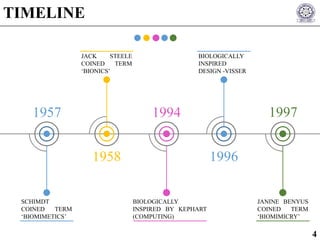
TIMELINE
4
1957
SCHIMDT
COINED TERM
‘BIOMIMETICS’
1958
JACK STEELE
COINED TERM
‘BIONICS’
1994
BIOLOGICALLY
INSPIRED BY KEPHART
(COMPUTING)
1996
BIOLOGICALLY
INSPIRED
DESIGN -VISSER
1997
JANINE BENYUS
COINED TERM
‘BIOMIMICRY’
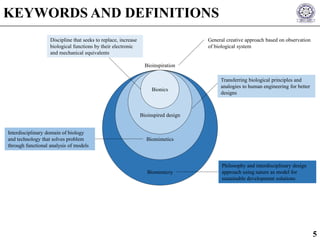
KEYWORDS AND DEFINITIONS
5
Bioinspiration
General creative approach based on observation
of biological system
Bionics
Discipline that seeks to replace, increase
biological functions by their electronic
and mechanical equivalents
Bioinspired design
Transferring biological principles and
analogies to human engineering for better
designs
Biomimetics
Biomimicry
Interdisciplinary domain of biology
and technology that solves problem
through functional analysis of models
Philosophy and interdisciplinary design
approach using nature as model for
sustainable development solutions
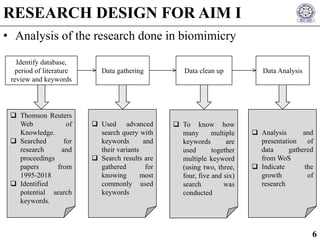
• Analysis of the research done in biomimicry
RESEARCH DESIGN FOR AIM I
6
Data gathering
Identify database,
period of literature
review and keywords
Data clean up Data Analysis
 Thomson Reuters
Web of
Knowledge.
 Searched for
research and
proceedings
papers from
1995-2018
 Identified
potential search
keywords.
 Used advanced
search query with
keywords and
their variants
 Search results are
gathered for
knowing most
commonly used
keywords
 To know how
many multiple
keywords are
used together
multiple keyword
(using two, three,
four, five and six)
search was
conducted
 Analysis and
presentation of
data gathered
from WoS
 Indicate the
growth of
research
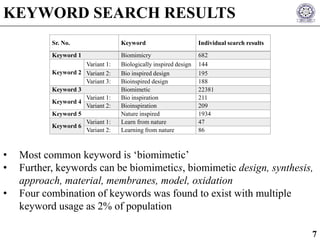
• Most common keyword is ‘biomimetic’
• Further, keywords can be biomimetics, biomimetic design, synthesis,
approach, material, membranes, model, oxidation
• Four combination of keywords was found to exist with multiple
keyword usage as 2% of population
KEYWORD SEARCH RESULTS
7
Sr. No. Keyword Individual search results
Keyword 1 Biomimicry 682
Keyword 2
Variant 1: Biologically inspired design 144
Variant 2: Bio inspired design 195
Variant 3: Bioinspired design 188
Keyword 3 Biomimetic 22381
Keyword 4
Variant 1: Bio inspiration 211
Variant 2: Bioinspiration 209
Keyword 5 Nature inspired 1934
Keyword 6
Variant 1: Learn from nature 47
Variant 2: Learning from nature 86
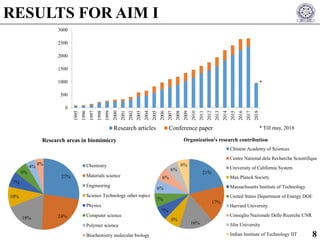
RESULTS FOR AIM I
8
0
500
1000
1500
2000
2500
3000
1995
1996
1997
1998
1999
2000
2001
2002
2003
2004
2005
2006
2007
2008
2009
2010
2011
2012
2013
2014
2015
2016
2017
2018
Research articles Conference paper
27%
24%18%
10%
7%
6%
4%
4%
Research areas in biomimicry
Chemistry
Materials science
Engineering
Science Technology other topics
Physics
Computer science
Polymer science
Biochemistry molecular biology
21%
17%
16%
8%
7%
7%
6%
6%
6%
6%
Organization's research contribution
Chinese Academy of Sciences
Centre National dela Recherche Scientifique
University of California System
Max Planck Society
Massachusetts Institute of Technology
United States Department of Energy DOE
Harvard University
Consiglio Nazionale Delle Ricerche CNR
Jilin University
Indian Institute of Technology IIT
*
* Till may, 2018
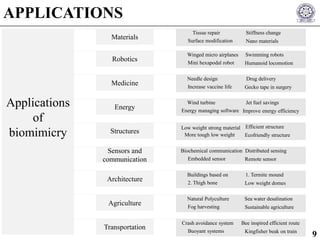
APPLICATIONS
9
Applications
of
biomimicry
Materials
Robotics
Medicine
Energy
Structures
Sensors and
communication
Architecture
Agriculture
Transportation
Tissue repair
Surface modification
Stiffness change
Nano materials
Winged micro airplanes
Mini hexapodal robot
Swimming robots
Humanoid locomotion
Needle design
Increase vaccine life
Drug delivery
Gecko tape in surgery
Wind turbine
Energy managing software
Jet fuel savings
Improve energy efficiency
Low weight strong material
More tough low weight
Efficient structure
Ecofriendly structure
Biochemical communication
Embedded sensor
Distributed sensing
Remote sensor
Buildings based on
2. Thigh bone
1. Termite mound
Low weight domes
Natural Polyculture
Fog harvesting
Sea water desalination
Sustainable agriculture
Crash avoidance system
Buoyant systems
Bee inspired efficient route
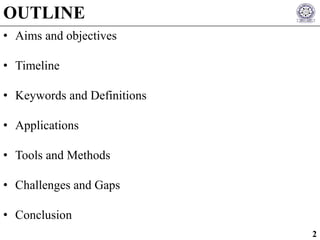
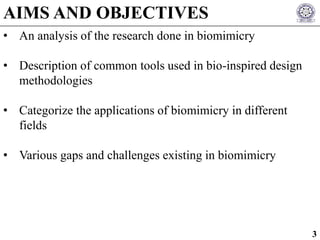
Kingfisher beak on train
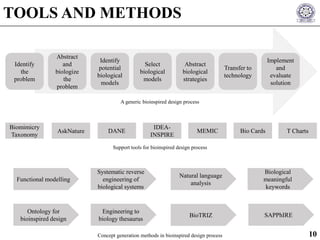
TOOLS AND METHODS
Identify
the
problem
Abstract
and
biologize
the
problem
Identify
potential
biological
models
Select
biological
models
Abstract
biological
strategies
Transfer to
technology
Implement
and
evaluate
solution
MEMICDANE
IDEA-
INSPIRE
AskNature T ChartsBio Cards
Functional modelling
Systematic reverse
engineering of
biological systems
Natural language
analysis
Biological
meaningful
keywords
Ontology for
bioinspired design
Biomimicry
Taxonomy
Engineering to
biology thesaurus
BioTRIZ SAPPhIRE
A generic bioinspired design process
Support tools for bioinspired design process
Concept generation methods in bioinspired design process 10
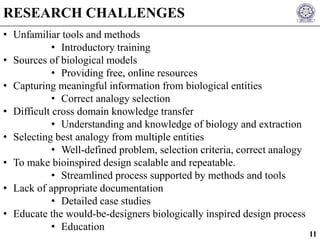
• Unfamiliar tools and methods
• Introductory training
• Sources of biological models
• Providing free, online resources
• Capturing meaningful information from biological entities
• Correct analogy selection
• Difficult cross domain knowledge transfer
• Understanding and knowledge of biology and extraction
• Selecting best analogy from multiple entities
• Well-defined problem, selection criteria, correct analogy
• To make bioinspired design scalable and repeatable.
• Streamlined process supported by methods and tools
• Lack of appropriate documentation
• Detailed case studies
• Educate the would-be-designers biologically inspired design process
• Education
RESEARCH CHALLENGES
11
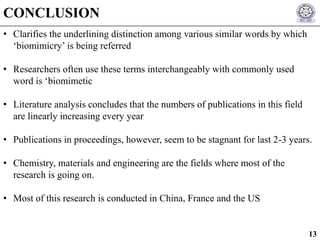
• Unfamiliarity with biology
• Thinly populated bioinspired repositories
• Transition gaps
• Methodological multimodal representation
• Logical reasoning system for verifying best analogy
• Sureshot commercialization strategy
• Unorganised tools and methods
• Effects of constraints and design fixation
RESEARCH GAPS
12
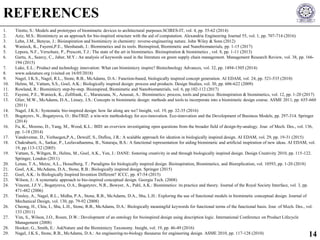
• Clarifies the underlining distinction among various similar words by which
‘biomimicry’ is being referred
• Researchers often use these terms interchangeably with commonly used
word is ‘biomimetic
• Literature analysis concludes that the numbers of publications in this field
are linearly increasing every year
• Publications in proceedings, however, seem to be stagnant for last 2-3 years.
• Chemistry, materials and engineering are the fields where most of the
research is going on.
• Most of this research is conducted in China, France and the US
CONCLUSION
13
1. Titotto, S.: Models and prototypes of biomimetic devices to architectural purposes.SCIRES-IT, vol. 4, pp. 55-62 (2014)
2. Aziz, M.S.: Biomimicry as an approach for bio-inspired structure with the aid of computation. Alexandria Engineering Journal 55, vol. 1, pp. 707-714 (2016)
3. Lehn, J.M., Benyus, J.: Bioinspiration and biomimicry in chemistry: reverse-engineering nature. John Wiley & Sons (2012)
4. Wanieck, K., Fayemi,P.E., Shoshanah, J.: Biomimetics and its tools. Bioinspired, Biomimetic and Nanobiomaterials, pp. 1-15 (2017)
5. Lepora, N.F., Verschure, P., Prescott, T.J.: The state of the art in biomimetics. Bioinspiration & biomimetics , vol. 8, pp. 1-11 (2013)
6. Gurtu, A., Searcy, C., Jaber, M.Y.: An analysis of keywords used in the literature on green supply chain management. Management Research Review, vol. 38, pp. 166-
194 (2015)
7. Luke, E.L.: Product and technology innovation: What can biomimicry inspire? Biotechnology Advances, vol. 32, pp. 1494-1505 (2014)
8. www.asknature.org (visited on 16/05/2018)
9. Nagel, J.K.S., Nagel, R.L., Stone, R.B., McAdams, D.A.: Function-based, biologically inspired concept generation. AI EDAM, vol. 24, pp. 521-535 (2010)
10. Helms, M., Vattam, S.S., Goel, A.K.: Biologically inspired design: process and products. Design Studies, vol. 30, pp. 606-622 (2009)
11. Rowland, R.: Biomimicry step-by-step. Bioinspired, Biomimetic and Nanobiomaterials, vol. 6, pp.102-112 (2017)
12. Fayemi, P.E., Wanieck, K., Zollfrank, C., Maranzana, N., Aoussat, A.: Biomimetics: process, tools and practice. Bioinspiration & biomimetics, vol. 12, pp. 1-20 (2017)
13. Glier, M.W., McAdams, D.A., Linsey, J.S.: Concepts in biomimetic design: methods and tools to incorporate into a biomimetic design course. ASME 2011, pp. 655-660
(2011)
14. Nagel, J.K.S.: Systematic bio‐inspired design: how far along are we? Insight, vol. 19, pp. 32-35 (2016)
15. Bogatyrev, N., Bogatyreva, O.: BioTRIZ: a win-win methodology for eco-innovation. Eco-innovation and the Development of Business Models, pp. 297-314. Springer
(2014)
16. Fu, K., Moreno, D., Yang, M., Wood, K.L.: BID: an overview investigating open questions from the broader field of design-by-analogy. Jour. of Mech. Des., vol. 136,
pp. 1-18 (2014)
17. Vandevenne, D., Verhaegen,P.A., Dewulf, S., Duflou, J.R.: A scalable approach for ideation in biologically inspired design. AI EDAM, vol. 29, pp. 19-31 (2015)
18. Chakrabarti, A., Sarkar, P., Leelavathamma, B., Nataraju, B.S.: A functional representation for aiding biomimetic and artificial inspiration of new ideas. AI EDAM, vol.
19, pp.113-132 (2005)
19. Vattam, S., Wiltgen, B., Helms, M., Goel, A.K., Yen, J.: DANE: fostering creativity in and through biologically inspired design. Design Creativity 2010, pp. 115-122.
Springer, London (2011)
20. Lenau, T.A., Metze, A.L., Hesselberg, T.: Paradigms for biologically inspired design. Bioinspiration, Biomimetics, and Bioreplication, vol. 10593, pp. 1-20 (2018)
21. Goel, A.K., McAdams, D.A., Stone, R.B.: Biologically inspired design. Springer (2015)
22. Goel, A.K.: Is Biologically Inspired Invention Different? ICCC, pp. 47-54 (2015)
23. Wilson, J.: A systematic approach to bio-inspired conceptual design. Georgia Tech. (2008)
24. Vincent, J.F.V., Bogatyreva, O.A., Bogatyrev, N.R., Bowyer, A., Pahl, A.K.: Biomimetics: its practice and theory. Journal of the Royal Society Interface, vol. 3, pp.
471-482 (2006)
25. Tinsley, A., Nagel, R.L., Midha, P.A., Stone, R.B., McAdams, D.A., Shu, L.H.: Exploring the use of functional models in biomimetic conceptual design. Journal of
Mechanical Design, vol. 130, pp. 79-92 (2008)
26. Cheong, H., Chiu, I., Shu, L.H., Stone, R.B., McAdams, D.A.: Biologically meaningful keywords for functional terms of the functional basis. Jour. of Mech. Des., vol.
133 (2011)
27. Yim, S., Wilson, J.O., Rosen, D.W.: Development of an ontology for bioinspired design using description logic. International Conference on Product Lifecycle
Management (2008)
28. Hooker, G., Smith, E.: AskNature and the Biomimicry Taxonomy. Insight, vol. 19, pp. 46-49 (2016)
29. Nagel, J.K.S., Stone, R.B., McAdams, D.A.: An engineering-to-biology thesaurus for engineering design. ASME 2010, pp. 117-128 (2010)
REFERENCES
14
1. Titotto, S.: Models and prototypes of biomimetic devices to architectural purposes.SCIRES-IT, vol. 4, pp. 55-62 (2014)
2. Aziz, M.S.: Biomimicry as an approach for bio-inspired structure with the aid of computation. Alexandria Engineering Journal 55, vol. 1, pp. 707-714 (2016)
3. Lehn, J.M., Benyus, J.: Bioinspiration and biomimicry in chemistry: reverse-engineering nature. John Wiley & Sons (2012)
4. Wanieck, K., Fayemi,P.E., Shoshanah, J.: Biomimetics and its tools. Bioinspired, Biomimetic and Nanobiomaterials, pp. 1-15 (2017)
5. Lepora, N.F., Verschure, P., Prescott, T.J.: The state of the art in biomimetics. Bioinspiration & biomimetics , vol. 8, pp. 1-11 (2013)
6. Gurtu, A., Searcy, C., Jaber, M.Y.: An analysis of keywords used in the literature on green supply chain management. Management Research Review, vol. 38, pp. 166-
194 (2015)
7. Luke, E.L.: Product and technology innovation: What can biomimicry inspire? Biotechnology Advances, vol. 32, pp. 1494-1505 (2014)
8. www.asknature.org (visited on 16/05/2018)
9. Nagel, J.K.S., Nagel, R.L., Stone, R.B., McAdams, D.A.: Function-based, biologically inspired concept generation. AI EDAM, vol. 24, pp. 521-535 (2010)
10. Helms, M., Vattam, S.S., Goel, A.K.: Biologically inspired design: process and products. Design Studies, vol. 30, pp. 606-622 (2009)
11. Rowland, R.: Biomimicry step-by-step. Bioinspired, Biomimetic and Nanobiomaterials, vol. 6, pp.102-112 (2017)
12. Fayemi, P.E., Wanieck, K., Zollfrank, C., Maranzana, N., Aoussat, A.: Biomimetics: process, tools and practice. Bioinspiration & biomimetics, vol. 12, pp. 1-20 (2017)
13. Glier, M.W., McAdams, D.A., Linsey, J.S.: Concepts in biomimetic design: methods and tools to incorporate into a biomimetic design course. ASME 2011, pp. 655-660
(2011)
14. Nagel, J.K.S.: Systematic bio‐inspired design: how far along are we? Insight, vol. 19, pp. 32-35 (2016)
15. Bogatyrev, N., Bogatyreva, O.: BioTRIZ: a win-win methodology for eco-innovation. Eco-innovation and the Development of Business Models, pp. 297-314. Springer
(2014)
16. Fu, K., Moreno, D., Yang, M., Wood, K.L.: BID: an overview investigating open questions from the broader field of design-by-analogy. Jour. of Mech. Des., vol. 136,
pp. 1-18 (2014)
17. Vandevenne, D., Verhaegen,P.A., Dewulf, S., Duflou, J.R.: A scalable approach for ideation in biologically inspired design. AI EDAM, vol. 29, pp. 19-31 (2015)
18. Chakrabarti, A., Sarkar, P., Leelavathamma, B., Nataraju, B.S.: A functional representation for aiding biomimetic and artificial inspiration of new ideas. AI EDAM, vol.
19, pp.113-132 (2005)
19. Vattam, S., Wiltgen, B., Helms, M., Goel, A.K., Yen, J.: DANE: fostering creativity in and through biologically inspired design. Design Creativity 2010, pp. 115-122.
Springer, London (2011)
20. Lenau, T.A., Metze, A.L., Hesselberg, T.: Paradigms for biologically inspired design. Bioinspiration, Biomimetics, and Bioreplication, vol. 10593, pp. 1-20 (2018)
21. Goel, A.K., McAdams, D.A., Stone, R.B.: Biologically inspired design. Springer (2015)
22. Goel, A.K.: Is Biologically Inspired Invention Different? ICCC, pp. 47-54 (2015)
23. Wilson, J.: A systematic approach to bio-inspired conceptual design. Georgia Tech. (2008)
24. Vincent, J.F.V., Bogatyreva, O.A., Bogatyrev, N.R., Bowyer, A., Pahl, A.K.: Biomimetics: its practice and theory. Journal of the Royal Society Interface, vol. 3, pp.
471-482 (2006)
25. Tinsley, A., Nagel, R.L., Midha, P.A., Stone, R.B., McAdams, D.A., Shu, L.H.: Exploring the use of functional models in biomimetic conceptual design. Journal of
Mechanical Design, vol. 130, pp. 79-92 (2008)
26. Cheong, H., Chiu, I., Shu, L.H., Stone, R.B., McAdams, D.A.: Biologically meaningful keywords for functional terms of the functional basis. Jour. of Mech. Des., vol.
133 (2011)
27. Yim, S., Wilson, J.O., Rosen, D.W.: Development of an ontology for bioinspired design using description logic. International Conference on Product Lifecycle
Management (2008)
28. Hooker, G., Smith, E.: AskNature and the Biomimicry Taxonomy. Insight, vol. 19, pp. 46-49 (2016)
29. Nagel, J.K.S., Stone, R.B., McAdams, D.A.: An engineering-to-biology thesaurus for engineering design. ASME 2010, pp. 117-128 (2010)
REFERENCES
15

Biomimicry

  • 1.
    Biomimicry: exploring research,challenges, gaps and tools (Paper ID 102) Sunil Sharma (Research Scholar) Dr. Prabir Sarkar (Associate Professor) Department of Mechanical Engineering, IIT Ropar, Punjab, India Sharma S., Sarkar P. (2019) Biomimicry: Exploring Research, Challenges, Gaps, and Tools. Download at: https://www.researchgate.net/publication/330246880_Biomimicry_Exploring_Research_Challenges_Gaps_and_Tools_Pr oceedings_of_ICoRD_2019_Volume_1
  • 2.
    • Aims andobjectives • Timeline • Keywords and Definitions • Applications • Tools and Methods • Challenges and Gaps • Conclusion OUTLINE 2
  • 3.
    • An analysisof the research done in biomimicry • Description of common tools used in bio-inspired design methodologies • Categorize the applications of biomimicry in different fields • Various gaps and challenges existing in biomimicry AIMS AND OBJECTIVES 3
  • 4.
    TIMELINE 4 1957 SCHIMDT COINED TERM ‘BIOMIMETICS’ 1958 JACK STEELE COINEDTERM ‘BIONICS’ 1994 BIOLOGICALLY INSPIRED BY KEPHART (COMPUTING) 1996 BIOLOGICALLY INSPIRED DESIGN -VISSER 1997 JANINE BENYUS COINED TERM ‘BIOMIMICRY’
  • 5.
    KEYWORDS AND DEFINITIONS 5 Bioinspiration Generalcreative approach based on observation of biological system Bionics Discipline that seeks to replace, increase biological functions by their electronic and mechanical equivalents Bioinspired design Transferring biological principles and analogies to human engineering for better designs Biomimetics Biomimicry Interdisciplinary domain of biology and technology that solves problem through functional analysis of models Philosophy and interdisciplinary design approach using nature as model for sustainable development solutions
  • 6.
    • Analysis ofthe research done in biomimicry RESEARCH DESIGN FOR AIM I 6 Data gathering Identify database, period of literature review and keywords Data clean up Data Analysis  Thomson Reuters Web of Knowledge.  Searched for research and proceedings papers from 1995-2018  Identified potential search keywords.  Used advanced search query with keywords and their variants  Search results are gathered for knowing most commonly used keywords  To know how many multiple keywords are used together multiple keyword (using two, three, four, five and six) search was conducted  Analysis and presentation of data gathered from WoS  Indicate the growth of research
  • 7.
    • Most commonkeyword is ‘biomimetic’ • Further, keywords can be biomimetics, biomimetic design, synthesis, approach, material, membranes, model, oxidation • Four combination of keywords was found to exist with multiple keyword usage as 2% of population KEYWORD SEARCH RESULTS 7 Sr. No. Keyword Individual search results Keyword 1 Biomimicry 682 Keyword 2 Variant 1: Biologically inspired design 144 Variant 2: Bio inspired design 195 Variant 3: Bioinspired design 188 Keyword 3 Biomimetic 22381 Keyword 4 Variant 1: Bio inspiration 211 Variant 2: Bioinspiration 209 Keyword 5 Nature inspired 1934 Keyword 6 Variant 1: Learn from nature 47 Variant 2: Learning from nature 86
  • 8.
    RESULTS FOR AIMI 8 0 500 1000 1500 2000 2500 3000 1995 1996 1997 1998 1999 2000 2001 2002 2003 2004 2005 2006 2007 2008 2009 2010 2011 2012 2013 2014 2015 2016 2017 2018 Research articles Conference paper 27% 24%18% 10% 7% 6% 4% 4% Research areas in biomimicry Chemistry Materials science Engineering Science Technology other topics Physics Computer science Polymer science Biochemistry molecular biology 21% 17% 16% 8% 7% 7% 6% 6% 6% 6% Organization's research contribution Chinese Academy of Sciences Centre National dela Recherche Scientifique University of California System Max Planck Society Massachusetts Institute of Technology United States Department of Energy DOE Harvard University Consiglio Nazionale Delle Ricerche CNR Jilin University Indian Institute of Technology IIT * * Till may, 2018
  • 9.
    APPLICATIONS 9 Applications of biomimicry Materials Robotics Medicine Energy Structures Sensors and communication Architecture Agriculture Transportation Tissue repair Surfacemodification Stiffness change Nano materials Winged micro airplanes Mini hexapodal robot Swimming robots Humanoid locomotion Needle design Increase vaccine life Drug delivery Gecko tape in surgery Wind turbine Energy managing software Jet fuel savings Improve energy efficiency Low weight strong material More tough low weight Efficient structure Ecofriendly structure Biochemical communication Embedded sensor Distributed sensing Remote sensor Buildings based on 2. Thigh bone 1. Termite mound Low weight domes Natural Polyculture Fog harvesting Sea water desalination Sustainable agriculture Crash avoidance system Buoyant systems Bee inspired efficient route Kingfisher beak on train
  • 10.
    TOOLS AND METHODS Identify the problem Abstract and biologize the problem Identify potential biological models Select biological models Abstract biological strategies Transferto technology Implement and evaluate solution MEMICDANE IDEA- INSPIRE AskNature T ChartsBio Cards Functional modelling Systematic reverse engineering of biological systems Natural language analysis Biological meaningful keywords Ontology for bioinspired design Biomimicry Taxonomy Engineering to biology thesaurus BioTRIZ SAPPhIRE A generic bioinspired design process Support tools for bioinspired design process Concept generation methods in bioinspired design process 10
  • 11.
    • Unfamiliar toolsand methods • Introductory training • Sources of biological models • Providing free, online resources • Capturing meaningful information from biological entities • Correct analogy selection • Difficult cross domain knowledge transfer • Understanding and knowledge of biology and extraction • Selecting best analogy from multiple entities • Well-defined problem, selection criteria, correct analogy • To make bioinspired design scalable and repeatable. • Streamlined process supported by methods and tools • Lack of appropriate documentation • Detailed case studies • Educate the would-be-designers biologically inspired design process • Education RESEARCH CHALLENGES 11
  • 12.
    • Unfamiliarity withbiology • Thinly populated bioinspired repositories • Transition gaps • Methodological multimodal representation • Logical reasoning system for verifying best analogy • Sureshot commercialization strategy • Unorganised tools and methods • Effects of constraints and design fixation RESEARCH GAPS 12
  • 13.
    • Clarifies theunderlining distinction among various similar words by which ‘biomimicry’ is being referred • Researchers often use these terms interchangeably with commonly used word is ‘biomimetic • Literature analysis concludes that the numbers of publications in this field are linearly increasing every year • Publications in proceedings, however, seem to be stagnant for last 2-3 years. • Chemistry, materials and engineering are the fields where most of the research is going on. • Most of this research is conducted in China, France and the US CONCLUSION 13
  • 14.
    1. Titotto, S.:Models and prototypes of biomimetic devices to architectural purposes.SCIRES-IT, vol. 4, pp. 55-62 (2014) 2. Aziz, M.S.: Biomimicry as an approach for bio-inspired structure with the aid of computation. Alexandria Engineering Journal 55, vol. 1, pp. 707-714 (2016) 3. Lehn, J.M., Benyus, J.: Bioinspiration and biomimicry in chemistry: reverse-engineering nature. John Wiley & Sons (2012) 4. Wanieck, K., Fayemi,P.E., Shoshanah, J.: Biomimetics and its tools. Bioinspired, Biomimetic and Nanobiomaterials, pp. 1-15 (2017) 5. Lepora, N.F., Verschure, P., Prescott, T.J.: The state of the art in biomimetics. Bioinspiration & biomimetics , vol. 8, pp. 1-11 (2013) 6. Gurtu, A., Searcy, C., Jaber, M.Y.: An analysis of keywords used in the literature on green supply chain management. Management Research Review, vol. 38, pp. 166- 194 (2015) 7. Luke, E.L.: Product and technology innovation: What can biomimicry inspire? Biotechnology Advances, vol. 32, pp. 1494-1505 (2014) 8. www.asknature.org (visited on 16/05/2018) 9. Nagel, J.K.S., Nagel, R.L., Stone, R.B., McAdams, D.A.: Function-based, biologically inspired concept generation. AI EDAM, vol. 24, pp. 521-535 (2010) 10. Helms, M., Vattam, S.S., Goel, A.K.: Biologically inspired design: process and products. Design Studies, vol. 30, pp. 606-622 (2009) 11. Rowland, R.: Biomimicry step-by-step. Bioinspired, Biomimetic and Nanobiomaterials, vol. 6, pp.102-112 (2017) 12. Fayemi, P.E., Wanieck, K., Zollfrank, C., Maranzana, N., Aoussat, A.: Biomimetics: process, tools and practice. Bioinspiration & biomimetics, vol. 12, pp. 1-20 (2017) 13. Glier, M.W., McAdams, D.A., Linsey, J.S.: Concepts in biomimetic design: methods and tools to incorporate into a biomimetic design course. ASME 2011, pp. 655-660 (2011) 14. Nagel, J.K.S.: Systematic bio‐inspired design: how far along are we? Insight, vol. 19, pp. 32-35 (2016) 15. Bogatyrev, N., Bogatyreva, O.: BioTRIZ: a win-win methodology for eco-innovation. Eco-innovation and the Development of Business Models, pp. 297-314. Springer (2014) 16. Fu, K., Moreno, D., Yang, M., Wood, K.L.: BID: an overview investigating open questions from the broader field of design-by-analogy. Jour. of Mech. Des., vol. 136, pp. 1-18 (2014) 17. Vandevenne, D., Verhaegen,P.A., Dewulf, S., Duflou, J.R.: A scalable approach for ideation in biologically inspired design. AI EDAM, vol. 29, pp. 19-31 (2015) 18. Chakrabarti, A., Sarkar, P., Leelavathamma, B., Nataraju, B.S.: A functional representation for aiding biomimetic and artificial inspiration of new ideas. AI EDAM, vol. 19, pp.113-132 (2005) 19. Vattam, S., Wiltgen, B., Helms, M., Goel, A.K., Yen, J.: DANE: fostering creativity in and through biologically inspired design. Design Creativity 2010, pp. 115-122. Springer, London (2011) 20. Lenau, T.A., Metze, A.L., Hesselberg, T.: Paradigms for biologically inspired design. Bioinspiration, Biomimetics, and Bioreplication, vol. 10593, pp. 1-20 (2018) 21. Goel, A.K., McAdams, D.A., Stone, R.B.: Biologically inspired design. Springer (2015) 22. Goel, A.K.: Is Biologically Inspired Invention Different? ICCC, pp. 47-54 (2015) 23. Wilson, J.: A systematic approach to bio-inspired conceptual design. Georgia Tech. (2008) 24. Vincent, J.F.V., Bogatyreva, O.A., Bogatyrev, N.R., Bowyer, A., Pahl, A.K.: Biomimetics: its practice and theory. Journal of the Royal Society Interface, vol. 3, pp. 471-482 (2006) 25. Tinsley, A., Nagel, R.L., Midha, P.A., Stone, R.B., McAdams, D.A., Shu, L.H.: Exploring the use of functional models in biomimetic conceptual design. Journal of Mechanical Design, vol. 130, pp. 79-92 (2008) 26. Cheong, H., Chiu, I., Shu, L.H., Stone, R.B., McAdams, D.A.: Biologically meaningful keywords for functional terms of the functional basis. Jour. of Mech. Des., vol. 133 (2011) 27. Yim, S., Wilson, J.O., Rosen, D.W.: Development of an ontology for bioinspired design using description logic. International Conference on Product Lifecycle Management (2008) 28. Hooker, G., Smith, E.: AskNature and the Biomimicry Taxonomy. Insight, vol. 19, pp. 46-49 (2016) 29. Nagel, J.K.S., Stone, R.B., McAdams, D.A.: An engineering-to-biology thesaurus for engineering design. ASME 2010, pp. 117-128 (2010) REFERENCES 14
  • 15.
    1. Titotto, S.:Models and prototypes of biomimetic devices to architectural purposes.SCIRES-IT, vol. 4, pp. 55-62 (2014) 2. Aziz, M.S.: Biomimicry as an approach for bio-inspired structure with the aid of computation. Alexandria Engineering Journal 55, vol. 1, pp. 707-714 (2016) 3. Lehn, J.M., Benyus, J.: Bioinspiration and biomimicry in chemistry: reverse-engineering nature. John Wiley & Sons (2012) 4. Wanieck, K., Fayemi,P.E., Shoshanah, J.: Biomimetics and its tools. Bioinspired, Biomimetic and Nanobiomaterials, pp. 1-15 (2017) 5. Lepora, N.F., Verschure, P., Prescott, T.J.: The state of the art in biomimetics. Bioinspiration & biomimetics , vol. 8, pp. 1-11 (2013) 6. Gurtu, A., Searcy, C., Jaber, M.Y.: An analysis of keywords used in the literature on green supply chain management. Management Research Review, vol. 38, pp. 166- 194 (2015) 7. Luke, E.L.: Product and technology innovation: What can biomimicry inspire? Biotechnology Advances, vol. 32, pp. 1494-1505 (2014) 8. www.asknature.org (visited on 16/05/2018) 9. Nagel, J.K.S., Nagel, R.L., Stone, R.B., McAdams, D.A.: Function-based, biologically inspired concept generation. AI EDAM, vol. 24, pp. 521-535 (2010) 10. Helms, M., Vattam, S.S., Goel, A.K.: Biologically inspired design: process and products. Design Studies, vol. 30, pp. 606-622 (2009) 11. Rowland, R.: Biomimicry step-by-step. Bioinspired, Biomimetic and Nanobiomaterials, vol. 6, pp.102-112 (2017) 12. Fayemi, P.E., Wanieck, K., Zollfrank, C., Maranzana, N., Aoussat, A.: Biomimetics: process, tools and practice. Bioinspiration & biomimetics, vol. 12, pp. 1-20 (2017) 13. Glier, M.W., McAdams, D.A., Linsey, J.S.: Concepts in biomimetic design: methods and tools to incorporate into a biomimetic design course. ASME 2011, pp. 655-660 (2011) 14. Nagel, J.K.S.: Systematic bio‐inspired design: how far along are we? Insight, vol. 19, pp. 32-35 (2016) 15. Bogatyrev, N., Bogatyreva, O.: BioTRIZ: a win-win methodology for eco-innovation. Eco-innovation and the Development of Business Models, pp. 297-314. Springer (2014) 16. Fu, K., Moreno, D., Yang, M., Wood, K.L.: BID: an overview investigating open questions from the broader field of design-by-analogy. Jour. of Mech. Des., vol. 136, pp. 1-18 (2014) 17. Vandevenne, D., Verhaegen,P.A., Dewulf, S., Duflou, J.R.: A scalable approach for ideation in biologically inspired design. AI EDAM, vol. 29, pp. 19-31 (2015) 18. Chakrabarti, A., Sarkar, P., Leelavathamma, B., Nataraju, B.S.: A functional representation for aiding biomimetic and artificial inspiration of new ideas. AI EDAM, vol. 19, pp.113-132 (2005) 19. Vattam, S., Wiltgen, B., Helms, M., Goel, A.K., Yen, J.: DANE: fostering creativity in and through biologically inspired design. Design Creativity 2010, pp. 115-122. Springer, London (2011) 20. Lenau, T.A., Metze, A.L., Hesselberg, T.: Paradigms for biologically inspired design. Bioinspiration, Biomimetics, and Bioreplication, vol. 10593, pp. 1-20 (2018) 21. Goel, A.K., McAdams, D.A., Stone, R.B.: Biologically inspired design. Springer (2015) 22. Goel, A.K.: Is Biologically Inspired Invention Different? ICCC, pp. 47-54 (2015) 23. Wilson, J.: A systematic approach to bio-inspired conceptual design. Georgia Tech. (2008) 24. Vincent, J.F.V., Bogatyreva, O.A., Bogatyrev, N.R., Bowyer, A., Pahl, A.K.: Biomimetics: its practice and theory. Journal of the Royal Society Interface, vol. 3, pp. 471-482 (2006) 25. Tinsley, A., Nagel, R.L., Midha, P.A., Stone, R.B., McAdams, D.A., Shu, L.H.: Exploring the use of functional models in biomimetic conceptual design. Journal of Mechanical Design, vol. 130, pp. 79-92 (2008) 26. Cheong, H., Chiu, I., Shu, L.H., Stone, R.B., McAdams, D.A.: Biologically meaningful keywords for functional terms of the functional basis. Jour. of Mech. Des., vol. 133 (2011) 27. Yim, S., Wilson, J.O., Rosen, D.W.: Development of an ontology for bioinspired design using description logic. International Conference on Product Lifecycle Management (2008) 28. Hooker, G., Smith, E.: AskNature and the Biomimicry Taxonomy. Insight, vol. 19, pp. 46-49 (2016) 29. Nagel, J.K.S., Stone, R.B., McAdams, D.A.: An engineering-to-biology thesaurus for engineering design. ASME 2010, pp. 117-128 (2010) REFERENCES 15

Editor's Notes

  • #7  Biomimicry has been extensively used in mathematics (e.g., Genetic algorithm, swarm intelligence, modeling), engineering (e.g., robotics, cars, train), material science, medical, architecture and even in arts
  • #12 Introductory training. For example, the taxonomy feature of Asknature needs sufficient training or appropriate selection of keyword while searching its database free resources (AskNature.org) and reserved databases (IDEA-INSPIRE, DANE).
  • #13 introductory training can fill this gap. For example, the taxonomy feature of AskNature needs sufficient training mapping the analogies and abstraction of analogies when partial model is helpful Which mode of knowledge representation is most significant for analogical transfer? If same analogies can solve a problem, is there a logical reasoning system for verifying which analogy can work best? A gap also exists in the final stage as, how to understand the appropriate application of knowledge, how these bio-inspiration can be implemented in products and what should be the commercialization strategies for such products as these products may be sustainable.
  • #14 We observed that chemistry, materials and engineering are the fields where most of the research is going on, and most of this research is conducted in China, France and the US.
  • #15 We observed that chemistry, materials and engineering are the fields where most of the research is going on, and most of this research is conducted in China, France and the US.
  • #16 We observed that chemistry, materials and engineering are the fields where most of the research is going on, and most of this research is conducted in China, France and the US.