Biomechanical considerations in
microimplant anchorage
By: Dr.Mamoun Khawileh under
supervision of dr Maher Fouda
The type of tooth movement that can be produced with
microimplant anchorage is determined by the same
biomechanical principles and considerations that operate
during conventional orthodontic treatment :
1. Force.
2. Moment.
3. Center of resistance.
4. Center of rotation.
Types of tooth movement can be produced depending on the
position of the microimplant, the height of the elastomare
attachment , and the magnitude of the force applied.
Maxillary anterior en masse retraction
mechanics in extraction cases
In masse retraction mechanics in extraction cases can be
classified in three categories much like the descriptors used
traditionally for headgear traction:
1. Low- pull mechanics.
2. Medium -pull mechanics.
3. High pull -mechanics.
Low –pull mechanics for the maxillary arch
When the microimplant is placed between the roots of the
maxillary second premolar and first molar and is less than 8mm
away from the main archwire, the term low-pull en masse
retraction mechanics is used. if force applied from a low-pull
microimplant to an anterior hook extending 6 to 7 mm above the
main archwire , the maxillary occlusal plane usually can be rotated
in a clockwise direction .therefore ,low-pull mechanics are useful in
treating patients who have an open bite tendency.
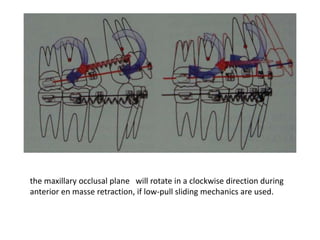
the maxillary occlusal plane will rotate in a clockwise direction during
anterior en masse retraction, if low-pull sliding mechanics are used.
Medium–pull mechanics for the maxillary arch
When a maxillary microimplant is placed about 8 to 10 mm
above the main archwire, the term medium –pull en masse
retraction mechanics is used. if force applied from a medium
–pull microimplant to a hook located between the lateral
incisor and canine that extend 6 to 7mm vertically, the
maxillary occlusal plane ordinarily can be maintained .thus,
medium-pull mechanics are useful in treating patients who
have normal overbite relationships.
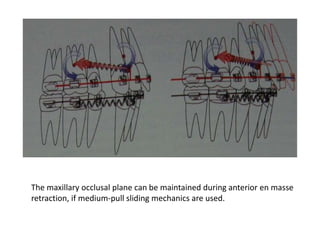
The maxillary occlusal plane can be maintained during anterior en masse
retraction, if medium-pull sliding mechanics are used.
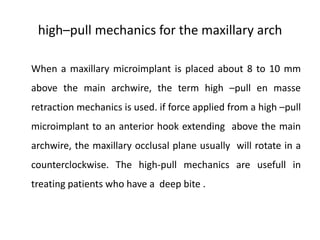
high–pull mechanics for the maxillary arch
When a maxillary microimplant is placed about 8 to 10 mm
above the main archwire, the term high –pull en masse
retraction mechanics is used. if force applied from a high –pull
microimplant to an anterior hook extending above the main
archwire, the maxillary occlusal plane usually will rotate in a
counterclockwise. The high-pull mechanics are usefull in
treating patients who have a deep bite .
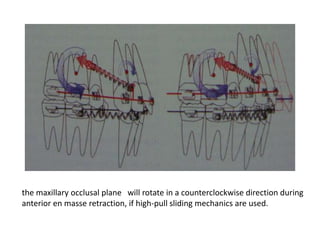
the maxillary occlusal plane will rotate in a counterclockwise direction during
anterior en masse retraction, if high-pull sliding mechanics are used.
Mandibular anterior en masse retraction
mechanics in extraction cases
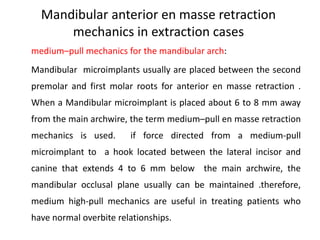
medium–pull mechanics for the mandibular arch:
Mandibular microimplants usually are placed between the second
premolar and first molar roots for anterior en masse retraction .
When a Mandibular microimplant is placed about 6 to 8 mm away
from the main archwire, the term medium–pull en masse retraction
mechanics is used. if force directed from a medium-pull
microimplant to a hook located between the lateral incisor and
canine that extends 4 to 6 mm below the main archwire, the
mandibular occlusal plane usually can be maintained .therefore,
medium high-pull mechanics are useful in treating patients who
have normal overbite relationships.
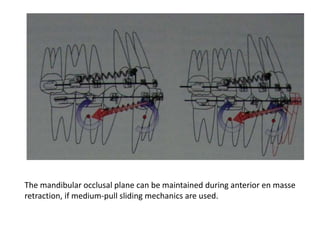
The mandibular occlusal plane can be maintained during anterior en masse
retraction, if medium-pull sliding mechanics are used.
Low –pull mechanics for the mandibular arch
When a microimplant is placed buccaly between the roots of the
mandibular second premolar and the first molar and is less than 6 mm
away from the archwire, the term low-pull en masse retraction
mechanics is used. if force applied from a microimplant in low-pull
location to an anterior hook extending 4 to 6 mm below the main
archwire a counterclockwise rotation of the mandibular occlusal plane
typically can be achieved. low-pull mechanics are useful in treating
patients who have an open bite tendency.
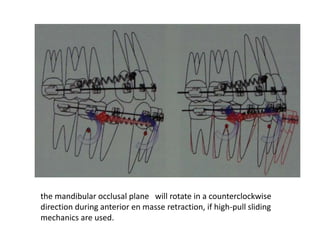
the mandibular occlusal plane will rotate in a counterclockwise
direction during anterior en masse retraction, if high-pull sliding
mechanics are used.
high–pull mechanics for the mandibular arch
When a microimplant is placed buccally between the roots of
the first molar and second premolar and more than 8 mm
away from the main archwire. if force applied from a high –
pull microimplant to an anterior hook extending 4 to 6 mm
below the main archwire. the mandibular occlusal plane
usually can be rotated in a clockwise direction . therefore,
low-pull mechanics are useful in treating patients who have
deep bite or deep bit tendency.
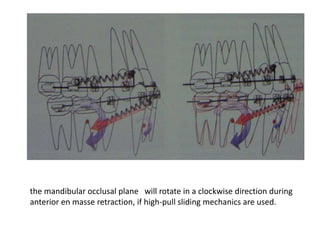
the mandibular occlusal plane will rotate in a clockwise direction during
anterior en masse retraction, if high-pull sliding mechanics are used.
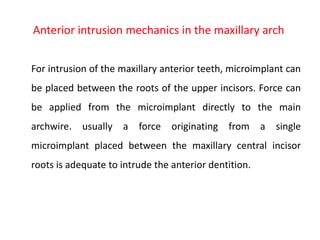
Anterior intrusion mechanics in the maxillary arch
For intrusion of the maxillary anterior teeth, microimplant can
be placed between the roots of the upper incisors. Force can
be applied from the microimplant directly to the main
archwire. usually a force originating from a single
microimplant placed between the maxillary central incisor
roots is adequate to intrude the anterior dentition.
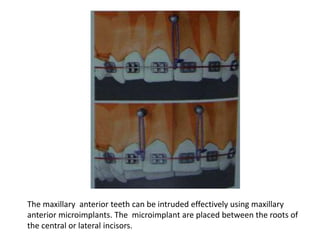
The maxillary anterior teeth can be intruded effectively using maxillary
anterior microimplants. The microimplant are placed between the roots of
the central or lateral incisors.
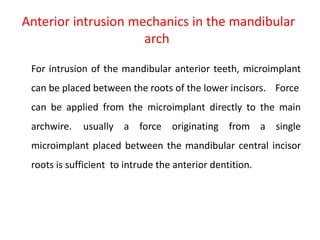
Anterior intrusion mechanics in the mandibular
arch
For intrusion of the mandibular anterior teeth, microimplant
can be placed between the roots of the lower incisors. Force
can be applied from the microimplant directly to the main
archwire. usually a force originating from a single
microimplant placed between the mandibular central incisor
roots is sufficient to intrude the anterior dentition.
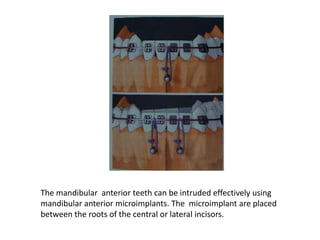
The mandibular anterior teeth can be intruded effectively using
mandibular anterior microimplants. The microimplant are placed
between the roots of the central or lateral incisors.
anterior en masse retraction with anterior
intrusion
In deep bite extraction cases, high–pull mechanics are
recommended in the maxillary arch for intrusion of the
anterior teeth during en masse retraction. posterior
microimplants usually will be more effective in retracting the
anterior teeth, whereas anterior microimplants will be more
effective in intrusion. furthermore, anterior intrusion
microimplants will counteract the tendency for incisors to tip
lingually during their retraction.
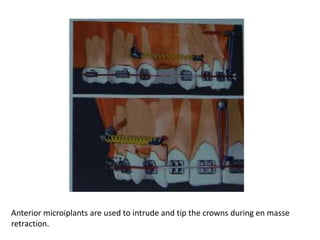
Anterior microiplants are used to intrude and tip the crowns during en masse
retraction.
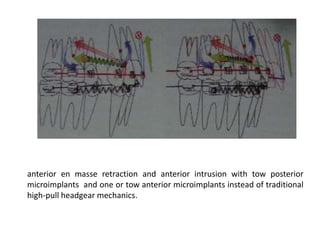
anterior en masse retraction and anterior intrusion with tow posterior
microimplants and one or tow anterior microimplants instead of traditional
high-pull headgear mechanics.
Sliding mechanics vs. loop
When a sliding mechanics are used for anterior en masse
retraction, fabricating the main archwire is relatively easy.
however if first, second or third order bends need to be
incorporated, sliding mechanics cannot be used effectively.
conversly, when loop mechanics are used for anterior en
masse retraction, fabricating the main archwire is more
complicated. however first, second or third order bends can
be incorporated with ease.
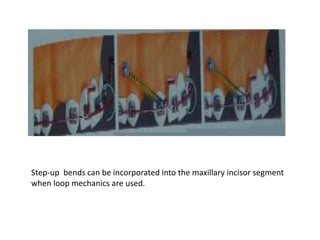
Step-up bends can be incorporated into the maxillary incisor segment
when loop mechanics are used.
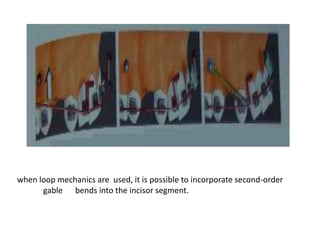
when loop mechanics are used, it is possible to incorporate second-order
gable bends into the incisor segment.
Molar intrusion mechanics for openbite cases
In that it is possible to intrude molar using microimplants, openbite
can be corrected relatively easily, especially skeletal openbite. If 1
mm of absolute molar intrusion is achieved postriorly, an anterior
openbite of 2 to3 mm will be closed anteriorly. A microimplant is
placed between the roots of the maxillary second premolar and
first molar or / the first molar and second molar, buccally and/ or
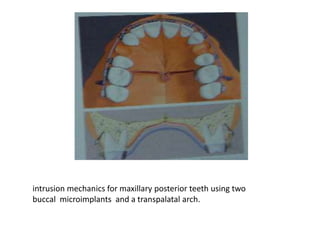
palatally, for the intrusion of maxillary molar teeth. transpalatal
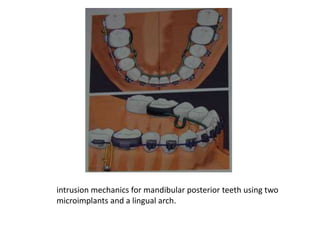
arch is used for palatal microimplants. In the mandibular arch,
however, it is not advisable to insert microimplants lingual to the
molar roots; a lingual holding arch can be used for support instead.
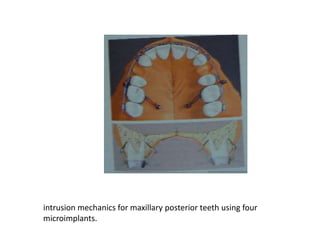
intrusion mechanics for maxillary posterior teeth using four
microimplants.
intrusion mechanics for maxillary posterior teeth using two
buccal microimplants and a transpalatal arch.
intrusion mechanics for mandibular posterior teeth using two
microimplants and a lingual arch.
Maxillary anterior lingual root torque mechanics
After anterior en masse retraction in an extraction case,
severe lingual tipping of the maxillary anterior teeth
sometimes is observed. Whenever lingual root torque then is
applied, labial crown tipping usually is observed instead. To
prevent this kind of labial crown tipping, class II Elastics are
required. Moreover, to prevent the side effect of the class II
elastics ,up-and down vertical elastics and high-pull headgear
are used.
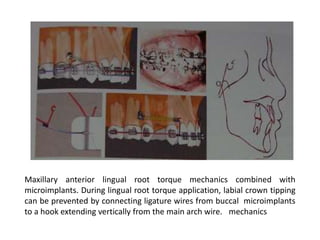
Maxillary anterior lingual root torque mechanics combined with
microimplants. During lingual root torque application, labial crown tipping
can be prevented by connecting ligature wires from buccal microimplants
to a hook extending vertically from the main arch wire. mechanics
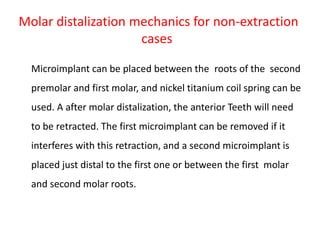
Molar distalization mechanics for non-extraction
cases
Microimplant can be placed between the roots of the second
premolar and first molar, and nickel titanium coil spring can be
used. A after molar distalization, the anterior Teeth will need
to be retracted. The first microimplant can be removed if it
interferes with this retraction, and a second microimplant is
placed just distal to the first one or between the first molar
and second molar roots.
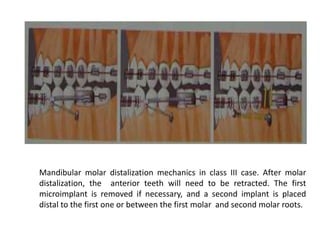
Mandibular molar distalization mechanics in class III case. After molar
distalization, the anterior teeth will need to be retracted. The first
microimplant is removed if necessary, and a second implant is placed
distal to the first one or between the first molar and second molar roots.
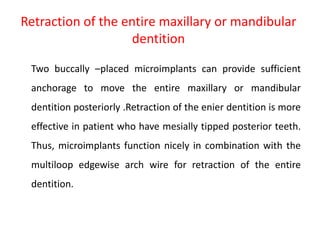
Retraction of the entire maxillary or mandibular
dentition
Two buccally –placed microimplants can provide sufficient
anchorage to move the entire maxillary or mandibular
dentition posteriorly .Retraction of the enier dentition is more
effective in patient who have mesially tipped posterior teeth.
Thus, microimplants function nicely in combination with the
multiloop edgewise arch wire for retraction of the entire
dentition.
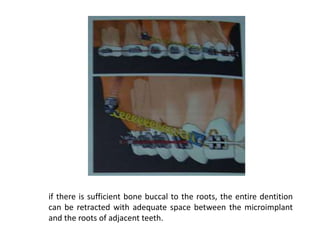
if there is sufficient bone buccal to the roots, the entire dentition
can be retracted with adequate space between the microimplant
and the roots of adjacent teeth.
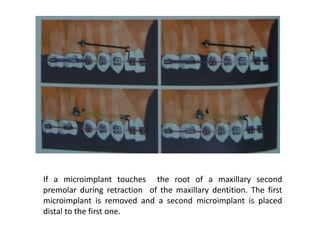
If a microimplant touches the root of a maxillary second
premolar during retraction of the maxillary dentition. The first
microimplant is removed and a second microimplant is placed
distal to the first one.
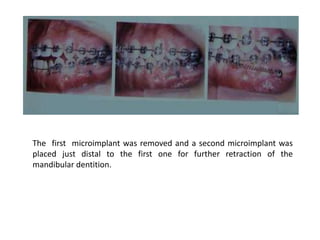
The first microimplant was removed and a second microimplant was
placed just distal to the first one for further retraction of the
mandibular dentition.
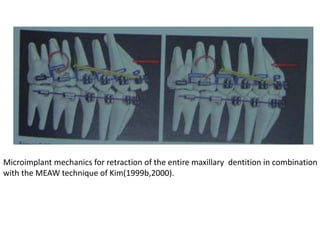
Microimplant mechanics for retraction of the entire maxillary dentition in combination
with the MEAW technique of Kim(1999b,2000).
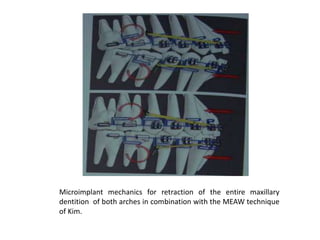
Microimplant mechanics for retraction of the entire maxillary
dentition of both arches in combination with the MEAW technique
of Kim.
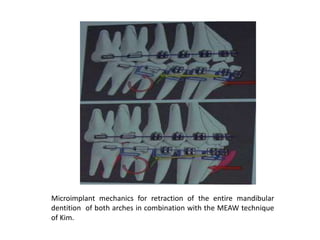
Microimplant mechanics for retraction of the entire mandibular
dentition of both arches in combination with the MEAW technique
of Kim.
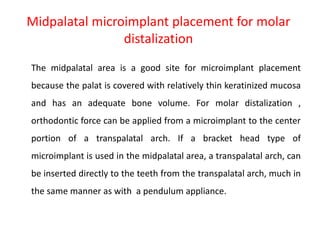
Midpalatal microimplant placement for molar
distalization
The midpalatal area is a good site for microimplant placement
because the palat is covered with relatively thin keratinized mucosa
and has an adequate bone volume. For molar distalization ,
orthodontic force can be applied from a microimplant to the center
portion of a transpalatal arch. If a bracket head type of
microimplant is used in the midpalatal area, a transpalatal arch, can
be inserted directly to the teeth from the transpalatal arch, much in
the same manner as with a pendulum appliance.
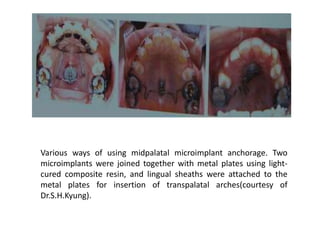
Various ways of using midpalatal microimplant anchorage. Two
microimplants were joined together with metal plates using light-
cured composite resin, and lingual sheaths were attached to the
metal plates for insertion of transpalatal arches(courtesy of
Dr.S.H.Kyung).
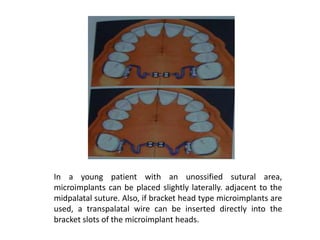
In a young patient with an unossified sutural area,
microimplants can be placed slightly laterally. adjacent to the
midpalatal suture. Also, if bracket head type microimplants are
used, a transpalatal wire can be inserted directly into the
bracket slots of the microimplant heads.
Protraction mechanics in extraction cases
Sometimes molar protraction is needed in minimum or moderate
anchorage cases or unusual extraction cases. however, molar
protraction is one of the most difficult tooth movements to
accomplish, especially in patients with a low mandibular plane
angle and deep bite. if microimplants are incorporated into the
treatment protocol, molar teeth can be moved forward more
effectively and without disturbing the anterior teeth.
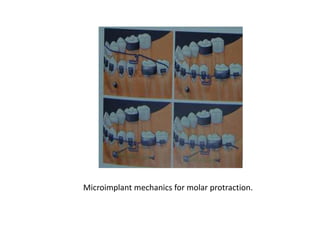
Microimplants for molar protraction are placed between the roots
of mandibular canine and first premolar or first premolar and
second premolar.
Microimplant mechanics for molar protraction.
Retromolar microimplants for single molar
uprighting
Elastic chain or ligature wire can be connected from a
retromolar microimplant to an attachment on the tipped
molar. These mechanics produce an intrusive force during
molar uprighting and prevent the occlusal trauma that
normaly would occur with conventional uprighting
techniques. However, this type of simple retromolar
microimplant mechanics cannot control the movement of a
tooth precisely.
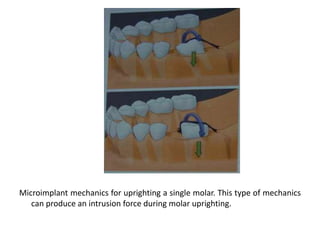
Microimplant mechanics for uprighting a single molar. This type of mechanics
can produce an intrusion force during molar uprighting.
Molar uprighting and/or portraction or distalization
mechanics using two microimplants in edentulous area
To resist rotational and torqueing forces, two microimplants
can be placed side-buy-side in an edentulous area and then
joined together using light-cured resin. Subsequently, a
bracket can be bonded to the resin of the microimplant –
supported structure. A rectangular wire inserted into this
bracket will facilitate three –dimensional movement of the
involved tooth.
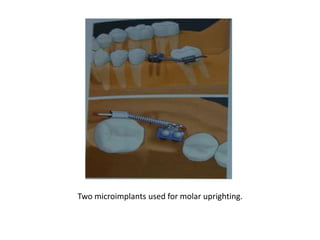
Two microimplants used for molar uprighting.
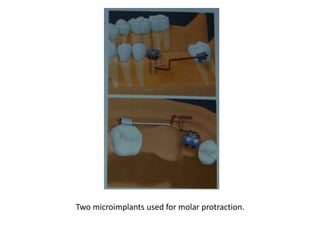
Two microimplants used for molar protraction.
Buccal crossbite (scissors bite) correction
To correct a scissors bite without causing molar extruusion, intra-
arch mechanics, rather than interarch mechanics, must be used.
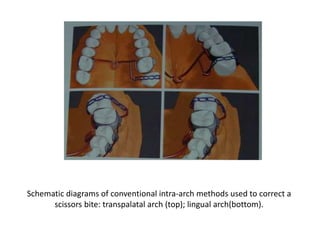
Transpalatal and lingual arch can be used to reinforce anchorage in
conventional intra-arch methods. If microimplants are used, the
same type of uprighting and intrusion is obsarved during buccal
crossbite correction. With only one microimplant, however, it is
difficult to apply orthodontic force in the proper direction; if a
bracket head type of microimplant is selected, a wire can be
extended from the slot of the bracket to allow the force to be
applied more effectively.
Schematic diagrams of conventional intra-arch methods used to correct a
scissors bite: transpalatal arch (top); lingual arch(bottom).
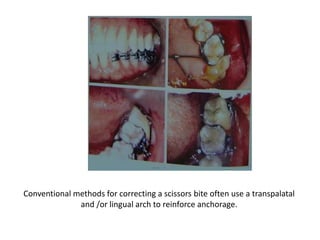
Conventional methods for correcting a scissors bite often use a transpalatal
and /or lingual arch to reinforce anchorage.
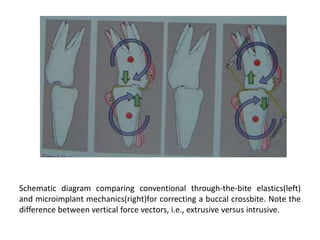
Schematic diagram comparing conventional through-the-bite elastics(left)
and microimplant mechanics(right)for correcting a buccal crossbite. Note the
difference between vertical force vectors, i.e., extrusive versus intrusive.
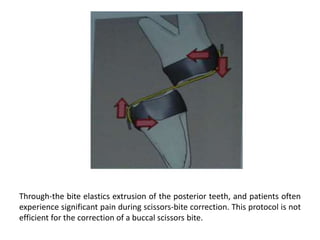
Through-the bite elastics extrusion of the posterior teeth, and patients often
experience significant pain during scissors-bite correction. This protocol is not
efficient for the correction of a buccal scissors bite.
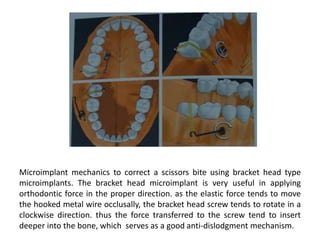
Microimplant mechanics to correct a scissors bite using bracket head type
microimplants. The bracket head microimplant is very useful in applying
orthodontic force in the proper direction. as the elastic force tends to move
the hooked metal wire occlusally, the bracket head screw tends to rotate in a
clockwise direction. thus the force transferred to the screw tend to insert
deeper into the bone, which serves as a good anti-dislodgment mechanism.
Thank you
Thank you

Biomechanical considerations in microimplants

  • 1.
    Biomechanical considerations in microimplantanchorage By: Dr.Mamoun Khawileh under supervision of dr Maher Fouda
  • 2.
    The type oftooth movement that can be produced with microimplant anchorage is determined by the same biomechanical principles and considerations that operate during conventional orthodontic treatment : 1. Force. 2. Moment. 3. Center of resistance. 4. Center of rotation.
  • 3.
    Types of toothmovement can be produced depending on the position of the microimplant, the height of the elastomare attachment , and the magnitude of the force applied.
  • 4.
    Maxillary anterior enmasse retraction mechanics in extraction cases In masse retraction mechanics in extraction cases can be classified in three categories much like the descriptors used traditionally for headgear traction: 1. Low- pull mechanics. 2. Medium -pull mechanics. 3. High pull -mechanics.
  • 5.
    Low –pull mechanicsfor the maxillary arch When the microimplant is placed between the roots of the maxillary second premolar and first molar and is less than 8mm away from the main archwire, the term low-pull en masse retraction mechanics is used. if force applied from a low-pull microimplant to an anterior hook extending 6 to 7 mm above the main archwire , the maxillary occlusal plane usually can be rotated in a clockwise direction .therefore ,low-pull mechanics are useful in treating patients who have an open bite tendency.
  • 6.
    the maxillary occlusalplane will rotate in a clockwise direction during anterior en masse retraction, if low-pull sliding mechanics are used.
  • 7.
    Medium–pull mechanics forthe maxillary arch When a maxillary microimplant is placed about 8 to 10 mm above the main archwire, the term medium –pull en masse retraction mechanics is used. if force applied from a medium –pull microimplant to a hook located between the lateral incisor and canine that extend 6 to 7mm vertically, the maxillary occlusal plane ordinarily can be maintained .thus, medium-pull mechanics are useful in treating patients who have normal overbite relationships.
  • 8.
    The maxillary occlusalplane can be maintained during anterior en masse retraction, if medium-pull sliding mechanics are used.
  • 9.
    high–pull mechanics forthe maxillary arch When a maxillary microimplant is placed about 8 to 10 mm above the main archwire, the term high –pull en masse retraction mechanics is used. if force applied from a high –pull microimplant to an anterior hook extending above the main archwire, the maxillary occlusal plane usually will rotate in a counterclockwise. The high-pull mechanics are usefull in treating patients who have a deep bite .
  • 10.
    the maxillary occlusalplane will rotate in a counterclockwise direction during anterior en masse retraction, if high-pull sliding mechanics are used.
  • 11.
    Mandibular anterior enmasse retraction mechanics in extraction cases medium–pull mechanics for the mandibular arch: Mandibular microimplants usually are placed between the second premolar and first molar roots for anterior en masse retraction . When a Mandibular microimplant is placed about 6 to 8 mm away from the main archwire, the term medium–pull en masse retraction mechanics is used. if force directed from a medium-pull microimplant to a hook located between the lateral incisor and canine that extends 4 to 6 mm below the main archwire, the mandibular occlusal plane usually can be maintained .therefore, medium high-pull mechanics are useful in treating patients who have normal overbite relationships.
  • 12.
    The mandibular occlusalplane can be maintained during anterior en masse retraction, if medium-pull sliding mechanics are used.
  • 13.
    Low –pull mechanicsfor the mandibular arch When a microimplant is placed buccaly between the roots of the mandibular second premolar and the first molar and is less than 6 mm away from the archwire, the term low-pull en masse retraction mechanics is used. if force applied from a microimplant in low-pull location to an anterior hook extending 4 to 6 mm below the main archwire a counterclockwise rotation of the mandibular occlusal plane typically can be achieved. low-pull mechanics are useful in treating patients who have an open bite tendency.
  • 14.
    the mandibular occlusalplane will rotate in a counterclockwise direction during anterior en masse retraction, if high-pull sliding mechanics are used.
  • 15.
    high–pull mechanics forthe mandibular arch When a microimplant is placed buccally between the roots of the first molar and second premolar and more than 8 mm away from the main archwire. if force applied from a high – pull microimplant to an anterior hook extending 4 to 6 mm below the main archwire. the mandibular occlusal plane usually can be rotated in a clockwise direction . therefore, low-pull mechanics are useful in treating patients who have deep bite or deep bit tendency.
  • 16.
    the mandibular occlusalplane will rotate in a clockwise direction during anterior en masse retraction, if high-pull sliding mechanics are used.
  • 17.
    Anterior intrusion mechanicsin the maxillary arch For intrusion of the maxillary anterior teeth, microimplant can be placed between the roots of the upper incisors. Force can be applied from the microimplant directly to the main archwire. usually a force originating from a single microimplant placed between the maxillary central incisor roots is adequate to intrude the anterior dentition.
  • 18.
    The maxillary anteriorteeth can be intruded effectively using maxillary anterior microimplants. The microimplant are placed between the roots of the central or lateral incisors.
  • 19.
    Anterior intrusion mechanicsin the mandibular arch For intrusion of the mandibular anterior teeth, microimplant can be placed between the roots of the lower incisors. Force can be applied from the microimplant directly to the main archwire. usually a force originating from a single microimplant placed between the mandibular central incisor roots is sufficient to intrude the anterior dentition.
  • 20.
    The mandibular anteriorteeth can be intruded effectively using mandibular anterior microimplants. The microimplant are placed between the roots of the central or lateral incisors.
  • 21.
    anterior en masseretraction with anterior intrusion In deep bite extraction cases, high–pull mechanics are recommended in the maxillary arch for intrusion of the anterior teeth during en masse retraction. posterior microimplants usually will be more effective in retracting the anterior teeth, whereas anterior microimplants will be more effective in intrusion. furthermore, anterior intrusion microimplants will counteract the tendency for incisors to tip lingually during their retraction.
  • 22.
    Anterior microiplants areused to intrude and tip the crowns during en masse retraction.
  • 23.
    anterior en masseretraction and anterior intrusion with tow posterior microimplants and one or tow anterior microimplants instead of traditional high-pull headgear mechanics.
  • 24.
    Sliding mechanics vs.loop When a sliding mechanics are used for anterior en masse retraction, fabricating the main archwire is relatively easy. however if first, second or third order bends need to be incorporated, sliding mechanics cannot be used effectively. conversly, when loop mechanics are used for anterior en masse retraction, fabricating the main archwire is more complicated. however first, second or third order bends can be incorporated with ease.
  • 25.
    Step-up bends canbe incorporated into the maxillary incisor segment when loop mechanics are used.
  • 26.
    when loop mechanicsare used, it is possible to incorporate second-order gable bends into the incisor segment.
  • 27.
    Molar intrusion mechanicsfor openbite cases In that it is possible to intrude molar using microimplants, openbite can be corrected relatively easily, especially skeletal openbite. If 1 mm of absolute molar intrusion is achieved postriorly, an anterior openbite of 2 to3 mm will be closed anteriorly. A microimplant is placed between the roots of the maxillary second premolar and first molar or / the first molar and second molar, buccally and/ or palatally, for the intrusion of maxillary molar teeth. transpalatal arch is used for palatal microimplants. In the mandibular arch, however, it is not advisable to insert microimplants lingual to the molar roots; a lingual holding arch can be used for support instead.
  • 28.
    intrusion mechanics formaxillary posterior teeth using four microimplants.
  • 29.
    intrusion mechanics formaxillary posterior teeth using two buccal microimplants and a transpalatal arch.
  • 30.
    intrusion mechanics formandibular posterior teeth using two microimplants and a lingual arch.
  • 31.
    Maxillary anterior lingualroot torque mechanics After anterior en masse retraction in an extraction case, severe lingual tipping of the maxillary anterior teeth sometimes is observed. Whenever lingual root torque then is applied, labial crown tipping usually is observed instead. To prevent this kind of labial crown tipping, class II Elastics are required. Moreover, to prevent the side effect of the class II elastics ,up-and down vertical elastics and high-pull headgear are used.
  • 32.
    Maxillary anterior lingualroot torque mechanics combined with microimplants. During lingual root torque application, labial crown tipping can be prevented by connecting ligature wires from buccal microimplants to a hook extending vertically from the main arch wire. mechanics
  • 33.
    Molar distalization mechanicsfor non-extraction cases Microimplant can be placed between the roots of the second premolar and first molar, and nickel titanium coil spring can be used. A after molar distalization, the anterior Teeth will need to be retracted. The first microimplant can be removed if it interferes with this retraction, and a second microimplant is placed just distal to the first one or between the first molar and second molar roots.
  • 34.
    Mandibular molar distalizationmechanics in class III case. After molar distalization, the anterior teeth will need to be retracted. The first microimplant is removed if necessary, and a second implant is placed distal to the first one or between the first molar and second molar roots.
  • 35.
    Retraction of theentire maxillary or mandibular dentition Two buccally –placed microimplants can provide sufficient anchorage to move the entire maxillary or mandibular dentition posteriorly .Retraction of the enier dentition is more effective in patient who have mesially tipped posterior teeth. Thus, microimplants function nicely in combination with the multiloop edgewise arch wire for retraction of the entire dentition.
  • 36.
    if there issufficient bone buccal to the roots, the entire dentition can be retracted with adequate space between the microimplant and the roots of adjacent teeth.
  • 37.
    If a microimplanttouches the root of a maxillary second premolar during retraction of the maxillary dentition. The first microimplant is removed and a second microimplant is placed distal to the first one.
  • 38.
    The first microimplantwas removed and a second microimplant was placed just distal to the first one for further retraction of the mandibular dentition.
  • 39.
    Microimplant mechanics forretraction of the entire maxillary dentition in combination with the MEAW technique of Kim(1999b,2000).
  • 40.
    Microimplant mechanics forretraction of the entire maxillary dentition of both arches in combination with the MEAW technique of Kim.
  • 41.
    Microimplant mechanics forretraction of the entire mandibular dentition of both arches in combination with the MEAW technique of Kim.
  • 42.
    Midpalatal microimplant placementfor molar distalization The midpalatal area is a good site for microimplant placement because the palat is covered with relatively thin keratinized mucosa and has an adequate bone volume. For molar distalization , orthodontic force can be applied from a microimplant to the center portion of a transpalatal arch. If a bracket head type of microimplant is used in the midpalatal area, a transpalatal arch, can be inserted directly to the teeth from the transpalatal arch, much in the same manner as with a pendulum appliance.
  • 43.
    Various ways ofusing midpalatal microimplant anchorage. Two microimplants were joined together with metal plates using light- cured composite resin, and lingual sheaths were attached to the metal plates for insertion of transpalatal arches(courtesy of Dr.S.H.Kyung).
  • 44.
    In a youngpatient with an unossified sutural area, microimplants can be placed slightly laterally. adjacent to the midpalatal suture. Also, if bracket head type microimplants are used, a transpalatal wire can be inserted directly into the bracket slots of the microimplant heads.
  • 45.
    Protraction mechanics inextraction cases Sometimes molar protraction is needed in minimum or moderate anchorage cases or unusual extraction cases. however, molar protraction is one of the most difficult tooth movements to accomplish, especially in patients with a low mandibular plane angle and deep bite. if microimplants are incorporated into the treatment protocol, molar teeth can be moved forward more effectively and without disturbing the anterior teeth. Microimplants for molar protraction are placed between the roots of mandibular canine and first premolar or first premolar and second premolar.
  • 46.
    Microimplant mechanics formolar protraction.
  • 47.
    Retromolar microimplants forsingle molar uprighting Elastic chain or ligature wire can be connected from a retromolar microimplant to an attachment on the tipped molar. These mechanics produce an intrusive force during molar uprighting and prevent the occlusal trauma that normaly would occur with conventional uprighting techniques. However, this type of simple retromolar microimplant mechanics cannot control the movement of a tooth precisely.
  • 48.
    Microimplant mechanics foruprighting a single molar. This type of mechanics can produce an intrusion force during molar uprighting.
  • 49.
    Molar uprighting and/orportraction or distalization mechanics using two microimplants in edentulous area To resist rotational and torqueing forces, two microimplants can be placed side-buy-side in an edentulous area and then joined together using light-cured resin. Subsequently, a bracket can be bonded to the resin of the microimplant – supported structure. A rectangular wire inserted into this bracket will facilitate three –dimensional movement of the involved tooth.
  • 50.
    Two microimplants usedfor molar uprighting.
  • 51.
    Two microimplants usedfor molar protraction.
  • 52.
    Buccal crossbite (scissorsbite) correction To correct a scissors bite without causing molar extruusion, intra- arch mechanics, rather than interarch mechanics, must be used. Transpalatal and lingual arch can be used to reinforce anchorage in conventional intra-arch methods. If microimplants are used, the same type of uprighting and intrusion is obsarved during buccal crossbite correction. With only one microimplant, however, it is difficult to apply orthodontic force in the proper direction; if a bracket head type of microimplant is selected, a wire can be extended from the slot of the bracket to allow the force to be applied more effectively.
  • 53.
    Schematic diagrams ofconventional intra-arch methods used to correct a scissors bite: transpalatal arch (top); lingual arch(bottom).
  • 54.
    Conventional methods forcorrecting a scissors bite often use a transpalatal and /or lingual arch to reinforce anchorage.
  • 55.
    Schematic diagram comparingconventional through-the-bite elastics(left) and microimplant mechanics(right)for correcting a buccal crossbite. Note the difference between vertical force vectors, i.e., extrusive versus intrusive.
  • 56.
    Through-the bite elasticsextrusion of the posterior teeth, and patients often experience significant pain during scissors-bite correction. This protocol is not efficient for the correction of a buccal scissors bite.
  • 57.
    Microimplant mechanics tocorrect a scissors bite using bracket head type microimplants. The bracket head microimplant is very useful in applying orthodontic force in the proper direction. as the elastic force tends to move the hooked metal wire occlusally, the bracket head screw tends to rotate in a clockwise direction. thus the force transferred to the screw tend to insert deeper into the bone, which serves as a good anti-dislodgment mechanism.
  • 58.