XX
RESPIRATION
The energy-providing process for all lifeThe energy-providing process for all life
In this presentation you will be looking at
respiration, to note its usefulness, and to
see how it works in living organisms.
In this presentation you will be looking at
respiration, to note its usefulness, and to
see how it works in living organisms.
XX
Contents
1. Objectives
2. Energy
3. Respiration
4. Aerobic Respiration
5. Anaerobic Respiration
6. Gaseous Exchange
7. Smoking
8. Summary
RESPIRATION
XX
Objectives
You should be able to:
 Recall that respiration takes place at the level of
the cell
 Describe the process of aerobic respiration
 Explain anaerobic respiration
 Compare breathing, respiration and gaseous
exchange
 Describe common features of respiratory
surfaces
 Explain how smoking affects respiratory system
XX
Energy in Living things
There are three types of energy important to
all living things: Heat, Chemical and Light.
Are all of these found in this living thing?
XX
Energy is needed for life processes
Energy is the capacity to do work; it is
available in different inter-convertible forms.
Life processes require energy.
Where do we obtain this energy from?
This process takes energy from foods and
lets the cells have it for their various
processes.
CHECK
From respirationFrom respiration
XX
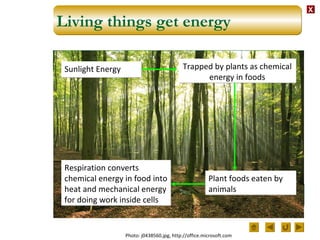
Living things get energy
Sunlight EnergySunlight Energy Trapped by plants as chemical
energy in foods
Trapped by plants as chemical
energy in foods
Plant foods eaten by
animals
Plant foods eaten by
animals
Respiration converts
chemical energy in food into
heat and mechanical energy
for doing work inside cells
Respiration converts
chemical energy in food into
heat and mechanical energy
for doing work inside cells
Photo: j0438560.jpg, http://office.microsoft.com
XX
Respiration
Respiration is the process by which living things
obtain their energy.
Chemical energy is made available to cells by a
series of respiratory reactions.
ATP produced (energy storage/transfer molecule),
food & oxygen used up, by products given off
Breathing is the mechanism used to enable gases
needed to come inside the body, and to remove
gases which are the by products.
Breathing is different from respiration !
XX
Respiration
Occurs in every living cell
Night - http://office.microsoft.com j0255566.jpg
Occurs all night
Remember ! Plants
respire all day and
all night, just like
all other living
things
Remember ! Plants
respire all day and
all night, just like
all other living
things
Day - http://office.microsoft.com j0438907.jpg
Occurs all day
Cell - http://office.microsoft.com j0390205.jpg
XX
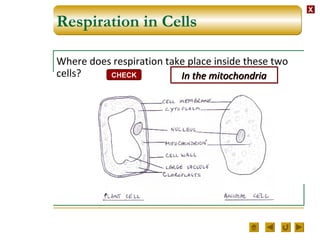
Respiration in Cells
Where does respiration take place inside these two
cells? CHECK In the mitochondriaIn the mitochondria
XX
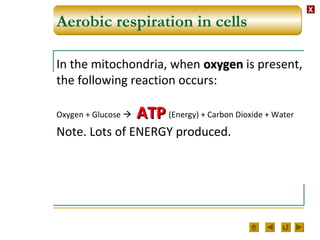
Aerobic respiration in cells
In the mitochondria, when oxygenoxygen is present,
the following reaction occurs:
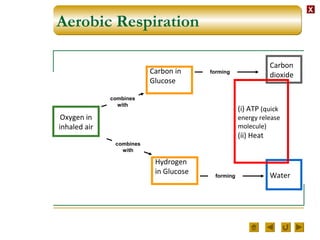
Oxygen + Glucose  (Energy) + Carbon Dioxide + Water
Note. Lots of ENERGY produced.
ATPATP
XX
Aerobic Respiration
Oxygen in
inhaled air
Carbon in
Glucose
Hydrogen
in Glucose
Carbon
dioxide
Water
(i) ATP (quick
energy release
molecule)
(ii) Heat
combines
with
combines
with
forming
forming
XX
Anaerobic Respiration in cells
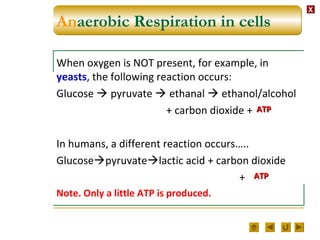
When oxygen is NOT present, for example, in
yeasts, the following reaction occurs:
Glucose  pyruvate  ethanal  ethanol/alcohol
+ carbon dioxide +
In humans, a different reaction occurs…..
Glucosepyruvatelactic acid + carbon dioxide
+
Note. Only a little ATP is produced.
An
ATPATP
ATPATP
XX
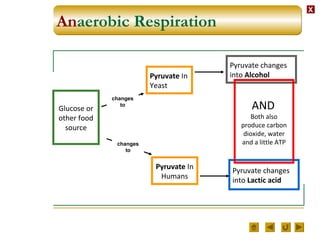
Anaerobic Respiration
Glucose or
other food
source
Pyruvate In
Yeast
Pyruvate In
Humans
Pyruvate changes
into Alcohol
Pyruvate changes
into Lactic acid
AND
Both also
produce carbon
dioxide, water
and a little ATP
changes
to
changes
to
XX
Gaseous Exchange
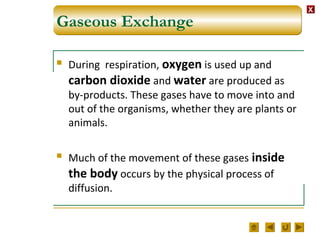
 During respiration, oxygen is used up and
carbon dioxide and water are produced as
by-products. These gases have to move into and
out of the organisms, whether they are plants or
animals.
 Much of the movement of these gases inside
the body occurs by the physical process of
diffusion.
XX
Movement of Gases
There are four parts to this process:
1. Breathing – movement of gases into and out of
the body or the lungs
2. Gases are exchanged between the alveoli and
the blood vessels around them
3. The oxygen is carried in the blood to cells, and
carbon dioxide and water are carried in the
blood to the alveoli
4. The gases are exchanged between the blood
and the body cells
XX
A look at these processes
If you go to the following site, you can see a
a short video clip (1.21 s) on the
respiration process in action:
http://www.youtube.com/watch?v=DoSTehS7
XX
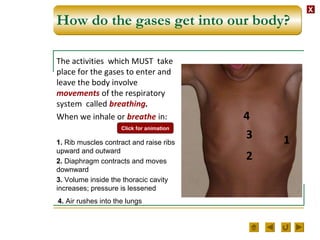
3. Volume inside the thoracic cavity
increases; pressure is lessened
How do the gases get into our body?
The activities which MUST take
place for the gases to enter and
leave the body involve
movements of the respiratory
system called breathing.
When we inhale or breathe in:
1
2
3
4
Click for animation
1. Rib muscles contract and raise ribs
upward and outward
2. Diaphragm contracts and moves
downward
4. Air rushes into the lungs
XX
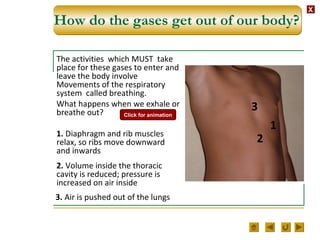
How do the gases get out of our body?
The activities which MUST take
place for these gases to enter and
leave the body involve
Movements of the respiratory
system called breathing.
What happens when we exhale or
breathe out?
1. Diaphragm and rib muscles
relax, so ribs move downward
and inwards
1
3
2
2. Volume inside the thoracic
cavity is reduced; pressure is
increased on air inside
3. Air is pushed out of the lungs
Click for animation
XX
What happens to the gases after the lungs?
1. Oxygen diffuses into the blood.
2. It combines with haemoglobin to form oxy-haemoglobin in
the red cells.
3. Once this blood reaches body cells, the oxygen removes itself
from the haemoglobin and diffuses into the cell.
4. Respiration occurs.
5. Carbon dioxide and water are produced by respiration.
6. Carbon dioxide diffuses into the blood vessels near the cell.
7. It changes into carbonic acid by combining with water and is
carried as part of the blood plasma.
8. Once this blood reaches the alveoli of the lungs, the carbonic
acid changes back into carbon dioxide and water.
9. These gases diffuse out of the blood vessels into the alveoli.
XX
What affects our breathing?
 What happens when you exercise vigorously, even for a
short time?
 What happens when you are frightened by someone
behind you?
 Does this fast breathing happen to athletes such as
football players and speed runners?
 Can you think why?
CHECK You start to breathe heavier and faster !You start to breathe heavier and faster !
CHECK Yes it does, but they are not as much affected as we are.Yes it does, but they are not as much affected as we are.
XX
Respiratory Surfaces
 Respiratory surfaces in animals have a number of special
characteristics:
 they are thinthin,
 have a large surface area to volume ratio,
 are well supplied with blood capillaries and
 they are constantly kept moistmoist.
 These characteristics help them to facilitate diffusion of
gases.
 If any of these characteristics become changed or lost, then
good and quick diffusion of gases will not occur.
So no respiration !
So no energy for cells to do their work !
So no LIFE !! No Living Things !!!
XX
Respiratory Surfaces
Plants also have respiratory surfaces !
 Can you think what these are? Where could gases come in and go out
of the plant?
 What other areas of the plant can do this?
 Plant tissues have rows of cells with lots of air spaces in between – in
the leaf the spongy mesophyll layer is like this.
 These layers ensure that there is much surface are, and the area is
moist. The cells are not large, so diffusion of gases can easily occur.
CHECK
The stomata are spaces which let gases enter and exit the plant.The stomata are spaces which let gases enter and exit the plant.
CHECK
The epidermal layer of roots and stems and at lenticels of woody
stems.
The epidermal layer of roots and stems and at lenticels of woody
stems.
XX
Effects of Smoking
Chemicals produced during the burning of
cigarettes cause:
- damage to cell structures (cilia,cell walls); this reduces
the surface area for exchange of gases
- blood cells to become sticky; increases the individual’s
risk of developing very serious circulatory system
disease.
- Nicotine is addictive; making it extremely
difficult for the smoker to give up the habit.
- Nicotine is also a stimulant; increases blood
pressure.
Burning cigarette: j0290955.wmf, http://office.microsoft.comBurning cigarette: j0290955.wmf, http://office.microsoft.com
No Smoking: j0433899.png, http://office.microsoft.comNo Smoking: j0433899.png, http://office.microsoft.com
XX
Summary
Respiration is a process that
1. occurs in all living cells and organisms
2. produces energy from food materials
3. gives off carbon dioxide and water vapour as
waste materials
4. uses different ways of getting the reactants
into the organism and the products out of the
organism
5. never stops until the organism dies.

Biology M2 Respiration

  • 1.
    XX RESPIRATION The energy-providing processfor all lifeThe energy-providing process for all life In this presentation you will be looking at respiration, to note its usefulness, and to see how it works in living organisms. In this presentation you will be looking at respiration, to note its usefulness, and to see how it works in living organisms.
  • 2.
    XX Contents 1. Objectives 2. Energy 3.Respiration 4. Aerobic Respiration 5. Anaerobic Respiration 6. Gaseous Exchange 7. Smoking 8. Summary RESPIRATION
  • 3.
    XX Objectives You should beable to:  Recall that respiration takes place at the level of the cell  Describe the process of aerobic respiration  Explain anaerobic respiration  Compare breathing, respiration and gaseous exchange  Describe common features of respiratory surfaces  Explain how smoking affects respiratory system
  • 4.
    XX Energy in Livingthings There are three types of energy important to all living things: Heat, Chemical and Light. Are all of these found in this living thing?
  • 5.
    XX Energy is neededfor life processes Energy is the capacity to do work; it is available in different inter-convertible forms. Life processes require energy. Where do we obtain this energy from? This process takes energy from foods and lets the cells have it for their various processes. CHECK From respirationFrom respiration
  • 6.
    XX Living things getenergy Sunlight EnergySunlight Energy Trapped by plants as chemical energy in foods Trapped by plants as chemical energy in foods Plant foods eaten by animals Plant foods eaten by animals Respiration converts chemical energy in food into heat and mechanical energy for doing work inside cells Respiration converts chemical energy in food into heat and mechanical energy for doing work inside cells Photo: j0438560.jpg, http://office.microsoft.com
  • 7.
    XX Respiration Respiration is theprocess by which living things obtain their energy. Chemical energy is made available to cells by a series of respiratory reactions. ATP produced (energy storage/transfer molecule), food & oxygen used up, by products given off Breathing is the mechanism used to enable gases needed to come inside the body, and to remove gases which are the by products. Breathing is different from respiration !
  • 8.
    XX Respiration Occurs in everyliving cell Night - http://office.microsoft.com j0255566.jpg Occurs all night Remember ! Plants respire all day and all night, just like all other living things Remember ! Plants respire all day and all night, just like all other living things Day - http://office.microsoft.com j0438907.jpg Occurs all day Cell - http://office.microsoft.com j0390205.jpg
  • 9.
    XX Respiration in Cells Wheredoes respiration take place inside these two cells? CHECK In the mitochondriaIn the mitochondria
  • 10.
    XX Aerobic respiration incells In the mitochondria, when oxygenoxygen is present, the following reaction occurs: Oxygen + Glucose  (Energy) + Carbon Dioxide + Water Note. Lots of ENERGY produced. ATPATP
  • 11.
    XX Aerobic Respiration Oxygen in inhaledair Carbon in Glucose Hydrogen in Glucose Carbon dioxide Water (i) ATP (quick energy release molecule) (ii) Heat combines with combines with forming forming
  • 12.
    XX Anaerobic Respiration incells When oxygen is NOT present, for example, in yeasts, the following reaction occurs: Glucose  pyruvate  ethanal  ethanol/alcohol + carbon dioxide + In humans, a different reaction occurs….. Glucosepyruvatelactic acid + carbon dioxide + Note. Only a little ATP is produced. An ATPATP ATPATP
  • 13.
    XX Anaerobic Respiration Glucose or otherfood source Pyruvate In Yeast Pyruvate In Humans Pyruvate changes into Alcohol Pyruvate changes into Lactic acid AND Both also produce carbon dioxide, water and a little ATP changes to changes to
  • 14.
    XX Gaseous Exchange  Duringrespiration, oxygen is used up and carbon dioxide and water are produced as by-products. These gases have to move into and out of the organisms, whether they are plants or animals.  Much of the movement of these gases inside the body occurs by the physical process of diffusion.
  • 15.
    XX Movement of Gases Thereare four parts to this process: 1. Breathing – movement of gases into and out of the body or the lungs 2. Gases are exchanged between the alveoli and the blood vessels around them 3. The oxygen is carried in the blood to cells, and carbon dioxide and water are carried in the blood to the alveoli 4. The gases are exchanged between the blood and the body cells
  • 16.
    XX A look atthese processes If you go to the following site, you can see a a short video clip (1.21 s) on the respiration process in action: http://www.youtube.com/watch?v=DoSTehS7
  • 17.
    XX 3. Volume insidethe thoracic cavity increases; pressure is lessened How do the gases get into our body? The activities which MUST take place for the gases to enter and leave the body involve movements of the respiratory system called breathing. When we inhale or breathe in: 1 2 3 4 Click for animation 1. Rib muscles contract and raise ribs upward and outward 2. Diaphragm contracts and moves downward 4. Air rushes into the lungs
  • 18.
    XX How do thegases get out of our body? The activities which MUST take place for these gases to enter and leave the body involve Movements of the respiratory system called breathing. What happens when we exhale or breathe out? 1. Diaphragm and rib muscles relax, so ribs move downward and inwards 1 3 2 2. Volume inside the thoracic cavity is reduced; pressure is increased on air inside 3. Air is pushed out of the lungs Click for animation
  • 19.
    XX What happens tothe gases after the lungs? 1. Oxygen diffuses into the blood. 2. It combines with haemoglobin to form oxy-haemoglobin in the red cells. 3. Once this blood reaches body cells, the oxygen removes itself from the haemoglobin and diffuses into the cell. 4. Respiration occurs. 5. Carbon dioxide and water are produced by respiration. 6. Carbon dioxide diffuses into the blood vessels near the cell. 7. It changes into carbonic acid by combining with water and is carried as part of the blood plasma. 8. Once this blood reaches the alveoli of the lungs, the carbonic acid changes back into carbon dioxide and water. 9. These gases diffuse out of the blood vessels into the alveoli.
  • 20.
    XX What affects ourbreathing?  What happens when you exercise vigorously, even for a short time?  What happens when you are frightened by someone behind you?  Does this fast breathing happen to athletes such as football players and speed runners?  Can you think why? CHECK You start to breathe heavier and faster !You start to breathe heavier and faster ! CHECK You start to breathe heavier and faster !You start to breathe heavier and faster ! CHECK Yes it does, but they are not as much affected as we are.Yes it does, but they are not as much affected as we are.
  • 21.
    XX Respiratory Surfaces  Respiratorysurfaces in animals have a number of special characteristics:  they are thinthin,  have a large surface area to volume ratio,  are well supplied with blood capillaries and  they are constantly kept moistmoist.  These characteristics help them to facilitate diffusion of gases.  If any of these characteristics become changed or lost, then good and quick diffusion of gases will not occur. So no respiration ! So no energy for cells to do their work ! So no LIFE !! No Living Things !!!
  • 22.
    XX Respiratory Surfaces Plants alsohave respiratory surfaces !  Can you think what these are? Where could gases come in and go out of the plant?  What other areas of the plant can do this?  Plant tissues have rows of cells with lots of air spaces in between – in the leaf the spongy mesophyll layer is like this.  These layers ensure that there is much surface are, and the area is moist. The cells are not large, so diffusion of gases can easily occur. CHECK The stomata are spaces which let gases enter and exit the plant.The stomata are spaces which let gases enter and exit the plant. CHECK The epidermal layer of roots and stems and at lenticels of woody stems. The epidermal layer of roots and stems and at lenticels of woody stems.
  • 23.
    XX Effects of Smoking Chemicalsproduced during the burning of cigarettes cause: - damage to cell structures (cilia,cell walls); this reduces the surface area for exchange of gases - blood cells to become sticky; increases the individual’s risk of developing very serious circulatory system disease. - Nicotine is addictive; making it extremely difficult for the smoker to give up the habit. - Nicotine is also a stimulant; increases blood pressure. Burning cigarette: j0290955.wmf, http://office.microsoft.comBurning cigarette: j0290955.wmf, http://office.microsoft.com No Smoking: j0433899.png, http://office.microsoft.comNo Smoking: j0433899.png, http://office.microsoft.com
  • 24.
    XX Summary Respiration is aprocess that 1. occurs in all living cells and organisms 2. produces energy from food materials 3. gives off carbon dioxide and water vapour as waste materials 4. uses different ways of getting the reactants into the organism and the products out of the organism 5. never stops until the organism dies.