BIOCHEMISTRY
Biological membranes,
transport & Related
questions
Structure of membrane
Davson and Danielle in 1935 proposed a lipid bilayer model of
membrane
Singer and Nicolson proposed fluid mosaic model.
The biological membranes usually have a thickness of 5-8 nm.
A mrmbrane is essencially composed of a lipid bilayer.
The hydrophobic (nonpolar) regions of the lipid face each other at the
core of the bilayer while the hydrophilic (polar) regions face outward.
Globular proteins are irregulary embedded in the lipid bilayer.
Symbol of a polar lipid molecule and a
phosphoglyceride monolayer
A phosphoglyceride showing the fatty acids (R1 and
R2), glycerol. And phosphorylated alcohol
components.
In phosphatidic acid R3 is hydrogen
Sponsored
Medical Lecture Notes – All Subjects
USMLE Exam (America) – Practice
Phosphatidate – elementary bilayer membrane unit
Diagram of a section of a bilayer membrane formed
from phospholipid molecules.
Polar, hydrophilic “head” and nonpolar hydrophobic,
fatty acid “tails” forming bilayer membrane
Space-filling model of a section of a highly fluid
phospholipid bilayer membrane
A phosphoglyceride bilayer (selforganization)
Liposome, Micelle, Bilayer sheet
Diagram of a lipid vesicle
Experimental arrangement for the study of planar
bilayer membranes.
Technique of freeze-fracture electron microscopy.
The cleavege plane passes through the middle of the
bilayer membrane
Permeability coefficients of some ions and molecules
in lipid bilayer membranes
Comparison of the mean concentration of various
substances onside and inside a membrane cell
Bilayer membrane
The fluid model of membrane structure
Ratio of protein to lipid
in different membranes.
Proteins equal or exceeded the
quantity in nearly all membranes.
The outstanding exception is
myelin, an electrical insulator
found on many nerve fibres.
Membrane proteins
are categorized into two groups
Extrinsic (peripheral) membrane proteins are loosely held to the surface
of the membrane and they can be easely separated (e.g. cytochrome c of
mitochondria)
Intrinsic (integral) membrane proteins are tightly bound to the lipid
bilayer and they can be separated only by the use of deterdgents or
organic solvents (e.g. hormone receptors, gytochrome P450)
The membrane is asymmetric due to the irregular distribution of
proteins.
The lipid and protein dubunits of the membrane give an appearance of
mosaic or a ceramic tile. Unlike a fixed ceramic tile, the membrane
freely changes, hence the ctructure of the membrane is consired as fluid
mosaic.
Integral membrane
proteins (a, b, c) interact
extensively with the
hydrocarbon region of the
bilayer.
Nearly all known integral
membrane protein
transverse the lipid
bilayer. Peripheral
membrane proteins (d)
and (e) bind to the surface
of integral membrane
proteins
Amino acid sequence and transmembrane disposition
of glycophorin A from the red-cell membrane.
The fifteen O-linked carbohydrate units are shown in light green and N-linked in dark green.
The hydrophobic residues (yellow) buried in the bilayer form a transmembrane α-helix. The
carboxyl-terminal part of molecule, located on the cytosolic side of the membrane, is rich in
negatively charged (red) and positively charged (blue) residues.
Schematic diagram of the mode of the erythrocyte
membrane skeleton to the plasma membrane.
Spectrin (yellow) is linked to the anion channel protein (blue) by ankyrin (red), and to
glycophorin by protein 4.1, which also binds an actin filament.
Model of bacteriorhodopsin constructed from a 7-Å
three-dimensional map
Interpretative diagram showing the arrangement of α-helical segments in the lipid
bilayer. The connections between these helicies are not yet known.
Transport across bilayer membranes
Passive diffusion – does not requore energy
Facilitated diffusion
Active transport (primery active transport system)
Small uncharged molecules freely pass through the
lipid bilayer
Transfer of material and information across
membranes
A comparison of the kinetics of carrier-mediated
(facilitated) diffusion with passive diffusion.
The “ping-pong” model of carrier-mediated
(facilitated) diffusion.
Transport systems
Uniport system – involves the movement of a single molecule through
the membrane (e.g. transport of glucose to the erythrocytes)
Symport system – simultaneous transport of two different molecules in
the same direction (e.g. transport of Na+ and glucose to the intestinal
mucosal cell from the gut)
Antiport system – the simultaneous transport of two different molecules
in the opposite direction (e.g. exchange of Cl– and HCO3
+ in the
erythrocytes).
Uniport, symport and antiport systems are considered as secondary
active transport system
Cotransport system – the transport of a substance through the membrane
coupled to the spontaneous movement of another substance. Symport
and antiport – are cotransport systems.
Schematic representation of types of transport
systems.
Membrane transport (passive and active)
Solubilization of integral membrane proteins by the
addition of detergent
Asymmetry of the Na+-K+ transport system in plasma
membranes
Stoichiometry of Na+/K+-ATP-ase pump.
Restoration of the transport activity of purified
calcium-pump protein (Ca2+-ATPase)
Transport of macromolecules
Endocytosis – intake of macromolecules by the cell
(e.g. uptake of LDL by cells)
Exocytosis – release of macromolecules from the cells to the outside
(e.g. secretion of insulin)
Transport (endocytosis & exocytosis)
Two types of endocytosis
(nondirected and receptor-mediated)
Fusion of a vesicle with the plasma membrane
preserves the orientation of any integral proteins
embedded in the vesicle bilayer.
Cell wall (peptidoglycan) 1
Schematic drawing of the peptidoglycan of the cell
wall of the gram-positive bacterium
Staphylococcus aureus
transglycosilation
transpeptidation
Structure of the repeating disaccharide unit in the
backbone of the peptidoglycan
N-Acetylglucosamine
N-Acetylmuramate
Fatty acid synthase multienzyme complex.
Principal reactions in fatty acid synthesis
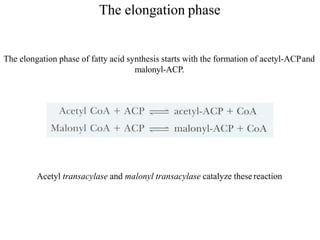
The elongation phase
The elongation phase of fatty acid synthesis starts with the formation of acetyl-ACPand
malonyl-ACP.
Acetyl transacylase and malonyl transacylase catalyze these reaction
Intermediates in fatty acid Synthesis (are attached to
an acyl carrier protein [ACP])
Intermediates in fatty acid synthesis in E.coli are linked to an acyl carrier protein.
Specifically, they are linked to the sulfhydryl terminus of phosphopantetheine group. In
the degradation of fatty acids, this unit is a part of CoA, whereas, in synthesis, it is
attached to a serine residue of theACP. This single polypeptide chain of 77 residues can
be regarded as a giant prostheric group, a “macro CoA”
Phosphopantetheine is the reactive unit of acyl carrier protein
[ACP] and CoA
Acyl-malonyl-ACP condensing enzyme – catalyze
reaction of Acetyl-ACP and malonyl-ACP forming
acetoacetyl-ACP
Reaction sequence in the synthesis of fatty acids in
E.coli: condensation, reduction, dehydration, and
reduction
The intermediates shown here are
produced in the first round of
synthesis.
Acetyl CoA to Malonyl CoA
condensation (1)
The intermediates shown here are
produced in the first round of
synthesis.
reduction (2)
The intermediates shown here are
produced in the first round of
synthesis.
dehydration (3)
The intermediates shown here are
produced in the first round of
synthesis.
reduction (4)
The intermediates shown here are
produced in the first round of
synthesis.
Microsomal system for fatty acid
chain elongation (elongase)
Biosynthesis of long-chain fatty acids.
Malonyl residue causes the
acyl chain to grow by 2
carbon atoms.
Cys – cystein residue; pan -
4'-phosphopanthetheine.
Fate of palmitate after biosynthesis
The provision of acetyl-CoA and NADPH for
lipogenesis, PPP, pentose phosphate pathway;
T – tricarboxylate transporter; K – α-ketoglutarate transporter, P – pyruvatetransporter.
Thank YOU for ATTENTION

Biological membranes, transport & Related questions

  • 1.
  • 2.
    Structure of membrane Davsonand Danielle in 1935 proposed a lipid bilayer model of membrane Singer and Nicolson proposed fluid mosaic model. The biological membranes usually have a thickness of 5-8 nm. A mrmbrane is essencially composed of a lipid bilayer. The hydrophobic (nonpolar) regions of the lipid face each other at the core of the bilayer while the hydrophilic (polar) regions face outward. Globular proteins are irregulary embedded in the lipid bilayer.
  • 3.
    Symbol of apolar lipid molecule and a phosphoglyceride monolayer
  • 4.
    A phosphoglyceride showingthe fatty acids (R1 and R2), glycerol. And phosphorylated alcohol components. In phosphatidic acid R3 is hydrogen
  • 5.
    Sponsored Medical Lecture Notes– All Subjects USMLE Exam (America) – Practice
  • 6.
    Phosphatidate – elementarybilayer membrane unit
  • 7.
    Diagram of asection of a bilayer membrane formed from phospholipid molecules.
  • 8.
    Polar, hydrophilic “head”and nonpolar hydrophobic, fatty acid “tails” forming bilayer membrane
  • 9.
    Space-filling model ofa section of a highly fluid phospholipid bilayer membrane
  • 10.
    A phosphoglyceride bilayer(selforganization)
  • 11.
  • 12.
    Diagram of alipid vesicle
  • 13.
    Experimental arrangement forthe study of planar bilayer membranes.
  • 14.
    Technique of freeze-fractureelectron microscopy. The cleavege plane passes through the middle of the bilayer membrane
  • 15.
    Permeability coefficients ofsome ions and molecules in lipid bilayer membranes
  • 16.
    Comparison of themean concentration of various substances onside and inside a membrane cell
  • 17.
  • 18.
    The fluid modelof membrane structure
  • 19.
    Ratio of proteinto lipid in different membranes. Proteins equal or exceeded the quantity in nearly all membranes. The outstanding exception is myelin, an electrical insulator found on many nerve fibres.
  • 20.
    Membrane proteins are categorizedinto two groups Extrinsic (peripheral) membrane proteins are loosely held to the surface of the membrane and they can be easely separated (e.g. cytochrome c of mitochondria) Intrinsic (integral) membrane proteins are tightly bound to the lipid bilayer and they can be separated only by the use of deterdgents or organic solvents (e.g. hormone receptors, gytochrome P450) The membrane is asymmetric due to the irregular distribution of proteins. The lipid and protein dubunits of the membrane give an appearance of mosaic or a ceramic tile. Unlike a fixed ceramic tile, the membrane freely changes, hence the ctructure of the membrane is consired as fluid mosaic.
  • 21.
    Integral membrane proteins (a,b, c) interact extensively with the hydrocarbon region of the bilayer. Nearly all known integral membrane protein transverse the lipid bilayer. Peripheral membrane proteins (d) and (e) bind to the surface of integral membrane proteins
  • 22.
    Amino acid sequenceand transmembrane disposition of glycophorin A from the red-cell membrane. The fifteen O-linked carbohydrate units are shown in light green and N-linked in dark green. The hydrophobic residues (yellow) buried in the bilayer form a transmembrane α-helix. The carboxyl-terminal part of molecule, located on the cytosolic side of the membrane, is rich in negatively charged (red) and positively charged (blue) residues.
  • 23.
    Schematic diagram ofthe mode of the erythrocyte membrane skeleton to the plasma membrane. Spectrin (yellow) is linked to the anion channel protein (blue) by ankyrin (red), and to glycophorin by protein 4.1, which also binds an actin filament.
  • 24.
    Model of bacteriorhodopsinconstructed from a 7-Å three-dimensional map Interpretative diagram showing the arrangement of α-helical segments in the lipid bilayer. The connections between these helicies are not yet known.
  • 25.
    Transport across bilayermembranes Passive diffusion – does not requore energy Facilitated diffusion Active transport (primery active transport system)
  • 26.
    Small uncharged moleculesfreely pass through the lipid bilayer
  • 27.
    Transfer of materialand information across membranes
  • 28.
    A comparison ofthe kinetics of carrier-mediated (facilitated) diffusion with passive diffusion.
  • 29.
    The “ping-pong” modelof carrier-mediated (facilitated) diffusion.
  • 30.
    Transport systems Uniport system– involves the movement of a single molecule through the membrane (e.g. transport of glucose to the erythrocytes) Symport system – simultaneous transport of two different molecules in the same direction (e.g. transport of Na+ and glucose to the intestinal mucosal cell from the gut) Antiport system – the simultaneous transport of two different molecules in the opposite direction (e.g. exchange of Cl– and HCO3 + in the erythrocytes). Uniport, symport and antiport systems are considered as secondary active transport system Cotransport system – the transport of a substance through the membrane coupled to the spontaneous movement of another substance. Symport and antiport – are cotransport systems.
  • 31.
    Schematic representation oftypes of transport systems.
  • 32.
  • 33.
    Solubilization of integralmembrane proteins by the addition of detergent
  • 34.
    Asymmetry of theNa+-K+ transport system in plasma membranes
  • 35.
  • 36.
    Restoration of thetransport activity of purified calcium-pump protein (Ca2+-ATPase)
  • 37.
    Transport of macromolecules Endocytosis– intake of macromolecules by the cell (e.g. uptake of LDL by cells) Exocytosis – release of macromolecules from the cells to the outside (e.g. secretion of insulin)
  • 38.
  • 39.
    Two types ofendocytosis (nondirected and receptor-mediated)
  • 40.
    Fusion of avesicle with the plasma membrane preserves the orientation of any integral proteins embedded in the vesicle bilayer.
  • 41.
  • 42.
    Schematic drawing ofthe peptidoglycan of the cell wall of the gram-positive bacterium Staphylococcus aureus transglycosilation transpeptidation
  • 43.
    Structure of therepeating disaccharide unit in the backbone of the peptidoglycan N-Acetylglucosamine N-Acetylmuramate
  • 44.
    Fatty acid synthasemultienzyme complex.
  • 45.
    Principal reactions infatty acid synthesis
  • 46.
    The elongation phase Theelongation phase of fatty acid synthesis starts with the formation of acetyl-ACPand malonyl-ACP. Acetyl transacylase and malonyl transacylase catalyze these reaction
  • 47.
    Intermediates in fattyacid Synthesis (are attached to an acyl carrier protein [ACP]) Intermediates in fatty acid synthesis in E.coli are linked to an acyl carrier protein. Specifically, they are linked to the sulfhydryl terminus of phosphopantetheine group. In the degradation of fatty acids, this unit is a part of CoA, whereas, in synthesis, it is attached to a serine residue of theACP. This single polypeptide chain of 77 residues can be regarded as a giant prostheric group, a “macro CoA” Phosphopantetheine is the reactive unit of acyl carrier protein [ACP] and CoA
  • 48.
    Acyl-malonyl-ACP condensing enzyme– catalyze reaction of Acetyl-ACP and malonyl-ACP forming acetoacetyl-ACP
  • 49.
    Reaction sequence inthe synthesis of fatty acids in E.coli: condensation, reduction, dehydration, and reduction The intermediates shown here are produced in the first round of synthesis.
  • 50.
    Acetyl CoA toMalonyl CoA
  • 51.
    condensation (1) The intermediatesshown here are produced in the first round of synthesis.
  • 52.
    reduction (2) The intermediatesshown here are produced in the first round of synthesis.
  • 53.
    dehydration (3) The intermediatesshown here are produced in the first round of synthesis.
  • 54.
    reduction (4) The intermediatesshown here are produced in the first round of synthesis.
  • 55.
    Microsomal system forfatty acid chain elongation (elongase)
  • 56.
    Biosynthesis of long-chainfatty acids. Malonyl residue causes the acyl chain to grow by 2 carbon atoms. Cys – cystein residue; pan - 4'-phosphopanthetheine.
  • 57.
    Fate of palmitateafter biosynthesis
  • 58.
    The provision ofacetyl-CoA and NADPH for lipogenesis, PPP, pentose phosphate pathway; T – tricarboxylate transporter; K – α-ketoglutarate transporter, P – pyruvatetransporter.
  • 59.
    Thank YOU forATTENTION