Integrated Pest Management (IPM)
Guide
Integrated Pest Management (IPM) Guide
Pest control has been one of the most debated topics among authorities,
environmentalists, and other stakeholders. For a long time, stakeholders
have been trying to develop safe and environmentally friendly ways to deal
with pests. To understand more about pest control and management in
Australia, here is an IPM guide.
What is Integrated Pest Management?
Before dwelling on the various principle and guidelines of IPM, you need to
understand what it is. Integrated Pest Management, also referred to as
Integrated Pest Control, is a practical, economic and eco-friendly approach
to pest control. This approach involves evaluating the pest control
techniques present and selecting specific measures to reduce the spread
of a pest or get rid of them entirely.
These approaches are mainly focused on preventing the spread and
existence of pests, unlike traditional methods that focus on pesticides to
control pests. Integrated Pest Management is environmentally conscious
since pesticides are only used in severe circumstances or when needed.
The principles behind IPM are primarily centred on using natural pest
control mechanisms to ensure a sustainable ecosystem. Most of the pest
control measures are based on the current data on the life cycle of pests
and their contribution to the ecosystem.
IPM is mainly applied in the agricultural sector, forestry, preventive
conservation, and human settlements. Various studies show that these
approaches are probably the best bet for turf, structural and ornamental
pest control.
How does IPM Work?
Most conventional pest control approaches involve the use of pesticides
and other products to reduce or eliminate pests. However, IPM is more
focused on exploring other options rather than solely relying on pesticides.
These approaches aim to reduce the amount of toxic substances released
into the ecosystem. Exposing the environment to chemical compounds
within pesticides beats the logic of trying to eliminate one problem while
creating another one in the process.
Some people tend to confuse IPM with organic pest control. IPM doesn't
discourage pesticides; this approach advocates the use of specific types of
pesticides selectively. Using pesticides when you need them can help
reduce the amount of toxic chemicals released into the environment. A
sound IPM program provides specific guidelines for using pesticides and
other harmful substances and encourages the use of alternative pest
control measures.
Integrated Pest Management leverages identification, monitoring,
prevention, and the most suitable pest control measure to deal with
infestations. These approaches are also geared towards providing a long-
term solution to your pest problem. To develop the best possible solution,
you need to go over the multiple control practices at your disposal based
on the data collected from inspecting and monitoring the affected region.
Types of Pest Control
As discussed before, IPM programs focus on the problem at hand and
come up with possible solutions to prevent future infestations. By
combining various control measures, IPM practitioners can develop the
best and most effective pest control strategies. Most pest control measures
are covered under,
Biological control
These control measures involve the use of natural elements to deal with
pest infestations. Most pests that wreak havoc on farms or in your home
have natural enemies that, when properly applied, can help reduce the
population of the pests. Some of these enemies act as predators,
parasites, and pathogens. The main benefits of employing these methods
are the low cost and minimal impact on the environment. Learn more here
https://portal.ct.gov/CAES/Fact-Sheets/Entomology/Approaches-to-the-
Biological-Control-of-Insect-Pests#:~:text=Summary-
,Biological%20control%20is%20the%20use%20of%20living%20organisms
%20to%20suppress,predators%2C%20parasitoids%2C%20and%20pathog
ens about Biological pest control.
Chemical control
This approach involves the use of pesticides. These methods are most
effective when combined with measures to ensure long-term benefits. As
an IPM practitioner, you are reminded to choose pesticides with low toxins
and choose modes of application that have minimal impact on non-target
organisms, the environment, and humans. It's also recommended to use
them in bait stations rather than spraying them.
Cultural controls
This approach involves minimizing the reproduction, survival, and spread of
the pests. These practices vary based on pests and sites. For instance, you
can decide to seal entry points to prevent pests from entering your home or
uproot sick plants in your farm to prevent them from spreading to healthier
ones. You can also plant beneficial plants and fungi and even introduce
bacteria to help deal with specific pests.
Mechanical control
Once an action threshold is met, most people resort to mechanical and
physical control measures. This approach involves making the site
uninhabitable for the pests. Some of these methods include clearing
vegetation and draining stagnant water.
Successful IPM Implementation Programs
A successful IPM implementation program is key to a cost-effective and
sustainable strategy to take care of the pest problem. To design the best
strategy, IPM uses a combination of effective and complementary practices
such as host resistance, biological, mechanical, cultural, and chemical. The
best programs are built from the following components.
Pest Identification
This is an essential part of designing a program. You need to conduct in-
depth research on various types of pests. This way, you can segment them
based on their level of destruction, species, distribution, and current
population. Accurately identifying and grouping the pests helps you identify
which control measure to use without resorting to the use of harmful
chemicals. Identification helps prevent the use of harmful toxins and helps
the IPM practitioner identify pests that are not harmful and do not pose any
threat.
You will also be able to come up with the best possible preventive
measures and intervention points based on the nature of the pests you are
dealing with. By having adequate data on the pests, you can hold off on
destroying beneficial organisms through extreme control measures. As
stated before, this stage needs in-depth research since wrongful
classification could affect your entire strategy leading to an infective
preventing strategy.
Prevention
The best way to deal with pests is by preventing them from wreaking havoc
in the first place. This means a successful IPM program should focus on
techniques to deal with pests before they grow into a full-blown infestation
problem. For IPM practitioners, the preventive measures implemented
should have minimal to no risk to the environment and people. Some of the
most efficient and cost-effective preventive methods include:
 Providing people with necessary information on IPM.
 Removing trash and clearing overgrown vegetation near your home.
 Making sure your food storage locations are kept clean.
 Drain stagnant water.
 Reduce clutter both inside and outside your home.
 Installing barriers to keep pests at bay.
 Structurally weatherizing your home and sealing all entry points.
The best preventive measure against pests is to get rid of anything that
may attract them in the first place. These include food, shelter, and water.
In some cases, you may have to employ biological methods like planting
pest-resistant crops or modifying cultural practices such as habitat
manipulation and crop sanitation. You could also use beneficial plants,
bacteria, and fungi to keep these pests away from your home.
Conventional pest control measures were mainly focused on eliminating
visible pests. However, as an IPM practitioner, you need to look at the
problem from different angles. It would be best if you thought about factors
that may be causing the pests to thrive in the first place. With this data, you
can work on creating an inhospitable environment for the pests. When
designing your program, keep in mind that prevention is one of the
fundamental keys to a successful program.
Set Action Thresholds
Action thresholds are points at which environmental conditions and pest
population size call for immediate action before they grow into a full-blown
infestation with severe economic and environmental implications. The
presence of one or two pests doesn't necessarily mean you have to employ
a control measure. Experts suggest that eliminating all pests is an
impossible fete and even if it were to be tried, the process would prove
costly and dangerous to the ecosystem.
It's for this reason that IPM principles are based on effective control
measures rather than total eradication. Once you identify and isolate the
pests, the next time is to limit population size. This is what is referred to as
the action threshold. These limits are also attached to specific control
measures that are implemented at every stage. Action thresholds are
usually activated when your pest problem starts to pose an economic
problem or becomes a health hazard. At this point, the benefits of pest
control outweigh the costs.
Action thresholds are not universally applied; these limits vary depending
on the type of pest and location. However, you need to keep in mind that
eradicating the entire pest population may cause survivors to develop
resistance to the method used, a trait they pass on to the new generation.
It's best to reduce their numbers to allow non-resistant pests to reproduce
with the resistant population, thus diluting the genes. You may also want to
consider rotating your control measures to prevent the pests from
developing resistance.
With an elaborate threshold, you can effectively determine the size and
scope of the IPM strategy you are looking to implement.
Monitoring
This is a simple process that involves observation and record keeping. You
can understand pest patterns, life cycles, and how they interact with the
environment through monitoring. You can choose to conduct a physical
inspection or put up traps to help you keep tabs on pest levels.
Record Keeping
Record keeping goes hand in hand with monitoring. The data collected
from observation can be noted and used for future reference. Most of this
data revolves around pest behaviours and life cycle; this means you can
prepare adequately before the infestation grows. During observation, vital
data that must be recorded include their identification, population
distribution, locations inspected, techniques used, inspection schedules,
findings, measures taken, and recommendations.
For a successful IPM program to kick off, here are a few locations you need
to monitor and keep records of your findings:
 Potential habitats and high-risk areas.
 Pest population and distribution.
 The efficiency of the prevention and control measures employed.
Control
Control measures are often implemented once the monitoring is complete
and a threat level is detected. As stated before, control is one of the
fundamental principles behind Integrated Pest Management. Control
involves reducing the number of pests up to an acceptable level. This is the
best time to implement the best control measure with minimum impact on
humans and the environment. There are several strategies to use during
control, categorized under chemical, biological, cultural, and mechanical.
When the threat levels exceed your maximum action threshold, it's
advisable to employ selective use of pesticides. An IPM practitioner, it's
advisable to go for pesticides with low toxin levels. This way, you can
minimize exposing humans and other organisms to harmful chemicals.
Remember to use a mode of application that also reduces the threat to
non-target organisms, humans, and the environment at large.
Evaluation
All through, you have been working towards realizing a successful IPM
strategy. The best way to know if your program was efficient is to conduct
an evaluation. Assessing the success of the program is not a one-0time
deal. This is a continuous process that is vital to coming up with the best
IPM implementation program. During your record-keeping and
documentation, be sure to include the success of the control measures,
evidence of using non-chemical control measures, organized records of
pest control measures and methods of application, and recommendations.
The Process of Integrated Pest Management
IPM involves analyzing all the control measures you have used before and
choosing the most suitable options alongside the mode of application.
These measures can be applied when dealing with a wide range of pests
that threaten agriculture and human health. This process involves following
all the steps mentioned above when dealing with pests.
There are several methods to deal with pests in the world today. However,
as a budding IPM practitioner, it's best to research and develop the best
and most sustainable pest control measure with minimal impact on
humans, the environment, and non-target organisms. The best way to
develop a working program is buying carrying out sufficient research on the
pest problem. The key to a successful IPM implementation program lies in
your ability to monitor and keep records.
SOURCE: https://www.ipaustralia.gov.au/tools-resources/certification-
rules/939875
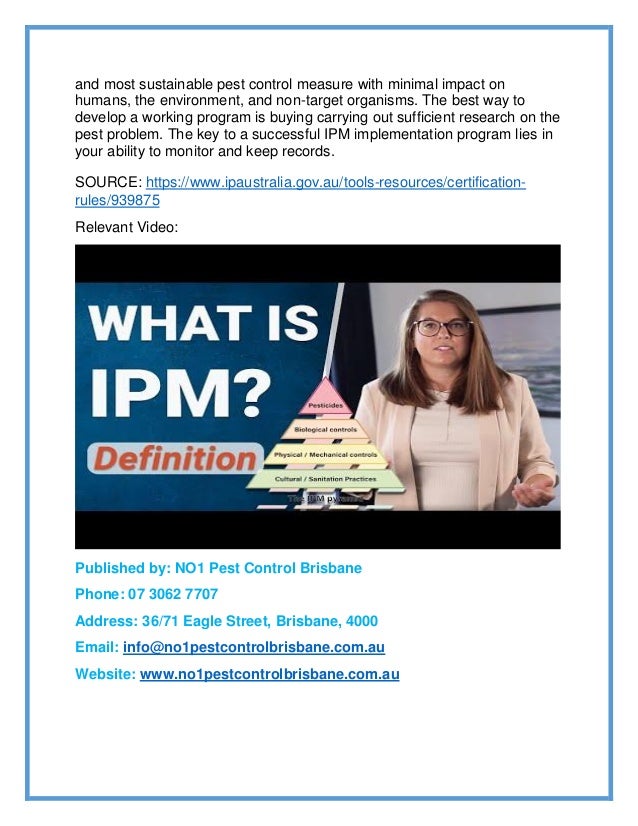
Relevant Video:
Published by: NO1 Pest Control Brisbane
Phone: 07 3062 7707
Address: 36/71 Eagle Street, Brisbane, 4000
Email: info@no1pestcontrolbrisbane.com.au
Website: www.no1pestcontrolbrisbane.com.au

Integrated Pest Management

  • 1.
  • 2.
    Integrated Pest Management(IPM) Guide Pest control has been one of the most debated topics among authorities, environmentalists, and other stakeholders. For a long time, stakeholders have been trying to develop safe and environmentally friendly ways to deal with pests. To understand more about pest control and management in Australia, here is an IPM guide. What is Integrated Pest Management? Before dwelling on the various principle and guidelines of IPM, you need to understand what it is. Integrated Pest Management, also referred to as Integrated Pest Control, is a practical, economic and eco-friendly approach to pest control. This approach involves evaluating the pest control techniques present and selecting specific measures to reduce the spread of a pest or get rid of them entirely. These approaches are mainly focused on preventing the spread and existence of pests, unlike traditional methods that focus on pesticides to control pests. Integrated Pest Management is environmentally conscious since pesticides are only used in severe circumstances or when needed. The principles behind IPM are primarily centred on using natural pest control mechanisms to ensure a sustainable ecosystem. Most of the pest
  • 3.
    control measures arebased on the current data on the life cycle of pests and their contribution to the ecosystem. IPM is mainly applied in the agricultural sector, forestry, preventive conservation, and human settlements. Various studies show that these approaches are probably the best bet for turf, structural and ornamental pest control. How does IPM Work? Most conventional pest control approaches involve the use of pesticides and other products to reduce or eliminate pests. However, IPM is more focused on exploring other options rather than solely relying on pesticides. These approaches aim to reduce the amount of toxic substances released into the ecosystem. Exposing the environment to chemical compounds within pesticides beats the logic of trying to eliminate one problem while creating another one in the process. Some people tend to confuse IPM with organic pest control. IPM doesn't discourage pesticides; this approach advocates the use of specific types of pesticides selectively. Using pesticides when you need them can help reduce the amount of toxic chemicals released into the environment. A sound IPM program provides specific guidelines for using pesticides and other harmful substances and encourages the use of alternative pest control measures. Integrated Pest Management leverages identification, monitoring, prevention, and the most suitable pest control measure to deal with infestations. These approaches are also geared towards providing a long- term solution to your pest problem. To develop the best possible solution, you need to go over the multiple control practices at your disposal based on the data collected from inspecting and monitoring the affected region. Types of Pest Control As discussed before, IPM programs focus on the problem at hand and come up with possible solutions to prevent future infestations. By combining various control measures, IPM practitioners can develop the
  • 4.
    best and mosteffective pest control strategies. Most pest control measures are covered under, Biological control These control measures involve the use of natural elements to deal with pest infestations. Most pests that wreak havoc on farms or in your home have natural enemies that, when properly applied, can help reduce the population of the pests. Some of these enemies act as predators, parasites, and pathogens. The main benefits of employing these methods are the low cost and minimal impact on the environment. Learn more here https://portal.ct.gov/CAES/Fact-Sheets/Entomology/Approaches-to-the- Biological-Control-of-Insect-Pests#:~:text=Summary- ,Biological%20control%20is%20the%20use%20of%20living%20organisms %20to%20suppress,predators%2C%20parasitoids%2C%20and%20pathog ens about Biological pest control. Chemical control This approach involves the use of pesticides. These methods are most effective when combined with measures to ensure long-term benefits. As an IPM practitioner, you are reminded to choose pesticides with low toxins and choose modes of application that have minimal impact on non-target organisms, the environment, and humans. It's also recommended to use them in bait stations rather than spraying them. Cultural controls This approach involves minimizing the reproduction, survival, and spread of the pests. These practices vary based on pests and sites. For instance, you can decide to seal entry points to prevent pests from entering your home or uproot sick plants in your farm to prevent them from spreading to healthier ones. You can also plant beneficial plants and fungi and even introduce bacteria to help deal with specific pests. Mechanical control
  • 5.
    Once an actionthreshold is met, most people resort to mechanical and physical control measures. This approach involves making the site uninhabitable for the pests. Some of these methods include clearing vegetation and draining stagnant water. Successful IPM Implementation Programs A successful IPM implementation program is key to a cost-effective and sustainable strategy to take care of the pest problem. To design the best strategy, IPM uses a combination of effective and complementary practices such as host resistance, biological, mechanical, cultural, and chemical. The best programs are built from the following components. Pest Identification This is an essential part of designing a program. You need to conduct in- depth research on various types of pests. This way, you can segment them based on their level of destruction, species, distribution, and current population. Accurately identifying and grouping the pests helps you identify which control measure to use without resorting to the use of harmful chemicals. Identification helps prevent the use of harmful toxins and helps the IPM practitioner identify pests that are not harmful and do not pose any
  • 6.
    threat. You will alsobe able to come up with the best possible preventive measures and intervention points based on the nature of the pests you are dealing with. By having adequate data on the pests, you can hold off on destroying beneficial organisms through extreme control measures. As stated before, this stage needs in-depth research since wrongful classification could affect your entire strategy leading to an infective preventing strategy. Prevention The best way to deal with pests is by preventing them from wreaking havoc in the first place. This means a successful IPM program should focus on techniques to deal with pests before they grow into a full-blown infestation problem. For IPM practitioners, the preventive measures implemented should have minimal to no risk to the environment and people. Some of the most efficient and cost-effective preventive methods include:  Providing people with necessary information on IPM.  Removing trash and clearing overgrown vegetation near your home.  Making sure your food storage locations are kept clean.  Drain stagnant water.  Reduce clutter both inside and outside your home.  Installing barriers to keep pests at bay.  Structurally weatherizing your home and sealing all entry points. The best preventive measure against pests is to get rid of anything that may attract them in the first place. These include food, shelter, and water. In some cases, you may have to employ biological methods like planting pest-resistant crops or modifying cultural practices such as habitat manipulation and crop sanitation. You could also use beneficial plants, bacteria, and fungi to keep these pests away from your home. Conventional pest control measures were mainly focused on eliminating visible pests. However, as an IPM practitioner, you need to look at the problem from different angles. It would be best if you thought about factors that may be causing the pests to thrive in the first place. With this data, you
  • 7.
    can work oncreating an inhospitable environment for the pests. When designing your program, keep in mind that prevention is one of the fundamental keys to a successful program. Set Action Thresholds Action thresholds are points at which environmental conditions and pest population size call for immediate action before they grow into a full-blown infestation with severe economic and environmental implications. The presence of one or two pests doesn't necessarily mean you have to employ a control measure. Experts suggest that eliminating all pests is an impossible fete and even if it were to be tried, the process would prove costly and dangerous to the ecosystem. It's for this reason that IPM principles are based on effective control measures rather than total eradication. Once you identify and isolate the pests, the next time is to limit population size. This is what is referred to as the action threshold. These limits are also attached to specific control measures that are implemented at every stage. Action thresholds are usually activated when your pest problem starts to pose an economic problem or becomes a health hazard. At this point, the benefits of pest control outweigh the costs. Action thresholds are not universally applied; these limits vary depending on the type of pest and location. However, you need to keep in mind that eradicating the entire pest population may cause survivors to develop resistance to the method used, a trait they pass on to the new generation. It's best to reduce their numbers to allow non-resistant pests to reproduce with the resistant population, thus diluting the genes. You may also want to consider rotating your control measures to prevent the pests from developing resistance. With an elaborate threshold, you can effectively determine the size and scope of the IPM strategy you are looking to implement. Monitoring This is a simple process that involves observation and record keeping. You
  • 8.
    can understand pestpatterns, life cycles, and how they interact with the environment through monitoring. You can choose to conduct a physical inspection or put up traps to help you keep tabs on pest levels. Record Keeping Record keeping goes hand in hand with monitoring. The data collected from observation can be noted and used for future reference. Most of this data revolves around pest behaviours and life cycle; this means you can prepare adequately before the infestation grows. During observation, vital data that must be recorded include their identification, population distribution, locations inspected, techniques used, inspection schedules, findings, measures taken, and recommendations. For a successful IPM program to kick off, here are a few locations you need to monitor and keep records of your findings:  Potential habitats and high-risk areas.  Pest population and distribution.  The efficiency of the prevention and control measures employed. Control Control measures are often implemented once the monitoring is complete and a threat level is detected. As stated before, control is one of the fundamental principles behind Integrated Pest Management. Control involves reducing the number of pests up to an acceptable level. This is the best time to implement the best control measure with minimum impact on humans and the environment. There are several strategies to use during control, categorized under chemical, biological, cultural, and mechanical. When the threat levels exceed your maximum action threshold, it's advisable to employ selective use of pesticides. An IPM practitioner, it's advisable to go for pesticides with low toxin levels. This way, you can minimize exposing humans and other organisms to harmful chemicals. Remember to use a mode of application that also reduces the threat to non-target organisms, humans, and the environment at large.
  • 9.
    Evaluation All through, youhave been working towards realizing a successful IPM strategy. The best way to know if your program was efficient is to conduct an evaluation. Assessing the success of the program is not a one-0time deal. This is a continuous process that is vital to coming up with the best IPM implementation program. During your record-keeping and documentation, be sure to include the success of the control measures, evidence of using non-chemical control measures, organized records of pest control measures and methods of application, and recommendations. The Process of Integrated Pest Management IPM involves analyzing all the control measures you have used before and choosing the most suitable options alongside the mode of application. These measures can be applied when dealing with a wide range of pests that threaten agriculture and human health. This process involves following all the steps mentioned above when dealing with pests. There are several methods to deal with pests in the world today. However, as a budding IPM practitioner, it's best to research and develop the best
  • 10.
    and most sustainablepest control measure with minimal impact on humans, the environment, and non-target organisms. The best way to develop a working program is buying carrying out sufficient research on the pest problem. The key to a successful IPM implementation program lies in your ability to monitor and keep records. SOURCE: https://www.ipaustralia.gov.au/tools-resources/certification- rules/939875 Relevant Video: Published by: NO1 Pest Control Brisbane Phone: 07 3062 7707 Address: 36/71 Eagle Street, Brisbane, 4000 Email: info@no1pestcontrolbrisbane.com.au Website: www.no1pestcontrolbrisbane.com.au