BIOFUNCTIONAL
PROSTHETIC
SYSTEM: A NEW ERA
COMPLETE DENTURE
Journal club presentation
Presented by- dr. nikita chhabariya(2nd year)
CONTENT
• Intoduction
• What is BPS system
• Conventional vs bps
• Produre and material
• Articles
• Conclusion
• References
INTRODUCTION
‘BPS dentures‘, the BPS (Biofunctional Prosthetic System) is a system of
professional expertise and quality products that are the standard for aesthetics,
comfort, fit and function. Only a complete system of coordinated materials covering
every area from impression taking to fitting the denture assures the desired
success and thus the satisfaction of all patients.
With sophisticated instrumentation, all your facial information is recorded to recreate the character of
patient smile and restore the natural contour of your lips and facial muscles.
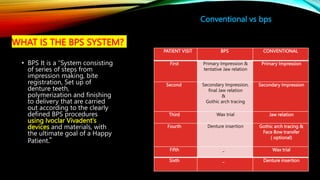
WHAT IS THE BPS SYSTEM?
• BPS It is a “System consisting
of series of steps from
impression making, bite
registration, Set up of
denture teeth,
polymerization and finishing
to delivery that are carried
out according to the clearly
defined BPS procedures
using Ivoclar Vivadent's
devices and materials, with
the ultimate goal of a Happy
Patient.”
PATIENT VISIT BPS CONVENTIONAL
First Primary Impression &
tentative Jaw relation
Primary Impression
Second Secondary Impression,
final Jaw relation
&
Gothic arch tracing
Secondary Impression
Third Wax trial Jaw relation
Fourth Denture insertion Gothic arch tracing &
Face Bow transfer
( optional)
Fifth _ Wax trial
Sixth _ Denture insertion
Conventional vs bps
FIRST CLINICAL VISIT
PRIMARY IMPRESSION AND
TENTATIVE JAW RELATION
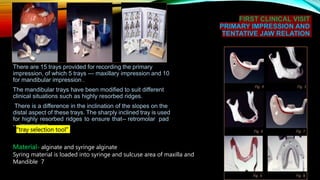
There are 15 trays provided for recording the primary
impression, of which 5 trays --- maxillary impression and 10
for mandibular impression .
The mandibular trays have been modified to suit different
clinical situations such as highly resorbed ridges.
There is a difference in the inclination of the slopes on the
distal aspect of these trays. The sharply inclined tray is used
for highly resorbed ridges to ensure that-- retromolar pad
-- impression.
“tray selection tool”
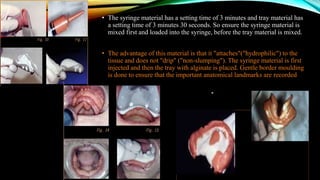
Material- alginate and syringe alginate
Syring material is loaded into syringe and sulcuse area of maxilla and
Mandible 7
• The syringe material has a setting time of 3 minutes and tray material has
a setting time of 3 minutes 30 seconds. So ensure the syringe material is
mixed first and loaded into the syringe, before the tray material is mixed.
• The advantage of this material is that it "attaches"("hydrophilic") to the
tissue and does not "drip" ("non-slumping"). The syringe material is first
injected and then the tray with alginate is placed. Gentle border moulding
is done to ensure that the important anatomical landmarks are recorded
F
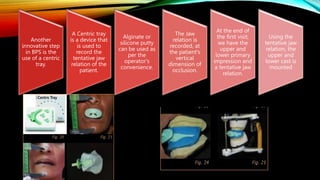
Another
innovative step
in BPS is the
use of a centric
tray.
A Centric tray
is a device that
is used to
record the
tentative jaw
relation of the
patient.
Alginate or
silicone putty
can be used as
per the
operator's
convenience.
The Jaw
relation is
recorded, at
the patient's
vertical
dimension of
occlusion.
At the end of
the first visit,
we have the
upper and
lower primary
impression and
a tentative jaw
relation.
Using the
tentative jaw
relation, the
upper and
lower cast is
mounted
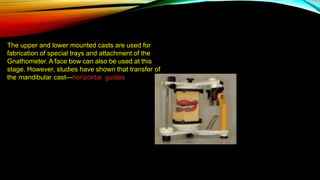
The upper and lower mounted casts are used for
fabrication of special trays and attachment of the
Gnathometer. A face bow can also be used at this
stage. However, studies have shown that transfer of
the mandibular cast—horizontal guides
SECOND CLINICAL VISIT
SECONDARY IMPRESSION, FINAL JAW RELATION
AND GOTHIC ARCH TRACING
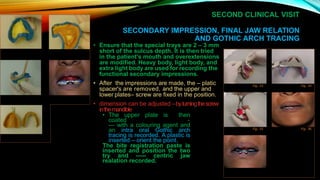
• Ensure that the special trays are 2 – 3 mm
short of the sulcus depth. It is then tried
in the patient's mouth and overextensions
are modified. Heavy body, light body, and
extra light body are used for recording the
functional secondary impressions.
• After the impressions are made, the – platic
spacer's are removed, and the upper and
lower plates– screw are fixed in the position.
• dimension can be adjusted –byturningthescrew
inthemandible
• The upper plate is then
coated -
--- with a colouring agent and
an intra oral Gothic arch
tracing is recorded. A plastic is
inserted – orient the point.
The bite registration paste is
inserted and position the two
try and ----- centric jaw
realation recorded.
Fig. 33 Fig. 34
Fig. 35 Fig. 36
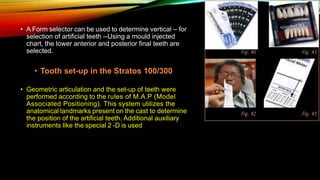
• A Form selector can be used to determine vertical – for
selection of artificial teeth --Using a mould injected
chart, the lower anterior and posterior final teeth are
selected.
• Tooth set-up in the Stratos 100/300
• Geometric articulation and the set-up of teeth were
performed according to the rules of M.A.P (Model
Associated Positioning). This system utilizes the
anatomical landmarks present on the cast to determine
the position of the artificial teeth. Additional auxiliary
instruments like the special 2 -D is used
• Premium SR Phonares II and SR Vivodent SPE denture teeth that mimic natural teeth
are used.
• SR Phonares II have been designed to match the age and characteristics of the
individual patient. The tooth moulds are available with “soft” and “bold” characteristics.
Each soft and bold category is further subdivided into the three age groups youthful,
universal and mature. SR Phonares II is distinguished by a high-quality surface texture
that endows the tooth moulds with a true-to-nature vitality. The proximal surfaces are
designed to tightly fit together, enhancing the “white esthetics” of the restoration. The
teeth feature a well-balanced relationship of translucency, opalescence and
fluorescence. Precision crafted with a nano-hybrid composite, these teeth are
characterized by high toughness, resistance to wear, tolerance and durability.
• R Vivodent SPE are a distinctive anterior tooth for sophisticated needs. The PE layer
and high shade intensity impart a very lifelike appearance. The moulds fulfill the
essential requirement of modern denture teeth. The new teeth are made entirely of
highly cross-linked DCL polymer (double cross-linked). This material displays a higher
compressive strength but a similar flexibility to that of conventional PMMA. As a result,
extended denture longevity can be expected.
POSTERIOR TEETH
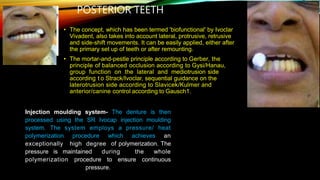
• The concept, which has been termed 'biofunctional' by Ivoclar
Vivadent, also takes into account lateral, protrusive, retrusive
and side-shift movements. It can be easily applied, either after
the primary set up of teeth or after remounting.
• The mortar-and-pestle principle according to Gerber, the
principle of balanced occlusion according to Gysi/Hanau,
group function on the lateral and mediotrusion side
according t o Strack/Ivoclar, sequential guidance on the
laterotrusion side according to Slavicek/Kulmer and
anterior/canine control according to Gausch1.
Injection moulding system- The denture is then
processed using the SR Ivocap injection moulding
system. The system employs a pressure/ heat
polymerization procedure which achieves an
exceptionally high degree of polymerization. The
pressure is maintained during the whole
polymerization procedure to ensure continuous
pressure.
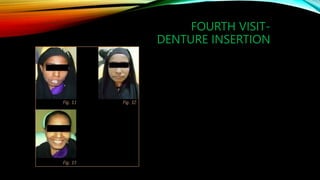
FOURTH VISIT-
DENTURE INSERTION
BIOFUNCTIONAL PROSTHETIC SYSTEM: A NEW ERA COMPLETE DENTURE
JOURNAL OF PHARMACY AND BIOALLIED SCIENCES · JANUARY 2011
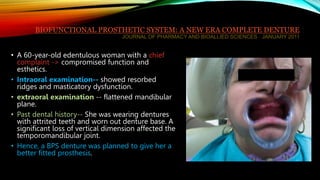
• A 60-year-old edentulous woman with a chief
complaint -> compromised function and
esthetics.
• Intraoral examination-- showed resorbed
ridges and masticatory dysfunction.
• extraoral examination -- flattened mandibular
plane.
• Past dental history-- She was wearing dentures
with attrited teeth and worn out denture base. A
significant loss of vertical dimension affected the
temporomandibular joint.
• Hence, a BPS denture was planned to give her a
better fitted prosthesis.
PROCEDURE--
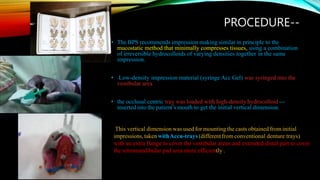
• The BPS recommends impression making similar in principle to the
mucostatic method that minimally compresses tissues, using a combination
of irreversible hydrocolloids of varying densities together in the same
impression.
• Low-density impression material (syringe Acc Gel) was syringed into the
vestibular area
• the occlusal centric tray was loaded with high-density hydrocolloid ---
inserted into the patient’s mouth to get the initial vertical dimension.
This vertical dimension was used for mounting the casts obtained from initial
impressions,takenwithAccu-trays(differentfrom conventional denture trays)
with an extra flange to cover the vestibular areas and extended distal part to cover
the retromandibular pad area more efficiently .
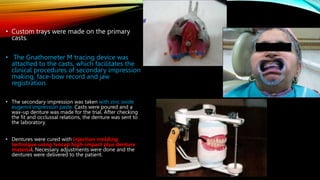
• Custom trays were made on the primary
casts.
• The Gnathometer M tracing device was
attached to the casts, which facilitates the
clinical procedures of secondary impression
making, face-bow record and jaw
registration.
• The secondary impression was taken with zinc oxide
eugenol impression paste. Casts were poured and a
wax-up denture was made for the trial. After checking
the fit and occlussal relations, the denture was sent to
the laboratory.
• Dentures were cured with injection molding
technique using Ivocap high-impact plus denture
material. Necessary adjustments were done and the
dentures were delivered to the patient.
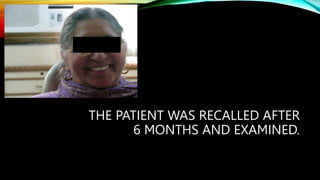
THE PATIENT WAS RECALLED AFTER
6 MONTHS AND EXAMINED.
BIOFUNCTIONAL PROSTHETIC SYSTEM IN
PROSTHODONTICS – A SYSTEMATIC REVIEW
SHAKEEL S. KHAZI1 , J STOMA 2019, 72, 6
• conducted a systematic review to critically evaluate application of BPS over
conventional dentures in removable prosthodontics.
• A search for full text articles with keywords “biofunctional prosthetic system (BPS)”,
using PubMed search engine was carried out.
• A search for the articles related to the topic was carried out in PubMed using
specific key words, along with an additional search in Google. Reviews, short
communications, commentaries, and letters to editors were excluded from
the study.
• In first phase, titles and abstracts from selected electronic databases were
reviewed by two authors---- Articles not fulfilling the inclusion criteria were
excluded from the review.
• In phase two, full text articles obtained after filtering in phase one were
evaluated by the same reviewers.
• In case of a disagreement in the selection process between the two reviewers,
a third author was requested to reach a consensus,.
Total 32 articles were selected – then in two phase data was excluded,.
RESULTS
Eleven articles were obtained from the PubMed database.
From the Google Scholar search, thirteen articles were primarily found with the above mentioned
keywords.
A total of thirty two articles were identified in the initial search.
The number of eligible articles was reduced to twenty three after removing duplicated articles, and from
the second stage of screening, seventeen full text articles were obtained.
During the third stage of determination of eligibility, eight articles were excluded for various reasons
The earliest article was from 2011, and the most recent one from 2017. The publishing trend revealed a growing interest
in this specific area of research. Among the nine full text articles, six were case reports, of which five were from India and
one from Mexico.
CONCLUSION
• The BPS System from Ivoclar Vivadent enables the dental team, to provide
patients with long-lasting, high-quality dentures. The biofunctional set-up
philosophy along with the MAP (model associated positioning) approach and
the heat/ pressure injection moulding procedure represent the
cornerstones of the system.
1. LT. COL M KUMAR ET AL; COMPARATIVE EVALUATION OF TWO TECHNIQUES IN ACHIEVING
BALANCED OCCLUSION IN COMPLETE DENTURE. MJAFI 2010.
2. SOLOMON EG, SINGLE STAGE SILICONE BORDER MOULDED CLOSED MOUTH
IMPRESSION TECHNIQUE- PART II; J INDIAN PROSTHODONT SOC. 2011, SEP ISSUE 11(3), 183-
8.
3. RUBEL B ET AL; GOTHIC ARCH TRACING; NY STATE DENT J, 2011 AUG-SEP
4. STROHAVER RA ET AL, COMPARISON OF CHANGES IN VERTICAL DIMENSION BETWEEN
COMPRESSION AND INJECTION MOLDED COMPLETE DENTURES; J PROSTH DENT 1989, DEC
62(6) 716-8
5. BIOFUNCTIONAL PROSTHETIC SYSTEM: A NEW ERA COMPLETE
DENTURE, SEPTEMBER 27, 2011, IP: 122.173.116.58]
6. BIOFUNCTIONAL PROSTHETIC SYSTEM IN PROSTHODONTICS – A SYSTEMATIC REVIEW SHAKEEL S. KHAZI1 , 2019
J SCOT
refrences
THANK YOU

biofunctional prosthesis system complete denture.pptx

  • 1.
    BIOFUNCTIONAL PROSTHETIC SYSTEM: A NEWERA COMPLETE DENTURE Journal club presentation Presented by- dr. nikita chhabariya(2nd year)
  • 2.
    CONTENT • Intoduction • Whatis BPS system • Conventional vs bps • Produre and material • Articles • Conclusion • References
  • 3.
    INTRODUCTION ‘BPS dentures‘, theBPS (Biofunctional Prosthetic System) is a system of professional expertise and quality products that are the standard for aesthetics, comfort, fit and function. Only a complete system of coordinated materials covering every area from impression taking to fitting the denture assures the desired success and thus the satisfaction of all patients. With sophisticated instrumentation, all your facial information is recorded to recreate the character of patient smile and restore the natural contour of your lips and facial muscles.
  • 4.
    WHAT IS THEBPS SYSTEM? • BPS It is a “System consisting of series of steps from impression making, bite registration, Set up of denture teeth, polymerization and finishing to delivery that are carried out according to the clearly defined BPS procedures using Ivoclar Vivadent's devices and materials, with the ultimate goal of a Happy Patient.” PATIENT VISIT BPS CONVENTIONAL First Primary Impression & tentative Jaw relation Primary Impression Second Secondary Impression, final Jaw relation & Gothic arch tracing Secondary Impression Third Wax trial Jaw relation Fourth Denture insertion Gothic arch tracing & Face Bow transfer ( optional) Fifth _ Wax trial Sixth _ Denture insertion Conventional vs bps
  • 5.
    FIRST CLINICAL VISIT PRIMARYIMPRESSION AND TENTATIVE JAW RELATION There are 15 trays provided for recording the primary impression, of which 5 trays --- maxillary impression and 10 for mandibular impression . The mandibular trays have been modified to suit different clinical situations such as highly resorbed ridges. There is a difference in the inclination of the slopes on the distal aspect of these trays. The sharply inclined tray is used for highly resorbed ridges to ensure that-- retromolar pad -- impression. “tray selection tool” Material- alginate and syringe alginate Syring material is loaded into syringe and sulcuse area of maxilla and Mandible 7
  • 6.
    • The syringematerial has a setting time of 3 minutes and tray material has a setting time of 3 minutes 30 seconds. So ensure the syringe material is mixed first and loaded into the syringe, before the tray material is mixed. • The advantage of this material is that it "attaches"("hydrophilic") to the tissue and does not "drip" ("non-slumping"). The syringe material is first injected and then the tray with alginate is placed. Gentle border moulding is done to ensure that the important anatomical landmarks are recorded F
  • 7.
    Another innovative step in BPSis the use of a centric tray. A Centric tray is a device that is used to record the tentative jaw relation of the patient. Alginate or silicone putty can be used as per the operator's convenience. The Jaw relation is recorded, at the patient's vertical dimension of occlusion. At the end of the first visit, we have the upper and lower primary impression and a tentative jaw relation. Using the tentative jaw relation, the upper and lower cast is mounted
  • 8.
    The upper andlower mounted casts are used for fabrication of special trays and attachment of the Gnathometer. A face bow can also be used at this stage. However, studies have shown that transfer of the mandibular cast—horizontal guides
  • 9.
    SECOND CLINICAL VISIT SECONDARYIMPRESSION, FINAL JAW RELATION AND GOTHIC ARCH TRACING • Ensure that the special trays are 2 – 3 mm short of the sulcus depth. It is then tried in the patient's mouth and overextensions are modified. Heavy body, light body, and extra light body are used for recording the functional secondary impressions. • After the impressions are made, the – platic spacer's are removed, and the upper and lower plates– screw are fixed in the position. • dimension can be adjusted –byturningthescrew inthemandible • The upper plate is then coated - --- with a colouring agent and an intra oral Gothic arch tracing is recorded. A plastic is inserted – orient the point. The bite registration paste is inserted and position the two try and ----- centric jaw realation recorded. Fig. 33 Fig. 34 Fig. 35 Fig. 36
  • 10.
    • A Formselector can be used to determine vertical – for selection of artificial teeth --Using a mould injected chart, the lower anterior and posterior final teeth are selected. • Tooth set-up in the Stratos 100/300 • Geometric articulation and the set-up of teeth were performed according to the rules of M.A.P (Model Associated Positioning). This system utilizes the anatomical landmarks present on the cast to determine the position of the artificial teeth. Additional auxiliary instruments like the special 2 -D is used
  • 11.
    • Premium SRPhonares II and SR Vivodent SPE denture teeth that mimic natural teeth are used. • SR Phonares II have been designed to match the age and characteristics of the individual patient. The tooth moulds are available with “soft” and “bold” characteristics. Each soft and bold category is further subdivided into the three age groups youthful, universal and mature. SR Phonares II is distinguished by a high-quality surface texture that endows the tooth moulds with a true-to-nature vitality. The proximal surfaces are designed to tightly fit together, enhancing the “white esthetics” of the restoration. The teeth feature a well-balanced relationship of translucency, opalescence and fluorescence. Precision crafted with a nano-hybrid composite, these teeth are characterized by high toughness, resistance to wear, tolerance and durability. • R Vivodent SPE are a distinctive anterior tooth for sophisticated needs. The PE layer and high shade intensity impart a very lifelike appearance. The moulds fulfill the essential requirement of modern denture teeth. The new teeth are made entirely of highly cross-linked DCL polymer (double cross-linked). This material displays a higher compressive strength but a similar flexibility to that of conventional PMMA. As a result, extended denture longevity can be expected.
  • 12.
    POSTERIOR TEETH • Theconcept, which has been termed 'biofunctional' by Ivoclar Vivadent, also takes into account lateral, protrusive, retrusive and side-shift movements. It can be easily applied, either after the primary set up of teeth or after remounting. • The mortar-and-pestle principle according to Gerber, the principle of balanced occlusion according to Gysi/Hanau, group function on the lateral and mediotrusion side according t o Strack/Ivoclar, sequential guidance on the laterotrusion side according to Slavicek/Kulmer and anterior/canine control according to Gausch1. Injection moulding system- The denture is then processed using the SR Ivocap injection moulding system. The system employs a pressure/ heat polymerization procedure which achieves an exceptionally high degree of polymerization. The pressure is maintained during the whole polymerization procedure to ensure continuous pressure.
  • 13.
  • 14.
    BIOFUNCTIONAL PROSTHETIC SYSTEM:A NEW ERA COMPLETE DENTURE JOURNAL OF PHARMACY AND BIOALLIED SCIENCES · JANUARY 2011 • A 60-year-old edentulous woman with a chief complaint -> compromised function and esthetics. • Intraoral examination-- showed resorbed ridges and masticatory dysfunction. • extraoral examination -- flattened mandibular plane. • Past dental history-- She was wearing dentures with attrited teeth and worn out denture base. A significant loss of vertical dimension affected the temporomandibular joint. • Hence, a BPS denture was planned to give her a better fitted prosthesis.
  • 15.
    PROCEDURE-- • The BPSrecommends impression making similar in principle to the mucostatic method that minimally compresses tissues, using a combination of irreversible hydrocolloids of varying densities together in the same impression. • Low-density impression material (syringe Acc Gel) was syringed into the vestibular area • the occlusal centric tray was loaded with high-density hydrocolloid --- inserted into the patient’s mouth to get the initial vertical dimension. This vertical dimension was used for mounting the casts obtained from initial impressions,takenwithAccu-trays(differentfrom conventional denture trays) with an extra flange to cover the vestibular areas and extended distal part to cover the retromandibular pad area more efficiently .
  • 16.
    • Custom trayswere made on the primary casts. • The Gnathometer M tracing device was attached to the casts, which facilitates the clinical procedures of secondary impression making, face-bow record and jaw registration. • The secondary impression was taken with zinc oxide eugenol impression paste. Casts were poured and a wax-up denture was made for the trial. After checking the fit and occlussal relations, the denture was sent to the laboratory. • Dentures were cured with injection molding technique using Ivocap high-impact plus denture material. Necessary adjustments were done and the dentures were delivered to the patient.
  • 17.
    THE PATIENT WASRECALLED AFTER 6 MONTHS AND EXAMINED.
  • 18.
    BIOFUNCTIONAL PROSTHETIC SYSTEMIN PROSTHODONTICS – A SYSTEMATIC REVIEW SHAKEEL S. KHAZI1 , J STOMA 2019, 72, 6 • conducted a systematic review to critically evaluate application of BPS over conventional dentures in removable prosthodontics. • A search for full text articles with keywords “biofunctional prosthetic system (BPS)”, using PubMed search engine was carried out. • A search for the articles related to the topic was carried out in PubMed using specific key words, along with an additional search in Google. Reviews, short communications, commentaries, and letters to editors were excluded from the study.
  • 19.
    • In firstphase, titles and abstracts from selected electronic databases were reviewed by two authors---- Articles not fulfilling the inclusion criteria were excluded from the review. • In phase two, full text articles obtained after filtering in phase one were evaluated by the same reviewers. • In case of a disagreement in the selection process between the two reviewers, a third author was requested to reach a consensus,. Total 32 articles were selected – then in two phase data was excluded,.
  • 20.
    RESULTS Eleven articles wereobtained from the PubMed database. From the Google Scholar search, thirteen articles were primarily found with the above mentioned keywords. A total of thirty two articles were identified in the initial search. The number of eligible articles was reduced to twenty three after removing duplicated articles, and from the second stage of screening, seventeen full text articles were obtained. During the third stage of determination of eligibility, eight articles were excluded for various reasons The earliest article was from 2011, and the most recent one from 2017. The publishing trend revealed a growing interest in this specific area of research. Among the nine full text articles, six were case reports, of which five were from India and one from Mexico.
  • 21.
    CONCLUSION • The BPSSystem from Ivoclar Vivadent enables the dental team, to provide patients with long-lasting, high-quality dentures. The biofunctional set-up philosophy along with the MAP (model associated positioning) approach and the heat/ pressure injection moulding procedure represent the cornerstones of the system.
  • 22.
    1. LT. COLM KUMAR ET AL; COMPARATIVE EVALUATION OF TWO TECHNIQUES IN ACHIEVING BALANCED OCCLUSION IN COMPLETE DENTURE. MJAFI 2010. 2. SOLOMON EG, SINGLE STAGE SILICONE BORDER MOULDED CLOSED MOUTH IMPRESSION TECHNIQUE- PART II; J INDIAN PROSTHODONT SOC. 2011, SEP ISSUE 11(3), 183- 8. 3. RUBEL B ET AL; GOTHIC ARCH TRACING; NY STATE DENT J, 2011 AUG-SEP 4. STROHAVER RA ET AL, COMPARISON OF CHANGES IN VERTICAL DIMENSION BETWEEN COMPRESSION AND INJECTION MOLDED COMPLETE DENTURES; J PROSTH DENT 1989, DEC 62(6) 716-8 5. BIOFUNCTIONAL PROSTHETIC SYSTEM: A NEW ERA COMPLETE DENTURE, SEPTEMBER 27, 2011, IP: 122.173.116.58] 6. BIOFUNCTIONAL PROSTHETIC SYSTEM IN PROSTHODONTICS – A SYSTEMATIC REVIEW SHAKEEL S. KHAZI1 , 2019 J SCOT refrences
  • 23.