Biochemistry Homework Help
For more info and assignment related helps,
Visit : - https://www.eduassignmenthelp.com/
E-Mail : - info@eduassignmenthelp.com
Contact : - +1 678 648 4277
Edu Assignment Help
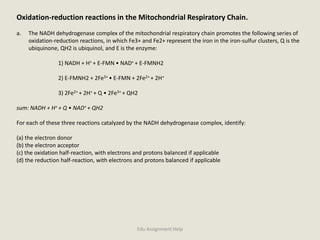
Oxidation-reduction reactions in the Mitochondrial Respiratory Chain.
a. The NADH dehydrogenase complex of the mitochondrial respiratory chain promotes the following series of
oxidation-reduction reactions, in which Fe3+ and Fe2+ represent the iron in the iron-sulfur clusters, Q is the
ubiquinone, QH2 is ubiquinol, and E is the enzyme:
1) NADH + H+ + E-FMN • NAD+ + E-FMNH2
2) E-FMNH2 + 2Fe3+ • E-FMN + 2Fe2+ + 2H+
3) 2Fe2+ + 2H+ + Q • 2Fe3+ + QH2
sum: NADH + H+ + Q • NAD+ + QH2
For each of these three reactions catalyzed by the NADH dehydrogenase complex, identify:
(a) the electron donor
(b) the electron acceptor
(c) the oxidation half-reaction, with electrons and protons balanced if applicable
(d) the reduction half-reaction, with electrons and protons balanced if applicable
Edu Assignment Help
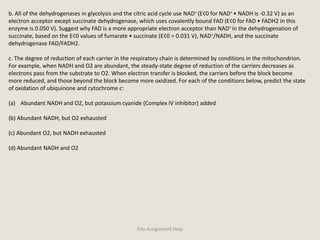
b. All of the dehydrogenases in glycolysis and the citric acid cycle use NAD+ (E¢0 for NAD+ • NADH is -0.32 V) as an
electron acceptor except succinate dehydrogenase, which uses covalently bound FAD (E¢0 for FAD • FADH2 in this
enzyme is 0.050 V). Suggest why FAD is a more appropriate electron acceptor than NAD+ in the dehydrogenation of
succinate, based on the E¢0 values of fumarate • succinate (E¢0 = 0.031 V), NAD+/NADH, and the succinate
dehydrogenase FAD/FADH2.
c. The degree of reduction of each carrier in the respiratory chain is determined by conditions in the mitochondrion.
For example, when NADH and O2 are abundant, the steady-state degree of reduction of the carriers decreases as
electrons pass from the substrate to O2. When electron transfer is blocked, the carriers before the block become
more reduced, and those beyond the block become more oxidized. For each of the conditions below, predict the state
of oxidation of ubiquinone and cytochrome c:
(a) Abundant NADH and O2, but potassium cyanide (Complex IV inhibitor) added
(b) Abundant NADH, but O2 exhausted
(c) Abundant O2, but NADH exhausted
(d) Abundant NADH and O2
Edu Assignment Help
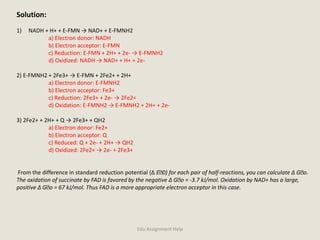
Solution:
1) NADH + H+ + E-FMN → NAD+ + E-FMNH2
a) Electron donor: NADH
b) Electron acceptor: E-FMN
c) Reduction: E-FMN + 2H+ + 2e- → E-FMNH2
d) Oxidized: NADH → NAD+ + H+ + 2e-
2) E-FMNH2 + 2Fe3+ → E-FMN + 2Fe2+ + 2H+
a) Electron donor: E-FMNH2
b) Electron acceptor: Fe3+
c) Reduction: 2Fe3+ + 2e- → 2Fe2+
d) Oxidation: E-FMNH2 → E-FMNH2 + 2H+ + 2e-
3) 2Fe2+ + 2H+ + Q → 2Fe3+ + QH2
a) Electron donor: Fe2+
b) Electron acceptor: Q
c) Reduced: Q + 2e- + 2H+ → QH2
d) Oxidized: 2Fe2+ → 2e- + 2Fe3+
From the difference in standard reduction potential (Δ E 0) for each pair of half-reactions, you can calculate Δ G o.
The oxidation of succinate by FAD is favored by the negative Δ G o = -3.7 kJ/mol. Oxidation by NAD+ has a large,
positive Δ G o = 67 kJ/mol. Thus FAD is a more appropriate electron acceptor in this case.
Edu Assignment Help
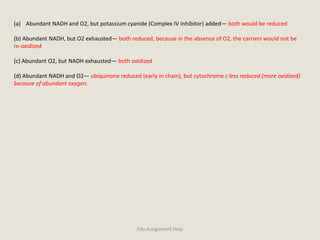
(a) Abundant NADH and O2, but potassium cyanide (Complex IV inhibitor) added— both would be reduced
(b) Abundant NADH, but O2 exhausted— both reduced, because in the absence of O2, the carriers would not be
re-oxidized
(c) Abundant O2, but NADH exhausted— both oxidized
(d) Abundant NADH and O2— ubiquinone reduced (early in chain), but cytochrome c less reduced (more oxidized)
because of abundant oxygen.
Edu Assignment Help
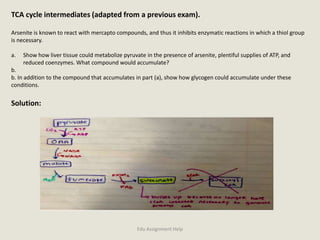
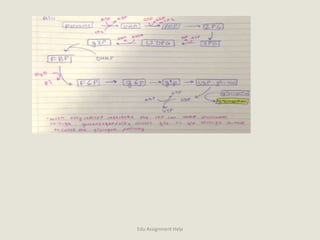
TCA cycle intermediates (adapted from a previous exam).
Arsenite is known to react with mercapto compounds, and thus it inhibits enzymatic reactions in which a thiol group
is necessary.
a. Show how liver tissue could metabolize pyruvate in the presence of arsenite, plentiful supplies of ATP, and
reduced coenzymes. What compound would accumulate?
b.
b. In addition to the compound that accumulates in part (a), show how glycogen could accumulate under these
conditions.
Solution:
Edu Assignment Help
Edu Assignment Help
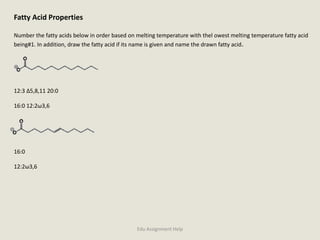
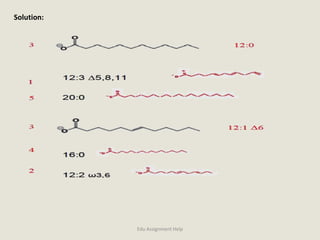
Fatty Acid Properties
Number the fatty acids below in order based on melting temperature with thel owest melting temperature fatty acid
being#1. In addition, draw the fatty acid if its name is given and name the drawn fatty acid.
12:3 Δ5,8,11 20:0
16:0 12:2ω3,6
16:0
12:2ω3,6
Edu Assignment Help
Solution:
Edu Assignment Help
Fatty Acid Oxidation
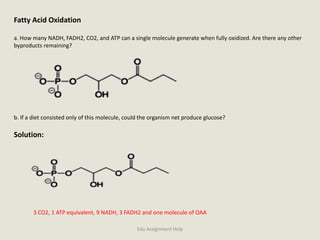
a. How many NADH, FADH2, CO2, and ATP can a single molecule generate when fully oxidized. Are there any other
byproducts remaining?
b. If a diet consisted only of this molecule, could the organism net produce glucose?
Solution:
3 CO2, 1 ATP equivalent, 9 NADH, 3 FADH2 and one molecule of OAA
Edu Assignment Help
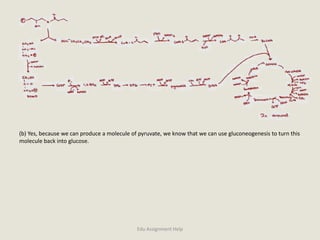
(b) Yes, because we can produce a molecule of pyruvate, we know that we can use gluconeogenesis to turn this
molecule back into glucose.
Edu Assignment Help
Introduction to photosynthesis.
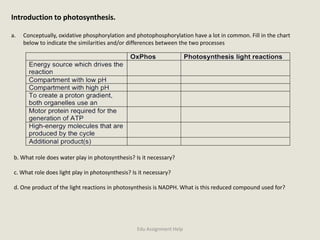
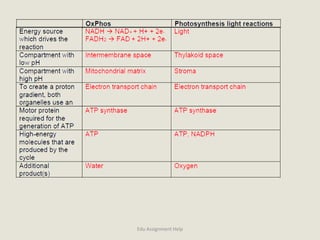
a. Conceptually, oxidative phosphorylation and photophosphorylation have a lot in common. Fill in the chart
below to indicate the similarities and/or differences between the two processes
b. What role does water play in photosynthesis? Is it necessary?
c. What role does light play in photosynthesis? Is it necessary?
d. One product of the light reactions in photosynthesis is NADPH. What is this reduced compound used for?
Edu Assignment Help
Edu Assignment Help
(b) Water is an electron donor—it is required for NADPH production, but an electron donor is not required for cyclic
electron transfer.
(c) Light provides the energy that drives photosynthesis. It is absolutely required to drive an otherwise endergonic
reaction.
(d) NADPH is used to synthesize carbohydrates like glucose from CO2 by reducing it.
Edu Assignment Help
Photosynthesis II (Adapted from a previous exam)
After graduation you are hired by a metabolic engineering company and are placed on a project developing
fluorescent plants that emit infrared light. To accomplish this, you modify Photosystem II (PSII; which absorbs 680 nm
light) such that it emits a longer wavelength.
a. In wild type plants where is PSII located?
b. Consider what effects engineering PSII to emit infrared light with have on the light reactions of photosynthesis. Will
this engineering increase, decrease or have no effect on the effect of NADPH production?
You successfully engineer your plant such that you can induce all of the PSII in the mature vegetative plant to switch to
a mutant form that emits infrared light. After several hours the plant appears healthy, and you find your leaves do emit
infrared light. However, the next day you find your plant is dead. Further study shows that the plant dies when
exposed to darkness.
c. Consider what effect engineering PSII to emit infrared light will have on the dark reactions of photosynthesis. Explain
why the plant dies during periods of darkness.
Solution:
(a) Thylakoid membrane in plants
(b) Engineering PSII to fluoresce will decrease efficiency of NADPH production. Energy absorbed by PSII is either
used in resonant energy transfer to excite electrons at the reaction centre, or is emitted as fluorescence. In the
engineered PSII, more energy is lost to fluorescence, decreasing the availability for resonant energy transfer and
lowering the efficiency of the ETC. (c) As NADPH production is lower than normal, not enough CO2 is fixed and
stored during the day. During the night, the plant dies as there isn’t enough stored sources of energy.
Edu Assignment Help
(c) As NADPH production is lower than normal, not enough CO2 is fixed and stored during the day. During the night,
the plant dies as there isn’t enough stored sources of energy.
Edu Assignment Help

Biochemistry Homework Help

  • 1.
    Biochemistry Homework Help Formore info and assignment related helps, Visit : - https://www.eduassignmenthelp.com/ E-Mail : - info@eduassignmenthelp.com Contact : - +1 678 648 4277 Edu Assignment Help
  • 2.
    Oxidation-reduction reactions inthe Mitochondrial Respiratory Chain. a. The NADH dehydrogenase complex of the mitochondrial respiratory chain promotes the following series of oxidation-reduction reactions, in which Fe3+ and Fe2+ represent the iron in the iron-sulfur clusters, Q is the ubiquinone, QH2 is ubiquinol, and E is the enzyme: 1) NADH + H+ + E-FMN • NAD+ + E-FMNH2 2) E-FMNH2 + 2Fe3+ • E-FMN + 2Fe2+ + 2H+ 3) 2Fe2+ + 2H+ + Q • 2Fe3+ + QH2 sum: NADH + H+ + Q • NAD+ + QH2 For each of these three reactions catalyzed by the NADH dehydrogenase complex, identify: (a) the electron donor (b) the electron acceptor (c) the oxidation half-reaction, with electrons and protons balanced if applicable (d) the reduction half-reaction, with electrons and protons balanced if applicable Edu Assignment Help
  • 3.
    b. All ofthe dehydrogenases in glycolysis and the citric acid cycle use NAD+ (E¢0 for NAD+ • NADH is -0.32 V) as an electron acceptor except succinate dehydrogenase, which uses covalently bound FAD (E¢0 for FAD • FADH2 in this enzyme is 0.050 V). Suggest why FAD is a more appropriate electron acceptor than NAD+ in the dehydrogenation of succinate, based on the E¢0 values of fumarate • succinate (E¢0 = 0.031 V), NAD+/NADH, and the succinate dehydrogenase FAD/FADH2. c. The degree of reduction of each carrier in the respiratory chain is determined by conditions in the mitochondrion. For example, when NADH and O2 are abundant, the steady-state degree of reduction of the carriers decreases as electrons pass from the substrate to O2. When electron transfer is blocked, the carriers before the block become more reduced, and those beyond the block become more oxidized. For each of the conditions below, predict the state of oxidation of ubiquinone and cytochrome c: (a) Abundant NADH and O2, but potassium cyanide (Complex IV inhibitor) added (b) Abundant NADH, but O2 exhausted (c) Abundant O2, but NADH exhausted (d) Abundant NADH and O2 Edu Assignment Help
  • 4.
    Solution: 1) NADH +H+ + E-FMN → NAD+ + E-FMNH2 a) Electron donor: NADH b) Electron acceptor: E-FMN c) Reduction: E-FMN + 2H+ + 2e- → E-FMNH2 d) Oxidized: NADH → NAD+ + H+ + 2e- 2) E-FMNH2 + 2Fe3+ → E-FMN + 2Fe2+ + 2H+ a) Electron donor: E-FMNH2 b) Electron acceptor: Fe3+ c) Reduction: 2Fe3+ + 2e- → 2Fe2+ d) Oxidation: E-FMNH2 → E-FMNH2 + 2H+ + 2e- 3) 2Fe2+ + 2H+ + Q → 2Fe3+ + QH2 a) Electron donor: Fe2+ b) Electron acceptor: Q c) Reduced: Q + 2e- + 2H+ → QH2 d) Oxidized: 2Fe2+ → 2e- + 2Fe3+ From the difference in standard reduction potential (Δ E 0) for each pair of half-reactions, you can calculate Δ G o. The oxidation of succinate by FAD is favored by the negative Δ G o = -3.7 kJ/mol. Oxidation by NAD+ has a large, positive Δ G o = 67 kJ/mol. Thus FAD is a more appropriate electron acceptor in this case. Edu Assignment Help
  • 5.
    (a) Abundant NADHand O2, but potassium cyanide (Complex IV inhibitor) added— both would be reduced (b) Abundant NADH, but O2 exhausted— both reduced, because in the absence of O2, the carriers would not be re-oxidized (c) Abundant O2, but NADH exhausted— both oxidized (d) Abundant NADH and O2— ubiquinone reduced (early in chain), but cytochrome c less reduced (more oxidized) because of abundant oxygen. Edu Assignment Help
  • 6.
    TCA cycle intermediates(adapted from a previous exam). Arsenite is known to react with mercapto compounds, and thus it inhibits enzymatic reactions in which a thiol group is necessary. a. Show how liver tissue could metabolize pyruvate in the presence of arsenite, plentiful supplies of ATP, and reduced coenzymes. What compound would accumulate? b. b. In addition to the compound that accumulates in part (a), show how glycogen could accumulate under these conditions. Solution: Edu Assignment Help
  • 7.
  • 8.
    Fatty Acid Properties Numberthe fatty acids below in order based on melting temperature with thel owest melting temperature fatty acid being#1. In addition, draw the fatty acid if its name is given and name the drawn fatty acid. 12:3 Δ5,8,11 20:0 16:0 12:2ω3,6 16:0 12:2ω3,6 Edu Assignment Help
  • 9.
  • 10.
    Fatty Acid Oxidation a.How many NADH, FADH2, CO2, and ATP can a single molecule generate when fully oxidized. Are there any other byproducts remaining? b. If a diet consisted only of this molecule, could the organism net produce glucose? Solution: 3 CO2, 1 ATP equivalent, 9 NADH, 3 FADH2 and one molecule of OAA Edu Assignment Help
  • 11.
    (b) Yes, becausewe can produce a molecule of pyruvate, we know that we can use gluconeogenesis to turn this molecule back into glucose. Edu Assignment Help
  • 12.
    Introduction to photosynthesis. a.Conceptually, oxidative phosphorylation and photophosphorylation have a lot in common. Fill in the chart below to indicate the similarities and/or differences between the two processes b. What role does water play in photosynthesis? Is it necessary? c. What role does light play in photosynthesis? Is it necessary? d. One product of the light reactions in photosynthesis is NADPH. What is this reduced compound used for? Edu Assignment Help
  • 13.
  • 14.
    (b) Water isan electron donor—it is required for NADPH production, but an electron donor is not required for cyclic electron transfer. (c) Light provides the energy that drives photosynthesis. It is absolutely required to drive an otherwise endergonic reaction. (d) NADPH is used to synthesize carbohydrates like glucose from CO2 by reducing it. Edu Assignment Help
  • 15.
    Photosynthesis II (Adaptedfrom a previous exam) After graduation you are hired by a metabolic engineering company and are placed on a project developing fluorescent plants that emit infrared light. To accomplish this, you modify Photosystem II (PSII; which absorbs 680 nm light) such that it emits a longer wavelength. a. In wild type plants where is PSII located? b. Consider what effects engineering PSII to emit infrared light with have on the light reactions of photosynthesis. Will this engineering increase, decrease or have no effect on the effect of NADPH production? You successfully engineer your plant such that you can induce all of the PSII in the mature vegetative plant to switch to a mutant form that emits infrared light. After several hours the plant appears healthy, and you find your leaves do emit infrared light. However, the next day you find your plant is dead. Further study shows that the plant dies when exposed to darkness. c. Consider what effect engineering PSII to emit infrared light will have on the dark reactions of photosynthesis. Explain why the plant dies during periods of darkness. Solution: (a) Thylakoid membrane in plants (b) Engineering PSII to fluoresce will decrease efficiency of NADPH production. Energy absorbed by PSII is either used in resonant energy transfer to excite electrons at the reaction centre, or is emitted as fluorescence. In the engineered PSII, more energy is lost to fluorescence, decreasing the availability for resonant energy transfer and lowering the efficiency of the ETC. (c) As NADPH production is lower than normal, not enough CO2 is fixed and stored during the day. During the night, the plant dies as there isn’t enough stored sources of energy. Edu Assignment Help
  • 16.
    (c) As NADPHproduction is lower than normal, not enough CO2 is fixed and stored during the day. During the night, the plant dies as there isn’t enough stored sources of energy. Edu Assignment Help