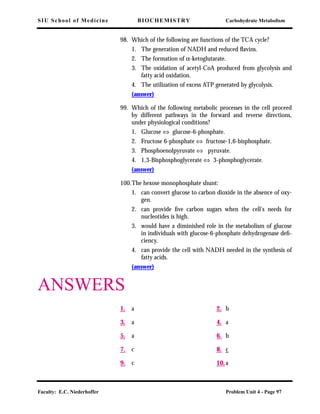
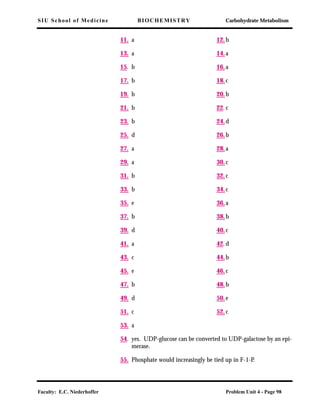
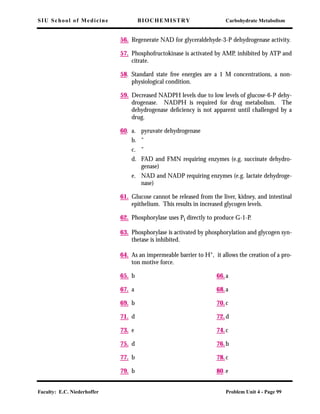
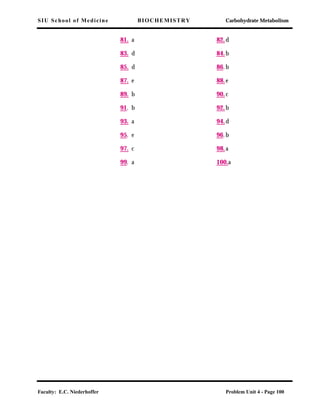
SIU School of Medicine BIOCHEMISTRY Carbohydrate Metabolism
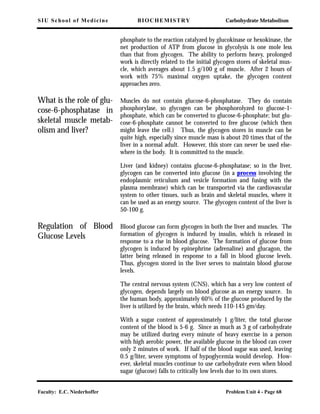
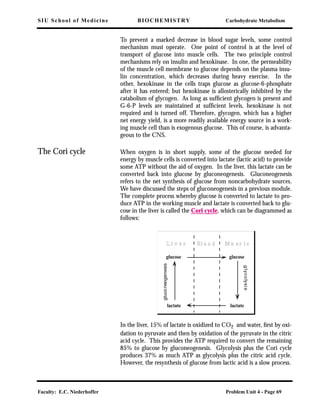
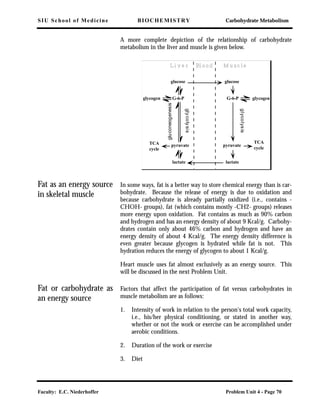
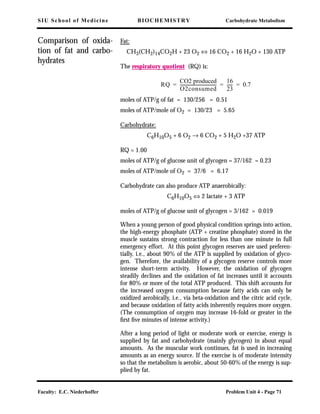
Faculty: E.C. Niederhoffer Problem Unit 4 - Page 1
BIOCHEMISTRY
AND
MOLECULAR BIOLOGY
Problem Unit Four
1999/2000
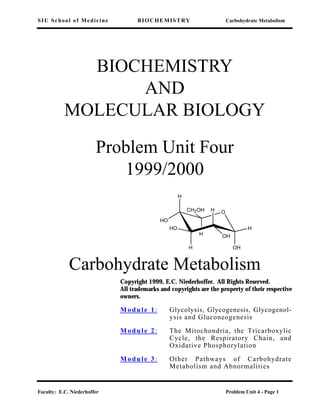
Carbohydrate Metabolism
Copyright 1999, E.C. Niederhoffer. All Rights Reserved.
All trademarks and copyrights are the property of their respective
owners.
Module 1: Glycolysis, Glycogenesis, Glycogenol-
ysis and Gluconeogenesis
Module 2: The Mitochondria, the Tricarboxylic
Cycle, the Respiratory Chain, and
Oxidative Phosphorylation
Module 3: Other Pathways of Carbohydrate
Metabolism and Abnormalities
O
H
HO
H
HO
H
OH
OHH
CH2OH
H
SIU School of Medicine BIOCHEMISTRY Carbohydrate Metabolism
Faculty: E.C. Niederhoffer Problem Unit 4 - Page 2
Faculty: Dr. Eric C. Niederhoffer
Biochemistry & Molecular Biology
Office: 210 Neckers Bldg.
email: enieder@som.siu.edu
Telephone: 453-6467
Learning Resources: ESTIMATED WORK TIME: 32 hours.
A. This study guide is provided in two forms: printed and elec-
tronic. It is best viewed in electronic form as a pdf file which can
be read on your computer using Adobe Acrobat Reader. See
Appendix I for an introduction on how to view a pdf file. The pdf
file can be downloaded from the biochemistry server (http://
www.siu.edu/departments/biochem) and Acrobat Reader can be
downloaded free from Adobe’s web page (http://www.adobe.com/
acrobat). They should also be installed on the student computers.
There are a number of advantages to using the electronic version
including color, a hypertext index, and hypertext links within the
text. Hypertext links in the text body are in blue underlined charac-
ters (such as this). Clicking on these will lead to a jump to the linked
material for further details. The destination material is indicated by
red underlined characters (such as this).
This and other study guides are provided to help you focus on the
topics that are important in the biochemistry curriculum. These are
designed to guide your studying and provide information that may
not be readily available in other resources. They are not designed to
replace textbooks, and are not intended to be complete. They are
guides for starting your reading and reviewing the material at a later
date.
B. Textbooks:
1. Devlin, Textbook of Biochemistry with Clinical Correla-
tions, 4th ed. ('97), Wiley-Liss. Core text for Biochemistry
& Molecular Biology.
2. Champ & Harvey, Lippincotts Illustrated Reviews: Bio-
chemistry, 2nd ed. (‘94), Lippincott. Efficient presentation
of basic principles.
3. Murray et al., Harper's Biochemistry, (24th ed.) ('96),
Appleton & Lange. A review text for examinations.
4. Marks, Marks, and Smith, Basic Medical Biochemistry: A
Clinical Approach, (‘96), Williams & Wilkins. Good basic
presentation with clinical relevance.
SIU School of Medicine BIOCHEMISTRY Carbohydrate Metabolism
Faculty: E.C. Niederhoffer Problem Unit 4 - Page 3
5. Cohn and Roth, Biochemistry and Disease, (‘96), Williams
& Wilkins. A good bridge between the basic sciences and
clinical medicine.
6. Garrett and Grishham, Biochemistry, 2nd ed., (‘99), Saun-
ders College Publishing.
7. Salway, Metabolism at a Glance, 2nd ed., (‘99), Blackwell
Science. An excellent presentation of metabolic pathways.
Most texts of biochemistry have sections on metabolism. It is a
mature subject in biochemistry, and consequently, the content of the
subject is much the same from text to text; the differences are basi-
cally in style and rigor. The Study Guide in this Problem Unit will
set the level of rigor expected of you. Read the sections on metabo-
lism in Devlin and Murray. What differences there will be between
these texts and the Study Guide will be helpful to you in gaining per-
spective on the subject.
Additional material can be found on the web at the National Insti-
tutes of Health (http://www.nih.gov), the National Library of Med-
icine (http://www.nlm.nih.gov), and the free MEDLINE PubMED
Search system at the National Library of Medicine (http://
www3.ncbi.nlm.nih.gov/PubMed/).
C. Lecture/Discussions
The lectures will provide an overview of the material and concentrate
on key points.
D. Practice Exam Questions are contained at the end of this Prob-
lem Unit along with answers. An on-line quiz (containing the Prac-
tice Exam Questions) is also available from the PU4 web page.
Evaluation Criteria: A pacing quiz will be given during Neuro Block 1. A written exami-
nation and one recycle covering the objectives will be scheduled dur-
ing CVR Block 2. Answers to questions and the solving of problems
will be judged against the learning resources of which the Study
Guide, the biochemistry text by Devlin, other texts and lectures are
the primary resources. You will need to receive 70% or better on the
final examination in order to pass PU04.
SIU School of Medicine BIOCHEMISTRY Carbohydrate Metabolism
Faculty: E.C. Niederhoffer Problem Unit 4 - Page 4
Module I: Glycolysis, Gluconeo-
genesis, Glycogenolysis and Gly-
cogenesis,
Introduction to
Metabolism:
A living organism is a highly complex and unstable system. Its exist-
ence is precarious because of its complexity. Metabolism is the sum
total of all biochemical reactions designed to maintain and replicate
the structure of the organism and to counteract a continuous drive
towards an increase in the disorder, or entropy, of the system.
To build complex structures requires energy, i.e., a system needs
energy for synthesis and maintenance. Human metabolism derives
energy from degradation of organized structures (food) from plants,
and, therefore, indirectly from the sun. In more affluent societies of
the world, a significant amount of energy is obtained from animals
which themselves have survived by utilizing plants and other animals.
For the most part, food represents complex organic molecules which
require energy to be synthesized and therefore can yield energy by
being destroyed. (Food also contains some constituents which are
not utilized for energy production, but have important roles in main-
taining life, e.g., minerals and vitamins.)
Some General Princi-
ples:
Organic molecules are composed primarily of carbon, oxygen, nitro-
gen, and hydrogen. The most stable form of carbon in our atmo-
sphere is CO2. The energy of CO2 may be increased by reduction to
yield organic molecules.
Organic reduction of a molecule results in an increase in energy
resulting in the addition of hydrogen atoms (a proton and an elec-
tron) and the removal of oxygen. Organic oxidation is the reverse,
i.e., the removal of hydrogen with the evolution of energy. Thus,
complex organic molecules may be degraded by oxidation to liberate
energy. We oxidize (burn) fossil fuels to obtain energy to run
engines and heat our society. Similarly, a living organism oxidizes
organic compounds in a highly controlled manner to capture the
energy to allow maintenance, synthesis, movement, and replication.
Some heat is produced intentionally to maintain body temperature in
warm-blooded animals.
SIU School of Medicine BIOCHEMISTRY Carbohydrate Metabolism
Faculty: E.C. Niederhoffer Problem Unit 4 - Page 5
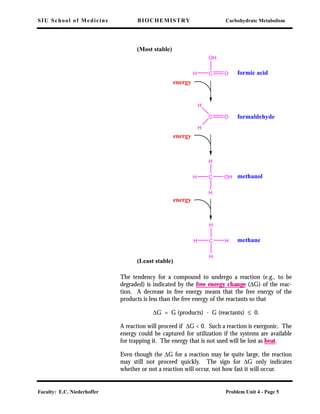
The tendency for a compound to undergo a reaction (e.g., to be
degraded) is indicated by the free energy change (∆G) of the reac-
tion. A decrease in free energy means that the free energy of the
products is less than the free energy of the reactants so that
∆G = G (products) - G (reactants) ≤ 0.
A reaction will proceed if ∆G < 0. Such a reaction is exergonic. The
energy could be captured for utilization if the systems are available
for trapping it. The energy that is not used will be lost as heat.
Even though the ∆G for a reaction may be quite large, the reaction
may still not proceed quickly. The sign for ∆G only indicates
whether or not a reaction will occur, not how fast it will occur.
(Most stable)
(Least stable)
formic acid
formaldehyde
methanol
methane
energy
energy
energy
C O
OH
H
C O
H
H
C OHH
H
H
C HH
H
H
SIU School of Medicine BIOCHEMISTRY Carbohydrate Metabolism
Faculty: E.C. Niederhoffer Problem Unit 4 - Page 6
Biochemical reactions occur with the aid of enzymes which are
examples of catalysts. Catalysts are substances which speed up
chemical reactions without themselves being altered. Most enzymes
are proteins. Enzymes are important in biological systems not only
because they accelerate reactions, but also because they can be regu-
lated, i.e., they can be turned on or off, thus allowing for the reaction
rate to be controlled.
Enzymes also control the type of reaction which is occurring so that
one reaction may not be allowed to occur without another simulta-
neously occurring, i.e., the two are tightly coupled. This aspect of
enzyme catalysis is often overlooked It is this characteristic of
enzymes which allows for the capture of energy resulting from the
degradation of organic foods and the prevention of its being lost as
heat. Specific examples will be presented many times below so that it
will not be necessary to give details here. Try to remember that
enzymes are more than mere catalysts. In many instances they direct
the flow of energy to/from specific molecules by defining metabolic
pathways. It is this property of enzymes which prevent chaos and
which is responsible for the order in biological systems. In the nor-
mal physiological state, enzymes permit the unstable organic mole-
cules we ingest as food to be degraded only if the energy is
simultaneously captured. The constant ingestion of food and its deg-
radation results in a maintenance of order (life). The "driving force"
for life is therefore the dissipation of the energy in the environment.
Hence the maintenance of life requires the constant loss of energy by
the universe, consistent with the laws of thermodynamics.
Objectives: 1. Be able to classify metabolic intermediates in the metabolism of
carbohydrates as alcohols, aldehydes, inorganic and organic
esters, acids, ketones, phosphates and nucleotides.
2. Discuss the role of enzymes in living systems as catalysts, regula-
tory gates, and coupling devices.
3. Distinguish between spontaneity and rate of a reaction. Which
is controlled by ∆G?
4. Summarize glycolysis by giving a diagram showing the metabolic
intermediates and the coenzymes in the pathway. Given such a
diagram, identify the missing components. What are the prod-
ucts of anaerobic and aerobic glycolysis?
5. Given the name of any enzyme of the glycolytic pathway, write
the complete reaction catalyzed by that enzyme including the
coenzymes required, their reaction (if any), and the structures of
SIU School of Medicine BIOCHEMISTRY Carbohydrate Metabolism
Faculty: E.C. Niederhoffer Problem Unit 4 - Page 7
the substrate(s) and product(s).
6. List the three thermodynamically irreversible steps in glycolysis.
How are these steps bypassed in gluconeogenesis? Identify the
metabolic and hormonal regulators that control the activity of
these enzymes. Are these reactions truly irreversible?
7. Give the major regulatory step in glycolysis and describe how the
activity of this enzyme is controlled. Explain how hormones
such as glucagon, epinephrine and insulin regulate the glycolytic
pathway.
8. List the reactions that generate NADH, and list the reactions
that regenerate NAD+
during both anaerobic and aerobic glycol-
ysis. Show how and explain why the reactions that generate
NADH and those that use NADH are coupled.
9. Answer questions concerning the general structure of glycogen,
including the types of glycosidic linkages and the number of
reducing sugar residues present per glycogen molecule. Explain
the biological role of glycogen, and tell why it is "fit" for this
role.
10. Glycogen phosphorylase and a debranching enzyme (4-α-D-glu-
canotransferase/amylo-α-1,6-glucosidase) are necessary for the
complete degradation of glycogen. Identify products of the reac-
tions catalyzed by each of these enzymes and show how they lead
to the complete degradation of glycogen.
11. Diagram the pathway and name the enzymes that are required
for glycogenesis from glucose-6-phosphate. When given such a
diagram, identify missing components.
12. Two of the enzymes that are required for the synthesis of glyco-
gen are glycogen synthase and a branching enzyme. Name and
identify the substrates and products of glycogen synthase.
Explain why branching is important to the biological function of
glycogen.
13. Explain why there are separate pathways for the synthesis and
degradation of glycogen.
14. Give the substrates and products of the reaction catalyzed by
UDP-glucose pyrophosphorylase. Describe the significance of
the formation of pyrophosphate and the metabolic fate of pyro-
phosphate in the cell.
SIU School of Medicine BIOCHEMISTRY Carbohydrate Metabolism
Faculty: E.C. Niederhoffer Problem Unit 4 - Page 8
15. The degradation and synthesis of glycogen is under hormonal
control. Describe the cascade of reactions in liver and muscle
that are initiated by epinephrine and glucagon and lead to the
activation of phosphorylase and the inhibition of glycogen syn-
thase. Include the following details: a) the binding sites for epi-
nephrine and glucagon, b) the effect of epinephrine and
glucagon on adenylate cyclase, c) the substrates and products of
adenylate cyclase, d) the effect of increased intracellular levels of
cAMP on protein kinase A, e) the effect of protein kinase A on
phosphorylase kinase and glycogen synthase, f) the activation of
glycogen phosphorylase, g) the role of phosphoprotein phos-
phatase, and phosphodiesterase, h) the role of inhibitor protein.
Show how the response of heart tissue differs from that of liver
during stimulation by epinephrine. Describe the action of insu-
lin on this cascade.
16. Describe the significance of the cascade and predict the effect of
an absence of any one of these enzymes on the levels of glycogen
and cAMP in muscle tissue.
17. List the factors that regulate intracellular cAMP concentration.
Describe cAMP synthesis and degradation. Write the structure
of cAMP.
18. Summarize gluconeogenesis by giving a diagram showing the
metabolic intermediates and the coenzymes in the pathway.
Given such a diagram, identify the missing components.
19. Given the name of any enzyme of the gluconeogenic pathway,
write the complete reaction catalyzed by that enzyme including
the coenzymes required, their reaction (if any), and the struc-
tures of the substrate(s) and product(s).
20. Use the above objectives and previous objectives to solve new
problems.
21. Define and use correctly the terms in the Nomenclature and
Vocabulary list.
Nomenclature and
Vocabulary:
2-phosphoglycerate 3-phosphoglycerate
1,3-bisphosphoglycerate 2,3-bisphosphoglycerate
α-1,6 glucosidase adenylate cyclase
adenosine cyclic monophosphate aerobic glycolysis
aldose aldolase
AMP amylase
SIU School of Medicine BIOCHEMISTRY Carbohydrate Metabolism
Faculty: E.C. Niederhoffer Problem Unit 4 - Page 9
amylose anabolism
anaerobic glycolysis anomer
ATP branching enzyme
calmodulin cAMP
carbohydrates catabolism
catalyst cellulose
citric acid cycle debranching enzyme
dihydroxyacetone phosphate dinucleotide
disaccharide enolase
enzymes exergonic
fructose fructose-1,6-bisphosphate
fructose-2,6-bisphosphate fructose-6-phosphate
fructose bisphosphatase glucokinase
glucose gluconeogenesis
glucose-1-phosphate glucose-6-phosphate
glucose-6-phosphatase glyceraldehyde-3-phosphate
dehydrogenase
glyceraldehyde-3-phosphate glycogen synthase
glycogen glycogenin
glycogenesis glycogenolysis
glycogenosis glycolysis
hexokinase hypoglycemia
inhibitor protein (IP) ketose
Kreb’s cycle lactate
lactic acid lactate dehydrogenase
metabolic pathway metabolism
monosaccharide nicotinamide adenine dinucleotide (NAD)
oxaloacetic acid oxidation
pentose PEP
phosphodiesterase phosphoenol pyruvate
phosphoenol pyruvate carboxykinase phosphofructokinase II
phosphofructokinase I phosphoglucomutase
phosphoglycerate kinase phosphoglyceromutase
phosphohexoisomerase phosphorylase a
phosphorylase b phosphorylase kinase
phosphorylase Pi
SIU School of Medicine BIOCHEMISTRY Carbohydrate Metabolism
Faculty: E.C. Niederhoffer Problem Unit 4 - Page 10
protein kinase A pyrophosphate
pyruvate kinase pyruvate
pyruvate carboxylase reducing equivalents
reducing sugar reduction
saccharide second messenger
starch sucrose
TCA cycle triosephosphate isomerase
UDP-glc pyrophosphorylase UDP-glc
UDPG ∆G
SIU School of Medicine BIOCHEMISTRY Carbohydrate Metabolism
Faculty: E.C. Niederhoffer Problem Unit 4 - Page 11
STUDY GUIDE - I
What is metabolism? Metabolism is the total of anabolism and catabolism. Anabolism
refers to the synthetic activities of a cell; it uses energy and forms
more complex molecules from simpler ones. Catabolism refers to
the degradation reactions in a cell; it produces energy which is most
commonly stored as ATP. Anabolism requires catabolism because of
its need for energy.
Life is characterized by growth, movement, and reproduction. Each
of these properties depends on controlled chemical reactions for the
biosynthesis of organic compounds (anabolism) and the production
of usable energy (catabolism). Control is attained by enzyme cataly-
sis of the reactions of metabolic pathways.
Each of the activities of a cell requires energy. The cell constantly
uses energy for the biosynthesis of chemical substances, mechanical
work (e.g. muscle contraction), maintenance of cell turgor (osmotic
pressure), etc. Chemical energy is also transferred into the electrical
energy of nerve impulses.
A living cell is inherently an unstable organization. It maintains the
complexity and orderliness of its fragile structure only by constantly
rebuilding itself. Most cell components are in a dynamic state, i.e.,
are constantly broken down and replaced.
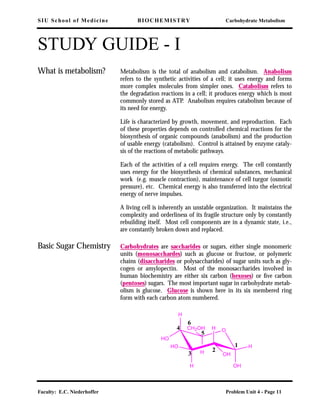
Basic Sugar Chemistry Carbohydrates are saccharides or sugars, either single monomeric
units (monosacchardes) such as glucose or fructose, or polymeric
chains (disaccharides or polysaccharides) of sugar units such as gly-
cogen or amylopectin. Most of the monosaccharides involved in
human biochemistry are either six carbon (hexoses) or five carbon
(pentoses) sugars. The most important sugar in carbohydrate metab-
olism is glucose. Glucose is shown here in its six membered ring
form with each carbon atom numbered.
O
H
HO
H
HO
H
OH
OHH
CH2OH
H1
2
3
4
5
6
SIU School of Medicine BIOCHEMISTRY Carbohydrate Metabolism
Faculty: E.C. Niederhoffer Problem Unit 4 - Page 12
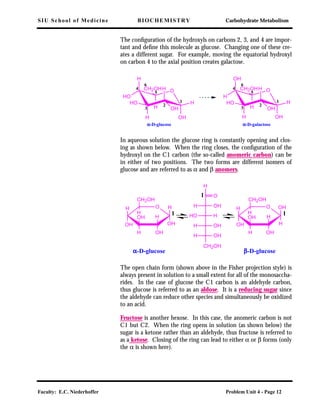
The configuration of the hydroxyls on carbons 2, 3, and 4 are impor-
tant and define this molecule as glucose. Changing one of these cre-
ates a different sugar. For example, moving the equatorial hydroxyl
on carbon 4 to the axial position creates galactose.
In aqueous solution the glucose ring is constantly opening and clos-
ing as shown below. When the ring closes, the configuration of the
hydroxyl on the C1 carbon (the so-called anomeric carbon) can be
in either of two positions. The two forms are different isomers of
glucose and are referred to as α and β anomers.
The open chain form (shown above in the Fisher projection style) is
always present in solution to a small extent for all of the monosaccha-
rides. In the case of glucose the C1 carbon is an aldehyde carbon,
thus glucose is referred to as an aldose. It is a reducing sugar since
the aldehyde can reduce other species and simultaneously be oxidized
to an acid.
Fructose is another hexose. In this case, the anomeric carbon is not
C1 but C2. When the ring opens in solution (as shown below) the
sugar is a ketone rather than an aldehyde, thus fructose is referred to
as a ketose. Closing of the ring can lead to either α or β forms (only
the α is shown here).
O
H
HO
H
HO
H
OH
OHH
CH2OH
H
O
OH
H
H
HO
H
OH
OHH
CH2OH
H1
2
3
4
5
6
1
2
3
4
5
6
αααα-D-glucose αααα-D-galactose
OHH
HHO
OHH
OH
H
O
H
CH2OH
1
αααα-D-glucose ββββ-D-glucose
H O
OH
H
OH
H
OHH
OH
CH2OH
H 1
H O
OH
OH
H
H
OHH
OH
CH2OH
H 1
SIU School of Medicine BIOCHEMISTRY Carbohydrate Metabolism
Faculty: E.C. Niederhoffer Problem Unit 4 - Page 13
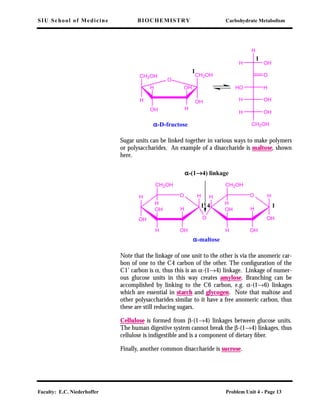
Sugar units can be linked together in various ways to make polymers
or polysaccharides. An example of a disaccharide is maltose, shown
here.
Note that the linkage of one unit to the other is via the anomeric car-
bon of one to the C4 carbon of the other. The configuration of the
C1’ carbon is α, thus this is an α-(1→4) linkage. Linkage of numer-
ous glucose units in this way creates amylose. Branching can be
accomplished by linking to the C6 carbon, e.g. α-(1→6) linkages
which are essential in starch and glycogen. Note that maltose and
other polysaccharides similar to it have a free anomeric carbon, thus
these are still reducing sugars.
Cellulose is formed from β-(1→4) linkages between glucose units.
The human digestive system cannot break the β-(1→4) linkages, thus
cellulose is indigestible and is a component of dietary fiber.
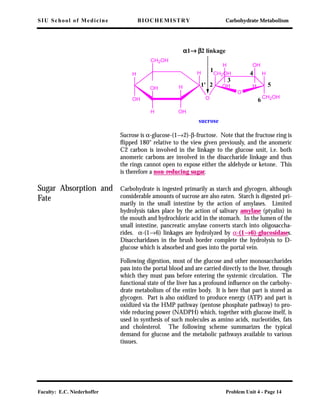
Finally, another common disaccharide is sucrose.
O
HHO
OHH
OH
H
OH
H
CH2OH
H
αααα-D-fructose
OH
CH2OH
H
CH2OH
OH H
H OH
O
1
1
αααα-maltose
αααα-(1→→→→4) linkage
OH
OH
H
O
H
OHH
OH
CH2OH
H
OH H
OH
H
OHH
OH
CH2OH
H
141'
SIU School of Medicine BIOCHEMISTRY Carbohydrate Metabolism
Faculty: E.C. Niederhoffer Problem Unit 4 - Page 14
Sucrose is α-glucose-(1→2)-β-fructose. Note that the fructose ring is
flipped 180° relative to the view given previously, and the anomeric
C2 carbon is involved in the linkage to the glucose unit, i.e. both
anomeric carbons are involved in the disaccharide linkage and thus
the rings cannot open to expose either the aldehyde or ketone. This
is therefore a non-reducing sugar.
Sugar Absorption and
Fate
Carbohydrate is ingested primarily as starch and glycogen, although
considerable amounts of sucrose are also eaten. Starch is digested pri-
marily in the small intestine by the action of amylases. Limited
hydrolysis takes place by the action of salivary amylase (ptyalin) in
the mouth and hydrochloric acid in the stomach. In the lumen of the
small intestine, pancreatic amylase converts starch into oligosaccha-
rides. α-(1→6) linkages are hydrolyzed by α-(1→→→→6)-glucosidases.
Disaccharidases in the brush border complete the hydrolysis to D-
glucose which is absorbed and goes into the portal vein.
Following digestion, most of the glucose and other monosaccharides
pass into the portal blood and are carried directly to the liver, through
which they must pass before entering the systemic circulation. The
functional state of the liver has a profound influence on the carbohy-
drate metabolism of the entire body. It is here that part is stored as
glycogen. Part is also oxidized to produce energy (ATP) and part is
oxidized via the HMP pathway (pentose phosphate pathway) to pro-
vide reducing power (NADPH) which, together with glucose itself, is
used in synthesis of such molecules as amino acids, nucleotides, fats
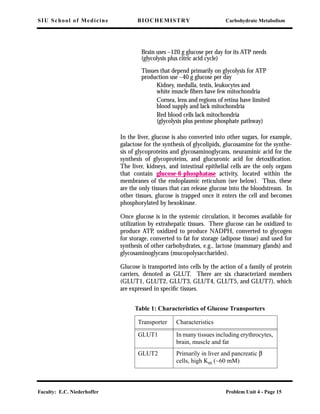
and cholesterol. The following scheme summarizes the typical
demand for glucose and the metabolic pathways available to various
tissues.
sucrose
αααα1→→→→ ββββ2 linkage
H
OH
H
O
H
OHH
OH
CH2OH
H
CH2OH
CH2OH
H OH
OH H
O
1'
1
2
3
4
5
6
SIU School of Medicine BIOCHEMISTRY Carbohydrate Metabolism
Faculty: E.C. Niederhoffer Problem Unit 4 - Page 15
In the liver, glucose is also converted into other sugars, for example,
galactose for the synthesis of glycolipids, glucosamine for the synthe-
sis of glycoproteins and glycosaminoglycans, neuraminic acid for the
synthesis of glycoproteins, and glucuronic acid for detoxification.
The liver, kidneys, and intestinal epithelial cells are the only organs
that contain glucose-6-phosphatase activity, located within the
membranes of the endoplasmic reticulum (see below). Thus, these
are the only tissues that can release glucose into the bloodstream. In
other tissues, glucose is trapped once it enters the cell and becomes
phosphorylated by hexokinase.
Once glucose is in the systemic circulation, it becomes available for
utilization by extrahepatic tissues. There glucose can be oxidized to
produce ATP, oxidized to produce NADPH, converted to glycogen
for storage, converted to fat for storage (adipose tissue) and used for
synthesis of other carbohydrates, e.g., lactose (mammary glands) and
glycosaminoglycans (mucopolysaccharides).
Glucose is transported into cells by the action of a family of protein
carriers, denoted as GLUT. There are six characterized members
(GLUT1, GLUT2, GLUT3, GLUT4, GLUT5, and GLUT7), which
are expressed in specific tissues.
Table 1: Characteristics of Glucose Transporters
Transporter Characteristics
GLUT1 In many tissues including erythrocytes,
brain, muscle and fat
GLUT2 Primarily in liver and pancreatic β
cells, high Km (~60 mM)
Brain uses ~120 g glucose per day for its ATP needs
(glycolysis plus citric acid cycle)
Tissues that depend primarily on glycolysis for ATP
production use ~40 g glucose per day
Kidney, medulla, testis, leukocytes and
white muscle fibers have few mitochondria
Cornea, lens and regions of retina have limited
blood supply and lack mitochondria
Red blood cells lack mitochondria
(glycolysis plus pentose phosphate pathway)
SIU School of Medicine BIOCHEMISTRY Carbohydrate Metabolism
Faculty: E.C. Niederhoffer Problem Unit 4 - Page 16
NOTE: Under normal dietary conditions in a healthy individual, the
brain, the retina, mature erythrocytes, the renal medulla, and germi-
nal epithelium will only use glucose as an energy source.
Carbohydrate metabo-
lism overview
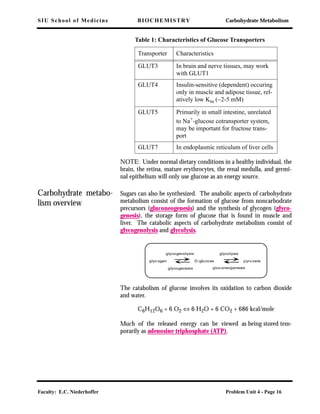
Sugars can also be synthesized. The anabolic aspects of carbohydrate
metabolism consist of the formation of glucose from noncarbodrate
precursors (gluconeogenesis) and the synthesis of glycogen (glyco-
genesis), the storage form of glucose that is found in muscle and
liver. The catabolic aspects of carbohydrate metabolism consist of
glycogenolysis and glycolysis.
The catabolism of glucose involves its oxidation to carbon dioxide
and water.
C6H12O6 + 6 O2 ⇔ 6 H2O + 6 CO2 + 686 kcal/mole
Much of the released energy can be viewed as being stored tem-
porarily as adenosine triphosphate (ATP).
GLUT3 In brain and nerve tissues, may work
with GLUT1
GLUT4 Insulin-sensitive (dependent) occuring
only in muscle and adipose tissue, rel-
atively low Km (~2-5 mM)
GLUT5 Primarily in small intestine, unrelated
to Na+-glucose cotransporter system,
may be important for fructose trans-
port
GLUT7 In endoplasmic reticulum of liver cells
Table 1: Characteristics of Glucose Transporters
Transporter Characteristics
glycogen D-glucose pyruvate
glycolysis
gluconeogenesisglycogenesis
glycogenolysis
SIU School of Medicine BIOCHEMISTRY Carbohydrate Metabolism
Faculty: E.C. Niederhoffer Problem Unit 4 - Page 17
The triphosphate chain in ATP is energetically unstable. Energy
must be put into the synthesis of ATP by extending the diphosphate
chain in adenosine diphosphate. ATP is therefore a high energy com-
pound that serves as a reservoir of energy that can be released when
required by breaking (hydrolyzing) the triphosphate to give diphos-
phate (ADP) and phosphate (orthophosphate sometimes called inor-
ganic phosphate, or Pi).
Even though cells are better than most nonliving systems in energy
transformation, they cannot achieve 100% efficiency, i.e., not all the
energy released by oxidation of glucose is captured in the form of
ATP. Part of the energy is lost as heat. Indeed, some maintenance of
the creation of heat through metabolism is essential to regulate the
body temperature.
The total oxidation of glucose is accomplished in two stages. The
first, the pathway of glycolysis or the Embden-Myerhof pathway,
takes place in the cytosol of most cells in either the presence or
absence of oxygen (i.e. it does not require oxygen), and produces little
energy. The second, the citric acid, tricarboxylic acid (TCA) or
Kreb's cycle, takes place in mitochondria, requires oxygen indirectly,
and when coupled with electron transport and oxidative phosphory-
lation, produces most of the usable energy in the form of ATP.
Glycolysis, literally the splitting of carbohydrate, is the conversion of
a glucose molecule or a glucopyranosyl unit of glycogen into pyru-
vate. If oxygen is present (aerobic glycolysis), the pyruvate is oxi-
dized further via the TCA cycle and the electron transport chain to
produce CO2 and H2O. In the absence of oxygen (anaerobic glyco-
H2C
OH OH
O
N
N N
N
NH2
O P O P O P O
-
O O O
O
-
O
-
O
-
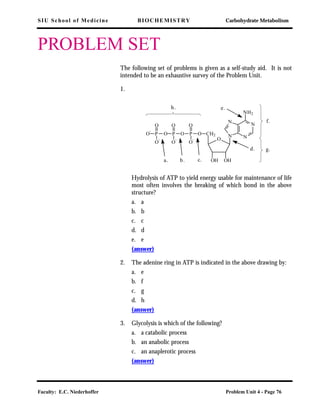
Adenosine Triphosphate (ATP)
hydrolysis of the phosphoester
linkage between the ββββ and γγγγ
phosphates gives ADP
SIU School of Medicine BIOCHEMISTRY Carbohydrate Metabolism
Faculty: E.C. Niederhoffer Problem Unit 4 - Page 18
lysis), pyruvate is converted to lactate.
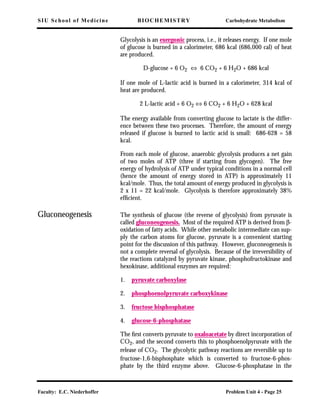
Glycolysis Glycolysis represents the initial degradation of glucose. It is an
anaerobic process, i.e. oxygen is not utilized. It is useful in emergen-
cies when oxygen is not available since a minor amount of ATP is
produced.
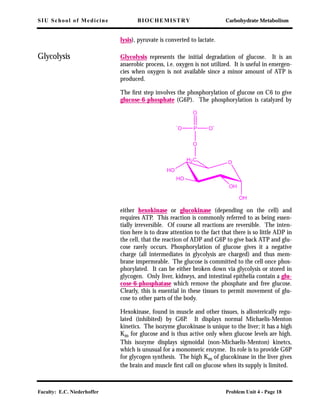
The first step involves the phosphorylation of glucose on C6 to give
glucose-6-phosphate (G6P). The phosphorylation is catalyzed by
either hexokinase or glucokinase (depending on the cell) and
requires ATP. This reaction is commonly referred to as being essen-
tially irreversible. Of course all reactions are reversible. The inten-
tion here is to draw attention to the fact that there is so little ADP in
the cell, that the reaction of ADP and G6P to give back ATP and glu-
cose rarely occurs. Phosphorylation of glucose gives it a negative
charge (all intermediates in glycolysis are charged) and thus mem-
brane impermeable. The glucose is committed to the cell once phos-
phorylated. It can be either broken down via glycolysis or stored in
glycogen. Only liver, kidneys, and intestinal epithelia contain a glu-
cose-6-phosphatase which remove the phosphate and free glucose.
Clearly, this is essential in these tissues to permit movement of glu-
cose to other parts of the body.
Hexokinase, found in muscle and other tissues, is allosterically regu-
lated (inhibited) by G6P. It displays normal Michaelis-Menton
kinetics. The isozyme glucokinase is unique to the liver; it has a high
Km for glucose and is thus active only when glucose levels are high.
This isozyme displays sigmoidal (non-Michaelis-Menton) kinetcs,
which is unusual for a monomeric enzyme. Its role is to provide G6P
for glycogen synthesis. The high Km of glucokinase in the liver gives
the brain and muscle first call on glucose when its supply is limited.
O
HO
HO
OH
OH
H2C
O
P
O
O
--
O
SIU School of Medicine BIOCHEMISTRY Carbohydrate Metabolism
Faculty: E.C. Niederhoffer Problem Unit 4 - Page 19
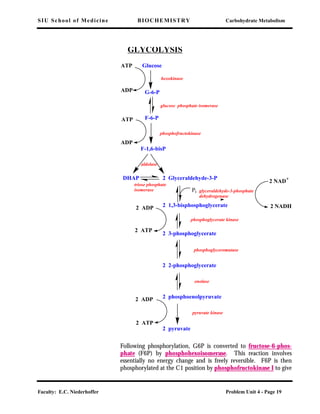
Following phosphorylation, G6P is converted to fructose-6-phos-
phate (F6P) by phosphohexoisomerase. This reaction involves
essentially no energy change and is freely reversible. F6P is then
phosphorylated at the C1 position by phosphofructokinase I to give
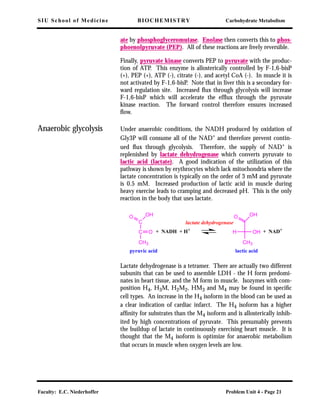
Glucose
G-6-P
F-6-P
F-1,6-bisP
DHAP 2 Glyceraldehyde-3-P
2 1,3-bisphosphoglycerate
2 3-phosphoglycerate
2 2-phosphoglycerate
2 phosphoenolpyruvate
2 pyruvate
Pi
ATP
ADP
ATP
2 ATP
2 ATP
ADP
2 ADP
2 ADP
2 NAD+
2 NADH
GLYCOLYSIS
hexokinase
glucose phosphate isomerase
phosphofructokinase
aldolase
triose phosphate
isomerase glyceraldehyde-3-phosphate
dehydrogenase
phosphoglycerate kinase
phosphoglyceromutase
enolase
pyruvate kinase
SIU School of Medicine BIOCHEMISTRY Carbohydrate Metabolism
Faculty: E.C. Niederhoffer Problem Unit 4 - Page 20
fructose-1,6-diphosphate. This reaction is allosterically controlled
by ATP (-), AMP (+), citrate (-) and fructose-2,6-bisphosphate (+)
(the signs indicate positive or negative regulation). AMP is used as
an allosteric effector since its concentration changes significantly
under anaerobic conditions (see Table below). This is the first reac-
tion which commits sugars to catabolism rather than storage. It is
irreversible in that ATP is utilized.
F-1,6-bisP is then broken by aldolase into two 3 carbon fragments:
dihydroxyacetone phosphate and glyceraldehyde-3-phosphate.
This reaction is freely reversible. Triose phosphate isomerase con-
verts DHAP to Gly3P, which then proceeds on to be oxidized by
glyceraldehyde-3-phosphate dehydrogenase to 1,3-bisphospho-
glycerate. This is an unusual enzyme in that it utilizes inorganic
phosphate to make a high energy compound - i.e. substrate phospho-
rylation. In addition, the oxidation of the glyceraldehyde releases
reducing equivalents (hydride, H-
) which are deposited in NAD+
to
give NADH (hydrogen carrier).
Arsenate is poisonous at least in part because it can substitute for
phosphate in the glyceraldehyde-3-dehydrogenase catalyzed reac-
tion. Arsenate is then spontaneously released, leading to no incorpo-
ration of phosphate.
1,3-bisphosphoglycerate can be converted to 2,3-bisphosphoglycer-
ate by bisphosphoglycerate mutase. This is especially important in
red blood cells since 2,3-bisphosphoglycerate is important in regulat-
ing the oxygen affinity of hemoglobin.
The high energy 1,3-bisphosphoglycerate can now release its energy
to make ATP in a reaction catalyzed by phosphoglycerate kinase.
Thus the incorporation of inorganic phosphate by glyceraldehyde
dehydrogenase ultimately goes to ATP.
The resulting 3-phosphoglycerate is converted to 2-phosphoglycer-
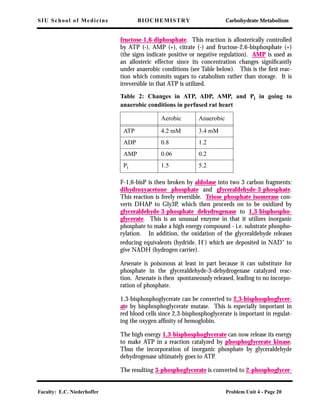
Table 2: Changes in ATP, ADP, AMP, and Pi in going to
anaerobic conditions in perfused rat heart
Aerobic Anaerobic
ATP 4.2 mM 3.4 mM
ADP 0.8 1.2
AMP 0.06 0.2
Pi 1.5 5.2
SIU School of Medicine BIOCHEMISTRY Carbohydrate Metabolism
Faculty: E.C. Niederhoffer Problem Unit 4 - Page 21
ate by phosphoglyceromutase. Enolase then converts this to phos-
phoenolpyruvate (PEP). All of these reactions are freely reversible.
Finally, pyruvate kinase converts PEP to pyruvate with the produc-
tion of ATP. This enzyme is allosterically controlled by F-1,6-bisP
(+), PEP (+), ATP (-), citrate (-), and acetyl CoA (-). In muscle it is
not activated by F-1,6-bisP. Note that in liver this is a secondary for-
ward regulation site. Increased flux through glycolysis will increase
F-1,6-bisP which will accelerate the efflux through the pyruvate
kinase reaction. The forward control therefore ensures increased
flow.
Anaerobic glycolysis Under anaerobic conditions, the NADH produced by oxidation of
Gly3P will consume all of the NAD+ and therefore prevent contin-
ued flux through glycolysis. Therefore, the supply of NAD+
is
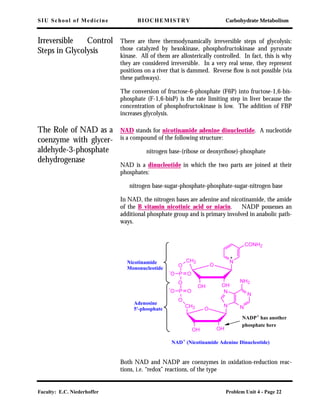
replenished by lactate dehydrogenase which converts pyruvate to
lactic acid (lactate). A good indication of the utilization of this
pathway is shown by erythrocytes which lack mitochondria where the
lactate concentration is typically on the order of 3 mM and pyruvate
is 0.5 mM. Increased production of lactic acid in muscle during
heavy exercise leads to cramping and decreased pH. This is the only
reaction in the body that uses lactate.
Lactate dehydrogenase is a tetramer. There are actually two different
subunits that can be used to assemble LDH - the H form predomi-
nates in heart tissue, and the M form in muscle. Isozymes with com-
position H4, H3M, H2M2, HM3 and M4 may be found in specific
cell types. An increase in the H4 isoform in the blood can be used as
a clear indication of cardiac infarct. The H4 isoform has a higher
affinity for substrates than the M4 isoform and is allosterically inhib-
ited by high concentrations of pyruvate. This presumably prevents
the buildup of lactate in continuously exercising heart muscle. It is
thought that the M4 isoform is optimize for anaerobic metabolism
that occurs in muscle when oxygen levels are low.
C
C
CH3
O
OHO
CH3
OHO
OHH+ NADH + H+
+ NAD+
pyruvic acid lactic acid
lactate dehydrogenase
SIU School of Medicine BIOCHEMISTRY Carbohydrate Metabolism
Faculty: E.C. Niederhoffer Problem Unit 4 - Page 22
Irreversible Control
Steps in Glycolysis
There are three thermodynamically irreversible steps of glycolysis:
those catalyzed by hexokinase, phosphofructokinase and pyruvate
kinase. All of them are allosterically controlled. In fact, this is why
they are considered irreversible. In a very real sense, they represent
positions on a river that is dammed. Reverse flow is not possible (via
these pathways).
The conversion of fructose-6-phosphate (F6P) into fructose-1,6-bis-
phosphate (F-1,6-bisP) is the rate limiting step in liver because the
concentration of phosphofructokinase is low. The addition of FBP
increases glycolysis.
The Role of NAD as a
coenzyme with glycer-
aldehyde-3-phosphate
dehydrogenase
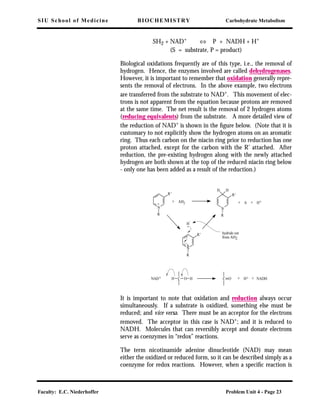
NAD stands for nicotinamide adenine dinucleotide. A nucleotide
is a compound of the following structure:
nitrogen base-(ribose or deoxyribose)-phosphate
NAD is a dinucleotide in which the two parts are joined at their
phosphates:
nitrogen base-sugar-phosphate-phosphate-sugar-nitrogen base
In NAD, the nitrogen bases are adenine and nicotinamide, the amide
of the B vitamin nicotinic acid or niacin. NADP possesses an
additional phosphate group and is primary involved in anabolic path-
ways.
Both NAD and NADP are coenzymes in oxidation-reduction reac-
tions, i.e. “redox” reactions, of the type
OH OH
O
CH2
OH OH
O
O
P
O
P
O
CH2
-
O O
-
O O
N
CONH2
N
NN
N
NH2
Nicotinamide
Mononucleotide
Adenosine
5'-phosphate
NAD+
(Nicotinamide Adenine Dinucleotide)
NADP+
has another
phosphate here
SIU School of Medicine BIOCHEMISTRY Carbohydrate Metabolism
Faculty: E.C. Niederhoffer Problem Unit 4 - Page 23
SH2 + NAD+
⇔ P + NADH + H+
(S = substrate, P = product)
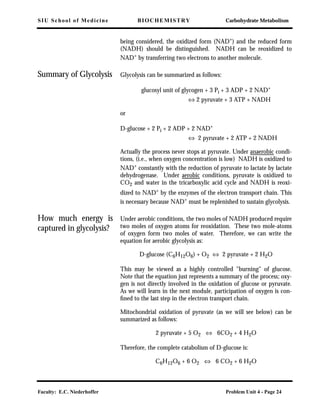
Biological oxidations frequently are of this type, i.e., the removal of
hydrogen. Hence, the enzymes involved are called dehydrogenases.
However, it is important to remember that oxidation generally repre-
sents the removal of electrons. In the above example, two electrons
are transferred from the substrate to NAD+
. This movement of elec-
trons is not apparent from the equation because protons are removed
at the same time. The net result is the removal of 2 hydrogen atoms
(reducing equivalents) from the substrate. A more detailed view of
the reduction of NAD+ is shown in the figure below. (Note that it is
customary to not explicitly show the hydrogen atoms on an aromatic
ring. Thus each carbon on the niacin ring prior to reduction has one
proton attached, except for the carbon with the R’ attached. After
reduction, the pre-existing hydrogen along with the newly attached
hydrogen are both shown at the top of the reduced niacin ring below
- only one has been added as a result of the reduction.)
It is important to note that oxidation and reduction always occur
simultaneously. If a substrate is oxidized, something else must be
reduced; and vice versa. There must be an acceptor for the electrons
removed. The acceptor in this case is NAD+; and it is reduced to
NADH. Molecules that can reversibly accept and donate electrons
serve as coenzymes in “redox” reactions.
The term nicotinamide adenine dinucleotide (NAD) may mean
either the oxidized or reduced form, so it can be described simply as a
coenzyme for redox reactions. However, when a specific reaction is
+
NAD+ H C O H C O + H+ + NADH
N
R'
R
+ AH2
N
H H
R'
R
+ A + H+
N
R'
R
H
-
hydride ion
from AH2
SIU School of Medicine BIOCHEMISTRY Carbohydrate Metabolism
Faculty: E.C. Niederhoffer Problem Unit 4 - Page 24
being considered, the oxidized form (NAD+
) and the reduced form
(NADH) should be distinguished. NADH can be reoxidized to
NAD+ by transferring two electrons to another molecule.
Summary of Glycolysis Glycolysis can be summarized as follows:
glucosyl unit of glycogen + 3 Pi + 3 ADP + 2 NAD+
⇔ 2 pyruvate + 3 ATP + NADH
or
D-glucose + 2 Pi + 2 ADP + 2 NAD+
⇔ 2 pyruvate + 2 ATP + 2 NADH
Actually the process never stops at pyruvate. Under anaerobic condi-
tions, (i.e., when oxygen concentration is low) NADH is oxidized to
NAD+
constantly with the reduction of pyruvate to lactate by lactate
dehydrogenase. Under aerobic conditions, pyruvate is oxidized to
CO2 and water in the tricarboxylic acid cycle and NADH is reoxi-
dized to NAD+ by the enzymes of the electron transport chain. This
is necessary because NAD+
must be replenished to sustain glycolysis.
How much energy is
captured in glycolysis?
Under aerobic conditions, the two moles of NADH produced require
two moles of oxygen atoms for reoxidation. These two mole-atoms
of oxygen form two moles of water. Therefore, we can write the
equation for aerobic glycolysis as:
D-glucose (C6H12O6) + O2 ⇔ 2 pyruvate + 2 H2O
This may be viewed as a highly controlled "burning" of glucose.
Note that the equation just represents a summary of the process; oxy-
gen is not directly involved in the oxidation of glucose or pyruvate.
As we will learn in the next module, participation of oxygen is con-
fined to the last step in the electron transport chain.
Mitochondrial oxidation of pyruvate (as we will see below) can be
summarized as follows:
2 pyruvate + 5 O2 ⇔ 6CO2 + 4 H2O
Therefore, the complete catabolism of D-glucose is:
C6H12O6 + 6 O2 ⇔ 6 CO2 + 6 H2O
SIU School of Medicine BIOCHEMISTRY Carbohydrate Metabolism
Faculty: E.C. Niederhoffer Problem Unit 4 - Page 25
Glycolysis is an exergonic process, i.e., it releases energy. If one mole
of glucose is burned in a calorimeter, 686 kcal (686,000 cal) of heat
are produced.
D-glucose + 6 O2 ⇔ 6 CO2 + 6 H2O + 686 kcal
If one mole of L-lactic acid is burned in a calorimeter, 314 kcal of
heat are produced.
2 L-lactic acid + 6 O2 ⇔ 6 CO2 + 6 H2O + 628 kcal
The energy available from converting glucose to lactate is the differ-
ence between these two processes. Therefore, the amount of energy
released if glucose is burned to lactic acid is small: 686-628 = 58
kcal.
From each mole of glucose, anaerobic glycolysis produces a net gain
of two moles of ATP (three if starting from glycogen). The free
energy of hydrolysis of ATP under typical conditions in a normal cell
(hence the amount of energy stored in ATP) is approximately 11
kcal/mole. Thus, the total amount of energy produced in glycolysis is
2 x 11 = 22 kcal/mole. Glycolysis is therefore approximately 38%
efficient.
Gluconeogenesis The synthesis of glucose (the reverse of glycolysis) from pyruvate is
called gluconeogenesis. Most of the required ATP is derived from β-
oxidation of fatty acids. While other metabolic intermediate can sup-
ply the carbon atoms for glucose, pyruvate is a convenient starting
point for the discussion of this pathway. However, gluconeogenesis is
not a complete reversal of glycolysis. Because of the irreversibility of
the reactions catalyzed by pyruvate kinase, phosphofructokinase and
hexokinase, additional enzymes are required:
1. pyruvate carboxylase
2. phosphoenolpyruvate carboxykinase
3. fructose bisphosphatase
4. glucose-6-phosphatase
The first converts pyruvate to oxaloacetate by direct incorporation of
CO2, and the second converts this to phosphoenolpyruvate with the
release of CO2. The glycolytic pathway reactions are reversible up to
fructose-1,6-bisphosphate which is converted to fructose-6-phos-
phate by the third enzyme above. Glucose-6-phosphatase in the
SIU School of Medicine BIOCHEMISTRY Carbohydrate Metabolism
Faculty: E.C. Niederhoffer Problem Unit 4 - Page 26
membranes of the endoplasmic reticulum of liver and kidney cells
removes the phosphate so that glucose contained within forming ves-
icles can fuse with the plasma membrane and be released into the cir-
culation. This is thought to involve both GLUT7 and GLUT2.
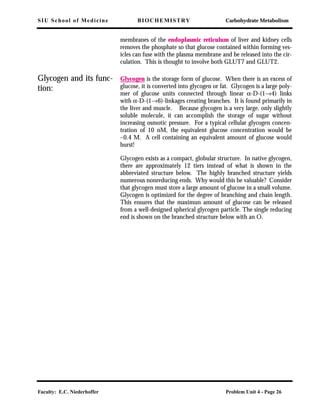
Glycogen and its func-
tion:
Glycogen is the storage form of glucose. When there is an excess of
glucose, it is converted into glycogen or fat. Glycogen is a large poly-
mer of glucose units connected through linear α-D-(1→4) links
with α-D-(1→6)-linkages creating branches. It is found primarily in
the liver and muscle. Because glycogen is a very large, only slightly
soluble molecule, it can accomplish the storage of sugar without
increasing osmotic pressure. For a typical cellular glycogen concen-
tration of 10 nM, the equivalent glucose concentration would be
~0.4 M. A cell containing an equivalent amount of glucose would
burst!
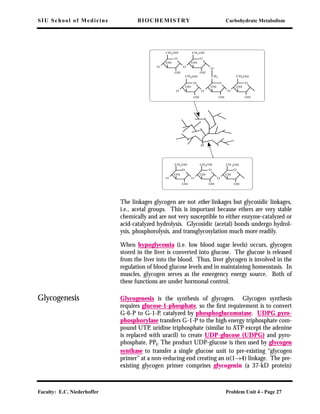
Glycogen exists as a compact, globular structure. In native glycogen,
there are approximately 12 tiers instead of what is shown in the
abbreviated structure below. The highly branched structure yields
numerous nonreducing ends. Why would this be valuable? Consider
that glycogen must store a large amount of glucose in a small volume.
Glycogen is optimized for the degree of branching and chain length.
This ensures that the maximun amount of glucose can be released
from a well-designed spherical glycogen particle. The single reducing
end is shown on the branched structure below with an O.
SIU School of Medicine BIOCHEMISTRY Carbohydrate Metabolism
Faculty: E.C. Niederhoffer Problem Unit 4 - Page 27
The linkages glycogen are not ether linkages but glycosidic linkages,
i.e., acetal groups. This is important because ethers are very stable
chemically and are not very susceptible to either enzyme-catalyzed or
acid-catalyzed hydrolysis. Glycosidic (acetal) bonds undergo hydrol-
ysis, phosphorolysis, and transglycosylation much more readily.
When hypoglycemia (i.e. low blood sugar levels) occurs, glycogen
stored in the liver is converted into glucose. The glucose is released
from the liver into the blood. Thus, liver glycogen is involved in the
regulation of blood glucose levels and in maintaining homeostasis. In
muscles, glycogen serves as the emergency energy source. Both of
these functions are under hormonal control.
Glycogenesis Glycogenesis is the synthesis of glycogen. Glycogen synthesis
requires glucose-1-phosphate, so the first requirement is to convert
G-6-P to G-1-P, catalyzed by phosphoglucomutase. UDPG pyro-
phosphorylase transfers G-1-P to the high energy triphosphate com-
pound UTP, uridine triphosphate (similar to ATP except the adenine
is replaced with uracil) to create UDP-glucose (UDPG) and pyro-
phosphate, PPi. The product UDP-glucose is then used by glycogen
synthase to transfer a single glucose unit to pre-existing “glycogen
primer” at a non-reducing end creating an α(1→4) linkage. The pre-
existing glycogen primer comprises glycogenin (a 37-kD protein)
O
OH
OH
OO
CH2OH
O
OH
OH
CH 2OHCH2OH
O
OH
OH
O
o
O
OH
OH
OO
CH2OH
O
OH
OH
CH2OHCH2
O
OH
OH
O
O
O
OH
OH
O
CH2OH CH2OH
OH
OH
O
O
SIU School of Medicine BIOCHEMISTRY Carbohydrate Metabolism
Faculty: E.C. Niederhoffer Problem Unit 4 - Page 28
linked through a tyrosine residue to the anomeric carbon of a glucose
molecule, a reaction catalyzed by a tyrosine glucosyltransferase, fol-
lowed by an additional 7 glucan residues. There appears to be a 1:1
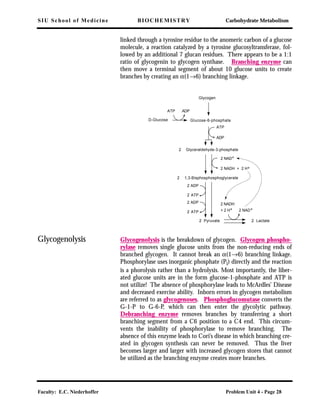
ratio of glycogenin to glycogen synthase. Branching enzyme can
then move a terminal segment of about 10 glucose units to create
branches by creating an α(1→6) branching linkage.
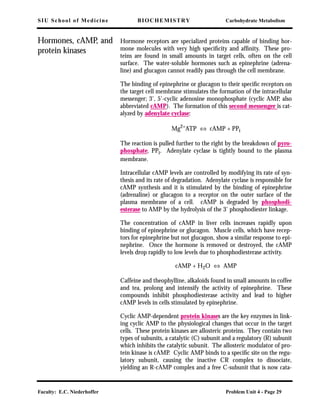
Glycogenolysis Glycogenolysis is the breakdown of glycogen. Glycogen phospho-
rylase removes single glucose units from the non-reducing ends of
branched glycogen. It cannot break an α(1→6) branching linkage.
Phosphorylase uses inorganic phosphate (Pi) directly and the reaction
is a phorolysis rather than a hydrolysis. Most importantly, the liber-
ated glucose units are in the form glucose-1-phosphate and ATP is
not utilize! The absence of phosphorylase leads to McArdles’ Disease
and decreased exercise ability. Inborn errors in glycogen metabolism
are referred to as glycogenoses. Phosphoglucomutase converts the
G-1-P to G-6-P, which can then enter the glycolytic pathway.
Debranching enzyme removes branches by transferring a short
branching segment from a C6 position to a C4 end. This circum-
vents the inability of phosphorylase to remove branching. The
absence of this enzyme leads to Cori’s disease in which branching cre-
ated in glycogen synthesis can never be removed. Thus the liver
becomes larger and larger with increased glycogen stores that cannot
be utilized as the branching enzyme creates more branches.
Glycogen
2 Glyceraldehyde-3-phosphate
2 1,3-Bisphosphosphoglycerate
2 Pyruvate 2 Lactate
2 NAD+
2 NADH + 2 H+
2 ATP
2 ATP
2 ADP
2 ADP 2 NADH
+ 2 H+ 2 NAD+
ATP
ADP
D-Glucose Glucose-6-phosphate
ATP ADP
SIU School of Medicine BIOCHEMISTRY Carbohydrate Metabolism
Faculty: E.C. Niederhoffer Problem Unit 4 - Page 29
Hormones, cAMP, and
protein kinases
Hormone receptors are specialized proteins capable of binding hor-
mone molecules with very high specificity and affinity. These pro-
teins are found in small amounts in target cells, often on the cell
surface. The water-soluble hormones such as epinephrine (adrena-
line) and glucagon cannot readily pass through the cell membrane.
The binding of epinephrine or glucagon to their specific receptors on
the target cell membrane stimulates the formation of the intracellular
messenger; 3', 5'-cyclic adenosine monophosphate (cyclic AMP, also
abbreviated cAMP). The formation of this second messenger is cat-
alyzed by adenylate cyclase:
Mg2+ATP ⇔ cAMP + PPi
The reaction is pulled further to the right by the breakdown of pyro-
phosphate, PPi. Adenylate cyclase is tightly bound to the plasma
membrane.
Intracellular cAMP levels are controlled by modifying its rate of syn-
thesis and its rate of degradation. Adenylate cyclase is responsible for
cAMP synthesis and it is stimulated by the binding of epinephrine
(adrenaline) or glucagon to a receptor on the outer surface of the
plasma membrane of a cell. cAMP is degraded by phosphodi-
esterase to AMP by the hydrolysis of the 3' phosphodiester linkage.
The concentration of cAMP in liver cells increases rapidly upon
binding of epinephrine or glucagon. Muscle cells, which have recep-
tors for epinephrine but not glucagon, show a similar response to epi-
nephrine. Once the hormone is removed or destroyed, the cAMP
levels drop rapidly to low levels due to phosphodiesterase activity.
cAMP + H2O ⇔ AMP
Caffeine and theophylline, alkaloids found in small amounts in coffee
and tea, prolong and intensify the activity of epinephrine. These
compounds inhibit phosphodiesterase activity and lead to higher
cAMP levels in cells stimulated by epinephrine.
Cyclic AMP-dependent protein kinases are the key enzymes in link-
ing cyclic AMP to the physiological changes that occur in the target
cells. These protein kinases are allosteric proteins. They contain two
types of subunits, a catalytic (C) subunit and a regulatory (R) subunit
which inhibits the catalytic subunit. The allosteric modulator of pro-
tein kinase is cAMP. Cyclic AMP binds to a specific site on the regu-
latory subunit, causing the inactive CR complex to dissociate,
yielding an R-cAMP complex and a free C-subunit that is now cata-
SIU School of Medicine BIOCHEMISTRY Carbohydrate Metabolism
Faculty: E.C. Niederhoffer Problem Unit 4 - Page 30
lytically active.
Protein kinase can phosphorylate a number of proteins such as phos-
phorylase kinase, glycogen synthase, inhibitor protein, histones, ribo-
somal proteins, membrane proteins of fat cells, and mitochondrial
and lysosomal membrane proteins.
In liver, protein kinase A phosphorylates phosphofructokinase-2
and fructose-2,6-bisphosphatase. These are actually the same pro-
tein with two different activities. The first is inactivated, and the sec-
ond is activated upon phosphorylation. This leads to a decrease in
fructose-2,6-bisphosphate, which is an allosteric activator of phos-
phofructokinase-1, so glycolysis is shut down when cAMP levels are
increased in the liver. In muscle, phosphorylation of phosphofruc-
tokinase-2 and fructose-2,6-bisphosphatase leads to the opposite
effect, so glycolysis is stimulated with increased cAMP.
Phosphorylase kinase is the enzyme responsible for activating phos-
phorylase and thus stimulating the mobilization of glycogen. Phos-
phorylase kinase is a large protein (over 1 million molecular weight)
with 16 subunits. It exists in two forms; an inactive form with no
phosphate attached and an active phosphorylated form.
Each of the 16 subunits becomes phosphorylated by ATP at a serine
residue through the action of protein kinase.
The active phosphorylase kinase catalyzes the phosphorylation of
phosphorylase b to give phosphorylase a.
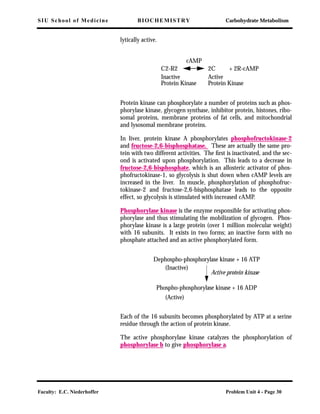
cAMP
C2-R2 2C
Inactive
Protein Kinase
Active
Protein Kinase
+ 2R-cAMP
Dephospho-phosphorylase kinase + 16 ATP
(Inactive)
Active protein kinase
Phospho-phosphorylase kinase + 16 ADP
(Active)
SIU School of Medicine BIOCHEMISTRY Carbohydrate Metabolism
Faculty: E.C. Niederhoffer Problem Unit 4 - Page 31
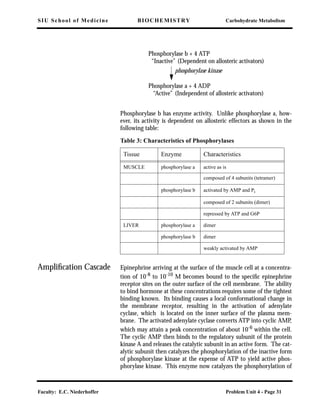
Phosphorylase b has enzyme activity. Unlike phosphorylase a, how-
ever, its activity is dependent on allosteric effectors as shown in the
following table:
Amplification Cascade Epinephrine arriving at the surface of the muscle cell at a concentra-
tion of 10-8 to 10-10 M becomes bound to the specific epinephrine
receptor sites on the outer surface of the cell membrane. The ability
to bind hormone at these concentrations requires some of the tightest
binding known. Its binding causes a local conformational change in
the membrane receptor, resulting in the activation of adenylate
cyclase, which is located on the inner surface of the plasma mem-
brane. The activated adenylate cyclase converts ATP into cyclic AMP,
which may attain a peak concentration of about 10-6 within the cell.
The cyclic AMP then binds to the regulatory subunit of the protein
kinase A and releases the catalytic subunit in an active form. The cat-
alytic subunit then catalyzes the phosphorylation of the inactive form
of phosphorylase kinase at the expense of ATP to yield active phos-
phorylase kinase. This enzyme now catalyzes the phosphorylation of
Table 3: Characteristics of Phosphorylases
Tissue Enzyme Characteristics
MUSCLE phosphorylase a active as is
composed of 4 subunits (tetramer)
phosphorylase b activated by AMP and Pi
composed of 2 subunits (dimer)
repressed by ATP and G6P
LIVER phosphorylase a dimer
phosphorylase b dimer
weakly activated by AMP
Phosphorylase b + 4 ATP
“Inactive” (Dependent on allosteric activators)
phosphorylase kinase
Phosphorylase a + 4 ADP
“Active” (Independent of allosteric activators)
SIU School of Medicine BIOCHEMISTRY Carbohydrate Metabolism
Faculty: E.C. Niederhoffer Problem Unit 4 - Page 32
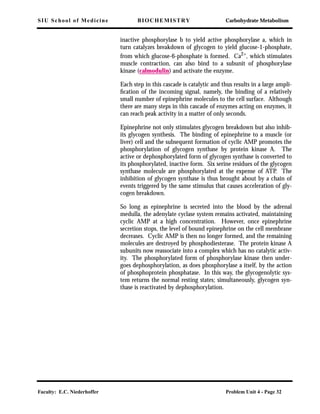
inactive phosphorylase b to yield active phosphorylase a, which in
turn catalyzes breakdown of glycogen to yield glucose-1-phosphate,
from which glucose-6-phosphate is formed. Ca2+
, which stimulates
muscle contraction, can also bind to a subunit of phosphorylase
kinase (calmodulin) and activate the enzyme.
Each step in this cascade is catalytic and thus results in a large ampli-
fication of the incoming signal, namely, the binding of a relatively
small number of epinephrine molecules to the cell surface. Although
there are many steps in this cascade of enzymes acting on enzymes, it
can reach peak activity in a matter of only seconds.
Epinephrine not only stimulates glycogen breakdown but also inhib-
its glycogen synthesis. The binding of epinephrine to a muscle (or
liver) cell and the subsequent formation of cyclic AMP promotes the
phosphorylation of glycogen synthase by protein kinase A. The
active or dephosphorylated form of glycogen synthase is converted to
its phosphorylated, inactive form. Six serine residues of the glycogen
synthase molecule are phosphorylated at the expense of ATP. The
inhibition of glycogen synthase is thus brought about by a chain of
events triggered by the same stimulus that causes acceleration of gly-
cogen breakdown.
So long as epinephrine is secreted into the blood by the adrenal
medulla, the adenylate cyclase system remains activated, maintaining
cyclic AMP at a high concentration. However, once epinephrine
secretion stops, the level of bound epinephrine on the cell membrane
decreases. Cyclic AMP is then no longer formed, and the remaining
molecules are destroyed by phosphodiesterase. The protein kinase A
subunits now reassociate into a complex which has no catalytic activ-
ity. The phosphorylated form of phosphorylase kinase then under-
goes dephosphorylation, as does phosphorylase a itself, by the action
of phosphoprotein phosphatase. In this way, the glycogenolytic sys-
tem returns the normal resting states; simultaneously, glycogen syn-
thase is reactivated by dephosphorylation.
SIU School of Medicine BIOCHEMISTRY Carbohydrate Metabolism
Faculty: E.C. Niederhoffer Problem Unit 4 - Page 33
The return of the system to the normal resting state is rapid for the
following reason. Phosphoprotein phosphatase activity is inhibited
by phosphorylated inhibitor protein (IP). However, IP does not
inhibit the action of the phosphatase on IP itself.
Thus, in order to maintain a high concentration of active inhibitor
protein, signal must be continuously applied to maintain active pro-
tein kinase. (Since IP is continually being deactivated.) As soon as
the stimulatory signal is removed, the IP returns to the inactive form
and the phosphatases are no longer inhibited, i.e. the system is
designed to deactivate itself upon removal of the stimulatory signal.
glycogen
D-glucose-1-phosphate
phosphorylase a
glycolysis
kinase
Activated
D-glucose
D-glucose
cAMP
kinase
ATP
ADP
ATP
ADP
glycogen synthase D
(requires G-6-P)
D-glucose-6-phosphate
phosphorylase b
(requires AMP)
glycogen synthase I
Protein kinase
IPb IPa (active form)
Phosphatase
SIU School of Medicine BIOCHEMISTRY Carbohydrate Metabolism
Faculty: E.C. Niederhoffer Problem Unit 4 - Page 34
Module II: Mitochondria, the Tri-
carboxylic Acid Cycle, the Respi-
ratory Chain, and Oxidative
Phosphorylation
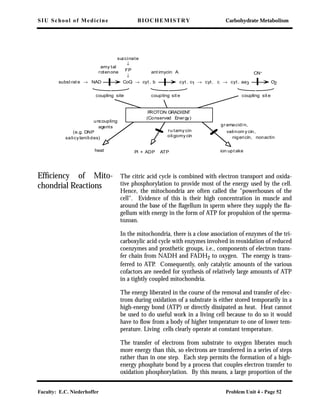
Objectives: 1. When given the name of an enzyme of the tricarboxylic acid
cycle, write the reaction catalyzed by that enzyme, including the
coenzymes required, their reaction, if any, and structure of the
substrate(s) and product(s).
2. Pyruvate dehydrogenase and the TCA cycle are regulated by
acetyl CoA, NADH, GTP, AMP, ADP and succinyl CoA. Ratio-
nalize why these particular compounds might be used for this
purpose.
3. Write structures for ATP and ADP.
4. Describe the function of the TCA cycle. What metabolic path-
ways (e.g., carbohydrate, lipid, etc.) is the TCA cycle coupled to?
5. Describe the effect the following inhibitors on both ATP pro-
duction and electron transport: rotenone, amytal, antimycin A,
cyanide, CO, oligomycin, 2,4-dinitrophenol, valinomycin,
gramicidin. What is the difference between uncoupler and ETC
inhibitor?
6. Identify the components of the respiratory chain. On a diagram,
indicate the coupling sites for ATP formation and the points of
action of each of the inhibitors listed in 6. Justify the P/O ratios
for NADH, FADH2 and metabolites that lead to the formation
of these reduced coenzymes.
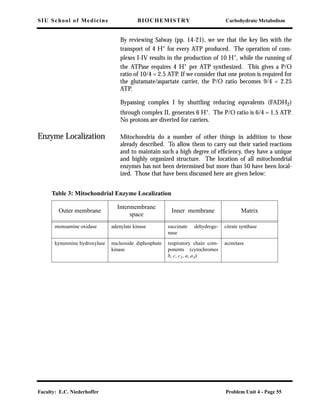
7. Describe the chemiosmotic mechanism for oxidative phosphory-
lation.
8. What is substrate-level phosphorylation and how is it different
from oxidative phosphorylation?
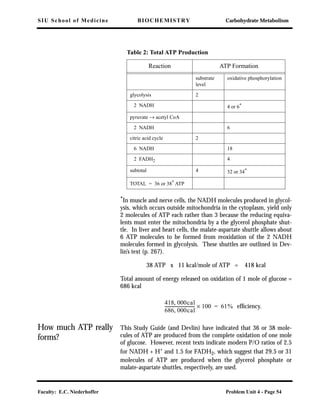
9. Why is there a difference in the amount of ATP generated from
the aerobic oxidation of one molecule of glucose and one glucose
residue in glycogen?
SIU School of Medicine BIOCHEMISTRY Carbohydrate Metabolism
Faculty: E.C. Niederhoffer Problem Unit 4 - Page 35
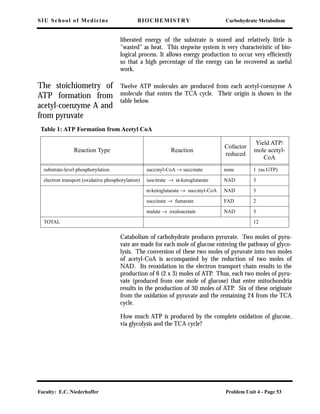
10. Show how oxidation of one molecule of acetyl coenzyme A can
yield 12 ATP molecules.
11. How do the concentrations of ATP, ADP, and Pi differ during
aerobic and anaerobic metabolism?
12. Describe the relationship of the following coenzymes to the B
vitamins:
coenzyme A
FAD
FMN
lipoic acid
NAD
TPP
13. Use the above objectives and previous objectives to solve new
problems. For examples, see the problem set for this Problem
Unit.
14. Define, describe and be able to identify the correct and incorrect
use of each of the terms in the Nomenclature and Vocabulary
list.
Nomenclature and
Vocabulary:
2,4-dinitrophenol α-ketoglutarate dehydrogenase
a-ketoglutarate acetaldehyde
acetyl CoA aconitase
amytal antimycin A
chemiosmotic coupling citrate synthase
citric acid cycle citrate
CO CO2
coenzyme A coenzyme Q
coupling site cristae
cyanide cytochrome aa3
cytochrome b cytochrome c1
cytochrome c cytochrome oxidase
cytochromes electron transport chain
ethanol F1F0 ATPase
FAD FADH2
flavoprotein FMN
fumarase fumarate
SIU School of Medicine BIOCHEMISTRY Carbohydrate Metabolism
Faculty: E.C. Niederhoffer Problem Unit 4 - Page 36
gramicidin GTP
heme ionophore
iron-sulfur proteins isocitrate
isocitrate dehydrogenase lipoic acid
malate malate dehydrogenase
mitochondrial inner membrane mitochondrial matrix
mitochondrial outer membrane multienzyme complex
nigericin non-heme-iron protein
oligomycin oxaloacetate
oxidative phosphorylation P/O ratio
protoporphyrin IX proton concentration gradient
proton motive force proton pump
pyruvate dehydrogenase complex reducing equivalents
respiratory chain rotenone
substrate-level phosphorylation succinate
succinate dehydrogenase succinyl CoA
thiamine pyrophosphate (TPP) ubiquinone
uncoupling agent valinomycin
STUDY GUIDE - II
The main function of the Tricarboxylic Acid (TCA), Krebs, or Cit-
ric Acid Cycle, as it is variously called, is to produce the reduced
coenzymes NADH and FADH2. These compounds are used to sup-
ply reducing equivalents for the respiratory chain, which in turn leads
to ATP formation for the cell's energy needs. The production of
NADH and FADH2 (hydrogen carriers) is accomplished by coupling
the reduction of NAD+
and FAD with the oxidation of intermediates
of the TCA cycle.
The TCA cycle plays a central role in the catabolism of many com-
pounds. The food we eat consists mainly of carbohydrates, fats, and
proteins. Each of these is eventually degraded to less complex mole-
cules (catabolism) which are then oxidized to carbon dioxide and
reducing equivalents in the TCA cycle. Carbohydrates are degraded
to a three carbon compound, pyruvate. (At physiological pH pyruvic
acid occurs as the carboxylate anion). Fatty acids from lipids are bro-
ken down to produce reducing equivalents and acetyl CoA, a two-
carbon derivative with the skeleton of acetic acid. Proteins are
SIU School of Medicine BIOCHEMISTRY Carbohydrate Metabolism
Faculty: E.C. Niederhoffer Problem Unit 4 - Page 37
metabolized to amino acids which are converted to simpler α-keto
acids. These can enter the TCA cycle and eventually yield reducing
equivalents and CO2. Our discussion for the present will be limited
to carbohydrates and the TCA cycle, but you should be aware that
the TCA cycle is a focal point of much of metabolism.
Carbohydrates (e.g., glucose) are converted to pyruvate by glycolysis.
Glycolysis takes place in the soluble cytoplasm outside the mitochon-
dria. The TCA cycle enzymes and the respiratory chain occur inside
the mitochondria. Pyruvate, unlike other intermediates of glycolysis,
can enter the mitochondria. (It is worth noting that the other inter-
mediates of glycolysis are phosphorylated and hence are highly polar
and, therefore, unable to cross the mitochondrial membrane by pas-
sive transport. There are no active transport systems for these phos-
phorylated intermediates.)
Mitochondria The mitochondrion is an intracellular organelle which houses all of
the enzymes that are involved in oxidative metabolism of sugars (and
fatty acids). It is the machine which utilizes oxygen and thus is
responsible for our reliance on oxygen. It is also the site of CO2 pro-
duction. The mitochondrion is composed of two membranes. The
outer membrane is highly permeable due to the presence of a protein
called porin that creates pores permitting passage of molecules on the
order of 10,000 Daltons or less. The inner membrane is highly con-
voluted leading to the appearance of “fingers” in electron microscopic
images. These are the so-called cristae. The space between the fin-
gers, i.e. the inner space of the mitochondrion or matrix, is a highly
crowded aqueous gel with less than 50% water. This is the location
of the TCA cycle enzymes. The oxidative phosphorylation proteins
reside in the inner mitochondrial membrane. The convolutions pre-
sumably increase the surface area of the inner membrane in increase
the proximity of the TCA cycle proteins to the oxidative phosphory-
lation machinery, thereby increasing the speed by which pyruvate can
be oxidized and ATP can be produced.
ATP The ultimate purpose of the complete oxidation of carbohydrate via
glycolysis and the TCA cycle to carbon dioxide and water is to trans-
fer the chemical energy of the sugar to adenosine triphosphate (ATP).
ATP contains a high energy bond between its second and third phos-
phates. A high energy bond is one that releases more than 4-5 kcal/
mole of energy upon hydrolysis. The standard state free energy of
hydrolysis of the terminal phosphate of ATP is -7.3 kcal/mol. How-
ever, standard state free energies are those that would be observed if
all of the products and reactants are at 1.0 M concentration. Since
SIU School of Medicine BIOCHEMISTRY Carbohydrate Metabolism
Faculty: E.C. Niederhoffer Problem Unit 4 - Page 38
this is not the situation in vivo (see Table 1 in Module I), this is not
the energy of hydrolysis in a cell. The actual free energy is given by
where ∆G° is the standard state free energy, R is the gas constant
(1.99 cal/deg/mol), T is the temperature in Kelvin (i.e. 273.15 plus
the temperature in Celsius), and [ATP], [ADP], and [P] are the con-
centrations of ATP, ADP, and Pi in the cell. In most cells, the con-
centrations of ATP, ADP, and Pi are such that the ∆G is on the order
of -10 to -13 kcal/mol.
When a chemical change takes place, the maximum energy available
for useful work is the decrease in free energy (∆G) which accompa-
nies the change, under the conditions of temperature and concentra-
tion at the time of the change. The free energy that is released by
ATP hydrolysis may be captured for useful work in the cell, e.g., syn-
thesis of a new bond, active transport, transmission of an impulse
along a nerve, and muscular movement.
As we have seen, there are many phosphorylated compounds involved
in metabolism. Phosphorylated proteins were discussed in the previ-
ous section under the regulation of glycogenolysis. Monophosphate
esters such as these are low energy compounds and are not important
in energy transfer. The greater the release of free energy generated
during the hydrolytic release of Pi, the greater the free energy stored
in the original bond and the greater the phosphate group transfer
potential, i.e., if X~Pi has a greater phosphate potential than ATP,
then the following reaction is possible: X~Pi + ADP → X + ATP,
while the reverse does not occur to as great an extent. If Y-Pi has a
lower phosphate group transfer potential than ATP, the following
reaction is possible: ATP + Y → ADP + Y-Pi, and the reverse is not
favored.
Thus the phosphate group transfer potential indicates the direction
of flow of phosphate groups from donors of high transfer potential to
an acceptor which forms a compound of lower phosphate group
transfer potential. ATP has an intermediate value in the scale of
phosphate group transfer potential. The ATP-ADP system can there-
fore accept Pi from high potential systems and transfer Pi to acceptor
systems of low potential.
∆G ∆G° RT
ADP[ ] P[ ]
ATP[ ]
--------------------------ln+=
SIU School of Medicine BIOCHEMISTRY Carbohydrate Metabolism
Faculty: E.C. Niederhoffer Problem Unit 4 - Page 39
Enzymes using or making ATP always employ Mg2+
. ATP and ADP
can pass freely in and out of mitochondria via an adenine nucleotide
translocase which is an antiport transport protein for ATP and ADP.
(In tightly coupled mitochondria, the rate of ADP entry controls the
rate of oxygen consumption.)
Pyruvate dehydroge-
nase
Pyruvate dehydrogenase links glycolysis to the TCA cycle. It is a
large multienzyme complex made up of 5 enzymatic activities (in
three different proteins) and uses 5 coenzymes: thiamine pyrophos-
phate, lipoic acid, FAD, NAD, Coenzyme A. It is a key utilizer of a
number of vitamins. Thiamine pyrophosphate is the coenzyme for
most oxidative decarboxylations. Hence, it is sometimes called co-
carboxylase. Lipoic acid is a cofactor, typically associated with thia-
mine pyrophosphate, that functions in redox reactions while attached
to an enzyme by an amide linkage to the ε-amino group of a lysine
residue.
Pyruvate dehydrogenase performs the oxidation of pyruvate to acetyl
CoA with the liberation of CO2. Note that this is the first point in
the “burning” of sugar where CO2 appears. Essentially the three car-
bon fragments produced by aldolase have now been converted to an
acetyl group attached to Coenzyme A and free CO2. The acetyl CoA
will now enter the TCA cycle to be further oxidized.
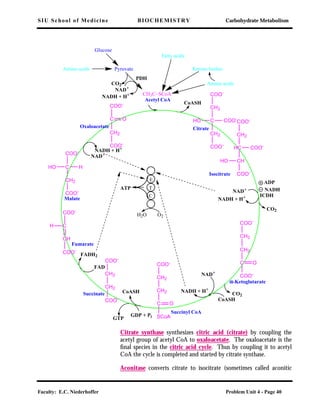
TCA Cycle The TCA (tricarboxylic acid) cycle consists of a closed circle of reac-
tions starting with using oxaloacetate and acetyl CoA to form citrate
and ending with reformation of oxaloacetate. The two carbons of the
acetyl group in acetyl CoA are liberated as CO2. The reducing equiv-
alents obtained from the oxidation are passed on to the electron
transport chain to be converted into ATP.
SIU School of Medicine BIOCHEMISTRY Carbohydrate Metabolism
Faculty: E.C. Niederhoffer Problem Unit 4 - Page 40
Citrate synthase synthesizes citric acid (citrate) by coupling the
acetyl group of acetyl CoA to oxaloacetate. The oxaloacetate is the
final species in the citric acid cycle. Thus by coupling it to acetyl
CoA the cycle is completed and started by citrate synthase.
Aconitase converts citrate to isocitrate (sometimes called aconitic
COO-
C
CH2
COO-
O
COO-
C
CH2
COO-
HHO
COO-
C
CH
COO-
H
COO-
CH2
CH2
COO-
COO-
CH2
CH2
C
SCoA
O
COO-
CH2
CH2
C
COO-
O
COO-
CH2
HC
CH
COO-
COO-
HO
COO-
CH2
C
CH2
COO-
COO-
HO
CoASH
Oxaloacetate
Malate
Fumarate
Succinate
Succinyl CoA
αααα-Ketoglutarate
Isocitrate
Citrate
NAD+
NADH + H+
FAD
FADH2
CoASH
GTP
GDP + Pi
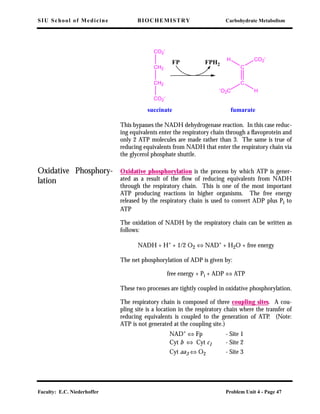
NADH + H+
NAD+
CoASH
CO2
NAD+
CO2
NADH + H+ ICDH
ADP
NADH
E
ATP T
C
H2O O2
Amino acids
Glucose
Pyruvate
PDH
NAD+
CO2
NADH + H+
Ketone bodies
Fatty acids
Amino acids
Acetyl CoA
CH3C~SCoA
SIU School of Medicine BIOCHEMISTRY Carbohydrate Metabolism
Faculty: E.C. Niederhoffer Problem Unit 4 - Page 41
acid, thus the name of the enzyme).
Isocitrate dehydrogenase oxidizes isocitrate to α-ketoglutarate with
the concomitant release of CO2. This is the second molecule of CO2
released in the breakdown of the three carbon fragments of glucose.
The reducing equivalents from the oxidation are captured in NADH.
α-ketoglutarate is similar to pyruvate and α-ketoglutarate dehy-
drogenase catalyses an oxidation similar to that catalyzed by pyruvate
dehydrogenase yielding succinyl CoA, the final molecule of CO2, and
reducing equivalents are captured in NADH.
Succinyl CoA synthase converts succinyl CoA to succinic acid and
the energy of the CoA derivative is captured by the coupled synthesis
of GTP, the guanosine analog of ATP. This is another example of
substrate level phosphorylation since the formation of GTP does
not require the electron transport chain of the mitochondria.
Succinate dehydrogenase differs from the other enzymes in the TCA
cycle in that it is an integral membrane protein in the mitochondria.
It is also a flavoprotein. The reducing equivalents are captured in
FADH2, not NADH, and are fed directly into the electron transport
chain. The product of the oxidation of succinate is fumarate.
Fumarase catalyzes the isomerization of fumarate to malate. There
is no energy change associated with this reaction. This is simply a
conversion necessary for the last oxidation.
Malate dehydrogenase oxidizes malate to oxaloacetate. The reduc-
ing equivalents are put into NADH. The resulting oxaloacetate is
now ready to react with another incoming acetyl CoA to begin the
cycle again.
Note that there is no oxygen is utilized in the TCA cycle. Oxygen
enters oxidative metabolism at the very last step (see cytochrome
oxidase below).
Regulation of the TCA
cycle
There are four primary points of regulation of the citric acid cycle
(see the figure below; red circles are points of inhibition, red dashed
lines signify inhibitory intermediates of the pathway, green circles are
activators). One is prior to entry at the pyruvate dehydrogenase com-
plex. The specific pyruvate dehydrogenase component of this com-
plex is inhibited by GTP and activated by AMP. The enzyme
complex is also controlled by covalent modification. It is inactive
when the pyruvate dehydrogenase component is phosphorylated by a
specific kinase which is part of the complex. The enzyme complex is
SIU School of Medicine BIOCHEMISTRY Carbohydrate Metabolism
Faculty: E.C. Niederhoffer Problem Unit 4 - Page 42
inactive until the phosphoryl group is removed by a specific phos-
phatase. The kinase is inhibited by pyruvate and ADP. Thus,
increased levels of pyruvate act to activate the dehydrogenase activity
by inhibiting the kinase. Finally, the products, acetyl coenzyme A
and NADH inhibit the complex directly by product inhibition.
Citrate synthase provides another control point. It is inhibited by
citrate and to a lesser extent by NADH. Succinyl-CoA competes
with acetyl-CoA for the enzyme. Please note that Devlin (p. 233)
indicates that the purified enzyme is inhibited by ATP, NADH, succi-
nyl-CoA, and long-chain acyl-CoA derivatives.
Another regulatory enzyme is isocitrate dehydrogenase. ADP is an
allosteric activator of this enzyme, while ATP inhibits the enzyme.
NADH inhibits it by directly displacing NAD+
.
pyruvate
Ca2+
citrate
isocitrate
αααα-ketoglutarate
Ca2+
,
ADP
Ca2+
succinyl-CoA
succinate
fumarate
malate
oxaloacetate
NADH
GTP
ATP
acetyl-CoA
SIU School of Medicine BIOCHEMISTRY Carbohydrate Metabolism
Faculty: E.C. Niederhoffer Problem Unit 4 - Page 43
The last point of control is α-ketoglutarate dehydrogenase, which is
inhibited by GTP (ATP), NADH (product inhibition), and succinyl-
CoA. This is another multienzyme complex and some of its compo-
nents are the same as those in the pyruvate dehydrogenase complex.
Figure 6.23 in Devlin (p. 239) illustrates some of these controls. The
cycle, whose main purpose is to produce ATP when coupled with the
respiratory chain and oxidative phosphorylation, is inhibited by the
high-energy compounds GTP and ATP, by the product that feeds
into the respiratory chain (NADH) and by specific intermediates
(acetyl-CoA and succinyl-CoA); it is stimulated by the products of
ATP utilization (ADP and AMP) and by pyruvate which feeds into
the cycle.
Among inhibitors of the TCA cycle is the arsenite ion which inhibits
the pyruvate dehydrogenase and α-ketoglutarate dehydrogenase com-
plexes. (See Clinical Correlation 7.2 in Devlin, p.283)
Stoichiometry of the
TCA cycle
The citric acid cycle satisfies stoichiometric requirements for the
complete oxidation of pyruvate by oxygen to carbon dioxide and
water, viz.
Oxidation of pyruvate
CH3-CO-COO- + 5 [O] + H+ ⇔ 3 CO2 + 2 H2O
The uptake of 5 atoms of oxygen corresponds to the removal of 5
pairs of electrons during operation of the cycle. Later the electrons
are transferred to oxygen. Note that oxygen is not directly utilized in
the TCA cycle. Rather, it acts as the electron acceptor at the end of
the electron transport chain. For each atom of oxygen reduced, one
molecule of water is formed. Because 3 molecules of water are taken
up during operation of the cycle, the net change corresponds to the
formation of 2 moles of water per mole of pyruvate oxidized.
The Respiratory Chain The respiratory chain (or electron transport chain (ETC)) is a
group of proteins located in the inner membrane of the mitochondria
which channel reducing equivalents to oxygen. Reducing equiva-
lents are the electrons (and sometimes protons) which are lost by a
substrate when it is oxidized and, thus, are capable of reducing
another compound.
Electrons flow through the respiratory chain from a high energy level
to a low energy level, much as water flows downhill. The electron
transport chain serves as a conduit, or pipe, through which the reduc-
ing equivalents may flow, and simultaneously capture a portion of the
SIU School of Medicine BIOCHEMISTRY Carbohydrate Metabolism
Faculty: E.C. Niederhoffer Problem Unit 4 - Page 44
energy, similar to a turbine in a hydroelectric plant which converts
the downhill flow of water to electricity. In this case, the flow of
reducing equivalents is coupled to pumping protons across a mem-
brane to create a proton concentration gradient that can be utilized
elsewhere to do work and synthesize ATP. A pair of electrons and
two protons are removed from a substrate by a dehydrogenase, result-
ing in oxidation of the substrate. The electrons and one proton (from
NADH) are passed together through the first part of the chain to
coenzyme Q (ubiquinone). Then the electrons are passed through
the cytochrome system, finally reducing an atom of oxygen. The
reduction of oxygen by the reducing equivalents results in the forma-
tion of water:
[O] + 2 e- + 2 H+ ⇔ H2O
There are three questions that need to be considered:
a) where do the reducing equivalents which feed the respiratory
chain come from?;
b) what are the members of the respiratory chain which channel the
reducing equivalents?; and
c) what reactions are involved that permit the capture of energy?
The origin of reducing
equivalents
The product of glycolysis is pyruvate which is transported into the
mitochondria. Pyruvate releases energy during its oxidation to CO2
in the tricarboxylic acid cycle. The reducing equivalents then enter
the respiratory chain.
Biological oxidations, like any other oxidations, involve the loss of
electrons. Frequently, protons are lost at the same time, i.e., hydro-
gen atoms are removed. The enzymes that catalyze these reactions
are, therefore, called dehydrogenases. There must be an acceptor for
the electrons. When something is oxidized, something else must be
reduced. The actual electron acceptor in the dehydrogenases is one of
several coenzymes (usually NAD+
or FAD).
Dehydrogenases cata-
lyze the oxidation of
substrates
Many oxidation enzymes use NAD+
as a coenzyme. For example, the
enzyme alcohol dehydrogenase has NAD+ as a coenzyme and medi-
ates the following reaction.
CH3-CH2OH ⇔ CH3-CHO + 2 H+
+ 2 e-
ethanol acetaldehyde
(an alcohol) (an aldehyde)
SIU School of Medicine BIOCHEMISTRY Carbohydrate Metabolism
Faculty: E.C. Niederhoffer Problem Unit 4 - Page 45
In this reaction, ethanol looses two hydrogen atoms - two protons
and two electrons. These are the reducing equivalents (for further
details, see discussion of this in Module 1). One proton and two
electrons are transferred to NAD+
to give NADH, and H+
is left over
in solution. The overall reaction can be represented as:
Ethanol + NAD+ ⇔ Acetaldehyde + NADH + H+
NAD+ (NADH) is a pyridine nucleotide. It is non-covalently bound
to the dehydrogenase and may dissociate to transfer the reducing
equivalents to other sites, most importantly to the electron transport
chain.
Flavoproteins A flavoprotein is a protein whose coenzyme is either FAD (flavin
adenine dinucleotide) or FMN (flavin mononucleotide). FAD or
FMN may be covalently bound or loosely bound to enzymes,
depending on the particular enzyme. When FAD is reduced to
FADH2, the conversion involves the net addition of 2 hydrogen
atoms (i.e., 2 H).
Cytochromes and what
they do
Cytochromes are proteins that are found in virtually all aerobic
organisms. They contain a prosthetic group which is related to the
porphyrin ring system. The porphyrin molecule is a flat, conjugated,
aromatic and extremely stable ring system that can chelate metal ions.
They are highly colored compounds typically being yellow or orange.
It is the metal that participates in transferring reducing equivalents in
the cytochromes.
A variety of substituents are found around the perimeter of the rings.
In protoporphyrin there are 3 types of substituents on the ring which
allow 15 isomers. One isomer is called protoporphyrin IX. Proto-
porphyrin IX is part of the prosthetic group of cytochrome b (as well
as hemoglobin and myoglobin). The protoporphyrin ring in cyto-
chrome c is linked covalently to cysteine residues in the protein. A
complex between a protoporphyrin and Fe2+ is called heme. A com-
plex between a protoporphyrin and Fe3+ is called hemin. Hemoglo-
bin (the protein which transports oxygen in the blood) is a heme
compound, i.e., the Fe is in the 2+ state.
While the iron in hemoglobin remains as Fe2+ during its function,
when the cytochromes are oxidized, the iron changes from 2+ to 3+.
This may be represented as:
SIU School of Medicine BIOCHEMISTRY Carbohydrate Metabolism
Faculty: E.C. Niederhoffer Problem Unit 4 - Page 46
Cyt (Fe2+
) ⇔ Cyt (Fe3+
) + e-
There are several cytochromes in the respiratory chain, viz. b1, c1, c,
a, and a3. Thus, the oxidized form of cytochrome c1 is represented
as Cyt c1(Fe3+) while the reduced form of cytochrome c1 is repre-
sented as Cyt c1(Fe2+
).
Non-heme iron pro-
teins
Non-heme iron proteins contain iron which is not associated with a
porphyrin ring system. The iron is attached to the protein through
iron sulfur clusters, typically [2Fe-2S] or [4Fe-4S] clusters attached to
the protein by coordination with the sulfur of cysteine sulfhydryl
groups. Such proteins are often referred to as iron-sulfur proteins.
The iron atoms can transfer electrons by existing in either oxidized or
reduced states. They are usually closely associated with flavoproteins.
Four complexes in the
Chain
There are four protein complexes which make up the electron trans-
port chain. Complex I is the NADH dehydrogenase complex which
receives the reducing equivalents from NADH (from the TCA cycle).
It is a flavoprotein containing both FMN and non-heme iron (iron-
sulfur) centers. The reducing equivalents exit the complex and are
passed to CoQ, which is freely soluble in the mitochondrial mem-
brane and diffuses to Complex III. Complex II is the succinate dehy-
drogenase discussed below. The reducing equivalents from Complex
II are also passed to CoQ. Complex III is a cytochrome b and c1
complex, which accepts the electrons from ubiquinone (CoQ). The
electrons are passed from Complex III to cytochrome c, a protein
loosely associated with the membrane. Cytochrome c acts as an elec-
tron carrier to transport the electrons to Complex IV, also known as
cytochrome oxidase and contains cytochrome aa3. Cytochrome oxi-
dase catalyzes the reduction of O2 to H2O. This is the only point
where O2 is utilized in oxidative metabolism of sugars.
The respiratory chain
may be entered at two
points
Succinate feeds reducing equivalents directly into the chain via the
following reaction:
SIU School of Medicine BIOCHEMISTRY Carbohydrate Metabolism
Faculty: E.C. Niederhoffer Problem Unit 4 - Page 47
This bypasses the NADH dehydrogenase reaction. In this case reduc-
ing equivalents enter the respiratory chain through a flavoprotein and
only 2 ATP molecules are made rather than 3. The same is true of
reducing equivalents from NADH that enter the respiratory chain via
the glycerol phosphate shuttle.
Oxidative Phosphory-
lation
Oxidative phosphorylation is the process by which ATP is gener-
ated as a result of the flow of reducing equivalents from NADH
through the respiratory chain. This is one of the most important
ATP producing reactions in higher organisms. The free energy
released by the respiratory chain is used to convert ADP plus Pi to
ATP
The oxidation of NADH by the respiratory chain can be written as
follows:
NADH + H+
+ 1/2 O2 ⇔ NAD+
+ H2O + free energy
The net phosphorylation of ADP is given by:
free energy + Pi + ADP ⇔ ATP
These two processes are tightly coupled in oxidative phosphorylation.
The respiratory chain is composed of three coupling sites. A cou-
pling site is a location in the respiratory chain where the transfer of
reducing equivalents is coupled to the generation of ATP. (Note:
ATP is not generated at the coupling site.)
NAD+ ⇔ Fp - Site 1
Cyt b ⇔ Cyt c1 - Site 2
Cyt aa3 ⇔ O2 - Site 3
CO2
-
CH2
CH2
CO2
-
C
C
CO2
-
H
-
O2C H
FP FPH2
succinate fumarate
SIU School of Medicine BIOCHEMISTRY Carbohydrate Metabolism
Faculty: E.C. Niederhoffer Problem Unit 4 - Page 48
There are two electron carriers that bridge these sites – CoQ between
site 1 and site 2 and cyt c between site 2 and site 3. O2 is the ultimate
electron acceptor after site 3.
When all three coupling sites are utilized, the maximum yield of
ATP per 1/2 O2 used is 3. The ratio (Pi converted to ATP) / (1/2 O2
[flux of 2e]) is called the P/O ratio.
The decline in free energy as electron pairs
flow down the respiratory chain to oxygen.
Each of the three segments yields sufficient
energy to generate a molecule of ATP from
ADP and phosphate
kcal
Q
b
a
c
NAD
50
40
30
20
10
0.27 V
12.2 kcal
0.22 V
9.9 kcal
0.59 V
23.0 kcal
-∆G°'
Substrate
NAD
Flavoprotein
Cytochromes
Oxygen
A schematic view of the
free-energy changes associated
with the oxidative pathway
SIU School of Medicine BIOCHEMISTRY Carbohydrate Metabolism
Faculty: E.C. Niederhoffer Problem Unit 4 - Page 49
Note that the P/O ratio is 2 (maximum yield of ATP per 1/2 O2
used is 2) for the oxidation of succinate since the reducing equiva-
lents enter the respiratory chain after the first coupling site.
The efficiency of oxidative phosphorylation is not the same for each
coupling site. The diagrams above show the decline in free energy as
electron pairs flow down the respiratory chain to oxygen and the
three segments that yield sufficient energy to generate a molecule of
ATP.
Oxidative phosphorylation is coupled to the electron transport chain
via a proton concentration gradient using a chemiosmotic cou-
pling mechanism (see figure above). The three "coupling sites” in
the respiratory chain actually contain proton pumps such that elec-
tron transport through the site results in a pumping of protons across
the mitochondrial membrane from the matrix into the cytosolic
space. This results in a proton concentration gradient or proton
motive force across the inner mitochondrial membrane. The
H+
H+
H+H+
H+
H+
H+
H+
H+
H+
H+ H+
H+
H+
H+
H+
H+
H+
H+
O2
H2O
H+
H+H+
H+
H+
H+
H+
Cytosol Mitochondrial Matrix
F1F0 ATPase
Electron Transport Chain
NADH
NAD+
H+
H+
H+
H+
H+
H+
H+
H+
CChheemmiioossmmoottiicc CCoouupplliinngg ooff tthhee
EElleeccttrroonn TTrraannssppoorrtt CChhaaiinn ttoo tthhee FF11 FF00 AATTPPaassee
outer mitochondrial
membrane
inner mitochondrial
membrane
e-
ADP + Pi
ATP
H+
H+
SIU School of Medicine BIOCHEMISTRY Carbohydrate Metabolism
Faculty: E.C. Niederhoffer Problem Unit 4 - Page 50
increased concentration of protons in the cytosol creates an osmotic
force or potential across the membrane attempting to drive the pro-
tons back to equilibrium (i.e. equal concentrations on both sides).
The situation is similar to a battery in that the energy of the reducing
equivalents is stored in a proton concentration gradient. Maintain-
ing the concentration gradient is similar to the charging of a battery.
The drive to dissipate the non-equilibrium state across the membrane
pushes protons through any available pore in the inner mitochondrial
membrane. The most important here is the F1F0 ATPase. A proton
passing through the ATPase is tighty coupled to the synthesis of ATP.
This is the site of ATP synthesis in oxidative phosphorylation, a site
distinct from the electron transport chain and the TCA cycle, but
coupled to them via the proton concentration gradient across the
mitochondrial membrane. ATPase are normally thought of as
enzymes which break down ATP to do work. This one functions in
the “reverse” direction to use the energy of proton flux to make ATP.
Coupled and uncou-
pled mitochondria
The flux of reducing equivalents through a coupling site leads to
proton pumping across the membrane, and ultimately causes Pi +
ADP to form ATP. Since the flux of reducing equivalents is geared to
the formation of ATP, a restriction at any part of the flow, or a lack of
any single necessary component (such as ADP), could stop the pro-
cess. If ADP is left out and the available ATP is consumed, will there
be increased uptake of oxygen to produce more ATP? The answer is
normally "no", even though all other components are present (sub-
strate, oxygen, mitochondria, buffer, Pi), because the cycle needs
ADP to allow a flux of reducing equivalents. Such mitochondria are
called tightly coupled.
The coupling mechanism imposes a restraint on the flux of reducing
equivalents. Reducing equivalents cannot flow through the ETC if
all of the necessary components are not available further along in the
mechanism. Thus, if ADP or Pi are diminished there will be no
uptake of oxygen since there is no flow of protons through the F1F0
ATPase, the proton gradient is maximally charged, and so the flux of
reducing equivalents through the respiratory chain comes to a halt.
2,4-Dinitrophenol (DNP) is a classic uncoupling agent. DNP
functions by allowing H+'s to pass through the membrane and bypass
the F1F0 ATPase. It is observed that when DNP is added to a system
such as that described in the preceding paragraph, there is a sudden
burst of respiration (oxygen uptake). Clearly, in the presence of
DNP, the obligatory formation of ATP from ADP plus Pi no longer
imposes a restraint on the flux of reducing equivalents through the
respiratory chain, i.e., the flux of reducing equivalents is no longer
SIU School of Medicine BIOCHEMISTRY Carbohydrate Metabolism
Faculty: E.C. Niederhoffer Problem Unit 4 - Page 51
coupled to the formation of ATP. The energy (chemical potential)
generated by the flow of reducing equivalents can no longer be used
to join Pi to ADP. Such mitochondria are said to be uncoupled and
DNP is called an uncoupling agent. In other words, in the presence
of DNP, the transfer of electrons from NADH or FADH2 to oxygen
is no longer coupled to the production of ATP, and no ATP is made.
Ionophores Since the protons used to create the chemiosmotic force across the
inner mitochondrial membrane have a positive charge, there is an
electric component to the energy difference that makes the outside
positively charged relative to the inside of the mitochondrion. Iono-
phores can perturb or dissipate the electric component of the chemi-
osmotic gradient by transporting ions across the mitochondrial
membrane. Valinomycin is an ionophore with high specificity for
K+
. Note that if there is pre-existing K+
gradient, valinomycin will
generate a potential across the membrane, i.e. it can be electrogenic.
Nigericin can move K+
and H+
ions in opposite directions, i.e. it is
an electroneutral antiporter. Gramicidin forms a channel in the
membrane with little specificity. It therefore can dissipate both a pH
and charge gradient across the membrane.
Inhibition of ATP for-
mation
Besides uncoupling agents, there are also respiratory inhibitors and
inhibitors of phosphorylation. Respiratory inhibitors are compounds
that prevent the flow of electrons through the chain. Cyanide and
carbon monoxide (CO) are two; they bind to cyt aa3 and prevent
the flow of electron from cyt aa3 to oxygen. Another is the antibiotic
antimycin which blocks the flux of reducing equivalents from cyt b
to cyt c1. Other respiratory inhibitors are rotenone and amytal
which block site I.
Inhibitors of phosphorylation block oxidative phosphorylation. Two
of these are the antibiotics oligomycin and rutamycin. These func-
tion by acting at the F1F0 ATPase level preventing its function.
These relationships are diagrammed in the Figure below.
SIU School of Medicine BIOCHEMISTRY Carbohydrate Metabolism
Faculty: E.C. Niederhoffer Problem Unit 4 - Page 52
Efficiency of Mito-
chondrial Reactions
The citric acid cycle is combined with electron transport and oxida-
tive phosphorylation to provide most of the energy used by the cell.
Hence, the mitochondria are often called the "powerhouses of the
cell". Evidence of this is their high concentration in muscle and
around the base of the flagellum in sperm where they supply the fla-
gellum with energy in the form of ATP for propulsion of the sperma-
tozoan.
In the mitochondria, there is a close association of enzymes of the tri-
carboxylic acid cycle with enzymes involved in reoxidation of reduced
coenzymes and prosthetic groups, i.e., components of electron trans-
fer chain from NADH and FADH2 to oxygen. The energy is trans-
ferred to ATP. Consequently, only catalytic amounts of the various
cofactors are needed for synthesis of relatively large amounts of ATP
in a tightly coupled mitochondria.
The energy liberated in the course of the removal and transfer of elec-
trons during oxidation of a substrate is either stored temporarily in a
high-energy bond (ATP) or directly dissipated as heat. Heat cannot
be used to do useful work in a living cell because to do so it would
have to flow from a body of higher temperature to one of lower tem-
perature. Living cells clearly operate at constant temperature.
The transfer of electrons from substrate to oxygen liberates much
more energy than this, so electrons are transferred in a series of steps
rather than in one step. Each step permits the formation of a high-
energy phosphate bond by a process that couples electron transfer to
oxidation phosphorylation. By this means, a large proportion of the
subst rat e → NAD CoQ → cyt . b cyt . c1 → cyt. c → cyt . aa3 O2
amy tal
rotenone ant imycin A CN-
succinate
↓
FP
↓
coupling site coupling sit e coupling sit e
PROTON GRADIENT
(Conserved Energy)
uncoupling
agents gramacidin,
valinom y cin,
nigericin, nonactin
ion upt akeheat Pi + ADP ATP
ru tamy cin
oligomy cin
(e.g. DNP
salicylanilides)
SIU School of Medicine BIOCHEMISTRY Carbohydrate Metabolism
Faculty: E.C. Niederhoffer Problem Unit 4 - Page 53
liberated energy of the substrate is stored and relatively little is
"wasted" as heat. This stepwise system is very characteristic of bio-
logical process. It allows energy production to occur very efficiently
so that a high percentage of the energy can be recovered as useful
work.
The stoichiometry of
ATP formation from
acetyl-coenzyme A and
from pyruvate
Twelve ATP molecules are produced from each acetyl-coenzyme A
molecule that enters the TCA cycle. Their origin is shown in the
table below.
Catabolism of carbohydrate produces pyruvate. Two moles of pyru-
vate are made for each mole of glucose entering the pathway of glyco-
lysis. The conversion of these two moles of pyruvate into two moles
of acetyl-CoA is accompanied by the reduction of two moles of
NAD. Its reoxidation in the electron transport chain results in the
production of 6 (2 x 3) moles of ATP. Thus, each two moles of pyru-
vate (produced from one mole of glucose) that enter mitochondria
results in the production of 30 moles of ATP. Six of these originate
from the oxidation of pyruvate and the remaining 24 from the TCA
cycle.
How much ATP is produced by the complete oxidation of glucose,
via glycolysis and the TCA cycle?
Table 1: ATP Formation from Acetyl CoA
Reaction Type Reaction
Cofactor
reduced
Yield ATP/
mole acetyl-
CoA
substrate-level phosphorylation succinyl-CoA → succinate none 1 (as GTP)
electron transport (oxidative phosphorylation) isocitrate → α-ketoglutarate NAD 3
α-ketoglutarate → succinyl-CoA NAD 3
succinate → fumarate FAD 2
malate → oxaloacetate NAD 3
TOTAL 12
SIU School of Medicine BIOCHEMISTRY Carbohydrate Metabolism
Faculty: E.C. Niederhoffer Problem Unit 4 - Page 54
*
In muscle and nerve cells, the NADH molecules produced in glycol-
ysis, which occurs outside mitochondria in the cytoplasm, yield only
2 molecules of ATP each rather than 3 because the reducing equiva-
lents must enter the mitochondria by a the glycerol phosphate shut-
tle. In liver and heart cells, the malate-aspartate shuttle allows about
6 ATP molecules to be formed from reoxidation of the 2 NADH
molecules formed in glycolysis. These shuttles are outlined in Dev-
lin’s text (p. 267).
38 ATP x 11 kcal/mole of ATP = 418 kcal
Total amount of energy released on oxidation of 1 mole of glucose =
686 kcal
efficiency.
How much ATP really
forms?
This Study Guide (and Devlin) have indicated that 36 or 38 mole-
cules of ATP are produced from the complete oxidation of one mole
of glucose. However, recent texts indicate modern P/O ratios of 2.5
for NADH + H+ and 1.5 for FADH2, which suggest that 29.5 or 31
molecules of ATP are produced when the glycerol phosphate or
malate-aspartate shuttles, respectively, are used.
Table 2: Total ATP Production
Reaction ATP Formation
substrate
level
oxidative phosphorylation
glycolysis 2
2 NADH 4 or 6*
pyruvate → acetyl CoA
2 NADH 6
citric acid cycle 2
6 NADH 18
2 FADH2 4
subtotal 4 32 or 34*
TOTAL = 36 or 38*
ATP
418 000cal,
686 000cal,
----------------------------- 100× 61%=
SIU School of Medicine BIOCHEMISTRY Carbohydrate Metabolism
Faculty: E.C. Niederhoffer Problem Unit 4 - Page 55
By reviewing Salway (pp. 14-21), we see that the key lies with the
transport of 4 H+
for every ATP produced. The operation of com-
plexes I-IV results in the production of 10 H+, while the running of
the ATPase requires 4 H+ per ATP synthesized. This gives a P/O
ratio of 10/4 = 2.5 ATP. If we consider that one proton is required for
the glutamate/aspartate carrier, the P/O ratio becomes 9/4 = 2.25
ATP.
Bypassing complex I by shuttling reducing equvalents (FADH2)
through complex II, generates 6 H+. The P/O ratio is 6/4 = 1.5 ATP.
No protons are diverted for carriers.
Enzyme Localization Mitochondria do a number of other things in addition to those
already described. To allow them to carry out their varied reactions
and to maintain such a high degree of efficiency, they have a unique
and highly organized structure. The location of all mitochondrial
enzymes has not been determined but more than 50 have been local-
ized. Those that have been discussed here are given below:
Table 3: Mitochondrial Enzyme Localization
Outer membrane
Intermembrane
space
Inner membrane Matrix
monoamine oxidase adenylate kinase succinate dehydroge-
nase
citrate synthase
kynurenine hydroxylase nucleoside diphosphate
kinase
respiratory chain com-
ponents (cytochromes
b, c, c1, a, a3)
aconitase
SIU School of Medicine BIOCHEMISTRY Carbohydrate Metabolism
Faculty: E.C. Niederhoffer Problem Unit 4 - Page 56
Pyruvate dehydrogenase and α-ketoglutarate have been located in the
matrix.
The enzymes of the respiratory chain and oxidative phosphorylation
are located on the inner membrane, while many of the enzymes of the
TCA cycle, but not all, are located in the matrix.
None of the enzymes of the TCA cycle, the respiratory chain, or oxi-
dative phosphorylation have been found in the outer membrane or
the intermembrane space (outer compartment).
See Devlin, pp. 238-246 for a description of mitochondrial structure
and transport systems.
nucleoside diphosphate
kinase
mitochondrial α-glyc-
erol phosphate dehy-
drogenase
(flavoprotein)
isocitrate dehydroge-
nase
phospholipase A F1-ATPase fumarase
fatty acyl-CoA syn-
thetases
NADH dehydrogenase malate dehydrogenase
NADH: cytochrome c
reductase (rotenone
insensitive)
β-hydroxybutyrate
dehydrogenase
pyruvate dehydroge-
nase
choline phosphotrans-
ferase
carnitine: acyl-CoA
transferase
α-ketoglutarate dehy-
drogenase
adenine nucleotide
translocase
succinyl-CoA syn-
thetase
mono, di, and tricarbox-
ylate translocase
malate dehydrogenase
glutamate-aspartate
translocase
fatty acid oxidation sys-
tem
glutamate dehydroge-
nase
glutamate-oxaloacetate
transaminase
ornithine transcarbam-
oylase
Table 3: Mitochondrial Enzyme Localization
Outer membrane
Intermembrane
space
Inner membrane Matrix
SIU School of Medicine BIOCHEMISTRY Carbohydrate Metabolism
Faculty: E.C. Niederhoffer Problem Unit 4 - Page 57
Glycerol Phosphate
Shuttle
The α-glycerol phosphate shuttle operates in muscle and nerve to
move reducing equivalents from the cytoplasm (generated by glycoly-
sis) into mitochondria. An outline is given in the figure below. The
reducing equivalents from NADH are transferred to α-glycerol phos-
phate by reducing dihyroxyacetone phosphate using the cytosolic
glycerol phosphate dehydrogenase. α-glycerol phosphate then dif-
fuses to the inner mitochondrial membrane where there is a mem-
brane bound mitochondrial glycerol phosphate dehydrogenase. The
previous reaction is reversed so that now the glycerol phosphate is
oxidized and the reducing equivalents are injected into the electron
transport chain at site II. This recycles the dihydroxyacetone phos-
phate permitting more NADH to be oxidized and more reducing
equivalents to be moved into the mitochondria. Note that by enter-
ing the electron transport chain at site II, the traditional P/O ratio is
decreased to 2 maximum, i.e. only 2 ATP are made per NADH oxi-
dized. Recall that the modern P/O ratio is 6/4 = 1.5 for the glycerol
phosphate shuttle.
Malate-Aspartate Shut-
tle
The malate-aspartate shuttle functions in liver and heart to move
reducing equivalents from the cytoplasm into the mitochondria. Two
different transporters exchange glutamate with aspartate and malate
with α-ketoglutarate. A transaminase in the mitochondrial matrix
permits the transfer of an amino group from glutamate to oxaloace-
tate to make α-ketoglutarate and aspartate. The reverse process
occurs in the cytosol. Malate dehydrogenases in both the cytosol and
Inner mitochondrial membrane
cytoplasmic sideNADH NAD+
phosphate α-glycerol phosphate
dihydroxy acetone
phosphate
cytochrome b
e-
αα--ggllyycceerrooll pphhoosspphhaattee sshhuuttttllee
mitochondrial α−glycerol
phosphate dehydrogenase
reducing equivalents
dihydroxy acetone
cytosolic α-glycerol phosphate dehydrogenase
matrix side
SIU School of Medicine BIOCHEMISTRY Carbohydrate Metabolism
Faculty: E.C. Niederhoffer Problem Unit 4 - Page 58
matrix permit the interconversion of malate and oxaloacetate. The
net reaction is the movement of reducing equivalents in NADH from
the cytosol to the matrix where it can be utilized at the electron trans-
port chain. Since the product is NADH in the matrix, this can enter
site I in the electron transport chain and give a maximum of 3 ATP’s
per NADH, or a P/O ratio of 3. Recall that the modern P/O ratio is
10/4 = 2.5.
glutamate glutamate
aspartateaspartate
oxaloacetate
α-ketoglutarate
malatemalate
oxaloacetate
α-ketoglutarateoxaloacetate
NNAADDHH
NAD+
glutamate-oxaloacetate
transaminase
glutamate
NAD+
glutamate-
oxaloacetate
transaminase
Inner mitochondrial membrane
malate
dehydrogenase
malate
dehydrogenase
cytosolic side matrix side
glutamate-aspartate transporter
malate-α-ketoglutarate transporter
NNAADDHH
MMaallaattee--AAssppaarrttaattee SShhuuttttllee
SIU School of Medicine BIOCHEMISTRY Carbohydrate Metabolism
Faculty: E.C. Niederhoffer Problem Unit 4 - Page 59
Module III: Other Pathways of
Carbohydrate Metabolism.
Objectives: 1. Describe the function of lactate formation. Describe the Cori
cycle and give its function.
2. Describe the hexose monophosphate pathway with particular
reference to the oxidative and regenerative phases. Identify the
principal and secondary function of the HMP pathway.
3. Discuss, in general terms, drug-induced erythrocyte glucose-6-
phosphate dehydrogenase deficiency.
4. Describe the structural and functional differences of the pyridine
nucleotide, NAD and NADP. How do they differ energetically?
5. Describe and explain the clinical symptoms of galactosemia.
Describe how galactosemia is managed. Give the pathway for
galactose metabolism. Identify the enzyme that is defective or
absent in the two forms of galactosemia.
6. Describe and explain the clinical symptoms of fructose intoler-
ance. Describe the management of fructose intolerance. Iden-
tify the enzyme that is defective or absent in patients who are
fructose intolerant.
7. Account for the presence of ethanol in the blood of a normal
individual. Describe the routes of ethanol elimination from the
body. Prioritize these in terms of importance.
8. Use the above objectives and previous objectives to solve new
problems.
9. Define and use correctly the terms in the Nomenclature and
Vocabulary list. Be able to answer questions such as those in the
Practice Exam which pertain to this Problem Unit.
Nomenclature and
Vocabulary:
6-phosphogluconate dehydrogenase aldolase A, B, and C
Cori cycle erythrose-4-P
fructokinase fructose-6-P
fructose-1-P fructose intolerance
G6PDH deficiency galactokinase
SIU School of Medicine BIOCHEMISTRY Carbohydrate Metabolism
Faculty: E.C. Niederhoffer Problem Unit 4 - Page 60
galactose-1-phosphate uridyl transferase galactose-1-P
galactosemia glucose-6-phosphate dehydrogenase
HMP pentose phosphate epimerase
pentose phosphate pathway respiratory quotient
ribose-5-phosphate isomerase ribulose
seduheptulose-7-P transaldolase
transketolase UDP galactose
UDP-glucose UDP-galactose-4-epimerase
xylulose
STUDY GUIDE - III
Hexose Monophos-
phate Pathway
The hexose monophosphate (HMP) pathway is also called the pen-
tose phosphate pathway or shunt.
The overall reaction of the HMP pathway is as follows:
G-6-P + 12 NADP+ ⇔ 6 CO2 + 12 NADPH + 12 H+ + Pi
The pathway should be viewed in two stages:
1) There are two oxidative steps that produce all the NADPH.
(The pathway can be balanced most easily by starting with 6
moles of glucose-6-phosphate.) Thus, in the two oxidative steps,
6 moles of hexose phosphate (6 x C6 = 36C) are converted into 6
moles of pentose phosphate (6 x C5 = 30C) and 6 moles of car-
bon dioxide.
2) In the regenerative or shuffling phase, the 6 moles of pentose
phosphate (30C) are converted into 5 moles of hexose phosphate
(30C). Thus, the net reaction is the conversion of 1 mole of hex-
ose phosphate into 6 moles of CO2.
The regenerative phase merely involves a reshuffling of the carbons in
six 5-carbon sugars to give five 6-carbon sugars.
SIU School of Medicine BIOCHEMISTRY Carbohydrate Metabolism
Faculty: E.C. Niederhoffer Problem Unit 4 - Page 61
Oxidative Phase of
HMP Pathway
The first reaction in the oxidative phase is the oxidation of glucose-6-
phosphate by glucose-6-phosphate dehydrogenase to give 6-phos-
phogluconolactone. The reducing equivalents are passed to NADP+
to give NADPH, which is similar to NADH except for an additional
phosphate (see NAD structure above). Lactonase opens the lactone
ring to give 6-phosphogluconate. We can see now that the oxidation
of the aldose aldehyde has produced an acid. 6-phosphogluconate
dehydrogenase then oxidizes the acid to ribulose-5-phosphate. The
oxidation of the acid leads to release of CO2 and shortening of the
hexose to a pentose along with capture of the reducing equivalents
into NADPH. These three reactions essentially constitute the energy
production part of the HMP pathway.
Interconversion reac-
tions
The remaining reactions in the HMP pathway take six ribulose-5-
phosphates and convert them to 5 glucose-6-phosphates, permitting
another oxidative cycle. In addition, some of the sugars made in the
shuffling can be used for synthetic purposes, e.g. ribose-5-phosphate
is needed for nucleotide synthesis.
ribose-5-phosphate isomerase
ribulose-5-phosphate ⇔ ribose-5-phosphate
phosphopentose epimerase
ribulose-5-phosphate ⇔ xylulose-5-phosphate
transketolase
xylulose-5-phosphate + ribose-5-phosphate ⇔
glucose-6-phosphate (G6P) 6-phosphoglucono-δδδδ-lactone 6-phosphogluconate ribulose-5-phosphate (Ru5P)
ribose-5-phosphate (R5P)
xylulose-5-phosphate (Xu5P)
glyceraldehyde-3-phosphate
(G3P)
+
sedoheptolose-7-phosphate
(S7P)
fructose-6-phosphate (F6P) +erythrose-4-phosphate (E4P)
fructose-6-phosphate (F6P)
+
glyceraldehyde-3-phosphate (G3P)
NADP
+
NADPH + H
+
H2O H
+ NADP
+
NADPH + CO2
2 3
glucose-6-phosphate
dehydrogenase
6-phosphogluc
onolactonase
6-phosphogluconate
dehydrogenase
4
5
6
7
ribulose-5-phosphate
isomerasetransketolase
transketolase
transketolase8
ribulose-5-phosphate
epimerase
1
SIU School of Medicine BIOCHEMISTRY Carbohydrate Metabolism
Faculty: E.C. Niederhoffer Problem Unit 4 - Page 62
sedoheptulose-7-phosphate + glyceraldehyde-3-phosphate
transaldolase
xylulose-5-phosphate + ribose-5-phosphate ⇔
fructose-6-phosphate + erythrose-4-phosphate
transketolase
erythrose-4-phosphate + xylulose-5-phosphate ⇔
fructose-6-phosphate + glyceraldehyde-3-phosphate
glucose phosphate isomerase
fructose-6-phosphate ⇔ glucose-6-phosphate
Function of the HMP
Pathway
Note that although glucose can be completely oxidized to CO2 via
this pathway, there is no ATP production anywhere! Reducing power
is needed in the body for more that ATP production. For example, it
is necessary for the biosynthesis of molecules such as fatty acids and
steroid hormones (adrenal cortex). Most of this reducing power is
produced by the hexose monophosphate pathway in the form of
NADPH. The extra phosphate on the structure of NADPH is a
“flag” indicating that this is to be used for biosynthesis. This permits
separate control of ATP production and anabolism. In some tissues,
the HMP pathway is more significant for the oxidation of glucose
than the glycolytic pathway and the citric acid cycle. The HMP path-
way is most active in those tissues in which there is greatest fatty acid
synthesis such as in adipose tissues and lactating mammary glands.
A secondary function of the HMP pathway is the production of D-
ribose-5-phosphate for the synthesis of nucleotides.
glucose
G6P
F6P
GAP
pyruvate
Ru5P
Xu5P R5P
CO2 NADPH
Nucleotides
NADH
ATP
glycolysis
pentose
phosphate
pathway
SIU School of Medicine BIOCHEMISTRY Carbohydrate Metabolism
Faculty: E.C. Niederhoffer Problem Unit 4 - Page 63
NAD vs NADP The structures of the pyridine nucleotides nicotinamide adenine
dinucleotide (NAD) and nicotinamide adenine dinucleotide phos-
phate (NADP) were given in the glycolysis module. NAD and
NADP have very similar standard free energies of oxidation and
reduction, but dehydrogenases that use NADP as coenzyme cannot
use NAD, and vice versa. Therefore, the two pyridine nucleotides
can be used in separately controlled sequences involving the same
sorts of reactions. In general, NADP is used as an electron carrier for
reductive synthesis (anabolic reactions), such as the biosynthesis of
fatty acids and cholesterol. NAD, in general, is used in energy pro-
duction, i.e., catabolic reactions that generate reducing equivalents
for the respiratory chain. There are exceptions to these rules, but
they hold most of the time.
The essential point is that the ratio of concentrations of the oxidized
and reduced forms of these two pyridine nucleotides can be main-
tained at different levels because they participate in different reac-
tions using different enzymes. In the liver, the ratio of
NAD+:NADH is approximately 4:1, while the ratio of
NADP+
:NADPH is approximately 1:3. Other things being equal,
these differences will have the following results. Dehydrogenases
with a specificity for NAD can readily oxidize their substrates and
dehydrogenases with a specificity for NADP will tend to reduce their
substrates.
Drug-Induced Symp-
toms of Erythrocyte
Glucose-6-Phosphate
Dehydrogenase
(G6PDH) Deficiency
Red cells contain an active HMP pathway to produce NADPH.
NADPH is a coenzyme of glutathione reductase and its primary role
is to keep glutathione in erythrocytes in a reduced state. Reduced
glutathione, in turn, prevents oxidation of hemoglobin to methemo-
globin and also maintains the erythrocyte membrane. Insufficient
reduced glutathione leads to lysis of the erythrocyte and hemolytic
anemia.
A deficiency in glucose-6-phosphate dehydrogenase (G6PDH) in
erythrocytes can have significant effects. Hemolysis of red blood cells
can occur in a person with such a deficiency when exposed to drugs
such as antimalarials and sulfa antibiotics. The syndrome is some-
times called primaquine sensitivity because it was recognized during
studies of the antimalarial drug primaquine.
Because of a deficiency of G6PDH in red cells, there is a limited pro-
duction of NADPH. Though there is evidence of other abnormali-
ties in these cells, the afflicted individuals have no clinical symptoms
unless exposed to primaquine or another of the group of drugs and
other substances known to have this effect.
SIU School of Medicine BIOCHEMISTRY Carbohydrate Metabolism
Faculty: E.C. Niederhoffer Problem Unit 4 - Page 64
When primaquine is administered daily to sensitive persons, an acute
hemolytic crisis develops; it begins on the second or third day and
lasts six to ten days. From 30 to 50% of the circulating red cells may
be destroyed in this period. The patient becomes jaundiced, with
blackish urine and a serum bilirubin of 3-5 mg/100mL due to break-
down of the released heme.
There is more than one genetic type of the disease. In African Amer-
icans, about 10% of sample populations have been found to be pri-
maquine sensitive. In some patients the concentrations of G6PDH
may be 30-50% of normal. A more severe form of sensitivity has
been found in Sardinians, Greeks, Iranians, and Sephardic Jews (but
not in Ashkenazi Jews from Germany, Poland, or Russia). There may
be a complete absence of the enzyme in sensitive individuals.
The mutant gene is sex-linked and is partially dominant. Affected
males have full expression by having the mutant gene on the X-chro-
mosome (XdY), while the female will have full expression only if she
inherits the trait from both parents (XdXd). Most often she has only
expression as a heterozygote (XdX).
Galactosemias Galactosemia implies an abnormal amount of galactose in the blood.
Galactose arises from the hydrolysis of lactose, the major carbohy-
drate of milk. There are 3 steps in the pathway from galactose to glu-
cose-1-phosphate. The first reaction is the phosphorylation of
galactose to galactose-1-phosphate by galactokinase.
galactose + ATP ⇔ gal-1-P + ADP
In the second step UDP-galactose is formed by an interchange reac-
tion catalyzed by galactose-1-phosphate uridyl transferase.
gal-1-P + UDP-glucose ⇔ UDP-gal + glu-1-P
In the third reaction, UDP-galactose is converted to UDP-glucose
by UDP-galactose-4-epimerase while attached to UDP. (Glucose
and galactose are epimers; they differ only in the arrangement of
atoms at C4 (see structure above))
UDP-galactose ⇔ UDP-glucose
The overall reaction is the sum of these three reactions is as follows:
galactose + ATP ⇔ glucose-1-P + ADP
A diagram of this pathway is given below.
SIU School of Medicine BIOCHEMISTRY Carbohydrate Metabolism
Faculty: E.C. Niederhoffer Problem Unit 4 - Page 65
Note that UDP-galactose is also important in the synthesis of lactose
in lactating mammary gland. The epimerase permits the production
of UDP-galactose from UDP-glucose, so that dietary galactose and
the transferase are not required.
The absence of galactose-1-phosphate uridyl transferase causes galac-
tosemia, a severe disease that is inherited as an autosomal recessive
gene. One in 70,000 individuals suffers from this disorder. Afflicted
infants fail to thrive or diarrhea occurs following milk consumption,
and enlargement of the liver and jaundice are common. Also, many
galactosemics are mentally retarded. Blood galactose level is elevated,
and galactose is found in the urine. The concentration of galactose-
1-phosphate is elevated in red cells. The absence of the transferase in
red blood cells is a definitive diagnostic criterion.
Galactosemia is simply treated by the exclusion of galactose from the
diet. Such a diet leads to regression of virtually all the clinical symp-
toms, expect for mental retardation, which may not be reversible.
Continued galactose intake may lead to death. After these individu-
als have reached puberty, a new enzyme, UDP-galactose pyrophos-
phorylase, appears in the liver and dietary restrictions can be released.
This enzyme catalyzes the reaction of galactose-1-phosphate with
UTP to form UDP-Gal directly.
A second less common form of galactosemia is caused by a defect in
galactokinase. These individuals accumulate galactose and its alcohol
derivative, galactitol, in the blood. Galactitol causes cataracts to form
in these individuals as well as those that lack the transferase. Other
galactose
galactokinase
A TP
ADP
galactose-1 -phosphate
UDP-glucose
UDP-galactose
glucose -1-phosph ate
galactose- 1-
phosphate uridyl
t ran sferase
glycogenglu cose-6-phosphate
epimerase
SIU School of Medicine BIOCHEMISTRY Carbohydrate Metabolism
Faculty: E.C. Niederhoffer Problem Unit 4 - Page 66
than the formation of cataracts, this type of galactosemia does not
have the severe symptoms associated with the absence of the trans-
ferase. It is also treated by eliminating galactose from the diet.
Fructose Intolerance Fructose comprises a significant portion of the carbohydrate in the
diet of most Americans (100g/day), both as the free sugar and as a
moiety of sucrose. A large part of the ingested fructose is metabolized
in the liver by the fructose-1-phosphate pathway. The first step is
the phosphorylation of fructose to fructose-1-phosphate by fructoki-
nase. Fructose-1-phosphate is then split into glyceraldehyde (not
phosphorylated) and dihydroxyacetone phosphate by aldolase (see
below). Glyceraldehyde is then phosphorylated by triose kinase to
give glyceraldehyde-3-phosphate.
Alternatively, fructose can be phosphorylated to fructose-6-phos-
phate by hexokinase. However, the affinity of hexokinase for glucose
is twenty times what it is for fructose. In the liver, the glucose level is
high; so there is little phosphorylation of fructose to fructose-6-phos-
phate in the liver. In other tissues, with low glucose levels (i.e., adi-
pose tissue), the formation of fructose-6-phosphate an occur to an
appreciable extent.
There are three structurally distinct forms of aldolase. Aldolase A is
found predominantly in muscle, aldolase B in the liver, and aldolase
C in the brain. Each of the aldolase isozymes catalyzes the aldolytic
cleavage of both fructose bisphosphate and fructose-1-phosphate.
However, they differ from on another in their detailed kinetics. Mus-
cle extracts, which contain virtually only aldolase A, have an activity
ratio of about 50:1 (i.e. there is a 50:1 preference for fructose bispho-
sphate). In contrast, in liver extracts which contain predominantly
aldolase B, the activity ratio is 1:1.
Fructose intolerance is caused by a deficiency in liver aldolase B.
This disorder is highly deleterious and results in hypoglucosemia and
liver damage. This condition is usually first recognized in infancy
when the child is put on foods that contain added sucrose.
When fructose is administered to individuals with defective aldolase
B, F-1-P accumulates in their tissues, blood fructose levels are high,
and fructose is excreted in the urine. The toxic effect of fructose is
attributed to the increased concentration of F-1-P since a deficiency
in fructokinase which also gives rise to increased fructose levels has no
clinical symptoms.
Alcoholism Alcohol is both a rapidly metabolized substance and a drug, depend-
ing on the amount consumed and the duration of exposure. Only 2-
SIU School of Medicine BIOCHEMISTRY Carbohydrate Metabolism
Faculty: E.C. Niederhoffer Problem Unit 4 - Page 67
10% of that absorbed is eliminated through the kidneys and lungs;
the rest must be oxidized in the body. Organs that metabolize etha-
nol are the liver and, only to a small degree, the kidney. Therefore,
direct effects are on the liver where marked metabolic imbalances are
seen.
The physiological mechanism for alcohol metabolism starts function-
ing at very low concentrations and approaches its maximal rate at
concentrations of about 10 mM (40 mg/100 mL of blood). Ethanol
catabolism produces striking metabolic imbalances in the liver
because of the following characteristics:
1. It produces a large caloric load, sometimes exceeding that of all
other nutrients.
2. There is very little renal or pulmonary excretion.
3. It cannot be stored.
4. It is oxidized almost exclusively in the liver.
5. There is no feedback mechanism to adjust the rate of ethanol
oxidation to the metabolic state of the hepatocyte.
The biochemistry of its catabolism can be summarized as follows:
Ethanol + NAD+
⇔ acetaldehyde + NADH + H+
Acetaldehyde + NAD+ ⇔ acetate + NADH + H+
The NADH:NAD+ ratio in the cytoplasm increases 3-4 times and in
the mitochondria 2-3 times, producing a change in the concentra-
tions of all metabolites that are dependent on the NADH-NAD+
couple. The concentration of acetate in the blood increases to about
1 mM. The concentration of acetaldehyde in the blood increases to
about 10 mM. The lactate:pyruvate ratio in the blood and liver
increases, resulting in hyperlactacidemia. There is an increase in the
concentration of α-glycerol phosphate in the liver that, along with
the increase in NADH, results in enhanced lipogenesis. See Clinical
Correlation 28.5 in Devlin (p.1128) for a discussion of the nutri-
tional problems of the chronic alcoholic.
What is the role of gly-
cogen in skeletal mus-
cle metabolism?
Glycogen is a more readily available substrate for energy production
in the working muscle than is exogenous glucose. You should recall
that in glycolysis each D-glycopyranosyl unit of glycogen yields a net
of 3 ATP molecules; whereas, glucose yields 2 ATP. Thus, in a sense,
glucose has a slightly lower energy content than glycogen. Because an
additional mole of ATP is required to convert glucose to glucose-6-
SIU School of Medicine BIOCHEMISTRY Carbohydrate Metabolism
Faculty: E.C. Niederhoffer Problem Unit 4 - Page 68
phosphate to the reaction catalyzed by glucokinase or hexokinase, the
net production of ATP from glucose in glycolysis is one mole less
than that from glycogen. The ability to perform heavy, prolonged
work is directly related to the initial glycogen stores of skeletal mus-
cle, which averages about 1.5 g/100 g of muscle. After 2 hours of
work with 75% maximal oxygen uptake, the glycogen content
approaches zero.
What is the role of glu-
cose-6-phosphatase in
skeletal muscle metab-
olism and liver?
Muscles do not contain glucose-6-phosphatase. They do contain
phosphorylase, so glycogen can be phosphorolyzed to glucose-1-
phosphate, which can be converted to glucose-6-phosphate; but glu-
cose-6-phosphate cannot be converted to free glucose (which then
might leave the cell.) Thus, the glycogen stores in muscle can be
quite high, especially since muscle mass is about 20 times that of the
liver in a normal adult. However, this store can never be used else-
where in the body. It is committed to the muscle.
Liver (and kidney) contains glucose-6-phosphatase; so in the liver,
glycogen can be converted into glucose (in a process involving the
endoplasmic reticulum and vesicle formation and fusing with the
plasma membrane) which can be transported via the cardiovascular
system to other tissues, such as brain and skeletal muscles, where it
can be used as an energy source. The glycogen content of the liver is
50-100 g.
Regulation of Blood
Glucose Levels
Blood glucose can form glycogen in both the liver and muscles. The
formation of glycogen is induced by insulin, which is released in
response to a rise in blood glucose. The formation of glucose from
glycogen is induced by epinephrine (adrenaline) and glucagon, the
latter being released in response to a fall in blood glucose levels.
Thus, glycogen stored in the liver serves to maintain blood glucose
levels.
The central nervous system (CNS), which has a very low content of
glycogen, depends largely on blood glucose as an energy source. In
the human body, approximately 60% of the glucose produced by the
liver is utilized by the brain, which needs 110-145 gm/day.
With a sugar content of approximately 1 g/liter, the total glucose
content of the blood is 5-6 g. Since as much as 3 g of carbohydrate
may be utilized during every minute of heavy exercise in a person
with high aerobic power, the available glucose in the blood can cover
only 2 minutes of work. If half of the blood sugar was used, leaving
0.5 g/liter, severe symptoms of hypoglycemia would develop. How-
ever, skeletal muscles continue to use carbohydrate even when blood
sugar (glucose) falls to critically low levels due to its own stores.
SIU School of Medicine BIOCHEMISTRY Carbohydrate Metabolism
Faculty: E.C. Niederhoffer Problem Unit 4 - Page 69
To prevent a marked decrease in blood sugar levels, some control
mechanism must operate. One point of control is at the level of
transport of glucose into muscle cells. The two principle control
mechanisms rely on insulin and hexokinase. In one, the permeability
of the muscle cell membrane to glucose depends on the plasma insu-
lin concentration, which decreases during heavy exercise. In the
other, hexokinase in the cells traps glucose as glucose-6-phosphate
after it has entered; but hexokinase is allosterically inhibited by the
catabolism of glycogen. As long as sufficient glycogen is present and
G-6-P levels are maintained at sufficient levels, hexokinase is not
required and is turned off. Therefore, glycogen, which has a higher
net energy yield, is a more readily available energy source in a work-
ing muscle cell than is exogenous glucose. This of course, is advanta-
geous to the CNS.
The Cori cycle When oxygen is in short supply, some of the glucose needed for
energy by muscle cells is converted into lactate (lactic acid) to provide
some ATP without the aid of oxygen. In the liver, this lactate can be
converted back into glucose by gluconeogenesis. Gluconeogenesis
refers to the net synthesis of glucose from noncarbohydrate sources.
We have discussed the steps of gluconeogenesis in a previous module.
The complete process whereby glucose is converted to lactate to pro-
duce ATP in the working muscle and lactate is converted back to glu-
cose in the liver is called the Cori cycle, which can be diagrammed as
follows:
In the liver, 15% of lactate is oxidized to CO2 and water, first by oxi-
dation to pyruvate and then by oxidation of the pyruvate in the citric
acid cycle. This provides the ATP required to convert the remaining
85% to glucose by gluconeogenesis. Glycolysis plus the Cori cycle
produces 37% as much ATP as glycolysis plus the citric acid cycle.
However, the resynthesis of glucose from lactic acid is a slow process.
Bl o o dL i v e r Mu s c l e
glucose glucose
lactate lactate
glycolysis
gluconeogenesis
SIU School of Medicine BIOCHEMISTRY Carbohydrate Metabolism
Faculty: E.C. Niederhoffer Problem Unit 4 - Page 70
A more complete depiction of the relationship of carbohydrate
metabolism in the liver and muscle is given below.
Fat as an energy source
in skeletal muscle
In some ways, fat is a better way to store chemical energy than is car-
bohydrate. Because the release of energy is due to oxidation and
because carbohydrate is already partially oxidized (i.e., contains -
CHOH- groups), fat (which contains mostly -CH2- groups) releases
more energy upon oxidation. Fat contains as much as 90% carbon
and hydrogen and has an energy density of about 9 Kcal/g. Carbohy-
drates contain only about 46% carbon and hydrogen and have an
energy density of about 4 Kcal/g. The energy density difference is
even greater because glycogen is hydrated while fat is not. This
hydration reduces the energy of glycogen to about 1 Kcal/g.
Heart muscle uses fat almost exclusively as an energy source. This
will be discussed in the next Problem Unit.
Fat or carbohydrate as
an energy source
Factors that affect the participation of fat versus carbohydrates in
muscle metabolism are as follows:
1. Intensity of work in relation to the person's total work capacity,
i.e., his/her physical conditioning, or stated in another way,
whether or not the work or exercise can be accomplished under
aerobic conditions.
2. Duration of the work or exercise
3. Diet
Bl oodLi v e r M u s c l e
glucose glucose
lactate lactate
G-6-PG-6-Pglycogen glycogen
pyruvate pyruvateTCA
cycle
TCA
cycle
glycolysis
gluconeogenesis
glycolysis
SIU School of Medicine BIOCHEMISTRY Carbohydrate Metabolism
Faculty: E.C. Niederhoffer Problem Unit 4 - Page 71
Comparison of oxida-
tion of fat and carbo-
hydrates
Fat:
CH3(CH2)14CO2H + 23 O2 ⇔ 16 CO2 + 16 H2O + 130 ATP
The respiratory quotient (RQ) is:
moles of ATP/g of fat = 130/256 = 0.51
moles of ATP/mole of O2 = 130/23 = 5.65
Carbohydrate:
C6H10O5 + 6 O2 → 6 CO2 + 5 H2O +37 ATP
RQ = 1.00
moles of ATP/g of glucose unit of glycogen = 37/162 = 0.23
moles of ATP/mole of O2 = 37/6 = 6.17
Carbohydrate can also produce ATP anaerobically:
C6H10O5 ⇔ 2 lactate + 3 ATP
moles of ATP/g of glucose unit of glycogen = 3/162 = 0.019
When a young person of good physical condition springs into action,
the high-energy phosphate (ATP + creatine phosphate) stored in the
muscle sustains strong contraction for less than one minute in full
emergency effort. At this point glycogen reserves are used preferen-
tially, i.e., about 90% of the ATP is supplied by oxidation of glyco-
gen. Therefore, the availability of a glycogen reserve controls more
intense short-term activity. However, the oxidation of glycogen
steadily declines and the oxidation of fat increases until it accounts
for 80% or more of the total ATP produced. This shift accounts for
the increased oxygen consumption because fatty acids can only be
oxidized aerobically, i.e., via beta-oxidation and the citric acid cycle,
and because oxidation of fatty acids inherently requires more oxygen.
(The consumption of oxygen may increase 16-fold or greater in the
first five minutes of intense activity.)
After a long period of light or moderate work or exercise, energy is
supplied by fat and carbohydrate (mainly glycogen) in about equal
amounts. As the muscular work continues, fat is used in increasing
amounts as an energy source. If the exercise is of moderate intensity
so that the metabolism is aerobic, about 50-60% of the energy is sup-
plied by fat.
RQ
CO2 produced
O2consumed
-----------------------------------
16
23
------ 0.7= = =
SIU School of Medicine BIOCHEMISTRY Carbohydrate Metabolism
Faculty: E.C. Niederhoffer Problem Unit 4 - Page 72
As explained above, during heavy muscular work, where the metabo-
lism is in part anaerobic, the major energy source must be glycogen.
In other words, the more inadequate the oxygen supply, the higher
the carbohydrate (glycogen) utilization. Assuming 7.3/kcal of usable
chemical energy for muscle contraction per mole of ATP (which is
undoubtedly a minimum value), in the catabolism of carbohydrate to
CO2 and water, 1 liter of oxygen will provide at least 2.02 kcal of
usable energy as ATP while, in the complete catabolism of a fatty acid
(for example, palmitic acid), 1 liter of oxygen will provide at least
1.85 kcal of usable energy as ATP. In other words, there is about 9%
higher energy yield in terms of ATP per liter of oxygen used when
carbohydrate is catabolized than when fat is catabolized. The circula-
tory capacity to transport oxygen during heavy exercise averages
about 3.0 liters/min in a young adult male. In summary, endurance
during heavy exercise is determined by the size of the glycogen stores
and the oxygen delivery rate.
Glycogen stores in skeletal muscles determine the person's ability to
sustain prolonged heavy exercise. Assuming a glycogen concentration
of 1.5-2.0% at the beginning of work or exercise, the glycogen utili-
zation at a work level of 25-30% of the patient's maximum aerobic
power would be sufficient to allow him to continue for 8-10 hours
before depletion of the glycogen. At a work load demanding 75-85%
of the maximum, the same amount of glycogen would be catabolized
within 1.5 hours. (This calculation assumes complete utilization of
glycogen, which may never occur.)
Skeletal muscle can also use 3-hydroxybutyrate and acetoacetate
(ketone bodies) very efficiently. However, these are not major sub-
strates during activity.
Cardiac muscle, which is rich in myoglobin and mitochondria,
mainly utilizes aerobic reactions to make ATP. Relatively little glu-
cose is used by cardiac muscle.
The effect of diet on
the energy metabolism
of skeletal muscle
A low-carbohydrate diet tends to favor the utilization of fat as an
energy source, but this will reduce the capacity for prolonged heavy
work. A carbohydrate-rich diet enhances the storage of glycogen,
which improves endurance. It is possible to increase the glycogen
content of skeletal muscles by a carbohydrate-rich diet to about 2.5
g/100 g of muscle, thus improving performance in heavy, prolonged
exercise (i.e., carbo-loading).
What is oxygen debt? During recovery from work, oxygen consumption remains high for a
period of time and then gradually declines over an extended period as
ADP concentration falls. The extra consumption over the resting
SIU School of Medicine BIOCHEMISTRY Carbohydrate Metabolism
Faculty: E.C. Niederhoffer Problem Unit 4 - Page 73
level during recovery is sometimes referred to as an oxygen debt. The
increased oxygen consumption during recovery represents a contin-
ued demand for high-energy phosphate for replenishment of the cre-
atine phosphate and glycogen stores, i.e., the oxygen that is needed
past the time activity ceases is used for the restore the normal phos-
pho-creatine concentration and to convert the remaining lactate to
glycogen.
Summary Stores of ATP and creatine phosphate will sustain intense muscular
activity for less than one minute. Then carbohydrate (glycogen)
metabolism starts to replenish the ATP. It takes a while longer for the
respiratory and cardiovascular systems to respond so that initially the
metabolism is, in part anaerobic. Lactic acid production begins in
about 15 seconds when about 50% of the creatine phosphate is gone.
Lactic acid production rate peaks in about 35 seconds.
As the respiratory and cardiovascular systems begin to respond, the
percentage of carbohydrate (glucose units of glycogen) converted into
lactate declines and the percentages completely oxidized to CO2 and
water in mitochondria increases. Glycogen initially supplies 90% of
the energy. Therefore, the availability of glycogen determines the
intensity of short term activity. (A 1.5-2.0% concentration of glyco-
gen and utilization at 25-30% of maximum aerobic power would
allow work for 8-10 hours; a 1.5-2.0 concentration of glycogen and
utilization at 75-85% of maximum aerobic power would allow work
for 1.5 hours.) The RQ sometimes goes over 1.00 during this period,
probably because of a release of CO2 due to the lactic acid in the
blood.
Carbohydrate gives more ATP per liter of oxygen, but fat gives more
ATP per gram. Therefore, fat is a better energy store but requires
more oxygen for its oxidation. Fats are not stored in muscle but in
adipose tissue and must be mobilized and transported to muscle for
use. An initial drop in fatty acid metabolism by skeletal muscle is fol-
lowed by a gradual rise until it supplies 60% of the energy utilized.
Muscle uses little blood glucose for rapid energy. Available blood glu-
cose could cover only about 2 minutes of work; 60% of glucose pro-
duced by the liver is used in the brain. Control of glucose
metabolism in skeletal muscle cells is at the level of transport into the
cells.
Muscles able to work over long periods (smooth muscle, cardiac mus-
cle) have many mitochondria, more myoglobin, and little glycogen.
Muscles used for short bursts of activity have more ATP and creatine
phosphate and fewer mitochondria.
SIU School of Medicine BIOCHEMISTRY Carbohydrate Metabolism
Faculty: E.C. Niederhoffer Problem Unit 4 - Page 74
APPENDIX I: Using Acrobat
Reader with pdf Files
Portable Document Format (PDF) files can be read by Acrobat
Reader, a free program which can be downloaded from the Adobe
Web site (http://www.adobe.com/acrobat). If Acrobat Reader is
installed on your system, it will automatically open simply by double-
clicking on the pdf file that you wish to read.
Acrobat Window The document will be displayed in the center of your window and an
index will appear at the left side of the screen. Each entry in the
index is a hypertext link to the associated topic in the text.
Using hypertext links in a pdf document is exactly like that in a web
page or html document. When you place the cursor over a hypertext
link, it changes to a hand with the index finger pointing to the under-
lying text. Clicking the mouse causes the text window to jump to
that location. The index does not change. Magnification may need
to be adjusted using the menu option in the lower part of the screen
to optimize the view and readability. The best magnification is usu-
ally around 125%.
Subheadings in the index can be viewed by clicking on the open dia-
monds to the left of appropriate entries to cause them to point down-
wards. Clicking again will close the subheadings lists.
Hypertext links Hypertext links in the text (not in the index) are indicated by blue
underlined text. The cursor should change to a hand with the index
finger pointing to this text when it passes over it. Clicking will cause
the text page to move to the associated or linked text which will be
highlighted in red underlined text. Red underlined text is not a
hyperlink, only a destination.
How to back up to a
previous window:
If you wish to return to a previous text window after following a
hypertext link, use the double solid arrow key at the top of the
Acrobat window (or use the key equivalent “command - “).
Acrobat keeps a record of your last 20 or so windows so that multiple
steps back can be made my repeating the command.
Links to web sites A number of url links to web sites are located in the pdf file and
appear in blue underlined type starting with http:// (e.g. http://
SIU School of Medicine BIOCHEMISTRY Carbohydrate Metabolism
Faculty: E.C. Niederhoffer Problem Unit 4 - Page 75
www.som.siu.edu). Clicking on these should open a web browser
such as Netscape and take you to those web sites. You may need to
resize the Acrobat Window to view the web browser window dis-
played underneath it.
COMMENTS
I hope that you find this pdf file useful. Comments on how to make
it better would be greatly appreciated. Please notify me in person or
by email (enieder@som.siu.edu) of any errors so that they can be
removed. The online version on the Biochem server can be easily
updated.
SIU School of Medicine BIOCHEMISTRY Carbohydrate Metabolism
Faculty: E.C. Niederhoffer Problem Unit 4 - Page 76
PROBLEM SET
The following set of problems is given as a self-study aid. It is not
intended to be an exhaustive survey of the Problem Unit.
1.
Hydrolysis of ATP to yield energy usable for maintenance of life
most often involves the breaking of which bond in the above
structure?
a. a
b. b
c. c
d. d
e. e
(answer)
2. The adenine ring in ATP is indicated in the above drawing by:
a. e
b. f
c. g
d. h
(answer)
3. Glycolysis is which of the following?
a. a catabolic process
b. an anabolic process
c. an anaplerotic process
(answer)
N
N
N
N
NH2
OHOH
CH2
O
OP
O
O
-
OP
O
O
-
OP
O
O
-
O
-
a. b. c.
d.
e.
f.
g.
h.
SIU School of Medicine BIOCHEMISTRY Carbohydrate Metabolism
Faculty: E.C. Niederhoffer Problem Unit 4 - Page 77
4. For the reaction
Glucose + ATP → G-6-P + ADP
∆Go
´ = -4 Kcal/mole. This implies that the preferred direction
of the reaction is:
a. to the right
b. to the left
c. the reaction is at equilibrium as written
(answer)
5. Organic reduction normally involves:
a. an increase in energy
b. a decrease in energy
c. no change in energy
(answer)
6. For a reaction with a very large ∆Go´, e.g., +15 Kcal/mole, the
velocity of the reaction is very large.
a. True
b. False
(answer)
7. The following reaction (not balanced)
represents which of the following?
a. a hydrolysis
b. a reduction
c. an oxidation
d. nonsense
(answer)
8. Which of the following are "high energy" compounds important
in bioenergetics and the transferal of energy.
CH3C
OH
H
H
C H
O
H3C
SIU School of Medicine BIOCHEMISTRY Carbohydrate Metabolism
Faculty: E.C. Niederhoffer Problem Unit 4 - Page 78
1. ATP
2. NADH + H+
3. NADPH + H+
4. creatine
a. 1
b. 1, 2
c. 1, 2, 3
d. 1, 2, 3, 4
e. 1, 2, 4
(answer)
9. Enzymes are important because they:
1. direct the flow of energy in certain paths.
2. increase the velocity of a reaction.
3. may be regulated.
4. decrease the relative free energies of the reactants and prod-
ucts.
5. are composed of protein.
a. 1
b. 1, 2
c. 1, 2, 3
d. 2, 3, 4
e. 3, 4, 5
f. 1, 3, 5
(answer)
10. Which of the following determines the amount of work required
to synthesize ATP in a living cell, and therefore the amount of
work obtainable from ATP for processes such as muscle contrac-
tion.
a. ∆G´
b. ∆Go´
c. K
d. ∆S
(answer)
SIU School of Medicine BIOCHEMISTRY Carbohydrate Metabolism
Faculty: E.C. Niederhoffer Problem Unit 4 - Page 79
11. How many reducing ends does glycogen have?
a. 0
b. 1
c. 2
d. a very large number
(answer)
12. Glucose-6-phosphate is a reasonable inhibitor of liver glucoki-
nase.
a. True
b. False
(answer)
13. Citrate is a reasonable inhibitor of phosphofructokinase 1.
a. True
b. False
(answer)
14. Ca2+
is a reasonable activator of phosphorylase kinase.
a. True
b. False
(answer)
15. AMP is a reasonable inhibitor of phosphorylase.
a. True
b. False
(answer)
16. AMP is a reasonable activator of isocitrate dehydrogenase.
a. True
b. False
(answer)
17. Acetyl CoA is a reasonable activator of pyruvate kinase.
a. True
b. False
(answer)
18. If hexokinase has a Km of 1 x 10⁻⁴ M for glucose, it will be func-
tioning at full velocity, for all practical purposes, at (assume high
SIU School of Medicine BIOCHEMISTRY Carbohydrate Metabolism
Faculty: E.C. Niederhoffer Problem Unit 4 - Page 80
[ATP])
a. 10-6
M glucose
b. 10-4 M glucose
c. 10-2 M glucose
(answer)
19. Lactic dehydrogenase functions most importantly in:
a. aerobic metabolism
b. anaerobic metabolism
(answer)
20. When a cell is switched from aerobic metabolism to anaerobic
metabolism, the ATP concentration changes roughly from 4.2
mM to:
a. 10 mM
b. 4 mM
c. 0.1 mM
(answer)
21.The reaction which irreversibly commits sugar to the glycolytic
pathway is catalyzed by:
a. hexokinase or glucokinase
b. phosphofructokinase
c. phosphoglucomutase
d. glucose phosphate isomerase
e. aldolase
(answer)
22. NAD+ contains which of the following?
a. thiamine
b. lipoic acid
c. niacin
d. riboflavin
e. CoA
(answer)
23. Phosphoglycerate kinase functions in carbohydrate metabolism
to produce ATP via:
a. oxidative phosphorylation
SIU School of Medicine BIOCHEMISTRY Carbohydrate Metabolism
Faculty: E.C. Niederhoffer Problem Unit 4 - Page 81
b. substrate level phosphorylation
c. oxidative decarboxylation
d. phosphorolysis
(answer)
24. Glucose-1-phosphate is produced from glycogen via:
a. oxidative phosphorylation
b. substrate phosphorylation
c. glycogen kinase activity
d. phosphorolysis
(answer)
25. Which of the following is important in transferring energy from
the glycolytic pathway to the TCA cycle?
a. NADH + H+
b. FADH2
c. citrate
d. acetyl CoA
e. GTP
(answer)
26. Which enzyme is deficient in the liver in cases of fructose intol-
erance?
a. hexokinase
b. aldolase
c. glucokinase
d. phosphofructokinase
e. triose kinase
(answer)
27. Riboflavin is a part of the structure of which of the following?
a. FAD
b. NAD+
c. CoA
d. ATP
e. UTP
(answer)
28.
SIU School of Medicine BIOCHEMISTRY Carbohydrate Metabolism
Faculty: E.C. Niederhoffer Problem Unit 4 - Page 82
The above is the structure of:
a. CoA
b. thiamine pyrophosphate
c. FAD
d. lipoic acid
(answer)
29. A deficiency in UDP-glucose: galactose-1-phosphate uridylyl-
transferase will lead to an accumulation of:
a. galactose
b. glucose
c. glycogen
d. UDP
e. UTP
(answer)
30. Cori's, McArdle's, von Gierke's and Andersen's diseases are all
examples of:
a. glycogenolysis
b. gluconeogenesis
c. glycogenosis
d. glycogenesis
(answer)
31. Hormones such as epinephrine and glucagon function by enter-
ing the target cell and activating adenylate kinase directly.
a.True
b.False
N
N
N
N
NH2
OH O
H2C
O
O P
O
O
-
O P
O
O
-
O
P
O
O
-
O
-
CH2 C
CH3
CH3
C
H
OH
C
O
NH
CH2
CH2
C
O
N
H
H2CH2CHS
SIU School of Medicine BIOCHEMISTRY Carbohydrate Metabolism
Faculty: E.C. Niederhoffer Problem Unit 4 - Page 83
(answer)
32. Caffeine functions by inactivating:
a. adenylate kinase
b. cAMP
c. phosphodiesterase
d. phosphorylase
(answer)
33. Glycogen synthase is _______________ by phosphorylation.
a. activated
b. inhibited
(answer)
34. A thiamine deficiency will affect the activity of which of the fol-
lowing directly?
a. isocitrate dehydrogenase
b. lactate dehydrogenase
c. pyruvate dehydrogenase
(answer)
35. The TCA cycle is important for which of the following?
1. carbohydrate metabolism
2. lipid metabolism
3. amino acid metabolism
a. 1 d. 1, 2
b. 2 e. 1, 2, 3
c. 3 f. 2, 3
(answer)
36. Electron transport and oxidative phosphorylation require the
presence of mitochondria.
a. True
b. False
(answer)
37. In the chemiosmotic mechanism of oxidative phosphorylation,
electrons are pumped across a membrane to drive the reducing
equivalents through the three complexes of the electron trans-
SIU School of Medicine BIOCHEMISTRY Carbohydrate Metabolism
Faculty: E.C. Niederhoffer Problem Unit 4 - Page 84
port chain.
a. True
b. False
(answer)
38. If site I is inhibited by rotenone, then all further electron trans-
port must come to a stop.
a. True
b. False
(answer)
39. Oligomycin interacts directly with:
a. complex I
b. complex II
c. complex III
d. F1F0 ATPase
e. NADH dehydrogenase
(answer)
40. Cyanide interacts directly with:
a. complex I
b. complex II
c. complex IV
d. F1F0 ATPase
e. NADH dehydrogenase
(answer)
41. Uncouplers are substances which allow electron transport but
ATP is not made.
a. True
b. False
(answer)
42. Under anaerobic conditions a cell may obtain energy from all of
the following except for:
a. ATP
b. creatine phosphate
c. glycogen
d. fatty acids
SIU School of Medicine BIOCHEMISTRY Carbohydrate Metabolism
Faculty: E.C. Niederhoffer Problem Unit 4 - Page 85
e. glucose
(answer)
43. Glycogen yields _____ ATP(s) per glucopyranosyl unit passing
through the glycolytic pathway.
a. 1
b. 2
c. 3
d. 4
e. 5
(answer)
44. Glucose yields_____ ATP(s) per mole when passing through
the glycolytic pathway.
a. 1
b. 2
c. 3
d. 4
e. 5
(answer)
45. The glycogen level in skeletal muscle is a function of:
1. amount of exercise 3. conditioning
2. length of time since last meal 4. diet
a. 1 d. 2, 3, 4
b. 1, 2 e. 1, 2, 3, 4
c. 1, 2, 3 f. 1, 2, 4
(answer)
46. Lactate does not accumulate in cardiac muscle which is function-
ing continuously because:
a. lactate inhibits glucokinase
b. lactate inhibits lactate dehydrogenase
c. pyruvate inhibits lactate dehydrogenase
d. pyruvate activates citrate synthase
(answer)
47. The normal blood-level of ethanol is approximately 1 mM.
Where is this predominantly derived from?
SIU School of Medicine BIOCHEMISTRY Carbohydrate Metabolism
Faculty: E.C. Niederhoffer Problem Unit 4 - Page 86
a. glycolysis in the brain
b. glycolysis by the flora in the lumen of the gut
c. from ingestion of alcoholic beverages
(answer)
48. Sugar phosphates are oxidized via the hexose monophosphate
pathway to:
a. provide energy in the form of ATP.
b. synthesize NADPH + H+
c. synthesize pyruvate and acetyl CoA
d. synthesize fructose-1,6-bisphosphate
(answer)
49. A patient who has ingested a large amount of methanol will
begin to show which of the following in his blood as a result of
alcohol dehydrogenase activity?
a. acetaldehyde
b. acetic acid
c. pyruvate
d. formaldehyde
e. ethanol
(answer)
50. The patient described in #49 should be administered which of
the following to prevent death?
a. acetaldehyde
b. acetic acid
c. pyruvate
d. formaldehyde
e. ethanol
(answer)
51. Ethanol is removed from the body primarily by:
a. exhaling it from the lungs.
b. excreting it in the urine.
c. metabolism in the liver.
(answer)
52. In terms of carbohydrate metabolism the most active organ in
the body is:
SIU School of Medicine BIOCHEMISTRY Carbohydrate Metabolism
Faculty: E.C. Niederhoffer Problem Unit 4 - Page 87
a. heart
b. skeletal muscle
c. brain
d. smooth muscle
(answer)
53. The standard free energy difference between NADPH and
NADP+
is:
a. about the same as
b. less than
c. greater than
that for NADH and NAD+?
(answer)
54. Lactose is synthesized in human mammary gland by lactose syn-
thetase. Uridine diphosphate galactose is joined to glucose to
form lactose. Can a mother homozygous for galactosemia (i.e.,
lacking uridyl transferase) produce lactose?
Explain your answer.
(answer)
55. Explain the observation of hypophosphatemia (i.e., low blood
phosphate) in a patient experiencing fructose intolerance, i.e.,
lacking aldolase B.
(answer)
56. Explain the role of lactate dehydrogenase in efficient anaerobic
metabolism.
(answer)
57. What is the major regulatory step in glycolysis. How is this reac-
tion controlled?
(answer)
58. Discuss standard state free energies and free energies in a cell.
Are they different, and if so, why are they different?
(answer)
59. Explain drug induced erythrocyte glucose-6-phosphate dehydro-
genase deficiency.
(answer)
SIU School of Medicine BIOCHEMISTRY Carbohydrate Metabolism
Faculty: E.C. Niederhoffer Problem Unit 4 - Page 88
60. What is the biochemical importance of the following coenzymes
or vitamins?
A. thiamine
B. lipoic acid
C. pantothenic acid
D. riboflavin
E. niacin
(answer)
61. Von Gierke's disease results from a deficiency in glucose-6-phos-
phatase. Explain what the ramifications of this disease might be.
(answer)
62. Explain why 50% more energy in the form of ATP is obtained
from glycolysis when starting with glycogen than when starting
with glucose.
(answer)
63. Explain how epinephrine is able to activate phosphorylase and
simultaneously inhibit glycogen synthase.
(answer)
64. Describe the role of a membrane in oxidative phosphorylation.
(answer)
65. Which of the following enzymes generate high-energy phosphate
at the substrate level?
a. Phosphofructokinase
b. Phosphoglycerate kinase
c. Lactate dehydrogenase
d. Aldolase
e. Phosphoglyceromutase
(answer)
66. All of the following are required for the conversion of glucose to
acetyl-CoA in striated muscle EXCEPT which one?
a. The action of lactate dehydrogenase (LDH).
b. The action of phosphofructokinase 1 (PFK1).
c. Phosphorylation of glucose to glucose-6-phosphate.
SIU School of Medicine BIOCHEMISTRY Carbohydrate Metabolism
Faculty: E.C. Niederhoffer Problem Unit 4 - Page 89
d. Cleavage of fructose-1,6-bisphosphate to triose phosphates.
e. NAD.
(answer)
67. Administration of primaquine to humans with a deficiency of
glucose-6-phosphate dehydrogenase produces anemia. The best
reason given below for this anemia is:
a. inability to decompose peroxide via glutathione peroxidase
because of lack of a physiological reductant for glutathione.
b. excess ATP production in the absence of an alternate path-
way for utilization of glucose-6-phosphate.
c. lower than normal NADH production rates.
d. inhibition of glycolysis by primaquine.
e. inability to produce nucleotides and thus limiting DNA pro-
duction and causing a slowing of erythrocyte production.
(answer)
68. All of the following occur in the hexose monophosphate pathway
for glucose metabolism, EXCEPT:
a. reduction of NAD.
b. formation of C-7 sugar phosphates.
c.formation of C-5 sugar phosphate precursor of nucleotides.
d. release of C-1 of glucose as carbon dioxide.
e. reduction of NADP.
(answer)
69. During strenuous exercise, the NADH produced in the reaction
catalyzed by glyceraldehyde-3-phosphate dehydrogenase in skele-
tal muscle has to be reoxidized in order for glycolysis to con-
tinue. The primary enzyme involved in this reoxidation is:
a. malate dehydrogenase.
b. lactate dehydrogenase.
c. pyruvate dehydrogenase.
d. isocitrate dehydrogenase.
e. glucose-6-phosphate dehydrogenase.
(answer)
70. In oxidative phosphorylation, an uncoupling agent causes which
of the following?
a. Both respiration and phosphorylation to decrease
SIU School of Medicine BIOCHEMISTRY Carbohydrate Metabolism
Faculty: E.C. Niederhoffer Problem Unit 4 - Page 90
b. Phosphorylation to remain constant and respiration to
decrease
c. Respiration to increase and phosphorylation to decrease
d. Respiration and phosphorylation to increase
e. The P/O ratio to go up.
(answer)
71. In the electron transport scheme below, which electron carrier is
missing?
NADH → FMNH2 → ? → cytochromes → 02
a. Vitamin K
b. Vitamin C
c. Ferridoxin
d. Ubiquinone
e. NADPH
(answer)
72. Which of the following is the first enzyme unique to the pentose
phosphate pathway?
a. Lactonase
b. 6-Phosphogluconate dehydrogenase
c. Transaldolase
d. Glucose-6-phosphate dehydrogenase
e. Phosphoglucoisomerase
(answer)
73. Cyanide is toxic because it inhibits:
a. succinate dehydrogenase.
b. NADH dehydrogenase.
c. phosphorylase.
d. pyruvate dehydrogenase.
e. cytochrome oxidase.
(answer)
74. All of the following will inhibit electron transport in mitochon-
dria EXCEPT:
a. amytal.
b. antimycin A.
SIU School of Medicine BIOCHEMISTRY Carbohydrate Metabolism
Faculty: E.C. Niederhoffer Problem Unit 4 - Page 91
c. dinitrophenol.
d. cyanide.
e. rotenone.
(answer)
75. Oligomycin interferes with synthesis of "high energy" com-
pounds by:
a. dissociating cytochrome components from mitochondrial
membranes.
b. uncoupling electron transfer between NADH and a fla-
voprotein.
c. preventing formation of a proton gradient across the inner
mitochondrial membrane.
d. inhibiting the activity of ATP synthesis.
e. catalyzing degradation of a "high energy" chemical interme-
diate.
(answer)
76. The products of oxidation of one mole of glucose 6-phosphate
through the oxidative portion of the pentose phosphate pathway
are:
a. 2 moles of reduced NAD, one mole of ribulose 5-phosphate
and one mole of carbon dioxide.
b. 2 moles of reduced NADP, one mole of ribulose 5-phosphate
and one mole of carbon dioxide.
c. 2 moles of reduced NADP, one mole of xylulose 5-phosphate
and one mole of carbon dioxide.
d. 2 moles of reduced NADP, one mole of ribose 5 phosphate
and one mole of carbon dioxide.
e. one mole of fructose 6-phosphate and five moles of carbon
dioxide.
(answer)
77. What is the terminal cytochrome in the mitochondrial electron
transport process leading to reduction of oxygen to form water?
a. Cytochrome c1
b. Cytochrome aa3
c. Cytochrome d
d. Cytochrome b
e. None of these.
SIU School of Medicine BIOCHEMISTRY Carbohydrate Metabolism
Faculty: E.C. Niederhoffer Problem Unit 4 - Page 92
(answer)
78. If both pyruvate and succinate are present in a mitochondrial
reaction mixture and rotenone is added to the reaction mixture,
the P/O ratio observed will be:
a. 0.
b. 1.
c. 2.
d. 3.
e. 4.
(answer)
79. If the following compounds are added to a suspension of mito-
chondria metabolizing succinate as a substrate, the system that
will produce the most heat is:
a. 2,4-dinitrophenol and cyanide.
b. 2,4-dinitrophenol and rotenone.
c. rotenone and ADP.
d. 2,4-dinitrophenol and antimycin A.
(answer)
80. NADH can reduce coenzyme Q through the mediation of an
enzyme associated with which of the following?
a. cytochrome c
b. lipoic acid
c. iron-Porphyrin
d. cytochrome a
e. FMN
(answer)
81. In order to reverse glycolysis, which one of the following
enzymes must be present in addition to the regular glycolytic
enzymes?
a. fructose-1,6-bisphosphate phosphatase
b. phosphofructokinase
c. pyruvate kinase
d. aldolase
e. glyceraldehyde-3-phosphate dehydrogenase
(answer)
SIU School of Medicine BIOCHEMISTRY Carbohydrate Metabolism
Faculty: E.C. Niederhoffer Problem Unit 4 - Page 93
82. Electrons on the way to molecular oxygen are first transferred
from NADH to:
a. a quinone.
b. a cytochrome.
c. lipoic acid.
d. a flavin.
e. ferredoxin.
(answer)
83. Which of the following is an iron-porphyrin-protein found as a
component of the mitochondrial respiratory chain?
a. catalase
b. myoglobin
c. coenzyme Q
d. cytochrome c
e. flavoprotein
(answer)
84. The enzymes responsible for electron transfer to oxygen are
located in the mitochondrial:
a. matrix.
b. inner membrane.
c. space between inner and outer membranes.
d. outer membrane.
(answer)
85. The oxidation and reduction of NAD occurs on which of the
following?
a. the adenine ring
b. the phosphodiester bonds
c. the side-chain nitrogen of nicotinamide
d. the pyridine ring of nicotinamide
e. a ribose hydroxyl
(answer)
86. Phosphorylase is activated directly by:
a. epinephrine.
b. phosphorylase kinase.
c. phosphorylase phosphatase.
SIU School of Medicine BIOCHEMISTRY Carbohydrate Metabolism
Faculty: E.C. Niederhoffer Problem Unit 4 - Page 94
d. cAMP.
e. glucagon.
(answer)
87. The enzyme in the citric acid cycle that converts GDP + Pi →
GTP is:
a. fumarase.
b. isocitrate dehydrogenase.
c. malate dehydrogenase.
d. succinate dehydrogenase.
e. succinyl-CoA synthetase.
(answer)
88. All of the following steps in the oxidation of pyruvate to carbon
dioxide and water eventually result in the generation of 3 ATP
from ADP by oxidative phosphorylation EXCEPT which one?
a. pyruvate dehydrogenase
b. isocitrate dehydrogenase
c. α-ketoglutarate dehydrogenase
d. malate dehydrogenase
e. succinate dehydrogenase
(answer)
89. If electrons from NADH are diverted to an artificial electron
acceptor so that no electrons enter the electron transport chain
from NADH, how many ATP's will be formed when acetyl-CoA
is completely oxidized in such a system?
a. None
b. One
c. Two
d. Three
e. Four
(answer)
90. A simple explanation of the action of an uncoupler of mitochon-
drial oxidative phosphorylation is that it is any agent that:
a. blocks the oxidation of reduced cytochrome c by cytochrome
oxidase.
b. prevents formation of ATP by interacting with and blocking
proton transport through the proton translocating ATPase.
SIU School of Medicine BIOCHEMISTRY Carbohydrate Metabolism
Faculty: E.C. Niederhoffer Problem Unit 4 - Page 95
c. acts to conduct protons back into the mitochondrial matrix
without accompanying formation of ATP.
d. blocks proton conductance and slows oxygen uptake rates.
(answer)
91. The synthesis and degradation of glycogen in muscle is not a
futile (ATP-hydrolyzing) cycle because:
a. glycogen synthase and phosphorylase are simultaneously
activated.
b. when glycogen synthase is inactivated, phosphorylase is
simultaneously activated.
c. glycogen binds Mg2+
, thereby lowering the concentration of
MgATP2-.
d. cyclic AMP activates adenylate kinase.
e. of the Pasteur effect.
(answer)
92. Which one of the following is the most correct?
a. NAD is used in glycolysis and in the pentose shunt.
b. NAD is used in glycolysis, but not in the pentose shunt.
c. NADP is used in glycolysis and in the pentose shunt.
d. NADP is used in glycolysis, but not in the pentose shunt.
e. NAD and NADP are both used in oxidative phosphoryla-
tion.
(answer)
93. The hexose monophosphate shunt pathway is utilized for all of
the following EXCEPT which one?
a. formation of ATP
b. generation of NADPH
c. ribose-5-phosphate synthesis
d. ribose-5-phosphate degradation
e. synthesis of pentoses
(answer)
94. Which of the following is a tricarboxylic acid?
a. oxaloacetate
b. succinate
c. α-ketoglutarate
SIU School of Medicine BIOCHEMISTRY Carbohydrate Metabolism
Faculty: E.C. Niederhoffer Problem Unit 4 - Page 96
d. citrate
e. acetate
(answer)
95. Which one of the following substances can be formed directly by
a carbon dioxide fixation reaction?
a. glucose
b. glutamine
c. lactic acid
d. pyruvic acid
e. oxaloacetic acid
(answer)
96. The reduced coenzyme of glycerol phosphate dehydrogenase,
located in the mitochondrial membrane, is oxidized by:
a. NADH dehydrogenase.
b. coenzyme Q (ubiquinone).
c. cytochrome c.
d. cytochrome oxidase.
e. cytochrome a.
(answer)
97. The glycerol phosphate shuttle functions in:
a. anaerobic glycolysis for regeneration of NAD.
b. lipid catabolism.
c. aerobic glycolysis to transport NADH equivalents resulting
from glycolysis into mitochondria.
d. triglyceride synthesis.
(answer)
Answer the following questions using the key outlined below:
A. If 1, 2, and 3 are correct
B. If 1 and 3 are correct
C. If 2 and 4 are correct
D. If only 4 is correct
E. If all four are correct
SIU School of Medicine BIOCHEMISTRY Carbohydrate Metabolism
Faculty: E.C. Niederhoffer Problem Unit 4 - Page 97
98. Which of the following are functions of the TCA cycle?
1. The generation of NADH and reduced flavins.
2. The formation of α-ketoglutarate.
3. The oxidation of acetyl-CoA produced from glycolysis and
fatty acid oxidation.
4. The utilization of excess ATP generated by glycolysis.
(answer)
99. Which of the following metabolic processes in the cell proceed
by different pathways in the forward and reverse directions,
under physiological conditions?
1. Glucose ⇔ glucose-6-phosphate.
2. Fructose 6-phosphate ⇔ fructose-1,6-bisphosphate.
3. Phosphoenolpyruvate ⇔ pyruvate.
4. 1,3-Bisphosphoglycerate ⇔ 3-phosphoglycerate.
(answer)
100.The hexose monophosphate shunt:
1. can convert glucose to carbon dioxide in the absence of oxy-
gen.
2. can provide five carbon sugars when the cell's needs for
nucleotides is high.
3. would have a diminished role in the metabolism of glucose
in individuals with glucose-6-phosphate dehydrogenase defi-
ciency.
4. can provide the cell with NADH needed in the synthesis of
fatty acids.
(answer)
ANSWERS
1. a 2. b
3. a 4. a
5. a 6. b
7. c 8. c
9. c 10.a
SIU School of Medicine BIOCHEMISTRY Carbohydrate Metabolism
Faculty: E.C. Niederhoffer Problem Unit 4 - Page 98
11. a 12.b
13. a 14.a
15. b 16.a
17. b 18.c
19. b 20.b
21. b 22.c
23. b 24.d
25. d 26.b
27. a 28.a
29. a 30.c
31. b 32.c
33. b 34.c
35. e 36.a
37. b 38.b
39. d 40.c
41. a 42.d
43. c 44.b
45. e 46.c
47. b 48.b
49. d 50.e
51. c 52.c
53. a
54. yes. UDP-glucose can be converted to UDP-galactose by an epi-
merase.
55. Phosphate would increasingly be tied up in F-1-P.
SIU School of Medicine BIOCHEMISTRY Carbohydrate Metabolism
Faculty: E.C. Niederhoffer Problem Unit 4 - Page 99
56. Regenerate NAD for glyceraldehyde-3-P dehydrogenase activity.
57. Phosphofructokinase is activated by AMP, inhibited by ATP and
citrate.
58. Standard state free energies are a 1 M concentrations, a non-
physiological condition.
59. Decreased NADPH levels due to low levels of glucose-6-P dehy-
drogenase. NADPH is required for drug metabolism. The
dehydrogenase deficiency is not apparent until challenged by a
drug.
60. a. pyruvate dehydrogenase
b. "
c. "
d. FAD and FMN requiring enzymes (e.g. succinate dehydro-
genase)
e. NAD and NADP requiring enzymes (e.g. lactate dehydroge-
nase)
61. Glucose cannot be released from the liver, kidney, and intestinal
epithelium. This results in increased glycogen levels.
62. Phosphorylase uses Pi directly to produce G-1-P.
63. Phosphorylase is activated by phosphorylation and glycogen syn-
thetase is inhibited.
64. As an impermeable barrier to H+, it allows the creation of a pro-
ton motive force.
65. b 66.a
67. a 68.a
69. b 70.c
71. d 72.d
73. e 74.c
75. d 76.b
77. b 78.c
79. b 80.e
SIU School of Medicine BIOCHEMISTRY Carbohydrate Metabolism
Faculty: E.C. Niederhoffer Problem Unit 4 - Page 100
81. a 82.d
83. d 84.b
85. d 86.b
87. e 88.e
89. b 90.c
91. b 92.b
93. a 94.d
95. e 96.b
97. c 98.a
99. a 100.a

Biochemistry 150402010123-conversion-gate01

  • 1.
    SIU School ofMedicine BIOCHEMISTRY Carbohydrate Metabolism Faculty: E.C. Niederhoffer Problem Unit 4 - Page 1 BIOCHEMISTRY AND MOLECULAR BIOLOGY Problem Unit Four 1999/2000 Carbohydrate Metabolism Copyright 1999, E.C. Niederhoffer. All Rights Reserved. All trademarks and copyrights are the property of their respective owners. Module 1: Glycolysis, Glycogenesis, Glycogenol- ysis and Gluconeogenesis Module 2: The Mitochondria, the Tricarboxylic Cycle, the Respiratory Chain, and Oxidative Phosphorylation Module 3: Other Pathways of Carbohydrate Metabolism and Abnormalities O H HO H HO H OH OHH CH2OH H
  • 2.
    SIU School ofMedicine BIOCHEMISTRY Carbohydrate Metabolism Faculty: E.C. Niederhoffer Problem Unit 4 - Page 2 Faculty: Dr. Eric C. Niederhoffer Biochemistry & Molecular Biology Office: 210 Neckers Bldg. email: enieder@som.siu.edu Telephone: 453-6467 Learning Resources: ESTIMATED WORK TIME: 32 hours. A. This study guide is provided in two forms: printed and elec- tronic. It is best viewed in electronic form as a pdf file which can be read on your computer using Adobe Acrobat Reader. See Appendix I for an introduction on how to view a pdf file. The pdf file can be downloaded from the biochemistry server (http:// www.siu.edu/departments/biochem) and Acrobat Reader can be downloaded free from Adobe’s web page (http://www.adobe.com/ acrobat). They should also be installed on the student computers. There are a number of advantages to using the electronic version including color, a hypertext index, and hypertext links within the text. Hypertext links in the text body are in blue underlined charac- ters (such as this). Clicking on these will lead to a jump to the linked material for further details. The destination material is indicated by red underlined characters (such as this). This and other study guides are provided to help you focus on the topics that are important in the biochemistry curriculum. These are designed to guide your studying and provide information that may not be readily available in other resources. They are not designed to replace textbooks, and are not intended to be complete. They are guides for starting your reading and reviewing the material at a later date. B. Textbooks: 1. Devlin, Textbook of Biochemistry with Clinical Correla- tions, 4th ed. ('97), Wiley-Liss. Core text for Biochemistry & Molecular Biology. 2. Champ & Harvey, Lippincotts Illustrated Reviews: Bio- chemistry, 2nd ed. (‘94), Lippincott. Efficient presentation of basic principles. 3. Murray et al., Harper's Biochemistry, (24th ed.) ('96), Appleton & Lange. A review text for examinations. 4. Marks, Marks, and Smith, Basic Medical Biochemistry: A Clinical Approach, (‘96), Williams & Wilkins. Good basic presentation with clinical relevance.
  • 3.
    SIU School ofMedicine BIOCHEMISTRY Carbohydrate Metabolism Faculty: E.C. Niederhoffer Problem Unit 4 - Page 3 5. Cohn and Roth, Biochemistry and Disease, (‘96), Williams & Wilkins. A good bridge between the basic sciences and clinical medicine. 6. Garrett and Grishham, Biochemistry, 2nd ed., (‘99), Saun- ders College Publishing. 7. Salway, Metabolism at a Glance, 2nd ed., (‘99), Blackwell Science. An excellent presentation of metabolic pathways. Most texts of biochemistry have sections on metabolism. It is a mature subject in biochemistry, and consequently, the content of the subject is much the same from text to text; the differences are basi- cally in style and rigor. The Study Guide in this Problem Unit will set the level of rigor expected of you. Read the sections on metabo- lism in Devlin and Murray. What differences there will be between these texts and the Study Guide will be helpful to you in gaining per- spective on the subject. Additional material can be found on the web at the National Insti- tutes of Health (http://www.nih.gov), the National Library of Med- icine (http://www.nlm.nih.gov), and the free MEDLINE PubMED Search system at the National Library of Medicine (http:// www3.ncbi.nlm.nih.gov/PubMed/). C. Lecture/Discussions The lectures will provide an overview of the material and concentrate on key points. D. Practice Exam Questions are contained at the end of this Prob- lem Unit along with answers. An on-line quiz (containing the Prac- tice Exam Questions) is also available from the PU4 web page. Evaluation Criteria: A pacing quiz will be given during Neuro Block 1. A written exami- nation and one recycle covering the objectives will be scheduled dur- ing CVR Block 2. Answers to questions and the solving of problems will be judged against the learning resources of which the Study Guide, the biochemistry text by Devlin, other texts and lectures are the primary resources. You will need to receive 70% or better on the final examination in order to pass PU04.
  • 4.
    SIU School ofMedicine BIOCHEMISTRY Carbohydrate Metabolism Faculty: E.C. Niederhoffer Problem Unit 4 - Page 4 Module I: Glycolysis, Gluconeo- genesis, Glycogenolysis and Gly- cogenesis, Introduction to Metabolism: A living organism is a highly complex and unstable system. Its exist- ence is precarious because of its complexity. Metabolism is the sum total of all biochemical reactions designed to maintain and replicate the structure of the organism and to counteract a continuous drive towards an increase in the disorder, or entropy, of the system. To build complex structures requires energy, i.e., a system needs energy for synthesis and maintenance. Human metabolism derives energy from degradation of organized structures (food) from plants, and, therefore, indirectly from the sun. In more affluent societies of the world, a significant amount of energy is obtained from animals which themselves have survived by utilizing plants and other animals. For the most part, food represents complex organic molecules which require energy to be synthesized and therefore can yield energy by being destroyed. (Food also contains some constituents which are not utilized for energy production, but have important roles in main- taining life, e.g., minerals and vitamins.) Some General Princi- ples: Organic molecules are composed primarily of carbon, oxygen, nitro- gen, and hydrogen. The most stable form of carbon in our atmo- sphere is CO2. The energy of CO2 may be increased by reduction to yield organic molecules. Organic reduction of a molecule results in an increase in energy resulting in the addition of hydrogen atoms (a proton and an elec- tron) and the removal of oxygen. Organic oxidation is the reverse, i.e., the removal of hydrogen with the evolution of energy. Thus, complex organic molecules may be degraded by oxidation to liberate energy. We oxidize (burn) fossil fuels to obtain energy to run engines and heat our society. Similarly, a living organism oxidizes organic compounds in a highly controlled manner to capture the energy to allow maintenance, synthesis, movement, and replication. Some heat is produced intentionally to maintain body temperature in warm-blooded animals.
  • 5.
    SIU School ofMedicine BIOCHEMISTRY Carbohydrate Metabolism Faculty: E.C. Niederhoffer Problem Unit 4 - Page 5 The tendency for a compound to undergo a reaction (e.g., to be degraded) is indicated by the free energy change (∆G) of the reac- tion. A decrease in free energy means that the free energy of the products is less than the free energy of the reactants so that ∆G = G (products) - G (reactants) ≤ 0. A reaction will proceed if ∆G < 0. Such a reaction is exergonic. The energy could be captured for utilization if the systems are available for trapping it. The energy that is not used will be lost as heat. Even though the ∆G for a reaction may be quite large, the reaction may still not proceed quickly. The sign for ∆G only indicates whether or not a reaction will occur, not how fast it will occur. (Most stable) (Least stable) formic acid formaldehyde methanol methane energy energy energy C O OH H C O H H C OHH H H C HH H H
  • 6.
    SIU School ofMedicine BIOCHEMISTRY Carbohydrate Metabolism Faculty: E.C. Niederhoffer Problem Unit 4 - Page 6 Biochemical reactions occur with the aid of enzymes which are examples of catalysts. Catalysts are substances which speed up chemical reactions without themselves being altered. Most enzymes are proteins. Enzymes are important in biological systems not only because they accelerate reactions, but also because they can be regu- lated, i.e., they can be turned on or off, thus allowing for the reaction rate to be controlled. Enzymes also control the type of reaction which is occurring so that one reaction may not be allowed to occur without another simulta- neously occurring, i.e., the two are tightly coupled. This aspect of enzyme catalysis is often overlooked It is this characteristic of enzymes which allows for the capture of energy resulting from the degradation of organic foods and the prevention of its being lost as heat. Specific examples will be presented many times below so that it will not be necessary to give details here. Try to remember that enzymes are more than mere catalysts. In many instances they direct the flow of energy to/from specific molecules by defining metabolic pathways. It is this property of enzymes which prevent chaos and which is responsible for the order in biological systems. In the nor- mal physiological state, enzymes permit the unstable organic mole- cules we ingest as food to be degraded only if the energy is simultaneously captured. The constant ingestion of food and its deg- radation results in a maintenance of order (life). The "driving force" for life is therefore the dissipation of the energy in the environment. Hence the maintenance of life requires the constant loss of energy by the universe, consistent with the laws of thermodynamics. Objectives: 1. Be able to classify metabolic intermediates in the metabolism of carbohydrates as alcohols, aldehydes, inorganic and organic esters, acids, ketones, phosphates and nucleotides. 2. Discuss the role of enzymes in living systems as catalysts, regula- tory gates, and coupling devices. 3. Distinguish between spontaneity and rate of a reaction. Which is controlled by ∆G? 4. Summarize glycolysis by giving a diagram showing the metabolic intermediates and the coenzymes in the pathway. Given such a diagram, identify the missing components. What are the prod- ucts of anaerobic and aerobic glycolysis? 5. Given the name of any enzyme of the glycolytic pathway, write the complete reaction catalyzed by that enzyme including the coenzymes required, their reaction (if any), and the structures of
  • 7.
    SIU School ofMedicine BIOCHEMISTRY Carbohydrate Metabolism Faculty: E.C. Niederhoffer Problem Unit 4 - Page 7 the substrate(s) and product(s). 6. List the three thermodynamically irreversible steps in glycolysis. How are these steps bypassed in gluconeogenesis? Identify the metabolic and hormonal regulators that control the activity of these enzymes. Are these reactions truly irreversible? 7. Give the major regulatory step in glycolysis and describe how the activity of this enzyme is controlled. Explain how hormones such as glucagon, epinephrine and insulin regulate the glycolytic pathway. 8. List the reactions that generate NADH, and list the reactions that regenerate NAD+ during both anaerobic and aerobic glycol- ysis. Show how and explain why the reactions that generate NADH and those that use NADH are coupled. 9. Answer questions concerning the general structure of glycogen, including the types of glycosidic linkages and the number of reducing sugar residues present per glycogen molecule. Explain the biological role of glycogen, and tell why it is "fit" for this role. 10. Glycogen phosphorylase and a debranching enzyme (4-α-D-glu- canotransferase/amylo-α-1,6-glucosidase) are necessary for the complete degradation of glycogen. Identify products of the reac- tions catalyzed by each of these enzymes and show how they lead to the complete degradation of glycogen. 11. Diagram the pathway and name the enzymes that are required for glycogenesis from glucose-6-phosphate. When given such a diagram, identify missing components. 12. Two of the enzymes that are required for the synthesis of glyco- gen are glycogen synthase and a branching enzyme. Name and identify the substrates and products of glycogen synthase. Explain why branching is important to the biological function of glycogen. 13. Explain why there are separate pathways for the synthesis and degradation of glycogen. 14. Give the substrates and products of the reaction catalyzed by UDP-glucose pyrophosphorylase. Describe the significance of the formation of pyrophosphate and the metabolic fate of pyro- phosphate in the cell.
  • 8.
    SIU School ofMedicine BIOCHEMISTRY Carbohydrate Metabolism Faculty: E.C. Niederhoffer Problem Unit 4 - Page 8 15. The degradation and synthesis of glycogen is under hormonal control. Describe the cascade of reactions in liver and muscle that are initiated by epinephrine and glucagon and lead to the activation of phosphorylase and the inhibition of glycogen syn- thase. Include the following details: a) the binding sites for epi- nephrine and glucagon, b) the effect of epinephrine and glucagon on adenylate cyclase, c) the substrates and products of adenylate cyclase, d) the effect of increased intracellular levels of cAMP on protein kinase A, e) the effect of protein kinase A on phosphorylase kinase and glycogen synthase, f) the activation of glycogen phosphorylase, g) the role of phosphoprotein phos- phatase, and phosphodiesterase, h) the role of inhibitor protein. Show how the response of heart tissue differs from that of liver during stimulation by epinephrine. Describe the action of insu- lin on this cascade. 16. Describe the significance of the cascade and predict the effect of an absence of any one of these enzymes on the levels of glycogen and cAMP in muscle tissue. 17. List the factors that regulate intracellular cAMP concentration. Describe cAMP synthesis and degradation. Write the structure of cAMP. 18. Summarize gluconeogenesis by giving a diagram showing the metabolic intermediates and the coenzymes in the pathway. Given such a diagram, identify the missing components. 19. Given the name of any enzyme of the gluconeogenic pathway, write the complete reaction catalyzed by that enzyme including the coenzymes required, their reaction (if any), and the struc- tures of the substrate(s) and product(s). 20. Use the above objectives and previous objectives to solve new problems. 21. Define and use correctly the terms in the Nomenclature and Vocabulary list. Nomenclature and Vocabulary: 2-phosphoglycerate 3-phosphoglycerate 1,3-bisphosphoglycerate 2,3-bisphosphoglycerate α-1,6 glucosidase adenylate cyclase adenosine cyclic monophosphate aerobic glycolysis aldose aldolase AMP amylase
  • 9.
    SIU School ofMedicine BIOCHEMISTRY Carbohydrate Metabolism Faculty: E.C. Niederhoffer Problem Unit 4 - Page 9 amylose anabolism anaerobic glycolysis anomer ATP branching enzyme calmodulin cAMP carbohydrates catabolism catalyst cellulose citric acid cycle debranching enzyme dihydroxyacetone phosphate dinucleotide disaccharide enolase enzymes exergonic fructose fructose-1,6-bisphosphate fructose-2,6-bisphosphate fructose-6-phosphate fructose bisphosphatase glucokinase glucose gluconeogenesis glucose-1-phosphate glucose-6-phosphate glucose-6-phosphatase glyceraldehyde-3-phosphate dehydrogenase glyceraldehyde-3-phosphate glycogen synthase glycogen glycogenin glycogenesis glycogenolysis glycogenosis glycolysis hexokinase hypoglycemia inhibitor protein (IP) ketose Kreb’s cycle lactate lactic acid lactate dehydrogenase metabolic pathway metabolism monosaccharide nicotinamide adenine dinucleotide (NAD) oxaloacetic acid oxidation pentose PEP phosphodiesterase phosphoenol pyruvate phosphoenol pyruvate carboxykinase phosphofructokinase II phosphofructokinase I phosphoglucomutase phosphoglycerate kinase phosphoglyceromutase phosphohexoisomerase phosphorylase a phosphorylase b phosphorylase kinase phosphorylase Pi
  • 10.
    SIU School ofMedicine BIOCHEMISTRY Carbohydrate Metabolism Faculty: E.C. Niederhoffer Problem Unit 4 - Page 10 protein kinase A pyrophosphate pyruvate kinase pyruvate pyruvate carboxylase reducing equivalents reducing sugar reduction saccharide second messenger starch sucrose TCA cycle triosephosphate isomerase UDP-glc pyrophosphorylase UDP-glc UDPG ∆G
  • 11.
    SIU School ofMedicine BIOCHEMISTRY Carbohydrate Metabolism Faculty: E.C. Niederhoffer Problem Unit 4 - Page 11 STUDY GUIDE - I What is metabolism? Metabolism is the total of anabolism and catabolism. Anabolism refers to the synthetic activities of a cell; it uses energy and forms more complex molecules from simpler ones. Catabolism refers to the degradation reactions in a cell; it produces energy which is most commonly stored as ATP. Anabolism requires catabolism because of its need for energy. Life is characterized by growth, movement, and reproduction. Each of these properties depends on controlled chemical reactions for the biosynthesis of organic compounds (anabolism) and the production of usable energy (catabolism). Control is attained by enzyme cataly- sis of the reactions of metabolic pathways. Each of the activities of a cell requires energy. The cell constantly uses energy for the biosynthesis of chemical substances, mechanical work (e.g. muscle contraction), maintenance of cell turgor (osmotic pressure), etc. Chemical energy is also transferred into the electrical energy of nerve impulses. A living cell is inherently an unstable organization. It maintains the complexity and orderliness of its fragile structure only by constantly rebuilding itself. Most cell components are in a dynamic state, i.e., are constantly broken down and replaced. Basic Sugar Chemistry Carbohydrates are saccharides or sugars, either single monomeric units (monosacchardes) such as glucose or fructose, or polymeric chains (disaccharides or polysaccharides) of sugar units such as gly- cogen or amylopectin. Most of the monosaccharides involved in human biochemistry are either six carbon (hexoses) or five carbon (pentoses) sugars. The most important sugar in carbohydrate metab- olism is glucose. Glucose is shown here in its six membered ring form with each carbon atom numbered. O H HO H HO H OH OHH CH2OH H1 2 3 4 5 6
  • 12.
    SIU School ofMedicine BIOCHEMISTRY Carbohydrate Metabolism Faculty: E.C. Niederhoffer Problem Unit 4 - Page 12 The configuration of the hydroxyls on carbons 2, 3, and 4 are impor- tant and define this molecule as glucose. Changing one of these cre- ates a different sugar. For example, moving the equatorial hydroxyl on carbon 4 to the axial position creates galactose. In aqueous solution the glucose ring is constantly opening and clos- ing as shown below. When the ring closes, the configuration of the hydroxyl on the C1 carbon (the so-called anomeric carbon) can be in either of two positions. The two forms are different isomers of glucose and are referred to as α and β anomers. The open chain form (shown above in the Fisher projection style) is always present in solution to a small extent for all of the monosaccha- rides. In the case of glucose the C1 carbon is an aldehyde carbon, thus glucose is referred to as an aldose. It is a reducing sugar since the aldehyde can reduce other species and simultaneously be oxidized to an acid. Fructose is another hexose. In this case, the anomeric carbon is not C1 but C2. When the ring opens in solution (as shown below) the sugar is a ketone rather than an aldehyde, thus fructose is referred to as a ketose. Closing of the ring can lead to either α or β forms (only the α is shown here). O H HO H HO H OH OHH CH2OH H O OH H H HO H OH OHH CH2OH H1 2 3 4 5 6 1 2 3 4 5 6 αααα-D-glucose αααα-D-galactose OHH HHO OHH OH H O H CH2OH 1 αααα-D-glucose ββββ-D-glucose H O OH H OH H OHH OH CH2OH H 1 H O OH OH H H OHH OH CH2OH H 1
  • 13.
    SIU School ofMedicine BIOCHEMISTRY Carbohydrate Metabolism Faculty: E.C. Niederhoffer Problem Unit 4 - Page 13 Sugar units can be linked together in various ways to make polymers or polysaccharides. An example of a disaccharide is maltose, shown here. Note that the linkage of one unit to the other is via the anomeric car- bon of one to the C4 carbon of the other. The configuration of the C1’ carbon is α, thus this is an α-(1→4) linkage. Linkage of numer- ous glucose units in this way creates amylose. Branching can be accomplished by linking to the C6 carbon, e.g. α-(1→6) linkages which are essential in starch and glycogen. Note that maltose and other polysaccharides similar to it have a free anomeric carbon, thus these are still reducing sugars. Cellulose is formed from β-(1→4) linkages between glucose units. The human digestive system cannot break the β-(1→4) linkages, thus cellulose is indigestible and is a component of dietary fiber. Finally, another common disaccharide is sucrose. O HHO OHH OH H OH H CH2OH H αααα-D-fructose OH CH2OH H CH2OH OH H H OH O 1 1 αααα-maltose αααα-(1→→→→4) linkage OH OH H O H OHH OH CH2OH H OH H OH H OHH OH CH2OH H 141'
  • 14.
    SIU School ofMedicine BIOCHEMISTRY Carbohydrate Metabolism Faculty: E.C. Niederhoffer Problem Unit 4 - Page 14 Sucrose is α-glucose-(1→2)-β-fructose. Note that the fructose ring is flipped 180° relative to the view given previously, and the anomeric C2 carbon is involved in the linkage to the glucose unit, i.e. both anomeric carbons are involved in the disaccharide linkage and thus the rings cannot open to expose either the aldehyde or ketone. This is therefore a non-reducing sugar. Sugar Absorption and Fate Carbohydrate is ingested primarily as starch and glycogen, although considerable amounts of sucrose are also eaten. Starch is digested pri- marily in the small intestine by the action of amylases. Limited hydrolysis takes place by the action of salivary amylase (ptyalin) in the mouth and hydrochloric acid in the stomach. In the lumen of the small intestine, pancreatic amylase converts starch into oligosaccha- rides. α-(1→6) linkages are hydrolyzed by α-(1→→→→6)-glucosidases. Disaccharidases in the brush border complete the hydrolysis to D- glucose which is absorbed and goes into the portal vein. Following digestion, most of the glucose and other monosaccharides pass into the portal blood and are carried directly to the liver, through which they must pass before entering the systemic circulation. The functional state of the liver has a profound influence on the carbohy- drate metabolism of the entire body. It is here that part is stored as glycogen. Part is also oxidized to produce energy (ATP) and part is oxidized via the HMP pathway (pentose phosphate pathway) to pro- vide reducing power (NADPH) which, together with glucose itself, is used in synthesis of such molecules as amino acids, nucleotides, fats and cholesterol. The following scheme summarizes the typical demand for glucose and the metabolic pathways available to various tissues. sucrose αααα1→→→→ ββββ2 linkage H OH H O H OHH OH CH2OH H CH2OH CH2OH H OH OH H O 1' 1 2 3 4 5 6
  • 15.
    SIU School ofMedicine BIOCHEMISTRY Carbohydrate Metabolism Faculty: E.C. Niederhoffer Problem Unit 4 - Page 15 In the liver, glucose is also converted into other sugars, for example, galactose for the synthesis of glycolipids, glucosamine for the synthe- sis of glycoproteins and glycosaminoglycans, neuraminic acid for the synthesis of glycoproteins, and glucuronic acid for detoxification. The liver, kidneys, and intestinal epithelial cells are the only organs that contain glucose-6-phosphatase activity, located within the membranes of the endoplasmic reticulum (see below). Thus, these are the only tissues that can release glucose into the bloodstream. In other tissues, glucose is trapped once it enters the cell and becomes phosphorylated by hexokinase. Once glucose is in the systemic circulation, it becomes available for utilization by extrahepatic tissues. There glucose can be oxidized to produce ATP, oxidized to produce NADPH, converted to glycogen for storage, converted to fat for storage (adipose tissue) and used for synthesis of other carbohydrates, e.g., lactose (mammary glands) and glycosaminoglycans (mucopolysaccharides). Glucose is transported into cells by the action of a family of protein carriers, denoted as GLUT. There are six characterized members (GLUT1, GLUT2, GLUT3, GLUT4, GLUT5, and GLUT7), which are expressed in specific tissues. Table 1: Characteristics of Glucose Transporters Transporter Characteristics GLUT1 In many tissues including erythrocytes, brain, muscle and fat GLUT2 Primarily in liver and pancreatic β cells, high Km (~60 mM) Brain uses ~120 g glucose per day for its ATP needs (glycolysis plus citric acid cycle) Tissues that depend primarily on glycolysis for ATP production use ~40 g glucose per day Kidney, medulla, testis, leukocytes and white muscle fibers have few mitochondria Cornea, lens and regions of retina have limited blood supply and lack mitochondria Red blood cells lack mitochondria (glycolysis plus pentose phosphate pathway)
  • 16.
    SIU School ofMedicine BIOCHEMISTRY Carbohydrate Metabolism Faculty: E.C. Niederhoffer Problem Unit 4 - Page 16 NOTE: Under normal dietary conditions in a healthy individual, the brain, the retina, mature erythrocytes, the renal medulla, and germi- nal epithelium will only use glucose as an energy source. Carbohydrate metabo- lism overview Sugars can also be synthesized. The anabolic aspects of carbohydrate metabolism consist of the formation of glucose from noncarbodrate precursors (gluconeogenesis) and the synthesis of glycogen (glyco- genesis), the storage form of glucose that is found in muscle and liver. The catabolic aspects of carbohydrate metabolism consist of glycogenolysis and glycolysis. The catabolism of glucose involves its oxidation to carbon dioxide and water. C6H12O6 + 6 O2 ⇔ 6 H2O + 6 CO2 + 686 kcal/mole Much of the released energy can be viewed as being stored tem- porarily as adenosine triphosphate (ATP). GLUT3 In brain and nerve tissues, may work with GLUT1 GLUT4 Insulin-sensitive (dependent) occuring only in muscle and adipose tissue, rel- atively low Km (~2-5 mM) GLUT5 Primarily in small intestine, unrelated to Na+-glucose cotransporter system, may be important for fructose trans- port GLUT7 In endoplasmic reticulum of liver cells Table 1: Characteristics of Glucose Transporters Transporter Characteristics glycogen D-glucose pyruvate glycolysis gluconeogenesisglycogenesis glycogenolysis
  • 17.
    SIU School ofMedicine BIOCHEMISTRY Carbohydrate Metabolism Faculty: E.C. Niederhoffer Problem Unit 4 - Page 17 The triphosphate chain in ATP is energetically unstable. Energy must be put into the synthesis of ATP by extending the diphosphate chain in adenosine diphosphate. ATP is therefore a high energy com- pound that serves as a reservoir of energy that can be released when required by breaking (hydrolyzing) the triphosphate to give diphos- phate (ADP) and phosphate (orthophosphate sometimes called inor- ganic phosphate, or Pi). Even though cells are better than most nonliving systems in energy transformation, they cannot achieve 100% efficiency, i.e., not all the energy released by oxidation of glucose is captured in the form of ATP. Part of the energy is lost as heat. Indeed, some maintenance of the creation of heat through metabolism is essential to regulate the body temperature. The total oxidation of glucose is accomplished in two stages. The first, the pathway of glycolysis or the Embden-Myerhof pathway, takes place in the cytosol of most cells in either the presence or absence of oxygen (i.e. it does not require oxygen), and produces little energy. The second, the citric acid, tricarboxylic acid (TCA) or Kreb's cycle, takes place in mitochondria, requires oxygen indirectly, and when coupled with electron transport and oxidative phosphory- lation, produces most of the usable energy in the form of ATP. Glycolysis, literally the splitting of carbohydrate, is the conversion of a glucose molecule or a glucopyranosyl unit of glycogen into pyru- vate. If oxygen is present (aerobic glycolysis), the pyruvate is oxi- dized further via the TCA cycle and the electron transport chain to produce CO2 and H2O. In the absence of oxygen (anaerobic glyco- H2C OH OH O N N N N NH2 O P O P O P O - O O O O - O - O - Adenosine Triphosphate (ATP) hydrolysis of the phosphoester linkage between the ββββ and γγγγ phosphates gives ADP
  • 18.
    SIU School ofMedicine BIOCHEMISTRY Carbohydrate Metabolism Faculty: E.C. Niederhoffer Problem Unit 4 - Page 18 lysis), pyruvate is converted to lactate. Glycolysis Glycolysis represents the initial degradation of glucose. It is an anaerobic process, i.e. oxygen is not utilized. It is useful in emergen- cies when oxygen is not available since a minor amount of ATP is produced. The first step involves the phosphorylation of glucose on C6 to give glucose-6-phosphate (G6P). The phosphorylation is catalyzed by either hexokinase or glucokinase (depending on the cell) and requires ATP. This reaction is commonly referred to as being essen- tially irreversible. Of course all reactions are reversible. The inten- tion here is to draw attention to the fact that there is so little ADP in the cell, that the reaction of ADP and G6P to give back ATP and glu- cose rarely occurs. Phosphorylation of glucose gives it a negative charge (all intermediates in glycolysis are charged) and thus mem- brane impermeable. The glucose is committed to the cell once phos- phorylated. It can be either broken down via glycolysis or stored in glycogen. Only liver, kidneys, and intestinal epithelia contain a glu- cose-6-phosphatase which remove the phosphate and free glucose. Clearly, this is essential in these tissues to permit movement of glu- cose to other parts of the body. Hexokinase, found in muscle and other tissues, is allosterically regu- lated (inhibited) by G6P. It displays normal Michaelis-Menton kinetics. The isozyme glucokinase is unique to the liver; it has a high Km for glucose and is thus active only when glucose levels are high. This isozyme displays sigmoidal (non-Michaelis-Menton) kinetcs, which is unusual for a monomeric enzyme. Its role is to provide G6P for glycogen synthesis. The high Km of glucokinase in the liver gives the brain and muscle first call on glucose when its supply is limited. O HO HO OH OH H2C O P O O -- O
  • 19.
    SIU School ofMedicine BIOCHEMISTRY Carbohydrate Metabolism Faculty: E.C. Niederhoffer Problem Unit 4 - Page 19 Following phosphorylation, G6P is converted to fructose-6-phos- phate (F6P) by phosphohexoisomerase. This reaction involves essentially no energy change and is freely reversible. F6P is then phosphorylated at the C1 position by phosphofructokinase I to give Glucose G-6-P F-6-P F-1,6-bisP DHAP 2 Glyceraldehyde-3-P 2 1,3-bisphosphoglycerate 2 3-phosphoglycerate 2 2-phosphoglycerate 2 phosphoenolpyruvate 2 pyruvate Pi ATP ADP ATP 2 ATP 2 ATP ADP 2 ADP 2 ADP 2 NAD+ 2 NADH GLYCOLYSIS hexokinase glucose phosphate isomerase phosphofructokinase aldolase triose phosphate isomerase glyceraldehyde-3-phosphate dehydrogenase phosphoglycerate kinase phosphoglyceromutase enolase pyruvate kinase
  • 20.
    SIU School ofMedicine BIOCHEMISTRY Carbohydrate Metabolism Faculty: E.C. Niederhoffer Problem Unit 4 - Page 20 fructose-1,6-diphosphate. This reaction is allosterically controlled by ATP (-), AMP (+), citrate (-) and fructose-2,6-bisphosphate (+) (the signs indicate positive or negative regulation). AMP is used as an allosteric effector since its concentration changes significantly under anaerobic conditions (see Table below). This is the first reac- tion which commits sugars to catabolism rather than storage. It is irreversible in that ATP is utilized. F-1,6-bisP is then broken by aldolase into two 3 carbon fragments: dihydroxyacetone phosphate and glyceraldehyde-3-phosphate. This reaction is freely reversible. Triose phosphate isomerase con- verts DHAP to Gly3P, which then proceeds on to be oxidized by glyceraldehyde-3-phosphate dehydrogenase to 1,3-bisphospho- glycerate. This is an unusual enzyme in that it utilizes inorganic phosphate to make a high energy compound - i.e. substrate phospho- rylation. In addition, the oxidation of the glyceraldehyde releases reducing equivalents (hydride, H- ) which are deposited in NAD+ to give NADH (hydrogen carrier). Arsenate is poisonous at least in part because it can substitute for phosphate in the glyceraldehyde-3-dehydrogenase catalyzed reac- tion. Arsenate is then spontaneously released, leading to no incorpo- ration of phosphate. 1,3-bisphosphoglycerate can be converted to 2,3-bisphosphoglycer- ate by bisphosphoglycerate mutase. This is especially important in red blood cells since 2,3-bisphosphoglycerate is important in regulat- ing the oxygen affinity of hemoglobin. The high energy 1,3-bisphosphoglycerate can now release its energy to make ATP in a reaction catalyzed by phosphoglycerate kinase. Thus the incorporation of inorganic phosphate by glyceraldehyde dehydrogenase ultimately goes to ATP. The resulting 3-phosphoglycerate is converted to 2-phosphoglycer- Table 2: Changes in ATP, ADP, AMP, and Pi in going to anaerobic conditions in perfused rat heart Aerobic Anaerobic ATP 4.2 mM 3.4 mM ADP 0.8 1.2 AMP 0.06 0.2 Pi 1.5 5.2
  • 21.
    SIU School ofMedicine BIOCHEMISTRY Carbohydrate Metabolism Faculty: E.C. Niederhoffer Problem Unit 4 - Page 21 ate by phosphoglyceromutase. Enolase then converts this to phos- phoenolpyruvate (PEP). All of these reactions are freely reversible. Finally, pyruvate kinase converts PEP to pyruvate with the produc- tion of ATP. This enzyme is allosterically controlled by F-1,6-bisP (+), PEP (+), ATP (-), citrate (-), and acetyl CoA (-). In muscle it is not activated by F-1,6-bisP. Note that in liver this is a secondary for- ward regulation site. Increased flux through glycolysis will increase F-1,6-bisP which will accelerate the efflux through the pyruvate kinase reaction. The forward control therefore ensures increased flow. Anaerobic glycolysis Under anaerobic conditions, the NADH produced by oxidation of Gly3P will consume all of the NAD+ and therefore prevent contin- ued flux through glycolysis. Therefore, the supply of NAD+ is replenished by lactate dehydrogenase which converts pyruvate to lactic acid (lactate). A good indication of the utilization of this pathway is shown by erythrocytes which lack mitochondria where the lactate concentration is typically on the order of 3 mM and pyruvate is 0.5 mM. Increased production of lactic acid in muscle during heavy exercise leads to cramping and decreased pH. This is the only reaction in the body that uses lactate. Lactate dehydrogenase is a tetramer. There are actually two different subunits that can be used to assemble LDH - the H form predomi- nates in heart tissue, and the M form in muscle. Isozymes with com- position H4, H3M, H2M2, HM3 and M4 may be found in specific cell types. An increase in the H4 isoform in the blood can be used as a clear indication of cardiac infarct. The H4 isoform has a higher affinity for substrates than the M4 isoform and is allosterically inhib- ited by high concentrations of pyruvate. This presumably prevents the buildup of lactate in continuously exercising heart muscle. It is thought that the M4 isoform is optimize for anaerobic metabolism that occurs in muscle when oxygen levels are low. C C CH3 O OHO CH3 OHO OHH+ NADH + H+ + NAD+ pyruvic acid lactic acid lactate dehydrogenase
  • 22.
    SIU School ofMedicine BIOCHEMISTRY Carbohydrate Metabolism Faculty: E.C. Niederhoffer Problem Unit 4 - Page 22 Irreversible Control Steps in Glycolysis There are three thermodynamically irreversible steps of glycolysis: those catalyzed by hexokinase, phosphofructokinase and pyruvate kinase. All of them are allosterically controlled. In fact, this is why they are considered irreversible. In a very real sense, they represent positions on a river that is dammed. Reverse flow is not possible (via these pathways). The conversion of fructose-6-phosphate (F6P) into fructose-1,6-bis- phosphate (F-1,6-bisP) is the rate limiting step in liver because the concentration of phosphofructokinase is low. The addition of FBP increases glycolysis. The Role of NAD as a coenzyme with glycer- aldehyde-3-phosphate dehydrogenase NAD stands for nicotinamide adenine dinucleotide. A nucleotide is a compound of the following structure: nitrogen base-(ribose or deoxyribose)-phosphate NAD is a dinucleotide in which the two parts are joined at their phosphates: nitrogen base-sugar-phosphate-phosphate-sugar-nitrogen base In NAD, the nitrogen bases are adenine and nicotinamide, the amide of the B vitamin nicotinic acid or niacin. NADP possesses an additional phosphate group and is primary involved in anabolic path- ways. Both NAD and NADP are coenzymes in oxidation-reduction reac- tions, i.e. “redox” reactions, of the type OH OH O CH2 OH OH O O P O P O CH2 - O O - O O N CONH2 N NN N NH2 Nicotinamide Mononucleotide Adenosine 5'-phosphate NAD+ (Nicotinamide Adenine Dinucleotide) NADP+ has another phosphate here
  • 23.
    SIU School ofMedicine BIOCHEMISTRY Carbohydrate Metabolism Faculty: E.C. Niederhoffer Problem Unit 4 - Page 23 SH2 + NAD+ ⇔ P + NADH + H+ (S = substrate, P = product) Biological oxidations frequently are of this type, i.e., the removal of hydrogen. Hence, the enzymes involved are called dehydrogenases. However, it is important to remember that oxidation generally repre- sents the removal of electrons. In the above example, two electrons are transferred from the substrate to NAD+ . This movement of elec- trons is not apparent from the equation because protons are removed at the same time. The net result is the removal of 2 hydrogen atoms (reducing equivalents) from the substrate. A more detailed view of the reduction of NAD+ is shown in the figure below. (Note that it is customary to not explicitly show the hydrogen atoms on an aromatic ring. Thus each carbon on the niacin ring prior to reduction has one proton attached, except for the carbon with the R’ attached. After reduction, the pre-existing hydrogen along with the newly attached hydrogen are both shown at the top of the reduced niacin ring below - only one has been added as a result of the reduction.) It is important to note that oxidation and reduction always occur simultaneously. If a substrate is oxidized, something else must be reduced; and vice versa. There must be an acceptor for the electrons removed. The acceptor in this case is NAD+; and it is reduced to NADH. Molecules that can reversibly accept and donate electrons serve as coenzymes in “redox” reactions. The term nicotinamide adenine dinucleotide (NAD) may mean either the oxidized or reduced form, so it can be described simply as a coenzyme for redox reactions. However, when a specific reaction is + NAD+ H C O H C O + H+ + NADH N R' R + AH2 N H H R' R + A + H+ N R' R H - hydride ion from AH2
  • 24.
    SIU School ofMedicine BIOCHEMISTRY Carbohydrate Metabolism Faculty: E.C. Niederhoffer Problem Unit 4 - Page 24 being considered, the oxidized form (NAD+ ) and the reduced form (NADH) should be distinguished. NADH can be reoxidized to NAD+ by transferring two electrons to another molecule. Summary of Glycolysis Glycolysis can be summarized as follows: glucosyl unit of glycogen + 3 Pi + 3 ADP + 2 NAD+ ⇔ 2 pyruvate + 3 ATP + NADH or D-glucose + 2 Pi + 2 ADP + 2 NAD+ ⇔ 2 pyruvate + 2 ATP + 2 NADH Actually the process never stops at pyruvate. Under anaerobic condi- tions, (i.e., when oxygen concentration is low) NADH is oxidized to NAD+ constantly with the reduction of pyruvate to lactate by lactate dehydrogenase. Under aerobic conditions, pyruvate is oxidized to CO2 and water in the tricarboxylic acid cycle and NADH is reoxi- dized to NAD+ by the enzymes of the electron transport chain. This is necessary because NAD+ must be replenished to sustain glycolysis. How much energy is captured in glycolysis? Under aerobic conditions, the two moles of NADH produced require two moles of oxygen atoms for reoxidation. These two mole-atoms of oxygen form two moles of water. Therefore, we can write the equation for aerobic glycolysis as: D-glucose (C6H12O6) + O2 ⇔ 2 pyruvate + 2 H2O This may be viewed as a highly controlled "burning" of glucose. Note that the equation just represents a summary of the process; oxy- gen is not directly involved in the oxidation of glucose or pyruvate. As we will learn in the next module, participation of oxygen is con- fined to the last step in the electron transport chain. Mitochondrial oxidation of pyruvate (as we will see below) can be summarized as follows: 2 pyruvate + 5 O2 ⇔ 6CO2 + 4 H2O Therefore, the complete catabolism of D-glucose is: C6H12O6 + 6 O2 ⇔ 6 CO2 + 6 H2O
  • 25.
    SIU School ofMedicine BIOCHEMISTRY Carbohydrate Metabolism Faculty: E.C. Niederhoffer Problem Unit 4 - Page 25 Glycolysis is an exergonic process, i.e., it releases energy. If one mole of glucose is burned in a calorimeter, 686 kcal (686,000 cal) of heat are produced. D-glucose + 6 O2 ⇔ 6 CO2 + 6 H2O + 686 kcal If one mole of L-lactic acid is burned in a calorimeter, 314 kcal of heat are produced. 2 L-lactic acid + 6 O2 ⇔ 6 CO2 + 6 H2O + 628 kcal The energy available from converting glucose to lactate is the differ- ence between these two processes. Therefore, the amount of energy released if glucose is burned to lactic acid is small: 686-628 = 58 kcal. From each mole of glucose, anaerobic glycolysis produces a net gain of two moles of ATP (three if starting from glycogen). The free energy of hydrolysis of ATP under typical conditions in a normal cell (hence the amount of energy stored in ATP) is approximately 11 kcal/mole. Thus, the total amount of energy produced in glycolysis is 2 x 11 = 22 kcal/mole. Glycolysis is therefore approximately 38% efficient. Gluconeogenesis The synthesis of glucose (the reverse of glycolysis) from pyruvate is called gluconeogenesis. Most of the required ATP is derived from β- oxidation of fatty acids. While other metabolic intermediate can sup- ply the carbon atoms for glucose, pyruvate is a convenient starting point for the discussion of this pathway. However, gluconeogenesis is not a complete reversal of glycolysis. Because of the irreversibility of the reactions catalyzed by pyruvate kinase, phosphofructokinase and hexokinase, additional enzymes are required: 1. pyruvate carboxylase 2. phosphoenolpyruvate carboxykinase 3. fructose bisphosphatase 4. glucose-6-phosphatase The first converts pyruvate to oxaloacetate by direct incorporation of CO2, and the second converts this to phosphoenolpyruvate with the release of CO2. The glycolytic pathway reactions are reversible up to fructose-1,6-bisphosphate which is converted to fructose-6-phos- phate by the third enzyme above. Glucose-6-phosphatase in the
  • 26.
    SIU School ofMedicine BIOCHEMISTRY Carbohydrate Metabolism Faculty: E.C. Niederhoffer Problem Unit 4 - Page 26 membranes of the endoplasmic reticulum of liver and kidney cells removes the phosphate so that glucose contained within forming ves- icles can fuse with the plasma membrane and be released into the cir- culation. This is thought to involve both GLUT7 and GLUT2. Glycogen and its func- tion: Glycogen is the storage form of glucose. When there is an excess of glucose, it is converted into glycogen or fat. Glycogen is a large poly- mer of glucose units connected through linear α-D-(1→4) links with α-D-(1→6)-linkages creating branches. It is found primarily in the liver and muscle. Because glycogen is a very large, only slightly soluble molecule, it can accomplish the storage of sugar without increasing osmotic pressure. For a typical cellular glycogen concen- tration of 10 nM, the equivalent glucose concentration would be ~0.4 M. A cell containing an equivalent amount of glucose would burst! Glycogen exists as a compact, globular structure. In native glycogen, there are approximately 12 tiers instead of what is shown in the abbreviated structure below. The highly branched structure yields numerous nonreducing ends. Why would this be valuable? Consider that glycogen must store a large amount of glucose in a small volume. Glycogen is optimized for the degree of branching and chain length. This ensures that the maximun amount of glucose can be released from a well-designed spherical glycogen particle. The single reducing end is shown on the branched structure below with an O.
  • 27.
    SIU School ofMedicine BIOCHEMISTRY Carbohydrate Metabolism Faculty: E.C. Niederhoffer Problem Unit 4 - Page 27 The linkages glycogen are not ether linkages but glycosidic linkages, i.e., acetal groups. This is important because ethers are very stable chemically and are not very susceptible to either enzyme-catalyzed or acid-catalyzed hydrolysis. Glycosidic (acetal) bonds undergo hydrol- ysis, phosphorolysis, and transglycosylation much more readily. When hypoglycemia (i.e. low blood sugar levels) occurs, glycogen stored in the liver is converted into glucose. The glucose is released from the liver into the blood. Thus, liver glycogen is involved in the regulation of blood glucose levels and in maintaining homeostasis. In muscles, glycogen serves as the emergency energy source. Both of these functions are under hormonal control. Glycogenesis Glycogenesis is the synthesis of glycogen. Glycogen synthesis requires glucose-1-phosphate, so the first requirement is to convert G-6-P to G-1-P, catalyzed by phosphoglucomutase. UDPG pyro- phosphorylase transfers G-1-P to the high energy triphosphate com- pound UTP, uridine triphosphate (similar to ATP except the adenine is replaced with uracil) to create UDP-glucose (UDPG) and pyro- phosphate, PPi. The product UDP-glucose is then used by glycogen synthase to transfer a single glucose unit to pre-existing “glycogen primer” at a non-reducing end creating an α(1→4) linkage. The pre- existing glycogen primer comprises glycogenin (a 37-kD protein) O OH OH OO CH2OH O OH OH CH 2OHCH2OH O OH OH O o O OH OH OO CH2OH O OH OH CH2OHCH2 O OH OH O O O OH OH O CH2OH CH2OH OH OH O O
  • 28.
    SIU School ofMedicine BIOCHEMISTRY Carbohydrate Metabolism Faculty: E.C. Niederhoffer Problem Unit 4 - Page 28 linked through a tyrosine residue to the anomeric carbon of a glucose molecule, a reaction catalyzed by a tyrosine glucosyltransferase, fol- lowed by an additional 7 glucan residues. There appears to be a 1:1 ratio of glycogenin to glycogen synthase. Branching enzyme can then move a terminal segment of about 10 glucose units to create branches by creating an α(1→6) branching linkage. Glycogenolysis Glycogenolysis is the breakdown of glycogen. Glycogen phospho- rylase removes single glucose units from the non-reducing ends of branched glycogen. It cannot break an α(1→6) branching linkage. Phosphorylase uses inorganic phosphate (Pi) directly and the reaction is a phorolysis rather than a hydrolysis. Most importantly, the liber- ated glucose units are in the form glucose-1-phosphate and ATP is not utilize! The absence of phosphorylase leads to McArdles’ Disease and decreased exercise ability. Inborn errors in glycogen metabolism are referred to as glycogenoses. Phosphoglucomutase converts the G-1-P to G-6-P, which can then enter the glycolytic pathway. Debranching enzyme removes branches by transferring a short branching segment from a C6 position to a C4 end. This circum- vents the inability of phosphorylase to remove branching. The absence of this enzyme leads to Cori’s disease in which branching cre- ated in glycogen synthesis can never be removed. Thus the liver becomes larger and larger with increased glycogen stores that cannot be utilized as the branching enzyme creates more branches. Glycogen 2 Glyceraldehyde-3-phosphate 2 1,3-Bisphosphosphoglycerate 2 Pyruvate 2 Lactate 2 NAD+ 2 NADH + 2 H+ 2 ATP 2 ATP 2 ADP 2 ADP 2 NADH + 2 H+ 2 NAD+ ATP ADP D-Glucose Glucose-6-phosphate ATP ADP
  • 29.
    SIU School ofMedicine BIOCHEMISTRY Carbohydrate Metabolism Faculty: E.C. Niederhoffer Problem Unit 4 - Page 29 Hormones, cAMP, and protein kinases Hormone receptors are specialized proteins capable of binding hor- mone molecules with very high specificity and affinity. These pro- teins are found in small amounts in target cells, often on the cell surface. The water-soluble hormones such as epinephrine (adrena- line) and glucagon cannot readily pass through the cell membrane. The binding of epinephrine or glucagon to their specific receptors on the target cell membrane stimulates the formation of the intracellular messenger; 3', 5'-cyclic adenosine monophosphate (cyclic AMP, also abbreviated cAMP). The formation of this second messenger is cat- alyzed by adenylate cyclase: Mg2+ATP ⇔ cAMP + PPi The reaction is pulled further to the right by the breakdown of pyro- phosphate, PPi. Adenylate cyclase is tightly bound to the plasma membrane. Intracellular cAMP levels are controlled by modifying its rate of syn- thesis and its rate of degradation. Adenylate cyclase is responsible for cAMP synthesis and it is stimulated by the binding of epinephrine (adrenaline) or glucagon to a receptor on the outer surface of the plasma membrane of a cell. cAMP is degraded by phosphodi- esterase to AMP by the hydrolysis of the 3' phosphodiester linkage. The concentration of cAMP in liver cells increases rapidly upon binding of epinephrine or glucagon. Muscle cells, which have recep- tors for epinephrine but not glucagon, show a similar response to epi- nephrine. Once the hormone is removed or destroyed, the cAMP levels drop rapidly to low levels due to phosphodiesterase activity. cAMP + H2O ⇔ AMP Caffeine and theophylline, alkaloids found in small amounts in coffee and tea, prolong and intensify the activity of epinephrine. These compounds inhibit phosphodiesterase activity and lead to higher cAMP levels in cells stimulated by epinephrine. Cyclic AMP-dependent protein kinases are the key enzymes in link- ing cyclic AMP to the physiological changes that occur in the target cells. These protein kinases are allosteric proteins. They contain two types of subunits, a catalytic (C) subunit and a regulatory (R) subunit which inhibits the catalytic subunit. The allosteric modulator of pro- tein kinase is cAMP. Cyclic AMP binds to a specific site on the regu- latory subunit, causing the inactive CR complex to dissociate, yielding an R-cAMP complex and a free C-subunit that is now cata-
  • 30.
    SIU School ofMedicine BIOCHEMISTRY Carbohydrate Metabolism Faculty: E.C. Niederhoffer Problem Unit 4 - Page 30 lytically active. Protein kinase can phosphorylate a number of proteins such as phos- phorylase kinase, glycogen synthase, inhibitor protein, histones, ribo- somal proteins, membrane proteins of fat cells, and mitochondrial and lysosomal membrane proteins. In liver, protein kinase A phosphorylates phosphofructokinase-2 and fructose-2,6-bisphosphatase. These are actually the same pro- tein with two different activities. The first is inactivated, and the sec- ond is activated upon phosphorylation. This leads to a decrease in fructose-2,6-bisphosphate, which is an allosteric activator of phos- phofructokinase-1, so glycolysis is shut down when cAMP levels are increased in the liver. In muscle, phosphorylation of phosphofruc- tokinase-2 and fructose-2,6-bisphosphatase leads to the opposite effect, so glycolysis is stimulated with increased cAMP. Phosphorylase kinase is the enzyme responsible for activating phos- phorylase and thus stimulating the mobilization of glycogen. Phos- phorylase kinase is a large protein (over 1 million molecular weight) with 16 subunits. It exists in two forms; an inactive form with no phosphate attached and an active phosphorylated form. Each of the 16 subunits becomes phosphorylated by ATP at a serine residue through the action of protein kinase. The active phosphorylase kinase catalyzes the phosphorylation of phosphorylase b to give phosphorylase a. cAMP C2-R2 2C Inactive Protein Kinase Active Protein Kinase + 2R-cAMP Dephospho-phosphorylase kinase + 16 ATP (Inactive) Active protein kinase Phospho-phosphorylase kinase + 16 ADP (Active)
  • 31.
    SIU School ofMedicine BIOCHEMISTRY Carbohydrate Metabolism Faculty: E.C. Niederhoffer Problem Unit 4 - Page 31 Phosphorylase b has enzyme activity. Unlike phosphorylase a, how- ever, its activity is dependent on allosteric effectors as shown in the following table: Amplification Cascade Epinephrine arriving at the surface of the muscle cell at a concentra- tion of 10-8 to 10-10 M becomes bound to the specific epinephrine receptor sites on the outer surface of the cell membrane. The ability to bind hormone at these concentrations requires some of the tightest binding known. Its binding causes a local conformational change in the membrane receptor, resulting in the activation of adenylate cyclase, which is located on the inner surface of the plasma mem- brane. The activated adenylate cyclase converts ATP into cyclic AMP, which may attain a peak concentration of about 10-6 within the cell. The cyclic AMP then binds to the regulatory subunit of the protein kinase A and releases the catalytic subunit in an active form. The cat- alytic subunit then catalyzes the phosphorylation of the inactive form of phosphorylase kinase at the expense of ATP to yield active phos- phorylase kinase. This enzyme now catalyzes the phosphorylation of Table 3: Characteristics of Phosphorylases Tissue Enzyme Characteristics MUSCLE phosphorylase a active as is composed of 4 subunits (tetramer) phosphorylase b activated by AMP and Pi composed of 2 subunits (dimer) repressed by ATP and G6P LIVER phosphorylase a dimer phosphorylase b dimer weakly activated by AMP Phosphorylase b + 4 ATP “Inactive” (Dependent on allosteric activators) phosphorylase kinase Phosphorylase a + 4 ADP “Active” (Independent of allosteric activators)
  • 32.
    SIU School ofMedicine BIOCHEMISTRY Carbohydrate Metabolism Faculty: E.C. Niederhoffer Problem Unit 4 - Page 32 inactive phosphorylase b to yield active phosphorylase a, which in turn catalyzes breakdown of glycogen to yield glucose-1-phosphate, from which glucose-6-phosphate is formed. Ca2+ , which stimulates muscle contraction, can also bind to a subunit of phosphorylase kinase (calmodulin) and activate the enzyme. Each step in this cascade is catalytic and thus results in a large ampli- fication of the incoming signal, namely, the binding of a relatively small number of epinephrine molecules to the cell surface. Although there are many steps in this cascade of enzymes acting on enzymes, it can reach peak activity in a matter of only seconds. Epinephrine not only stimulates glycogen breakdown but also inhib- its glycogen synthesis. The binding of epinephrine to a muscle (or liver) cell and the subsequent formation of cyclic AMP promotes the phosphorylation of glycogen synthase by protein kinase A. The active or dephosphorylated form of glycogen synthase is converted to its phosphorylated, inactive form. Six serine residues of the glycogen synthase molecule are phosphorylated at the expense of ATP. The inhibition of glycogen synthase is thus brought about by a chain of events triggered by the same stimulus that causes acceleration of gly- cogen breakdown. So long as epinephrine is secreted into the blood by the adrenal medulla, the adenylate cyclase system remains activated, maintaining cyclic AMP at a high concentration. However, once epinephrine secretion stops, the level of bound epinephrine on the cell membrane decreases. Cyclic AMP is then no longer formed, and the remaining molecules are destroyed by phosphodiesterase. The protein kinase A subunits now reassociate into a complex which has no catalytic activ- ity. The phosphorylated form of phosphorylase kinase then under- goes dephosphorylation, as does phosphorylase a itself, by the action of phosphoprotein phosphatase. In this way, the glycogenolytic sys- tem returns the normal resting states; simultaneously, glycogen syn- thase is reactivated by dephosphorylation.
  • 33.
    SIU School ofMedicine BIOCHEMISTRY Carbohydrate Metabolism Faculty: E.C. Niederhoffer Problem Unit 4 - Page 33 The return of the system to the normal resting state is rapid for the following reason. Phosphoprotein phosphatase activity is inhibited by phosphorylated inhibitor protein (IP). However, IP does not inhibit the action of the phosphatase on IP itself. Thus, in order to maintain a high concentration of active inhibitor protein, signal must be continuously applied to maintain active pro- tein kinase. (Since IP is continually being deactivated.) As soon as the stimulatory signal is removed, the IP returns to the inactive form and the phosphatases are no longer inhibited, i.e. the system is designed to deactivate itself upon removal of the stimulatory signal. glycogen D-glucose-1-phosphate phosphorylase a glycolysis kinase Activated D-glucose D-glucose cAMP kinase ATP ADP ATP ADP glycogen synthase D (requires G-6-P) D-glucose-6-phosphate phosphorylase b (requires AMP) glycogen synthase I Protein kinase IPb IPa (active form) Phosphatase
  • 34.
    SIU School ofMedicine BIOCHEMISTRY Carbohydrate Metabolism Faculty: E.C. Niederhoffer Problem Unit 4 - Page 34 Module II: Mitochondria, the Tri- carboxylic Acid Cycle, the Respi- ratory Chain, and Oxidative Phosphorylation Objectives: 1. When given the name of an enzyme of the tricarboxylic acid cycle, write the reaction catalyzed by that enzyme, including the coenzymes required, their reaction, if any, and structure of the substrate(s) and product(s). 2. Pyruvate dehydrogenase and the TCA cycle are regulated by acetyl CoA, NADH, GTP, AMP, ADP and succinyl CoA. Ratio- nalize why these particular compounds might be used for this purpose. 3. Write structures for ATP and ADP. 4. Describe the function of the TCA cycle. What metabolic path- ways (e.g., carbohydrate, lipid, etc.) is the TCA cycle coupled to? 5. Describe the effect the following inhibitors on both ATP pro- duction and electron transport: rotenone, amytal, antimycin A, cyanide, CO, oligomycin, 2,4-dinitrophenol, valinomycin, gramicidin. What is the difference between uncoupler and ETC inhibitor? 6. Identify the components of the respiratory chain. On a diagram, indicate the coupling sites for ATP formation and the points of action of each of the inhibitors listed in 6. Justify the P/O ratios for NADH, FADH2 and metabolites that lead to the formation of these reduced coenzymes. 7. Describe the chemiosmotic mechanism for oxidative phosphory- lation. 8. What is substrate-level phosphorylation and how is it different from oxidative phosphorylation? 9. Why is there a difference in the amount of ATP generated from the aerobic oxidation of one molecule of glucose and one glucose residue in glycogen?
  • 35.
    SIU School ofMedicine BIOCHEMISTRY Carbohydrate Metabolism Faculty: E.C. Niederhoffer Problem Unit 4 - Page 35 10. Show how oxidation of one molecule of acetyl coenzyme A can yield 12 ATP molecules. 11. How do the concentrations of ATP, ADP, and Pi differ during aerobic and anaerobic metabolism? 12. Describe the relationship of the following coenzymes to the B vitamins: coenzyme A FAD FMN lipoic acid NAD TPP 13. Use the above objectives and previous objectives to solve new problems. For examples, see the problem set for this Problem Unit. 14. Define, describe and be able to identify the correct and incorrect use of each of the terms in the Nomenclature and Vocabulary list. Nomenclature and Vocabulary: 2,4-dinitrophenol α-ketoglutarate dehydrogenase a-ketoglutarate acetaldehyde acetyl CoA aconitase amytal antimycin A chemiosmotic coupling citrate synthase citric acid cycle citrate CO CO2 coenzyme A coenzyme Q coupling site cristae cyanide cytochrome aa3 cytochrome b cytochrome c1 cytochrome c cytochrome oxidase cytochromes electron transport chain ethanol F1F0 ATPase FAD FADH2 flavoprotein FMN fumarase fumarate
  • 36.
    SIU School ofMedicine BIOCHEMISTRY Carbohydrate Metabolism Faculty: E.C. Niederhoffer Problem Unit 4 - Page 36 gramicidin GTP heme ionophore iron-sulfur proteins isocitrate isocitrate dehydrogenase lipoic acid malate malate dehydrogenase mitochondrial inner membrane mitochondrial matrix mitochondrial outer membrane multienzyme complex nigericin non-heme-iron protein oligomycin oxaloacetate oxidative phosphorylation P/O ratio protoporphyrin IX proton concentration gradient proton motive force proton pump pyruvate dehydrogenase complex reducing equivalents respiratory chain rotenone substrate-level phosphorylation succinate succinate dehydrogenase succinyl CoA thiamine pyrophosphate (TPP) ubiquinone uncoupling agent valinomycin STUDY GUIDE - II The main function of the Tricarboxylic Acid (TCA), Krebs, or Cit- ric Acid Cycle, as it is variously called, is to produce the reduced coenzymes NADH and FADH2. These compounds are used to sup- ply reducing equivalents for the respiratory chain, which in turn leads to ATP formation for the cell's energy needs. The production of NADH and FADH2 (hydrogen carriers) is accomplished by coupling the reduction of NAD+ and FAD with the oxidation of intermediates of the TCA cycle. The TCA cycle plays a central role in the catabolism of many com- pounds. The food we eat consists mainly of carbohydrates, fats, and proteins. Each of these is eventually degraded to less complex mole- cules (catabolism) which are then oxidized to carbon dioxide and reducing equivalents in the TCA cycle. Carbohydrates are degraded to a three carbon compound, pyruvate. (At physiological pH pyruvic acid occurs as the carboxylate anion). Fatty acids from lipids are bro- ken down to produce reducing equivalents and acetyl CoA, a two- carbon derivative with the skeleton of acetic acid. Proteins are
  • 37.
    SIU School ofMedicine BIOCHEMISTRY Carbohydrate Metabolism Faculty: E.C. Niederhoffer Problem Unit 4 - Page 37 metabolized to amino acids which are converted to simpler α-keto acids. These can enter the TCA cycle and eventually yield reducing equivalents and CO2. Our discussion for the present will be limited to carbohydrates and the TCA cycle, but you should be aware that the TCA cycle is a focal point of much of metabolism. Carbohydrates (e.g., glucose) are converted to pyruvate by glycolysis. Glycolysis takes place in the soluble cytoplasm outside the mitochon- dria. The TCA cycle enzymes and the respiratory chain occur inside the mitochondria. Pyruvate, unlike other intermediates of glycolysis, can enter the mitochondria. (It is worth noting that the other inter- mediates of glycolysis are phosphorylated and hence are highly polar and, therefore, unable to cross the mitochondrial membrane by pas- sive transport. There are no active transport systems for these phos- phorylated intermediates.) Mitochondria The mitochondrion is an intracellular organelle which houses all of the enzymes that are involved in oxidative metabolism of sugars (and fatty acids). It is the machine which utilizes oxygen and thus is responsible for our reliance on oxygen. It is also the site of CO2 pro- duction. The mitochondrion is composed of two membranes. The outer membrane is highly permeable due to the presence of a protein called porin that creates pores permitting passage of molecules on the order of 10,000 Daltons or less. The inner membrane is highly con- voluted leading to the appearance of “fingers” in electron microscopic images. These are the so-called cristae. The space between the fin- gers, i.e. the inner space of the mitochondrion or matrix, is a highly crowded aqueous gel with less than 50% water. This is the location of the TCA cycle enzymes. The oxidative phosphorylation proteins reside in the inner mitochondrial membrane. The convolutions pre- sumably increase the surface area of the inner membrane in increase the proximity of the TCA cycle proteins to the oxidative phosphory- lation machinery, thereby increasing the speed by which pyruvate can be oxidized and ATP can be produced. ATP The ultimate purpose of the complete oxidation of carbohydrate via glycolysis and the TCA cycle to carbon dioxide and water is to trans- fer the chemical energy of the sugar to adenosine triphosphate (ATP). ATP contains a high energy bond between its second and third phos- phates. A high energy bond is one that releases more than 4-5 kcal/ mole of energy upon hydrolysis. The standard state free energy of hydrolysis of the terminal phosphate of ATP is -7.3 kcal/mol. How- ever, standard state free energies are those that would be observed if all of the products and reactants are at 1.0 M concentration. Since
  • 38.
    SIU School ofMedicine BIOCHEMISTRY Carbohydrate Metabolism Faculty: E.C. Niederhoffer Problem Unit 4 - Page 38 this is not the situation in vivo (see Table 1 in Module I), this is not the energy of hydrolysis in a cell. The actual free energy is given by where ∆G° is the standard state free energy, R is the gas constant (1.99 cal/deg/mol), T is the temperature in Kelvin (i.e. 273.15 plus the temperature in Celsius), and [ATP], [ADP], and [P] are the con- centrations of ATP, ADP, and Pi in the cell. In most cells, the con- centrations of ATP, ADP, and Pi are such that the ∆G is on the order of -10 to -13 kcal/mol. When a chemical change takes place, the maximum energy available for useful work is the decrease in free energy (∆G) which accompa- nies the change, under the conditions of temperature and concentra- tion at the time of the change. The free energy that is released by ATP hydrolysis may be captured for useful work in the cell, e.g., syn- thesis of a new bond, active transport, transmission of an impulse along a nerve, and muscular movement. As we have seen, there are many phosphorylated compounds involved in metabolism. Phosphorylated proteins were discussed in the previ- ous section under the regulation of glycogenolysis. Monophosphate esters such as these are low energy compounds and are not important in energy transfer. The greater the release of free energy generated during the hydrolytic release of Pi, the greater the free energy stored in the original bond and the greater the phosphate group transfer potential, i.e., if X~Pi has a greater phosphate potential than ATP, then the following reaction is possible: X~Pi + ADP → X + ATP, while the reverse does not occur to as great an extent. If Y-Pi has a lower phosphate group transfer potential than ATP, the following reaction is possible: ATP + Y → ADP + Y-Pi, and the reverse is not favored. Thus the phosphate group transfer potential indicates the direction of flow of phosphate groups from donors of high transfer potential to an acceptor which forms a compound of lower phosphate group transfer potential. ATP has an intermediate value in the scale of phosphate group transfer potential. The ATP-ADP system can there- fore accept Pi from high potential systems and transfer Pi to acceptor systems of low potential. ∆G ∆G° RT ADP[ ] P[ ] ATP[ ] --------------------------ln+=
  • 39.
    SIU School ofMedicine BIOCHEMISTRY Carbohydrate Metabolism Faculty: E.C. Niederhoffer Problem Unit 4 - Page 39 Enzymes using or making ATP always employ Mg2+ . ATP and ADP can pass freely in and out of mitochondria via an adenine nucleotide translocase which is an antiport transport protein for ATP and ADP. (In tightly coupled mitochondria, the rate of ADP entry controls the rate of oxygen consumption.) Pyruvate dehydroge- nase Pyruvate dehydrogenase links glycolysis to the TCA cycle. It is a large multienzyme complex made up of 5 enzymatic activities (in three different proteins) and uses 5 coenzymes: thiamine pyrophos- phate, lipoic acid, FAD, NAD, Coenzyme A. It is a key utilizer of a number of vitamins. Thiamine pyrophosphate is the coenzyme for most oxidative decarboxylations. Hence, it is sometimes called co- carboxylase. Lipoic acid is a cofactor, typically associated with thia- mine pyrophosphate, that functions in redox reactions while attached to an enzyme by an amide linkage to the ε-amino group of a lysine residue. Pyruvate dehydrogenase performs the oxidation of pyruvate to acetyl CoA with the liberation of CO2. Note that this is the first point in the “burning” of sugar where CO2 appears. Essentially the three car- bon fragments produced by aldolase have now been converted to an acetyl group attached to Coenzyme A and free CO2. The acetyl CoA will now enter the TCA cycle to be further oxidized. TCA Cycle The TCA (tricarboxylic acid) cycle consists of a closed circle of reac- tions starting with using oxaloacetate and acetyl CoA to form citrate and ending with reformation of oxaloacetate. The two carbons of the acetyl group in acetyl CoA are liberated as CO2. The reducing equiv- alents obtained from the oxidation are passed on to the electron transport chain to be converted into ATP.
  • 40.
    SIU School ofMedicine BIOCHEMISTRY Carbohydrate Metabolism Faculty: E.C. Niederhoffer Problem Unit 4 - Page 40 Citrate synthase synthesizes citric acid (citrate) by coupling the acetyl group of acetyl CoA to oxaloacetate. The oxaloacetate is the final species in the citric acid cycle. Thus by coupling it to acetyl CoA the cycle is completed and started by citrate synthase. Aconitase converts citrate to isocitrate (sometimes called aconitic COO- C CH2 COO- O COO- C CH2 COO- HHO COO- C CH COO- H COO- CH2 CH2 COO- COO- CH2 CH2 C SCoA O COO- CH2 CH2 C COO- O COO- CH2 HC CH COO- COO- HO COO- CH2 C CH2 COO- COO- HO CoASH Oxaloacetate Malate Fumarate Succinate Succinyl CoA αααα-Ketoglutarate Isocitrate Citrate NAD+ NADH + H+ FAD FADH2 CoASH GTP GDP + Pi NADH + H+ NAD+ CoASH CO2 NAD+ CO2 NADH + H+ ICDH ADP NADH E ATP T C H2O O2 Amino acids Glucose Pyruvate PDH NAD+ CO2 NADH + H+ Ketone bodies Fatty acids Amino acids Acetyl CoA CH3C~SCoA
  • 41.
    SIU School ofMedicine BIOCHEMISTRY Carbohydrate Metabolism Faculty: E.C. Niederhoffer Problem Unit 4 - Page 41 acid, thus the name of the enzyme). Isocitrate dehydrogenase oxidizes isocitrate to α-ketoglutarate with the concomitant release of CO2. This is the second molecule of CO2 released in the breakdown of the three carbon fragments of glucose. The reducing equivalents from the oxidation are captured in NADH. α-ketoglutarate is similar to pyruvate and α-ketoglutarate dehy- drogenase catalyses an oxidation similar to that catalyzed by pyruvate dehydrogenase yielding succinyl CoA, the final molecule of CO2, and reducing equivalents are captured in NADH. Succinyl CoA synthase converts succinyl CoA to succinic acid and the energy of the CoA derivative is captured by the coupled synthesis of GTP, the guanosine analog of ATP. This is another example of substrate level phosphorylation since the formation of GTP does not require the electron transport chain of the mitochondria. Succinate dehydrogenase differs from the other enzymes in the TCA cycle in that it is an integral membrane protein in the mitochondria. It is also a flavoprotein. The reducing equivalents are captured in FADH2, not NADH, and are fed directly into the electron transport chain. The product of the oxidation of succinate is fumarate. Fumarase catalyzes the isomerization of fumarate to malate. There is no energy change associated with this reaction. This is simply a conversion necessary for the last oxidation. Malate dehydrogenase oxidizes malate to oxaloacetate. The reduc- ing equivalents are put into NADH. The resulting oxaloacetate is now ready to react with another incoming acetyl CoA to begin the cycle again. Note that there is no oxygen is utilized in the TCA cycle. Oxygen enters oxidative metabolism at the very last step (see cytochrome oxidase below). Regulation of the TCA cycle There are four primary points of regulation of the citric acid cycle (see the figure below; red circles are points of inhibition, red dashed lines signify inhibitory intermediates of the pathway, green circles are activators). One is prior to entry at the pyruvate dehydrogenase com- plex. The specific pyruvate dehydrogenase component of this com- plex is inhibited by GTP and activated by AMP. The enzyme complex is also controlled by covalent modification. It is inactive when the pyruvate dehydrogenase component is phosphorylated by a specific kinase which is part of the complex. The enzyme complex is
  • 42.
    SIU School ofMedicine BIOCHEMISTRY Carbohydrate Metabolism Faculty: E.C. Niederhoffer Problem Unit 4 - Page 42 inactive until the phosphoryl group is removed by a specific phos- phatase. The kinase is inhibited by pyruvate and ADP. Thus, increased levels of pyruvate act to activate the dehydrogenase activity by inhibiting the kinase. Finally, the products, acetyl coenzyme A and NADH inhibit the complex directly by product inhibition. Citrate synthase provides another control point. It is inhibited by citrate and to a lesser extent by NADH. Succinyl-CoA competes with acetyl-CoA for the enzyme. Please note that Devlin (p. 233) indicates that the purified enzyme is inhibited by ATP, NADH, succi- nyl-CoA, and long-chain acyl-CoA derivatives. Another regulatory enzyme is isocitrate dehydrogenase. ADP is an allosteric activator of this enzyme, while ATP inhibits the enzyme. NADH inhibits it by directly displacing NAD+ . pyruvate Ca2+ citrate isocitrate αααα-ketoglutarate Ca2+ , ADP Ca2+ succinyl-CoA succinate fumarate malate oxaloacetate NADH GTP ATP acetyl-CoA
  • 43.
    SIU School ofMedicine BIOCHEMISTRY Carbohydrate Metabolism Faculty: E.C. Niederhoffer Problem Unit 4 - Page 43 The last point of control is α-ketoglutarate dehydrogenase, which is inhibited by GTP (ATP), NADH (product inhibition), and succinyl- CoA. This is another multienzyme complex and some of its compo- nents are the same as those in the pyruvate dehydrogenase complex. Figure 6.23 in Devlin (p. 239) illustrates some of these controls. The cycle, whose main purpose is to produce ATP when coupled with the respiratory chain and oxidative phosphorylation, is inhibited by the high-energy compounds GTP and ATP, by the product that feeds into the respiratory chain (NADH) and by specific intermediates (acetyl-CoA and succinyl-CoA); it is stimulated by the products of ATP utilization (ADP and AMP) and by pyruvate which feeds into the cycle. Among inhibitors of the TCA cycle is the arsenite ion which inhibits the pyruvate dehydrogenase and α-ketoglutarate dehydrogenase com- plexes. (See Clinical Correlation 7.2 in Devlin, p.283) Stoichiometry of the TCA cycle The citric acid cycle satisfies stoichiometric requirements for the complete oxidation of pyruvate by oxygen to carbon dioxide and water, viz. Oxidation of pyruvate CH3-CO-COO- + 5 [O] + H+ ⇔ 3 CO2 + 2 H2O The uptake of 5 atoms of oxygen corresponds to the removal of 5 pairs of electrons during operation of the cycle. Later the electrons are transferred to oxygen. Note that oxygen is not directly utilized in the TCA cycle. Rather, it acts as the electron acceptor at the end of the electron transport chain. For each atom of oxygen reduced, one molecule of water is formed. Because 3 molecules of water are taken up during operation of the cycle, the net change corresponds to the formation of 2 moles of water per mole of pyruvate oxidized. The Respiratory Chain The respiratory chain (or electron transport chain (ETC)) is a group of proteins located in the inner membrane of the mitochondria which channel reducing equivalents to oxygen. Reducing equiva- lents are the electrons (and sometimes protons) which are lost by a substrate when it is oxidized and, thus, are capable of reducing another compound. Electrons flow through the respiratory chain from a high energy level to a low energy level, much as water flows downhill. The electron transport chain serves as a conduit, or pipe, through which the reduc- ing equivalents may flow, and simultaneously capture a portion of the
  • 44.
    SIU School ofMedicine BIOCHEMISTRY Carbohydrate Metabolism Faculty: E.C. Niederhoffer Problem Unit 4 - Page 44 energy, similar to a turbine in a hydroelectric plant which converts the downhill flow of water to electricity. In this case, the flow of reducing equivalents is coupled to pumping protons across a mem- brane to create a proton concentration gradient that can be utilized elsewhere to do work and synthesize ATP. A pair of electrons and two protons are removed from a substrate by a dehydrogenase, result- ing in oxidation of the substrate. The electrons and one proton (from NADH) are passed together through the first part of the chain to coenzyme Q (ubiquinone). Then the electrons are passed through the cytochrome system, finally reducing an atom of oxygen. The reduction of oxygen by the reducing equivalents results in the forma- tion of water: [O] + 2 e- + 2 H+ ⇔ H2O There are three questions that need to be considered: a) where do the reducing equivalents which feed the respiratory chain come from?; b) what are the members of the respiratory chain which channel the reducing equivalents?; and c) what reactions are involved that permit the capture of energy? The origin of reducing equivalents The product of glycolysis is pyruvate which is transported into the mitochondria. Pyruvate releases energy during its oxidation to CO2 in the tricarboxylic acid cycle. The reducing equivalents then enter the respiratory chain. Biological oxidations, like any other oxidations, involve the loss of electrons. Frequently, protons are lost at the same time, i.e., hydro- gen atoms are removed. The enzymes that catalyze these reactions are, therefore, called dehydrogenases. There must be an acceptor for the electrons. When something is oxidized, something else must be reduced. The actual electron acceptor in the dehydrogenases is one of several coenzymes (usually NAD+ or FAD). Dehydrogenases cata- lyze the oxidation of substrates Many oxidation enzymes use NAD+ as a coenzyme. For example, the enzyme alcohol dehydrogenase has NAD+ as a coenzyme and medi- ates the following reaction. CH3-CH2OH ⇔ CH3-CHO + 2 H+ + 2 e- ethanol acetaldehyde (an alcohol) (an aldehyde)
  • 45.
    SIU School ofMedicine BIOCHEMISTRY Carbohydrate Metabolism Faculty: E.C. Niederhoffer Problem Unit 4 - Page 45 In this reaction, ethanol looses two hydrogen atoms - two protons and two electrons. These are the reducing equivalents (for further details, see discussion of this in Module 1). One proton and two electrons are transferred to NAD+ to give NADH, and H+ is left over in solution. The overall reaction can be represented as: Ethanol + NAD+ ⇔ Acetaldehyde + NADH + H+ NAD+ (NADH) is a pyridine nucleotide. It is non-covalently bound to the dehydrogenase and may dissociate to transfer the reducing equivalents to other sites, most importantly to the electron transport chain. Flavoproteins A flavoprotein is a protein whose coenzyme is either FAD (flavin adenine dinucleotide) or FMN (flavin mononucleotide). FAD or FMN may be covalently bound or loosely bound to enzymes, depending on the particular enzyme. When FAD is reduced to FADH2, the conversion involves the net addition of 2 hydrogen atoms (i.e., 2 H). Cytochromes and what they do Cytochromes are proteins that are found in virtually all aerobic organisms. They contain a prosthetic group which is related to the porphyrin ring system. The porphyrin molecule is a flat, conjugated, aromatic and extremely stable ring system that can chelate metal ions. They are highly colored compounds typically being yellow or orange. It is the metal that participates in transferring reducing equivalents in the cytochromes. A variety of substituents are found around the perimeter of the rings. In protoporphyrin there are 3 types of substituents on the ring which allow 15 isomers. One isomer is called protoporphyrin IX. Proto- porphyrin IX is part of the prosthetic group of cytochrome b (as well as hemoglobin and myoglobin). The protoporphyrin ring in cyto- chrome c is linked covalently to cysteine residues in the protein. A complex between a protoporphyrin and Fe2+ is called heme. A com- plex between a protoporphyrin and Fe3+ is called hemin. Hemoglo- bin (the protein which transports oxygen in the blood) is a heme compound, i.e., the Fe is in the 2+ state. While the iron in hemoglobin remains as Fe2+ during its function, when the cytochromes are oxidized, the iron changes from 2+ to 3+. This may be represented as:
  • 46.
    SIU School ofMedicine BIOCHEMISTRY Carbohydrate Metabolism Faculty: E.C. Niederhoffer Problem Unit 4 - Page 46 Cyt (Fe2+ ) ⇔ Cyt (Fe3+ ) + e- There are several cytochromes in the respiratory chain, viz. b1, c1, c, a, and a3. Thus, the oxidized form of cytochrome c1 is represented as Cyt c1(Fe3+) while the reduced form of cytochrome c1 is repre- sented as Cyt c1(Fe2+ ). Non-heme iron pro- teins Non-heme iron proteins contain iron which is not associated with a porphyrin ring system. The iron is attached to the protein through iron sulfur clusters, typically [2Fe-2S] or [4Fe-4S] clusters attached to the protein by coordination with the sulfur of cysteine sulfhydryl groups. Such proteins are often referred to as iron-sulfur proteins. The iron atoms can transfer electrons by existing in either oxidized or reduced states. They are usually closely associated with flavoproteins. Four complexes in the Chain There are four protein complexes which make up the electron trans- port chain. Complex I is the NADH dehydrogenase complex which receives the reducing equivalents from NADH (from the TCA cycle). It is a flavoprotein containing both FMN and non-heme iron (iron- sulfur) centers. The reducing equivalents exit the complex and are passed to CoQ, which is freely soluble in the mitochondrial mem- brane and diffuses to Complex III. Complex II is the succinate dehy- drogenase discussed below. The reducing equivalents from Complex II are also passed to CoQ. Complex III is a cytochrome b and c1 complex, which accepts the electrons from ubiquinone (CoQ). The electrons are passed from Complex III to cytochrome c, a protein loosely associated with the membrane. Cytochrome c acts as an elec- tron carrier to transport the electrons to Complex IV, also known as cytochrome oxidase and contains cytochrome aa3. Cytochrome oxi- dase catalyzes the reduction of O2 to H2O. This is the only point where O2 is utilized in oxidative metabolism of sugars. The respiratory chain may be entered at two points Succinate feeds reducing equivalents directly into the chain via the following reaction:
  • 47.
    SIU School ofMedicine BIOCHEMISTRY Carbohydrate Metabolism Faculty: E.C. Niederhoffer Problem Unit 4 - Page 47 This bypasses the NADH dehydrogenase reaction. In this case reduc- ing equivalents enter the respiratory chain through a flavoprotein and only 2 ATP molecules are made rather than 3. The same is true of reducing equivalents from NADH that enter the respiratory chain via the glycerol phosphate shuttle. Oxidative Phosphory- lation Oxidative phosphorylation is the process by which ATP is gener- ated as a result of the flow of reducing equivalents from NADH through the respiratory chain. This is one of the most important ATP producing reactions in higher organisms. The free energy released by the respiratory chain is used to convert ADP plus Pi to ATP The oxidation of NADH by the respiratory chain can be written as follows: NADH + H+ + 1/2 O2 ⇔ NAD+ + H2O + free energy The net phosphorylation of ADP is given by: free energy + Pi + ADP ⇔ ATP These two processes are tightly coupled in oxidative phosphorylation. The respiratory chain is composed of three coupling sites. A cou- pling site is a location in the respiratory chain where the transfer of reducing equivalents is coupled to the generation of ATP. (Note: ATP is not generated at the coupling site.) NAD+ ⇔ Fp - Site 1 Cyt b ⇔ Cyt c1 - Site 2 Cyt aa3 ⇔ O2 - Site 3 CO2 - CH2 CH2 CO2 - C C CO2 - H - O2C H FP FPH2 succinate fumarate
  • 48.
    SIU School ofMedicine BIOCHEMISTRY Carbohydrate Metabolism Faculty: E.C. Niederhoffer Problem Unit 4 - Page 48 There are two electron carriers that bridge these sites – CoQ between site 1 and site 2 and cyt c between site 2 and site 3. O2 is the ultimate electron acceptor after site 3. When all three coupling sites are utilized, the maximum yield of ATP per 1/2 O2 used is 3. The ratio (Pi converted to ATP) / (1/2 O2 [flux of 2e]) is called the P/O ratio. The decline in free energy as electron pairs flow down the respiratory chain to oxygen. Each of the three segments yields sufficient energy to generate a molecule of ATP from ADP and phosphate kcal Q b a c NAD 50 40 30 20 10 0.27 V 12.2 kcal 0.22 V 9.9 kcal 0.59 V 23.0 kcal -∆G°' Substrate NAD Flavoprotein Cytochromes Oxygen A schematic view of the free-energy changes associated with the oxidative pathway
  • 49.
    SIU School ofMedicine BIOCHEMISTRY Carbohydrate Metabolism Faculty: E.C. Niederhoffer Problem Unit 4 - Page 49 Note that the P/O ratio is 2 (maximum yield of ATP per 1/2 O2 used is 2) for the oxidation of succinate since the reducing equiva- lents enter the respiratory chain after the first coupling site. The efficiency of oxidative phosphorylation is not the same for each coupling site. The diagrams above show the decline in free energy as electron pairs flow down the respiratory chain to oxygen and the three segments that yield sufficient energy to generate a molecule of ATP. Oxidative phosphorylation is coupled to the electron transport chain via a proton concentration gradient using a chemiosmotic cou- pling mechanism (see figure above). The three "coupling sites” in the respiratory chain actually contain proton pumps such that elec- tron transport through the site results in a pumping of protons across the mitochondrial membrane from the matrix into the cytosolic space. This results in a proton concentration gradient or proton motive force across the inner mitochondrial membrane. The H+ H+ H+H+ H+ H+ H+ H+ H+ H+ H+ H+ H+ H+ H+ H+ H+ H+ H+ O2 H2O H+ H+H+ H+ H+ H+ H+ Cytosol Mitochondrial Matrix F1F0 ATPase Electron Transport Chain NADH NAD+ H+ H+ H+ H+ H+ H+ H+ H+ CChheemmiioossmmoottiicc CCoouupplliinngg ooff tthhee EElleeccttrroonn TTrraannssppoorrtt CChhaaiinn ttoo tthhee FF11 FF00 AATTPPaassee outer mitochondrial membrane inner mitochondrial membrane e- ADP + Pi ATP H+ H+
  • 50.
    SIU School ofMedicine BIOCHEMISTRY Carbohydrate Metabolism Faculty: E.C. Niederhoffer Problem Unit 4 - Page 50 increased concentration of protons in the cytosol creates an osmotic force or potential across the membrane attempting to drive the pro- tons back to equilibrium (i.e. equal concentrations on both sides). The situation is similar to a battery in that the energy of the reducing equivalents is stored in a proton concentration gradient. Maintain- ing the concentration gradient is similar to the charging of a battery. The drive to dissipate the non-equilibrium state across the membrane pushes protons through any available pore in the inner mitochondrial membrane. The most important here is the F1F0 ATPase. A proton passing through the ATPase is tighty coupled to the synthesis of ATP. This is the site of ATP synthesis in oxidative phosphorylation, a site distinct from the electron transport chain and the TCA cycle, but coupled to them via the proton concentration gradient across the mitochondrial membrane. ATPase are normally thought of as enzymes which break down ATP to do work. This one functions in the “reverse” direction to use the energy of proton flux to make ATP. Coupled and uncou- pled mitochondria The flux of reducing equivalents through a coupling site leads to proton pumping across the membrane, and ultimately causes Pi + ADP to form ATP. Since the flux of reducing equivalents is geared to the formation of ATP, a restriction at any part of the flow, or a lack of any single necessary component (such as ADP), could stop the pro- cess. If ADP is left out and the available ATP is consumed, will there be increased uptake of oxygen to produce more ATP? The answer is normally "no", even though all other components are present (sub- strate, oxygen, mitochondria, buffer, Pi), because the cycle needs ADP to allow a flux of reducing equivalents. Such mitochondria are called tightly coupled. The coupling mechanism imposes a restraint on the flux of reducing equivalents. Reducing equivalents cannot flow through the ETC if all of the necessary components are not available further along in the mechanism. Thus, if ADP or Pi are diminished there will be no uptake of oxygen since there is no flow of protons through the F1F0 ATPase, the proton gradient is maximally charged, and so the flux of reducing equivalents through the respiratory chain comes to a halt. 2,4-Dinitrophenol (DNP) is a classic uncoupling agent. DNP functions by allowing H+'s to pass through the membrane and bypass the F1F0 ATPase. It is observed that when DNP is added to a system such as that described in the preceding paragraph, there is a sudden burst of respiration (oxygen uptake). Clearly, in the presence of DNP, the obligatory formation of ATP from ADP plus Pi no longer imposes a restraint on the flux of reducing equivalents through the respiratory chain, i.e., the flux of reducing equivalents is no longer
  • 51.
    SIU School ofMedicine BIOCHEMISTRY Carbohydrate Metabolism Faculty: E.C. Niederhoffer Problem Unit 4 - Page 51 coupled to the formation of ATP. The energy (chemical potential) generated by the flow of reducing equivalents can no longer be used to join Pi to ADP. Such mitochondria are said to be uncoupled and DNP is called an uncoupling agent. In other words, in the presence of DNP, the transfer of electrons from NADH or FADH2 to oxygen is no longer coupled to the production of ATP, and no ATP is made. Ionophores Since the protons used to create the chemiosmotic force across the inner mitochondrial membrane have a positive charge, there is an electric component to the energy difference that makes the outside positively charged relative to the inside of the mitochondrion. Iono- phores can perturb or dissipate the electric component of the chemi- osmotic gradient by transporting ions across the mitochondrial membrane. Valinomycin is an ionophore with high specificity for K+ . Note that if there is pre-existing K+ gradient, valinomycin will generate a potential across the membrane, i.e. it can be electrogenic. Nigericin can move K+ and H+ ions in opposite directions, i.e. it is an electroneutral antiporter. Gramicidin forms a channel in the membrane with little specificity. It therefore can dissipate both a pH and charge gradient across the membrane. Inhibition of ATP for- mation Besides uncoupling agents, there are also respiratory inhibitors and inhibitors of phosphorylation. Respiratory inhibitors are compounds that prevent the flow of electrons through the chain. Cyanide and carbon monoxide (CO) are two; they bind to cyt aa3 and prevent the flow of electron from cyt aa3 to oxygen. Another is the antibiotic antimycin which blocks the flux of reducing equivalents from cyt b to cyt c1. Other respiratory inhibitors are rotenone and amytal which block site I. Inhibitors of phosphorylation block oxidative phosphorylation. Two of these are the antibiotics oligomycin and rutamycin. These func- tion by acting at the F1F0 ATPase level preventing its function. These relationships are diagrammed in the Figure below.
  • 52.
    SIU School ofMedicine BIOCHEMISTRY Carbohydrate Metabolism Faculty: E.C. Niederhoffer Problem Unit 4 - Page 52 Efficiency of Mito- chondrial Reactions The citric acid cycle is combined with electron transport and oxida- tive phosphorylation to provide most of the energy used by the cell. Hence, the mitochondria are often called the "powerhouses of the cell". Evidence of this is their high concentration in muscle and around the base of the flagellum in sperm where they supply the fla- gellum with energy in the form of ATP for propulsion of the sperma- tozoan. In the mitochondria, there is a close association of enzymes of the tri- carboxylic acid cycle with enzymes involved in reoxidation of reduced coenzymes and prosthetic groups, i.e., components of electron trans- fer chain from NADH and FADH2 to oxygen. The energy is trans- ferred to ATP. Consequently, only catalytic amounts of the various cofactors are needed for synthesis of relatively large amounts of ATP in a tightly coupled mitochondria. The energy liberated in the course of the removal and transfer of elec- trons during oxidation of a substrate is either stored temporarily in a high-energy bond (ATP) or directly dissipated as heat. Heat cannot be used to do useful work in a living cell because to do so it would have to flow from a body of higher temperature to one of lower tem- perature. Living cells clearly operate at constant temperature. The transfer of electrons from substrate to oxygen liberates much more energy than this, so electrons are transferred in a series of steps rather than in one step. Each step permits the formation of a high- energy phosphate bond by a process that couples electron transfer to oxidation phosphorylation. By this means, a large proportion of the subst rat e → NAD CoQ → cyt . b cyt . c1 → cyt. c → cyt . aa3 O2 amy tal rotenone ant imycin A CN- succinate ↓ FP ↓ coupling site coupling sit e coupling sit e PROTON GRADIENT (Conserved Energy) uncoupling agents gramacidin, valinom y cin, nigericin, nonactin ion upt akeheat Pi + ADP ATP ru tamy cin oligomy cin (e.g. DNP salicylanilides)
  • 53.
    SIU School ofMedicine BIOCHEMISTRY Carbohydrate Metabolism Faculty: E.C. Niederhoffer Problem Unit 4 - Page 53 liberated energy of the substrate is stored and relatively little is "wasted" as heat. This stepwise system is very characteristic of bio- logical process. It allows energy production to occur very efficiently so that a high percentage of the energy can be recovered as useful work. The stoichiometry of ATP formation from acetyl-coenzyme A and from pyruvate Twelve ATP molecules are produced from each acetyl-coenzyme A molecule that enters the TCA cycle. Their origin is shown in the table below. Catabolism of carbohydrate produces pyruvate. Two moles of pyru- vate are made for each mole of glucose entering the pathway of glyco- lysis. The conversion of these two moles of pyruvate into two moles of acetyl-CoA is accompanied by the reduction of two moles of NAD. Its reoxidation in the electron transport chain results in the production of 6 (2 x 3) moles of ATP. Thus, each two moles of pyru- vate (produced from one mole of glucose) that enter mitochondria results in the production of 30 moles of ATP. Six of these originate from the oxidation of pyruvate and the remaining 24 from the TCA cycle. How much ATP is produced by the complete oxidation of glucose, via glycolysis and the TCA cycle? Table 1: ATP Formation from Acetyl CoA Reaction Type Reaction Cofactor reduced Yield ATP/ mole acetyl- CoA substrate-level phosphorylation succinyl-CoA → succinate none 1 (as GTP) electron transport (oxidative phosphorylation) isocitrate → α-ketoglutarate NAD 3 α-ketoglutarate → succinyl-CoA NAD 3 succinate → fumarate FAD 2 malate → oxaloacetate NAD 3 TOTAL 12
  • 54.
    SIU School ofMedicine BIOCHEMISTRY Carbohydrate Metabolism Faculty: E.C. Niederhoffer Problem Unit 4 - Page 54 * In muscle and nerve cells, the NADH molecules produced in glycol- ysis, which occurs outside mitochondria in the cytoplasm, yield only 2 molecules of ATP each rather than 3 because the reducing equiva- lents must enter the mitochondria by a the glycerol phosphate shut- tle. In liver and heart cells, the malate-aspartate shuttle allows about 6 ATP molecules to be formed from reoxidation of the 2 NADH molecules formed in glycolysis. These shuttles are outlined in Dev- lin’s text (p. 267). 38 ATP x 11 kcal/mole of ATP = 418 kcal Total amount of energy released on oxidation of 1 mole of glucose = 686 kcal efficiency. How much ATP really forms? This Study Guide (and Devlin) have indicated that 36 or 38 mole- cules of ATP are produced from the complete oxidation of one mole of glucose. However, recent texts indicate modern P/O ratios of 2.5 for NADH + H+ and 1.5 for FADH2, which suggest that 29.5 or 31 molecules of ATP are produced when the glycerol phosphate or malate-aspartate shuttles, respectively, are used. Table 2: Total ATP Production Reaction ATP Formation substrate level oxidative phosphorylation glycolysis 2 2 NADH 4 or 6* pyruvate → acetyl CoA 2 NADH 6 citric acid cycle 2 6 NADH 18 2 FADH2 4 subtotal 4 32 or 34* TOTAL = 36 or 38* ATP 418 000cal, 686 000cal, ----------------------------- 100× 61%=
  • 55.
    SIU School ofMedicine BIOCHEMISTRY Carbohydrate Metabolism Faculty: E.C. Niederhoffer Problem Unit 4 - Page 55 By reviewing Salway (pp. 14-21), we see that the key lies with the transport of 4 H+ for every ATP produced. The operation of com- plexes I-IV results in the production of 10 H+, while the running of the ATPase requires 4 H+ per ATP synthesized. This gives a P/O ratio of 10/4 = 2.5 ATP. If we consider that one proton is required for the glutamate/aspartate carrier, the P/O ratio becomes 9/4 = 2.25 ATP. Bypassing complex I by shuttling reducing equvalents (FADH2) through complex II, generates 6 H+. The P/O ratio is 6/4 = 1.5 ATP. No protons are diverted for carriers. Enzyme Localization Mitochondria do a number of other things in addition to those already described. To allow them to carry out their varied reactions and to maintain such a high degree of efficiency, they have a unique and highly organized structure. The location of all mitochondrial enzymes has not been determined but more than 50 have been local- ized. Those that have been discussed here are given below: Table 3: Mitochondrial Enzyme Localization Outer membrane Intermembrane space Inner membrane Matrix monoamine oxidase adenylate kinase succinate dehydroge- nase citrate synthase kynurenine hydroxylase nucleoside diphosphate kinase respiratory chain com- ponents (cytochromes b, c, c1, a, a3) aconitase
  • 56.
    SIU School ofMedicine BIOCHEMISTRY Carbohydrate Metabolism Faculty: E.C. Niederhoffer Problem Unit 4 - Page 56 Pyruvate dehydrogenase and α-ketoglutarate have been located in the matrix. The enzymes of the respiratory chain and oxidative phosphorylation are located on the inner membrane, while many of the enzymes of the TCA cycle, but not all, are located in the matrix. None of the enzymes of the TCA cycle, the respiratory chain, or oxi- dative phosphorylation have been found in the outer membrane or the intermembrane space (outer compartment). See Devlin, pp. 238-246 for a description of mitochondrial structure and transport systems. nucleoside diphosphate kinase mitochondrial α-glyc- erol phosphate dehy- drogenase (flavoprotein) isocitrate dehydroge- nase phospholipase A F1-ATPase fumarase fatty acyl-CoA syn- thetases NADH dehydrogenase malate dehydrogenase NADH: cytochrome c reductase (rotenone insensitive) β-hydroxybutyrate dehydrogenase pyruvate dehydroge- nase choline phosphotrans- ferase carnitine: acyl-CoA transferase α-ketoglutarate dehy- drogenase adenine nucleotide translocase succinyl-CoA syn- thetase mono, di, and tricarbox- ylate translocase malate dehydrogenase glutamate-aspartate translocase fatty acid oxidation sys- tem glutamate dehydroge- nase glutamate-oxaloacetate transaminase ornithine transcarbam- oylase Table 3: Mitochondrial Enzyme Localization Outer membrane Intermembrane space Inner membrane Matrix
  • 57.
    SIU School ofMedicine BIOCHEMISTRY Carbohydrate Metabolism Faculty: E.C. Niederhoffer Problem Unit 4 - Page 57 Glycerol Phosphate Shuttle The α-glycerol phosphate shuttle operates in muscle and nerve to move reducing equivalents from the cytoplasm (generated by glycoly- sis) into mitochondria. An outline is given in the figure below. The reducing equivalents from NADH are transferred to α-glycerol phos- phate by reducing dihyroxyacetone phosphate using the cytosolic glycerol phosphate dehydrogenase. α-glycerol phosphate then dif- fuses to the inner mitochondrial membrane where there is a mem- brane bound mitochondrial glycerol phosphate dehydrogenase. The previous reaction is reversed so that now the glycerol phosphate is oxidized and the reducing equivalents are injected into the electron transport chain at site II. This recycles the dihydroxyacetone phos- phate permitting more NADH to be oxidized and more reducing equivalents to be moved into the mitochondria. Note that by enter- ing the electron transport chain at site II, the traditional P/O ratio is decreased to 2 maximum, i.e. only 2 ATP are made per NADH oxi- dized. Recall that the modern P/O ratio is 6/4 = 1.5 for the glycerol phosphate shuttle. Malate-Aspartate Shut- tle The malate-aspartate shuttle functions in liver and heart to move reducing equivalents from the cytoplasm into the mitochondria. Two different transporters exchange glutamate with aspartate and malate with α-ketoglutarate. A transaminase in the mitochondrial matrix permits the transfer of an amino group from glutamate to oxaloace- tate to make α-ketoglutarate and aspartate. The reverse process occurs in the cytosol. Malate dehydrogenases in both the cytosol and Inner mitochondrial membrane cytoplasmic sideNADH NAD+ phosphate α-glycerol phosphate dihydroxy acetone phosphate cytochrome b e- αα--ggllyycceerrooll pphhoosspphhaattee sshhuuttttllee mitochondrial α−glycerol phosphate dehydrogenase reducing equivalents dihydroxy acetone cytosolic α-glycerol phosphate dehydrogenase matrix side
  • 58.
    SIU School ofMedicine BIOCHEMISTRY Carbohydrate Metabolism Faculty: E.C. Niederhoffer Problem Unit 4 - Page 58 matrix permit the interconversion of malate and oxaloacetate. The net reaction is the movement of reducing equivalents in NADH from the cytosol to the matrix where it can be utilized at the electron trans- port chain. Since the product is NADH in the matrix, this can enter site I in the electron transport chain and give a maximum of 3 ATP’s per NADH, or a P/O ratio of 3. Recall that the modern P/O ratio is 10/4 = 2.5. glutamate glutamate aspartateaspartate oxaloacetate α-ketoglutarate malatemalate oxaloacetate α-ketoglutarateoxaloacetate NNAADDHH NAD+ glutamate-oxaloacetate transaminase glutamate NAD+ glutamate- oxaloacetate transaminase Inner mitochondrial membrane malate dehydrogenase malate dehydrogenase cytosolic side matrix side glutamate-aspartate transporter malate-α-ketoglutarate transporter NNAADDHH MMaallaattee--AAssppaarrttaattee SShhuuttttllee
  • 59.
    SIU School ofMedicine BIOCHEMISTRY Carbohydrate Metabolism Faculty: E.C. Niederhoffer Problem Unit 4 - Page 59 Module III: Other Pathways of Carbohydrate Metabolism. Objectives: 1. Describe the function of lactate formation. Describe the Cori cycle and give its function. 2. Describe the hexose monophosphate pathway with particular reference to the oxidative and regenerative phases. Identify the principal and secondary function of the HMP pathway. 3. Discuss, in general terms, drug-induced erythrocyte glucose-6- phosphate dehydrogenase deficiency. 4. Describe the structural and functional differences of the pyridine nucleotide, NAD and NADP. How do they differ energetically? 5. Describe and explain the clinical symptoms of galactosemia. Describe how galactosemia is managed. Give the pathway for galactose metabolism. Identify the enzyme that is defective or absent in the two forms of galactosemia. 6. Describe and explain the clinical symptoms of fructose intoler- ance. Describe the management of fructose intolerance. Iden- tify the enzyme that is defective or absent in patients who are fructose intolerant. 7. Account for the presence of ethanol in the blood of a normal individual. Describe the routes of ethanol elimination from the body. Prioritize these in terms of importance. 8. Use the above objectives and previous objectives to solve new problems. 9. Define and use correctly the terms in the Nomenclature and Vocabulary list. Be able to answer questions such as those in the Practice Exam which pertain to this Problem Unit. Nomenclature and Vocabulary: 6-phosphogluconate dehydrogenase aldolase A, B, and C Cori cycle erythrose-4-P fructokinase fructose-6-P fructose-1-P fructose intolerance G6PDH deficiency galactokinase
  • 60.
    SIU School ofMedicine BIOCHEMISTRY Carbohydrate Metabolism Faculty: E.C. Niederhoffer Problem Unit 4 - Page 60 galactose-1-phosphate uridyl transferase galactose-1-P galactosemia glucose-6-phosphate dehydrogenase HMP pentose phosphate epimerase pentose phosphate pathway respiratory quotient ribose-5-phosphate isomerase ribulose seduheptulose-7-P transaldolase transketolase UDP galactose UDP-glucose UDP-galactose-4-epimerase xylulose STUDY GUIDE - III Hexose Monophos- phate Pathway The hexose monophosphate (HMP) pathway is also called the pen- tose phosphate pathway or shunt. The overall reaction of the HMP pathway is as follows: G-6-P + 12 NADP+ ⇔ 6 CO2 + 12 NADPH + 12 H+ + Pi The pathway should be viewed in two stages: 1) There are two oxidative steps that produce all the NADPH. (The pathway can be balanced most easily by starting with 6 moles of glucose-6-phosphate.) Thus, in the two oxidative steps, 6 moles of hexose phosphate (6 x C6 = 36C) are converted into 6 moles of pentose phosphate (6 x C5 = 30C) and 6 moles of car- bon dioxide. 2) In the regenerative or shuffling phase, the 6 moles of pentose phosphate (30C) are converted into 5 moles of hexose phosphate (30C). Thus, the net reaction is the conversion of 1 mole of hex- ose phosphate into 6 moles of CO2. The regenerative phase merely involves a reshuffling of the carbons in six 5-carbon sugars to give five 6-carbon sugars.
  • 61.
    SIU School ofMedicine BIOCHEMISTRY Carbohydrate Metabolism Faculty: E.C. Niederhoffer Problem Unit 4 - Page 61 Oxidative Phase of HMP Pathway The first reaction in the oxidative phase is the oxidation of glucose-6- phosphate by glucose-6-phosphate dehydrogenase to give 6-phos- phogluconolactone. The reducing equivalents are passed to NADP+ to give NADPH, which is similar to NADH except for an additional phosphate (see NAD structure above). Lactonase opens the lactone ring to give 6-phosphogluconate. We can see now that the oxidation of the aldose aldehyde has produced an acid. 6-phosphogluconate dehydrogenase then oxidizes the acid to ribulose-5-phosphate. The oxidation of the acid leads to release of CO2 and shortening of the hexose to a pentose along with capture of the reducing equivalents into NADPH. These three reactions essentially constitute the energy production part of the HMP pathway. Interconversion reac- tions The remaining reactions in the HMP pathway take six ribulose-5- phosphates and convert them to 5 glucose-6-phosphates, permitting another oxidative cycle. In addition, some of the sugars made in the shuffling can be used for synthetic purposes, e.g. ribose-5-phosphate is needed for nucleotide synthesis. ribose-5-phosphate isomerase ribulose-5-phosphate ⇔ ribose-5-phosphate phosphopentose epimerase ribulose-5-phosphate ⇔ xylulose-5-phosphate transketolase xylulose-5-phosphate + ribose-5-phosphate ⇔ glucose-6-phosphate (G6P) 6-phosphoglucono-δδδδ-lactone 6-phosphogluconate ribulose-5-phosphate (Ru5P) ribose-5-phosphate (R5P) xylulose-5-phosphate (Xu5P) glyceraldehyde-3-phosphate (G3P) + sedoheptolose-7-phosphate (S7P) fructose-6-phosphate (F6P) +erythrose-4-phosphate (E4P) fructose-6-phosphate (F6P) + glyceraldehyde-3-phosphate (G3P) NADP + NADPH + H + H2O H + NADP + NADPH + CO2 2 3 glucose-6-phosphate dehydrogenase 6-phosphogluc onolactonase 6-phosphogluconate dehydrogenase 4 5 6 7 ribulose-5-phosphate isomerasetransketolase transketolase transketolase8 ribulose-5-phosphate epimerase 1
  • 62.
    SIU School ofMedicine BIOCHEMISTRY Carbohydrate Metabolism Faculty: E.C. Niederhoffer Problem Unit 4 - Page 62 sedoheptulose-7-phosphate + glyceraldehyde-3-phosphate transaldolase xylulose-5-phosphate + ribose-5-phosphate ⇔ fructose-6-phosphate + erythrose-4-phosphate transketolase erythrose-4-phosphate + xylulose-5-phosphate ⇔ fructose-6-phosphate + glyceraldehyde-3-phosphate glucose phosphate isomerase fructose-6-phosphate ⇔ glucose-6-phosphate Function of the HMP Pathway Note that although glucose can be completely oxidized to CO2 via this pathway, there is no ATP production anywhere! Reducing power is needed in the body for more that ATP production. For example, it is necessary for the biosynthesis of molecules such as fatty acids and steroid hormones (adrenal cortex). Most of this reducing power is produced by the hexose monophosphate pathway in the form of NADPH. The extra phosphate on the structure of NADPH is a “flag” indicating that this is to be used for biosynthesis. This permits separate control of ATP production and anabolism. In some tissues, the HMP pathway is more significant for the oxidation of glucose than the glycolytic pathway and the citric acid cycle. The HMP path- way is most active in those tissues in which there is greatest fatty acid synthesis such as in adipose tissues and lactating mammary glands. A secondary function of the HMP pathway is the production of D- ribose-5-phosphate for the synthesis of nucleotides. glucose G6P F6P GAP pyruvate Ru5P Xu5P R5P CO2 NADPH Nucleotides NADH ATP glycolysis pentose phosphate pathway
  • 63.
    SIU School ofMedicine BIOCHEMISTRY Carbohydrate Metabolism Faculty: E.C. Niederhoffer Problem Unit 4 - Page 63 NAD vs NADP The structures of the pyridine nucleotides nicotinamide adenine dinucleotide (NAD) and nicotinamide adenine dinucleotide phos- phate (NADP) were given in the glycolysis module. NAD and NADP have very similar standard free energies of oxidation and reduction, but dehydrogenases that use NADP as coenzyme cannot use NAD, and vice versa. Therefore, the two pyridine nucleotides can be used in separately controlled sequences involving the same sorts of reactions. In general, NADP is used as an electron carrier for reductive synthesis (anabolic reactions), such as the biosynthesis of fatty acids and cholesterol. NAD, in general, is used in energy pro- duction, i.e., catabolic reactions that generate reducing equivalents for the respiratory chain. There are exceptions to these rules, but they hold most of the time. The essential point is that the ratio of concentrations of the oxidized and reduced forms of these two pyridine nucleotides can be main- tained at different levels because they participate in different reac- tions using different enzymes. In the liver, the ratio of NAD+:NADH is approximately 4:1, while the ratio of NADP+ :NADPH is approximately 1:3. Other things being equal, these differences will have the following results. Dehydrogenases with a specificity for NAD can readily oxidize their substrates and dehydrogenases with a specificity for NADP will tend to reduce their substrates. Drug-Induced Symp- toms of Erythrocyte Glucose-6-Phosphate Dehydrogenase (G6PDH) Deficiency Red cells contain an active HMP pathway to produce NADPH. NADPH is a coenzyme of glutathione reductase and its primary role is to keep glutathione in erythrocytes in a reduced state. Reduced glutathione, in turn, prevents oxidation of hemoglobin to methemo- globin and also maintains the erythrocyte membrane. Insufficient reduced glutathione leads to lysis of the erythrocyte and hemolytic anemia. A deficiency in glucose-6-phosphate dehydrogenase (G6PDH) in erythrocytes can have significant effects. Hemolysis of red blood cells can occur in a person with such a deficiency when exposed to drugs such as antimalarials and sulfa antibiotics. The syndrome is some- times called primaquine sensitivity because it was recognized during studies of the antimalarial drug primaquine. Because of a deficiency of G6PDH in red cells, there is a limited pro- duction of NADPH. Though there is evidence of other abnormali- ties in these cells, the afflicted individuals have no clinical symptoms unless exposed to primaquine or another of the group of drugs and other substances known to have this effect.
  • 64.
    SIU School ofMedicine BIOCHEMISTRY Carbohydrate Metabolism Faculty: E.C. Niederhoffer Problem Unit 4 - Page 64 When primaquine is administered daily to sensitive persons, an acute hemolytic crisis develops; it begins on the second or third day and lasts six to ten days. From 30 to 50% of the circulating red cells may be destroyed in this period. The patient becomes jaundiced, with blackish urine and a serum bilirubin of 3-5 mg/100mL due to break- down of the released heme. There is more than one genetic type of the disease. In African Amer- icans, about 10% of sample populations have been found to be pri- maquine sensitive. In some patients the concentrations of G6PDH may be 30-50% of normal. A more severe form of sensitivity has been found in Sardinians, Greeks, Iranians, and Sephardic Jews (but not in Ashkenazi Jews from Germany, Poland, or Russia). There may be a complete absence of the enzyme in sensitive individuals. The mutant gene is sex-linked and is partially dominant. Affected males have full expression by having the mutant gene on the X-chro- mosome (XdY), while the female will have full expression only if she inherits the trait from both parents (XdXd). Most often she has only expression as a heterozygote (XdX). Galactosemias Galactosemia implies an abnormal amount of galactose in the blood. Galactose arises from the hydrolysis of lactose, the major carbohy- drate of milk. There are 3 steps in the pathway from galactose to glu- cose-1-phosphate. The first reaction is the phosphorylation of galactose to galactose-1-phosphate by galactokinase. galactose + ATP ⇔ gal-1-P + ADP In the second step UDP-galactose is formed by an interchange reac- tion catalyzed by galactose-1-phosphate uridyl transferase. gal-1-P + UDP-glucose ⇔ UDP-gal + glu-1-P In the third reaction, UDP-galactose is converted to UDP-glucose by UDP-galactose-4-epimerase while attached to UDP. (Glucose and galactose are epimers; they differ only in the arrangement of atoms at C4 (see structure above)) UDP-galactose ⇔ UDP-glucose The overall reaction is the sum of these three reactions is as follows: galactose + ATP ⇔ glucose-1-P + ADP A diagram of this pathway is given below.
  • 65.
    SIU School ofMedicine BIOCHEMISTRY Carbohydrate Metabolism Faculty: E.C. Niederhoffer Problem Unit 4 - Page 65 Note that UDP-galactose is also important in the synthesis of lactose in lactating mammary gland. The epimerase permits the production of UDP-galactose from UDP-glucose, so that dietary galactose and the transferase are not required. The absence of galactose-1-phosphate uridyl transferase causes galac- tosemia, a severe disease that is inherited as an autosomal recessive gene. One in 70,000 individuals suffers from this disorder. Afflicted infants fail to thrive or diarrhea occurs following milk consumption, and enlargement of the liver and jaundice are common. Also, many galactosemics are mentally retarded. Blood galactose level is elevated, and galactose is found in the urine. The concentration of galactose- 1-phosphate is elevated in red cells. The absence of the transferase in red blood cells is a definitive diagnostic criterion. Galactosemia is simply treated by the exclusion of galactose from the diet. Such a diet leads to regression of virtually all the clinical symp- toms, expect for mental retardation, which may not be reversible. Continued galactose intake may lead to death. After these individu- als have reached puberty, a new enzyme, UDP-galactose pyrophos- phorylase, appears in the liver and dietary restrictions can be released. This enzyme catalyzes the reaction of galactose-1-phosphate with UTP to form UDP-Gal directly. A second less common form of galactosemia is caused by a defect in galactokinase. These individuals accumulate galactose and its alcohol derivative, galactitol, in the blood. Galactitol causes cataracts to form in these individuals as well as those that lack the transferase. Other galactose galactokinase A TP ADP galactose-1 -phosphate UDP-glucose UDP-galactose glucose -1-phosph ate galactose- 1- phosphate uridyl t ran sferase glycogenglu cose-6-phosphate epimerase
  • 66.
    SIU School ofMedicine BIOCHEMISTRY Carbohydrate Metabolism Faculty: E.C. Niederhoffer Problem Unit 4 - Page 66 than the formation of cataracts, this type of galactosemia does not have the severe symptoms associated with the absence of the trans- ferase. It is also treated by eliminating galactose from the diet. Fructose Intolerance Fructose comprises a significant portion of the carbohydrate in the diet of most Americans (100g/day), both as the free sugar and as a moiety of sucrose. A large part of the ingested fructose is metabolized in the liver by the fructose-1-phosphate pathway. The first step is the phosphorylation of fructose to fructose-1-phosphate by fructoki- nase. Fructose-1-phosphate is then split into glyceraldehyde (not phosphorylated) and dihydroxyacetone phosphate by aldolase (see below). Glyceraldehyde is then phosphorylated by triose kinase to give glyceraldehyde-3-phosphate. Alternatively, fructose can be phosphorylated to fructose-6-phos- phate by hexokinase. However, the affinity of hexokinase for glucose is twenty times what it is for fructose. In the liver, the glucose level is high; so there is little phosphorylation of fructose to fructose-6-phos- phate in the liver. In other tissues, with low glucose levels (i.e., adi- pose tissue), the formation of fructose-6-phosphate an occur to an appreciable extent. There are three structurally distinct forms of aldolase. Aldolase A is found predominantly in muscle, aldolase B in the liver, and aldolase C in the brain. Each of the aldolase isozymes catalyzes the aldolytic cleavage of both fructose bisphosphate and fructose-1-phosphate. However, they differ from on another in their detailed kinetics. Mus- cle extracts, which contain virtually only aldolase A, have an activity ratio of about 50:1 (i.e. there is a 50:1 preference for fructose bispho- sphate). In contrast, in liver extracts which contain predominantly aldolase B, the activity ratio is 1:1. Fructose intolerance is caused by a deficiency in liver aldolase B. This disorder is highly deleterious and results in hypoglucosemia and liver damage. This condition is usually first recognized in infancy when the child is put on foods that contain added sucrose. When fructose is administered to individuals with defective aldolase B, F-1-P accumulates in their tissues, blood fructose levels are high, and fructose is excreted in the urine. The toxic effect of fructose is attributed to the increased concentration of F-1-P since a deficiency in fructokinase which also gives rise to increased fructose levels has no clinical symptoms. Alcoholism Alcohol is both a rapidly metabolized substance and a drug, depend- ing on the amount consumed and the duration of exposure. Only 2-
  • 67.
    SIU School ofMedicine BIOCHEMISTRY Carbohydrate Metabolism Faculty: E.C. Niederhoffer Problem Unit 4 - Page 67 10% of that absorbed is eliminated through the kidneys and lungs; the rest must be oxidized in the body. Organs that metabolize etha- nol are the liver and, only to a small degree, the kidney. Therefore, direct effects are on the liver where marked metabolic imbalances are seen. The physiological mechanism for alcohol metabolism starts function- ing at very low concentrations and approaches its maximal rate at concentrations of about 10 mM (40 mg/100 mL of blood). Ethanol catabolism produces striking metabolic imbalances in the liver because of the following characteristics: 1. It produces a large caloric load, sometimes exceeding that of all other nutrients. 2. There is very little renal or pulmonary excretion. 3. It cannot be stored. 4. It is oxidized almost exclusively in the liver. 5. There is no feedback mechanism to adjust the rate of ethanol oxidation to the metabolic state of the hepatocyte. The biochemistry of its catabolism can be summarized as follows: Ethanol + NAD+ ⇔ acetaldehyde + NADH + H+ Acetaldehyde + NAD+ ⇔ acetate + NADH + H+ The NADH:NAD+ ratio in the cytoplasm increases 3-4 times and in the mitochondria 2-3 times, producing a change in the concentra- tions of all metabolites that are dependent on the NADH-NAD+ couple. The concentration of acetate in the blood increases to about 1 mM. The concentration of acetaldehyde in the blood increases to about 10 mM. The lactate:pyruvate ratio in the blood and liver increases, resulting in hyperlactacidemia. There is an increase in the concentration of α-glycerol phosphate in the liver that, along with the increase in NADH, results in enhanced lipogenesis. See Clinical Correlation 28.5 in Devlin (p.1128) for a discussion of the nutri- tional problems of the chronic alcoholic. What is the role of gly- cogen in skeletal mus- cle metabolism? Glycogen is a more readily available substrate for energy production in the working muscle than is exogenous glucose. You should recall that in glycolysis each D-glycopyranosyl unit of glycogen yields a net of 3 ATP molecules; whereas, glucose yields 2 ATP. Thus, in a sense, glucose has a slightly lower energy content than glycogen. Because an additional mole of ATP is required to convert glucose to glucose-6-
  • 68.
    SIU School ofMedicine BIOCHEMISTRY Carbohydrate Metabolism Faculty: E.C. Niederhoffer Problem Unit 4 - Page 68 phosphate to the reaction catalyzed by glucokinase or hexokinase, the net production of ATP from glucose in glycolysis is one mole less than that from glycogen. The ability to perform heavy, prolonged work is directly related to the initial glycogen stores of skeletal mus- cle, which averages about 1.5 g/100 g of muscle. After 2 hours of work with 75% maximal oxygen uptake, the glycogen content approaches zero. What is the role of glu- cose-6-phosphatase in skeletal muscle metab- olism and liver? Muscles do not contain glucose-6-phosphatase. They do contain phosphorylase, so glycogen can be phosphorolyzed to glucose-1- phosphate, which can be converted to glucose-6-phosphate; but glu- cose-6-phosphate cannot be converted to free glucose (which then might leave the cell.) Thus, the glycogen stores in muscle can be quite high, especially since muscle mass is about 20 times that of the liver in a normal adult. However, this store can never be used else- where in the body. It is committed to the muscle. Liver (and kidney) contains glucose-6-phosphatase; so in the liver, glycogen can be converted into glucose (in a process involving the endoplasmic reticulum and vesicle formation and fusing with the plasma membrane) which can be transported via the cardiovascular system to other tissues, such as brain and skeletal muscles, where it can be used as an energy source. The glycogen content of the liver is 50-100 g. Regulation of Blood Glucose Levels Blood glucose can form glycogen in both the liver and muscles. The formation of glycogen is induced by insulin, which is released in response to a rise in blood glucose. The formation of glucose from glycogen is induced by epinephrine (adrenaline) and glucagon, the latter being released in response to a fall in blood glucose levels. Thus, glycogen stored in the liver serves to maintain blood glucose levels. The central nervous system (CNS), which has a very low content of glycogen, depends largely on blood glucose as an energy source. In the human body, approximately 60% of the glucose produced by the liver is utilized by the brain, which needs 110-145 gm/day. With a sugar content of approximately 1 g/liter, the total glucose content of the blood is 5-6 g. Since as much as 3 g of carbohydrate may be utilized during every minute of heavy exercise in a person with high aerobic power, the available glucose in the blood can cover only 2 minutes of work. If half of the blood sugar was used, leaving 0.5 g/liter, severe symptoms of hypoglycemia would develop. How- ever, skeletal muscles continue to use carbohydrate even when blood sugar (glucose) falls to critically low levels due to its own stores.
  • 69.
    SIU School ofMedicine BIOCHEMISTRY Carbohydrate Metabolism Faculty: E.C. Niederhoffer Problem Unit 4 - Page 69 To prevent a marked decrease in blood sugar levels, some control mechanism must operate. One point of control is at the level of transport of glucose into muscle cells. The two principle control mechanisms rely on insulin and hexokinase. In one, the permeability of the muscle cell membrane to glucose depends on the plasma insu- lin concentration, which decreases during heavy exercise. In the other, hexokinase in the cells traps glucose as glucose-6-phosphate after it has entered; but hexokinase is allosterically inhibited by the catabolism of glycogen. As long as sufficient glycogen is present and G-6-P levels are maintained at sufficient levels, hexokinase is not required and is turned off. Therefore, glycogen, which has a higher net energy yield, is a more readily available energy source in a work- ing muscle cell than is exogenous glucose. This of course, is advanta- geous to the CNS. The Cori cycle When oxygen is in short supply, some of the glucose needed for energy by muscle cells is converted into lactate (lactic acid) to provide some ATP without the aid of oxygen. In the liver, this lactate can be converted back into glucose by gluconeogenesis. Gluconeogenesis refers to the net synthesis of glucose from noncarbohydrate sources. We have discussed the steps of gluconeogenesis in a previous module. The complete process whereby glucose is converted to lactate to pro- duce ATP in the working muscle and lactate is converted back to glu- cose in the liver is called the Cori cycle, which can be diagrammed as follows: In the liver, 15% of lactate is oxidized to CO2 and water, first by oxi- dation to pyruvate and then by oxidation of the pyruvate in the citric acid cycle. This provides the ATP required to convert the remaining 85% to glucose by gluconeogenesis. Glycolysis plus the Cori cycle produces 37% as much ATP as glycolysis plus the citric acid cycle. However, the resynthesis of glucose from lactic acid is a slow process. Bl o o dL i v e r Mu s c l e glucose glucose lactate lactate glycolysis gluconeogenesis
  • 70.
    SIU School ofMedicine BIOCHEMISTRY Carbohydrate Metabolism Faculty: E.C. Niederhoffer Problem Unit 4 - Page 70 A more complete depiction of the relationship of carbohydrate metabolism in the liver and muscle is given below. Fat as an energy source in skeletal muscle In some ways, fat is a better way to store chemical energy than is car- bohydrate. Because the release of energy is due to oxidation and because carbohydrate is already partially oxidized (i.e., contains - CHOH- groups), fat (which contains mostly -CH2- groups) releases more energy upon oxidation. Fat contains as much as 90% carbon and hydrogen and has an energy density of about 9 Kcal/g. Carbohy- drates contain only about 46% carbon and hydrogen and have an energy density of about 4 Kcal/g. The energy density difference is even greater because glycogen is hydrated while fat is not. This hydration reduces the energy of glycogen to about 1 Kcal/g. Heart muscle uses fat almost exclusively as an energy source. This will be discussed in the next Problem Unit. Fat or carbohydrate as an energy source Factors that affect the participation of fat versus carbohydrates in muscle metabolism are as follows: 1. Intensity of work in relation to the person's total work capacity, i.e., his/her physical conditioning, or stated in another way, whether or not the work or exercise can be accomplished under aerobic conditions. 2. Duration of the work or exercise 3. Diet Bl oodLi v e r M u s c l e glucose glucose lactate lactate G-6-PG-6-Pglycogen glycogen pyruvate pyruvateTCA cycle TCA cycle glycolysis gluconeogenesis glycolysis
  • 71.
    SIU School ofMedicine BIOCHEMISTRY Carbohydrate Metabolism Faculty: E.C. Niederhoffer Problem Unit 4 - Page 71 Comparison of oxida- tion of fat and carbo- hydrates Fat: CH3(CH2)14CO2H + 23 O2 ⇔ 16 CO2 + 16 H2O + 130 ATP The respiratory quotient (RQ) is: moles of ATP/g of fat = 130/256 = 0.51 moles of ATP/mole of O2 = 130/23 = 5.65 Carbohydrate: C6H10O5 + 6 O2 → 6 CO2 + 5 H2O +37 ATP RQ = 1.00 moles of ATP/g of glucose unit of glycogen = 37/162 = 0.23 moles of ATP/mole of O2 = 37/6 = 6.17 Carbohydrate can also produce ATP anaerobically: C6H10O5 ⇔ 2 lactate + 3 ATP moles of ATP/g of glucose unit of glycogen = 3/162 = 0.019 When a young person of good physical condition springs into action, the high-energy phosphate (ATP + creatine phosphate) stored in the muscle sustains strong contraction for less than one minute in full emergency effort. At this point glycogen reserves are used preferen- tially, i.e., about 90% of the ATP is supplied by oxidation of glyco- gen. Therefore, the availability of a glycogen reserve controls more intense short-term activity. However, the oxidation of glycogen steadily declines and the oxidation of fat increases until it accounts for 80% or more of the total ATP produced. This shift accounts for the increased oxygen consumption because fatty acids can only be oxidized aerobically, i.e., via beta-oxidation and the citric acid cycle, and because oxidation of fatty acids inherently requires more oxygen. (The consumption of oxygen may increase 16-fold or greater in the first five minutes of intense activity.) After a long period of light or moderate work or exercise, energy is supplied by fat and carbohydrate (mainly glycogen) in about equal amounts. As the muscular work continues, fat is used in increasing amounts as an energy source. If the exercise is of moderate intensity so that the metabolism is aerobic, about 50-60% of the energy is sup- plied by fat. RQ CO2 produced O2consumed ----------------------------------- 16 23 ------ 0.7= = =
  • 72.
    SIU School ofMedicine BIOCHEMISTRY Carbohydrate Metabolism Faculty: E.C. Niederhoffer Problem Unit 4 - Page 72 As explained above, during heavy muscular work, where the metabo- lism is in part anaerobic, the major energy source must be glycogen. In other words, the more inadequate the oxygen supply, the higher the carbohydrate (glycogen) utilization. Assuming 7.3/kcal of usable chemical energy for muscle contraction per mole of ATP (which is undoubtedly a minimum value), in the catabolism of carbohydrate to CO2 and water, 1 liter of oxygen will provide at least 2.02 kcal of usable energy as ATP while, in the complete catabolism of a fatty acid (for example, palmitic acid), 1 liter of oxygen will provide at least 1.85 kcal of usable energy as ATP. In other words, there is about 9% higher energy yield in terms of ATP per liter of oxygen used when carbohydrate is catabolized than when fat is catabolized. The circula- tory capacity to transport oxygen during heavy exercise averages about 3.0 liters/min in a young adult male. In summary, endurance during heavy exercise is determined by the size of the glycogen stores and the oxygen delivery rate. Glycogen stores in skeletal muscles determine the person's ability to sustain prolonged heavy exercise. Assuming a glycogen concentration of 1.5-2.0% at the beginning of work or exercise, the glycogen utili- zation at a work level of 25-30% of the patient's maximum aerobic power would be sufficient to allow him to continue for 8-10 hours before depletion of the glycogen. At a work load demanding 75-85% of the maximum, the same amount of glycogen would be catabolized within 1.5 hours. (This calculation assumes complete utilization of glycogen, which may never occur.) Skeletal muscle can also use 3-hydroxybutyrate and acetoacetate (ketone bodies) very efficiently. However, these are not major sub- strates during activity. Cardiac muscle, which is rich in myoglobin and mitochondria, mainly utilizes aerobic reactions to make ATP. Relatively little glu- cose is used by cardiac muscle. The effect of diet on the energy metabolism of skeletal muscle A low-carbohydrate diet tends to favor the utilization of fat as an energy source, but this will reduce the capacity for prolonged heavy work. A carbohydrate-rich diet enhances the storage of glycogen, which improves endurance. It is possible to increase the glycogen content of skeletal muscles by a carbohydrate-rich diet to about 2.5 g/100 g of muscle, thus improving performance in heavy, prolonged exercise (i.e., carbo-loading). What is oxygen debt? During recovery from work, oxygen consumption remains high for a period of time and then gradually declines over an extended period as ADP concentration falls. The extra consumption over the resting
  • 73.
    SIU School ofMedicine BIOCHEMISTRY Carbohydrate Metabolism Faculty: E.C. Niederhoffer Problem Unit 4 - Page 73 level during recovery is sometimes referred to as an oxygen debt. The increased oxygen consumption during recovery represents a contin- ued demand for high-energy phosphate for replenishment of the cre- atine phosphate and glycogen stores, i.e., the oxygen that is needed past the time activity ceases is used for the restore the normal phos- pho-creatine concentration and to convert the remaining lactate to glycogen. Summary Stores of ATP and creatine phosphate will sustain intense muscular activity for less than one minute. Then carbohydrate (glycogen) metabolism starts to replenish the ATP. It takes a while longer for the respiratory and cardiovascular systems to respond so that initially the metabolism is, in part anaerobic. Lactic acid production begins in about 15 seconds when about 50% of the creatine phosphate is gone. Lactic acid production rate peaks in about 35 seconds. As the respiratory and cardiovascular systems begin to respond, the percentage of carbohydrate (glucose units of glycogen) converted into lactate declines and the percentages completely oxidized to CO2 and water in mitochondria increases. Glycogen initially supplies 90% of the energy. Therefore, the availability of glycogen determines the intensity of short term activity. (A 1.5-2.0% concentration of glyco- gen and utilization at 25-30% of maximum aerobic power would allow work for 8-10 hours; a 1.5-2.0 concentration of glycogen and utilization at 75-85% of maximum aerobic power would allow work for 1.5 hours.) The RQ sometimes goes over 1.00 during this period, probably because of a release of CO2 due to the lactic acid in the blood. Carbohydrate gives more ATP per liter of oxygen, but fat gives more ATP per gram. Therefore, fat is a better energy store but requires more oxygen for its oxidation. Fats are not stored in muscle but in adipose tissue and must be mobilized and transported to muscle for use. An initial drop in fatty acid metabolism by skeletal muscle is fol- lowed by a gradual rise until it supplies 60% of the energy utilized. Muscle uses little blood glucose for rapid energy. Available blood glu- cose could cover only about 2 minutes of work; 60% of glucose pro- duced by the liver is used in the brain. Control of glucose metabolism in skeletal muscle cells is at the level of transport into the cells. Muscles able to work over long periods (smooth muscle, cardiac mus- cle) have many mitochondria, more myoglobin, and little glycogen. Muscles used for short bursts of activity have more ATP and creatine phosphate and fewer mitochondria.
  • 74.
    SIU School ofMedicine BIOCHEMISTRY Carbohydrate Metabolism Faculty: E.C. Niederhoffer Problem Unit 4 - Page 74 APPENDIX I: Using Acrobat Reader with pdf Files Portable Document Format (PDF) files can be read by Acrobat Reader, a free program which can be downloaded from the Adobe Web site (http://www.adobe.com/acrobat). If Acrobat Reader is installed on your system, it will automatically open simply by double- clicking on the pdf file that you wish to read. Acrobat Window The document will be displayed in the center of your window and an index will appear at the left side of the screen. Each entry in the index is a hypertext link to the associated topic in the text. Using hypertext links in a pdf document is exactly like that in a web page or html document. When you place the cursor over a hypertext link, it changes to a hand with the index finger pointing to the under- lying text. Clicking the mouse causes the text window to jump to that location. The index does not change. Magnification may need to be adjusted using the menu option in the lower part of the screen to optimize the view and readability. The best magnification is usu- ally around 125%. Subheadings in the index can be viewed by clicking on the open dia- monds to the left of appropriate entries to cause them to point down- wards. Clicking again will close the subheadings lists. Hypertext links Hypertext links in the text (not in the index) are indicated by blue underlined text. The cursor should change to a hand with the index finger pointing to this text when it passes over it. Clicking will cause the text page to move to the associated or linked text which will be highlighted in red underlined text. Red underlined text is not a hyperlink, only a destination. How to back up to a previous window: If you wish to return to a previous text window after following a hypertext link, use the double solid arrow key at the top of the Acrobat window (or use the key equivalent “command - “). Acrobat keeps a record of your last 20 or so windows so that multiple steps back can be made my repeating the command. Links to web sites A number of url links to web sites are located in the pdf file and appear in blue underlined type starting with http:// (e.g. http://
  • 75.
    SIU School ofMedicine BIOCHEMISTRY Carbohydrate Metabolism Faculty: E.C. Niederhoffer Problem Unit 4 - Page 75 www.som.siu.edu). Clicking on these should open a web browser such as Netscape and take you to those web sites. You may need to resize the Acrobat Window to view the web browser window dis- played underneath it. COMMENTS I hope that you find this pdf file useful. Comments on how to make it better would be greatly appreciated. Please notify me in person or by email (enieder@som.siu.edu) of any errors so that they can be removed. The online version on the Biochem server can be easily updated.
  • 76.
    SIU School ofMedicine BIOCHEMISTRY Carbohydrate Metabolism Faculty: E.C. Niederhoffer Problem Unit 4 - Page 76 PROBLEM SET The following set of problems is given as a self-study aid. It is not intended to be an exhaustive survey of the Problem Unit. 1. Hydrolysis of ATP to yield energy usable for maintenance of life most often involves the breaking of which bond in the above structure? a. a b. b c. c d. d e. e (answer) 2. The adenine ring in ATP is indicated in the above drawing by: a. e b. f c. g d. h (answer) 3. Glycolysis is which of the following? a. a catabolic process b. an anabolic process c. an anaplerotic process (answer) N N N N NH2 OHOH CH2 O OP O O - OP O O - OP O O - O - a. b. c. d. e. f. g. h.
  • 77.
    SIU School ofMedicine BIOCHEMISTRY Carbohydrate Metabolism Faculty: E.C. Niederhoffer Problem Unit 4 - Page 77 4. For the reaction Glucose + ATP → G-6-P + ADP ∆Go ´ = -4 Kcal/mole. This implies that the preferred direction of the reaction is: a. to the right b. to the left c. the reaction is at equilibrium as written (answer) 5. Organic reduction normally involves: a. an increase in energy b. a decrease in energy c. no change in energy (answer) 6. For a reaction with a very large ∆Go´, e.g., +15 Kcal/mole, the velocity of the reaction is very large. a. True b. False (answer) 7. The following reaction (not balanced) represents which of the following? a. a hydrolysis b. a reduction c. an oxidation d. nonsense (answer) 8. Which of the following are "high energy" compounds important in bioenergetics and the transferal of energy. CH3C OH H H C H O H3C
  • 78.
    SIU School ofMedicine BIOCHEMISTRY Carbohydrate Metabolism Faculty: E.C. Niederhoffer Problem Unit 4 - Page 78 1. ATP 2. NADH + H+ 3. NADPH + H+ 4. creatine a. 1 b. 1, 2 c. 1, 2, 3 d. 1, 2, 3, 4 e. 1, 2, 4 (answer) 9. Enzymes are important because they: 1. direct the flow of energy in certain paths. 2. increase the velocity of a reaction. 3. may be regulated. 4. decrease the relative free energies of the reactants and prod- ucts. 5. are composed of protein. a. 1 b. 1, 2 c. 1, 2, 3 d. 2, 3, 4 e. 3, 4, 5 f. 1, 3, 5 (answer) 10. Which of the following determines the amount of work required to synthesize ATP in a living cell, and therefore the amount of work obtainable from ATP for processes such as muscle contrac- tion. a. ∆G´ b. ∆Go´ c. K d. ∆S (answer)
  • 79.
    SIU School ofMedicine BIOCHEMISTRY Carbohydrate Metabolism Faculty: E.C. Niederhoffer Problem Unit 4 - Page 79 11. How many reducing ends does glycogen have? a. 0 b. 1 c. 2 d. a very large number (answer) 12. Glucose-6-phosphate is a reasonable inhibitor of liver glucoki- nase. a. True b. False (answer) 13. Citrate is a reasonable inhibitor of phosphofructokinase 1. a. True b. False (answer) 14. Ca2+ is a reasonable activator of phosphorylase kinase. a. True b. False (answer) 15. AMP is a reasonable inhibitor of phosphorylase. a. True b. False (answer) 16. AMP is a reasonable activator of isocitrate dehydrogenase. a. True b. False (answer) 17. Acetyl CoA is a reasonable activator of pyruvate kinase. a. True b. False (answer) 18. If hexokinase has a Km of 1 x 10⁻⁴ M for glucose, it will be func- tioning at full velocity, for all practical purposes, at (assume high
  • 80.
    SIU School ofMedicine BIOCHEMISTRY Carbohydrate Metabolism Faculty: E.C. Niederhoffer Problem Unit 4 - Page 80 [ATP]) a. 10-6 M glucose b. 10-4 M glucose c. 10-2 M glucose (answer) 19. Lactic dehydrogenase functions most importantly in: a. aerobic metabolism b. anaerobic metabolism (answer) 20. When a cell is switched from aerobic metabolism to anaerobic metabolism, the ATP concentration changes roughly from 4.2 mM to: a. 10 mM b. 4 mM c. 0.1 mM (answer) 21.The reaction which irreversibly commits sugar to the glycolytic pathway is catalyzed by: a. hexokinase or glucokinase b. phosphofructokinase c. phosphoglucomutase d. glucose phosphate isomerase e. aldolase (answer) 22. NAD+ contains which of the following? a. thiamine b. lipoic acid c. niacin d. riboflavin e. CoA (answer) 23. Phosphoglycerate kinase functions in carbohydrate metabolism to produce ATP via: a. oxidative phosphorylation
  • 81.
    SIU School ofMedicine BIOCHEMISTRY Carbohydrate Metabolism Faculty: E.C. Niederhoffer Problem Unit 4 - Page 81 b. substrate level phosphorylation c. oxidative decarboxylation d. phosphorolysis (answer) 24. Glucose-1-phosphate is produced from glycogen via: a. oxidative phosphorylation b. substrate phosphorylation c. glycogen kinase activity d. phosphorolysis (answer) 25. Which of the following is important in transferring energy from the glycolytic pathway to the TCA cycle? a. NADH + H+ b. FADH2 c. citrate d. acetyl CoA e. GTP (answer) 26. Which enzyme is deficient in the liver in cases of fructose intol- erance? a. hexokinase b. aldolase c. glucokinase d. phosphofructokinase e. triose kinase (answer) 27. Riboflavin is a part of the structure of which of the following? a. FAD b. NAD+ c. CoA d. ATP e. UTP (answer) 28.
  • 82.
    SIU School ofMedicine BIOCHEMISTRY Carbohydrate Metabolism Faculty: E.C. Niederhoffer Problem Unit 4 - Page 82 The above is the structure of: a. CoA b. thiamine pyrophosphate c. FAD d. lipoic acid (answer) 29. A deficiency in UDP-glucose: galactose-1-phosphate uridylyl- transferase will lead to an accumulation of: a. galactose b. glucose c. glycogen d. UDP e. UTP (answer) 30. Cori's, McArdle's, von Gierke's and Andersen's diseases are all examples of: a. glycogenolysis b. gluconeogenesis c. glycogenosis d. glycogenesis (answer) 31. Hormones such as epinephrine and glucagon function by enter- ing the target cell and activating adenylate kinase directly. a.True b.False N N N N NH2 OH O H2C O O P O O - O P O O - O P O O - O - CH2 C CH3 CH3 C H OH C O NH CH2 CH2 C O N H H2CH2CHS
  • 83.
    SIU School ofMedicine BIOCHEMISTRY Carbohydrate Metabolism Faculty: E.C. Niederhoffer Problem Unit 4 - Page 83 (answer) 32. Caffeine functions by inactivating: a. adenylate kinase b. cAMP c. phosphodiesterase d. phosphorylase (answer) 33. Glycogen synthase is _______________ by phosphorylation. a. activated b. inhibited (answer) 34. A thiamine deficiency will affect the activity of which of the fol- lowing directly? a. isocitrate dehydrogenase b. lactate dehydrogenase c. pyruvate dehydrogenase (answer) 35. The TCA cycle is important for which of the following? 1. carbohydrate metabolism 2. lipid metabolism 3. amino acid metabolism a. 1 d. 1, 2 b. 2 e. 1, 2, 3 c. 3 f. 2, 3 (answer) 36. Electron transport and oxidative phosphorylation require the presence of mitochondria. a. True b. False (answer) 37. In the chemiosmotic mechanism of oxidative phosphorylation, electrons are pumped across a membrane to drive the reducing equivalents through the three complexes of the electron trans-
  • 84.
    SIU School ofMedicine BIOCHEMISTRY Carbohydrate Metabolism Faculty: E.C. Niederhoffer Problem Unit 4 - Page 84 port chain. a. True b. False (answer) 38. If site I is inhibited by rotenone, then all further electron trans- port must come to a stop. a. True b. False (answer) 39. Oligomycin interacts directly with: a. complex I b. complex II c. complex III d. F1F0 ATPase e. NADH dehydrogenase (answer) 40. Cyanide interacts directly with: a. complex I b. complex II c. complex IV d. F1F0 ATPase e. NADH dehydrogenase (answer) 41. Uncouplers are substances which allow electron transport but ATP is not made. a. True b. False (answer) 42. Under anaerobic conditions a cell may obtain energy from all of the following except for: a. ATP b. creatine phosphate c. glycogen d. fatty acids
  • 85.
    SIU School ofMedicine BIOCHEMISTRY Carbohydrate Metabolism Faculty: E.C. Niederhoffer Problem Unit 4 - Page 85 e. glucose (answer) 43. Glycogen yields _____ ATP(s) per glucopyranosyl unit passing through the glycolytic pathway. a. 1 b. 2 c. 3 d. 4 e. 5 (answer) 44. Glucose yields_____ ATP(s) per mole when passing through the glycolytic pathway. a. 1 b. 2 c. 3 d. 4 e. 5 (answer) 45. The glycogen level in skeletal muscle is a function of: 1. amount of exercise 3. conditioning 2. length of time since last meal 4. diet a. 1 d. 2, 3, 4 b. 1, 2 e. 1, 2, 3, 4 c. 1, 2, 3 f. 1, 2, 4 (answer) 46. Lactate does not accumulate in cardiac muscle which is function- ing continuously because: a. lactate inhibits glucokinase b. lactate inhibits lactate dehydrogenase c. pyruvate inhibits lactate dehydrogenase d. pyruvate activates citrate synthase (answer) 47. The normal blood-level of ethanol is approximately 1 mM. Where is this predominantly derived from?
  • 86.
    SIU School ofMedicine BIOCHEMISTRY Carbohydrate Metabolism Faculty: E.C. Niederhoffer Problem Unit 4 - Page 86 a. glycolysis in the brain b. glycolysis by the flora in the lumen of the gut c. from ingestion of alcoholic beverages (answer) 48. Sugar phosphates are oxidized via the hexose monophosphate pathway to: a. provide energy in the form of ATP. b. synthesize NADPH + H+ c. synthesize pyruvate and acetyl CoA d. synthesize fructose-1,6-bisphosphate (answer) 49. A patient who has ingested a large amount of methanol will begin to show which of the following in his blood as a result of alcohol dehydrogenase activity? a. acetaldehyde b. acetic acid c. pyruvate d. formaldehyde e. ethanol (answer) 50. The patient described in #49 should be administered which of the following to prevent death? a. acetaldehyde b. acetic acid c. pyruvate d. formaldehyde e. ethanol (answer) 51. Ethanol is removed from the body primarily by: a. exhaling it from the lungs. b. excreting it in the urine. c. metabolism in the liver. (answer) 52. In terms of carbohydrate metabolism the most active organ in the body is:
  • 87.
    SIU School ofMedicine BIOCHEMISTRY Carbohydrate Metabolism Faculty: E.C. Niederhoffer Problem Unit 4 - Page 87 a. heart b. skeletal muscle c. brain d. smooth muscle (answer) 53. The standard free energy difference between NADPH and NADP+ is: a. about the same as b. less than c. greater than that for NADH and NAD+? (answer) 54. Lactose is synthesized in human mammary gland by lactose syn- thetase. Uridine diphosphate galactose is joined to glucose to form lactose. Can a mother homozygous for galactosemia (i.e., lacking uridyl transferase) produce lactose? Explain your answer. (answer) 55. Explain the observation of hypophosphatemia (i.e., low blood phosphate) in a patient experiencing fructose intolerance, i.e., lacking aldolase B. (answer) 56. Explain the role of lactate dehydrogenase in efficient anaerobic metabolism. (answer) 57. What is the major regulatory step in glycolysis. How is this reac- tion controlled? (answer) 58. Discuss standard state free energies and free energies in a cell. Are they different, and if so, why are they different? (answer) 59. Explain drug induced erythrocyte glucose-6-phosphate dehydro- genase deficiency. (answer)
  • 88.
    SIU School ofMedicine BIOCHEMISTRY Carbohydrate Metabolism Faculty: E.C. Niederhoffer Problem Unit 4 - Page 88 60. What is the biochemical importance of the following coenzymes or vitamins? A. thiamine B. lipoic acid C. pantothenic acid D. riboflavin E. niacin (answer) 61. Von Gierke's disease results from a deficiency in glucose-6-phos- phatase. Explain what the ramifications of this disease might be. (answer) 62. Explain why 50% more energy in the form of ATP is obtained from glycolysis when starting with glycogen than when starting with glucose. (answer) 63. Explain how epinephrine is able to activate phosphorylase and simultaneously inhibit glycogen synthase. (answer) 64. Describe the role of a membrane in oxidative phosphorylation. (answer) 65. Which of the following enzymes generate high-energy phosphate at the substrate level? a. Phosphofructokinase b. Phosphoglycerate kinase c. Lactate dehydrogenase d. Aldolase e. Phosphoglyceromutase (answer) 66. All of the following are required for the conversion of glucose to acetyl-CoA in striated muscle EXCEPT which one? a. The action of lactate dehydrogenase (LDH). b. The action of phosphofructokinase 1 (PFK1). c. Phosphorylation of glucose to glucose-6-phosphate.
  • 89.
    SIU School ofMedicine BIOCHEMISTRY Carbohydrate Metabolism Faculty: E.C. Niederhoffer Problem Unit 4 - Page 89 d. Cleavage of fructose-1,6-bisphosphate to triose phosphates. e. NAD. (answer) 67. Administration of primaquine to humans with a deficiency of glucose-6-phosphate dehydrogenase produces anemia. The best reason given below for this anemia is: a. inability to decompose peroxide via glutathione peroxidase because of lack of a physiological reductant for glutathione. b. excess ATP production in the absence of an alternate path- way for utilization of glucose-6-phosphate. c. lower than normal NADH production rates. d. inhibition of glycolysis by primaquine. e. inability to produce nucleotides and thus limiting DNA pro- duction and causing a slowing of erythrocyte production. (answer) 68. All of the following occur in the hexose monophosphate pathway for glucose metabolism, EXCEPT: a. reduction of NAD. b. formation of C-7 sugar phosphates. c.formation of C-5 sugar phosphate precursor of nucleotides. d. release of C-1 of glucose as carbon dioxide. e. reduction of NADP. (answer) 69. During strenuous exercise, the NADH produced in the reaction catalyzed by glyceraldehyde-3-phosphate dehydrogenase in skele- tal muscle has to be reoxidized in order for glycolysis to con- tinue. The primary enzyme involved in this reoxidation is: a. malate dehydrogenase. b. lactate dehydrogenase. c. pyruvate dehydrogenase. d. isocitrate dehydrogenase. e. glucose-6-phosphate dehydrogenase. (answer) 70. In oxidative phosphorylation, an uncoupling agent causes which of the following? a. Both respiration and phosphorylation to decrease
  • 90.
    SIU School ofMedicine BIOCHEMISTRY Carbohydrate Metabolism Faculty: E.C. Niederhoffer Problem Unit 4 - Page 90 b. Phosphorylation to remain constant and respiration to decrease c. Respiration to increase and phosphorylation to decrease d. Respiration and phosphorylation to increase e. The P/O ratio to go up. (answer) 71. In the electron transport scheme below, which electron carrier is missing? NADH → FMNH2 → ? → cytochromes → 02 a. Vitamin K b. Vitamin C c. Ferridoxin d. Ubiquinone e. NADPH (answer) 72. Which of the following is the first enzyme unique to the pentose phosphate pathway? a. Lactonase b. 6-Phosphogluconate dehydrogenase c. Transaldolase d. Glucose-6-phosphate dehydrogenase e. Phosphoglucoisomerase (answer) 73. Cyanide is toxic because it inhibits: a. succinate dehydrogenase. b. NADH dehydrogenase. c. phosphorylase. d. pyruvate dehydrogenase. e. cytochrome oxidase. (answer) 74. All of the following will inhibit electron transport in mitochon- dria EXCEPT: a. amytal. b. antimycin A.
  • 91.
    SIU School ofMedicine BIOCHEMISTRY Carbohydrate Metabolism Faculty: E.C. Niederhoffer Problem Unit 4 - Page 91 c. dinitrophenol. d. cyanide. e. rotenone. (answer) 75. Oligomycin interferes with synthesis of "high energy" com- pounds by: a. dissociating cytochrome components from mitochondrial membranes. b. uncoupling electron transfer between NADH and a fla- voprotein. c. preventing formation of a proton gradient across the inner mitochondrial membrane. d. inhibiting the activity of ATP synthesis. e. catalyzing degradation of a "high energy" chemical interme- diate. (answer) 76. The products of oxidation of one mole of glucose 6-phosphate through the oxidative portion of the pentose phosphate pathway are: a. 2 moles of reduced NAD, one mole of ribulose 5-phosphate and one mole of carbon dioxide. b. 2 moles of reduced NADP, one mole of ribulose 5-phosphate and one mole of carbon dioxide. c. 2 moles of reduced NADP, one mole of xylulose 5-phosphate and one mole of carbon dioxide. d. 2 moles of reduced NADP, one mole of ribose 5 phosphate and one mole of carbon dioxide. e. one mole of fructose 6-phosphate and five moles of carbon dioxide. (answer) 77. What is the terminal cytochrome in the mitochondrial electron transport process leading to reduction of oxygen to form water? a. Cytochrome c1 b. Cytochrome aa3 c. Cytochrome d d. Cytochrome b e. None of these.
  • 92.
    SIU School ofMedicine BIOCHEMISTRY Carbohydrate Metabolism Faculty: E.C. Niederhoffer Problem Unit 4 - Page 92 (answer) 78. If both pyruvate and succinate are present in a mitochondrial reaction mixture and rotenone is added to the reaction mixture, the P/O ratio observed will be: a. 0. b. 1. c. 2. d. 3. e. 4. (answer) 79. If the following compounds are added to a suspension of mito- chondria metabolizing succinate as a substrate, the system that will produce the most heat is: a. 2,4-dinitrophenol and cyanide. b. 2,4-dinitrophenol and rotenone. c. rotenone and ADP. d. 2,4-dinitrophenol and antimycin A. (answer) 80. NADH can reduce coenzyme Q through the mediation of an enzyme associated with which of the following? a. cytochrome c b. lipoic acid c. iron-Porphyrin d. cytochrome a e. FMN (answer) 81. In order to reverse glycolysis, which one of the following enzymes must be present in addition to the regular glycolytic enzymes? a. fructose-1,6-bisphosphate phosphatase b. phosphofructokinase c. pyruvate kinase d. aldolase e. glyceraldehyde-3-phosphate dehydrogenase (answer)
  • 93.
    SIU School ofMedicine BIOCHEMISTRY Carbohydrate Metabolism Faculty: E.C. Niederhoffer Problem Unit 4 - Page 93 82. Electrons on the way to molecular oxygen are first transferred from NADH to: a. a quinone. b. a cytochrome. c. lipoic acid. d. a flavin. e. ferredoxin. (answer) 83. Which of the following is an iron-porphyrin-protein found as a component of the mitochondrial respiratory chain? a. catalase b. myoglobin c. coenzyme Q d. cytochrome c e. flavoprotein (answer) 84. The enzymes responsible for electron transfer to oxygen are located in the mitochondrial: a. matrix. b. inner membrane. c. space between inner and outer membranes. d. outer membrane. (answer) 85. The oxidation and reduction of NAD occurs on which of the following? a. the adenine ring b. the phosphodiester bonds c. the side-chain nitrogen of nicotinamide d. the pyridine ring of nicotinamide e. a ribose hydroxyl (answer) 86. Phosphorylase is activated directly by: a. epinephrine. b. phosphorylase kinase. c. phosphorylase phosphatase.
  • 94.
    SIU School ofMedicine BIOCHEMISTRY Carbohydrate Metabolism Faculty: E.C. Niederhoffer Problem Unit 4 - Page 94 d. cAMP. e. glucagon. (answer) 87. The enzyme in the citric acid cycle that converts GDP + Pi → GTP is: a. fumarase. b. isocitrate dehydrogenase. c. malate dehydrogenase. d. succinate dehydrogenase. e. succinyl-CoA synthetase. (answer) 88. All of the following steps in the oxidation of pyruvate to carbon dioxide and water eventually result in the generation of 3 ATP from ADP by oxidative phosphorylation EXCEPT which one? a. pyruvate dehydrogenase b. isocitrate dehydrogenase c. α-ketoglutarate dehydrogenase d. malate dehydrogenase e. succinate dehydrogenase (answer) 89. If electrons from NADH are diverted to an artificial electron acceptor so that no electrons enter the electron transport chain from NADH, how many ATP's will be formed when acetyl-CoA is completely oxidized in such a system? a. None b. One c. Two d. Three e. Four (answer) 90. A simple explanation of the action of an uncoupler of mitochon- drial oxidative phosphorylation is that it is any agent that: a. blocks the oxidation of reduced cytochrome c by cytochrome oxidase. b. prevents formation of ATP by interacting with and blocking proton transport through the proton translocating ATPase.
  • 95.
    SIU School ofMedicine BIOCHEMISTRY Carbohydrate Metabolism Faculty: E.C. Niederhoffer Problem Unit 4 - Page 95 c. acts to conduct protons back into the mitochondrial matrix without accompanying formation of ATP. d. blocks proton conductance and slows oxygen uptake rates. (answer) 91. The synthesis and degradation of glycogen in muscle is not a futile (ATP-hydrolyzing) cycle because: a. glycogen synthase and phosphorylase are simultaneously activated. b. when glycogen synthase is inactivated, phosphorylase is simultaneously activated. c. glycogen binds Mg2+ , thereby lowering the concentration of MgATP2-. d. cyclic AMP activates adenylate kinase. e. of the Pasteur effect. (answer) 92. Which one of the following is the most correct? a. NAD is used in glycolysis and in the pentose shunt. b. NAD is used in glycolysis, but not in the pentose shunt. c. NADP is used in glycolysis and in the pentose shunt. d. NADP is used in glycolysis, but not in the pentose shunt. e. NAD and NADP are both used in oxidative phosphoryla- tion. (answer) 93. The hexose monophosphate shunt pathway is utilized for all of the following EXCEPT which one? a. formation of ATP b. generation of NADPH c. ribose-5-phosphate synthesis d. ribose-5-phosphate degradation e. synthesis of pentoses (answer) 94. Which of the following is a tricarboxylic acid? a. oxaloacetate b. succinate c. α-ketoglutarate
  • 96.
    SIU School ofMedicine BIOCHEMISTRY Carbohydrate Metabolism Faculty: E.C. Niederhoffer Problem Unit 4 - Page 96 d. citrate e. acetate (answer) 95. Which one of the following substances can be formed directly by a carbon dioxide fixation reaction? a. glucose b. glutamine c. lactic acid d. pyruvic acid e. oxaloacetic acid (answer) 96. The reduced coenzyme of glycerol phosphate dehydrogenase, located in the mitochondrial membrane, is oxidized by: a. NADH dehydrogenase. b. coenzyme Q (ubiquinone). c. cytochrome c. d. cytochrome oxidase. e. cytochrome a. (answer) 97. The glycerol phosphate shuttle functions in: a. anaerobic glycolysis for regeneration of NAD. b. lipid catabolism. c. aerobic glycolysis to transport NADH equivalents resulting from glycolysis into mitochondria. d. triglyceride synthesis. (answer) Answer the following questions using the key outlined below: A. If 1, 2, and 3 are correct B. If 1 and 3 are correct C. If 2 and 4 are correct D. If only 4 is correct E. If all four are correct
  • 97.
    SIU School ofMedicine BIOCHEMISTRY Carbohydrate Metabolism Faculty: E.C. Niederhoffer Problem Unit 4 - Page 97 98. Which of the following are functions of the TCA cycle? 1. The generation of NADH and reduced flavins. 2. The formation of α-ketoglutarate. 3. The oxidation of acetyl-CoA produced from glycolysis and fatty acid oxidation. 4. The utilization of excess ATP generated by glycolysis. (answer) 99. Which of the following metabolic processes in the cell proceed by different pathways in the forward and reverse directions, under physiological conditions? 1. Glucose ⇔ glucose-6-phosphate. 2. Fructose 6-phosphate ⇔ fructose-1,6-bisphosphate. 3. Phosphoenolpyruvate ⇔ pyruvate. 4. 1,3-Bisphosphoglycerate ⇔ 3-phosphoglycerate. (answer) 100.The hexose monophosphate shunt: 1. can convert glucose to carbon dioxide in the absence of oxy- gen. 2. can provide five carbon sugars when the cell's needs for nucleotides is high. 3. would have a diminished role in the metabolism of glucose in individuals with glucose-6-phosphate dehydrogenase defi- ciency. 4. can provide the cell with NADH needed in the synthesis of fatty acids. (answer) ANSWERS 1. a 2. b 3. a 4. a 5. a 6. b 7. c 8. c 9. c 10.a
  • 98.
    SIU School ofMedicine BIOCHEMISTRY Carbohydrate Metabolism Faculty: E.C. Niederhoffer Problem Unit 4 - Page 98 11. a 12.b 13. a 14.a 15. b 16.a 17. b 18.c 19. b 20.b 21. b 22.c 23. b 24.d 25. d 26.b 27. a 28.a 29. a 30.c 31. b 32.c 33. b 34.c 35. e 36.a 37. b 38.b 39. d 40.c 41. a 42.d 43. c 44.b 45. e 46.c 47. b 48.b 49. d 50.e 51. c 52.c 53. a 54. yes. UDP-glucose can be converted to UDP-galactose by an epi- merase. 55. Phosphate would increasingly be tied up in F-1-P.
  • 99.
    SIU School ofMedicine BIOCHEMISTRY Carbohydrate Metabolism Faculty: E.C. Niederhoffer Problem Unit 4 - Page 99 56. Regenerate NAD for glyceraldehyde-3-P dehydrogenase activity. 57. Phosphofructokinase is activated by AMP, inhibited by ATP and citrate. 58. Standard state free energies are a 1 M concentrations, a non- physiological condition. 59. Decreased NADPH levels due to low levels of glucose-6-P dehy- drogenase. NADPH is required for drug metabolism. The dehydrogenase deficiency is not apparent until challenged by a drug. 60. a. pyruvate dehydrogenase b. " c. " d. FAD and FMN requiring enzymes (e.g. succinate dehydro- genase) e. NAD and NADP requiring enzymes (e.g. lactate dehydroge- nase) 61. Glucose cannot be released from the liver, kidney, and intestinal epithelium. This results in increased glycogen levels. 62. Phosphorylase uses Pi directly to produce G-1-P. 63. Phosphorylase is activated by phosphorylation and glycogen syn- thetase is inhibited. 64. As an impermeable barrier to H+, it allows the creation of a pro- ton motive force. 65. b 66.a 67. a 68.a 69. b 70.c 71. d 72.d 73. e 74.c 75. d 76.b 77. b 78.c 79. b 80.e
  • 100.
    SIU School ofMedicine BIOCHEMISTRY Carbohydrate Metabolism Faculty: E.C. Niederhoffer Problem Unit 4 - Page 100 81. a 82.d 83. d 84.b 85. d 86.b 87. e 88.e 89. b 90.c 91. b 92.b 93. a 94.d 95. e 96.b 97. c 98.a 99. a 100.a