V.Umakanth NaikV.Umakanth Naik
DBT-BIF-TRAINEEDBT-BIF-TRAINEE
Svims universitySvims university
TirupatiTirupati
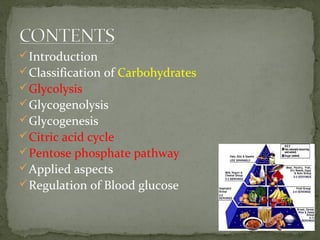
Introduction
Classification of Carbohydrates
Glycolysis
Glycogenolysis
Glycogenesis
Citric acid cycle
Pentose phosphate pathway
Applied aspects
Regulation of Blood glucose
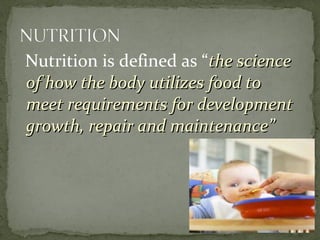
Nutrition is defined as “the sciencethe science
of how the body utilizes food toof how the body utilizes food to
meet requirements for developmentmeet requirements for development
growth, repair and maintenance”growth, repair and maintenance”
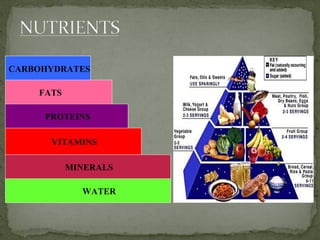
FATS
PROTEINS
VITAMINS
MINERALS
WATER
CARBOHYDRATES
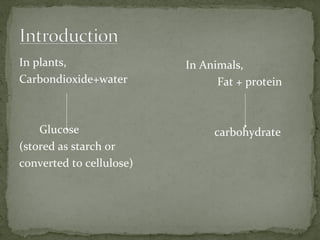
In plants,
Carbondioxide+water
Glucose
(stored as starch or
converted to cellulose)
In Animals,
Fat + protein
carbohydrate
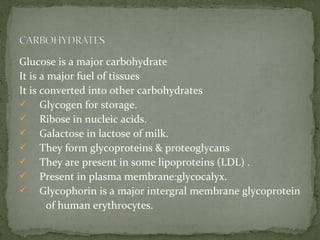
Glucose is a major carbohydrate
It is a major fuel of tissues
It is converted into other carbohydrates
 Glycogen for storage.
 Ribose in nucleic acids.
 Galactose in lactose of milk.
 They form glycoproteins & proteoglycans
 They are present in some lipoproteins (LDL) .
 Present in plasma membrane:glycocalyx.
 Glycophorin is a major intergral membrane glycoprotein
of human erythrocytes.
Most abudant organic molecules in nature.
Composition-carbon,oxygen,hydrogen
Also called as hydrates of carbon
Formula [CH20]n
Definiton;it is defined as polyhydroxy aldehydes or ketones
,compounds which produce them on hydrolysis .aslo called
as sugars
 soluble in water and sweet to taste.
Ex:glucose,fructose,sucrose,maltose etc.
Abundant dietary source of energy 4cal /g for all
organisms
Precursors for many organic compounds {fats,aa}.
Present in cell membrane as glycoproteins and
glycolipids .
Helps in cell growth,cell adhesion & fertilization.
Storage form of energy for immediate energy
demands [glucose is stored as glycogen]
In plants its is present as a cellulose (fiber content
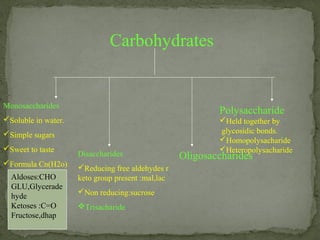
Carbohydrates
Monosaccharides
Soluble in water.
Simple sugars
Sweet to taste
Formula Cn(H2o)
Disaccharides
Reducing free aldehydes r
keto group present :mal,lac
Non reducing:sucrose
Trisacharide
Oligosaccharides
Polysaccharide
Held together by
glycosidic bonds.
Homopolysacharide
Heteropolysacharide
Aldoses:CHO
GLU,Glycerade
hyde
Ketoses :C=O
Fructose,dhap
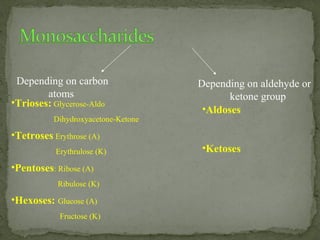
Depending on carbon
atoms
Depending on aldehyde or
ketone group
•Trioses: Glycerose-Aldo
Dihydroxyacetone-Ketone
•Tetroses Erythrose (A)
Erythrulose (K)
•Pentoses: Ribose (A)
Ribulose (K)
•Hexoses: Glucose (A)
Fructose (K)
•Aldoses
•Ketoses
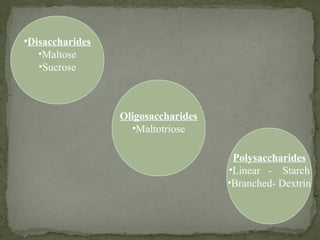
•Disaccharides
•Maltose
•Sucrose
Oligosaccharides
•Maltotriose
Polysaccharides
•Linear - Starch
•Branched- Dextrin
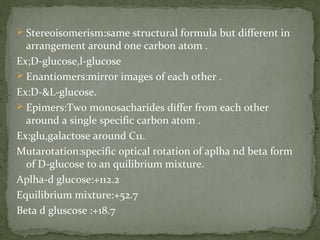
 Stereoisomerism:same structural formula but different in
arrangement around one carbon atom .
Ex;D-glucose,l-glucose
 Enantiomers:mirror images of each other .
Ex:D-&L-glucose.
 Epimers:Two monosacharides differ from each other
around a single specific carbon atom .
Ex:glu,galactose around C11.
Mutarotation:specific optical rotation of aplha nd beta form
of D-glucose to an quilibrium mixture.
Aplha-d glucose:+112.2
Equilibrium mixture:+52.7
Beta d gluscose :+18.7
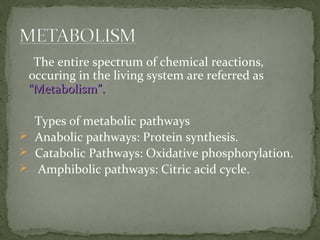
The entire spectrum of chemical reactions,
occuring in the living system are referred as
“Metabolism”.“Metabolism”.
Types of metabolic pathways
 Anabolic pathways: Protein synthesis.
 Catabolic Pathways: Oxidative phosphorylation.
 Amphibolic pathways: Citric acid cycle.
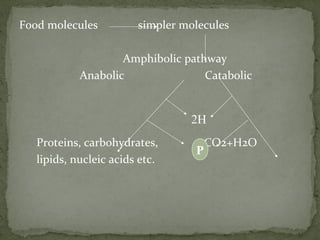
Food molecules simpler molecules
Amphibolic pathway
Anabolic Catabolic
Proteins, carbohydrates, CO2+H2O
lipids, nucleic acids etc.
2H
P
Metabolic pathways may be studied at different levels
of organisation.
 At tissue level
 At subcellular level
Overview of
Carbohydrate
Metabolism
Overview of
Carbohydrate
Metabolism
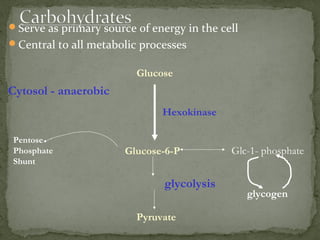
Glucose
Glucose-6-P
Pyruvate
Hexokinase
Pentose
Phosphate
Shunt
glycolysis
Serve as primary source of energy in the cell
Central to all metabolic processes
Glc-1- phosphate
glycogen
Cytosol - anaerobic
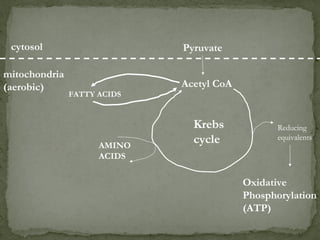
Pyruvatecytosol
Acetyl CoA
mitochondria
(aerobic)
Krebs
cycle
Reducing
equivalents
Oxidative
Phosphorylation
(ATP)
AMINO
ACIDS
FATTY ACIDS
GLYCOLYSIS
Defn: It is defined as sequence of reactions of glucose
to lactate & pyruvate with the production of ATP.
It is derived from greek word glycose -sweet or sugar,
lysis- dissolution.
Site: Cytosolic fraction of cell
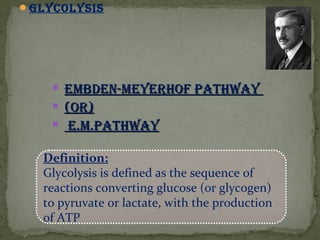
Glycolysis
 EmbdEn-mEyErhof pathwayEmbdEn-mEyErhof pathway
 (or)(or)
 E.m.pathwayE.m.pathway
Definition:
Glycolysis is defined as the sequence of
reactions converting glucose (or glycogen)
to pyruvate or lactate, with the production
of ATP
Reactions of Glycolysis
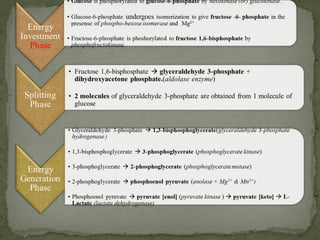
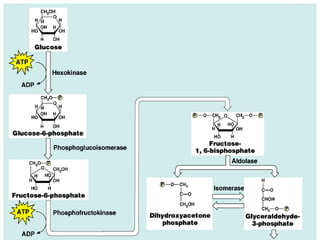
1) Energy Investment phase (or) priming phase
2) Splitting phase
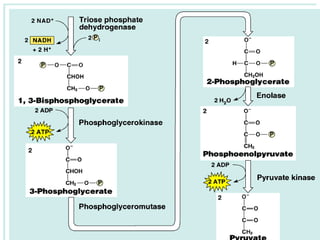
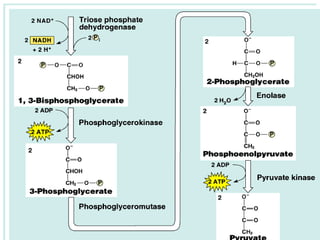
3) Energy generation phase
STAGE III
STAGE III
STAGE III
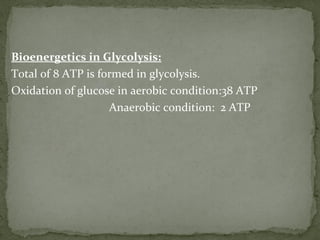
Bioenergetics in Glycolysis:
Total of 8 ATP is formed in glycolysis.
Oxidation of glucose in aerobic condition:38 ATP
Anaerobic condition: 2 ATP
Hemolytic Anaemias: Inherited aldolase A & pyruvate
kinase deficiencies.
Skeletal muscle fatigue
Inherited Pyruvate dehydrogenase deficiency-Lactic
acidosis
Fast growing cancer cells glycolysis proceeds at faster
rate – increased acidic environment-implication in
certain types of cancer.
Major storage form of carbohydrate.
Glycogenesis: occurs in muscle & liver.
Liver glycogen largely concerned with transport &
storage of hexose units.
For maintenance of blood glucose mainly between
meals.
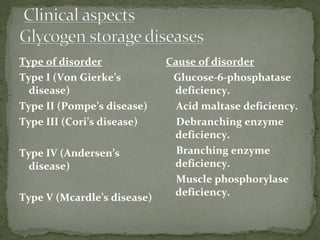
Type of disorder
Type I (Von Gierke’s
disease)
Type II (Pompe’s disease)
Type III (Cori’s disease)
Type IV (Andersen’s
disease)
Type V (Mcardle’s disease)
Cause of disorder
Glucose-6-phosphatase
deficiency.
Acid maltase deficiency.
Debranching enzyme
deficiency.
Branching enzyme
deficiency.
Muscle phosphorylase
deficiency.
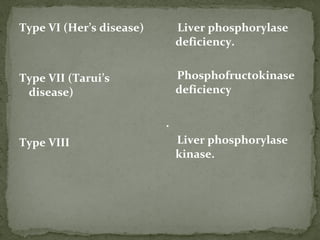
Type VI (Her’s disease)
Type VII (Tarui’s
disease)
Type VIII
Liver phosphorylase
deficiency.
Phosphofructokinase
deficiency
.
Liver phosphorylase
kinase.
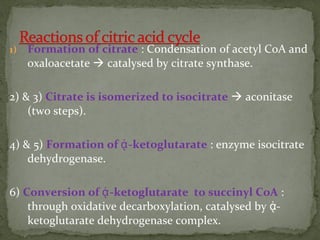
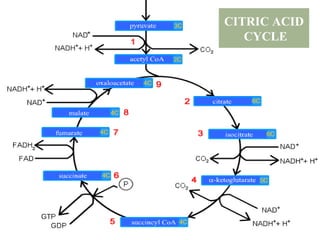
1) Formation of citrate : Condensation of acetyl CoA and
oxaloacetate  catalysed by citrate synthase.
2) & 3) Citrate is isomerized to isocitrate  aconitase
(two steps).
4) & 5) Formation of ᾀ-ketoglutarate : enzyme isocitrate
dehydrogenase.
6) Conversion of ᾀ-ketoglutarate to succinyl CoA :
through oxidative decarboxylation, catalysed by ᾀ-
ketoglutarate dehydrogenase complex.
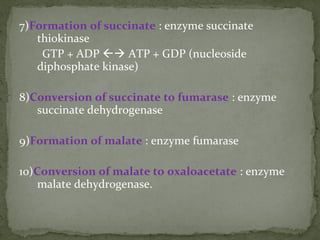
7)Formation of succinate : enzyme succinate
thiokinase
GTP + ADP  ATP + GDP (nucleoside
diphosphate kinase)
8)Conversion of succinate to fumarase : enzyme
succinate dehydrogenase
9)Formation of malate : enzyme fumarase
10)Conversion of malate to oxaloacetate : enzyme
malate dehydrogenase.
CITRIC ACID
CYCLE
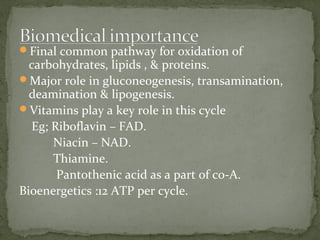
Final common pathway for oxidation of
carbohydrates, lipids , & proteins.
Major role in gluconeogenesis, transamination,
deamination & lipogenesis.
Vitamins play a key role in this cycle
Eg; Riboflavin – FAD.
Niacin – NAD.
Thiamine.
Pantothenic acid as a part of co-A.
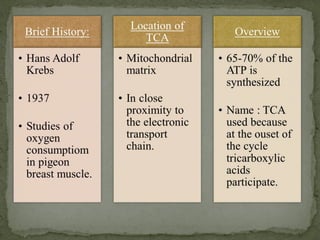
Bioenergetics :12 ATP per cycle.
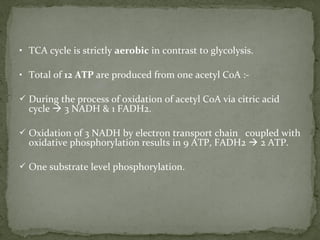
• TCA cycle is strictly aerobic in contrast to glycolysis.
• Total of 12 ATP are produced from one acetyl CoA :-
 During the process of oxidation of acetyl CoA via citric acid
cycle  3 NADH & 1 FADH2.
 Oxidation of 3 NADH by electron transport chain coupled with
oxidative phosphorylation results in 9 ATP, FADH2  2 ATP.
 One substrate level phosphorylation.
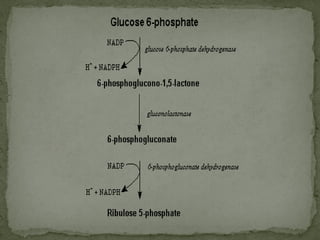
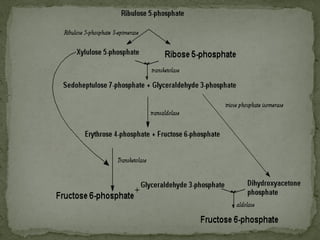
Alternative route for metabolism of glucose
It occurs in cytosol
Sequence of reactions occur in two phases
1.Oxidative non reversible phase-Forms NADPH
2. Non oxidative reversible phase.- Forms ribose
precursors for nucleotide synthesis.
Glutathione peroxidase protects erythrocytes against
hemolysis.
Pentose useful in synthesis of DNA & RNA.
NADPH is required for reductive biosynthesis of fatty
acids & steroids.
NADPH is required in synthesis of amino acids.
Microsomal cytochrome P450 system brings
detoxification of drugs & foreign compounds.
Erythrocyte hemolysis
Impairment of generation of NADPH manifests as
hemolysis when given drugs like
Antimalarial- Primaquine aspirin or sulfonamides.
(G6 PD) Deficiency:
 It makes red cells susceptible to hemolysis
 X linked inheritance
 Onset of Anaemia is rapid
 Mild jaundice
Defects in Fructose metabolism
Lack of hepatic fructokinase causes Fructosuria.
Absence of Hepatic aldolase-Hereditary fructose
intolerance.
 Hypoglycemia, vomiting, sweating.
 Albuminuria, aminoaciduria.
 Reduced caries incidence.
.
Fructose & sorbitol in lens asssociated with
diabetic cataract.
 Starch
 Dextrins
 Inulin
 Glycogen
 Dextrans
 Cellulose
 chitin
Starch:carbohydrate reserve of plants .
Presents in cereals ,roots,vegertables ,tubers etc, consists of
repeated units of D-glucose units by alpha glycosidic
bonds
2 polysacaride components –water soluble amylose (15-20%)
Water insoluble amylopectin (80-85%)
Amylose –long unbranched chain (alpha 1-4 linkages)
Amylopectin –branched chain (alpha 1-6 linkages )
Starch -> dextrins->maltose &glucose
Agar:present in sea weeds
Not digested
Dietary fiber
Used in microbial culture (agarose)
Pectin :
Present in apples & citrus fruits
Not digested
Used as dietary fibers
Used in preparation of jellies .
Seven glycosaminoglycans(GAG)
1 Hyaluronic acid
2 Chondriotin sulfate
3 Keratan sulfate
4 hyaluronidase
5 Heparin
6 Dermatan sulfate
Mucopolysaccharides:there also called as
heteropolysacharides or heteroglycans.
Consisting of repeating units of sugars derivatives .
They are amino sugars,uronic acids –knowns as GaG.
Acetylated amino groups are present ,sulfate,,carboxyl
groups are also prsent in GAG structure
Present of sulfate & carbonyl groups ---acidity of molecule
Mucopolysacharide +protein ---------mucoproteins or
mucoids r proteoglycans.
mucopolysacharide ------essential component of tissue
structure.
Present in extracellular spaces of tissues seen in connective
tissue ,cartilage ,bone,skin,tendon,blood vessels .
Present in collagen,& elastic fibers in ground substance
concsits of mainly GAG.
Hyaluronic acid :important GAG found in ground substance
of synovial fluid of joints & vitreous human or eyes.
Present as ground substance in conective tissues
Present as gel aroundhe ovum.
Function:lubrication,shock absorber in joints
Structure:alternate units of D-glucorinic acid & n acty D-
Glucosamine units .
It consists 250-25000 disacharide units with beta 1->4
bonds.
Hyalourindase :present in testes ,seminal fluid ,snake &
insect venoms .
Enzyme that’ breaks beta 1->4 bonds of hyaluronic acid.
Hyaluronidase prsent in semen play an important role in
fertlization .by cleaning the hyaluronic acid present around
the ovum & helps inn better penetrations of sperm into
ovum.
Heparin;anticoggulant ,present in blood ,liver ,lung
,kidney spleen etc,
Helps in releade of enzyme lipoprotein lipase ->clearing
the turbidity of lipemic plasma
Chondrotin 4 sulphate:prsent in various tissues
9bone,cartilage ,tendons,heart values ,skin,cornea,0in
human beings.
Structure:comparbile same as hyaluronic acid ,consists of
repeating disacharide units of D-GLUCORINIC ACID,& n-
acetyl ,d galactosamine 4 sulphate .
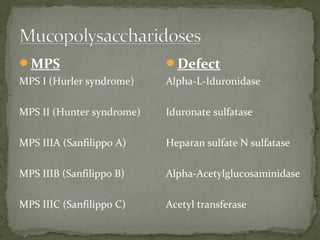
MPS
MPS I (Hurler syndrome)
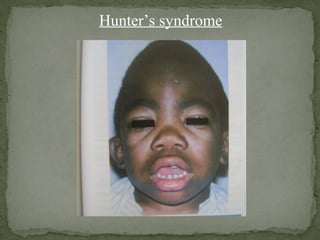
MPS II (Hunter syndrome)
MPS IIIA (Sanfilippo A)
MPS IIIB (Sanfilippo B)
MPS IIIC (Sanfilippo C)
Defect
Alpha-L-Iduronidase
Iduronate sulfatase
Heparan sulfate N sulfatase
Alpha-Acetylglucosaminidase
Acetyl transferase
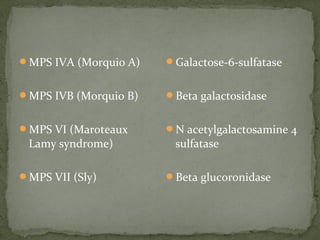
MPS IVA (Morquio A)
MPS IVB (Morquio B)
MPS VI (Maroteaux
Lamy syndrome)
MPS VII (Sly)
Galactose-6-sulfatase
Beta galactosidase
N acetylgalactosamine 4
sulfatase
Beta glucoronidase
Hunter’s syndrome
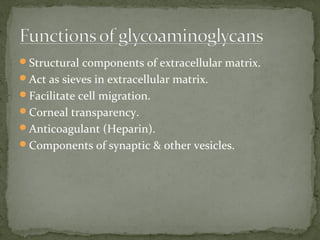
Structural components of extracellular matrix.
Act as sieves in extracellular matrix.
Facilitate cell migration.
Corneal transparency.
Anticoagulant (Heparin).
Components of synaptic & other vesicles.
Thank you

Carbohydratemetabolism svims

  • 1.
  • 2.
    Introduction Classification of Carbohydrates Glycolysis Glycogenolysis Glycogenesis Citricacid cycle Pentose phosphate pathway Applied aspects Regulation of Blood glucose
  • 3.
    Nutrition is definedas “the sciencethe science of how the body utilizes food toof how the body utilizes food to meet requirements for developmentmeet requirements for development growth, repair and maintenance”growth, repair and maintenance”
  • 4.
  • 5.
    In plants, Carbondioxide+water Glucose (stored asstarch or converted to cellulose) In Animals, Fat + protein carbohydrate
  • 6.
    Glucose is amajor carbohydrate It is a major fuel of tissues It is converted into other carbohydrates  Glycogen for storage.  Ribose in nucleic acids.  Galactose in lactose of milk.  They form glycoproteins & proteoglycans  They are present in some lipoproteins (LDL) .  Present in plasma membrane:glycocalyx.  Glycophorin is a major intergral membrane glycoprotein of human erythrocytes.
  • 7.
    Most abudant organicmolecules in nature. Composition-carbon,oxygen,hydrogen Also called as hydrates of carbon Formula [CH20]n Definiton;it is defined as polyhydroxy aldehydes or ketones ,compounds which produce them on hydrolysis .aslo called as sugars  soluble in water and sweet to taste. Ex:glucose,fructose,sucrose,maltose etc.
  • 8.
    Abundant dietary sourceof energy 4cal /g for all organisms Precursors for many organic compounds {fats,aa}. Present in cell membrane as glycoproteins and glycolipids . Helps in cell growth,cell adhesion & fertilization. Storage form of energy for immediate energy demands [glucose is stored as glycogen] In plants its is present as a cellulose (fiber content
  • 9.
    Carbohydrates Monosaccharides Soluble in water. Simplesugars Sweet to taste Formula Cn(H2o) Disaccharides Reducing free aldehydes r keto group present :mal,lac Non reducing:sucrose Trisacharide Oligosaccharides Polysaccharide Held together by glycosidic bonds. Homopolysacharide Heteropolysacharide Aldoses:CHO GLU,Glycerade hyde Ketoses :C=O Fructose,dhap
  • 10.
    Depending on carbon atoms Dependingon aldehyde or ketone group •Trioses: Glycerose-Aldo Dihydroxyacetone-Ketone •Tetroses Erythrose (A) Erythrulose (K) •Pentoses: Ribose (A) Ribulose (K) •Hexoses: Glucose (A) Fructose (K) •Aldoses •Ketoses
  • 11.
  • 12.
     Stereoisomerism:same structuralformula but different in arrangement around one carbon atom . Ex;D-glucose,l-glucose  Enantiomers:mirror images of each other . Ex:D-&L-glucose.  Epimers:Two monosacharides differ from each other around a single specific carbon atom . Ex:glu,galactose around C11. Mutarotation:specific optical rotation of aplha nd beta form of D-glucose to an quilibrium mixture. Aplha-d glucose:+112.2 Equilibrium mixture:+52.7 Beta d gluscose :+18.7
  • 13.
    The entire spectrumof chemical reactions, occuring in the living system are referred as “Metabolism”.“Metabolism”. Types of metabolic pathways  Anabolic pathways: Protein synthesis.  Catabolic Pathways: Oxidative phosphorylation.  Amphibolic pathways: Citric acid cycle.
  • 14.
    Food molecules simplermolecules Amphibolic pathway Anabolic Catabolic Proteins, carbohydrates, CO2+H2O lipids, nucleic acids etc. 2H P
  • 15.
    Metabolic pathways maybe studied at different levels of organisation.  At tissue level  At subcellular level
  • 16.
  • 17.
    Glucose Glucose-6-P Pyruvate Hexokinase Pentose Phosphate Shunt glycolysis Serve as primarysource of energy in the cell Central to all metabolic processes Glc-1- phosphate glycogen Cytosol - anaerobic
  • 18.
  • 19.
  • 20.
    Defn: It isdefined as sequence of reactions of glucose to lactate & pyruvate with the production of ATP. It is derived from greek word glycose -sweet or sugar, lysis- dissolution. Site: Cytosolic fraction of cell
  • 21.
    Glycolysis  EmbdEn-mEyErhof pathwayEmbdEn-mEyErhofpathway  (or)(or)  E.m.pathwayE.m.pathway Definition: Glycolysis is defined as the sequence of reactions converting glucose (or glycogen) to pyruvate or lactate, with the production of ATP
  • 22.
    Reactions of Glycolysis 1)Energy Investment phase (or) priming phase 2) Splitting phase 3) Energy generation phase
  • 24.
  • 25.
  • 26.
  • 27.
    Bioenergetics in Glycolysis: Totalof 8 ATP is formed in glycolysis. Oxidation of glucose in aerobic condition:38 ATP Anaerobic condition: 2 ATP
  • 28.
    Hemolytic Anaemias: Inheritedaldolase A & pyruvate kinase deficiencies. Skeletal muscle fatigue Inherited Pyruvate dehydrogenase deficiency-Lactic acidosis Fast growing cancer cells glycolysis proceeds at faster rate – increased acidic environment-implication in certain types of cancer.
  • 29.
    Major storage formof carbohydrate. Glycogenesis: occurs in muscle & liver.
  • 30.
    Liver glycogen largelyconcerned with transport & storage of hexose units. For maintenance of blood glucose mainly between meals.
  • 31.
    Type of disorder TypeI (Von Gierke’s disease) Type II (Pompe’s disease) Type III (Cori’s disease) Type IV (Andersen’s disease) Type V (Mcardle’s disease) Cause of disorder Glucose-6-phosphatase deficiency. Acid maltase deficiency. Debranching enzyme deficiency. Branching enzyme deficiency. Muscle phosphorylase deficiency.
  • 32.
    Type VI (Her’sdisease) Type VII (Tarui’s disease) Type VIII Liver phosphorylase deficiency. Phosphofructokinase deficiency . Liver phosphorylase kinase.
  • 34.
    1) Formation ofcitrate : Condensation of acetyl CoA and oxaloacetate  catalysed by citrate synthase. 2) & 3) Citrate is isomerized to isocitrate  aconitase (two steps). 4) & 5) Formation of ᾀ-ketoglutarate : enzyme isocitrate dehydrogenase. 6) Conversion of ᾀ-ketoglutarate to succinyl CoA : through oxidative decarboxylation, catalysed by ᾀ- ketoglutarate dehydrogenase complex.
  • 35.
    7)Formation of succinate: enzyme succinate thiokinase GTP + ADP  ATP + GDP (nucleoside diphosphate kinase) 8)Conversion of succinate to fumarase : enzyme succinate dehydrogenase 9)Formation of malate : enzyme fumarase 10)Conversion of malate to oxaloacetate : enzyme malate dehydrogenase.
  • 36.
  • 37.
    Final common pathwayfor oxidation of carbohydrates, lipids , & proteins. Major role in gluconeogenesis, transamination, deamination & lipogenesis. Vitamins play a key role in this cycle Eg; Riboflavin – FAD. Niacin – NAD. Thiamine. Pantothenic acid as a part of co-A. Bioenergetics :12 ATP per cycle.
  • 38.
    • TCA cycleis strictly aerobic in contrast to glycolysis. • Total of 12 ATP are produced from one acetyl CoA :-  During the process of oxidation of acetyl CoA via citric acid cycle  3 NADH & 1 FADH2.  Oxidation of 3 NADH by electron transport chain coupled with oxidative phosphorylation results in 9 ATP, FADH2  2 ATP.  One substrate level phosphorylation.
  • 39.
    Alternative route formetabolism of glucose It occurs in cytosol Sequence of reactions occur in two phases 1.Oxidative non reversible phase-Forms NADPH 2. Non oxidative reversible phase.- Forms ribose precursors for nucleotide synthesis.
  • 42.
    Glutathione peroxidase protectserythrocytes against hemolysis. Pentose useful in synthesis of DNA & RNA. NADPH is required for reductive biosynthesis of fatty acids & steroids. NADPH is required in synthesis of amino acids. Microsomal cytochrome P450 system brings detoxification of drugs & foreign compounds.
  • 43.
    Erythrocyte hemolysis Impairment ofgeneration of NADPH manifests as hemolysis when given drugs like Antimalarial- Primaquine aspirin or sulfonamides. (G6 PD) Deficiency:  It makes red cells susceptible to hemolysis  X linked inheritance  Onset of Anaemia is rapid  Mild jaundice
  • 44.
    Defects in Fructosemetabolism Lack of hepatic fructokinase causes Fructosuria. Absence of Hepatic aldolase-Hereditary fructose intolerance.  Hypoglycemia, vomiting, sweating.  Albuminuria, aminoaciduria.  Reduced caries incidence. . Fructose & sorbitol in lens asssociated with diabetic cataract.
  • 45.
     Starch  Dextrins Inulin  Glycogen  Dextrans  Cellulose  chitin
  • 46.
    Starch:carbohydrate reserve ofplants . Presents in cereals ,roots,vegertables ,tubers etc, consists of repeated units of D-glucose units by alpha glycosidic bonds 2 polysacaride components –water soluble amylose (15-20%) Water insoluble amylopectin (80-85%) Amylose –long unbranched chain (alpha 1-4 linkages) Amylopectin –branched chain (alpha 1-6 linkages ) Starch -> dextrins->maltose &glucose
  • 47.
    Agar:present in seaweeds Not digested Dietary fiber Used in microbial culture (agarose) Pectin : Present in apples & citrus fruits Not digested Used as dietary fibers Used in preparation of jellies .
  • 48.
    Seven glycosaminoglycans(GAG) 1 Hyaluronicacid 2 Chondriotin sulfate 3 Keratan sulfate 4 hyaluronidase 5 Heparin 6 Dermatan sulfate
  • 49.
    Mucopolysaccharides:there also calledas heteropolysacharides or heteroglycans. Consisting of repeating units of sugars derivatives . They are amino sugars,uronic acids –knowns as GaG. Acetylated amino groups are present ,sulfate,,carboxyl groups are also prsent in GAG structure Present of sulfate & carbonyl groups ---acidity of molecule Mucopolysacharide +protein ---------mucoproteins or mucoids r proteoglycans. mucopolysacharide ------essential component of tissue structure. Present in extracellular spaces of tissues seen in connective tissue ,cartilage ,bone,skin,tendon,blood vessels . Present in collagen,& elastic fibers in ground substance concsits of mainly GAG.
  • 50.
    Hyaluronic acid :importantGAG found in ground substance of synovial fluid of joints & vitreous human or eyes. Present as ground substance in conective tissues Present as gel aroundhe ovum. Function:lubrication,shock absorber in joints Structure:alternate units of D-glucorinic acid & n acty D- Glucosamine units . It consists 250-25000 disacharide units with beta 1->4 bonds. Hyalourindase :present in testes ,seminal fluid ,snake & insect venoms . Enzyme that’ breaks beta 1->4 bonds of hyaluronic acid. Hyaluronidase prsent in semen play an important role in fertlization .by cleaning the hyaluronic acid present around the ovum & helps inn better penetrations of sperm into ovum.
  • 51.
    Heparin;anticoggulant ,present inblood ,liver ,lung ,kidney spleen etc, Helps in releade of enzyme lipoprotein lipase ->clearing the turbidity of lipemic plasma Chondrotin 4 sulphate:prsent in various tissues 9bone,cartilage ,tendons,heart values ,skin,cornea,0in human beings. Structure:comparbile same as hyaluronic acid ,consists of repeating disacharide units of D-GLUCORINIC ACID,& n- acetyl ,d galactosamine 4 sulphate .
  • 52.
    MPS MPS I (Hurlersyndrome) MPS II (Hunter syndrome) MPS IIIA (Sanfilippo A) MPS IIIB (Sanfilippo B) MPS IIIC (Sanfilippo C) Defect Alpha-L-Iduronidase Iduronate sulfatase Heparan sulfate N sulfatase Alpha-Acetylglucosaminidase Acetyl transferase
  • 53.
    MPS IVA (MorquioA) MPS IVB (Morquio B) MPS VI (Maroteaux Lamy syndrome) MPS VII (Sly) Galactose-6-sulfatase Beta galactosidase N acetylgalactosamine 4 sulfatase Beta glucoronidase
  • 54.
  • 55.
    Structural components ofextracellular matrix. Act as sieves in extracellular matrix. Facilitate cell migration. Corneal transparency. Anticoagulant (Heparin). Components of synaptic & other vesicles.
  • 56.