BIO102: 5 KEYS TO POOL CARE
Pool & Spa University
THE 5 KEYS
➤ No matter what type of pool or
system the customer owns, there are
five keys to keeping that pool clean
and clear.
➤ The 5 Keys:
➤ Circulation
➤ Filtration
➤ Cleaning
➤ Testing
➤ Chemicals
➤ We’ll look at each key in the order
presented above; this list can also be
used as a rough “order of operations”
when it comes to troubleshooting.
CIRCULATION & FILTRATION
➤ Proper circulation and filtration are the backbone of a clean
swimming pool. If the circulation and filtration in a pool are
poor, no amount of chemicals will be able to fix a problem.
➤ Circulation and filtration are mostly managed by the existing
equipment system. All components of that system should be
kept in good working order and replaced when they are no
longer able to keep up with the stresses placed on them by
water chemistry, bathers, and the environment.
➤ The recommended minimum run time for the equipment
system to adequately circulate and filter water is 10-12 hours
a day. However, it is recommended to run the pump 24/7
while resolving issues such as cloudy water and algae.
WHY 10-12 HOURS?
➤ In general, pool pumps and filters are sized so
that the pump moves an amount of water
equal to the gallons of the pool through the
system in 6-8 hours. This is known as a
turnover.
➤ However, that does not mean that all the water
is filtered in this time! On average, after 1
turnover (approx. 6 hours), only 42% of the
water has been filtered. This is insufficient to
keep the pool clear!
➤ Some water will be filtered more than
once, while some won’t be filtered at all.
➤ After 2 turnovers, approximately 84% of the
water has been filtered. This is usually enough
to keep pools clear; above 12 hours, while
more water is filtered, the relative gains are
much lower.
➤ During heavy usage or problem-solving,
running the pump 24 hours a day can ensure a
faster clean-up.
After 6 Hours
58%
42%
Filtered
Unfiltered
After 12 Hours
16%
84%
Filtered
Unfiltered
After 18 Hours
5%
95%
Filtered
Unfiltered
After 24 Hours
2%
98%
Filtered
Unfiltered
CIRCULATION & FILTRATION
➤ Many pumps nowadays are being manufactured with variable
speed settings; this allows the owner to precisely dial in how fast
the pool pump is moving water. This is beneficial for both the
pool and for the owner’s pocketbook, as it is overall more
efficient than traditional single-speed pool pumps.
➤ These pumps are designed to run 24 hours a day; this is perfectly
fine! Running the pool pump 24/7, while not strictly necessary,
is generally a safer way to ensure the pool gets enough
circulation and can reduce the chance of problems happening.
➤ For best circulation, return jets in the pool should be pointed 45
degrees down and to the left (or right); this helps to move water
in the deeper ends of the pool.
CIRCULATION & FILTRATION
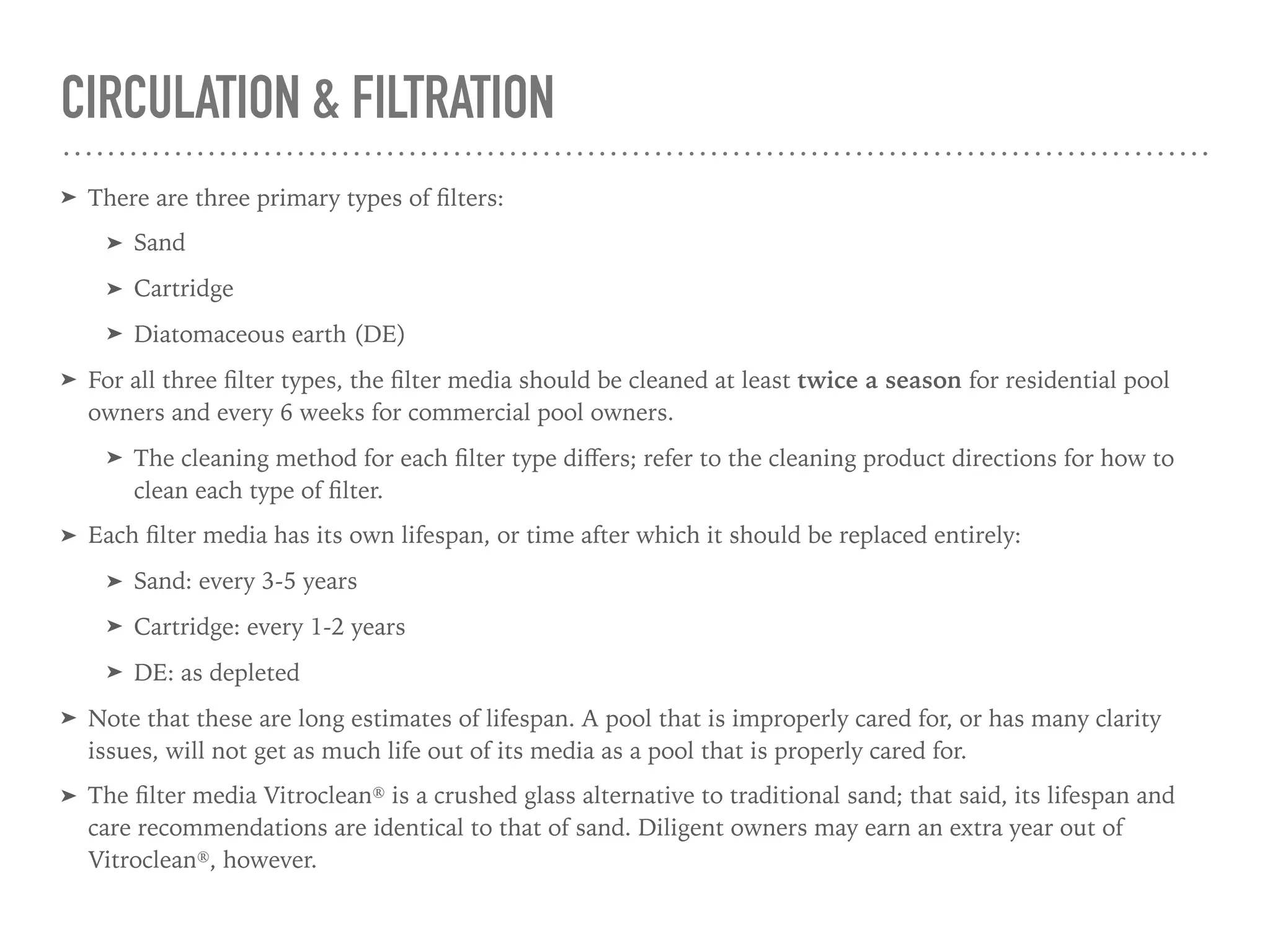
➤ There are three primary types of filters:
➤ Sand
➤ Cartridge
➤ Diatomaceous earth (DE)
➤ For all three filter types, the filter media should be cleaned at least twice a season for residential pool
owners and every 6 weeks for commercial pool owners.
➤ The cleaning method for each filter type differs; refer to the cleaning product directions for how to
clean each type of filter.
➤ Each filter media has its own lifespan, or time after which it should be replaced entirely:
➤ Sand: every 3-5 years
➤ Cartridge: every 1-2 years
➤ DE: as depleted
➤ Note that these are long estimates of lifespan. A pool that is improperly cared for, or has many clarity
issues, will not get as much life out of its media as a pool that is properly cared for.
➤ The filter media Vitroclean® is a crushed glass alternative to traditional sand; that said, its lifespan and
care recommendations are identical to that of sand. Diligent owners may earn an extra year out of
Vitroclean®, however.
CLEANING & TESTING
➤ The physical maintenance of the pool—cleaning—covers a wide range of activities:
➤ Brushing weekly, paying special attention to areas with low circulation
➤ Skimming & removing large debris weekly & as needed
➤ Vacuuming weekly
➤ Inspecting equipment at least once a season
➤ Covering & uncovering the pool as needed
➤ Automatic pool cleaners can help reduce many of these cleaning tasks, but are not
designed to perform big cleanups—such as after treating for algae or during spring
cleanup—and expectations for their efficacy should be communicated clearly.
➤ Additionally, customers should test their pool at home at least once a week, paying special
attention to the sanitizer level (chlorine, bromine, SoftSwim® B) and the pH, and make
adjustments as necessary.
➤ Customers should have their water professionally analyzed at The Pool & Spa House
monthly and at start-up and closing; more frequent testing may be required when
problem-solving.
CHEMICALS
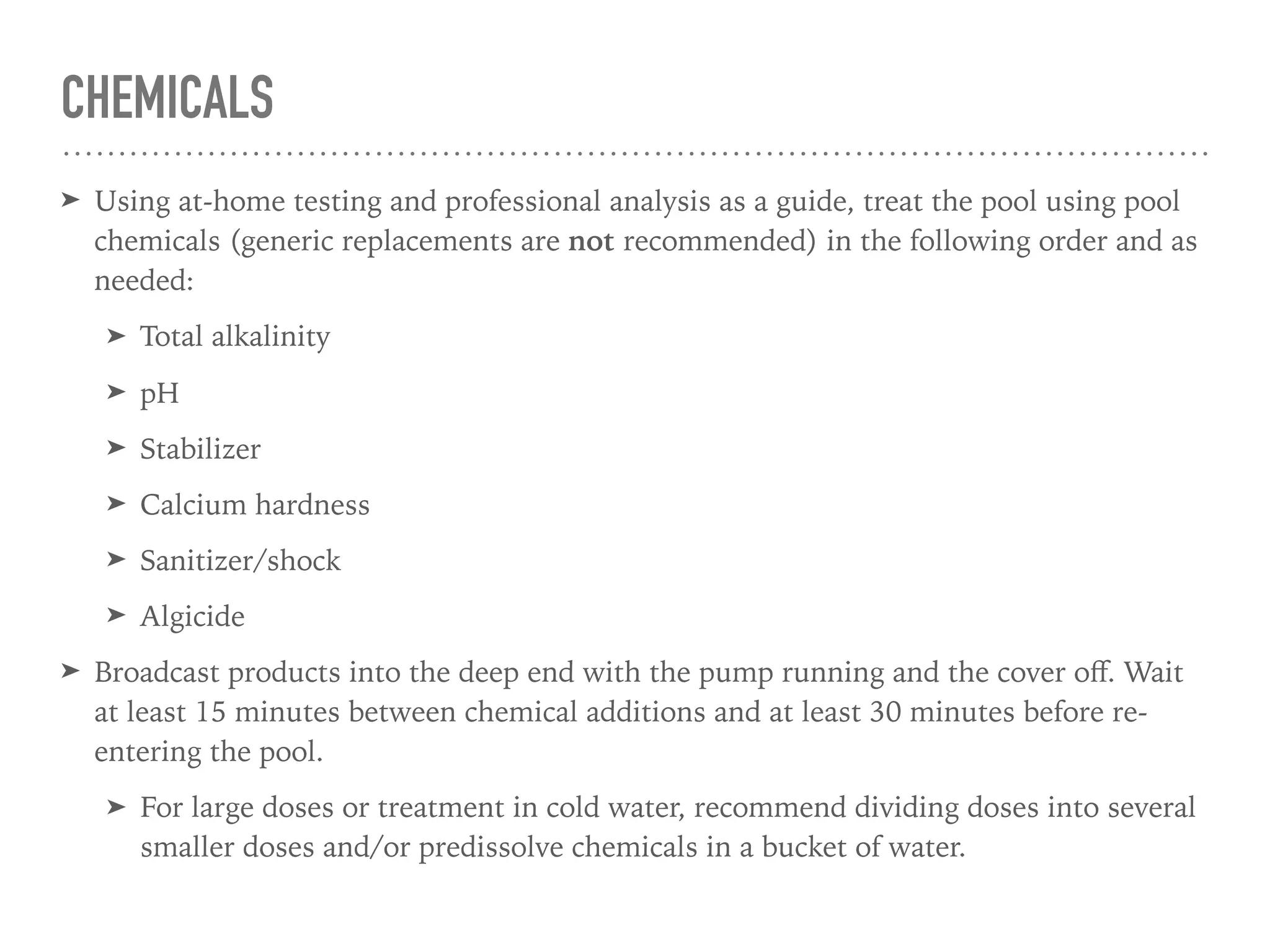
➤ Using at-home testing and professional analysis as a guide, treat the pool using pool
chemicals (generic replacements are not recommended) in the following order and as
needed:
➤ Total alkalinity
➤ pH
➤ Stabilizer
➤ Calcium hardness
➤ Sanitizer/shock
➤ Algicide
➤ Broadcast products into the deep end with the pump running and the cover off. Wait
at least 15 minutes between chemical additions and at least 30 minutes before re-
entering the pool.
➤ For large doses or treatment in cold water, recommend dividing doses into several
smaller doses and/or predissolve chemicals in a bucket of water.
PREDISSOLVING CHEMICALS
➤ When predissolving chemicals, use a clean plastic bucket and plastic or
wooden stirring device; never use metal.
➤ Always predissolve outdoors. Certain chemicals will produce fumes, which
can cause injury if inhaled.
➤ Water should be average pool temperature (between 70°F and 90°F) but
measuring water temperature isn’t necessary. Just don’t recommend very
hot or boiling water.
➤ If the customer has them available, they should wear gloves and goggles
to protect hands and eyes from injury.
➤ Always use at least 4x the amount of water relative to the amount of
chemical being dissolved. 1 gallon of water can dissolve roughly 2# of
product.
➤ If in doubt, always use more water than what one thinks is needed.
CONGRATULATIONS!
You have completed the activity!

BIO102: 5 Keys

  • 1.
    BIO102: 5 KEYSTO POOL CARE Pool & Spa University
  • 2.
    THE 5 KEYS ➤No matter what type of pool or system the customer owns, there are five keys to keeping that pool clean and clear. ➤ The 5 Keys: ➤ Circulation ➤ Filtration ➤ Cleaning ➤ Testing ➤ Chemicals ➤ We’ll look at each key in the order presented above; this list can also be used as a rough “order of operations” when it comes to troubleshooting.
  • 3.
    CIRCULATION & FILTRATION ➤Proper circulation and filtration are the backbone of a clean swimming pool. If the circulation and filtration in a pool are poor, no amount of chemicals will be able to fix a problem. ➤ Circulation and filtration are mostly managed by the existing equipment system. All components of that system should be kept in good working order and replaced when they are no longer able to keep up with the stresses placed on them by water chemistry, bathers, and the environment. ➤ The recommended minimum run time for the equipment system to adequately circulate and filter water is 10-12 hours a day. However, it is recommended to run the pump 24/7 while resolving issues such as cloudy water and algae.
  • 4.
    WHY 10-12 HOURS? ➤In general, pool pumps and filters are sized so that the pump moves an amount of water equal to the gallons of the pool through the system in 6-8 hours. This is known as a turnover. ➤ However, that does not mean that all the water is filtered in this time! On average, after 1 turnover (approx. 6 hours), only 42% of the water has been filtered. This is insufficient to keep the pool clear! ➤ Some water will be filtered more than once, while some won’t be filtered at all. ➤ After 2 turnovers, approximately 84% of the water has been filtered. This is usually enough to keep pools clear; above 12 hours, while more water is filtered, the relative gains are much lower. ➤ During heavy usage or problem-solving, running the pump 24 hours a day can ensure a faster clean-up. After 6 Hours 58% 42% Filtered Unfiltered After 12 Hours 16% 84% Filtered Unfiltered After 18 Hours 5% 95% Filtered Unfiltered After 24 Hours 2% 98% Filtered Unfiltered
  • 5.
    CIRCULATION & FILTRATION ➤Many pumps nowadays are being manufactured with variable speed settings; this allows the owner to precisely dial in how fast the pool pump is moving water. This is beneficial for both the pool and for the owner’s pocketbook, as it is overall more efficient than traditional single-speed pool pumps. ➤ These pumps are designed to run 24 hours a day; this is perfectly fine! Running the pool pump 24/7, while not strictly necessary, is generally a safer way to ensure the pool gets enough circulation and can reduce the chance of problems happening. ➤ For best circulation, return jets in the pool should be pointed 45 degrees down and to the left (or right); this helps to move water in the deeper ends of the pool.
  • 6.
    CIRCULATION & FILTRATION ➤There are three primary types of filters: ➤ Sand ➤ Cartridge ➤ Diatomaceous earth (DE) ➤ For all three filter types, the filter media should be cleaned at least twice a season for residential pool owners and every 6 weeks for commercial pool owners. ➤ The cleaning method for each filter type differs; refer to the cleaning product directions for how to clean each type of filter. ➤ Each filter media has its own lifespan, or time after which it should be replaced entirely: ➤ Sand: every 3-5 years ➤ Cartridge: every 1-2 years ➤ DE: as depleted ➤ Note that these are long estimates of lifespan. A pool that is improperly cared for, or has many clarity issues, will not get as much life out of its media as a pool that is properly cared for. ➤ The filter media Vitroclean® is a crushed glass alternative to traditional sand; that said, its lifespan and care recommendations are identical to that of sand. Diligent owners may earn an extra year out of Vitroclean®, however.
  • 7.
    CLEANING & TESTING ➤The physical maintenance of the pool—cleaning—covers a wide range of activities: ➤ Brushing weekly, paying special attention to areas with low circulation ➤ Skimming & removing large debris weekly & as needed ➤ Vacuuming weekly ➤ Inspecting equipment at least once a season ➤ Covering & uncovering the pool as needed ➤ Automatic pool cleaners can help reduce many of these cleaning tasks, but are not designed to perform big cleanups—such as after treating for algae or during spring cleanup—and expectations for their efficacy should be communicated clearly. ➤ Additionally, customers should test their pool at home at least once a week, paying special attention to the sanitizer level (chlorine, bromine, SoftSwim® B) and the pH, and make adjustments as necessary. ➤ Customers should have their water professionally analyzed at The Pool & Spa House monthly and at start-up and closing; more frequent testing may be required when problem-solving.
  • 8.
    CHEMICALS ➤ Using at-hometesting and professional analysis as a guide, treat the pool using pool chemicals (generic replacements are not recommended) in the following order and as needed: ➤ Total alkalinity ➤ pH ➤ Stabilizer ➤ Calcium hardness ➤ Sanitizer/shock ➤ Algicide ➤ Broadcast products into the deep end with the pump running and the cover off. Wait at least 15 minutes between chemical additions and at least 30 minutes before re- entering the pool. ➤ For large doses or treatment in cold water, recommend dividing doses into several smaller doses and/or predissolve chemicals in a bucket of water.
  • 9.
    PREDISSOLVING CHEMICALS ➤ Whenpredissolving chemicals, use a clean plastic bucket and plastic or wooden stirring device; never use metal. ➤ Always predissolve outdoors. Certain chemicals will produce fumes, which can cause injury if inhaled. ➤ Water should be average pool temperature (between 70°F and 90°F) but measuring water temperature isn’t necessary. Just don’t recommend very hot or boiling water. ➤ If the customer has them available, they should wear gloves and goggles to protect hands and eyes from injury. ➤ Always use at least 4x the amount of water relative to the amount of chemical being dissolved. 1 gallon of water can dissolve roughly 2# of product. ➤ If in doubt, always use more water than what one thinks is needed.
  • 10.