SC101: SPA BALANCING
SMART START Pool School
BALANCING?
➤ When we talk about balancing your spa, we’re talking about more than
just adding sanitizer and shocking it; there are other key components
to water care that you should measure and adjust to ensure crystal-
clear water.
➤ Other than your sanitizer level, these are the primary components of
balancing:
➤ pH
➤ Total alkalinity
➤ Calcium hardness
➤ TDS
➤ Of these four, you only need to test pH at home; you can test the rest
at The Pool & Spa House as part of a comprehensive water analysis.
PH
➤ Of all balancing components, pH
is the most important; keeping
your pH in range will let your
other chemicals work their best
and reduce the chance of skin
irritation or dryness.
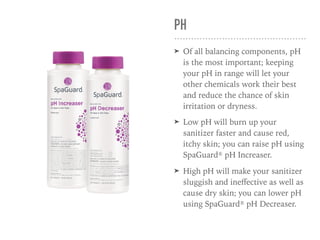
➤ Low pH will burn up your
sanitizer faster and cause red,
itchy skin; you can raise pH using
SpaGuard® pH Increaser.
➤ High pH will make your sanitizer
sluggish and ineffective as well as
cause dry skin; you can lower pH
using SpaGuard® pH Decreaser.
TOTAL ALKALINITY
➤ Alkalinity serves as a buffer for
your pH; when alkalinity is in
range, it helps to keep your pH
in range.
➤ Low alkalinity will result in pH
bounce, making it difficult to
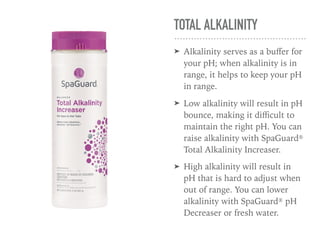
maintain the right pH. You can
raise alkalinity with SpaGuard®
Total Alkalinity Increaser.
➤ High alkalinity will result in
pH that is hard to adjust when
out of range. You can lower
alkalinity with SpaGuard® pH
Decreaser or fresh water.
CALCIUM HARDNESS
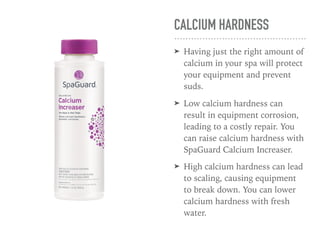
➤ Having just the right amount of
calcium in your spa will protect
your equipment and prevent
suds.
➤ Low calcium hardness can
result in equipment corrosion,
leading to a costly repair. You
can raise calcium hardness with
SpaGuard Calcium Increaser.
➤ High calcium hardness can lead
to scaling, causing equipment
to break down. You can lower
calcium hardness with fresh
water.
SPA SENTRY
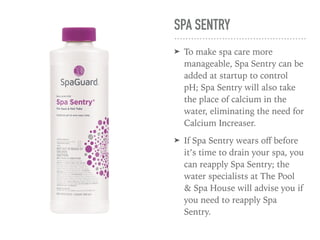
➤ To make spa care more
manageable, Spa Sentry can be
added at startup to control
pH; Spa Sentry will also take
the place of calcium in the
water, eliminating the need for
Calcium Increaser.
➤ If Spa Sentry wears off before
it’s time to drain your spa, you
can reapply Spa Sentry; the
water specialists at The Pool
& Spa House will advise you if
you need to reapply Spa
Sentry.
TDS
➤ TDS, or “total dissolved solids,” is a measure of all the “stuff”
dissolved in your water:
➤ Chemicals
➤ Bather waste, like sweat and dead skin cells
➤ Environmental waste, like pollen and leaves
➤ While TDS starts low, it increases over time; once it passes a certain
threshold, it can make balancing your spa and maintaining clear
water difficult.
➤ To lower TDS, add fresh water; a total drain and refill of your spa
should be done approximately every 3-4 months, depending on size
and usage. Refer to the Draining & Refilling part of “Intro to Spa
Care” to figure out how often you should drain your spa.
WHEN SHOULD I TEST?
➤ You should check your pH, along with your sanitizer, at least
weekly; pH is more likely to move in spas—particularly spas
not using Spa Sentry—and catching and adjusting pH early
will decrease your chance of spa downtime.
➤ Check your alkalinity, calcium, and TDS levels monthly with a
comprehensive water analysis at The Pool & Spa House; your
water care specialist will advise you on how to adjust these
levels, if needed.
➤ If you prefer to test at home, test and adjust alkalinity,
calcium, and TDS monthly.
CONGRATULATIONS!
You have completed the activity!

SC101: Spa Balancing

  • 1.
    SC101: SPA BALANCING SMARTSTART Pool School
  • 2.
    BALANCING? ➤ When wetalk about balancing your spa, we’re talking about more than just adding sanitizer and shocking it; there are other key components to water care that you should measure and adjust to ensure crystal- clear water. ➤ Other than your sanitizer level, these are the primary components of balancing: ➤ pH ➤ Total alkalinity ➤ Calcium hardness ➤ TDS ➤ Of these four, you only need to test pH at home; you can test the rest at The Pool & Spa House as part of a comprehensive water analysis.
  • 3.
    PH ➤ Of allbalancing components, pH is the most important; keeping your pH in range will let your other chemicals work their best and reduce the chance of skin irritation or dryness. ➤ Low pH will burn up your sanitizer faster and cause red, itchy skin; you can raise pH using SpaGuard® pH Increaser. ➤ High pH will make your sanitizer sluggish and ineffective as well as cause dry skin; you can lower pH using SpaGuard® pH Decreaser.
  • 4.
    TOTAL ALKALINITY ➤ Alkalinityserves as a buffer for your pH; when alkalinity is in range, it helps to keep your pH in range. ➤ Low alkalinity will result in pH bounce, making it difficult to maintain the right pH. You can raise alkalinity with SpaGuard® Total Alkalinity Increaser. ➤ High alkalinity will result in pH that is hard to adjust when out of range. You can lower alkalinity with SpaGuard® pH Decreaser or fresh water.
  • 5.
    CALCIUM HARDNESS ➤ Havingjust the right amount of calcium in your spa will protect your equipment and prevent suds. ➤ Low calcium hardness can result in equipment corrosion, leading to a costly repair. You can raise calcium hardness with SpaGuard Calcium Increaser. ➤ High calcium hardness can lead to scaling, causing equipment to break down. You can lower calcium hardness with fresh water.
  • 6.
    SPA SENTRY ➤ Tomake spa care more manageable, Spa Sentry can be added at startup to control pH; Spa Sentry will also take the place of calcium in the water, eliminating the need for Calcium Increaser. ➤ If Spa Sentry wears off before it’s time to drain your spa, you can reapply Spa Sentry; the water specialists at The Pool & Spa House will advise you if you need to reapply Spa Sentry.
  • 7.
    TDS ➤ TDS, or“total dissolved solids,” is a measure of all the “stuff” dissolved in your water: ➤ Chemicals ➤ Bather waste, like sweat and dead skin cells ➤ Environmental waste, like pollen and leaves ➤ While TDS starts low, it increases over time; once it passes a certain threshold, it can make balancing your spa and maintaining clear water difficult. ➤ To lower TDS, add fresh water; a total drain and refill of your spa should be done approximately every 3-4 months, depending on size and usage. Refer to the Draining & Refilling part of “Intro to Spa Care” to figure out how often you should drain your spa.
  • 8.
    WHEN SHOULD ITEST? ➤ You should check your pH, along with your sanitizer, at least weekly; pH is more likely to move in spas—particularly spas not using Spa Sentry—and catching and adjusting pH early will decrease your chance of spa downtime. ➤ Check your alkalinity, calcium, and TDS levels monthly with a comprehensive water analysis at The Pool & Spa House; your water care specialist will advise you on how to adjust these levels, if needed. ➤ If you prefer to test at home, test and adjust alkalinity, calcium, and TDS monthly.
  • 9.