Section 24.3
  Joe Smith
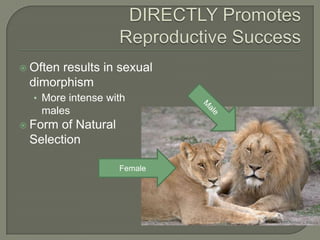
 Often
      results in sexual
 dimorphism
  • More intense with
   males
 Formof Natural
 Selection

                   Female
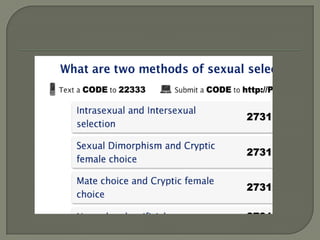
2   methods
  • Intrasexual
     Competition within one sex for opportunity to mate with
      opposite sex
  • Intersexual
     “Mate choice”
     “Cryptic Female Choice”
      Less Obvious
 These   two methods can overlap
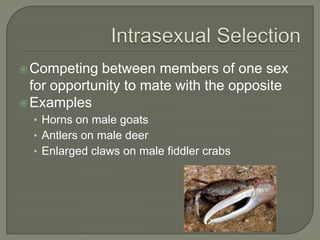
 Competing  between members of one sex
  for opportunity to mate with the opposite
 Examples
  • Horns on male goats
  • Antlers on male deer
  • Enlarged claws on male fiddler crabs
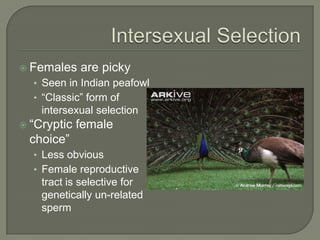
 Females    are picky
  • Seen in Indian peafowl
  • “Classic” form of
    intersexual selection
 “Cryptic   female
 choice”
  • Less obvious
  • Female reproductive
    tract is selective for
    genetically un-related
    sperm
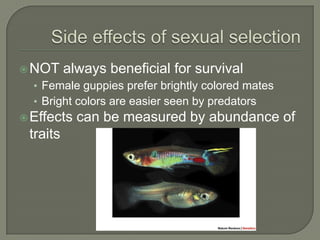
 NOT     always beneficial for survival
  • Female guppies prefer brightly colored mates
  • Bright colors are easier seen by predators
 Effects   can be measured by abundance of
 traits
 Many   different hypotheses
 • Related to upbringing of offspring
 • Dependant on fitness
    Age is a factor
 Governed       by same processes
 • Directional
 • Stabilizing
 • Diversifying
 • Balanced
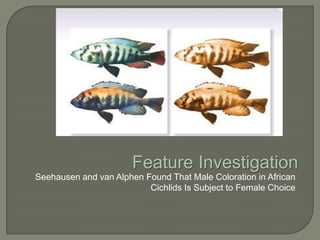
Feature Investigation
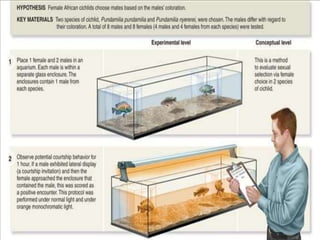
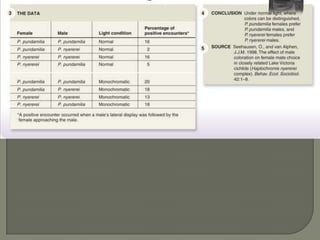
Seehausen and van Alphen Found That Male Coloration in African
                          Cichlids Is Subject to Female Choice
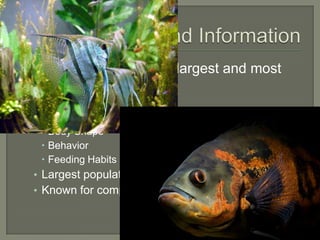
 Cichlidae   family one of largest and most
 diverse
  • Vary by:
     Coloration
     Body Shape
     Behavior
     Feeding Habits
  • Largest population in Eastern African lakes
  • Known for complex mating behavior
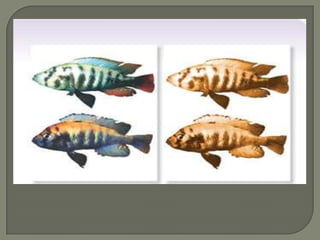
 P. pandamilia and P. nyerierei can
  interbreed
 Both found in Lake Victoria
  • Certain areas of the lake have interbreeding;
       others do not
 Coloration     valued in female choice of mate
Bio presentation section 24 point 3

Bio presentation section 24 point 3

  • 2.
    Section 24.3 Joe Smith
  • 3.
     Often results in sexual dimorphism • More intense with males  Formof Natural Selection Female
  • 4.
    2 methods • Intrasexual  Competition within one sex for opportunity to mate with opposite sex • Intersexual  “Mate choice”  “Cryptic Female Choice”  Less Obvious  These two methods can overlap
  • 6.
     Competing between members of one sex for opportunity to mate with the opposite  Examples • Horns on male goats • Antlers on male deer • Enlarged claws on male fiddler crabs
  • 7.
     Females are picky • Seen in Indian peafowl • “Classic” form of intersexual selection  “Cryptic female choice” • Less obvious • Female reproductive tract is selective for genetically un-related sperm
  • 8.
     NOT always beneficial for survival • Female guppies prefer brightly colored mates • Bright colors are easier seen by predators  Effects can be measured by abundance of traits
  • 9.
     Many different hypotheses • Related to upbringing of offspring • Dependant on fitness  Age is a factor
  • 10.
     Governed by same processes • Directional • Stabilizing • Diversifying • Balanced
  • 11.
    Feature Investigation Seehausen andvan Alphen Found That Male Coloration in African Cichlids Is Subject to Female Choice
  • 12.
     Cichlidae family one of largest and most diverse • Vary by:  Coloration  Body Shape  Behavior  Feeding Habits • Largest population in Eastern African lakes • Known for complex mating behavior
  • 13.
     P. pandamiliaand P. nyerierei can interbreed  Both found in Lake Victoria • Certain areas of the lake have interbreeding; others do not  Coloration valued in female choice of mate