


Welcome To
❤ My ❤
Presentation
My
Presentation
Is
Genome Assembly
2
Hello!
I am Marjuk Ahmed Siddiki
ID: 171-15-8959
Bio-Informatics
Daffodil International University
What is
Genome
Assembly
?
4
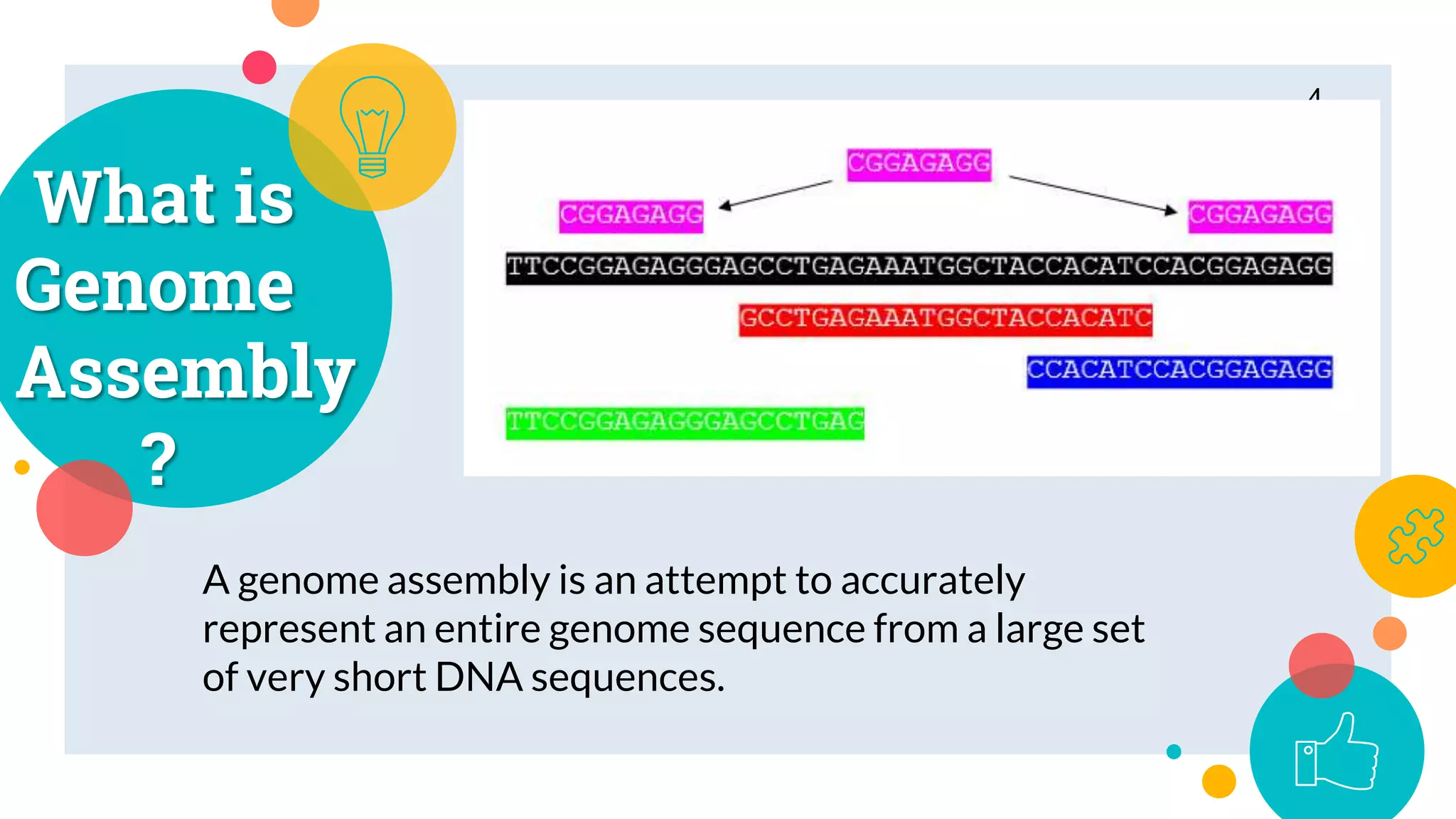
A genome assembly is an attempt to accurately
represent an entire genome sequence from a large set
of very short DNA sequences.
Genome
Assembly
History
5
The first genome assemblers began to appear in the
late 1980s and early 1990s as variants of simpler
sequence alignment programs to piece together vast
quantities of fragments generated by automated
sequencing instruments called DNA sequencers. As
the sequenced organisms grew in size and complexity.
What is a
good
genome
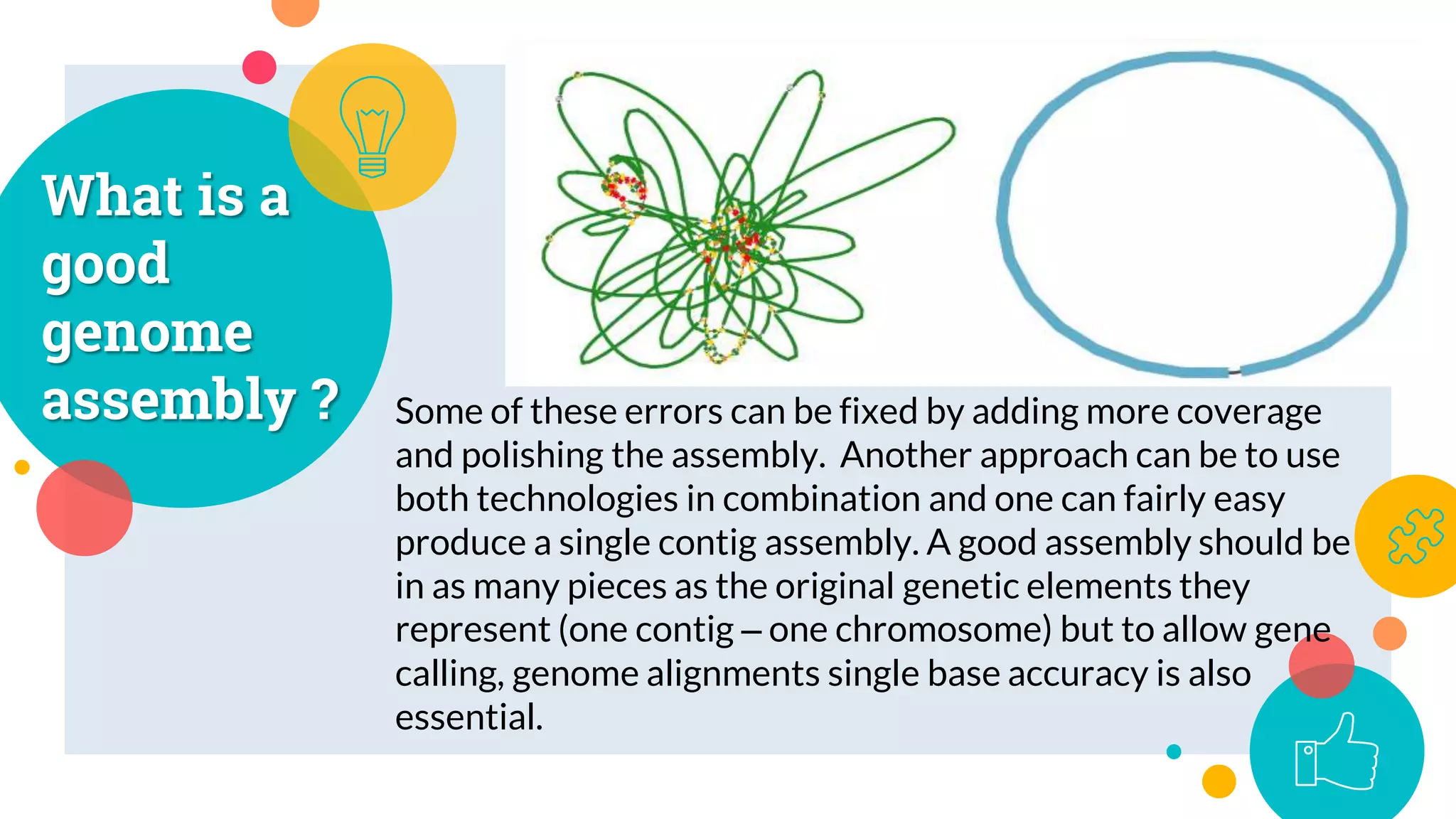
assembly ? Some of these errors can be fixed by adding more coverage
and polishing the assembly. Another approach can be to use
both technologies in combination and one can fairly easy
produce a single contig assembly. A good assembly should be
in as many pieces as the original genetic elements they
represent (one contig – one chromosome) but to allow gene
calling, genome alignments single base accuracy is also
essential.
6
Genome
Assembly
Method
A primer on genome assembly methods:
I. Introduction
II. Hierarchical
III. Whole Genome Assembly
IV. Hybrid Methods
V. Comparative Assembly
7
Assembly
Introducing
The basic problem of genome assembly stems from
the fact that while genomes themselves are quite
large and contain long stretches of contiguous
sequence, on the order of millions of base pairs), the
current generation of commonly used genome
sequencers can only generate relatively short
segments of sequence. Traditional approaches,
based on Sanger sequence could produce reads of
up to 1000 bp.
8
Hierarchical
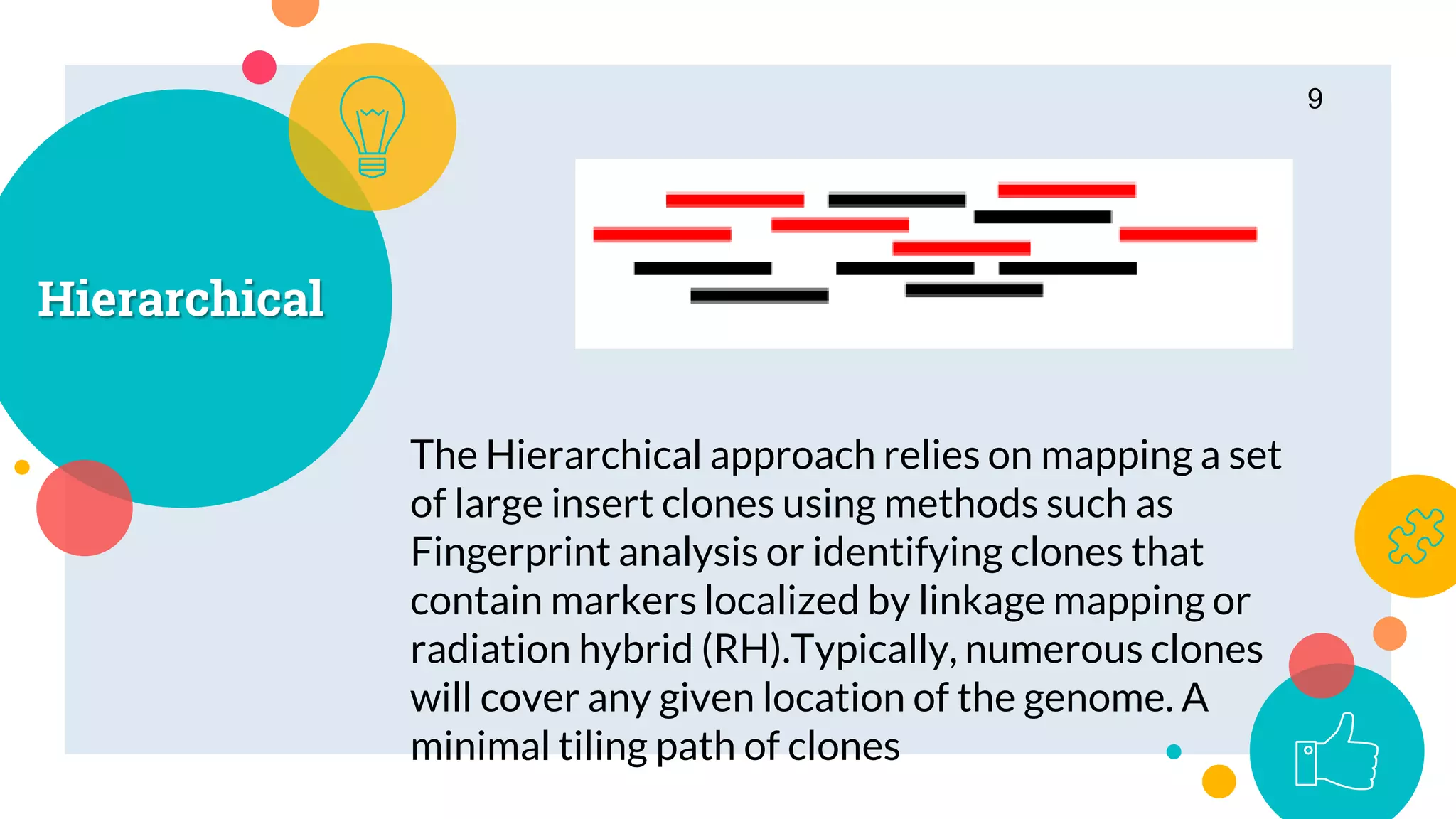
The Hierarchical approach relies on mapping a set
of large insert clones using methods such as
Fingerprint analysis or identifying clones that
contain markers localized by linkage mapping or
radiation hybrid (RH).Typically, numerous clones
will cover any given location of the genome. A
minimal tiling path of clones
9
Whole
Genome
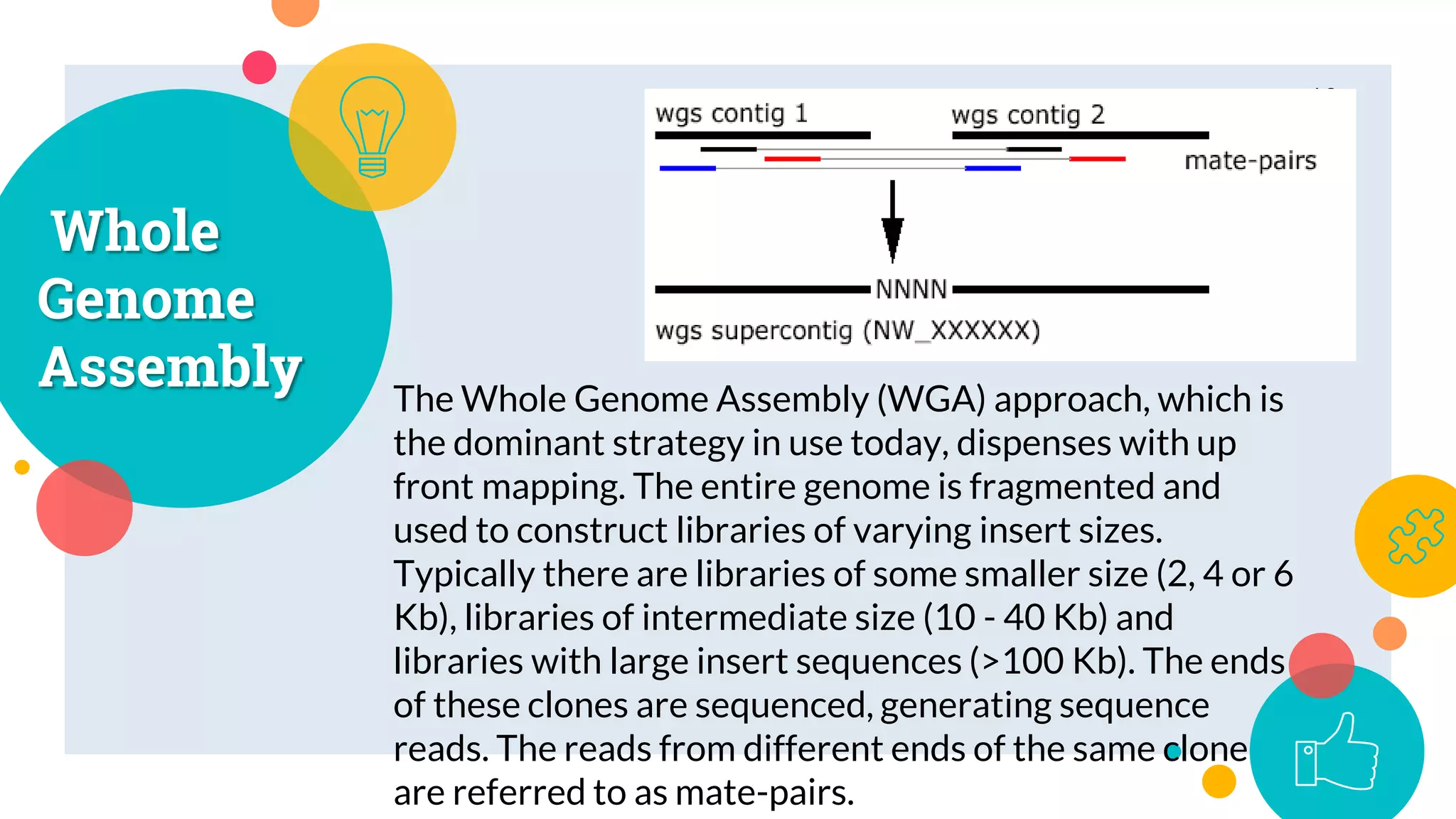
Assembly The Whole Genome Assembly (WGA) approach, which is
the dominant strategy in use today, dispenses with up
front mapping. The entire genome is fragmented and
used to construct libraries of varying insert sizes.
Typically there are libraries of some smaller size (2, 4 or 6
Kb), libraries of intermediate size (10 - 40 Kb) and
libraries with large insert sequences (>100 Kb). The ends
of these clones are sequenced, generating sequence
reads. The reads from different ends of the same clone
are referred to as mate-pairs.
10
Hybrid
Approaches
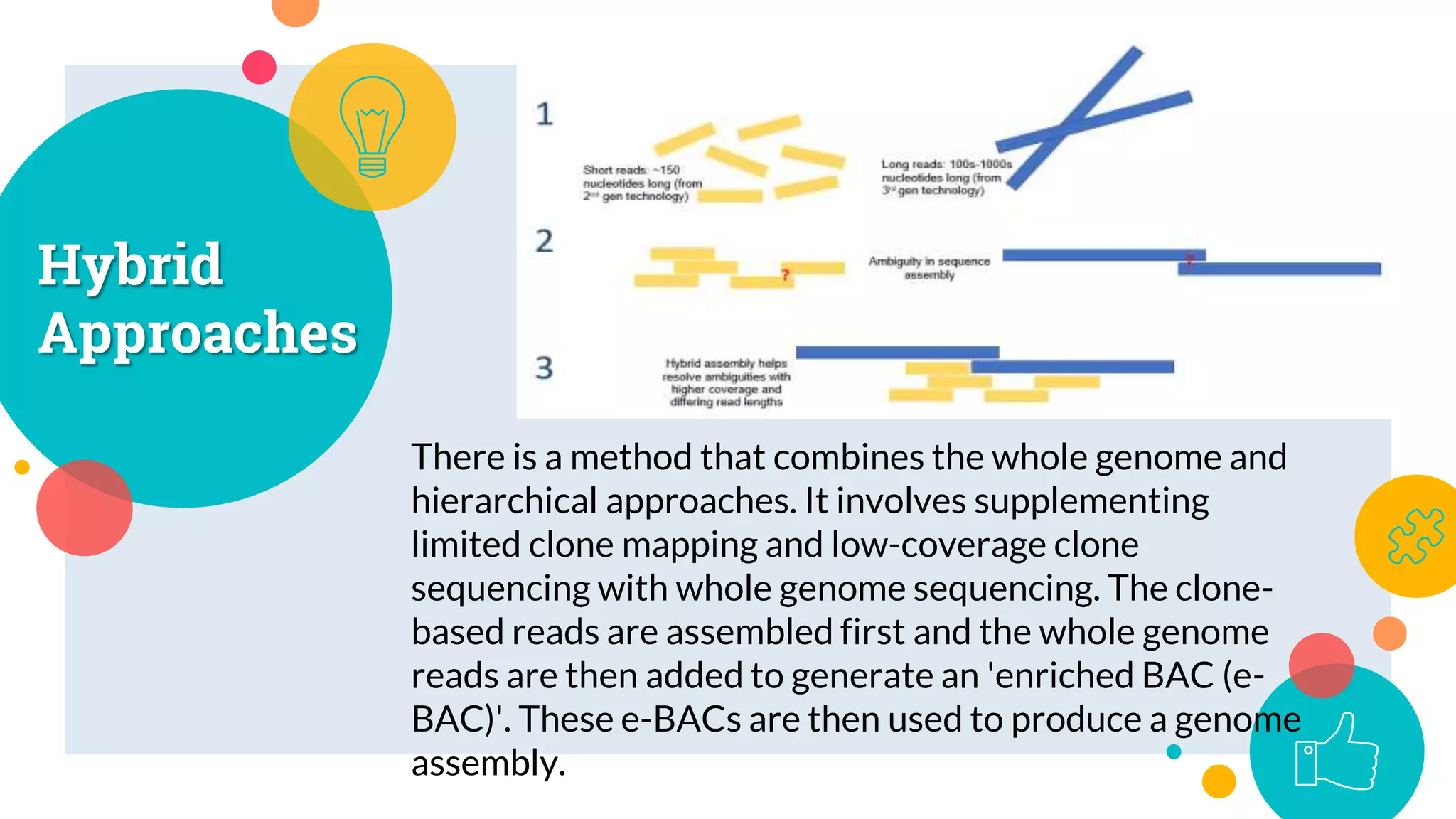
There is a method that combines the whole genome and
hierarchical approaches. It involves supplementing
limited clone mapping and low-coverage clone
sequencing with whole genome sequencing. The clone-
based reads are assembled first and the whole genome
reads are then added to generate an 'enriched BAC (e-
BAC)'. These e-BACs are then used to produce a genome
assembly.
11
Comparative
Assembly
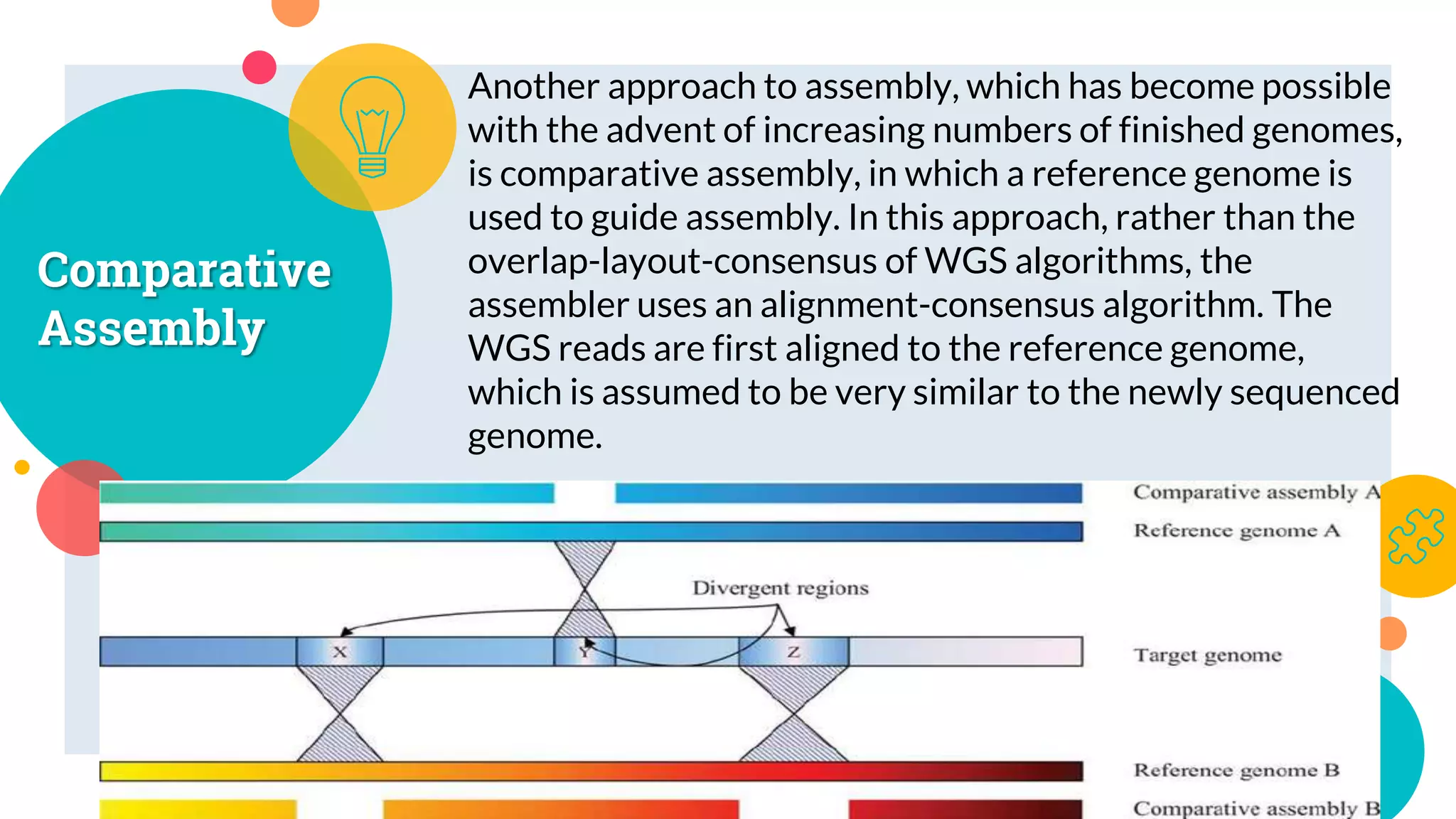
Another approach to assembly, which has become possible
with the advent of increasing numbers of finished genomes,
is comparative assembly, in which a reference genome is
used to guide assembly. In this approach, rather than the
overlap-layout-consensus of WGS algorithms, the
assembler uses an alignment-consensus algorithm. The
WGS reads are first aligned to the reference genome,
which is assumed to be very similar to the newly sequenced
genome.
13
Thanks
To ❤ All

Bio Informatics - Genome Assembly

  • 1.
    Welcome To ❤ My❤ Presentation
  • 2.
  • 3.
    Hello! I am MarjukAhmed Siddiki ID: 171-15-8959 Bio-Informatics Daffodil International University
  • 4.
    What is Genome Assembly ? 4 A genomeassembly is an attempt to accurately represent an entire genome sequence from a large set of very short DNA sequences.
  • 5.
    Genome Assembly History 5 The first genomeassemblers began to appear in the late 1980s and early 1990s as variants of simpler sequence alignment programs to piece together vast quantities of fragments generated by automated sequencing instruments called DNA sequencers. As the sequenced organisms grew in size and complexity.
  • 6.
    What is a good genome assembly? Some of these errors can be fixed by adding more coverage and polishing the assembly. Another approach can be to use both technologies in combination and one can fairly easy produce a single contig assembly. A good assembly should be in as many pieces as the original genetic elements they represent (one contig – one chromosome) but to allow gene calling, genome alignments single base accuracy is also essential. 6
  • 7.
    Genome Assembly Method A primer ongenome assembly methods: I. Introduction II. Hierarchical III. Whole Genome Assembly IV. Hybrid Methods V. Comparative Assembly 7
  • 8.
    Assembly Introducing The basic problemof genome assembly stems from the fact that while genomes themselves are quite large and contain long stretches of contiguous sequence, on the order of millions of base pairs), the current generation of commonly used genome sequencers can only generate relatively short segments of sequence. Traditional approaches, based on Sanger sequence could produce reads of up to 1000 bp. 8
  • 9.
    Hierarchical The Hierarchical approachrelies on mapping a set of large insert clones using methods such as Fingerprint analysis or identifying clones that contain markers localized by linkage mapping or radiation hybrid (RH).Typically, numerous clones will cover any given location of the genome. A minimal tiling path of clones 9
  • 10.
    Whole Genome Assembly The WholeGenome Assembly (WGA) approach, which is the dominant strategy in use today, dispenses with up front mapping. The entire genome is fragmented and used to construct libraries of varying insert sizes. Typically there are libraries of some smaller size (2, 4 or 6 Kb), libraries of intermediate size (10 - 40 Kb) and libraries with large insert sequences (>100 Kb). The ends of these clones are sequenced, generating sequence reads. The reads from different ends of the same clone are referred to as mate-pairs. 10
  • 11.
    Hybrid Approaches There is amethod that combines the whole genome and hierarchical approaches. It involves supplementing limited clone mapping and low-coverage clone sequencing with whole genome sequencing. The clone- based reads are assembled first and the whole genome reads are then added to generate an 'enriched BAC (e- BAC)'. These e-BACs are then used to produce a genome assembly. 11
  • 12.
    Comparative Assembly Another approach toassembly, which has become possible with the advent of increasing numbers of finished genomes, is comparative assembly, in which a reference genome is used to guide assembly. In this approach, rather than the overlap-layout-consensus of WGS algorithms, the assembler uses an alignment-consensus algorithm. The WGS reads are first aligned to the reference genome, which is assumed to be very similar to the newly sequenced genome.
  • 13.
  • 14.