


Welcome
To ❤ My
Presentation
Hello!
I am Marjuk Ahmed Siddiki
ID: 171-15-8959
Daffodil International University
What is the Internet of Things ?
The Internet of Things (IoT) is the network of physical objects or "things" embedded with
electronics, software, sensors, and network connectivity, which enables these objects to
collect and exchange data.
IoT allows objects to be sensed and controlled remotely across existing network
infrastructure, creating opportunities for more direct integration between the physical
world and computer-based systems, and resulting in improved efficiency, accuracy and
economic benefit
History of IoT
The concept of the Internet of Things first became popular in 1999, through the Auto-ID
Center at MIT and related market-analysis publications. Radio-frequency identification
(RFID) was seen as a prerequisite for the IoT at that point. If all objects and people in
daily life were equipped with identifiers, computers could manage and inventory them.
Such technologies as near field communication, barcodes, QR codes, bluetooth, and
digital watermarking.
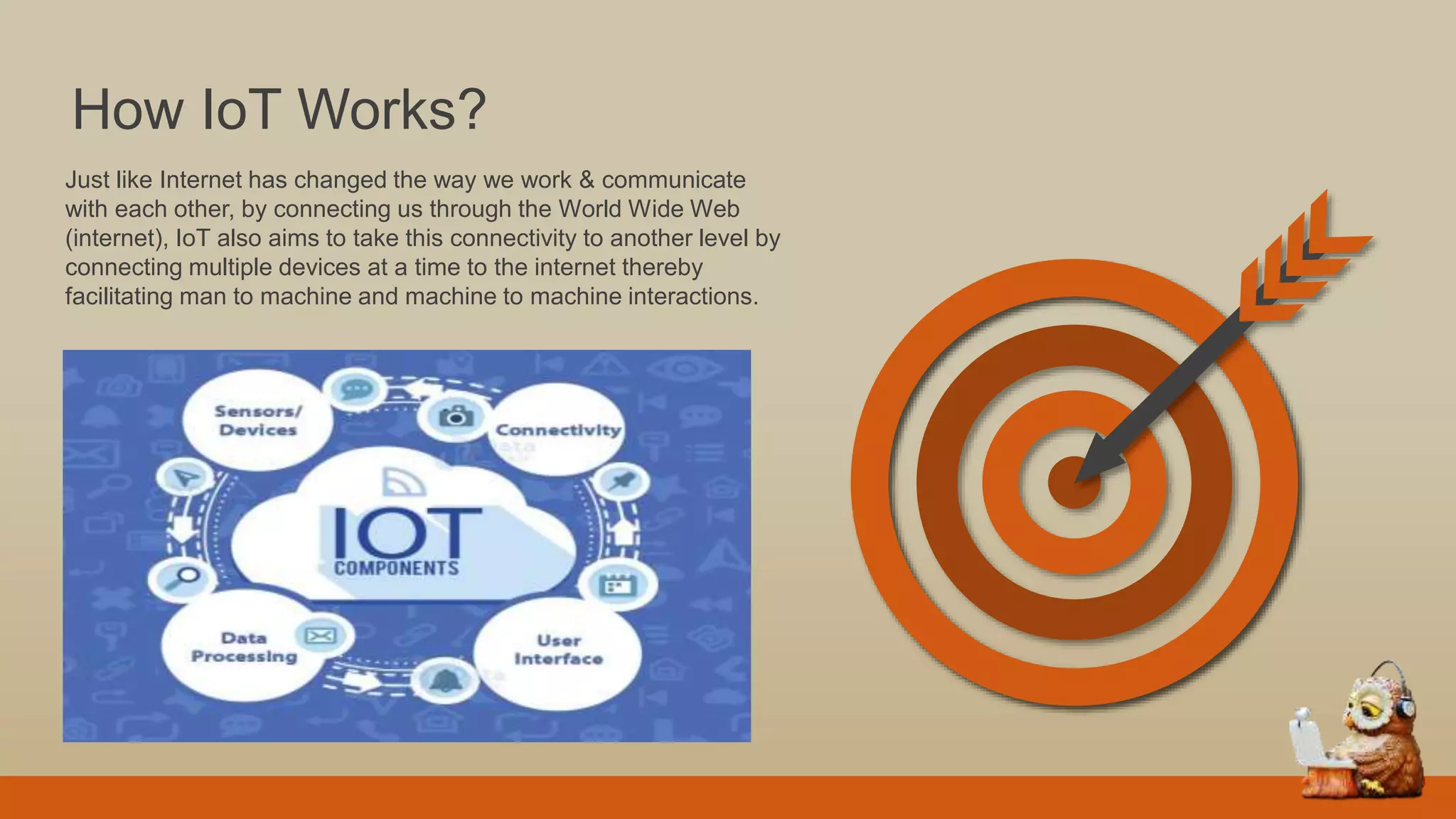
Just like Internet has changed the way we work & communicate
with each other, by connecting us through the World Wide Web
(internet), IoT also aims to take this connectivity to another level by
connecting multiple devices at a time to the internet thereby
facilitating man to machine and machine to machine interactions.
How IoT Works?
Sensors/Devices
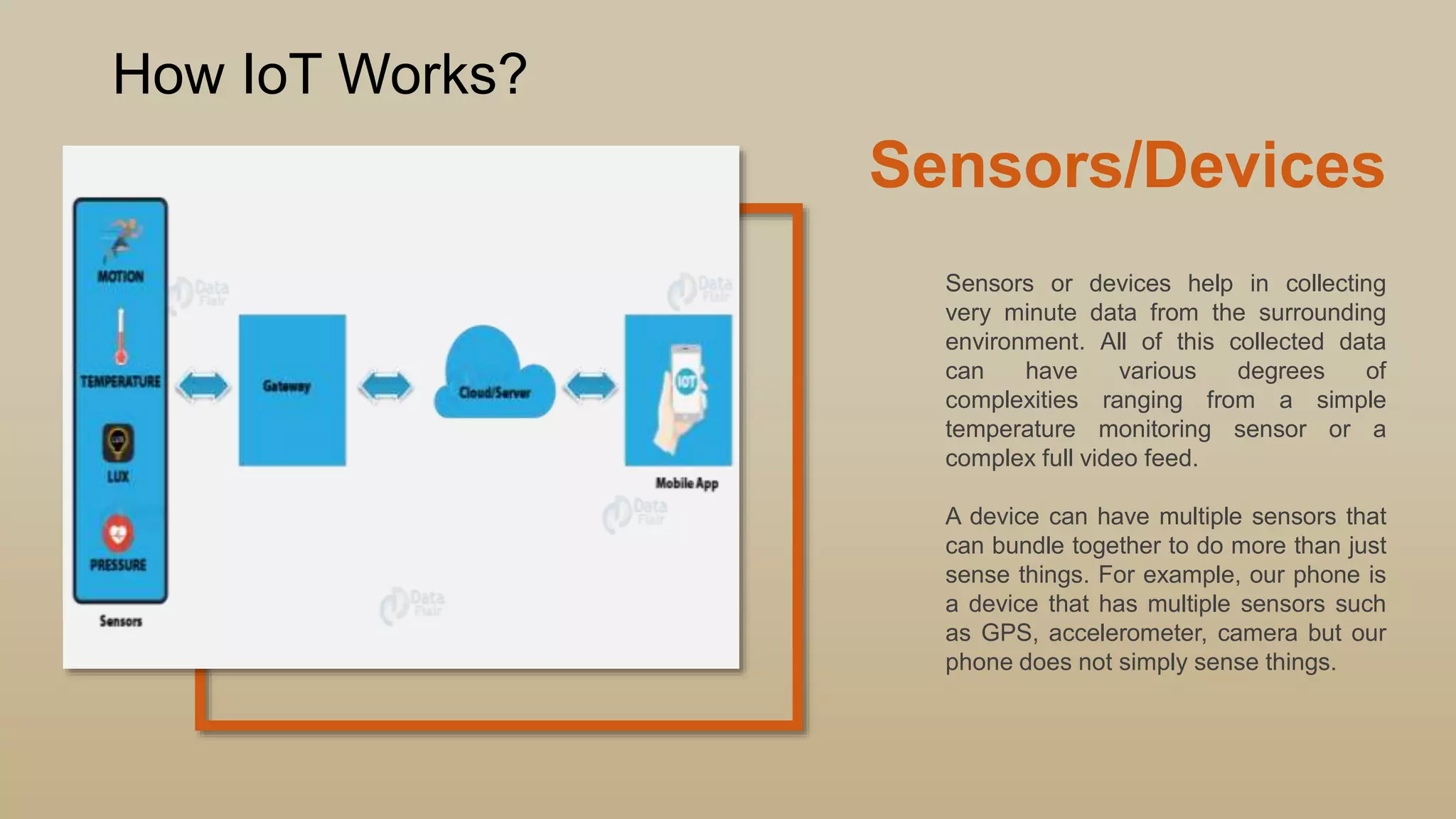
Sensors or devices help in collecting
very minute data from the surrounding
environment. All of this collected data
can have various degrees of
complexities ranging from a simple
temperature monitoring sensor or a
complex full video feed.
A device can have multiple sensors that
can bundle together to do more than just
sense things. For example, our phone is
a device that has multiple sensors such
as GPS, accelerometer, camera but our
phone does not simply sense things.
How IoT Works?
Connectivity
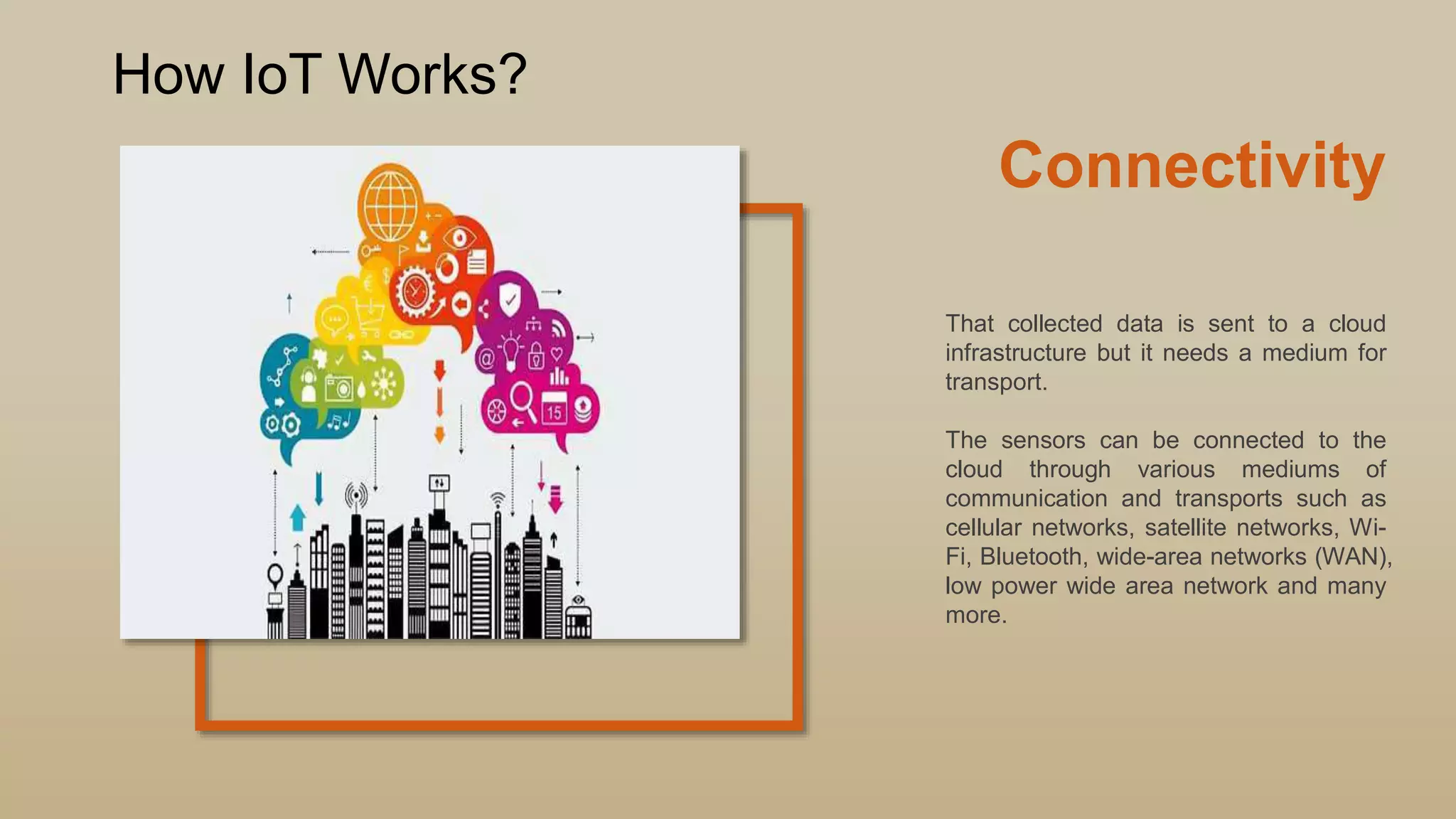
That collected data is sent to a cloud
infrastructure but it needs a medium for
transport.
The sensors can be connected to the
cloud through various mediums of
communication and transports such as
cellular networks, satellite networks, Wi-
Fi, Bluetooth, wide-area networks (WAN),
low power wide area network and many
more.
How IoT Works?
Data Processing
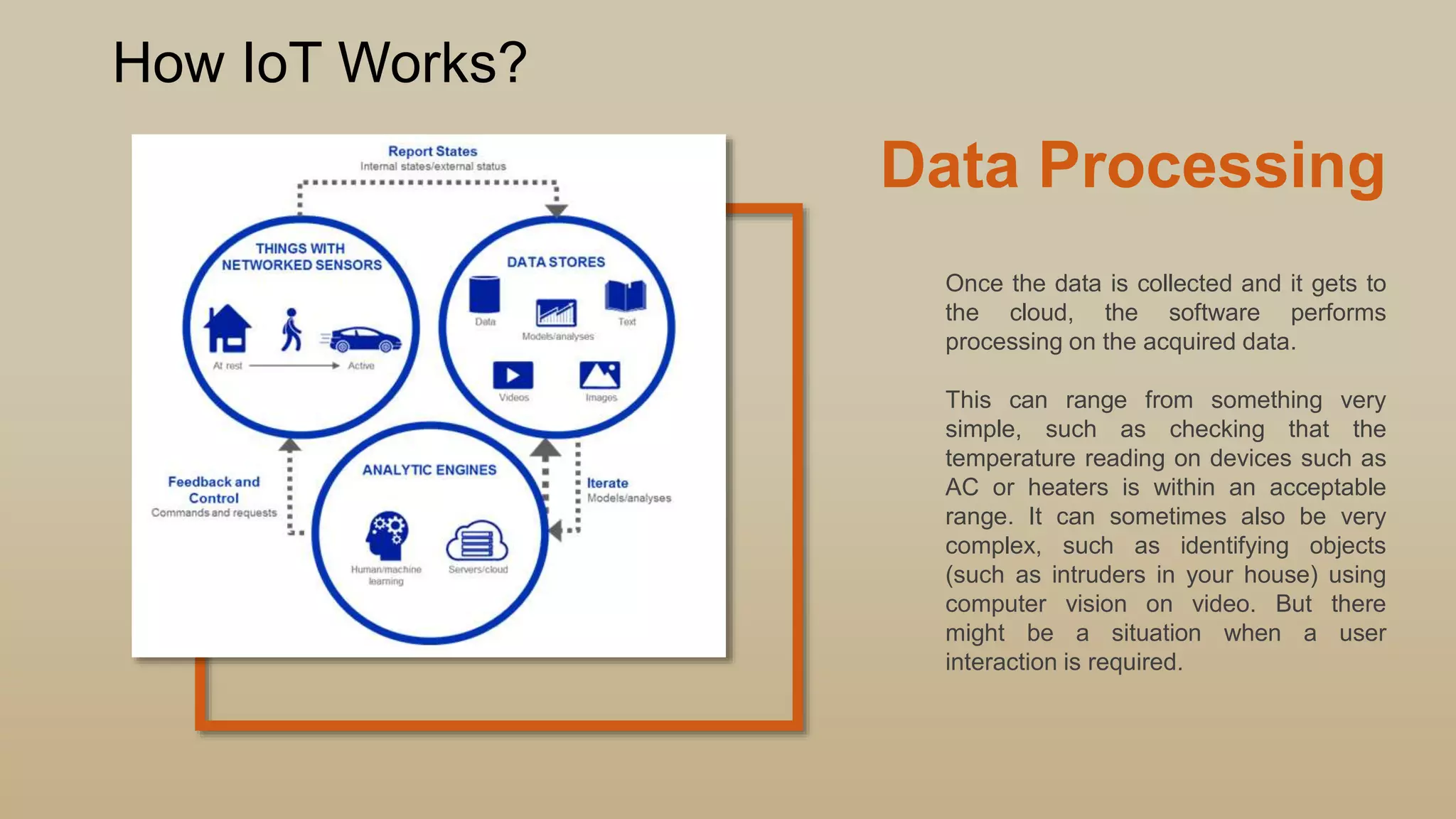
Once the data is collected and it gets to
the cloud, the software performs
processing on the acquired data.
This can range from something very
simple, such as checking that the
temperature reading on devices such as
AC or heaters is within an acceptable
range. It can sometimes also be very
complex, such as identifying objects
(such as intruders in your house) using
computer vision on video. But there
might be a situation when a user
interaction is required.
How IoT Works?
User Interface
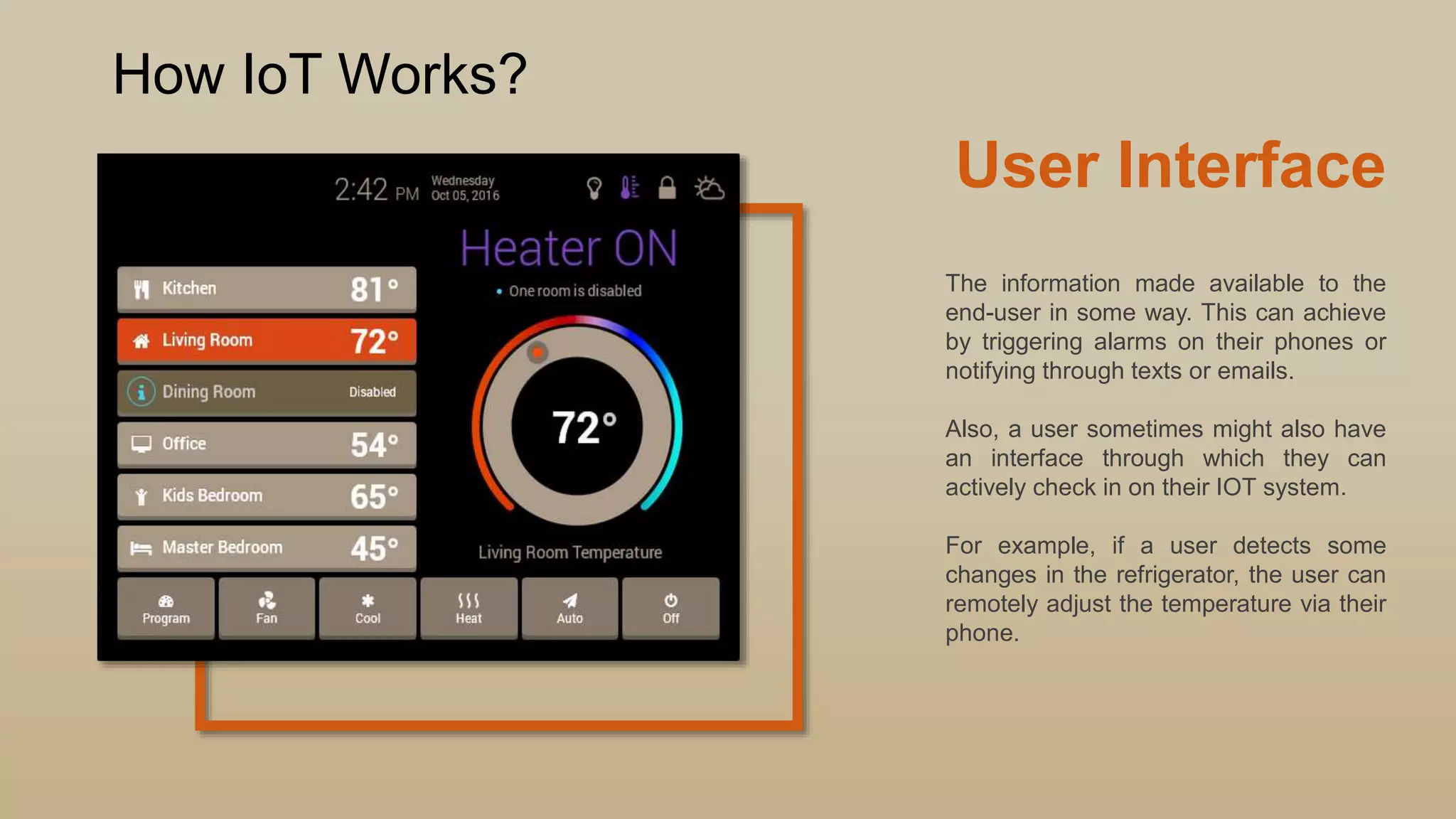
The information made available to the
end-user in some way. This can achieve
by triggering alarms on their phones or
notifying through texts or emails.
Also, a user sometimes might also have
an interface through which they can
actively check in on their IOT system.
For example, if a user detects some
changes in the refrigerator, the user can
remotely adjust the temperature via their
phone.
How IoT Works?
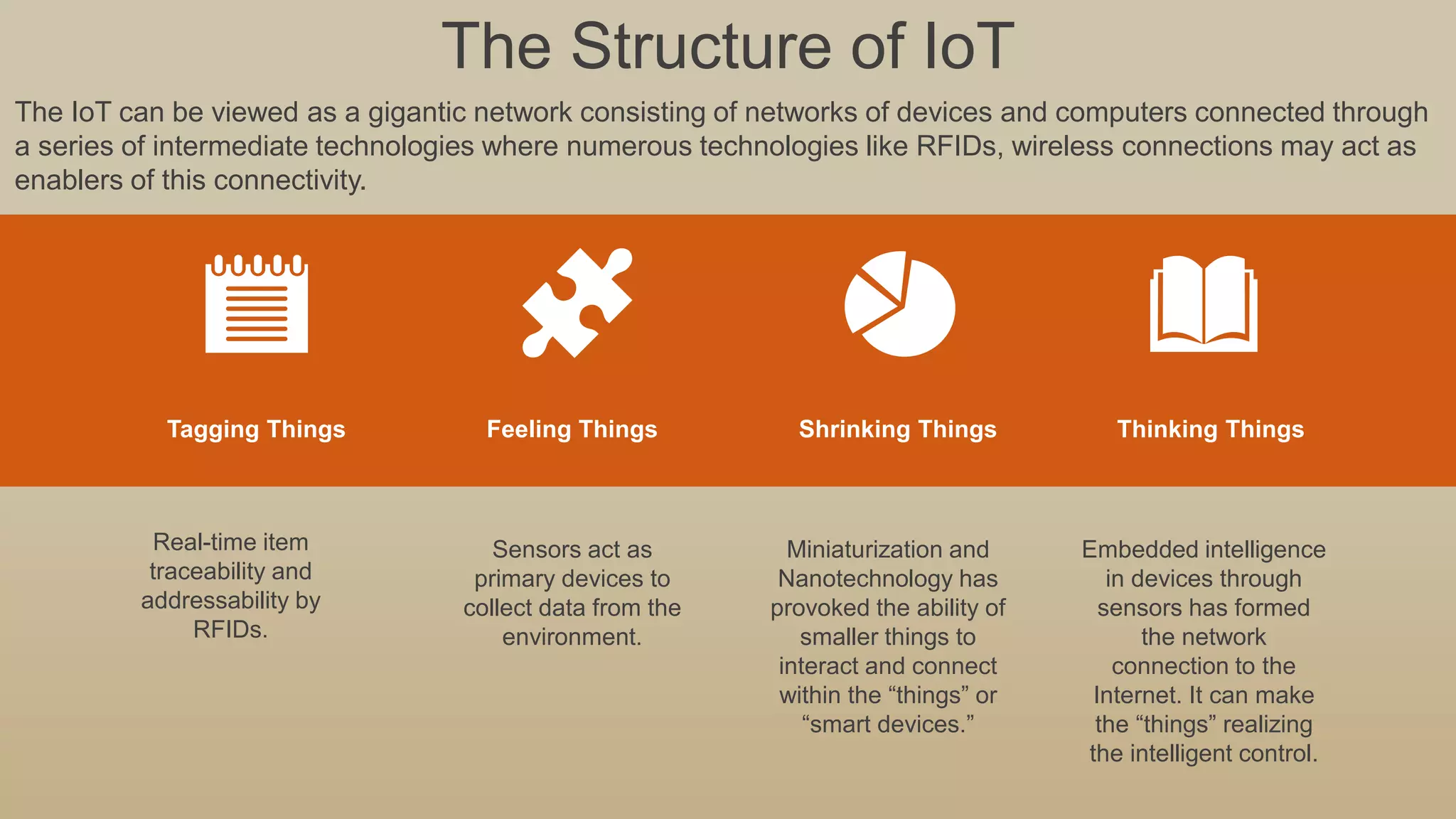
The Structure of IoT
The IoT can be viewed as a gigantic network consisting of networks of devices and computers connected through
a series of intermediate technologies where numerous technologies like RFIDs, wireless connections may act as
enablers of this connectivity.
Tagging Things Shrinking ThingsFeeling Things Thinking Things
Real-time item
traceability and
addressability by
RFIDs.
Sensors act as
primary devices to
collect data from the
environment.
Miniaturization and
Nanotechnology has
provoked the ability of
smaller things to
interact and connect
within the “things” or
“smart devices.”
Embedded intelligence
in devices through
sensors has formed
the network
connection to the
Internet. It can make
the “things” realizing
the intelligent control.
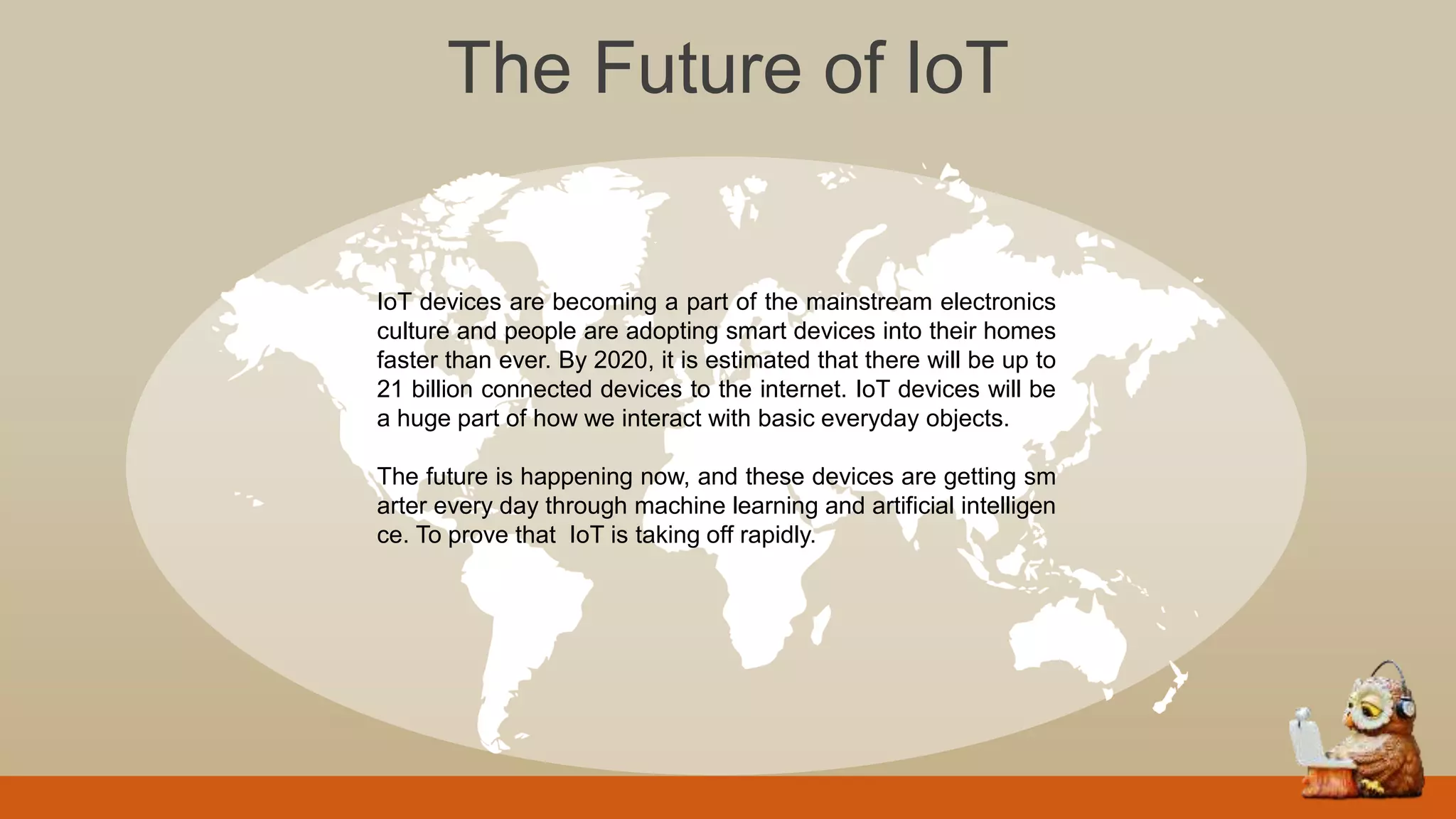
The Future of IoT
IoT devices are becoming a part of the mainstream electronics
culture and people are adopting smart devices into their homes
faster than ever. By 2020, it is estimated that there will be up to
21 billion connected devices to the internet. IoT devices will be
a huge part of how we interact with basic everyday objects.
The future is happening now, and these devices are getting sm
arter every day through machine learning and artificial intelligen
ce. To prove that IoT is taking off rapidly.
The challenge of IoT
IoT developers are constantly developing new and advanced devices for homes and offices that are connected
with each other and the Internet.
Inability to connect due to
billions of devices on a
centralized server
CONNECTIVITY CHALLENGES
Compatibility issues require
deployment of extra hardware
and software
COMPATIBILITY CHALLENGES
IoT can be hacked and can put
security at stake
SECURITY CHALLENGES
Private information on IoT can
be stolen
PRIVACY CHALLENGES
Thank 💕 you

Internet of Things (IoT)

  • 1.
  • 3.
    Hello! I am MarjukAhmed Siddiki ID: 171-15-8959 Daffodil International University
  • 4.
    What is theInternet of Things ? The Internet of Things (IoT) is the network of physical objects or "things" embedded with electronics, software, sensors, and network connectivity, which enables these objects to collect and exchange data. IoT allows objects to be sensed and controlled remotely across existing network infrastructure, creating opportunities for more direct integration between the physical world and computer-based systems, and resulting in improved efficiency, accuracy and economic benefit
  • 5.
    History of IoT Theconcept of the Internet of Things first became popular in 1999, through the Auto-ID Center at MIT and related market-analysis publications. Radio-frequency identification (RFID) was seen as a prerequisite for the IoT at that point. If all objects and people in daily life were equipped with identifiers, computers could manage and inventory them. Such technologies as near field communication, barcodes, QR codes, bluetooth, and digital watermarking.
  • 6.
    Just like Internethas changed the way we work & communicate with each other, by connecting us through the World Wide Web (internet), IoT also aims to take this connectivity to another level by connecting multiple devices at a time to the internet thereby facilitating man to machine and machine to machine interactions. How IoT Works?
  • 7.
    Sensors/Devices Sensors or deviceshelp in collecting very minute data from the surrounding environment. All of this collected data can have various degrees of complexities ranging from a simple temperature monitoring sensor or a complex full video feed. A device can have multiple sensors that can bundle together to do more than just sense things. For example, our phone is a device that has multiple sensors such as GPS, accelerometer, camera but our phone does not simply sense things. How IoT Works?
  • 8.
    Connectivity That collected datais sent to a cloud infrastructure but it needs a medium for transport. The sensors can be connected to the cloud through various mediums of communication and transports such as cellular networks, satellite networks, Wi- Fi, Bluetooth, wide-area networks (WAN), low power wide area network and many more. How IoT Works?
  • 9.
    Data Processing Once thedata is collected and it gets to the cloud, the software performs processing on the acquired data. This can range from something very simple, such as checking that the temperature reading on devices such as AC or heaters is within an acceptable range. It can sometimes also be very complex, such as identifying objects (such as intruders in your house) using computer vision on video. But there might be a situation when a user interaction is required. How IoT Works?
  • 10.
    User Interface The informationmade available to the end-user in some way. This can achieve by triggering alarms on their phones or notifying through texts or emails. Also, a user sometimes might also have an interface through which they can actively check in on their IOT system. For example, if a user detects some changes in the refrigerator, the user can remotely adjust the temperature via their phone. How IoT Works?
  • 11.
    The Structure ofIoT The IoT can be viewed as a gigantic network consisting of networks of devices and computers connected through a series of intermediate technologies where numerous technologies like RFIDs, wireless connections may act as enablers of this connectivity. Tagging Things Shrinking ThingsFeeling Things Thinking Things Real-time item traceability and addressability by RFIDs. Sensors act as primary devices to collect data from the environment. Miniaturization and Nanotechnology has provoked the ability of smaller things to interact and connect within the “things” or “smart devices.” Embedded intelligence in devices through sensors has formed the network connection to the Internet. It can make the “things” realizing the intelligent control.
  • 12.
    The Future ofIoT IoT devices are becoming a part of the mainstream electronics culture and people are adopting smart devices into their homes faster than ever. By 2020, it is estimated that there will be up to 21 billion connected devices to the internet. IoT devices will be a huge part of how we interact with basic everyday objects. The future is happening now, and these devices are getting sm arter every day through machine learning and artificial intelligen ce. To prove that IoT is taking off rapidly.
  • 13.
    The challenge ofIoT IoT developers are constantly developing new and advanced devices for homes and offices that are connected with each other and the Internet. Inability to connect due to billions of devices on a centralized server CONNECTIVITY CHALLENGES Compatibility issues require deployment of extra hardware and software COMPATIBILITY CHALLENGES IoT can be hacked and can put security at stake SECURITY CHALLENGES Private information on IoT can be stolen PRIVACY CHALLENGES
  • 14.