Biogas Upgrading to Renewable Natural Gas
(RNG)
Biocycle West Coast Conference 2013


Thomas Gratz, Regional Sales Manager

                                         www.eisenmann.com
                                          www.eisenmann.us.com
                                        © Eisenmann AG 2013
                                              © Eisenmann 2013
Agenda


 1 Biomethane Incentives

 2 Membrane Technology for Gas Upgrading

 3 Case Study: Gas Upgrading

 4 Membrane Technology and Anaerobic Digestion Integration

 5 US Application

 6 About Eisenmann

 7 Conclusions and Questions


                                                             2
Agenda


 1 Biomethane Incentives

 2 Membrane Technology for Gas Upgrading

 3 Case Study: Gas Upgrading

 4 Membrane Technology and Anaerobic Digestion Integration

 5 US Application

 6 About Eisenmann

 7 Conclusions and Questions


                                                             3
Drivers

Most biogas systems use CHP to generate electricity and heat
      The thermal energy cannot always be utilized


Incentives to use biogas as biomethane or CNG for transportation fuel
      More than 250,000 natural gas vehicles in the US
       (source: GE)
      12-15% public transit buses in US use CNG
       (source: CNG Now)
      A natural gas powered bus can displace 1,400 gallons of
       diesel fuel a year
       (source: CNG Now)
      Natural gas vehicles reduce greenhouse gas emissions
       between 20-29%
       (source: Natural Gas Vehicle Association)


                                                                        4
Advantages of Biomethane


 Decentralized production

 Independent, flexible and storable energy source

 Efficient use according to requirements

 Storage capability for when demand is higher

 Offsets non-renewable sources

  (coal, oil, fossil fuel derived natural gas)
 Production creates US jobs and benefits local
  economies


                                                     5
Agenda


 1 Biomethane Incentives

 2 Membrane Technology for Gas Upgrading

 3 Case Study: Gas Upgrading

 4 Membrane Technology and Anaerobic Digestion Integration

 5 US Application

 6 About Eisenmann

 7 Conclusions and Questions


                                                             6
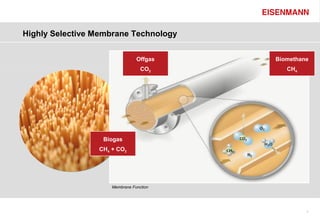
Highly Selective Membrane Technology


                                Offgas   Biomethane
                                  CO2       CH4


                  Biogas
                 CH4 + CO2


                     Membrane Function


                                                  7
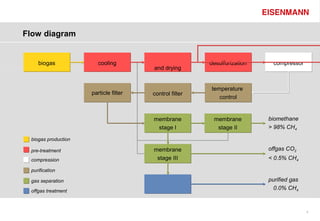
Flow diagram


    biogas              cooling                         desulfurization     compressor
                                       and drying


                                                        temperature
                     particle filter   control filter
                                                           control


                                       membrane          membrane         biomethane
                                        stage I           stage II        > 98% CH4

 biogas production

 pre-treatment                         membrane                           offgas CO2
 compression                            stage III                         < 0.5% CH4

 purification

 gas separation                                                           purified gas
 offgas treatment
                                                                            0.0% CH4


                                                                                         8
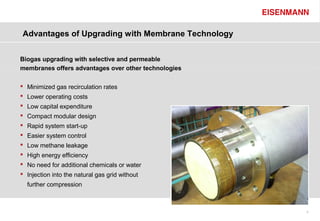
Advantages of Upgrading with Membrane Technology


Biogas upgrading with selective and permeable
membranes offers advantages over other technologies

 Minimized gas recirculation rates
 Lower operating costs
 Low capital expenditure
 Compact modular design
 Rapid system start-up
 Easier system control
 Low methane leakage
 High energy efficiency
 No need for additional chemicals or water
 Injection into the natural gas grid without
  further compression


                                                      9
Agenda


 1 Biomethane Incentives

 2 Membrane Technology for Gas Upgrading

 3 Case Study: Gas Upgrading

 4 Membrane Technology and Anaerobic Digestion Integration

 5 US Application

 6 About Eisenmann

 7 Conclusions and Questions


                                                             10
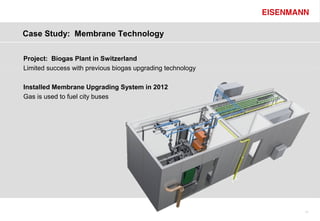
Case Study: Membrane Technology

Project: Biogas Plant in Switzerland
Limited success with previous biogas upgrading technology

Installed Membrane Upgrading System in 2012
Gas is used to fuel city buses


                                                            11
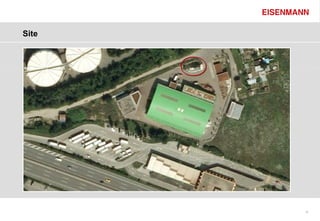
Site


       12
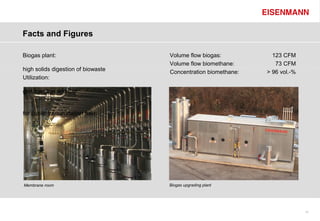
Facts and Figures

Biogas plant:                       Volume flow biogas:           123 CFM
                                    Volume flow biomethane:        73 CFM
high solids digestion of biowaste   Concentration biomethane:   > 96 vol.-%
Utilization:

grid injection and fuel


for public transportation fleet


Membrane room                       Biogas upgrading plant


                                                                              13
Measurement Data

Successful test operation in December 2012
Grid injection since January 26, 2013


                                                                              concentration [vol.-%]
 concentration [vol.-


                                        concentration biomethane [vol.-%]
                                                                                                                       concentration methane [vol.-%]
                                        concentration CO2 [vol.-%]
                                                                                                                       concentration CO2 [vol.-%]
        %]


                        Dec 3   Dec 4     Dec 5         Dec 6        Dec 7                             Dec 3   Dec 4     Dec 5        Dec 6     Dec 7
                                           2012                                                                           2012


Biomethane to grid injection: methane > 96 %                                 Offgas to atmosphere: methane leakage < 1.0 %


                                                                                                                                                        14
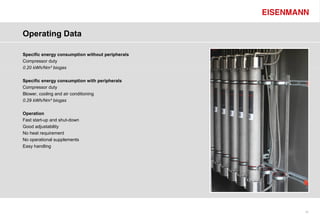
Operating Data

Specific energy consumption without peripherals
Compressor duty
0.20 kWh/Nm³ biogas

Specific energy consumption with peripherals
Compressor duty
Blower, cooling and air conditioning
0.29 kWh/Nm³ biogas

Operation
Fast start-up and shut-down
Good adjustability
No heat requirement
No operational supplements
Easy handling


                                                  15
Agenda


 1 Biomethane Incentives

 2 Membrane Technology for Gas Upgrading

 3 Case Study: Gas Upgrading

 4 Membrane Technology and Anaerobic Digestion Integration

 5 US Application

 6 About Eisenmann

 7 Conclusions and Questions


                                                             16
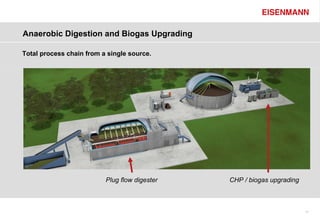
Anaerobic Digestion and Biogas Upgrading

Total process chain from a single source.


                          Plug flow digester   CHP / biogas upgrading


                                                                        17
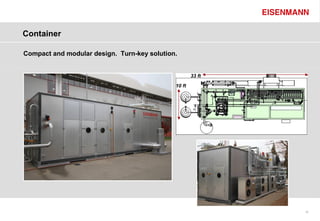
Container

Compact and modular design. Turn-key solution.


                                                     33 ft

                                             10 ft


                                                             18
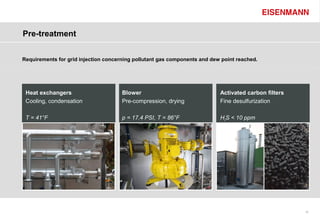
Pre-treatment


Requirements for grid injection concerning pollutant gas components and dew point reached.


 Heat exchangers                      Blower                               Activated carbon filters
 Cooling, condensation                Pre-compression, drying              Fine desulfurization

 T = 41°F                             p = 17.4 PSI, T = 86°F               H2S < 10 ppm


                                                                                                      19
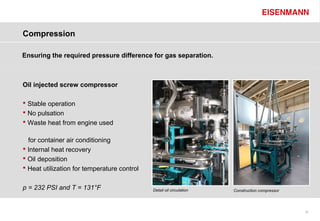
Compression

Ensuring the required pressure difference for gas separation.


Oil injected screw compressor

 Stable operation
 No pulsation
 Waste heat from engine used

  for container air conditioning
 Internal heat recovery
 Oil deposition
 Heat utilization for temperature control


p = 232 PSI and T = 131°F                    Detail oil circulation   Construction compressor


                                                                                                20
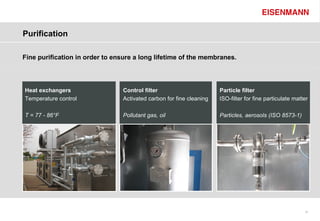
Purification

Fine purification in order to ensure a long lifetime of the membranes.


Heat exchangers                 Control filter                       Particle filter
Temperature control             Activated carbon for fine cleaning   ISO-filter for fine particulate matter

T = 77 - 86°F                   Pollutant gas, oil                   Particles, aerosols (ISO 8573-1)


                                                                                                         21
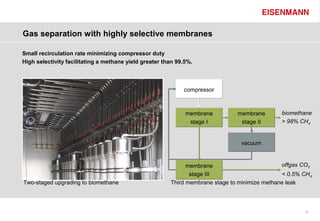
Gas separation with highly selective membranes

Small recirculation rate minimizing compressor duty
High selectivity facilitating a methane yield greater than 99.5%.


                                                             compressor


                                                              membrane         membrane       biomethane
                                                               stage I          stage II      > 98% CH4


                                                                                vacuum


                                                              membrane                         offgas CO2
                                                               stage III                       < 0.5% CH4
Two-staged upgrading to biomethane                      Third membrane stage to minimize methane leak


                                                                                                      22
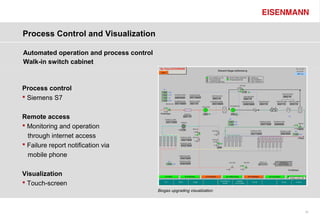
Process Control and Visualization

Automated operation and process control
Walk-in switch cabinet


Process control
 Siemens S7


Remote access
 Monitoring and operation
  through internet access
 Failure report notification via
  mobile phone

Visualization
 Touch-screen
                                          Biogas upgrading visualization


                                                                           23
Agenda


 1 Biomethane Incentives

 2 Membrane Technology for Gas Upgrading

 3 Case Study: Gas Upgrading

 4 Membrane Technology and Anaerobic Digestion Integration

 5 US Application

 6 About Eisenmann

 7 Conclusions and Questions


                                                             24
Business Study: Waste Collection Vehicles

Fuel costs for waste collection fleets are negatively impacted by
 Low miles per gallon
 Long service routes
 Increasing age of the fleets


Current Situation – 179,000 waste collection vehicles in America
 91% are diesel-fuel
 40% are over 10 years old
 Average 25,000 miles driven annually


Fuel Costs
 Average 3 miles to the gallon
 8,600 gallons of fuel use on average per truck per year
 For a fleet of 100 trucks, the average annual fuel costs would be $3.44 Million
  (assuming $4/gallon cost of diesel)


                                                                                    25
Business Study: Waste Collection Vehicles

Benefits of switching a fleet to natural gas

   Cleaner alternative fuel
   Significant cost savings
    At $2/gallon of CNG, on 100 truck fleet: daily savings is $4,800, annual savings is $1.75 M
   ROI: Just over a year with annual fuel savings
    (based on average cost of converting diesel engines)
   Cleaner, less noisy truck
   Non-corrosive, non-carcinogenic fuel is not a threat to soil, surface water or ground water
   Up to 90% less air pollution than diesel fuel


                                                                                                  26
Business Study: Waste Collection Vehicles


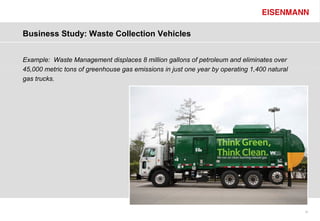
Example: Waste Management displaces 8 million gallons of petroleum and eliminates over
45,000 metric tons of greenhouse gas emissions in just one year by operating 1,400 natural
gas trucks.


                                                                                             27
Business Study: Waste Collection Vehicles


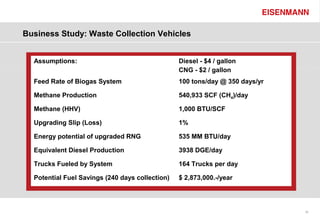
  Assumptions:                                   Diesel - $4 / gallon
                                                 CNG - $2 / gallon
  Feed Rate of Biogas System                     100 tons/day @ 350 days/yr

  Methane Production                             540,933 SCF (CH4)/day

  Methane (HHV)                                  1,000 BTU/SCF

  Upgrading Slip (Loss)                          1%

  Energy potential of upgraded RNG               535 MM BTU/day

  Equivalent Diesel Production                   3938 DGE/day

  Trucks Fueled by System                        164 Trucks per day

  Potential Fuel Savings (240 days collection)   $ 2,873,000.-/year


                                                                              28
Agenda


 1 Biomethane Incentives

 2 Membrane Technology for Gas Upgrading

 3 Case Study: Gas Upgrading

 4 Membrane Technology and Anaerobic Digestion Integration

 5 US Application

 6 About Eisenmann

 7 Conclusions and Questions


                                                             29
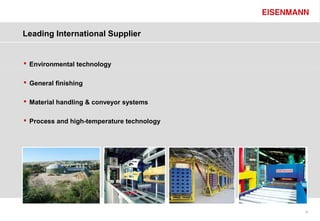
Leading International Supplier


     Environmental technology

     General finishing

     Material handling & conveyor systems

     Process and high-temperature technology


1                                               30
Offerings

     Green, sustainable engineering

     Top quality and reliability

     Modular and custom solutions

     Detailed system and process solutions

     Dedicated industrial service team

     Worldwide reference installations

     Global services


2                                             31
Facts and Figures

     Established 1951; Stuttgart, Germany

     12 locations worldwide

     US location since late 70‘s; Crystal Lake, IL

     3,600 employees

     More than 90 biogas facilities

                                                      Founding
                                                       Member


3                                                                32
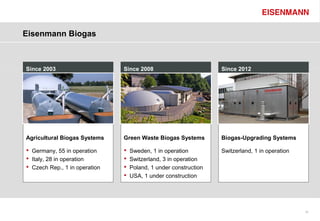
Eisenmann Biogas


Since 2003                     Since 2008                         Since 2012


Agricultural Biogas Systems    Green Waste Biogas Systems         Biogas-Upgrading Systems

 Germany, 55 in operation        Sweden, 1 in operation         Switzerland, 1 in operation
 Italy, 28 in operation          Switzerland, 3 in operation
 Czech Rep., 1 in operation      Poland, 1 under construction
                                  USA, 1 under construction


                                                                                                33
Agenda


 1 Biomethane Incentives

 2 Membrane Technology for Gas Upgrading

 3 Case Study: Gas Upgrading

 4 Membrane Technology and Anaerobic Digestion Integration

 5 US Application

 6 About Eisenmann

 7 Conclusions and Questions


                                                             34
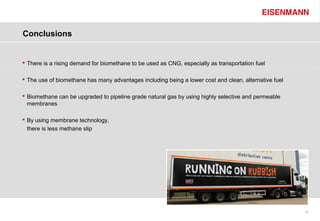
Conclusions


 There is a rising demand for biomethane to be used as CNG, especially as transportation fuel

 The use of biomethane has many advantages including being a lower cost and clean, alternative fuel

 Biomethane can be upgraded to pipeline grade natural gas by using highly selective and permeable
  membranes

 By using membrane technology,
  there is less methane slip


                                                                                                       35
Questions


                                  Green Engineering


Sustainability is in Our System


                                                      36
New Website

Introducing Eisenmann’s New Website


www.eisenmann.us.com/biocyclewc13


Available for download:
 Today’s presentation
 CNG to Fuel your Fleet
  (white paper)
 Sustainability in an Urban Environment
  (white paper)


                                           37
Contact


Thomas Gratz
Regional Sales Manager

Phone: (815) 477-8884
E-Mail: thomas.gratz@eisenmann.com
150 East Dartmoor Dr. Crystal Lake, IL 60014
www.eisenmann.us.com


Follow Us:
  Eisenmann Corporation   Eisenmann Corporation   @EISENMANNUSA


                                                                  38

Membrane Technology - Biocycle West Coast 2013

  • 1.
    Biogas Upgrading toRenewable Natural Gas (RNG) Biocycle West Coast Conference 2013 Thomas Gratz, Regional Sales Manager www.eisenmann.com www.eisenmann.us.com © Eisenmann AG 2013 © Eisenmann 2013
  • 2.
    Agenda 1 BiomethaneIncentives 2 Membrane Technology for Gas Upgrading 3 Case Study: Gas Upgrading 4 Membrane Technology and Anaerobic Digestion Integration 5 US Application 6 About Eisenmann 7 Conclusions and Questions 2
  • 3.
    Agenda 1 BiomethaneIncentives 2 Membrane Technology for Gas Upgrading 3 Case Study: Gas Upgrading 4 Membrane Technology and Anaerobic Digestion Integration 5 US Application 6 About Eisenmann 7 Conclusions and Questions 3
  • 4.
    Drivers Most biogas systemsuse CHP to generate electricity and heat  The thermal energy cannot always be utilized Incentives to use biogas as biomethane or CNG for transportation fuel  More than 250,000 natural gas vehicles in the US (source: GE)  12-15% public transit buses in US use CNG (source: CNG Now)  A natural gas powered bus can displace 1,400 gallons of diesel fuel a year (source: CNG Now)  Natural gas vehicles reduce greenhouse gas emissions between 20-29% (source: Natural Gas Vehicle Association) 4
  • 5.
    Advantages of Biomethane Decentralized production  Independent, flexible and storable energy source  Efficient use according to requirements  Storage capability for when demand is higher  Offsets non-renewable sources (coal, oil, fossil fuel derived natural gas)  Production creates US jobs and benefits local economies 5
  • 6.
    Agenda 1 BiomethaneIncentives 2 Membrane Technology for Gas Upgrading 3 Case Study: Gas Upgrading 4 Membrane Technology and Anaerobic Digestion Integration 5 US Application 6 About Eisenmann 7 Conclusions and Questions 6
  • 7.
    Highly Selective MembraneTechnology Offgas Biomethane CO2 CH4 Biogas CH4 + CO2 Membrane Function 7
  • 8.
    Flow diagram biogas cooling desulfurization compressor and drying temperature particle filter control filter control membrane membrane biomethane stage I stage II > 98% CH4 biogas production pre-treatment membrane offgas CO2 compression stage III < 0.5% CH4 purification gas separation purified gas offgas treatment 0.0% CH4 8
  • 9.
    Advantages of Upgradingwith Membrane Technology Biogas upgrading with selective and permeable membranes offers advantages over other technologies  Minimized gas recirculation rates  Lower operating costs  Low capital expenditure  Compact modular design  Rapid system start-up  Easier system control  Low methane leakage  High energy efficiency  No need for additional chemicals or water  Injection into the natural gas grid without further compression 9
  • 10.
    Agenda 1 BiomethaneIncentives 2 Membrane Technology for Gas Upgrading 3 Case Study: Gas Upgrading 4 Membrane Technology and Anaerobic Digestion Integration 5 US Application 6 About Eisenmann 7 Conclusions and Questions 10
  • 11.
    Case Study: MembraneTechnology Project: Biogas Plant in Switzerland Limited success with previous biogas upgrading technology Installed Membrane Upgrading System in 2012 Gas is used to fuel city buses 11
  • 12.
  • 13.
    Facts and Figures Biogasplant: Volume flow biogas: 123 CFM Volume flow biomethane: 73 CFM high solids digestion of biowaste Concentration biomethane: > 96 vol.-% Utilization: grid injection and fuel for public transportation fleet Membrane room Biogas upgrading plant 13
  • 14.
    Measurement Data Successful testoperation in December 2012 Grid injection since January 26, 2013 concentration [vol.-%] concentration [vol.- concentration biomethane [vol.-%] concentration methane [vol.-%] concentration CO2 [vol.-%] concentration CO2 [vol.-%] %] Dec 3 Dec 4 Dec 5 Dec 6 Dec 7 Dec 3 Dec 4 Dec 5 Dec 6 Dec 7 2012 2012 Biomethane to grid injection: methane > 96 % Offgas to atmosphere: methane leakage < 1.0 % 14
  • 15.
    Operating Data Specific energyconsumption without peripherals Compressor duty 0.20 kWh/Nm³ biogas Specific energy consumption with peripherals Compressor duty Blower, cooling and air conditioning 0.29 kWh/Nm³ biogas Operation Fast start-up and shut-down Good adjustability No heat requirement No operational supplements Easy handling 15
  • 16.
    Agenda 1 BiomethaneIncentives 2 Membrane Technology for Gas Upgrading 3 Case Study: Gas Upgrading 4 Membrane Technology and Anaerobic Digestion Integration 5 US Application 6 About Eisenmann 7 Conclusions and Questions 16
  • 17.
    Anaerobic Digestion andBiogas Upgrading Total process chain from a single source. Plug flow digester CHP / biogas upgrading 17
  • 18.
    Container Compact and modulardesign. Turn-key solution. 33 ft 10 ft 18
  • 19.
    Pre-treatment Requirements for gridinjection concerning pollutant gas components and dew point reached. Heat exchangers Blower Activated carbon filters Cooling, condensation Pre-compression, drying Fine desulfurization T = 41°F p = 17.4 PSI, T = 86°F H2S < 10 ppm 19
  • 20.
    Compression Ensuring the requiredpressure difference for gas separation. Oil injected screw compressor  Stable operation  No pulsation  Waste heat from engine used for container air conditioning  Internal heat recovery  Oil deposition  Heat utilization for temperature control p = 232 PSI and T = 131°F Detail oil circulation Construction compressor 20
  • 21.
    Purification Fine purification inorder to ensure a long lifetime of the membranes. Heat exchangers Control filter Particle filter Temperature control Activated carbon for fine cleaning ISO-filter for fine particulate matter T = 77 - 86°F Pollutant gas, oil Particles, aerosols (ISO 8573-1) 21
  • 22.
    Gas separation withhighly selective membranes Small recirculation rate minimizing compressor duty High selectivity facilitating a methane yield greater than 99.5%. compressor membrane membrane biomethane stage I stage II > 98% CH4 vacuum membrane offgas CO2 stage III < 0.5% CH4 Two-staged upgrading to biomethane Third membrane stage to minimize methane leak 22
  • 23.
    Process Control andVisualization Automated operation and process control Walk-in switch cabinet Process control  Siemens S7 Remote access  Monitoring and operation through internet access  Failure report notification via mobile phone Visualization  Touch-screen Biogas upgrading visualization 23
  • 24.
    Agenda 1 BiomethaneIncentives 2 Membrane Technology for Gas Upgrading 3 Case Study: Gas Upgrading 4 Membrane Technology and Anaerobic Digestion Integration 5 US Application 6 About Eisenmann 7 Conclusions and Questions 24
  • 25.
    Business Study: WasteCollection Vehicles Fuel costs for waste collection fleets are negatively impacted by  Low miles per gallon  Long service routes  Increasing age of the fleets Current Situation – 179,000 waste collection vehicles in America  91% are diesel-fuel  40% are over 10 years old  Average 25,000 miles driven annually Fuel Costs  Average 3 miles to the gallon  8,600 gallons of fuel use on average per truck per year  For a fleet of 100 trucks, the average annual fuel costs would be $3.44 Million (assuming $4/gallon cost of diesel) 25
  • 26.
    Business Study: WasteCollection Vehicles Benefits of switching a fleet to natural gas  Cleaner alternative fuel  Significant cost savings At $2/gallon of CNG, on 100 truck fleet: daily savings is $4,800, annual savings is $1.75 M  ROI: Just over a year with annual fuel savings (based on average cost of converting diesel engines)  Cleaner, less noisy truck  Non-corrosive, non-carcinogenic fuel is not a threat to soil, surface water or ground water  Up to 90% less air pollution than diesel fuel 26
  • 27.
    Business Study: WasteCollection Vehicles Example: Waste Management displaces 8 million gallons of petroleum and eliminates over 45,000 metric tons of greenhouse gas emissions in just one year by operating 1,400 natural gas trucks. 27
  • 28.
    Business Study: WasteCollection Vehicles Assumptions: Diesel - $4 / gallon CNG - $2 / gallon Feed Rate of Biogas System 100 tons/day @ 350 days/yr Methane Production 540,933 SCF (CH4)/day Methane (HHV) 1,000 BTU/SCF Upgrading Slip (Loss) 1% Energy potential of upgraded RNG 535 MM BTU/day Equivalent Diesel Production 3938 DGE/day Trucks Fueled by System 164 Trucks per day Potential Fuel Savings (240 days collection) $ 2,873,000.-/year 28
  • 29.
    Agenda 1 BiomethaneIncentives 2 Membrane Technology for Gas Upgrading 3 Case Study: Gas Upgrading 4 Membrane Technology and Anaerobic Digestion Integration 5 US Application 6 About Eisenmann 7 Conclusions and Questions 29
  • 30.
    Leading International Supplier  Environmental technology  General finishing  Material handling & conveyor systems  Process and high-temperature technology 1 30
  • 31.
    Offerings  Green, sustainable engineering  Top quality and reliability  Modular and custom solutions  Detailed system and process solutions  Dedicated industrial service team  Worldwide reference installations  Global services 2 31
  • 32.
    Facts and Figures  Established 1951; Stuttgart, Germany  12 locations worldwide  US location since late 70‘s; Crystal Lake, IL  3,600 employees  More than 90 biogas facilities Founding Member 3 32
  • 33.
    Eisenmann Biogas Since 2003 Since 2008 Since 2012 Agricultural Biogas Systems Green Waste Biogas Systems Biogas-Upgrading Systems  Germany, 55 in operation  Sweden, 1 in operation Switzerland, 1 in operation  Italy, 28 in operation  Switzerland, 3 in operation  Czech Rep., 1 in operation  Poland, 1 under construction  USA, 1 under construction 33
  • 34.
    Agenda 1 BiomethaneIncentives 2 Membrane Technology for Gas Upgrading 3 Case Study: Gas Upgrading 4 Membrane Technology and Anaerobic Digestion Integration 5 US Application 6 About Eisenmann 7 Conclusions and Questions 34
  • 35.
    Conclusions  There isa rising demand for biomethane to be used as CNG, especially as transportation fuel  The use of biomethane has many advantages including being a lower cost and clean, alternative fuel  Biomethane can be upgraded to pipeline grade natural gas by using highly selective and permeable membranes  By using membrane technology, there is less methane slip 35
  • 36.
    Questions Green Engineering Sustainability is in Our System 36
  • 37.
    New Website Introducing Eisenmann’sNew Website www.eisenmann.us.com/biocyclewc13 Available for download:  Today’s presentation  CNG to Fuel your Fleet (white paper)  Sustainability in an Urban Environment (white paper) 37
  • 38.
    Contact Thomas Gratz Regional SalesManager Phone: (815) 477-8884 E-Mail: thomas.gratz@eisenmann.com 150 East Dartmoor Dr. Crystal Lake, IL 60014 www.eisenmann.us.com Follow Us: Eisenmann Corporation Eisenmann Corporation @EISENMANNUSA 38

Editor's Notes

  • #2 Thank you for the introduction and Biocycle for the great forum. Touch on previous speakers upgrading technology before beginning.
  • #3 (Insert Description of Format)
  • #4 There are a number of incentives for renewable energy projects across technologies and geographies. Biomethane, with its capabilities and advantages over other forms of fuel and/or energy, is entirely renewable when derived from biogas and a low carbon alternative fuel.
  • #5 The US and European markets are very different. In Sweden more than half of the natural gas vehicles are running on biomethane. In fact, the word biogas in Sweden is associated with a vehicle fuel due to this prevalence. Additionally, Germany and Austria have established biomethane vehicle fuel target goals. There are several factors why the markets for biomethane are so different across the world. 1.) The physical size of the US makes for infrastructure challenges 2.) The availability of fossil fuels in the US lead to lower costs per unit of energy which in turn make the financing of biomethane projects more difficult as signing a long-term off-take agreement with a utility or fleet is difficult or impossible 3.) European countries are more like US states than the US in total. An overarching structure for upgraded biogas across the US is problematic due to differing state laws and regulations 4.) Population density – outside of the major cities, the US has very few people over many square miles. The US is the 142 nd ranked country in population density while many EU countries are ranked much higher with 8 in the top 50, including the Netherlands, Belgium, the UK, Germany, Italy and Switzerland.
  • #6 A vast network of pipelines in the US allows for convenient distribution of upgraded biogas while offering the advantage of lower distribution losses. Electricity grid is an aging, deteriorating system with an increasing costs required to maintain. Power lines and systems are subject or exposed to natural phenomena which increases risk and likelihood of power outages (i.e. Hurricane Sandy) There are currently 400 underground gas storage fields in the US (source: Forbes)
  • #8 Gas permeation with selective membranes from high-performance polymers Design membrane module Biogas: CH 4 + CO 2 (feed) Biomethane: CH 4 (retentate) Offgas: CO 2 (permeate) Hollow fiber membranes Separation of CO 2 and CH 4 through different gas permeation velocities CH 4 slow CO 2 fast
  • #9 Speak slowly through the stages!
  • #10 While these are all advantages, lets focus on two primarily: methane leakage or slippage, and lower operating as well as initial costs. As the rate of return and return on investment are primary drivers in initial project approval, the lower cost of a membrane system can be THE difference as to whether a project is financeable. With the purpose of a biomethane project being production of biomethane, a system which offers less slippage or methane loss during the upgrading process holds obvious benefit: more of the desired output!
  • #11 If I were in the audience right now, I would be thinking that all of this sounds great in theory but I need to learn about an actual application or system. Let’s explore one such facility.
  • #12 (Note: What was the technology? This will likely be a question and I need the answer!)
  • #14 Fueling station for buses is off-site so biomethane is injected. We could reach a higher % of CH4 but it is not necessary with this location or under the regulations As evidenced with the picture on your right, the membranes are within a containerized unit
  • #15 (Go through the graphs as it may be difficult to see in the room) We chose this case study as it is recent and relevant
  • #16 Even with energy consumption not directly related to the biomethane conditioning, the energy required is offset by the low rate of slippage associated with the membrane technology. Once again numerous advantages associated with this technology. One we haven’t discussed yet is that with the membrane, one does not need a source of heat for treatment of solution or material. The heat requirement associated with other upgrading technologies leads a facility or system to invest in peripheral equipment such as a boiler and divert a % of biogas to generate said heat.
  • #20 Standard equipment and technologies shown here. Note: the greater sulfur content in the biogas, the more activated carbon or material needed to absorb this gas is required.
  • #23 I have discussed and highlighted numerous advantages of the membrane technology. The modularity of the systems can serve benefit both in purification methane as well as treating increased volumes of biogas.
  • #24 Eisenmann as an organization prides itself upon service and reliability. With this as a core value, our biogas upgrading technology utilizes the latest in remote access technology keeping Eisenmann’s service team and the owner/operator in contact with the system.
  • #31 Environmental Technology Air and water treatment Anaerobic Digestion We were commissioned by the US Gov’t. to build munitions disposal facility which combines multiple technologies of Eisenmann’s including water treatment, high temperature kilns, exhaust air treatment and others. A very unique project which sets Eisenmann further apart from biogas companies. General Finishing Painting auto bodies, wood, plastics Material Handling Moving autobodies and parts through factories Pallet distribution systems Process and High Temp High temp kilns Ceramic firing lines
  • #32 This global network and rich history affords Eisenmann opportunities and capabilities few companies, if any, can match. A true solution based company, we will optimize or configure a technology to meet the exact need or desire for a client. Outstanding customer support with a 100% customer satisfaction rating over the past 9 years.
  • #33 Established in 1951 outside of Stuttgart Germany. Since, we have grown to 12 locations globally. Our US Office was one of the first locations outside of Germany and has been successfully completing projects for over 35 years. We are in Crystal Lake IL in the greater Chicago area. As I like to say it, we are where Chicago meets cornfields. We have 3,600 employees with the vast majority of engineers. To date, we have successfully realized over 90 biogas facilities and broke ground on our first US facility in the greater Chicago area in 4 th Q 2012. And we are one of the founding members of the American Biogas Council who’s goals are promoting environmental stewardship, promoting greenhouse gas reduction, and policy development
  • #34 Eisenmann installed over 2,500 environmental technology installations, including water treatment, exhaust air purification and waste treatment across the globe. Biogas technology only recently in our company history become a focus and is just a small part of the Eisenmann product portfolio. A company as diverse and deep as Eisenmann has begun allocating more resources toward the biogas industry which lead to our recent development and deployment of the membrane technology. Eisenmann’s primary digester technology is the horizontal plug flow technology. My colleague, John McDowell, will be presenting on this tomorrow afternoon and I strongly encourage you to attend!