2.3 Carbon-Based Molecules
KEY CONCEPT
Carbon-based molecules are the
foundation of life.
2.3 Carbon-Based Molecules
Carbon atoms have unique bonding
properties.
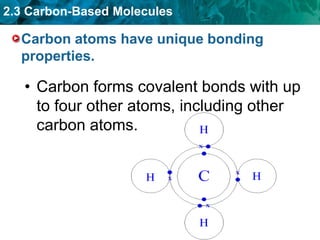
• Carbon forms covalent bonds with up
to four other atoms, including other
carbon atoms.
2.3 Carbon-Based Molecules
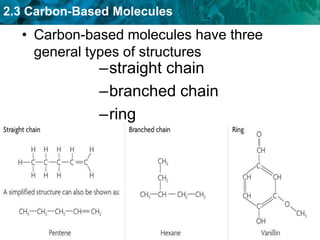
• Carbon-based molecules have three
general types of structures
–straight chain
–branched chain
–ring
2.3 Carbon-Based Molecules
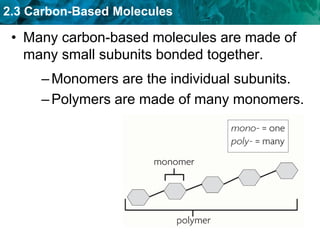
• Many carbon-based molecules are made of
many small subunits bonded together.
–Monomers are the individual subunits.
–Polymers are made of many monomers.
2.3 Carbon-Based Molecules
Organic vs. Inorganic Compounds
• Organic Compounds Inorganic Compounds
• Always contain carbon Contain other elements
• Made by living organisms
(exception: CO and CO2)
• Covalent bonds Ionic bonds
• Most are large molecules Most are small
molecules
with many atoms with few atoms
2.3 Carbon-Based Molecules
Four main types of carbon-based
molecules are found in living things.
•Carbohydrates
•Lipids
•Protein
•Nucleic acid
2.3 Carbon-Based Molecules
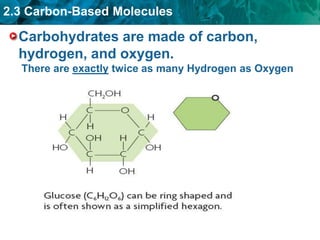
Carbohydrates are made of carbon,
hydrogen, and oxygen.
There are exactly twice as many Hydrogen as Oxygen
2.3 Carbon-Based Molecules
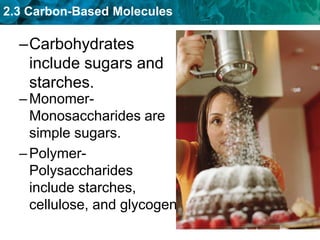
–Carbohydrates
include sugars and
starches.
–Monomer-
Monosaccharides are
simple sugars.
–Polymer-
Polysaccharides
include starches,
cellulose, and glycogen.
2.3 Carbon-Based Molecules
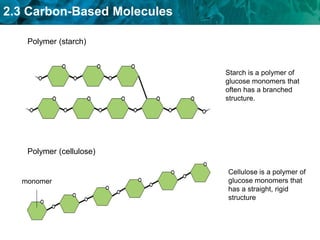
Polymer (starch)
Starch is a polymer of
glucose monomers that
often has a branched
structure.
Polymer (cellulose)
Cellulose is a polymer of
glucose monomers that
has a straight, rigid
structure
monomer
2.3 Carbon-Based Molecules
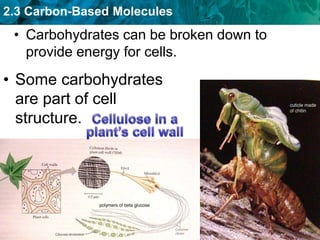
• Carbohydrates can be broken down to
provide energy for cells.
• Some carbohydrates
are part of cell
structure.
2.3 Carbon-Based Molecules
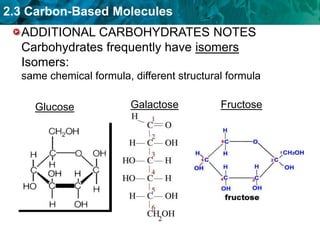
ADDITIONAL CARBOHYDRATES NOTES
Carbohydrates frequently have isomers
Isomers:
same chemical formula, different structural formula
Glucose Galactose Fructose
2.3 Carbon-Based Molecules
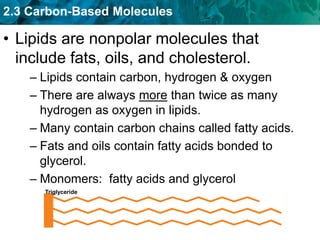
– Lipids contain carbon, hydrogen & oxygen
– There are always more than twice as many
hydrogen as oxygen in lipids.
– Many contain carbon chains called fatty acids.
– Fats and oils contain fatty acids bonded to
glycerol.
– Monomers: fatty acids and glycerol
• Lipids are nonpolar molecules that
include fats, oils, and cholesterol.
Triglyceride
2.3 Carbon-Based Molecules
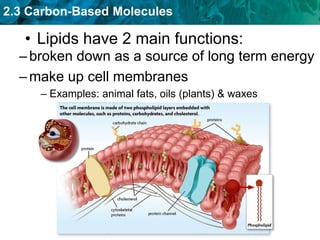
• Lipids have 2 main functions:
–broken down as a source of long term energy
–make up cell membranes
– Examples: animal fats, oils (plants) & waxes
2.3 Carbon-Based Molecules
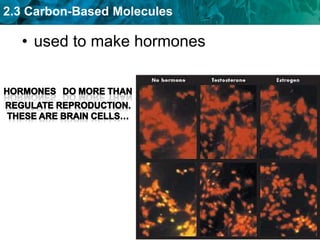
• used to make hormones
2.3 Carbon-Based Molecules
Fats & Oils
(Additional Notes on
Lipids)
• Fats & Oils are a major
category of lipids.
2.3 Carbon-Based Molecules
Types of Fats & Oils
• There are 3 main types:
1. Saturated Fats
2. Unsaturated Fats
3. Hydrogenated Fats
2.3 Carbon-Based Molecules
Generally animal fats
Examples: butter, shortening, lard
Solid at room temperature
Full of Hydrogen atoms
•Saturated Fats
2.3 Carbon-Based Molecules
Unsaturated Fats
• Generally found in plants
– Examples:
- olive oil, corn oil, sunflower oil, peanut oil
• Liquid at room temperature
• Missing Hydrogen atoms
– [Causes double bonds between C atoms]
2.3 Carbon-Based Molecules
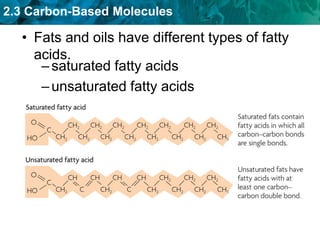
• Fats and oils have different types of fatty
acids.
–saturated fatty acids
–unsaturated fatty acids
2.3 Carbon-Based Molecules
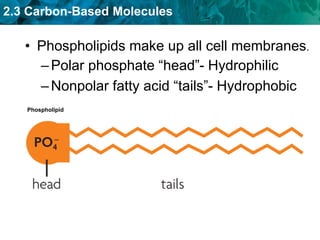
• Phospholipids make up all cell membranes.
–Polar phosphate “head”- Hydrophilic
–Nonpolar fatty acid “tails”- Hydrophobic
Phospholipid
2.3 Carbon-Based Molecules
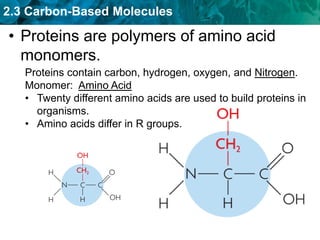
• Proteins are polymers of amino acid
monomers.
Proteins contain carbon, hydrogen, oxygen, and Nitrogen.
Monomer: Amino Acid
• Twenty different amino acids are used to build proteins in
organisms.
• Amino acids differ in R groups.
2.3 Carbon-Based Molecules
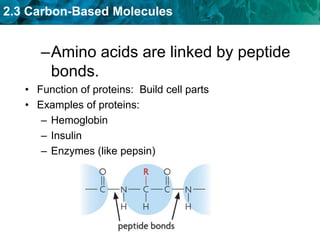
–Amino acids are linked by peptide
bonds.
• Function of proteins: Build cell parts
• Examples of proteins:
– Hemoglobin
– Insulin
– Enzymes (like pepsin)
2.3 Carbon-Based Molecules
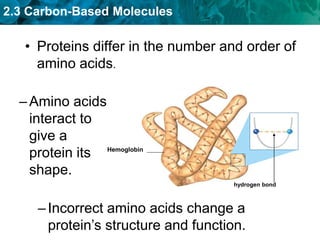
• Proteins differ in the number and order of
amino acids.
–Amino acids
interact to
give a
protein its
shape.
–Incorrect amino acids change a
protein’s structure and function.
hydrogen bond
Hemoglobin
2.3 Carbon-Based Molecules
Additional Protein Notes
 Proteins are strings of amino acids.
 The number and order of amino acids makes each
enzyme different
• Enzymes are a special kind of protein
• Enzymes speed up processes in living things.
• They help break things down (like in digestion)
• They help build things (like cell parts)
2.3 Carbon-Based Molecules
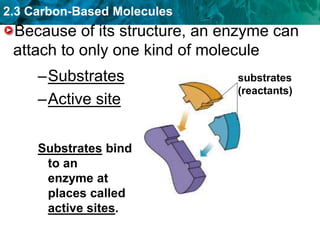
Because of its structure, an enzyme can
attach to only one kind of molecule
–Substrates
–Active site
Substrates bind
to an
enzyme at
places called
active sites.
substrates
(reactants)
2.3 Carbon-Based Molecules
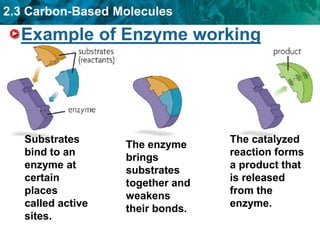
Example of Enzyme working
Substrates
bind to an
enzyme at
certain
places
called active
sites.
The enzyme
brings
substrates
together and
weakens
their bonds.
The catalyzed
reaction forms
a product that
is released
from the
enzyme.
2.3 Carbon-Based Molecules
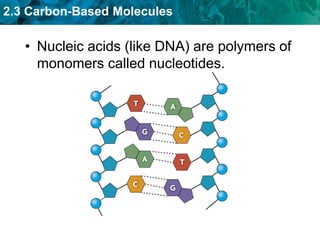
• Nucleic acids (like DNA) are polymers of
monomers called nucleotides.
2.3 Carbon-Based Molecules
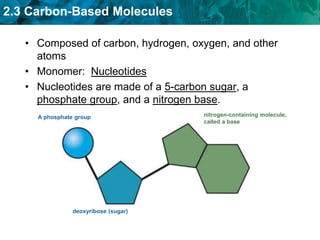
• Composed of carbon, hydrogen, oxygen, and other
atoms
• Monomer: Nucleotides
• Nucleotides are made of a 5-carbon sugar, a
phosphate group, and a nitrogen base.
A phosphate group nitrogen-containing molecule,
called a base
deoxyribose (sugar)
2.3 Carbon-Based Molecules
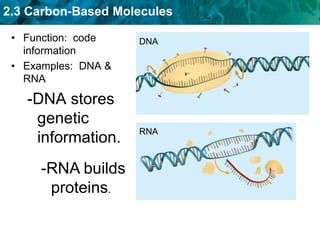
• Function: code
information
• Examples: DNA &
RNA
-DNA stores
genetic
information.
-RNA builds
proteins.
DNA
RNA
2.3 Carbon-Based Molecules
Organic vs. Inorganic Compounds
• Organic Compounds Inorganic Compounds
• Always contain carbon Contain other elements
• Made by living organisms
(exception: CO and CO2)
• Covalent bonds Ionic bonds
• Most are large molecules Most are small molecules
with many atoms with few atom
2.3 Carbon-Based Molecules
Types of Organic Compounds
•Carbohydrates
•Lipids
•Proteins
•Nucleic Acids

bio 2.3 carbon chemistry.ppt

  • 1.
    2.3 Carbon-Based Molecules KEYCONCEPT Carbon-based molecules are the foundation of life.
  • 2.
    2.3 Carbon-Based Molecules Carbonatoms have unique bonding properties. • Carbon forms covalent bonds with up to four other atoms, including other carbon atoms.
  • 3.
    2.3 Carbon-Based Molecules •Carbon-based molecules have three general types of structures –straight chain –branched chain –ring
  • 4.
    2.3 Carbon-Based Molecules •Many carbon-based molecules are made of many small subunits bonded together. –Monomers are the individual subunits. –Polymers are made of many monomers.
  • 5.
    2.3 Carbon-Based Molecules Organicvs. Inorganic Compounds • Organic Compounds Inorganic Compounds • Always contain carbon Contain other elements • Made by living organisms (exception: CO and CO2) • Covalent bonds Ionic bonds • Most are large molecules Most are small molecules with many atoms with few atoms
  • 6.
    2.3 Carbon-Based Molecules Fourmain types of carbon-based molecules are found in living things. •Carbohydrates •Lipids •Protein •Nucleic acid
  • 7.
    2.3 Carbon-Based Molecules Carbohydratesare made of carbon, hydrogen, and oxygen. There are exactly twice as many Hydrogen as Oxygen
  • 8.
    2.3 Carbon-Based Molecules –Carbohydrates includesugars and starches. –Monomer- Monosaccharides are simple sugars. –Polymer- Polysaccharides include starches, cellulose, and glycogen.
  • 9.
    2.3 Carbon-Based Molecules Polymer(starch) Starch is a polymer of glucose monomers that often has a branched structure. Polymer (cellulose) Cellulose is a polymer of glucose monomers that has a straight, rigid structure monomer
  • 10.
    2.3 Carbon-Based Molecules •Carbohydrates can be broken down to provide energy for cells. • Some carbohydrates are part of cell structure.
  • 11.
    2.3 Carbon-Based Molecules ADDITIONALCARBOHYDRATES NOTES Carbohydrates frequently have isomers Isomers: same chemical formula, different structural formula Glucose Galactose Fructose
  • 12.
    2.3 Carbon-Based Molecules –Lipids contain carbon, hydrogen & oxygen – There are always more than twice as many hydrogen as oxygen in lipids. – Many contain carbon chains called fatty acids. – Fats and oils contain fatty acids bonded to glycerol. – Monomers: fatty acids and glycerol • Lipids are nonpolar molecules that include fats, oils, and cholesterol. Triglyceride
  • 13.
    2.3 Carbon-Based Molecules •Lipids have 2 main functions: –broken down as a source of long term energy –make up cell membranes – Examples: animal fats, oils (plants) & waxes
  • 14.
    2.3 Carbon-Based Molecules •used to make hormones
  • 15.
    2.3 Carbon-Based Molecules Fats& Oils (Additional Notes on Lipids) • Fats & Oils are a major category of lipids.
  • 16.
    2.3 Carbon-Based Molecules Typesof Fats & Oils • There are 3 main types: 1. Saturated Fats 2. Unsaturated Fats 3. Hydrogenated Fats
  • 17.
    2.3 Carbon-Based Molecules Generallyanimal fats Examples: butter, shortening, lard Solid at room temperature Full of Hydrogen atoms •Saturated Fats
  • 18.
    2.3 Carbon-Based Molecules UnsaturatedFats • Generally found in plants – Examples: - olive oil, corn oil, sunflower oil, peanut oil • Liquid at room temperature • Missing Hydrogen atoms – [Causes double bonds between C atoms]
  • 19.
    2.3 Carbon-Based Molecules •Fats and oils have different types of fatty acids. –saturated fatty acids –unsaturated fatty acids
  • 20.
    2.3 Carbon-Based Molecules •Phospholipids make up all cell membranes. –Polar phosphate “head”- Hydrophilic –Nonpolar fatty acid “tails”- Hydrophobic Phospholipid
  • 21.
    2.3 Carbon-Based Molecules •Proteins are polymers of amino acid monomers. Proteins contain carbon, hydrogen, oxygen, and Nitrogen. Monomer: Amino Acid • Twenty different amino acids are used to build proteins in organisms. • Amino acids differ in R groups.
  • 22.
    2.3 Carbon-Based Molecules –Aminoacids are linked by peptide bonds. • Function of proteins: Build cell parts • Examples of proteins: – Hemoglobin – Insulin – Enzymes (like pepsin)
  • 23.
    2.3 Carbon-Based Molecules •Proteins differ in the number and order of amino acids. –Amino acids interact to give a protein its shape. –Incorrect amino acids change a protein’s structure and function. hydrogen bond Hemoglobin
  • 24.
    2.3 Carbon-Based Molecules AdditionalProtein Notes  Proteins are strings of amino acids.  The number and order of amino acids makes each enzyme different • Enzymes are a special kind of protein • Enzymes speed up processes in living things. • They help break things down (like in digestion) • They help build things (like cell parts)
  • 25.
    2.3 Carbon-Based Molecules Becauseof its structure, an enzyme can attach to only one kind of molecule –Substrates –Active site Substrates bind to an enzyme at places called active sites. substrates (reactants)
  • 26.
    2.3 Carbon-Based Molecules Exampleof Enzyme working Substrates bind to an enzyme at certain places called active sites. The enzyme brings substrates together and weakens their bonds. The catalyzed reaction forms a product that is released from the enzyme.
  • 27.
    2.3 Carbon-Based Molecules •Nucleic acids (like DNA) are polymers of monomers called nucleotides.
  • 28.
    2.3 Carbon-Based Molecules •Composed of carbon, hydrogen, oxygen, and other atoms • Monomer: Nucleotides • Nucleotides are made of a 5-carbon sugar, a phosphate group, and a nitrogen base. A phosphate group nitrogen-containing molecule, called a base deoxyribose (sugar)
  • 29.
    2.3 Carbon-Based Molecules •Function: code information • Examples: DNA & RNA -DNA stores genetic information. -RNA builds proteins. DNA RNA
  • 30.
    2.3 Carbon-Based Molecules Organicvs. Inorganic Compounds • Organic Compounds Inorganic Compounds • Always contain carbon Contain other elements • Made by living organisms (exception: CO and CO2) • Covalent bonds Ionic bonds • Most are large molecules Most are small molecules with many atoms with few atom
  • 31.
    2.3 Carbon-Based Molecules Typesof Organic Compounds •Carbohydrates •Lipids •Proteins •Nucleic Acids