Presentation on Final Year
Project
“Comparative Case Studies
of BIM Projects”
Submitted By:
Geetansh Chhabra (19EJCCE039)
Gunjan Gupta (19EJCCE040)
Karan Kumar (19EJCCE049)
Manan Biwal (19EJCCE061)
Mohd Anish Mirza (19EJCCE064)
Neel Kumar Bairwa (19EJCCE070)
Submitted To:
Mr. Teekam Singh (Asst. Professor)
Ms. Swarnima (Supervisor)
What is BIM ?
● BIM stands for Building Information Modeling, which is a process that involves creating and managing
digital representations of buildings and their components.
● BIM allows architects, engineers, contractors, and other professionals to collaborate on a project by sharing
information.
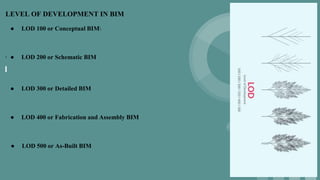
LEVEL OF DEVELOPMENT IN BIM
● LOD 100 or Conceptual BIM
.
● LOD 500 or As-Built BIM
● LOD 200 or Schematic BIM
● LOD 300 or Detailed BIM
● LOD 400 or Fabrication and Assembly BIM
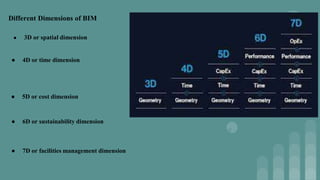
● 3D or spatial dimension
● 4D or time dimension
Different Dimensions of BIM
● 5D or cost dimension
● 6D or sustainability dimension
● 7D or facilities management dimension
BIM Implementation around the world
● In 2002, the National Institute of Building Sciences (NIBS) in the United States established the National BIM
Standard-United States (NBIMS-US) to promote the use of BIM across the industry.
● In 2011, the UK government announced that BIM would be mandatory for all public sector construction projects
by 2016.
● In 2012, the American Institute of Architects (AIA) launched its own set of BIM guidelines for architects and
designers.
● In 2014, Singapore launched its BIM e-Submission System (BESS) to streamline the regulatory
submission process for building
BIM Implementation around the world
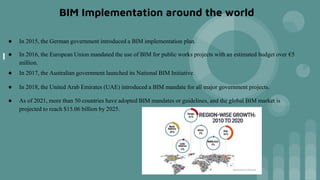
● In 2015, the German government introduced a BIM implementation plan.
● In 2016, the European Union mandated the use of BIM for public works projects with an estimated budget over €5
million.
● In 2017, the Australian government launched its National BIM Initiative.
● In 2018, the United Arab Emirates (UAE) introduced a BIM mandate for all major government projects.
● As of 2021, more than 50 countries have adopted BIM mandates or guidelines, and the global BIM market is
projected to reach $15.06 billion by 2025.
Where does India Stands ?
● The Indian government announced its BIM mandate for public infrastructure projects above Rs 500 crore in
November 2020, with the goal of improving efficiency, reducing project delays, and enhancing project quality.
● The mandate requires the use of BIM for all public infrastructure projects at the planning, design, and construction
stages, and applies to all stakeholders, including clients, architects, engineers, and contractors.
● Several Indian states, including Maharashtra, Andhra Pradesh, and Telangana, have also announced their own
BIM mandates for public infrastructure projects.
CASE STUDY - 1
The Nagpur Metro Rail Project
● Nagpur Metro is a rapid transit system for the city of Nagpur, Maharashtra, India. The final project cost
incurred was ₹9,279 crore (US$1.2 billion).
● Construction on the project began on 31 May 2015, with trial run beginning on 30 September 2017.
● Prime minister Narendra Modi inaugurated operations on Nagpur Metro on 8 March 2019.
● Nagpur Metro becomes 13th Metro system in India to be operational. It is also being touted as the greenest
metro rail in India.
The Nagpur Metro Rail Project
BIM Application in the construction of Nagpur metro station
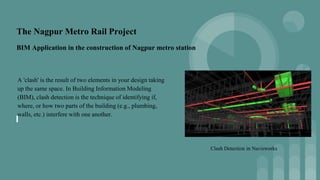
Clash Detection in Navisworks
A 'clash' is the result of two elements in your design taking
up the same space. In Building Information Modeling
(BIM), clash detection is the technique of identifying if,
where, or how two parts of the building (e.g., plumbing,
walls, etc.) interfere with one another.
The Nagpur Metro Rail Project
BIM Application in the construction of Nagpur metro station
BIM Structure of Nagpur Metro Station
BIM helps structural engineers optimize and automate designs, reduce
errors and risk, and improve accuracy and constructability, while
improving overall project delivery.
● Enhanced Quality.
● Increased Efficiency.
● Flexible Design Solutions.
● Enhanced Productivity.
CASE STUDY - 2
Comparative study between construction of Sardar Vallabhbhai Patel Stadium
and Qatar (Lusail) Stadium
QATAR STADIUM
● Lusail Stadium, is a football stadium in Lusail, Qatar. Owned by the Qatar Football Association.
● It is the largest stadium in Qatar and the Middle East by capacity and one of eight stadiums built for the
2022 FIFA World Cup
● It is currently the second largest stadium in Asia but eventually will reduce its current capacity of 88,966
to 40,000 in the near future.
● The stadium is located about 20 kilometres (12 mi) north of Doha. Lusail Stadium was inaugurated on 9
September 2022 with the Lusail Super Cup game.
BIM Application in Qatar Stadium
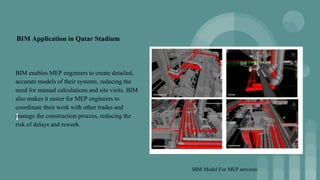
BIM Model For MEP services
BIM enables MEP engineers to create detailed,
accurate models of their systems, reducing the
need for manual calculations and site visits. BIM
also makes it easier for MEP engineers to
coordinate their work with other trades and
manage the construction process, reducing the
risk of delays and rework.
BIM Application in Qatar Stadium
Simulation model used to improve collaboration and safety in
construction process
Simulation analysis is a valuable tool in the
construction industry that can help improve
project planning and design, project scheduling
and sequencing, construction safety,
communication and collaboration, and reduce
project costs.
VALLABHBHAI STADIUM
● The Narendra Modi Stadium, (formerly known as Motera Stadium) is a cricket stadium situated in Sardar
Vallabhbhai Patel Sports Complex, Ahmedabad, India.
● It is the largest stadium in the world, with a seating capacity of 132,000 spectators. Owned by the Gujarat
Cricket Association.
● In 2015, the stadium was closed and demolished before being completely rebuilt by February 2020, with an
estimated cost of ₹800 crore (US$100 million).
● A unique feature of the stadium is the LED lights on the roof instead of the usual floodlights at cricket
grounds. The LED lights are installed on an antibacterial, fireproof canopy.
BIM Application in Vallabhbhai Stadium
Aerial view of Sardar Vallabhbhai Stadium
Aerial construction photography helps builders
see their construction projects differently. It
gives a top-down view which can alert
contractors to potential problems before they
occur. Construction photography services help
line up plans to reality.
Comparative study between construction of Vallabhbhai stadium and Qatar stadium
BIM Application in Vallabhbhai Stadium
3D Model of Narendra Modi Stadium
During the design stage, the BIM model was
used to identify and resolve design issues,
coordinate between different stakeholders, and
optimize construction sequencing. The BIM
model also allowed for the creation of a digital
twin, which was used to monitor the progress of
the project in real-time, ensuring that the project
was completed on schedule and within budget.
BIM Application in Vallabhbhai Stadium
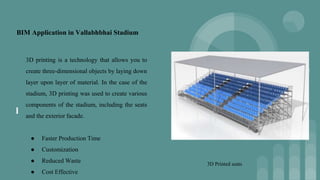
3D Printed seats
3D printing is a technology that allows you to
create three-dimensional objects by laying down
layer upon layer of material. In the case of the
stadium, 3D printing was used to create various
components of the stadium, including the seats
and the exterior facade.
● Faster Production Time
● Customization
● Reduced Waste
● Cost Effective
BIM Application in Vallabhbhai Stadium
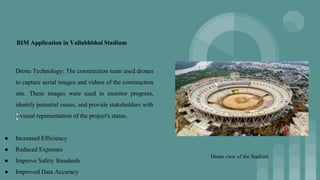
Drone view of the Stadium
Drone Technology: The construction team used drones
to capture aerial images and videos of the construction
site. These images were used to monitor progress,
identify potential issues, and provide stakeholders with
a visual representation of the project's status.
● Increased Efficiency
● Reduced Expenses
● Improve Safety Standards
● Improved Data Accuracy
Conclusion of the study
Qatar Stadium Sardar Vallabhbhai Patel
Stadium
Design Stage BIM model used to identify and
resolve potential issues, select
sustainable design options.
BIM model used to optimize
construction sequencing and
create a digital twin.
Construction Stage BIM model used to simulate
construction process, coordinate
between stakeholders.
BIM model used to
visualization, quantity
takeoffs, scheduling, and
safety.
Operation Stage BIM model used to manage
facilities, predictive maintenance,
asset management.
BIM model used for
efficiency, cost and risk
reduction, and safety.
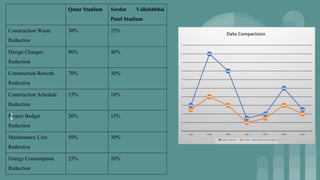
Qatar Stadium Sardar Vallabhbhai
Patel Stadium
Construction Waste
Reduction
30% 25%
Design Changes
Reduction
90% 40%
Construction Rework
Reduction
70% 30%
Construction Schedule
Reduction
15% 10%
Project Budget
Reduction
20% 15%
Maintenance Cost
Reduction
50% 30%
Energy Consumption
Reduction
25% 20%
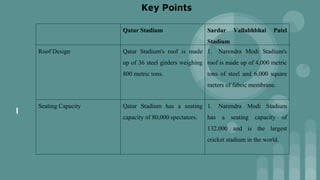
Key Points
Qatar Stadium Sardar Vallabhbhai Patel
Stadium
Roof Design Qatar Stadium's roof is made
up of 36 steel girders weighing
800 metric tons.
1. Narendra Modi Stadium's
roof is made up of 4,000 metric
tons of steel and 6,000 square
meters of fabric membrane.
Seating Capacity Qatar Stadium has a seating
capacity of 80,000 spectators.
1. Narendra Modi Stadium
has a seating capacity of
132,000 and is the largest
cricket stadium in the world.
Innovative Technology Qatar Stadium is equipped with
over 1,000 Wi-Fi access points
to provide spectators with high-
speed internet connectivity.
Narendra Modi Stadium's LED
lights consume 1/3rd the
amount of energy compared to
conventional floodlights and
are capable of providing high-
definition TV broadcasts.
Sustainable Features Qatar Stadium's solar panels
generate up to 16% of the
stadium's energy requirements,
and the stadium is designed to
minimize its environmental
impact.
Narendra Modi Stadium has a
rainwater harvesting system
that collects over 3 million
liters of water annually, which
is used to maintain the
stadium's green areas.
What does the future holds
for us ?
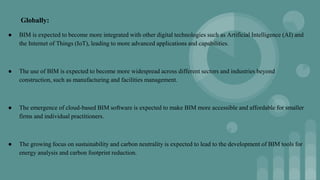
Globally:
● BIM is expected to become more integrated with other digital technologies such as Artificial Intelligence (AI) and
the Internet of Things (IoT), leading to more advanced applications and capabilities.
● The use of BIM is expected to become more widespread across different sectors and industries beyond
construction, such as manufacturing and facilities management.
● The emergence of cloud-based BIM software is expected to make BIM more accessible and affordable for smaller
firms and individual practitioners.
● The growing focus on sustainability and carbon neutrality is expected to lead to the development of BIM tools for
energy analysis and carbon footprint reduction.
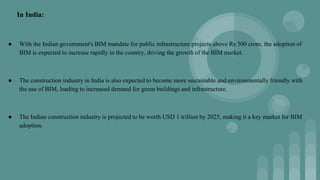
In India:
● With the Indian government's BIM mandate for public infrastructure projects above Rs 500 crore, the adoption of
BIM is expected to increase rapidly in the country, driving the growth of the BIM market.
● The construction industry in India is also expected to become more sustainable and environmentally friendly with
the use of BIM, leading to increased demand for green buildings and infrastructure.
● The Indian construction industry is projected to be worth USD 1 trillion by 2025, making it a key market for BIM
adoption.
Construction Projects completed over the years using BIM
Technology and process.
Conclusion
● The first case study analysed the impact of Building Information Modelling (BIM) on the Nagpur Metro,
examining the changes brought about by its implementation.
● The second case study compared the facilities of two major stadiums, namely, the Qatar and Sardar Patel
Stadiums.
● The comparison of the implementation of BIM in the Nagpur Metro and stadiums like Qatar Stadium and
Sardar Vallabhbhai Patel Stadium highlights the growing adoption of BIM in the construction industry, both in
India and internationally.
● While India has been relatively slow to adopt BIM compared to other countries, the Nagpur Metro project
demonstrates its increasing acceptance in India's infrastructure sector.
● On the other hand, the design and construction of Qatar Stadium, represents the cutting-edge of BIM adoption
in the construction industry. Its innovative use of BIM for simulating the construction process, clash detection,
and visualization is setting new benchmarks for project delivery and sustainability.
Reference
● Center for Integrated Facility Engineering CIFE. Virtual Design and Construction: Themes, Case Studies and Implementation
Studies. Stanford University, 2009. Web. 16 June 2017.
● Building SMART alliance Construction Operations Building information exchange (COBie) Project - National Institute of Building
Sciences. (2017). Nibs.org. Retrieved 16 June 2017.
● "Nagpur Metro Rail Project: A Case Study of Public-Private Partnership" by Akash B. More, Rahul R. Ralegaonkar, and Jayant B.
Thakre
● "Challenges in implementing BIM for metro rail projects in India: A case study of Nagpur metro" by Saurabh S. Joshi and Prasad
V. Rane
● "Integrating Building Information Modelling (BIM) with Operations and Maintenance (O&M) for Nagpur Metro" by Vishal
Kharche and Atul B. Deshmukh
● "Qatar National Convention Centre and Exhibition Hall: Building Information Modelling for Large-Scale and Complex Projects"
by Hoda Elmaraghy and Andrew D. Player
● "Design and Construction of the Qatar Iconic Stadium for the 2022 FIFA World Cup Qatar: An Integrated Approach Using
Building Information Modeling" by Sherif M. Hammad, Abdulaziz Al-Kuwari, and Amer A. M. Al-Bataineh
Thank You

BIM case study

  • 1.
    Presentation on FinalYear Project “Comparative Case Studies of BIM Projects” Submitted By: Geetansh Chhabra (19EJCCE039) Gunjan Gupta (19EJCCE040) Karan Kumar (19EJCCE049) Manan Biwal (19EJCCE061) Mohd Anish Mirza (19EJCCE064) Neel Kumar Bairwa (19EJCCE070) Submitted To: Mr. Teekam Singh (Asst. Professor) Ms. Swarnima (Supervisor)
  • 2.
  • 3.
    ● BIM standsfor Building Information Modeling, which is a process that involves creating and managing digital representations of buildings and their components. ● BIM allows architects, engineers, contractors, and other professionals to collaborate on a project by sharing information.
  • 4.
    LEVEL OF DEVELOPMENTIN BIM ● LOD 100 or Conceptual BIM . ● LOD 500 or As-Built BIM ● LOD 200 or Schematic BIM ● LOD 300 or Detailed BIM ● LOD 400 or Fabrication and Assembly BIM
  • 5.
    ● 3D orspatial dimension ● 4D or time dimension Different Dimensions of BIM ● 5D or cost dimension ● 6D or sustainability dimension ● 7D or facilities management dimension
  • 6.
    BIM Implementation aroundthe world ● In 2002, the National Institute of Building Sciences (NIBS) in the United States established the National BIM Standard-United States (NBIMS-US) to promote the use of BIM across the industry. ● In 2011, the UK government announced that BIM would be mandatory for all public sector construction projects by 2016. ● In 2012, the American Institute of Architects (AIA) launched its own set of BIM guidelines for architects and designers. ● In 2014, Singapore launched its BIM e-Submission System (BESS) to streamline the regulatory submission process for building
  • 7.
    BIM Implementation aroundthe world ● In 2015, the German government introduced a BIM implementation plan. ● In 2016, the European Union mandated the use of BIM for public works projects with an estimated budget over €5 million. ● In 2017, the Australian government launched its National BIM Initiative. ● In 2018, the United Arab Emirates (UAE) introduced a BIM mandate for all major government projects. ● As of 2021, more than 50 countries have adopted BIM mandates or guidelines, and the global BIM market is projected to reach $15.06 billion by 2025.
  • 8.
    Where does IndiaStands ? ● The Indian government announced its BIM mandate for public infrastructure projects above Rs 500 crore in November 2020, with the goal of improving efficiency, reducing project delays, and enhancing project quality. ● The mandate requires the use of BIM for all public infrastructure projects at the planning, design, and construction stages, and applies to all stakeholders, including clients, architects, engineers, and contractors. ● Several Indian states, including Maharashtra, Andhra Pradesh, and Telangana, have also announced their own BIM mandates for public infrastructure projects.
  • 9.
  • 10.
    The Nagpur MetroRail Project
  • 11.
    The Nagpur MetroRail Project ● Nagpur Metro is a rapid transit system for the city of Nagpur, Maharashtra, India. The final project cost incurred was ₹9,279 crore (US$1.2 billion). ● Construction on the project began on 31 May 2015, with trial run beginning on 30 September 2017. ● Prime minister Narendra Modi inaugurated operations on Nagpur Metro on 8 March 2019. ● Nagpur Metro becomes 13th Metro system in India to be operational. It is also being touted as the greenest metro rail in India.
  • 12.
    The Nagpur MetroRail Project BIM Application in the construction of Nagpur metro station Clash Detection in Navisworks A 'clash' is the result of two elements in your design taking up the same space. In Building Information Modeling (BIM), clash detection is the technique of identifying if, where, or how two parts of the building (e.g., plumbing, walls, etc.) interfere with one another.
  • 13.
    The Nagpur MetroRail Project BIM Application in the construction of Nagpur metro station BIM Structure of Nagpur Metro Station BIM helps structural engineers optimize and automate designs, reduce errors and risk, and improve accuracy and constructability, while improving overall project delivery. ● Enhanced Quality. ● Increased Efficiency. ● Flexible Design Solutions. ● Enhanced Productivity.
  • 14.
  • 15.
    Comparative study betweenconstruction of Sardar Vallabhbhai Patel Stadium and Qatar (Lusail) Stadium
  • 16.
    QATAR STADIUM ● LusailStadium, is a football stadium in Lusail, Qatar. Owned by the Qatar Football Association. ● It is the largest stadium in Qatar and the Middle East by capacity and one of eight stadiums built for the 2022 FIFA World Cup ● It is currently the second largest stadium in Asia but eventually will reduce its current capacity of 88,966 to 40,000 in the near future. ● The stadium is located about 20 kilometres (12 mi) north of Doha. Lusail Stadium was inaugurated on 9 September 2022 with the Lusail Super Cup game.
  • 17.
    BIM Application inQatar Stadium BIM Model For MEP services BIM enables MEP engineers to create detailed, accurate models of their systems, reducing the need for manual calculations and site visits. BIM also makes it easier for MEP engineers to coordinate their work with other trades and manage the construction process, reducing the risk of delays and rework.
  • 18.
    BIM Application inQatar Stadium Simulation model used to improve collaboration and safety in construction process Simulation analysis is a valuable tool in the construction industry that can help improve project planning and design, project scheduling and sequencing, construction safety, communication and collaboration, and reduce project costs.
  • 19.
    VALLABHBHAI STADIUM ● TheNarendra Modi Stadium, (formerly known as Motera Stadium) is a cricket stadium situated in Sardar Vallabhbhai Patel Sports Complex, Ahmedabad, India. ● It is the largest stadium in the world, with a seating capacity of 132,000 spectators. Owned by the Gujarat Cricket Association. ● In 2015, the stadium was closed and demolished before being completely rebuilt by February 2020, with an estimated cost of ₹800 crore (US$100 million). ● A unique feature of the stadium is the LED lights on the roof instead of the usual floodlights at cricket grounds. The LED lights are installed on an antibacterial, fireproof canopy.
  • 20.
    BIM Application inVallabhbhai Stadium Aerial view of Sardar Vallabhbhai Stadium Aerial construction photography helps builders see their construction projects differently. It gives a top-down view which can alert contractors to potential problems before they occur. Construction photography services help line up plans to reality.
  • 21.
    Comparative study betweenconstruction of Vallabhbhai stadium and Qatar stadium BIM Application in Vallabhbhai Stadium 3D Model of Narendra Modi Stadium During the design stage, the BIM model was used to identify and resolve design issues, coordinate between different stakeholders, and optimize construction sequencing. The BIM model also allowed for the creation of a digital twin, which was used to monitor the progress of the project in real-time, ensuring that the project was completed on schedule and within budget.
  • 22.
    BIM Application inVallabhbhai Stadium 3D Printed seats 3D printing is a technology that allows you to create three-dimensional objects by laying down layer upon layer of material. In the case of the stadium, 3D printing was used to create various components of the stadium, including the seats and the exterior facade. ● Faster Production Time ● Customization ● Reduced Waste ● Cost Effective
  • 23.
    BIM Application inVallabhbhai Stadium Drone view of the Stadium Drone Technology: The construction team used drones to capture aerial images and videos of the construction site. These images were used to monitor progress, identify potential issues, and provide stakeholders with a visual representation of the project's status. ● Increased Efficiency ● Reduced Expenses ● Improve Safety Standards ● Improved Data Accuracy
  • 24.
    Conclusion of thestudy Qatar Stadium Sardar Vallabhbhai Patel Stadium Design Stage BIM model used to identify and resolve potential issues, select sustainable design options. BIM model used to optimize construction sequencing and create a digital twin. Construction Stage BIM model used to simulate construction process, coordinate between stakeholders. BIM model used to visualization, quantity takeoffs, scheduling, and safety. Operation Stage BIM model used to manage facilities, predictive maintenance, asset management. BIM model used for efficiency, cost and risk reduction, and safety.
  • 25.
    Qatar Stadium SardarVallabhbhai Patel Stadium Construction Waste Reduction 30% 25% Design Changes Reduction 90% 40% Construction Rework Reduction 70% 30% Construction Schedule Reduction 15% 10% Project Budget Reduction 20% 15% Maintenance Cost Reduction 50% 30% Energy Consumption Reduction 25% 20%
  • 26.
    Key Points Qatar StadiumSardar Vallabhbhai Patel Stadium Roof Design Qatar Stadium's roof is made up of 36 steel girders weighing 800 metric tons. 1. Narendra Modi Stadium's roof is made up of 4,000 metric tons of steel and 6,000 square meters of fabric membrane. Seating Capacity Qatar Stadium has a seating capacity of 80,000 spectators. 1. Narendra Modi Stadium has a seating capacity of 132,000 and is the largest cricket stadium in the world.
  • 27.
    Innovative Technology QatarStadium is equipped with over 1,000 Wi-Fi access points to provide spectators with high- speed internet connectivity. Narendra Modi Stadium's LED lights consume 1/3rd the amount of energy compared to conventional floodlights and are capable of providing high- definition TV broadcasts. Sustainable Features Qatar Stadium's solar panels generate up to 16% of the stadium's energy requirements, and the stadium is designed to minimize its environmental impact. Narendra Modi Stadium has a rainwater harvesting system that collects over 3 million liters of water annually, which is used to maintain the stadium's green areas.
  • 28.
    What does thefuture holds for us ?
  • 29.
    Globally: ● BIM isexpected to become more integrated with other digital technologies such as Artificial Intelligence (AI) and the Internet of Things (IoT), leading to more advanced applications and capabilities. ● The use of BIM is expected to become more widespread across different sectors and industries beyond construction, such as manufacturing and facilities management. ● The emergence of cloud-based BIM software is expected to make BIM more accessible and affordable for smaller firms and individual practitioners. ● The growing focus on sustainability and carbon neutrality is expected to lead to the development of BIM tools for energy analysis and carbon footprint reduction.
  • 30.
    In India: ● Withthe Indian government's BIM mandate for public infrastructure projects above Rs 500 crore, the adoption of BIM is expected to increase rapidly in the country, driving the growth of the BIM market. ● The construction industry in India is also expected to become more sustainable and environmentally friendly with the use of BIM, leading to increased demand for green buildings and infrastructure. ● The Indian construction industry is projected to be worth USD 1 trillion by 2025, making it a key market for BIM adoption.
  • 31.
    Construction Projects completedover the years using BIM Technology and process.
  • 32.
    Conclusion ● The firstcase study analysed the impact of Building Information Modelling (BIM) on the Nagpur Metro, examining the changes brought about by its implementation. ● The second case study compared the facilities of two major stadiums, namely, the Qatar and Sardar Patel Stadiums. ● The comparison of the implementation of BIM in the Nagpur Metro and stadiums like Qatar Stadium and Sardar Vallabhbhai Patel Stadium highlights the growing adoption of BIM in the construction industry, both in India and internationally. ● While India has been relatively slow to adopt BIM compared to other countries, the Nagpur Metro project demonstrates its increasing acceptance in India's infrastructure sector. ● On the other hand, the design and construction of Qatar Stadium, represents the cutting-edge of BIM adoption in the construction industry. Its innovative use of BIM for simulating the construction process, clash detection, and visualization is setting new benchmarks for project delivery and sustainability.
  • 33.
    Reference ● Center forIntegrated Facility Engineering CIFE. Virtual Design and Construction: Themes, Case Studies and Implementation Studies. Stanford University, 2009. Web. 16 June 2017. ● Building SMART alliance Construction Operations Building information exchange (COBie) Project - National Institute of Building Sciences. (2017). Nibs.org. Retrieved 16 June 2017. ● "Nagpur Metro Rail Project: A Case Study of Public-Private Partnership" by Akash B. More, Rahul R. Ralegaonkar, and Jayant B. Thakre ● "Challenges in implementing BIM for metro rail projects in India: A case study of Nagpur metro" by Saurabh S. Joshi and Prasad V. Rane ● "Integrating Building Information Modelling (BIM) with Operations and Maintenance (O&M) for Nagpur Metro" by Vishal Kharche and Atul B. Deshmukh ● "Qatar National Convention Centre and Exhibition Hall: Building Information Modelling for Large-Scale and Complex Projects" by Hoda Elmaraghy and Andrew D. Player ● "Design and Construction of the Qatar Iconic Stadium for the 2022 FIFA World Cup Qatar: An Integrated Approach Using Building Information Modeling" by Sherif M. Hammad, Abdulaziz Al-Kuwari, and Amer A. M. Al-Bataineh
  • 34.