FOREWORD
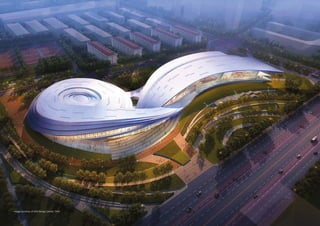
From skyscrapers
to airports, net-
zero buildings,
tunnels, and more,
the 5th annual AEC
Excellence Awards
competition
received 145
incredible entries for projects
that are transforming cities and
communities around the world.
Every submission showcased
innovation and embodied the future
of making things, with pioneering
uses of BIM enabled by the cloud
and emerging technologies such as
augmented reality, virtual reality,
drones, generative design, and more.
Sponsored by Autodesk, HP,
Construction Dive, and Smart Cities
Dive, the AEC Excellence Awards
recognize achievements in design,
engineering, and construction
across the Building, Infrastructure,
Construction, and Sustainability
segments. An international panel
of independent judges, selected for
their industry expertise, evaluated
the entries based on criteria
including project complexity,
sustainability, collaboration,
innovative processes and workflows,
use of emerging technologies, and
integrated analysis and simulation.
The award-winning projects featured
in the following pages shine a bright
light on the future of making things.
We’re proud to help celebrate
these achievements and continue
to encourage innovation toward
designing and making a better world.
Vice President, AEC Business
Strategy and Marketing,
Autodesk
Nicolas Mangon
1st PLACE
Nuevo Aeropuerto Internacional de la Ciudad de Mexico
2nd PLACE
East Side Access
3rd PLACE
Arna-Bergen, Ulriken Tunnel
1st PLACE
Museum of the Future
2nd PLACE
Hohhot City Saihan District National Fitness Center Project
3rd PLACE
Expo 2020 Dubai
1st PLACE
Tianjin Chow Tai Fook Financial Center Project
2nd PLACE
China Zun Tower
3rd PLACE
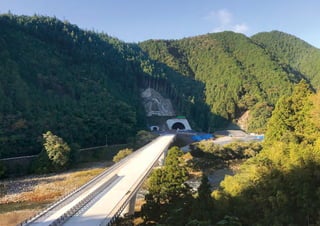
Mikusa tunnel on the Kinki Highway Kise Line
1st PLACE
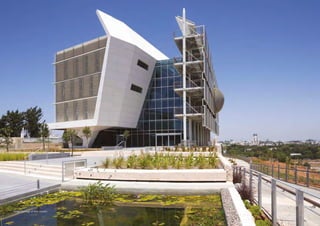
The Porter School of Environmental Studies
2nd PLACE
Jie Fang Nan Lu Community Culture and Sports Center
3rd PLACE
WHIZDOM 101 Bangkok
INFRASTRUCTURE
p.4
BUILDING
p.12
CONSTRUCTION
p.20
SUSTAINABILITY
p.28
INFRASTRUCTURE
4
BOB DRAKE
Editor-in-Chief
Civil + Structural Zweig Group
LIMING SHENG
Chief Engineer and Deputy Director	
China Railway Corporation Engineering Management Division
TODD DANIELSON
Editorial Director
V1 Media
KYLE FRAZIER
Managing Director, Research & Blueprint 2025
CG/LA Infrastructure
JEAN-BAPTISTE VALETTE
Civil Engineer and Chief of BIM Strategy
VINCI Construction France
Judges
5
NUEVO AEROPUERTO INTERNACIONAL DE LA CIUDAD DE MEXICO
Foster + Partners, FR-EE
EAST SIDE ACCESS
LiRo Group
ARNA-BERGEN, ULRIKEN TUNNEL
Norconsult AS
2nd
3rd
1st
2nd
3rd
2nd
3rd
1st
2nd
3rd
2nd
3rd
1st
2nd
3rd
Project:
Nuevo Aeropuerto Internacional de
la Ciudad de Mexico
Firm:
Foster + Partners, FR-EE
Owner:
Grupo Aeroportuario
de la Ciudad de Mexico
Location:
Texcoco, Mexico City, Mexico
Software:
Autodesk Revit,
Autodesk Dynamo Studio,
Autodesk Navisworks
1st PLACE
INFRASTRUCTURE Taking Off With BIM
For Mexico City’s New International Airport (Nuevo Aeropuerto Inter-
nacional de la Ciudad de Mexico - NAICM), Foster + Partners and FR-EE
had one core goal in mind: Put people first.
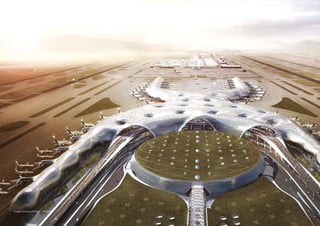
At 470,000 square meters, it will be one of the world’s largest air-
ports; its flowing form is inspired by flight. But its primary design fo-
cus is the passenger experience. With an open air concept, travelers
will be able to see the gates and where they are heading in a space
full of daylight. The design also anticipates the predicted increase
in passenger numbers by 2028 and beyond, along with an expansion
plan through 2062 for an eventual six runways.
The terminal itself is almost 1.5 kilometers in length and a single,
continuous gridshell with an innovative roof and fixed boarding
bridges in one enclosure. The computational design approach for the
roof is unique in the world for its complexity of generating a double
curvature light structure with long spans of 160 meters, serving as a
roof, façade, and structure at the same time. With spans of more than
100 meters, the lightweight glass and steel structure is designed for
challenging soil conditions as well.
“We believe that regardless of the size of the airport, people should al-
ways come first,” says Martha Tsigkari, Partner, Applied Research and
Development team, Foster + Partners. “Therefore, the primacy of passen-
ger experience is a consistent theme throughout all our work. A complex
building such as the passenger terminal building, involving collaboration
with multiple disciplines, would not have been possible without the ap-
propriate coordination workflows, procedures, tools, and technology.”
First net-zero airport
From its inception, Foster + Partners and FR-EE also set out to de-
sign one of the most sustainable airports in the world. NAICM aims to
become the first net-zero airport and achieve LEED Platinum certifi-
cation for the terminal building and LEED Gold for the ground trans-
portation center and control tower.
As part of the project, the surrounding natural landscape will be re-
stored, improving the quality of life in the Valley of Mexico and the
eastern half of the city. The airport will run on 100 percent renew-
able energy, using biogas generated from a sewage treatment center
nearby and photovoltaic roof panels.
Water will be 100 percent reutilized. Rainwater will be harvested to
support water supplies; wastewater will be treated to be reused in
external areas. Three thousand hectares of greenery will be also cre-
ated around the airport to offset the loss of vegetation due to con-
struction. The biodiversity of the area will be maintained in collabo-
ration with a group of specialists who will facilitate the management
of plant and animal species.
Improving design decisions with BIM
With the ambitious sustainability and terminal design goals, BIM be-
came crucial to making it happen. The sharing of the models from the
very early stages made it possible for all teams to access updated
information, enabling a smooth transition from the concept stage to
a more detailed stage of the design as well as construction.
In the design stage of the terminal’s interior, BIM was key for co-
ordination and bringing together several options from different dis-
ciplines. The data extraction from the model provided more control
when scheduling all of the elements as well as efficient quality au-
diting. The design teams solved both large and small clashes in the
model while also identifying and eliminating duplicates and missing
elements. A greater level of model analysis assisted design deci-
sions, including the studies of lighting, wind, and energy.
15,000 drawings created with BIM
The documentation for the terminal building was similar in scale to an
urban-planning exercise. The team created directly from the model more
than 10,000 construction documents and 5,000 data sheets for each of
the rooms in the buildings. It’s estimated that they would have had to hire
1.5 times more staff to produce the same amount of drawings without BIM.
A weekly BIM coordination schedule helped create an even faster
workflow for collaboration, coordination, and production. This pro-
cess included sharing and receiving multiple discipline models; pro-
cessing, navigating, and analyzing the models; creating issue reports
and collecting viewpoints; communicating the issues to the consul-
tants sharing the viewpoints; and solving the issues—all in the same
week. This workflow was repeated every week of the design stage and
made it possible to achieve a better, more coordinated model.
There is no doubt that
the BIM models and the general
workflow helps the communication
and collaboration on this project—
not only within our own design
team, but also between all the
various consultants. It allowed us
to navigate through the model with
real-time rendering, giving us a better
understanding of existing issues and
to evolve collaborative solutions with
the various project teams.
Jesus Perucho Alcalde,
BIM Coordinator,
Foster + Partners
6
“
“
Check-in area. Image courtesy of Foster + Partners.
Image courtesy of Foster + Partners.
Project:
East Side Access
Firm:
LiRo Group
Owner:
Metropolitan Transit Authority
Capital Construction
Location:
New York, USA
Software:
Autodesk ReCap,
Autodesk InfraWorks,
Autodesk Revit
2nd PLACE
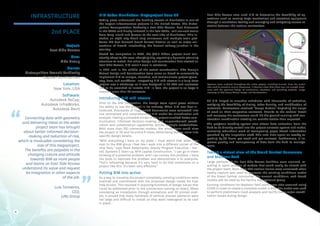
INFRASTRUCTURE BIM Takes Manhattan: Megaproject Goes 3D
Taking place underneath the bustling streets of Manhattan is one of
the largest infrastructure projects in the United States. The Metro-
politan Transportation Authority’s East Side Access—first discussed
in the 1950s and finally initiated in the late 1990s—will connect trains
from Long Island and Queens to the east side of Manhattan. This in-
cludes an eight city-block long concourse and multiple train plat-
forms 150 feet beneath Grand Central Station as well as major ren-
ovations of Harold Interlocking, the busiest railway junction in the
country.
Slated for completion in 2022, the $10.2 billion project must con-
stantly adapt to the ever-changing city, requiring a dynamic planning
structure to match. But when design and construction first started on
East Side Access, BIM wasn’t even in existence.
In 2011—and in the middle of the actual construction—LiRo Group’s
Virtual Design and Construction team came on board to successfully
implement BIM to analyze, visualize, and communicate project geom-
etry, data, and workflows. Integrating BIM mid-stream in a long-term
project was a challenge as it was designed in 2D CAD and contracts
had to be amended to include BIM. In fact, the project is so large it
requires more than 25 contracts.
Introducing BIM mid-stream
Prior to the BIM integration, the design team spent years without
the ability to see the project in its entirety. When BIM was first in-
troduced, thousands of fragmented documents were converted into
one centralized and comprehensive BIM model for visualization and
analysis. Having a complete model of the project enabled better com-
munication, informed decision-making, and unprecedented coordi-
nation and collaboration capabilities across multiple stakeholders.
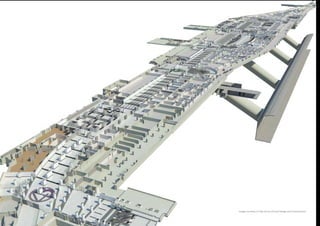
With more than 150 connected models, the whole team could view
the project in 3D and its entire 6 miles, while being able to zoom into
specific design details.
“With everything I have on my plate, I must admit that when I go
over to the BIM group I feel like I walk into a different corner of the
ship here,” says Mark Debarnardo, Deputy Program Executive - Har-
old, Systems & Start-up, MTA Capital Construction. “I can go in there
thinking of a potential problem, and I can convey this problem. I have
the tools to replicate the problem and demonstrate it to everyone.
That’s refreshing because it’s very hard to do that sometimes on a
project like this. It’s been very effective.”
Putting BIM into action
As a way to visualize the project completely, existing conditions were
scanned and coordinated with the proposed design model for East
Side Access. This resulted in exposing hundreds of design issues that
could be addressed prior to the contractors coming on board. When
simulating an installation through animations and 3D printed mod-
els, it proved that many hundreds of vertical precast elements were
too large and difficult to install so they were redesigned to be cast
in place.
East Side Access also used BIM to determine the feasibility of op-
erations such as moving large mechanical and electrical equipment
through a ventilation facility and managing and mitigating access re-
straint between the various contractors.
4D BIM helped to visualize schedules with thousands of activities,
verifying the feasibility of timing, labor density, and mobilization of
materials. Contractors received “Scope Models” depicting the scope
of work on their respective contracts. Thanks to the models’ detail
and accuracy the contractors could hit the ground running with con-
struction coordination starting six months earlier than expected.
The progress tracking system also allows data collection from the
field to be directly routed into the project controls system and model,
removing redundant work of transposing paper-based information
provided by the inspection staff. This cuts time spent on weekly re-
porting by 30 hours per week and per contract. Furthermore, it im-
proves quality and transparency of data from the field to manage-
ment.
Taking a virtual view of the Grand Central Concourse
and Madison Yard
Large portions of the East Side Access facilities were scanned, re-
sulting in rapid updates of models that could easily be shared with
the project team. More than 800 serious issues were uncovered when
reality capture was used to generate the existing conditions model
of the Grand Central concourse. The current conditions, web-based
models will be used by the facility management group.
Existing conditions for Madison Yard outfit were also scanned using
LiDAR in order to create a complete model in BIM. The model was used
to perform preliminary clash analysis and rectify many major coordi-
nation issues during design.
Connecting data with geometry
and delivering these to the wider
project team has brought
about better-informed decision-
making and reduction of risk,
which is invaluable considering the
size of this megaproject.
The benefits are palpable in the
changing culture and attitude
towards BIM as more people
and teams on East Side Access
understand its value and request
its integration in other aspects
of the job.
Luis Tormenta,
CEO,
LiRo Group
8
“
“
Systems were modeled throughout the entire project, including tunnels. Here the model
was used to visualize tunnel clearances. It became clear that there was not enough clear-
ance with the previous design of mechanical, electrical, and plumbing services. Image
courtesy of LiRo Group Virtual Design and Construction.
Image courtesy of LiRo Group Virtual Design and Construction.
Project:
Arna-Bergen, Ulriken Tunnel
Firm:
Norconsult AS
Owner:
Bane NOR
Location:
Sandvika, Oslo, Norway
Software:
Autodesk ReCap,
Autodesk InfraWorks,
Autodesk AutoCAD Civil 3D
3rd PLACE
INFRASTRUCTURE Game On: Bringing a Tunnel to Life
For Norconsult AS, it’s game time.
Norconsult AS chose BIM for not only coordination and collaboration
with design and construction of the new Arna-Bergen, Ulriken Tunnel
in Norway, but also to create a fully immersive game and virtual re-
ality experience.
As Northern Europe’s most-trafficked, single-track tunnel, the Nor-
wegian railway between Fløen and Arna required increased capacity
and safety. This meant boring through Mount Ulriken to build a new,
parallel 7.8 kilometer tunnel and upgrading existing stations that are
already tight on space within two city centers. And this all had to be
done without disrupting any of the current railway traffic.
Accessible gaming environment
The Arna-Bergen, Ulriken Tunnel is the first use of a tunnel boring
machine in Norway. When Bane NOR’s new parallel tunnel is finished,
double tracks will run between Arna and Bergen, providing more fre-
quent departures between the cities and updated stations to accom-
modate the new trains. The route will be safer with the creation of
16 evacuation cross passages every 500 meters between the tunnel
tubes. Ten technical rooms will also be built throughout the tunnel.
With this massive project, Norconsult AS took a decidedly different
route. Design validation, maintainability, and training could be easi-
ly achieved through the innovative use of immersive technology and
interactive virtual reality. The virtual environment also enabled the
firm to execute signal and sign placement verification and simula-
tions of emergency scenarios in a new way.
Disrupting the status quo
Creating this purpose-built environment served as a platform for re-
al-time, immersive design evaluation and communication. By virtual-
ly designing the tunnel before it’s built, Norconsult AS could minimize
the necessity of changes and adjustments after the construction
work is complete and in operation.
“Delivering an interactive virtual-reality experience with our BIM
models truly disrupts the status quo in a traditionally conservative
industry,” said Thomas Angeltveit, BIM coordinator, Norconsult AS.
“BIM improved coordination and phase planning by enabling us to
visualize, and we found a significant reduction in the amount of time
for approvals, stakeholder buy-in, and review cycles. Through an
intuitive experience, the design was fully understandable for even
non-professionals. In the end, we can help to deliver a better, safer
tunnel and stations than ever before.”
Laser scanning was also key for the BIM models and transferring the
data into the gaming engine. Robust, real-time virtual reality gave all
of the stakeholders deeper insights and enabled them to make bet-
ter decisions earlier in the design processes. Those involved ran the
gamut from the project owners to actual train operators who could
virtually drive trains in the tunnel and provide the feedback neces-
sary for a better design and use once constructed.
The use of BIM for construction
and design alone has saved us
half the time. The virtual reality
experience transformed the way we
approached the projects and how we
can communicate with clients and
stakeholders moving forward. It’s
truly a game changer.
Thomas Angeltveit,
BIM Coordinator,
Norconsult AS
10
“
“
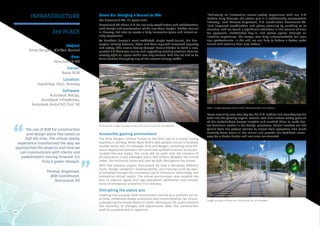
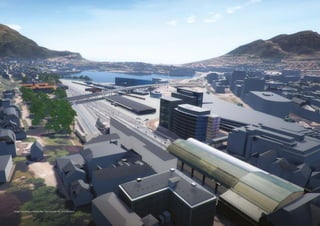
Image courtesy of Bane Nor, Norconsult AS, and Baezeni.
Fløen. Image courtesy of Bane Nor, Norconsult AS, and Baezeni.
Arna station. Image courtesy of Bane Nor, Norconsult AS, and Baezeni.
Image courtesy of Bane Nor, Norconsult AS, and Baezeni.
BUILDING
12
MARK SCACCO
AEC Technology Consulting Executive
Engineered Efficiency, Inc.
STEPHEN VAN DYCK
Partner
LMN Architects
CHENGYONG GAO
Chief Engineer
Shanghai Xian Dai Architectural Design (Group) Co., Ltd.
KEINICHI IIJIMA
General Manager, Design Process and Quality Management Unit
Yasui Architect & Engineering
REBECCA DE CICCO
Director
Digital Node
Judges
13
MUSEUM OF THE FUTURE
Dubai Future Foundation, BuroHappold Engineering,
Killa Design, BAM Higgs & Hill, Transgulf
HOHHOT CITY SAIHAN DISTRICT NATIONAL FITNESS CENTER PROJECT
Tianjin Architecture Design Institute
EXPO 2020 DUBAI
Dubai Expo 2020 Bureau
2nd
3rd
1st
2nd
3rd
2nd
3rd
1st
2nd
3rd
2nd
3rd
1st
2nd
3rd
Project:
Museum of the Future
Firm:
BuroHappold Engineering,
Killa Design, BAM Higgs & Hill,
Transgulf
Owner:
Dubai Future Foundation
Location:
Dubai, United Arab Emirates
Software:
Autodesk Revit,
Autodesk Dynamo Studio,
Autodesk Navisworks Manage,
Autodesk Robot Structural Analysis
Professional, Autodesk 3ds Max
1st PLACE
BUILDING “See the Future, Create the Future”
While the interior of many museums look at the past, the Museum
of the Future will be everything its name embodies: exhibitions of
innovation and incubation of new ideas. The building itself reflects
this completely.
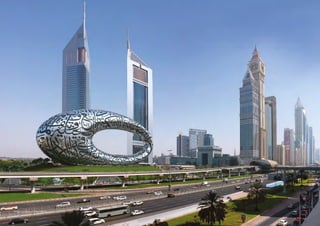
Located adjacent to Emirates Towers in Dubai, the $136 million, 30,000
square meter iconic building will have an instantly recognizable dis-
torted torus shape, epitomized by its futuristic stainless steel façade
with illuminated glazed Arabic calligraphy. Seven floors of exhibition
space will showcase innovative and futuristic concepts, services, and
products for the future of cities, healthcare, and education along with
areas devoted to labs and a 400-seat auditorium.
BIM as a requirement
The futuristic vision and focus on innovation also extends to Muse-
um of the Future’s design and construction. From the very beginning,
Dubai Future Foundation required BIM and a fully developed digital
workflow across the project lifecycle for BuroHappold Engineering
(lead consultant); Killa Design (architect); and BAM Higgs & Hill and
Transgulf (contractors).
The design and client teams meet regularly, allowing mark-ups of the
current designs to be done by anyone at any time. This shift to agile
project delivery replaces the creation of deliverables for milestone
meetings. Instead, everyone contributes continuously and moves the
project forward based on the most up-to-date information.
The accessibility of 3D coordination, clash resolution, and deci-
sion-making with all stakeholders have made a tremendous impact
as well. The handover of models at each stage from stakeholder to
stakeholder has ensured that model maturity continues and is de-
veloped from design to construction. This is reflected in real time in
the progress from the team’s LOD 300 models and the contractor’s
LOD 400 models. In addition, areas in the model have been identified
where prefabricated MEP modules manufactured off-site can be de-
veloped and installed to reduce installation time and labor cost—and
it’s only possible due to a high level of confidence in the accuracy and
quality of the virtual model.
Generative design at the heart
Design rationalization and generative design are at the center of the
iterative analysis process adopted for the optimization of the proj-
ect’s more complex elements.
For example, when it came to the complex steel diagrid geometry,
the steel contractors based iterations for the connection design, con-
structability, element length, angles, and nodes on the required for
strength analysis and serviceability requirements. Generative design
helped with the creation of bespoke scripts to drive multi-variable
optimization as well as increased definition and predictability. The
diagrid geometry was generated with an in-house parametric script,
allowing the team to quickly manipulate and study numerous iter-
ations to accommodate architectural and structural requirements.
Scripts were also used to assign the naming convention for the mem-
bers and nodes as well as generate geometry for drawing production.
“There is no project that epitomizes a full-scale digital project deliv-
ery more than the extraordinarily complex design of the Museum of
the Future,” says Tobias Bauly, Project Director, BuroHappold Engi-
neering. “It sets the benchmark for how all projects will be delivered
in the future: collaboration, generative design for high-speed design
optimizations, and complete construction views. Through technolo-
gy, this building has been designed as a fully resolved, fully optimized
product and represents the future of making buildings.”
Construction savings add up
With construction now underway, the use of QR codes for quality
control, safety, and material tracking contribute to a 65 percent re-
duction in rework on site. The construction management team and
inspectors save substantial time each day with BIM, and see a poten-
tial 50 percent improvement in productivity.
Due to the geometric form and complexity of the building, construc-
tion risk is mitigated by modeling the temporary framework. Now the
main contractor can view construction activities, along with collab-
oration and coordination for the critical construction challenges.
Waste material levels are reduced and controlled due to spatial coor-
dination prior to construction. And with the optimal design in 3D, the
teams experience less design issues during construction, enabling
minimal changes overall and on-schedule delivery.
“BIM is the medium, without which, this project would have been im-
possible,” says Bauly. “From the museum’s incredibly complex design
to the actual construction, only BIM could turn this vision for the fu-
ture into a reality today.”
The future belongs to those
who can imagine it, design it,
and execute it. While others try
to predict the future, we create it.
Museum of the Future will be an in-
tegrated environment empowering
creative minds to test, fund,
and market ideas for futuristic
prototypes and services.
His Highness
Sheikh Mohammed bin Rashid
Al Maktoum,
Vice President and Prime Minister
of the UAE and Ruler of Dubai
14
“
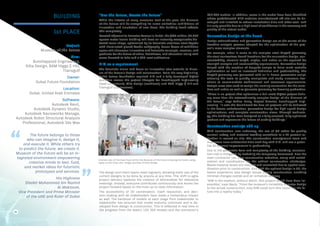
“ Internal view of the main foyer within the Museum of the Future showing the Arabic callig-
raphy on the inner skin. Image courtesy of Killa Design.
Image courtesy of Killa Design.
Project:
Hohhot City Saihan District National
Fitness Center Project
Firm:
Tianjin Architecture Design Institute
Owner:
Bureau of Culture, Sports, Media,
Sanhan District, Hohhot City
Location:
Hohhot City, Inner Mongolia, China
Software:
Autodesk Revit, Autodesk Insight,
Autodesk 3ds Max
2nd PLACE
BUILDING Getting Fit With BIM
In 2016, China approved its 2016-2020 National Fitness Plan that tar-
gets increased sports participation and fitness throughout the coun-
try as well as growing the sports industry. The plan also includes
ambitious construction for fitness facilities and infrastructure to
provide closer proximity and accessibility for both urban and rural
residents.
With an expected completion date in 2019, the Hohhot City Saihan
District National Fitness Center Project in Inner Mongolia is being
designed and constructed as part of the country’s plan and to en-
courage participation. With a site consisting of 91,437 square meters
and a total construction area of 33,000 square meters, the building is
divided into two zones. Zone A is a multi-functional gymnasium with
5,000 seats for sports events and Zone B houses the fitness center
with a swimming pool, basketball courts, tennis courts, and more.
Taking advantage of generative design
The entire project embraces BIM. Tianjin Architecture Design Insti-
tute placed a large focus on the use of generative design to orientate
structural components to tightly fit the finished surface, reducing
material waste. The non-linear design and optimization of the fitness
center was made possible through parametric modeling.
For example, at the junction of the steel roof truss and column top, a
truss support structure was generated by compiling scripts in gener-
ative design software to automatically align the angle and complete
the support design below the truss node. The panel design for the
roof was optimized to unify the size, reduce panel variety, and lower
the cost. Generative design was also used to quickly place stadium
seats and classify them for different functions. Pipes and electrical
installation optimization were completed as well.
Achieving goals with BIM
A key priority for the project was to enhance collaboration within a
very complex space for many different uses. This included identifying
negative space to take advantage of every part of the building. By
continuously improving the BIM model and working in 3D, the team
achieved coordination across disciplines and reduced design errors
and on-site design changes.
At the same time, this project adopts an open ceiling that highlights
the structural and MEP systems while reducing costs. Computational
fluid dynamics (CFD) was effectively utilized to analyze environmen-
tal simulation factors and optimize the layout. The interior CFD anal-
ysis improved HVAC selection and the layout of the sports buildings,
which are sensitive to airflow.
BIM is being applied in our whole
design process, and we are achieving
our 3D design goals for a very
complex building. Drawings from the
BIM model fully express the entire
project to avoid misunderstanding,
and the extracted parametric
model information instructs
the construction with pre-cast
fabrication and on-site assembly
efficiently and economically.
Lu Wanmei,
BIM Design Center Vice Director,
Tianjin Architecture Design Institute
16
“
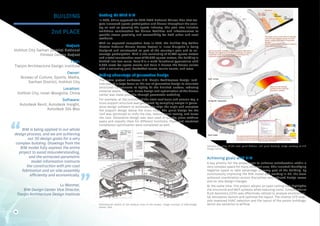
Architectural details of the stadium zone of the project. Image courtesy of BIM Design
Center, TADI.
Detailed structure of the roof, panel division, and panel drawing. Image courtesy of BIM
Design Center, TADI.
“
Image courtesy of BIM Design Center, TADI.
Project:
Expo 2020 Dubai
Firm:
Dubai Expo 2020 Bureau
Owner:
Dubai Expo 2020 Bureau
Location:
Dubai, United Arab Emirates
Software:
Autodesk Revit,
Autodesk Dynamo Studio,
Autodesk Navisworks Manage,
Autodesk AutoCAD,
Autodesk 3ds Max
3rd PLACE
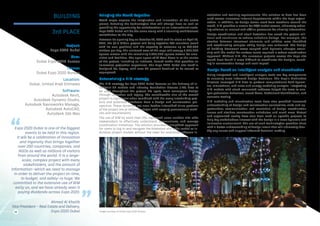
BUILDING Bringing the World Together
World expos capture the imagination and innovation of the entire
planet, debuting the technologies that will change lives as well as
providing the opportunity for collaboration on an international scale.
Expo 2020 Dubai will do the same along with a stunning architectural
contribution to the city.
Between its opening day on October 20, 2020 and its close on April 10,
2021, the $6.8 billion project will bring together 180 countries (each
with its own pavilion) and the capacity to welcome up to 270,000
visitors per day. The enclosed area of the expo will occupy 2,000,000
square meters with the remaining 2,400,000 square meters for ame-
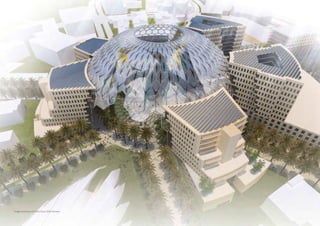
nities and facilities. The open space of Al Wasl Plaza is at the center
of the project, including an intricate, domed trellis that provides an
immersive projection experience. The Expo 2020 Dubai site itself is
designed for legacy, with over 80 percent destined to be reused or
repurposed.
Determining a BIM strategy
The BIM strategy for Expo 2020 Dubai focuses on the delivery of in-
telligent 3D models and Industry Foundation Classes (IFC) data to
be used throughout the project life cycle, from conceptual design
through operation and legacy. The considerable size of the overall
project is significant when combined with the many interlinking proj-
ects and potential interfaces from a design and construction per-
spective. These dynamics are even further intensified since portions
of the project are at different stages with varying procurement meth-
ods and requirements.
The use of BIM by more than 200 registered users enables site-wide
stakeholders to effectively understand, communicate, and manage
coordination initiatives. The solution provides a simplified approach
for users to log-in and navigate the federated site-wide model or in-
dividual project models without the need for extensive software in-
stallation and training requirements. The solution to date has been
used across numerous internal departments within the Expo organi-
zation. In addition, as design teams work from locations around the
world, BIM provides a means for 24/7 model access, ultimately reduc-
ing reliance on manual and offline processes for sharing information.
Design coordination and clash detection has saved the project mil-
lions and continues to reduce schedule delays. For example, the
clashes between structural elements and utilities were identified
and coordinating complex utility design was enhanced. The design
of building basement areas coupled with dynamic changes occur-
ring with the model for surface levels required a robust coordination
approach. Without BIM, the numerous projects across the Expo site
would have found it more difficult to coordinate the designs, result-
ing in construction delays and cost impact.
Design based on intelligent analysis and visualization
Using integrated and intelligent analysis tools are key components
to ensuring more informed design decisions. The Expo’s distinctive
districts leveraged BIM data to perform computational fluid dynam-
ics, simulations, and solar and energy modeling analysis. Integrating
BIM models with cloud-connected software helped the team to ana-
lyze pedestrian behaviors, crowd flows, bottleneck identification, and
scenario testing.
BIM modeling and visualization tools have also provided increased
understanding of design and construction constraints; risks and op-
portunities; communication and resolution of design coordination
issues and clashes; construction schedules; and much more. Virtual
and augmented reality have also been used on specific projects to
help key stakeholders interact with the design in a more dynamic and
immersive environment. The use of such technologies provides them
with a better understanding of design intent that will ultimately iden-
tify any issues and support informed decision-making.
Expo 2020 Dubai is one of the biggest
events to be held in this region.
It will be a celebration of innovation
and ingenuity that brings together
over 200 countries, companies, and
NGOs as well as millions of visitors
from around the world. It is a large-
scale, complex project with many
stakeholders, and the amount of
information—which we need to manage
in order to deliver the project on time,
to budget, and safely—is huge. We
committed to the extensive use of BIM
early on, and we have already seen it
paying dividends across Expo 2020.
Ahmed Al Khatib
Vice President – Real Estate and Delivery,
Expo 2020 Dubai18
“
“
Image courtesy of Dubai Expo 2020 Bureau.
CONSTRUCTION
20
MICHAEL D. BELLAMAN
President and Chief Executive Officer	
Associated Builders and Contractors
WALKER THISTED
Producer
BuiltWorlds
JUN OKOSHI
Design Division, Structural Planning
Taisei Corp.
DENISE CHEVIN
Editor
Construction Magazine
IR FRANCIS LEUNG
Associate Director (Assets Information Management)
New World Construction, Construction Department
of New World Development
Judges
21
TIANJIN CHOW TAI FOOK FINANCIAL CENTER PROJECT
China Construction Eighth Engineering Division Corp., Ltd.
CHINA ZUN TOWER
China Construction Third Engineering Bureau Group Co., Ltd.
MIKUSA TUNNEL ON THE KINKI HIGHWAY KISE LINE
Obayashi Corporation and ITOCHU Techno-Solutions Corporation
2nd
3rd
1st
2nd
3rd
2nd
3rd
1st
2nd
3rd
2nd
3rd
1st
2nd
3rd
Project:
Tianjin Chow Tai Fook
Financial Center Project
Firm:
China Construction Eighth
Engineering Division Corp., Ltd.
Owner:
NW Project Management Limited
(Developer)
Location:
Binhai New District, Tianjin, China
Software:
Autodesk Revit,
Autodesk Navisworks,
Autodesk ReCap
1st PLACE
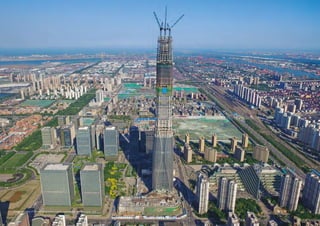
CONSTRUCTION Lofty Goals for a New Skyscraper
For China Construction Eighth Engineering Division Corp., Ltd., BIM
was integral to success on a complex tower project.
At the outset of the Tianjin Chow Tai Fook Financial Center project,
the goal was set for the use of BIM with all employees, specialties,
and processes. Not only that, the contract requires the delivery of
BIM models to serve the operation and maintenance upon completion
(in the precision of LOD500).
For the past three years, more than 100 members of the BIM team
have worked and collaborated on the design and construction.
Expected for completion in the fall of 2019, Tianjin Chow Tai Fook Fi-
nancial Center will be a striking new landmark and integrate busi-
ness and commercial space; luxury apartments; and a five-star hotel.
It has a 390,000-square-meter total construction area, constituting
a four-story basement, a five-story podium, and a 103-story tower,
reaching a total height of 530 meters.
Complexity by the numbers
The team set out to achieve high production precision, no storage
on the construction site, no rework in construction, and low cost in
operation and maintenance.
In a project this size, the numbers don’t lie. BIM has helped adjust
20,000 wall layouts and more than 8,000 door heights for ceilings of
different elevations and types in more than 50,000 square meters. By
avoiding the modification and rework ahead of time, the project saved
30 days and $10 million RMB. With an output of nearly 4,000 drawings
for the models of masonry panels, light partition walls, piping shafts,
doors, and more, contractors could prepare their work precisely. This
helped to cut the amount of materials needed for delivery, saving
60 days of construction work and material and labor costs of more
than $14 million RMB.
Beyond the construction work, generative design was used to pro-
gram and import the 3D coordinates to create an accurate façade.
14,800 pieces of façade components were finished three times faster
than the typical process and ensured 100 percent accuracy.
Data is everywhere and accessible
BIM has transformed the project management of the tower. Before
construction, 932 models were compressed into 12.21G and stored
in an accessible, private server. The total number of models to be
tracked reached 184,504 with 763,552 logistics updates.
All information—from ordering and transportation to entry, instal-
lation, and acceptance—is updated via mobile phones or iPads and
stored on the BIM platform so it’s easily accessible for everyone at
any time. Currently the project has created 2,950 QR codes for major
equipment and prefabrication components. By easily scanning the
QR code, the status of logistics can be updated automatically, creat-
ing greater collaboration and ensuring the accuracy of data. Approv-
al processes are also streamlined with mobile.
Automation and virtual reality improves safety
Emerging technologies are prevalent on the construction site of the
Tianjin Chow Tai Fook Financial Center. Robots are used to locate the
position of pipe supports accurately, improving the speed of measure-
ment and reducing errors
during installation. Above the
tower, drones fly to capture
images of the construction
site each day to compare and
analyze the schedules within
the different areas.
Through the combined ap-
plication of BIM models with
virtual reality devices, work-
ers experience safety simula-
tions about the risk of work-
ing at high heights, such as
feeling the actual danger and
fear when falling and work-
ing far above the ground with
no protection. The scenarios
also include machinery and
equipment operation in order
to improve their safety aware-
ness on the construction site.
In addition, virtual reality is
used for the owners, design-
ers, and construction team to
visualize the interiors of the
apartments and hotel and ex-
perience the different materi-
als for décor and design.
Only by using BIM and the latest
technologies throughout the entire
construction process, we can finish
a building 530 meters in height in
five years. BIM has not only changed
the way we work, but also clarifies
how we think about and meet new
challenges.
Yawu Su,
Project Manager,
China Construction Eighth
Engineering Division Corp., Ltd.
22
“
“
Image courtesy of China Construction Eighth Engineering Division Corp., Ltd.
Project:
China Zun Tower
Firm:
China Construction Third
Engineering Bureau Group Co., Ltd
Owner:
CITIC Heye Investment Co., Ltd.
Location:
Chaoyang District, Beijing, China
Software:
Autodesk BIM 360, Autodesk Revit,
Autodesk Navisworks
2nd PLACE
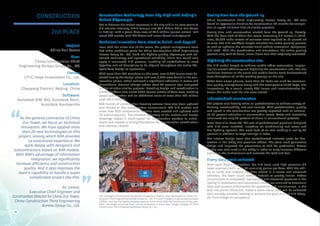
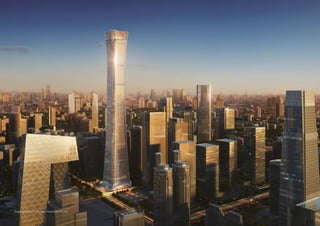
CONSTRUCTION Construction Technology Goes Sky High with Beijing’s
Tallest Skyscraper
Set to become the tallest structure in the city and in an area prone to
8.0 seismic intensity, CITIC Group’s new $3.5 billion China Zun Tower
in Beijing—with a gross floor area of 43.7 million square meters—will
reach 528 meters with 108 floors and seven floors underground.
Technical innovation from start to finish—and beyond
Even with the sheer size of the tower, the project management team
had other ambitious goals for China Construction Third Engineering
Bureau Group Co., Ltd: Build the highest quality skyscraper with ad-
vanced technology and operational reliability. China Zun would also
apply a connected BIM process, enabling all stakeholders to work
together and all disciplines to be aligned throughout the entire life-
cycle from design to operations.
With more than 100 members on the team, over 5,000 issues were de-
tected during the design phase and over 6,000 were found in the con-
struction phase, which achieved a significant reduction in errors and
demolitions. Passive change orders were 80 percent less compared
to that of other similar projects. Detailing design and coordination in
a BIM workflow also saved 7,200 square meters of floor area, creating
space optimization and an additional value of more than 100 million
yuan ($1.5 million).
806 rounds of construction drawing reviews have also been updated
and shared in this collaborative environment. 652 BIM models and
more than 800 components families were created and updated with
20 subcontractors. The inherent accuracy of the models and design
drawings makes it much easier for construction workers to under-
stand and creates a strong foundation for construction coordination
and collision checks.
Saving time from the ground up
China Construction Third Engineering Bureau Group Co., Ltd also
faced an aggressive timeline for construction: 62 months for comple-
tion (a speed 1.4 times that of similar projects).
Saving time with construction started from the ground up—literally.
With the base slab of China Zun tower measuring 6.5 meters in thick-
ness, 56,000 cubic meters of concrete were required to be poured all
at once. The BIM workflow helped simulate the entire pouring process
as well as optimize the concrete truck vehicle movement, equipment,
and staff. With this coordination and simulations, the entire pouring
process only took 93 hours, seven hours less than originally estimated.
Digitizing the construction site
The BIM model helped to achieve mobile office automation, improv-
ing the overall efficiency and digitizing the construction site. The low
technical barriers to the cloud and mobile device tools democratized
data throughout all of the working groups on the site.
Aside from smart phones, more than 40 iPads are used for construc-
tion quality management along with the arrangement of 30 large, site
inspections. As a result, nearly 400 issues and inconsistencies be-
tween the model and the site were solved.
Industrialized construction
The project also heavily relies on prefabrication to achieve energy ef-
ficiency, sustainability, and cost savings. With prefabrication, quality
and speed in the construction are greatly improved with an estimat-
ed 90 percent reduction in construction waste. Water and electricity
consumed are only 20 percent of those in conventional projects.
From Floor 7 to Floor 102, 192 sets of prefabricated pipelines designed
with BIM were installed, including air conditioning and water and
fire-fighting systems. The work load of on-site welding is cut by 30
percent in addition to large savings in labor.
The interior design team also prefabricated intricate parts for dec-
oration in the lobby and premium offices. The team used generative
design and imported the parameters to CNC for production. Virtual
reality was also used in the lobby in order to truly immerse different
parties in the environment and evaluate the look and feel.
Every data point collected
After each floor’s completion, the BIM team used high-precision 3D
laser scanners with up to 25 scanning points per floor. With the abil-
ity to verify and analyze the data stored in a server and accessed
remotely, the team could identify defects or quality issues. Before
construction is completed, mechanical and electrical pipelines in the
ceiling in installation and equipment rooms are scanned to document
data and location information for operation and maintenance. In the
end, the entire China Zun Tower’s point cloud data will be collected
and centrally located, helping to achieve the goal of a full BIM lifecy-
cle from design to occupancy.
As the general contractor of China
Zun Tower, we focus on technical
innovation. We have applied more
than 20 new technologies on this
project, among which BIM provides
us evolutional experience. We
work deeply with designers and
subcontractors based on BIM models.
With BIM’s advantage of information
integration, we significantly
increase efficiency and construction
quality. And it also improves the
team’s capability to handle a super
complicated project like this.
Xu Lishan,
Executive Chief Engineer and
ConstructionDirectorforChinaZunTower,
China Construction Third Engineering
Bureau Group Co., Ltd.
24
“
“
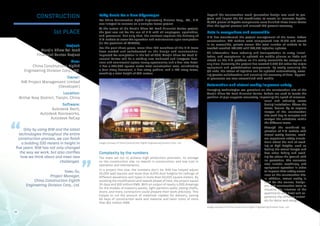
The Intelligent Construction Equipment Integration Platform was developed by China Con-
struction Third Engineering Bureau Group Co., Ltd. It is 22m in height, its gross area exceeds
1,800m2
, and has the highest loading capacity in the world. With the assistance of this plat-
form, one single structural floor can be completed in three days. Image courtesy of China
Construction Third Engineering Bureau Group Co., Ltd.
Image courtesy of CITIC Heye Investment CO., Ltd.
Project:
Mikusa tunnel
on the Kinki Highway Kise Line
Firm:
Obayashi Corporation and
ITOCHU Techno-Solutions Corporation
Owner:
Ministry of Land, Infrastructure,
Transport, and Tourism
Location:
Wakamaya Prefecture, Japan
Software:
Autodesk Revit,
Autodesk Navisworks,
Autodesk AutoCAD Civil 3D
3rd PLACE
CONSTRUCTION 3D Models, Drones, and IoT Shape Tunnel Construction
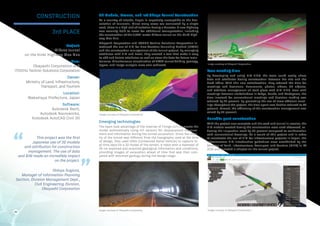
As a country of islands, Japan is especially susceptible to the dev-
astation of tsunamis. Since many areas are connected by a single
road, there is a high risk of isolation during a disaster. A new highway
was recently built to serve for additional transportation, including
the construction of the 2,380-meter Mikusa tunnel on the Kinki High-
way Kise Line.
Obayashi Corporation and ITOCHU Techno-Solutions Corporation in-
troduced the use of BIM for New Austrian Tunneling Method (NATM)
and the construction management of the tunnel project. By managing
attributes with BIM and Excel, they created a tool that made it easy
to add and delete attributes as well as store the data for future main-
tenance. Simultaneous visualization of NATM tunnel drilling, geology,
layers, and image analysis were also achieved.
Emerging technologies
The team took advantage of the Internet of Things (IoT) to create the
model automatically using IoT sensors for displacement measure-
ment and information during the tunnel excavation. Since the vicin-
ity of the tunnel was different from the topography used at the time
of design, they used UAVs (Unmanned Aerial Vehicle) to capture re-
al-time data for a 3D model of the terrain. A robot with a diameter of
20 cm explored and acquired geological information and conditions,
providing images of excavation ahead of time that was then com-
pared with assumed geology during the design stage.
Less meeting time
By developing and using CIM-LINK, the team could easily share
data and attributes during construction between the site and the
head office. With this new collaboration, they reduced the time for
meetings and decisions. Documents, photos, videos, 3D objects,
and attribute management all took place with CIM-LINK. Even with
meetings between stakeholders in Tokyo, Osaka, and Wakayama, the
time involved for conventional meetings and decision-making was
reduced by 25 percent. By promoting the use of more efficient meet-
ings throughout the project, the time spent was further reduced to 37
percent. Overall, the efficiency of the construction management was
raised by 35 percent.
Benefits post-construction
With the project now complete and the road and tunnel in service, the
BIM models created during the construction were used afterward, re-
ducing the inspection work by 50 percent compared to confirmation
with conventional drawings. As a result of this project and in order
to accelerate the use of BIM for infrastructure projects in Japan, the
infrastructure BIM introduction guidelines were established by the
Ministry of Land, Infrastructure, Transport, and Tourism (MLIT) in FY
2016 and included a chapter on the tunnel project.
This project was the first
Japanese use of 3D models
and attribution for construction
management. The use of data
and BIM made an incredible impact
on the project.
Shinya Sugiura,
Manager of Information Planning
Section, Division Management Dept.,
Civil Engineering Division,
Obayashi Corporation
26
“ “
Image courtesy of Obayashi Corporation.
SUSTAINABILITY
28
NINA BORGSTRÖM
Director Digital Design	
White Arkitekter AB
DAN STINE
BIM Administrator at LHB
Author, Lecturer at NDSU
BARBRA BATSHALOM
Founder and Executive Director
Sustainable Performance Institute
JULIA SIPLE
Manager of Sustainable Practice and Knowledge
American Institute of Architects
QING GE
Vice-General Manager and Chief Engineer of Shanghai Tower	
Shanghai Tower Construction and Development Co., Ltd.
Judges
29
THE PORTER SCHOOL OF ENVIRONMENTAL STUDIES
Geotectura, Axelrod-Grobman Architects, NCA,
Assa Aharoni Consulting Engineers
JIE FANG NAN LU COMMUNITY CULTURE AND SPORTS CENTER
Tianjin Architecture Design Institute
WHIZDOM 101 BANGKOK
Magnolia Quality Development Corporation Limited
2nd
3rd
1st
2nd
3rd2nd
3rd
1st
2nd
3rd
2nd
3rd
1st
2nd
3rd
Project:
The Porter School
of Environmental Studies
Firm:
Geotectura, Axelrod-Grobman
Architects, NCA, Assa Aharoni
Consulting Engineers
Owner:
Tel Aviv University
Location:
Tel Aviv, Israel
Software:
Autodesk Revit, Autodesk A360,
Autodesk ReCap
1st PLACE
SUSTAINABILITY A Green Education: First LEED Platinum Building in
Israel
As a place for environmental education, The Porter School of Environ-
mental Studies at Tel Aviv University truly embodies what is taught
and researched both within and outside of its walls.
Designed and constructed by Geotectura, Axelrod-Grobman Ar-
chitects, NCA, and Assa Aharoni Consulting Engineers, the 4,000
square-meter building is the first of its kind in Israel, achieving both
LEED Platinum certification (92 points) and 5 stars in the Israeli Green
Code 5281. Each aspect of the building includes an “eco-conscious”
design and each side serves a purpose as well. The north brings in
natural light; the west is shaped like a funnel to increase air flow
to the main atrium; and the east blocks heat during the winter and
noise from the highway. The south side’s Eco-Wall—an iconic por-
tion of the building—absorbs the hot southern sun with thermo solar
fields heated by glass-evacuated tubes, producing the energy source
for the mechanical ventilation and air conditioning of the building.
As a result, this saves 60 percent of the energy and reduces carbon
emissions.
The mechanical room on the building’s roof contains one 60-ton
refrigeration absorption chiller (operating from the thermo solar
fields) and one 70-ton refrigeration air-cooled chiller operating with
electricity. In total, a cooling capacity of 130-ton refrigeration was
installed, compared to a standard building where 170 tons would be
required. Additionally, the building chiller produces 25-30 tons of
water cooling after four hours of work.
BIM from the start
To achieve their sustainable goals and improve collaboration and
communication, the project team used BIM from the very start in or-
der to complete the project with a tight schedule and on a historical
site—all without compromising the design qualities. The digital model
helped make it much easier to discuss important decisions with all
of the stakeholders and synchronize the structure, architecture, and
MEP in an effortless way. And, by knowing right from the beginning
the potential costs, they could uncover the insights where the design
might exceed the budget.
BIM was crucial to improve the design with energy and natural and
artificial light simulations. This included a passive ventilation strate-
gy after studying wind directions and temperatures based on meteo-
rological data during different seasons and times of day. By conduct-
ing computational fluid dynamics simulations, they could improve
the geometry of the building as well as optimize the ventilation pipes.
All of the energy simulations in the cloud made the entire process
extremely fast and accurate.
Parametric design was also incorporated to solve a complex, dou-
ble-curved geometry of the floating capsule, allowing the inner clad-
ding of this double-curved space with flat bamboo boards.
Constructing a sustainable design
Point cloud data from laser scanning was incorporated and served
as a basis for the as-built architectural drawings. The digital infor-
mation highlighted issues with the geometry during the construction
phase and enabled real-time solutions and adjustments to those
structural elements. By using the point cloud data in the BIM model,
they could readily see inaccuracies as well as the need to redesign
the façade’s cladding.
Prefabrication was integral to construction with many parts of
the building designed in a detailed way, built in advance, and then
brought to the site. The entire steel structure and floating capsule
were prefabricated; work could be done in parallel and the project
finished ahead of schedule.
BIM guides material use
Another benefit was the ability to configure materials in a very
detailed way. Green standards directed the use of local, recycled,
and renewable materials in the project. The team could create those
materials in BIM and add information properties for each, such as
cost, thermal insulation, strength, durability, life cycle assessment,
and much more.
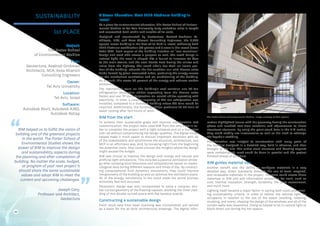
Lighting itself became a major factor in saving both costs and meet-
ing sustainability criteria. In order to deliver the optimal light for
occupants in relation to the use of the space (working, relaxing,
studying, and more), shaping the design of the windows and all of the
curtain walls was imperative. Doing so helped to let in natural light or
block direct sun during the hot season.
BIM helped us to fulfill the vision of
building one of the greenest projects
in the world. The Porter School of
Environmental Studies shows the
power of BIM to improve the design
and sustainability aspects during
the planning and after completion of
building. No matter the scale, budget,
or program of your next project it
should share the same sustainable
values and adopt BIM to meet the
current and upcoming challenges.
Joseph Cory,
Professor and Architect,
Geotectura
30
“
“
The Porter School of Environmental Studies. Image courtesy of Shai Epstein.
Image courtesy of Shai Epstein.
Project:
Jie Fang Nan Lu Community Culture
and Sports Center
Firm:
Tianjin Architecture Design Institute
Owner:
Tianjin Chengtouzhidi Investment
and Development Co. Ltd.
Location:
Tianjin, China
Software:
Autodesk Revit, Autodesk CFD,
Autodesk Insight
2nd PLACE
SUSTAINABILITY Reaching Net-Zero With BIM
Jie Fang Nan Lu Community Culture and Sports Center is dedicated
to public welfare—both physically and culturally. With a total con-
struction area of 11,659.5 square meters, it includes a natatorium,
badminton courts, lecture and multi-functional halls, gymnasium,
conference halls, a community school, and more. The center is also
designed for maximum sustainability and to operate as a net-zero
building, obtaining both LEED Platinum and China’s Three Star cer-
tifications.
Built for the community’s residents, the center must not only operate
at a low cost and with zero energy consumption, but also serve as an
inspiration to build more sustainably for other projects in the area. To
meet these goals, Tianjin Architecture Design Institute used BIM from
the very beginning to realize the most sustainable building possible
with energy consumption reduced to 765 MWh/year and renewable
energy production reaching 870 MWh/year.
Achieving sustainable design
With BIM, the team could set out to design a building suitable for the
area’s climate, the location, and function for low-impact development
as well as an innovative MEP system to reduce energy consumption.
They first started with four different designs. Based on the evaluation
of lighting, wind, heat, topography, and more, the ideal design was
chosen along with the use of renewable energy sources such as solar
and geothermal energy to reach their targets. All stakeholders could
also be provided direct updates to the model, including any analysis
data from each specialty in real time.
The simulations and analysis were crucial to improving the design.
Field simulation and analysis of light guided the climate response
design. By the analysis of interior functions and indoor lighting, the
window openings were optimized. Shading and lighting uniformity
determined the elevation. Based on IES analysis data through the
energy consumption simulation, the window-to-wall ratio alone was
calculated and determined for an interval of 30-40 percent and en-
ergy consumption reduced by 4.1 percent after optimizing that ratio.
Through the simulation of wind outside the building, a tunnel was
created in the atrium to bring air inside. The atrium itself creates its
own microclimate that also supports the temperature of other rooms.
The data of solar photovoltaic panel power generation were also cal-
culated; a detailed analysis model was built for a 15-degree sloping
roof, along with the total monthly electricity output in a year calcu-
lated according to the local climate conditions.
Central model drives collaboration
From start to finish, the Jie Fang Nan Lu Community Culture and
Sports Center makes full use of BIM across all specialties to share in-
formation. The 3D collaborative design of the complex space helped
to overcome information barriers and improve the design in a visual
environment. With all of the simulation data vividly expressed in the
model, the architecture team could quickly understand it and update
the model easily.
Through the continuous improvement of the model, negative space
and design errors were reduced. With the complete expression of
the model information in the drawings, it has eliminated most of the
rework and demolition issues typically encountered. Construction
costs were significantly reduced through this single look at the proj-
ect as well as the use or recycled and local materials with the end
goal of the most sustainable project possible for the community.
Only by using BIM could we reach
our core goal of zero energy
consumption. The inspiring
design and purpose of the center,
combined with the commitment to
sustainability, makes the project
an important contribution to the
community.
Zhang Jinyi,
Vice President,
Tianjin Architecture Design Institute
32
“
“
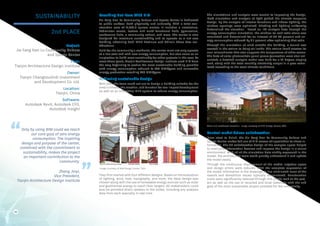
Image courtesy of BIM Design Center, TADI.
West and southwest elevation. Image courtesy of BIM Design Center, TADI.
Image courtesy of BIM Design Center, TADI
Project:
WHIZDOM 101 Bangkok
Firm:
Magnolia Quality Development
Corporation Limited
Owner:
Magnolia Quality Development
Corporation Limited
Location:
Bangkok, Thailand
Software:
Autodesk Revit, Autodesk CFD,
Autodesk BIM 360 Team
3rd PLACE
SUSTAINABILITY BIM Brings Smart City Model to Bangkok
Smart cities don’t have to start from scratch—they can be built within
metropolitan cities right now.
Take WHIZDOM 101 in Bangkok as a prime example. Its mission is to
transform an urban, 17-acre plot into a smart city model with a fully
integrated, digital, mixed-use development with both commercial
space and residential towers. By minimizing environmental impacts,
saving energy, and reducing carbon emissions, the $1 billion project
with a gross floor area of 3,842,716 square feet is designed not only
to improve quality of life, but also boost sustainable development for
the community.
The project itself features forward-thinking applications for
sustainability. This includes its accessibility to the public
train station; outdoor and the world’s first indoor bike paths;
solar use; and an innovative pathway that generates power
from footsteps and then used to light the walkways at night.
From the very beginning, WHIZDOM 101 was designed with sustain-
ability goals in mind: reduce energy consumption by 32 percent,
water usage by 40 percent, and CO2 emissions by 15,000 tons per
year. In order to make this happen, Magnolia Quality Development
Corporation Limited (MQDC) is relying on BIM.
BIM and sustainovation
MQDC placed an emphasis on “sutainovation” and finding new ways
to create opportunities and applications for sustainability. The firm
created their own standards and framework from design all the way
through construction to meet the requirements for certification by
LEED GOLD and TREES Gold and Platinum (Thai’s Rating of Energy
and Environmental Sustainability). They put a great deal of focus
on green space areas; designing high-performance buildings and
high-efficient MEP systems; maximizing natural ventilation and day-
light; selecting non-toxic and low VOC materials; and providing an
uplifting and creative atmosphere.
Computer fluid dynamics software was used in the early stage of
design to analyze storm water runoff as well as outdoor natural
ventilation and indoor air quality through the façade design ventilation.
With the BIM model, MQDC analyzed the design and energy consump-
tion in order to change the project’s orientation, building mass, or
building envelope as necessary to meet their sustainable goals. The
team is also improving collaboration between architectural, MEP, and
structural for visualization, interference checking, and crash detec-
tions, reducing construction waste and cost by 10 percent.
At MQDC, we have both
the challenge and responsibility to
minimize the impact on the Earth
from our project development.
WHIZDOM 101 is designed to be a
vibrant, active campus that meets
the ultimate in sustainability
standards. Our continued focus on
sustainovation guides our design and
construction.
Suttha Ruengchaipaiboon,
President,
Magnolia Quality Development
Corporation Limited
34
“
“
Image courtesy of Magnolia Quality Development Corporation Limited.
Thank you to our sponsors
Autodesk, Autodesk®
Revit®
, Autodesk®
Dynamo Studio, Autodesk®
Navisworks®
, Autodesk®
ReCap™, Autodesk®
InfraWorks®
, Autodesk®
AutoCAD®
Civil 3D®
, Autodesk®
Navisworks®
Manage, Autodesk Robot™ Structural Analysis Professional, Autodesk®
3Ds Max®
,
Autodesk®
Insight™, Autodesk®
AutoCAD®
, Autodesk®
BIM 360®
, Autodesk®
A360, Autodesk®
CFD, Autodesk®
BIM 360®
Team®
and the Autodesk logo, are registered trademarks or trademarks of Autodesk, Inc., and/or its subsidiaries and/or affiliates in the USA and/or other
countries. All other brand names, product names, or trademarks belong to their respective holders. Autodesk is not responsible for typographical or graphical errors that may appear in this document. © 2017 Autodesk, Inc. All rights reserved.

2017 AEC Excellence Awards Showcase Book

  • 2.
    FOREWORD From skyscrapers to airports,net- zero buildings, tunnels, and more, the 5th annual AEC Excellence Awards competition received 145 incredible entries for projects that are transforming cities and communities around the world. Every submission showcased innovation and embodied the future of making things, with pioneering uses of BIM enabled by the cloud and emerging technologies such as augmented reality, virtual reality, drones, generative design, and more. Sponsored by Autodesk, HP, Construction Dive, and Smart Cities Dive, the AEC Excellence Awards recognize achievements in design, engineering, and construction across the Building, Infrastructure, Construction, and Sustainability segments. An international panel of independent judges, selected for their industry expertise, evaluated the entries based on criteria including project complexity, sustainability, collaboration, innovative processes and workflows, use of emerging technologies, and integrated analysis and simulation. The award-winning projects featured in the following pages shine a bright light on the future of making things. We’re proud to help celebrate these achievements and continue to encourage innovation toward designing and making a better world. Vice President, AEC Business Strategy and Marketing, Autodesk Nicolas Mangon
  • 3.
    1st PLACE Nuevo AeropuertoInternacional de la Ciudad de Mexico 2nd PLACE East Side Access 3rd PLACE Arna-Bergen, Ulriken Tunnel 1st PLACE Museum of the Future 2nd PLACE Hohhot City Saihan District National Fitness Center Project 3rd PLACE Expo 2020 Dubai 1st PLACE Tianjin Chow Tai Fook Financial Center Project 2nd PLACE China Zun Tower 3rd PLACE Mikusa tunnel on the Kinki Highway Kise Line 1st PLACE The Porter School of Environmental Studies 2nd PLACE Jie Fang Nan Lu Community Culture and Sports Center 3rd PLACE WHIZDOM 101 Bangkok INFRASTRUCTURE p.4 BUILDING p.12 CONSTRUCTION p.20 SUSTAINABILITY p.28
  • 4.
    INFRASTRUCTURE 4 BOB DRAKE Editor-in-Chief Civil +Structural Zweig Group LIMING SHENG Chief Engineer and Deputy Director China Railway Corporation Engineering Management Division TODD DANIELSON Editorial Director V1 Media KYLE FRAZIER Managing Director, Research & Blueprint 2025 CG/LA Infrastructure JEAN-BAPTISTE VALETTE Civil Engineer and Chief of BIM Strategy VINCI Construction France Judges
  • 5.
    5 NUEVO AEROPUERTO INTERNACIONALDE LA CIUDAD DE MEXICO Foster + Partners, FR-EE EAST SIDE ACCESS LiRo Group ARNA-BERGEN, ULRIKEN TUNNEL Norconsult AS 2nd 3rd 1st 2nd 3rd 2nd 3rd 1st 2nd 3rd 2nd 3rd 1st 2nd 3rd
  • 6.
    Project: Nuevo Aeropuerto Internacionalde la Ciudad de Mexico Firm: Foster + Partners, FR-EE Owner: Grupo Aeroportuario de la Ciudad de Mexico Location: Texcoco, Mexico City, Mexico Software: Autodesk Revit, Autodesk Dynamo Studio, Autodesk Navisworks 1st PLACE INFRASTRUCTURE Taking Off With BIM For Mexico City’s New International Airport (Nuevo Aeropuerto Inter- nacional de la Ciudad de Mexico - NAICM), Foster + Partners and FR-EE had one core goal in mind: Put people first. At 470,000 square meters, it will be one of the world’s largest air- ports; its flowing form is inspired by flight. But its primary design fo- cus is the passenger experience. With an open air concept, travelers will be able to see the gates and where they are heading in a space full of daylight. The design also anticipates the predicted increase in passenger numbers by 2028 and beyond, along with an expansion plan through 2062 for an eventual six runways. The terminal itself is almost 1.5 kilometers in length and a single, continuous gridshell with an innovative roof and fixed boarding bridges in one enclosure. The computational design approach for the roof is unique in the world for its complexity of generating a double curvature light structure with long spans of 160 meters, serving as a roof, façade, and structure at the same time. With spans of more than 100 meters, the lightweight glass and steel structure is designed for challenging soil conditions as well. “We believe that regardless of the size of the airport, people should al- ways come first,” says Martha Tsigkari, Partner, Applied Research and Development team, Foster + Partners. “Therefore, the primacy of passen- ger experience is a consistent theme throughout all our work. A complex building such as the passenger terminal building, involving collaboration with multiple disciplines, would not have been possible without the ap- propriate coordination workflows, procedures, tools, and technology.” First net-zero airport From its inception, Foster + Partners and FR-EE also set out to de- sign one of the most sustainable airports in the world. NAICM aims to become the first net-zero airport and achieve LEED Platinum certifi- cation for the terminal building and LEED Gold for the ground trans- portation center and control tower. As part of the project, the surrounding natural landscape will be re- stored, improving the quality of life in the Valley of Mexico and the eastern half of the city. The airport will run on 100 percent renew- able energy, using biogas generated from a sewage treatment center nearby and photovoltaic roof panels. Water will be 100 percent reutilized. Rainwater will be harvested to support water supplies; wastewater will be treated to be reused in external areas. Three thousand hectares of greenery will be also cre- ated around the airport to offset the loss of vegetation due to con- struction. The biodiversity of the area will be maintained in collabo- ration with a group of specialists who will facilitate the management of plant and animal species. Improving design decisions with BIM With the ambitious sustainability and terminal design goals, BIM be- came crucial to making it happen. The sharing of the models from the very early stages made it possible for all teams to access updated information, enabling a smooth transition from the concept stage to a more detailed stage of the design as well as construction. In the design stage of the terminal’s interior, BIM was key for co- ordination and bringing together several options from different dis- ciplines. The data extraction from the model provided more control when scheduling all of the elements as well as efficient quality au- diting. The design teams solved both large and small clashes in the model while also identifying and eliminating duplicates and missing elements. A greater level of model analysis assisted design deci- sions, including the studies of lighting, wind, and energy. 15,000 drawings created with BIM The documentation for the terminal building was similar in scale to an urban-planning exercise. The team created directly from the model more than 10,000 construction documents and 5,000 data sheets for each of the rooms in the buildings. It’s estimated that they would have had to hire 1.5 times more staff to produce the same amount of drawings without BIM. A weekly BIM coordination schedule helped create an even faster workflow for collaboration, coordination, and production. This pro- cess included sharing and receiving multiple discipline models; pro- cessing, navigating, and analyzing the models; creating issue reports and collecting viewpoints; communicating the issues to the consul- tants sharing the viewpoints; and solving the issues—all in the same week. This workflow was repeated every week of the design stage and made it possible to achieve a better, more coordinated model. There is no doubt that the BIM models and the general workflow helps the communication and collaboration on this project— not only within our own design team, but also between all the various consultants. It allowed us to navigate through the model with real-time rendering, giving us a better understanding of existing issues and to evolve collaborative solutions with the various project teams. Jesus Perucho Alcalde, BIM Coordinator, Foster + Partners 6 “ “ Check-in area. Image courtesy of Foster + Partners. Image courtesy of Foster + Partners.
  • 7.
    Image courtesy ofFoster + Partners.
  • 8.
    Project: East Side Access Firm: LiRoGroup Owner: Metropolitan Transit Authority Capital Construction Location: New York, USA Software: Autodesk ReCap, Autodesk InfraWorks, Autodesk Revit 2nd PLACE INFRASTRUCTURE BIM Takes Manhattan: Megaproject Goes 3D Taking place underneath the bustling streets of Manhattan is one of the largest infrastructure projects in the United States. The Metro- politan Transportation Authority’s East Side Access—first discussed in the 1950s and finally initiated in the late 1990s—will connect trains from Long Island and Queens to the east side of Manhattan. This in- cludes an eight city-block long concourse and multiple train plat- forms 150 feet beneath Grand Central Station as well as major ren- ovations of Harold Interlocking, the busiest railway junction in the country. Slated for completion in 2022, the $10.2 billion project must con- stantly adapt to the ever-changing city, requiring a dynamic planning structure to match. But when design and construction first started on East Side Access, BIM wasn’t even in existence. In 2011—and in the middle of the actual construction—LiRo Group’s Virtual Design and Construction team came on board to successfully implement BIM to analyze, visualize, and communicate project geom- etry, data, and workflows. Integrating BIM mid-stream in a long-term project was a challenge as it was designed in 2D CAD and contracts had to be amended to include BIM. In fact, the project is so large it requires more than 25 contracts. Introducing BIM mid-stream Prior to the BIM integration, the design team spent years without the ability to see the project in its entirety. When BIM was first in- troduced, thousands of fragmented documents were converted into one centralized and comprehensive BIM model for visualization and analysis. Having a complete model of the project enabled better com- munication, informed decision-making, and unprecedented coordi- nation and collaboration capabilities across multiple stakeholders. With more than 150 connected models, the whole team could view the project in 3D and its entire 6 miles, while being able to zoom into specific design details. “With everything I have on my plate, I must admit that when I go over to the BIM group I feel like I walk into a different corner of the ship here,” says Mark Debarnardo, Deputy Program Executive - Har- old, Systems & Start-up, MTA Capital Construction. “I can go in there thinking of a potential problem, and I can convey this problem. I have the tools to replicate the problem and demonstrate it to everyone. That’s refreshing because it’s very hard to do that sometimes on a project like this. It’s been very effective.” Putting BIM into action As a way to visualize the project completely, existing conditions were scanned and coordinated with the proposed design model for East Side Access. This resulted in exposing hundreds of design issues that could be addressed prior to the contractors coming on board. When simulating an installation through animations and 3D printed mod- els, it proved that many hundreds of vertical precast elements were too large and difficult to install so they were redesigned to be cast in place. East Side Access also used BIM to determine the feasibility of op- erations such as moving large mechanical and electrical equipment through a ventilation facility and managing and mitigating access re- straint between the various contractors. 4D BIM helped to visualize schedules with thousands of activities, verifying the feasibility of timing, labor density, and mobilization of materials. Contractors received “Scope Models” depicting the scope of work on their respective contracts. Thanks to the models’ detail and accuracy the contractors could hit the ground running with con- struction coordination starting six months earlier than expected. The progress tracking system also allows data collection from the field to be directly routed into the project controls system and model, removing redundant work of transposing paper-based information provided by the inspection staff. This cuts time spent on weekly re- porting by 30 hours per week and per contract. Furthermore, it im- proves quality and transparency of data from the field to manage- ment. Taking a virtual view of the Grand Central Concourse and Madison Yard Large portions of the East Side Access facilities were scanned, re- sulting in rapid updates of models that could easily be shared with the project team. More than 800 serious issues were uncovered when reality capture was used to generate the existing conditions model of the Grand Central concourse. The current conditions, web-based models will be used by the facility management group. Existing conditions for Madison Yard outfit were also scanned using LiDAR in order to create a complete model in BIM. The model was used to perform preliminary clash analysis and rectify many major coordi- nation issues during design. Connecting data with geometry and delivering these to the wider project team has brought about better-informed decision- making and reduction of risk, which is invaluable considering the size of this megaproject. The benefits are palpable in the changing culture and attitude towards BIM as more people and teams on East Side Access understand its value and request its integration in other aspects of the job. Luis Tormenta, CEO, LiRo Group 8 “ “ Systems were modeled throughout the entire project, including tunnels. Here the model was used to visualize tunnel clearances. It became clear that there was not enough clear- ance with the previous design of mechanical, electrical, and plumbing services. Image courtesy of LiRo Group Virtual Design and Construction.
  • 9.
    Image courtesy ofLiRo Group Virtual Design and Construction.
  • 10.
    Project: Arna-Bergen, Ulriken Tunnel Firm: NorconsultAS Owner: Bane NOR Location: Sandvika, Oslo, Norway Software: Autodesk ReCap, Autodesk InfraWorks, Autodesk AutoCAD Civil 3D 3rd PLACE INFRASTRUCTURE Game On: Bringing a Tunnel to Life For Norconsult AS, it’s game time. Norconsult AS chose BIM for not only coordination and collaboration with design and construction of the new Arna-Bergen, Ulriken Tunnel in Norway, but also to create a fully immersive game and virtual re- ality experience. As Northern Europe’s most-trafficked, single-track tunnel, the Nor- wegian railway between Fløen and Arna required increased capacity and safety. This meant boring through Mount Ulriken to build a new, parallel 7.8 kilometer tunnel and upgrading existing stations that are already tight on space within two city centers. And this all had to be done without disrupting any of the current railway traffic. Accessible gaming environment The Arna-Bergen, Ulriken Tunnel is the first use of a tunnel boring machine in Norway. When Bane NOR’s new parallel tunnel is finished, double tracks will run between Arna and Bergen, providing more fre- quent departures between the cities and updated stations to accom- modate the new trains. The route will be safer with the creation of 16 evacuation cross passages every 500 meters between the tunnel tubes. Ten technical rooms will also be built throughout the tunnel. With this massive project, Norconsult AS took a decidedly different route. Design validation, maintainability, and training could be easi- ly achieved through the innovative use of immersive technology and interactive virtual reality. The virtual environment also enabled the firm to execute signal and sign placement verification and simula- tions of emergency scenarios in a new way. Disrupting the status quo Creating this purpose-built environment served as a platform for re- al-time, immersive design evaluation and communication. By virtual- ly designing the tunnel before it’s built, Norconsult AS could minimize the necessity of changes and adjustments after the construction work is complete and in operation. “Delivering an interactive virtual-reality experience with our BIM models truly disrupts the status quo in a traditionally conservative industry,” said Thomas Angeltveit, BIM coordinator, Norconsult AS. “BIM improved coordination and phase planning by enabling us to visualize, and we found a significant reduction in the amount of time for approvals, stakeholder buy-in, and review cycles. Through an intuitive experience, the design was fully understandable for even non-professionals. In the end, we can help to deliver a better, safer tunnel and stations than ever before.” Laser scanning was also key for the BIM models and transferring the data into the gaming engine. Robust, real-time virtual reality gave all of the stakeholders deeper insights and enabled them to make bet- ter decisions earlier in the design processes. Those involved ran the gamut from the project owners to actual train operators who could virtually drive trains in the tunnel and provide the feedback neces- sary for a better design and use once constructed. The use of BIM for construction and design alone has saved us half the time. The virtual reality experience transformed the way we approached the projects and how we can communicate with clients and stakeholders moving forward. It’s truly a game changer. Thomas Angeltveit, BIM Coordinator, Norconsult AS 10 “ “ Image courtesy of Bane Nor, Norconsult AS, and Baezeni. Fløen. Image courtesy of Bane Nor, Norconsult AS, and Baezeni. Arna station. Image courtesy of Bane Nor, Norconsult AS, and Baezeni.
  • 11.
    Image courtesy ofBane Nor, Norconsult AS, and Baezeni.
  • 12.
    BUILDING 12 MARK SCACCO AEC TechnologyConsulting Executive Engineered Efficiency, Inc. STEPHEN VAN DYCK Partner LMN Architects CHENGYONG GAO Chief Engineer Shanghai Xian Dai Architectural Design (Group) Co., Ltd. KEINICHI IIJIMA General Manager, Design Process and Quality Management Unit Yasui Architect & Engineering REBECCA DE CICCO Director Digital Node Judges
  • 13.
    13 MUSEUM OF THEFUTURE Dubai Future Foundation, BuroHappold Engineering, Killa Design, BAM Higgs & Hill, Transgulf HOHHOT CITY SAIHAN DISTRICT NATIONAL FITNESS CENTER PROJECT Tianjin Architecture Design Institute EXPO 2020 DUBAI Dubai Expo 2020 Bureau 2nd 3rd 1st 2nd 3rd 2nd 3rd 1st 2nd 3rd 2nd 3rd 1st 2nd 3rd
  • 14.
    Project: Museum of theFuture Firm: BuroHappold Engineering, Killa Design, BAM Higgs & Hill, Transgulf Owner: Dubai Future Foundation Location: Dubai, United Arab Emirates Software: Autodesk Revit, Autodesk Dynamo Studio, Autodesk Navisworks Manage, Autodesk Robot Structural Analysis Professional, Autodesk 3ds Max 1st PLACE BUILDING “See the Future, Create the Future” While the interior of many museums look at the past, the Museum of the Future will be everything its name embodies: exhibitions of innovation and incubation of new ideas. The building itself reflects this completely. Located adjacent to Emirates Towers in Dubai, the $136 million, 30,000 square meter iconic building will have an instantly recognizable dis- torted torus shape, epitomized by its futuristic stainless steel façade with illuminated glazed Arabic calligraphy. Seven floors of exhibition space will showcase innovative and futuristic concepts, services, and products for the future of cities, healthcare, and education along with areas devoted to labs and a 400-seat auditorium. BIM as a requirement The futuristic vision and focus on innovation also extends to Muse- um of the Future’s design and construction. From the very beginning, Dubai Future Foundation required BIM and a fully developed digital workflow across the project lifecycle for BuroHappold Engineering (lead consultant); Killa Design (architect); and BAM Higgs & Hill and Transgulf (contractors). The design and client teams meet regularly, allowing mark-ups of the current designs to be done by anyone at any time. This shift to agile project delivery replaces the creation of deliverables for milestone meetings. Instead, everyone contributes continuously and moves the project forward based on the most up-to-date information. The accessibility of 3D coordination, clash resolution, and deci- sion-making with all stakeholders have made a tremendous impact as well. The handover of models at each stage from stakeholder to stakeholder has ensured that model maturity continues and is de- veloped from design to construction. This is reflected in real time in the progress from the team’s LOD 300 models and the contractor’s LOD 400 models. In addition, areas in the model have been identified where prefabricated MEP modules manufactured off-site can be de- veloped and installed to reduce installation time and labor cost—and it’s only possible due to a high level of confidence in the accuracy and quality of the virtual model. Generative design at the heart Design rationalization and generative design are at the center of the iterative analysis process adopted for the optimization of the proj- ect’s more complex elements. For example, when it came to the complex steel diagrid geometry, the steel contractors based iterations for the connection design, con- structability, element length, angles, and nodes on the required for strength analysis and serviceability requirements. Generative design helped with the creation of bespoke scripts to drive multi-variable optimization as well as increased definition and predictability. The diagrid geometry was generated with an in-house parametric script, allowing the team to quickly manipulate and study numerous iter- ations to accommodate architectural and structural requirements. Scripts were also used to assign the naming convention for the mem- bers and nodes as well as generate geometry for drawing production. “There is no project that epitomizes a full-scale digital project deliv- ery more than the extraordinarily complex design of the Museum of the Future,” says Tobias Bauly, Project Director, BuroHappold Engi- neering. “It sets the benchmark for how all projects will be delivered in the future: collaboration, generative design for high-speed design optimizations, and complete construction views. Through technolo- gy, this building has been designed as a fully resolved, fully optimized product and represents the future of making buildings.” Construction savings add up With construction now underway, the use of QR codes for quality control, safety, and material tracking contribute to a 65 percent re- duction in rework on site. The construction management team and inspectors save substantial time each day with BIM, and see a poten- tial 50 percent improvement in productivity. Due to the geometric form and complexity of the building, construc- tion risk is mitigated by modeling the temporary framework. Now the main contractor can view construction activities, along with collab- oration and coordination for the critical construction challenges. Waste material levels are reduced and controlled due to spatial coor- dination prior to construction. And with the optimal design in 3D, the teams experience less design issues during construction, enabling minimal changes overall and on-schedule delivery. “BIM is the medium, without which, this project would have been im- possible,” says Bauly. “From the museum’s incredibly complex design to the actual construction, only BIM could turn this vision for the fu- ture into a reality today.” The future belongs to those who can imagine it, design it, and execute it. While others try to predict the future, we create it. Museum of the Future will be an in- tegrated environment empowering creative minds to test, fund, and market ideas for futuristic prototypes and services. His Highness Sheikh Mohammed bin Rashid Al Maktoum, Vice President and Prime Minister of the UAE and Ruler of Dubai 14 “ “ Internal view of the main foyer within the Museum of the Future showing the Arabic callig- raphy on the inner skin. Image courtesy of Killa Design.
  • 15.
    Image courtesy ofKilla Design.
  • 16.
    Project: Hohhot City SaihanDistrict National Fitness Center Project Firm: Tianjin Architecture Design Institute Owner: Bureau of Culture, Sports, Media, Sanhan District, Hohhot City Location: Hohhot City, Inner Mongolia, China Software: Autodesk Revit, Autodesk Insight, Autodesk 3ds Max 2nd PLACE BUILDING Getting Fit With BIM In 2016, China approved its 2016-2020 National Fitness Plan that tar- gets increased sports participation and fitness throughout the coun- try as well as growing the sports industry. The plan also includes ambitious construction for fitness facilities and infrastructure to provide closer proximity and accessibility for both urban and rural residents. With an expected completion date in 2019, the Hohhot City Saihan District National Fitness Center Project in Inner Mongolia is being designed and constructed as part of the country’s plan and to en- courage participation. With a site consisting of 91,437 square meters and a total construction area of 33,000 square meters, the building is divided into two zones. Zone A is a multi-functional gymnasium with 5,000 seats for sports events and Zone B houses the fitness center with a swimming pool, basketball courts, tennis courts, and more. Taking advantage of generative design The entire project embraces BIM. Tianjin Architecture Design Insti- tute placed a large focus on the use of generative design to orientate structural components to tightly fit the finished surface, reducing material waste. The non-linear design and optimization of the fitness center was made possible through parametric modeling. For example, at the junction of the steel roof truss and column top, a truss support structure was generated by compiling scripts in gener- ative design software to automatically align the angle and complete the support design below the truss node. The panel design for the roof was optimized to unify the size, reduce panel variety, and lower the cost. Generative design was also used to quickly place stadium seats and classify them for different functions. Pipes and electrical installation optimization were completed as well. Achieving goals with BIM A key priority for the project was to enhance collaboration within a very complex space for many different uses. This included identifying negative space to take advantage of every part of the building. By continuously improving the BIM model and working in 3D, the team achieved coordination across disciplines and reduced design errors and on-site design changes. At the same time, this project adopts an open ceiling that highlights the structural and MEP systems while reducing costs. Computational fluid dynamics (CFD) was effectively utilized to analyze environmen- tal simulation factors and optimize the layout. The interior CFD anal- ysis improved HVAC selection and the layout of the sports buildings, which are sensitive to airflow. BIM is being applied in our whole design process, and we are achieving our 3D design goals for a very complex building. Drawings from the BIM model fully express the entire project to avoid misunderstanding, and the extracted parametric model information instructs the construction with pre-cast fabrication and on-site assembly efficiently and economically. Lu Wanmei, BIM Design Center Vice Director, Tianjin Architecture Design Institute 16 “ Architectural details of the stadium zone of the project. Image courtesy of BIM Design Center, TADI. Detailed structure of the roof, panel division, and panel drawing. Image courtesy of BIM Design Center, TADI. “
  • 17.
    Image courtesy ofBIM Design Center, TADI.
  • 18.
    Project: Expo 2020 Dubai Firm: DubaiExpo 2020 Bureau Owner: Dubai Expo 2020 Bureau Location: Dubai, United Arab Emirates Software: Autodesk Revit, Autodesk Dynamo Studio, Autodesk Navisworks Manage, Autodesk AutoCAD, Autodesk 3ds Max 3rd PLACE BUILDING Bringing the World Together World expos capture the imagination and innovation of the entire planet, debuting the technologies that will change lives as well as providing the opportunity for collaboration on an international scale. Expo 2020 Dubai will do the same along with a stunning architectural contribution to the city. Between its opening day on October 20, 2020 and its close on April 10, 2021, the $6.8 billion project will bring together 180 countries (each with its own pavilion) and the capacity to welcome up to 270,000 visitors per day. The enclosed area of the expo will occupy 2,000,000 square meters with the remaining 2,400,000 square meters for ame- nities and facilities. The open space of Al Wasl Plaza is at the center of the project, including an intricate, domed trellis that provides an immersive projection experience. The Expo 2020 Dubai site itself is designed for legacy, with over 80 percent destined to be reused or repurposed. Determining a BIM strategy The BIM strategy for Expo 2020 Dubai focuses on the delivery of in- telligent 3D models and Industry Foundation Classes (IFC) data to be used throughout the project life cycle, from conceptual design through operation and legacy. The considerable size of the overall project is significant when combined with the many interlinking proj- ects and potential interfaces from a design and construction per- spective. These dynamics are even further intensified since portions of the project are at different stages with varying procurement meth- ods and requirements. The use of BIM by more than 200 registered users enables site-wide stakeholders to effectively understand, communicate, and manage coordination initiatives. The solution provides a simplified approach for users to log-in and navigate the federated site-wide model or in- dividual project models without the need for extensive software in- stallation and training requirements. The solution to date has been used across numerous internal departments within the Expo organi- zation. In addition, as design teams work from locations around the world, BIM provides a means for 24/7 model access, ultimately reduc- ing reliance on manual and offline processes for sharing information. Design coordination and clash detection has saved the project mil- lions and continues to reduce schedule delays. For example, the clashes between structural elements and utilities were identified and coordinating complex utility design was enhanced. The design of building basement areas coupled with dynamic changes occur- ring with the model for surface levels required a robust coordination approach. Without BIM, the numerous projects across the Expo site would have found it more difficult to coordinate the designs, result- ing in construction delays and cost impact. Design based on intelligent analysis and visualization Using integrated and intelligent analysis tools are key components to ensuring more informed design decisions. The Expo’s distinctive districts leveraged BIM data to perform computational fluid dynam- ics, simulations, and solar and energy modeling analysis. Integrating BIM models with cloud-connected software helped the team to ana- lyze pedestrian behaviors, crowd flows, bottleneck identification, and scenario testing. BIM modeling and visualization tools have also provided increased understanding of design and construction constraints; risks and op- portunities; communication and resolution of design coordination issues and clashes; construction schedules; and much more. Virtual and augmented reality have also been used on specific projects to help key stakeholders interact with the design in a more dynamic and immersive environment. The use of such technologies provides them with a better understanding of design intent that will ultimately iden- tify any issues and support informed decision-making. Expo 2020 Dubai is one of the biggest events to be held in this region. It will be a celebration of innovation and ingenuity that brings together over 200 countries, companies, and NGOs as well as millions of visitors from around the world. It is a large- scale, complex project with many stakeholders, and the amount of information—which we need to manage in order to deliver the project on time, to budget, and safely—is huge. We committed to the extensive use of BIM early on, and we have already seen it paying dividends across Expo 2020. Ahmed Al Khatib Vice President – Real Estate and Delivery, Expo 2020 Dubai18 “ “ Image courtesy of Dubai Expo 2020 Bureau.
  • 19.
    Image courtesy ofDubai Expo 2020 Bureau.
  • 20.
    CONSTRUCTION 20 MICHAEL D. BELLAMAN Presidentand Chief Executive Officer Associated Builders and Contractors WALKER THISTED Producer BuiltWorlds JUN OKOSHI Design Division, Structural Planning Taisei Corp. DENISE CHEVIN Editor Construction Magazine IR FRANCIS LEUNG Associate Director (Assets Information Management) New World Construction, Construction Department of New World Development Judges
  • 21.
    21 TIANJIN CHOW TAIFOOK FINANCIAL CENTER PROJECT China Construction Eighth Engineering Division Corp., Ltd. CHINA ZUN TOWER China Construction Third Engineering Bureau Group Co., Ltd. MIKUSA TUNNEL ON THE KINKI HIGHWAY KISE LINE Obayashi Corporation and ITOCHU Techno-Solutions Corporation 2nd 3rd 1st 2nd 3rd 2nd 3rd 1st 2nd 3rd 2nd 3rd 1st 2nd 3rd
  • 22.
    Project: Tianjin Chow TaiFook Financial Center Project Firm: China Construction Eighth Engineering Division Corp., Ltd. Owner: NW Project Management Limited (Developer) Location: Binhai New District, Tianjin, China Software: Autodesk Revit, Autodesk Navisworks, Autodesk ReCap 1st PLACE CONSTRUCTION Lofty Goals for a New Skyscraper For China Construction Eighth Engineering Division Corp., Ltd., BIM was integral to success on a complex tower project. At the outset of the Tianjin Chow Tai Fook Financial Center project, the goal was set for the use of BIM with all employees, specialties, and processes. Not only that, the contract requires the delivery of BIM models to serve the operation and maintenance upon completion (in the precision of LOD500). For the past three years, more than 100 members of the BIM team have worked and collaborated on the design and construction. Expected for completion in the fall of 2019, Tianjin Chow Tai Fook Fi- nancial Center will be a striking new landmark and integrate busi- ness and commercial space; luxury apartments; and a five-star hotel. It has a 390,000-square-meter total construction area, constituting a four-story basement, a five-story podium, and a 103-story tower, reaching a total height of 530 meters. Complexity by the numbers The team set out to achieve high production precision, no storage on the construction site, no rework in construction, and low cost in operation and maintenance. In a project this size, the numbers don’t lie. BIM has helped adjust 20,000 wall layouts and more than 8,000 door heights for ceilings of different elevations and types in more than 50,000 square meters. By avoiding the modification and rework ahead of time, the project saved 30 days and $10 million RMB. With an output of nearly 4,000 drawings for the models of masonry panels, light partition walls, piping shafts, doors, and more, contractors could prepare their work precisely. This helped to cut the amount of materials needed for delivery, saving 60 days of construction work and material and labor costs of more than $14 million RMB. Beyond the construction work, generative design was used to pro- gram and import the 3D coordinates to create an accurate façade. 14,800 pieces of façade components were finished three times faster than the typical process and ensured 100 percent accuracy. Data is everywhere and accessible BIM has transformed the project management of the tower. Before construction, 932 models were compressed into 12.21G and stored in an accessible, private server. The total number of models to be tracked reached 184,504 with 763,552 logistics updates. All information—from ordering and transportation to entry, instal- lation, and acceptance—is updated via mobile phones or iPads and stored on the BIM platform so it’s easily accessible for everyone at any time. Currently the project has created 2,950 QR codes for major equipment and prefabrication components. By easily scanning the QR code, the status of logistics can be updated automatically, creat- ing greater collaboration and ensuring the accuracy of data. Approv- al processes are also streamlined with mobile. Automation and virtual reality improves safety Emerging technologies are prevalent on the construction site of the Tianjin Chow Tai Fook Financial Center. Robots are used to locate the position of pipe supports accurately, improving the speed of measure- ment and reducing errors during installation. Above the tower, drones fly to capture images of the construction site each day to compare and analyze the schedules within the different areas. Through the combined ap- plication of BIM models with virtual reality devices, work- ers experience safety simula- tions about the risk of work- ing at high heights, such as feeling the actual danger and fear when falling and work- ing far above the ground with no protection. The scenarios also include machinery and equipment operation in order to improve their safety aware- ness on the construction site. In addition, virtual reality is used for the owners, design- ers, and construction team to visualize the interiors of the apartments and hotel and ex- perience the different materi- als for décor and design. Only by using BIM and the latest technologies throughout the entire construction process, we can finish a building 530 meters in height in five years. BIM has not only changed the way we work, but also clarifies how we think about and meet new challenges. Yawu Su, Project Manager, China Construction Eighth Engineering Division Corp., Ltd. 22 “ “ Image courtesy of China Construction Eighth Engineering Division Corp., Ltd. Image courtesy of China Construction Eighth Engineering Division Corp., Ltd.
  • 23.
    Image courtesy ofChina Construction Eighth Engineering Division Corp., Ltd.
  • 24.
    Project: China Zun Tower Firm: ChinaConstruction Third Engineering Bureau Group Co., Ltd Owner: CITIC Heye Investment Co., Ltd. Location: Chaoyang District, Beijing, China Software: Autodesk BIM 360, Autodesk Revit, Autodesk Navisworks 2nd PLACE CONSTRUCTION Construction Technology Goes Sky High with Beijing’s Tallest Skyscraper Set to become the tallest structure in the city and in an area prone to 8.0 seismic intensity, CITIC Group’s new $3.5 billion China Zun Tower in Beijing—with a gross floor area of 43.7 million square meters—will reach 528 meters with 108 floors and seven floors underground. Technical innovation from start to finish—and beyond Even with the sheer size of the tower, the project management team had other ambitious goals for China Construction Third Engineering Bureau Group Co., Ltd: Build the highest quality skyscraper with ad- vanced technology and operational reliability. China Zun would also apply a connected BIM process, enabling all stakeholders to work together and all disciplines to be aligned throughout the entire life- cycle from design to operations. With more than 100 members on the team, over 5,000 issues were de- tected during the design phase and over 6,000 were found in the con- struction phase, which achieved a significant reduction in errors and demolitions. Passive change orders were 80 percent less compared to that of other similar projects. Detailing design and coordination in a BIM workflow also saved 7,200 square meters of floor area, creating space optimization and an additional value of more than 100 million yuan ($1.5 million). 806 rounds of construction drawing reviews have also been updated and shared in this collaborative environment. 652 BIM models and more than 800 components families were created and updated with 20 subcontractors. The inherent accuracy of the models and design drawings makes it much easier for construction workers to under- stand and creates a strong foundation for construction coordination and collision checks. Saving time from the ground up China Construction Third Engineering Bureau Group Co., Ltd also faced an aggressive timeline for construction: 62 months for comple- tion (a speed 1.4 times that of similar projects). Saving time with construction started from the ground up—literally. With the base slab of China Zun tower measuring 6.5 meters in thick- ness, 56,000 cubic meters of concrete were required to be poured all at once. The BIM workflow helped simulate the entire pouring process as well as optimize the concrete truck vehicle movement, equipment, and staff. With this coordination and simulations, the entire pouring process only took 93 hours, seven hours less than originally estimated. Digitizing the construction site The BIM model helped to achieve mobile office automation, improv- ing the overall efficiency and digitizing the construction site. The low technical barriers to the cloud and mobile device tools democratized data throughout all of the working groups on the site. Aside from smart phones, more than 40 iPads are used for construc- tion quality management along with the arrangement of 30 large, site inspections. As a result, nearly 400 issues and inconsistencies be- tween the model and the site were solved. Industrialized construction The project also heavily relies on prefabrication to achieve energy ef- ficiency, sustainability, and cost savings. With prefabrication, quality and speed in the construction are greatly improved with an estimat- ed 90 percent reduction in construction waste. Water and electricity consumed are only 20 percent of those in conventional projects. From Floor 7 to Floor 102, 192 sets of prefabricated pipelines designed with BIM were installed, including air conditioning and water and fire-fighting systems. The work load of on-site welding is cut by 30 percent in addition to large savings in labor. The interior design team also prefabricated intricate parts for dec- oration in the lobby and premium offices. The team used generative design and imported the parameters to CNC for production. Virtual reality was also used in the lobby in order to truly immerse different parties in the environment and evaluate the look and feel. Every data point collected After each floor’s completion, the BIM team used high-precision 3D laser scanners with up to 25 scanning points per floor. With the abil- ity to verify and analyze the data stored in a server and accessed remotely, the team could identify defects or quality issues. Before construction is completed, mechanical and electrical pipelines in the ceiling in installation and equipment rooms are scanned to document data and location information for operation and maintenance. In the end, the entire China Zun Tower’s point cloud data will be collected and centrally located, helping to achieve the goal of a full BIM lifecy- cle from design to occupancy. As the general contractor of China Zun Tower, we focus on technical innovation. We have applied more than 20 new technologies on this project, among which BIM provides us evolutional experience. We work deeply with designers and subcontractors based on BIM models. With BIM’s advantage of information integration, we significantly increase efficiency and construction quality. And it also improves the team’s capability to handle a super complicated project like this. Xu Lishan, Executive Chief Engineer and ConstructionDirectorforChinaZunTower, China Construction Third Engineering Bureau Group Co., Ltd. 24 “ “ The Intelligent Construction Equipment Integration Platform was developed by China Con- struction Third Engineering Bureau Group Co., Ltd. It is 22m in height, its gross area exceeds 1,800m2 , and has the highest loading capacity in the world. With the assistance of this plat- form, one single structural floor can be completed in three days. Image courtesy of China Construction Third Engineering Bureau Group Co., Ltd.
  • 25.
    Image courtesy ofCITIC Heye Investment CO., Ltd.
  • 26.
    Project: Mikusa tunnel on theKinki Highway Kise Line Firm: Obayashi Corporation and ITOCHU Techno-Solutions Corporation Owner: Ministry of Land, Infrastructure, Transport, and Tourism Location: Wakamaya Prefecture, Japan Software: Autodesk Revit, Autodesk Navisworks, Autodesk AutoCAD Civil 3D 3rd PLACE CONSTRUCTION 3D Models, Drones, and IoT Shape Tunnel Construction As a country of islands, Japan is especially susceptible to the dev- astation of tsunamis. Since many areas are connected by a single road, there is a high risk of isolation during a disaster. A new highway was recently built to serve for additional transportation, including the construction of the 2,380-meter Mikusa tunnel on the Kinki High- way Kise Line. Obayashi Corporation and ITOCHU Techno-Solutions Corporation in- troduced the use of BIM for New Austrian Tunneling Method (NATM) and the construction management of the tunnel project. By managing attributes with BIM and Excel, they created a tool that made it easy to add and delete attributes as well as store the data for future main- tenance. Simultaneous visualization of NATM tunnel drilling, geology, layers, and image analysis were also achieved. Emerging technologies The team took advantage of the Internet of Things (IoT) to create the model automatically using IoT sensors for displacement measure- ment and information during the tunnel excavation. Since the vicin- ity of the tunnel was different from the topography used at the time of design, they used UAVs (Unmanned Aerial Vehicle) to capture re- al-time data for a 3D model of the terrain. A robot with a diameter of 20 cm explored and acquired geological information and conditions, providing images of excavation ahead of time that was then com- pared with assumed geology during the design stage. Less meeting time By developing and using CIM-LINK, the team could easily share data and attributes during construction between the site and the head office. With this new collaboration, they reduced the time for meetings and decisions. Documents, photos, videos, 3D objects, and attribute management all took place with CIM-LINK. Even with meetings between stakeholders in Tokyo, Osaka, and Wakayama, the time involved for conventional meetings and decision-making was reduced by 25 percent. By promoting the use of more efficient meet- ings throughout the project, the time spent was further reduced to 37 percent. Overall, the efficiency of the construction management was raised by 35 percent. Benefits post-construction With the project now complete and the road and tunnel in service, the BIM models created during the construction were used afterward, re- ducing the inspection work by 50 percent compared to confirmation with conventional drawings. As a result of this project and in order to accelerate the use of BIM for infrastructure projects in Japan, the infrastructure BIM introduction guidelines were established by the Ministry of Land, Infrastructure, Transport, and Tourism (MLIT) in FY 2016 and included a chapter on the tunnel project. This project was the first Japanese use of 3D models and attribution for construction management. The use of data and BIM made an incredible impact on the project. Shinya Sugiura, Manager of Information Planning Section, Division Management Dept., Civil Engineering Division, Obayashi Corporation 26 “ “ Image courtesy of Obayashi Corporation. Image courtesy of Obayashi Corporation. Image courtesy of Obayashi Corporation. Image courtesy of Obayashi Corporation.
  • 27.
    Image courtesy ofObayashi Corporation.
  • 28.
    SUSTAINABILITY 28 NINA BORGSTRÖM Director DigitalDesign White Arkitekter AB DAN STINE BIM Administrator at LHB Author, Lecturer at NDSU BARBRA BATSHALOM Founder and Executive Director Sustainable Performance Institute JULIA SIPLE Manager of Sustainable Practice and Knowledge American Institute of Architects QING GE Vice-General Manager and Chief Engineer of Shanghai Tower Shanghai Tower Construction and Development Co., Ltd. Judges
  • 29.
    29 THE PORTER SCHOOLOF ENVIRONMENTAL STUDIES Geotectura, Axelrod-Grobman Architects, NCA, Assa Aharoni Consulting Engineers JIE FANG NAN LU COMMUNITY CULTURE AND SPORTS CENTER Tianjin Architecture Design Institute WHIZDOM 101 BANGKOK Magnolia Quality Development Corporation Limited 2nd 3rd 1st 2nd 3rd2nd 3rd 1st 2nd 3rd 2nd 3rd 1st 2nd 3rd
  • 30.
    Project: The Porter School ofEnvironmental Studies Firm: Geotectura, Axelrod-Grobman Architects, NCA, Assa Aharoni Consulting Engineers Owner: Tel Aviv University Location: Tel Aviv, Israel Software: Autodesk Revit, Autodesk A360, Autodesk ReCap 1st PLACE SUSTAINABILITY A Green Education: First LEED Platinum Building in Israel As a place for environmental education, The Porter School of Environ- mental Studies at Tel Aviv University truly embodies what is taught and researched both within and outside of its walls. Designed and constructed by Geotectura, Axelrod-Grobman Ar- chitects, NCA, and Assa Aharoni Consulting Engineers, the 4,000 square-meter building is the first of its kind in Israel, achieving both LEED Platinum certification (92 points) and 5 stars in the Israeli Green Code 5281. Each aspect of the building includes an “eco-conscious” design and each side serves a purpose as well. The north brings in natural light; the west is shaped like a funnel to increase air flow to the main atrium; and the east blocks heat during the winter and noise from the highway. The south side’s Eco-Wall—an iconic por- tion of the building—absorbs the hot southern sun with thermo solar fields heated by glass-evacuated tubes, producing the energy source for the mechanical ventilation and air conditioning of the building. As a result, this saves 60 percent of the energy and reduces carbon emissions. The mechanical room on the building’s roof contains one 60-ton refrigeration absorption chiller (operating from the thermo solar fields) and one 70-ton refrigeration air-cooled chiller operating with electricity. In total, a cooling capacity of 130-ton refrigeration was installed, compared to a standard building where 170 tons would be required. Additionally, the building chiller produces 25-30 tons of water cooling after four hours of work. BIM from the start To achieve their sustainable goals and improve collaboration and communication, the project team used BIM from the very start in or- der to complete the project with a tight schedule and on a historical site—all without compromising the design qualities. The digital model helped make it much easier to discuss important decisions with all of the stakeholders and synchronize the structure, architecture, and MEP in an effortless way. And, by knowing right from the beginning the potential costs, they could uncover the insights where the design might exceed the budget. BIM was crucial to improve the design with energy and natural and artificial light simulations. This included a passive ventilation strate- gy after studying wind directions and temperatures based on meteo- rological data during different seasons and times of day. By conduct- ing computational fluid dynamics simulations, they could improve the geometry of the building as well as optimize the ventilation pipes. All of the energy simulations in the cloud made the entire process extremely fast and accurate. Parametric design was also incorporated to solve a complex, dou- ble-curved geometry of the floating capsule, allowing the inner clad- ding of this double-curved space with flat bamboo boards. Constructing a sustainable design Point cloud data from laser scanning was incorporated and served as a basis for the as-built architectural drawings. The digital infor- mation highlighted issues with the geometry during the construction phase and enabled real-time solutions and adjustments to those structural elements. By using the point cloud data in the BIM model, they could readily see inaccuracies as well as the need to redesign the façade’s cladding. Prefabrication was integral to construction with many parts of the building designed in a detailed way, built in advance, and then brought to the site. The entire steel structure and floating capsule were prefabricated; work could be done in parallel and the project finished ahead of schedule. BIM guides material use Another benefit was the ability to configure materials in a very detailed way. Green standards directed the use of local, recycled, and renewable materials in the project. The team could create those materials in BIM and add information properties for each, such as cost, thermal insulation, strength, durability, life cycle assessment, and much more. Lighting itself became a major factor in saving both costs and meet- ing sustainability criteria. In order to deliver the optimal light for occupants in relation to the use of the space (working, relaxing, studying, and more), shaping the design of the windows and all of the curtain walls was imperative. Doing so helped to let in natural light or block direct sun during the hot season. BIM helped us to fulfill the vision of building one of the greenest projects in the world. The Porter School of Environmental Studies shows the power of BIM to improve the design and sustainability aspects during the planning and after completion of building. No matter the scale, budget, or program of your next project it should share the same sustainable values and adopt BIM to meet the current and upcoming challenges. Joseph Cory, Professor and Architect, Geotectura 30 “ “ The Porter School of Environmental Studies. Image courtesy of Shai Epstein.
  • 31.
    Image courtesy ofShai Epstein.
  • 32.
    Project: Jie Fang NanLu Community Culture and Sports Center Firm: Tianjin Architecture Design Institute Owner: Tianjin Chengtouzhidi Investment and Development Co. Ltd. Location: Tianjin, China Software: Autodesk Revit, Autodesk CFD, Autodesk Insight 2nd PLACE SUSTAINABILITY Reaching Net-Zero With BIM Jie Fang Nan Lu Community Culture and Sports Center is dedicated to public welfare—both physically and culturally. With a total con- struction area of 11,659.5 square meters, it includes a natatorium, badminton courts, lecture and multi-functional halls, gymnasium, conference halls, a community school, and more. The center is also designed for maximum sustainability and to operate as a net-zero building, obtaining both LEED Platinum and China’s Three Star cer- tifications. Built for the community’s residents, the center must not only operate at a low cost and with zero energy consumption, but also serve as an inspiration to build more sustainably for other projects in the area. To meet these goals, Tianjin Architecture Design Institute used BIM from the very beginning to realize the most sustainable building possible with energy consumption reduced to 765 MWh/year and renewable energy production reaching 870 MWh/year. Achieving sustainable design With BIM, the team could set out to design a building suitable for the area’s climate, the location, and function for low-impact development as well as an innovative MEP system to reduce energy consumption. They first started with four different designs. Based on the evaluation of lighting, wind, heat, topography, and more, the ideal design was chosen along with the use of renewable energy sources such as solar and geothermal energy to reach their targets. All stakeholders could also be provided direct updates to the model, including any analysis data from each specialty in real time. The simulations and analysis were crucial to improving the design. Field simulation and analysis of light guided the climate response design. By the analysis of interior functions and indoor lighting, the window openings were optimized. Shading and lighting uniformity determined the elevation. Based on IES analysis data through the energy consumption simulation, the window-to-wall ratio alone was calculated and determined for an interval of 30-40 percent and en- ergy consumption reduced by 4.1 percent after optimizing that ratio. Through the simulation of wind outside the building, a tunnel was created in the atrium to bring air inside. The atrium itself creates its own microclimate that also supports the temperature of other rooms. The data of solar photovoltaic panel power generation were also cal- culated; a detailed analysis model was built for a 15-degree sloping roof, along with the total monthly electricity output in a year calcu- lated according to the local climate conditions. Central model drives collaboration From start to finish, the Jie Fang Nan Lu Community Culture and Sports Center makes full use of BIM across all specialties to share in- formation. The 3D collaborative design of the complex space helped to overcome information barriers and improve the design in a visual environment. With all of the simulation data vividly expressed in the model, the architecture team could quickly understand it and update the model easily. Through the continuous improvement of the model, negative space and design errors were reduced. With the complete expression of the model information in the drawings, it has eliminated most of the rework and demolition issues typically encountered. Construction costs were significantly reduced through this single look at the proj- ect as well as the use or recycled and local materials with the end goal of the most sustainable project possible for the community. Only by using BIM could we reach our core goal of zero energy consumption. The inspiring design and purpose of the center, combined with the commitment to sustainability, makes the project an important contribution to the community. Zhang Jinyi, Vice President, Tianjin Architecture Design Institute 32 “ “ Image courtesy of BIM Design Center, TADI. West and southwest elevation. Image courtesy of BIM Design Center, TADI.
  • 33.
    Image courtesy ofBIM Design Center, TADI
  • 34.
    Project: WHIZDOM 101 Bangkok Firm: MagnoliaQuality Development Corporation Limited Owner: Magnolia Quality Development Corporation Limited Location: Bangkok, Thailand Software: Autodesk Revit, Autodesk CFD, Autodesk BIM 360 Team 3rd PLACE SUSTAINABILITY BIM Brings Smart City Model to Bangkok Smart cities don’t have to start from scratch—they can be built within metropolitan cities right now. Take WHIZDOM 101 in Bangkok as a prime example. Its mission is to transform an urban, 17-acre plot into a smart city model with a fully integrated, digital, mixed-use development with both commercial space and residential towers. By minimizing environmental impacts, saving energy, and reducing carbon emissions, the $1 billion project with a gross floor area of 3,842,716 square feet is designed not only to improve quality of life, but also boost sustainable development for the community. The project itself features forward-thinking applications for sustainability. This includes its accessibility to the public train station; outdoor and the world’s first indoor bike paths; solar use; and an innovative pathway that generates power from footsteps and then used to light the walkways at night. From the very beginning, WHIZDOM 101 was designed with sustain- ability goals in mind: reduce energy consumption by 32 percent, water usage by 40 percent, and CO2 emissions by 15,000 tons per year. In order to make this happen, Magnolia Quality Development Corporation Limited (MQDC) is relying on BIM. BIM and sustainovation MQDC placed an emphasis on “sutainovation” and finding new ways to create opportunities and applications for sustainability. The firm created their own standards and framework from design all the way through construction to meet the requirements for certification by LEED GOLD and TREES Gold and Platinum (Thai’s Rating of Energy and Environmental Sustainability). They put a great deal of focus on green space areas; designing high-performance buildings and high-efficient MEP systems; maximizing natural ventilation and day- light; selecting non-toxic and low VOC materials; and providing an uplifting and creative atmosphere. Computer fluid dynamics software was used in the early stage of design to analyze storm water runoff as well as outdoor natural ventilation and indoor air quality through the façade design ventilation. With the BIM model, MQDC analyzed the design and energy consump- tion in order to change the project’s orientation, building mass, or building envelope as necessary to meet their sustainable goals. The team is also improving collaboration between architectural, MEP, and structural for visualization, interference checking, and crash detec- tions, reducing construction waste and cost by 10 percent. At MQDC, we have both the challenge and responsibility to minimize the impact on the Earth from our project development. WHIZDOM 101 is designed to be a vibrant, active campus that meets the ultimate in sustainability standards. Our continued focus on sustainovation guides our design and construction. Suttha Ruengchaipaiboon, President, Magnolia Quality Development Corporation Limited 34 “ “ Image courtesy of Magnolia Quality Development Corporation Limited. Image courtesy of Magnolia Quality Development Corporation Limited. Image courtesy of Magnolia Quality Development Corporation Limited.
  • 35.
    Image courtesy ofMagnolia Quality Development Corporation Limited.
  • 36.
    Thank you toour sponsors Autodesk, Autodesk® Revit® , Autodesk® Dynamo Studio, Autodesk® Navisworks® , Autodesk® ReCap™, Autodesk® InfraWorks® , Autodesk® AutoCAD® Civil 3D® , Autodesk® Navisworks® Manage, Autodesk Robot™ Structural Analysis Professional, Autodesk® 3Ds Max® , Autodesk® Insight™, Autodesk® AutoCAD® , Autodesk® BIM 360® , Autodesk® A360, Autodesk® CFD, Autodesk® BIM 360® Team® and the Autodesk logo, are registered trademarks or trademarks of Autodesk, Inc., and/or its subsidiaries and/or affiliates in the USA and/or other countries. All other brand names, product names, or trademarks belong to their respective holders. Autodesk is not responsible for typographical or graphical errors that may appear in this document. © 2017 Autodesk, Inc. All rights reserved.