MULTILINGUAL EDUCATION
AMRUDHASIBY
ROLLNO.2
ENGLISH
MULTILINGUALISM
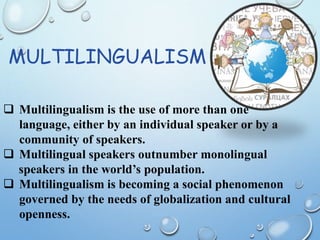
 Multilingualism is the use of more than one
language, either by an individual speaker or by a
community of speakers.
 Multilingual speakers outnumber monolingual
speakers in the world’s population.
 Multilingualism is becoming a social phenomenon
governed by the needs of globalization and cultural
openness.
 Multilingual speakers have acquired and maintained at least one language
during childhood, the so-called first language (L1).
 The first language is acquired without formal education, by mechanisms
heavily disputed.
 Children acquiring two languages in this way are called simultaneous
bilinguals, one language usually dominates the other.
 People who know more than one language have been reported to be more
adept at language learning compared to monolinguals.
 Additionally, bilinguals often have important economic advantages over
monolingual individuals
 Multilingualism in computing can be considered part of a continuum
between internationalization and localization.
What is Multilingual Education?
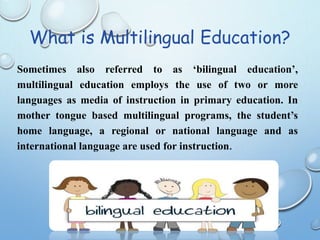
Sometimes also referred to as ‘bilingual education’,
multilingual education employs the use of two or more
languages as media of instruction in primary education. In
mother tongue based multilingual programs, the student’s
home language, a regional or national language and as
international language are used for instruction.
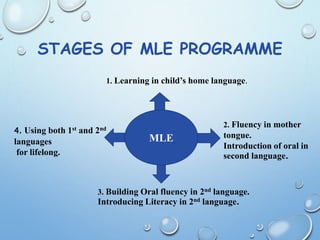
STAGES OF MLE PROGRAMME
MLE
1. Learning in child’s home language.
2. Fluency in mother
tongue.
Introduction of oral in
second language.
3. Building Oral fluency in 2nd language.
Introducing Literacy in 2nd language.
4. Using both 1st and 2nd
languages
for lifelong.
WHY ARE SUCH PROGRAMS
NEEDED?
• 4% of the world’s population speaks one or more
of the thousands of minority languages found
around the globe.
• Yet minority language speakers make up almost
50% of the world’s non-literate population.
• The reason for this is that children from minority
language communities are forced to attend schools
in which only the language of the majority
population is used.
• Children cannot succeed in school if they do not
understand what their teachers are saying
Who is suitable to work in the field
of multilingual education?
.
They must be creative, flexible, teachable and adaptable- able to
deal with diversity and uncertainty in their daily lives and in their work.
They need
to be good
communicators
who are able to
relate well
with educators
and government
officials, with
a servant’s
heart.
People who
work in this
field enjoy
interacting
with people,
especially with
those from
other cultures
Where are the needs of multilingual
specialists?
People are needed for work in multilingual education in
locations all around the world, but particularly in those
parts of the world where large numbers of local
languages are found: Africa and Asia.
ADVANTAGES
AND
DISADVANTAGE
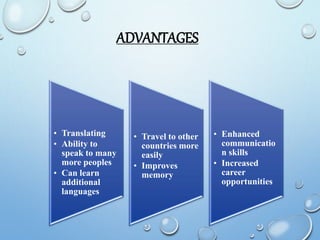
ADVANTAGES
• Translating
• Ability to
speak to many
more peoples
• Can learn
additional
languages
• Travel to other
countries more
easily
• Improves
memory
• Enhanced
communicatio
n skills
• Increased
career
opportunities
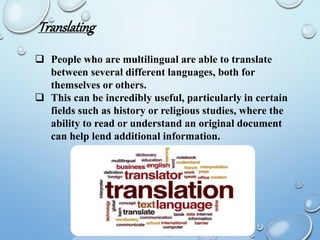
Translating
 People who are multilingual are able to translate
between several different languages, both for
themselves or others.
 This can be incredibly useful, particularly in certain
fields such as history or religious studies, where the
ability to read or understand an original document
can help lend additional information.
AbilitytoSpeaktoManyMorePeople
 The more languages you speak, the more people
you are able to easily communicate with.
 This opens up a world of possibilities, full of more
personal stories and interesting people to get to
know.
TraveltoOtherCountriesis Easier
 If you enjoy traveling abroad, multilingualism can
make this a lot easier.
 An ability to speak to a native population in their
own language is not only exciting, but also much
more convenient.
 It may even prove to be safer.
EnhancedCommunicationSkills
 Compared to monolingual
children, multilingual
children are exposed to more
diverse social experiences.
 As a result, multilingual
children often become adept
at considering other people’s
perspectives, making them
more effective
communicators.
IncreasedCareerOpportunities
 Communicating in various languages can give a
multilingual applicant a clear advantage over a
monolingual applicant in the job field.
 The international business community considers the
ability to communicate in more than one language an
“indispensable tool for relationship building and
financial success.”
ImprovesMemory
 Memory plays a huge part
in learning language, those
who are multilingual often
score higher in memory
tests than people who use
only one language.
 Having a great memory
can have both cognitive
and social benefits like
recognizing faces or
remembering names.
DISADVANTAGES
Confusion
 Keeping track of so
many different
languages in your
head may cause you
to confuse the words
of one language with
another.
PossibleLackofProficiency
 Although it is a rare possibility
you can obtain native fluency in
multiple languages, it is very
hard to accomplish.
 Multilingualism may cause you
to lack high levels of proficiency
in some languages, whereas you
could have learned a second or
third language to native
proficiency instead.
Time
Learning even one new language can
take upwards of two years – and that’s
only to reach an advanced
level of understanding, not a native one.
Some studies say reaching native fluency
can take as long as seven years if you
aren’t fully immersed in the culture,
such as when moving to a country where
that language is the native tongue
THANK YOU

Pptmultilingual

  • 1.
  • 2.
    MULTILINGUALISM  Multilingualism isthe use of more than one language, either by an individual speaker or by a community of speakers.  Multilingual speakers outnumber monolingual speakers in the world’s population.  Multilingualism is becoming a social phenomenon governed by the needs of globalization and cultural openness.
  • 3.
     Multilingual speakershave acquired and maintained at least one language during childhood, the so-called first language (L1).  The first language is acquired without formal education, by mechanisms heavily disputed.  Children acquiring two languages in this way are called simultaneous bilinguals, one language usually dominates the other.  People who know more than one language have been reported to be more adept at language learning compared to monolinguals.  Additionally, bilinguals often have important economic advantages over monolingual individuals  Multilingualism in computing can be considered part of a continuum between internationalization and localization.
  • 4.
    What is MultilingualEducation? Sometimes also referred to as ‘bilingual education’, multilingual education employs the use of two or more languages as media of instruction in primary education. In mother tongue based multilingual programs, the student’s home language, a regional or national language and as international language are used for instruction.
  • 5.
    STAGES OF MLEPROGRAMME MLE 1. Learning in child’s home language. 2. Fluency in mother tongue. Introduction of oral in second language. 3. Building Oral fluency in 2nd language. Introducing Literacy in 2nd language. 4. Using both 1st and 2nd languages for lifelong.
  • 6.
    WHY ARE SUCHPROGRAMS NEEDED? • 4% of the world’s population speaks one or more of the thousands of minority languages found around the globe. • Yet minority language speakers make up almost 50% of the world’s non-literate population. • The reason for this is that children from minority language communities are forced to attend schools in which only the language of the majority population is used. • Children cannot succeed in school if they do not understand what their teachers are saying
  • 7.
    Who is suitableto work in the field of multilingual education? . They must be creative, flexible, teachable and adaptable- able to deal with diversity and uncertainty in their daily lives and in their work. They need to be good communicators who are able to relate well with educators and government officials, with a servant’s heart. People who work in this field enjoy interacting with people, especially with those from other cultures
  • 8.
    Where are theneeds of multilingual specialists? People are needed for work in multilingual education in locations all around the world, but particularly in those parts of the world where large numbers of local languages are found: Africa and Asia.
  • 9.
  • 10.
    ADVANTAGES • Translating • Abilityto speak to many more peoples • Can learn additional languages • Travel to other countries more easily • Improves memory • Enhanced communicatio n skills • Increased career opportunities
  • 11.
    Translating  People whoare multilingual are able to translate between several different languages, both for themselves or others.  This can be incredibly useful, particularly in certain fields such as history or religious studies, where the ability to read or understand an original document can help lend additional information.
  • 12.
    AbilitytoSpeaktoManyMorePeople  The morelanguages you speak, the more people you are able to easily communicate with.  This opens up a world of possibilities, full of more personal stories and interesting people to get to know.
  • 13.
    TraveltoOtherCountriesis Easier  Ifyou enjoy traveling abroad, multilingualism can make this a lot easier.  An ability to speak to a native population in their own language is not only exciting, but also much more convenient.  It may even prove to be safer.
  • 14.
    EnhancedCommunicationSkills  Compared tomonolingual children, multilingual children are exposed to more diverse social experiences.  As a result, multilingual children often become adept at considering other people’s perspectives, making them more effective communicators.
  • 15.
    IncreasedCareerOpportunities  Communicating invarious languages can give a multilingual applicant a clear advantage over a monolingual applicant in the job field.  The international business community considers the ability to communicate in more than one language an “indispensable tool for relationship building and financial success.”
  • 16.
    ImprovesMemory  Memory playsa huge part in learning language, those who are multilingual often score higher in memory tests than people who use only one language.  Having a great memory can have both cognitive and social benefits like recognizing faces or remembering names.
  • 17.
  • 18.
    Confusion  Keeping trackof so many different languages in your head may cause you to confuse the words of one language with another.
  • 19.
    PossibleLackofProficiency  Although itis a rare possibility you can obtain native fluency in multiple languages, it is very hard to accomplish.  Multilingualism may cause you to lack high levels of proficiency in some languages, whereas you could have learned a second or third language to native proficiency instead.
  • 20.
    Time Learning even onenew language can take upwards of two years – and that’s only to reach an advanced level of understanding, not a native one. Some studies say reaching native fluency can take as long as seven years if you aren’t fully immersed in the culture, such as when moving to a country where that language is the native tongue
  • 21.