How Does Bilingual Education Help Minority
Students?
In the 21st century, globalization is at its peak, and knowing two or more languages is a
powerful asset. It’s where bilingual education comes into prominence.
Bilingual education programs are originally designed to educate minority students in
their native and dominant language of instruction. The program aims to make students
fluent in languages.
According to the independent source for health policy research, polling, and news,
“around 47% of immigrant adults in the U.S. have limited English proficiency (LEP),
meaning they speak English less than very well.
Immigrants with LEP come from diverse backgrounds and communicate in a variety of
languages. The top five languages spoken by people with LEP include Spanish (63%),
Chinese (7%), Vietnamese (3%), Arabic (2%), and Tagalog (2%), while the remaining
roughly quarter (23%) of people with LEP speak other languages. Having LEP can impact
individuals’ daily lives and access to health coverage and care.”
Do you want your kids to blend in like every other child and have numerous
opportunities? Then, bilingual education programs are the right pedagogy for your
child. This holistic approach instills a sense of cultural identity and fosters a successful
academic record and professional excellence.
In this article, you will explore the positive impacts of bilingual education on immigrant
and minority children.
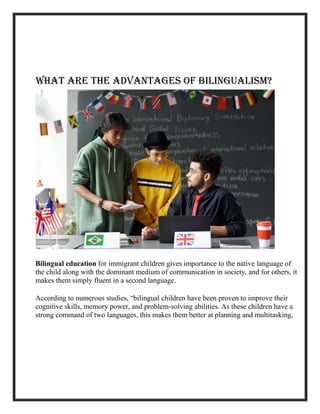
What Are the Advantages of Bilingualism?
Bilingual education for immigrant children gives importance to the native language of
the child along with the dominant medium of communication in society, and for others, it
makes them simply fluent in a second language.
According to numerous studies, “bilingual children have been proven to improve their
cognitive skills, memory power, and problem-solving abilities. As these children have a
strong command of two languages, this makes them better at planning and multitasking,
with enhanced cognitive flexibility, and ready for the challenges of the international
market.”
For immigrant and minority children, this enhances cultural pride, self-esteem, and value
for their heritage. Adopting bilingual education in schools has shown significant
improvements in bridging the gap between the school and minority parents.
There are numerous success stories across the globe supporting bilingual education
programs. In Canada, the French immersion program has developed high levels of
bilingualism among English and French-speaking friends.
How is Bilingual Education Implemented in
Classrooms?
Bilingual education is implemented in classrooms through numerous strategies; the
following two are popular methods:
1. Transitional Bilingual Education (TBE)
TBE is mainly adopted in transitional kindergarten or elementary schools. Here, children
who are fluent in their native tongue are given initial instructions. The system is paired
with instructions in the English language, and the level of proficiency is gradually
increased.
This is done until the students are fluent and the sole language of instruction in the
classroom is English. It allows students to compete in mainstream classrooms. The main
aim of this strategy is to make the students well aware of both languages.
2. Two-Way Dual Language Immersion (TWDL)
In an environment where TWDL strategies are adopted, the medium of instruction is
balanced. Here, English-speaking students and minority students learn side by side. This
method of instruction improves bilingualism in students excessively.
For effective instruction in bilingual education, the school needs to have teachers who
are effortlessly fluent in both languages. Moreover, the syllabus and pattern of teaching
need to be unique and should be crafted to cater to the classroom as a whole.
Conclusion
Bilingual education caters to minority education; this method of instruction equips
students with cognitive skills, educational equity, and robust communication skills. It’s a
powerful teaching tool for all students because the strength of two or more languages at
the global level helps you stand out in the competitive crowd.
Multilingualism and multiculturalism are powerful assets to build on. It has the potential
to develop self-esteem and confidence in your child. Investing in a bilingual education
program indicates investing in a promising future.
Are you worried about your child’s education? Do you want your child to be trained by
experienced and qualified teachers? Waste no time!
Choose Reframing Pedagogy for a loving atmosphere and anti-racist education,
principles, and practices with language. They have expert trainers in bilingualism. Visit
their website to learn more
cOntact us
Website : https://www.reframingpedagogy.org/
Mobile no. : +1-714 470 2662
Email : Reframingpedagogy@gmail.com
cOntent cOurtesy
https://silojohnson.livejournal.com/502.html
How Does Bilingual Education Help Minority Students?

How Does Bilingual Education Help Minority Students?

  • 1.
    How Does BilingualEducation Help Minority Students? In the 21st century, globalization is at its peak, and knowing two or more languages is a powerful asset. It’s where bilingual education comes into prominence. Bilingual education programs are originally designed to educate minority students in their native and dominant language of instruction. The program aims to make students fluent in languages. According to the independent source for health policy research, polling, and news, “around 47% of immigrant adults in the U.S. have limited English proficiency (LEP), meaning they speak English less than very well. Immigrants with LEP come from diverse backgrounds and communicate in a variety of languages. The top five languages spoken by people with LEP include Spanish (63%),
  • 2.
    Chinese (7%), Vietnamese(3%), Arabic (2%), and Tagalog (2%), while the remaining roughly quarter (23%) of people with LEP speak other languages. Having LEP can impact individuals’ daily lives and access to health coverage and care.” Do you want your kids to blend in like every other child and have numerous opportunities? Then, bilingual education programs are the right pedagogy for your child. This holistic approach instills a sense of cultural identity and fosters a successful academic record and professional excellence. In this article, you will explore the positive impacts of bilingual education on immigrant and minority children.
  • 3.
    What Are theAdvantages of Bilingualism? Bilingual education for immigrant children gives importance to the native language of the child along with the dominant medium of communication in society, and for others, it makes them simply fluent in a second language. According to numerous studies, “bilingual children have been proven to improve their cognitive skills, memory power, and problem-solving abilities. As these children have a strong command of two languages, this makes them better at planning and multitasking,
  • 4.
    with enhanced cognitiveflexibility, and ready for the challenges of the international market.” For immigrant and minority children, this enhances cultural pride, self-esteem, and value for their heritage. Adopting bilingual education in schools has shown significant improvements in bridging the gap between the school and minority parents. There are numerous success stories across the globe supporting bilingual education programs. In Canada, the French immersion program has developed high levels of bilingualism among English and French-speaking friends. How is Bilingual Education Implemented in Classrooms? Bilingual education is implemented in classrooms through numerous strategies; the following two are popular methods: 1. Transitional Bilingual Education (TBE) TBE is mainly adopted in transitional kindergarten or elementary schools. Here, children who are fluent in their native tongue are given initial instructions. The system is paired with instructions in the English language, and the level of proficiency is gradually increased. This is done until the students are fluent and the sole language of instruction in the classroom is English. It allows students to compete in mainstream classrooms. The main aim of this strategy is to make the students well aware of both languages.
  • 5.
    2. Two-Way DualLanguage Immersion (TWDL) In an environment where TWDL strategies are adopted, the medium of instruction is balanced. Here, English-speaking students and minority students learn side by side. This method of instruction improves bilingualism in students excessively. For effective instruction in bilingual education, the school needs to have teachers who are effortlessly fluent in both languages. Moreover, the syllabus and pattern of teaching need to be unique and should be crafted to cater to the classroom as a whole.
  • 6.
    Conclusion Bilingual education catersto minority education; this method of instruction equips students with cognitive skills, educational equity, and robust communication skills. It’s a powerful teaching tool for all students because the strength of two or more languages at the global level helps you stand out in the competitive crowd. Multilingualism and multiculturalism are powerful assets to build on. It has the potential to develop self-esteem and confidence in your child. Investing in a bilingual education program indicates investing in a promising future. Are you worried about your child’s education? Do you want your child to be trained by experienced and qualified teachers? Waste no time! Choose Reframing Pedagogy for a loving atmosphere and anti-racist education, principles, and practices with language. They have expert trainers in bilingualism. Visit their website to learn more
  • 7.
    cOntact us Website :https://www.reframingpedagogy.org/ Mobile no. : +1-714 470 2662 Email : Reframingpedagogy@gmail.com cOntent cOurtesy https://silojohnson.livejournal.com/502.html