International Journal of Trend in Scientific Research and Development (IJTSRD)
Volume: 3 | Issue: 2 | Jan-Feb 2019 Available Online: www.ijtsrd.com e-ISSN: 2456 - 6470
@ IJTSRD | Unique Reference Paper ID – IJTSRD21397 | Volume – 3 | Issue – 2 | Jan-Feb 2019 Page: 444
Bifid Xiphoid Process- A Case Report
Manu Krishnan. K1, Uma. B. Gopal2, Pranav Krishnan1,
Santoshkumarsingarapu1, Akshata. BK1, Jeevankumargiri1
1P.G Scholars, 2Professor
Department of Rachana Shareera, SDM College of Ayurveda and Hospital, Hassan, Karnataka, India
ABSTRACT
The sternum is a flat bone forming the anterior median part of the thoracic skeleton. Xiphoid process isthesmallestpart of the
sternum. It is at first cartilaginous, but in adult it becomes ossified near its upper end. It varies greatly in its morphology and
lies in the floor of epigastric fossa.
A bifid xiphoid process was observed during routine cadaveric dissection of the pectoral region, which was seen as aneverted
bulging mass in the epigastric pit between the two costal margins. There is a need for awareness of these findings as they may
determine the accuracy of clinical and other procedures in thoracic region.
KEYWORDS: Bifid xiphoid process, variation, sternum
INTRODUCTION
The sternum is a flat bone forming the anterior median wall
of the thoracic skeleton. In shape, it resembles ashortsword,
made of three parts. The upper part corresponding to the
handle is called the manubrium, middle part resembling the
blade is called the body and the lowesttaperingpartforming
the point of sword is the process or xiphisternum.
The xiphoid process, which is the smallest and mostvariable
part of the sternum, is thin and elongated. It lies at the level
of T10 vertebra. Although often pointed, the process may be
blunt, bifid, curved or deflected to one side or anteriorly.Itis
cartilaginous in young people but more or less ossified in
adults, older than the age of 40 years. In elderly people, the
xiphoid process may fuse with the sternal body.
Its junction with the sternal body at the xiphisternal joint
indicates the inferior limit of the central part of the thoracic
cavityprojected onto the anterior body wall; this jointis also
the site of the infrasternal angle (subcostal angle) of the
inferior thoracic aperture.
It is a midline marker for the superior limit of liver, the
central tendon of the diaphragm, and the inferior border of
the heart.
Attachments: to its anterior surface are attached the most
medial fibres of Rectus abdominis and aponeuroses of
External and Internal obliques, to its lower end the linea
Alba and to its border the aponeuroses of internal oblique
and Transversus abdominis. To its posterior aspect slips of
diaphragm and origin to sternocostalis muscles are attached
and it is here related to liver.
Case report:
During the routine dissection of pectoral region in
Department of Rachana sharer (Anatomy) of SDM College of
Ayurveda and Hospita , Hassan a bifid xiphoid process was
observed in an approximately60 year old male cadaver. The
cadaver was without any deformity and well preserved. The
dissection was carried out according to cunningham’s
manual of practical anatomy as follows-
A vertical incision over the skin of thorax was given
extending from the suprasternal notch to the tip of xiphoid
process. The skin was reflected following which the muscles
were exposed. The pectoralis major and pectoralis minor
muscles were reflected. The complete sternum was
visualized along with the xiphoid process.
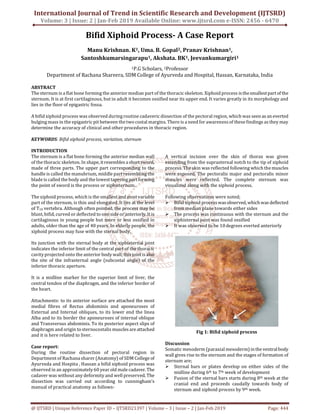
Following observations were noted;
 Bifid xiphoid processwas observed,whichwas deflected
from median plane towards either sides
 The process was continuous with the sternum and the
xiphisternal joint was found ossified
 It was observed to be 10degrees everted anteriorly
Fig 1: Bifid xiphoid process
Discussion
Somatic mesoderm (paraxial mesoderm) inthe ventralbody
wall gives rise to the sternum and the stages of formation of
sternum are;
 Sternal bars or plates develop on either sides of the
midline during 6th to 7th week of development
 Fusion of the sternal bars starts during 8th week at the
cranial end and proceeds caudally towards body of
sternum and xiphoid process by 9th week.
International Journal of Trend in Scientific Research and Development (IJTSRD) @ www.ijtsrd.com eISSN: 2456-6470
@ IJTSRD | Unique Reference Paper ID – IJTSRD21397 | Volume – 3 | Issue – 2 | Jan-Feb 2019 Page: 445
 Ossification of the manubrium and body of sternum
occurs by separate ossification centres. The xiphoid
process ossifies only late in life. The centre for xiphoid
process appears during the age of three years or later. It
fuses with the body at about 40 years.
variations of sternal development includes;
 Cleft sternum
 Perforated sternum
 Bifid xiphoid process
Conclusion
There are limited reports on variations of xiphoid process,
but it has to be considered. The xiphoidprocess is variablein
its morphology. It may be perforated, bifid, or deflected.
Many people in their early 40’s suddenly become aware of
their partly ossified xiphoid process and consult their
physician about the hard lump in the pit of their stomach
(epigastric fossa). Neverhavingbeen awareof theirxiphopid
process before they fear they have developed a tumoursuch
as stomach cancer.
Hence a thorough knowledge of the embryology and
anatomy of the xiphoid process is important in clinical and
surgical practice to make differential diagnosis in case of a
suspected mass in epigastric fossa. Sincexiphoidprocess is a
highly variable part of the sternum normal variations are to
be understood to plan accordingly during various surgical
interventions of thoracic region.
References
[1] Moore MK, Stewart JH, McCormick WF. Anomalies of
the human chest plate area: radiographic findings in a
large autopsy population. Am J Forensic Med Pathol.
1988;9(4):348-54.
[2] Das SK, Jana PK, Bairagya TD, Ghoshal B. Bifid sternum.
Lung India 2012; 29(1):73–5. PMID: 22345921.
[3] Murray JA. Bifid sternum. Br J Radiol 1966;
39:320.PMID:5910096.
[4] Lal KB, Pande SK. A case of congenital bifid sternum.
Scand J
[5] Thorac Cardiovasc Surg 1975;9(3):291–2. PMID:
1209216.
[6] Yekeler E, Tunaci M, Tunaci A, Dursun M, Acunas G.
Frequency of sternal variations and anomalies
evaluated by MDCT. AJR Am J Roentgenol 2006;
186(4):956–60. PMID: 16554563.
[7] Mashriqi F, D'antoni A V, Tubbs R (August 27, 2017)
Xiphoid Process Variations: A Review with an
Extremely Unusual Case Report. Cureus 9(8): e1613.
doi:10.7759/cureus.1613
[8] Bernhardt LC, Meyer T, Young WP. Bifid sternum: Case
report and surgical management. J Thorac Cardiovasc
Surg. 1968; 55:758–60. [PubMed]
[9] El- Busaid H, Kaisha W, Hassanali J, Hassan S,Ogeng’o J,
Mandela P. Sternal foramina and variant xiphoid
morphology in a Kenyan population. Folia Morphol
(Warsz). 2012; 71(1):19-22.

Bifid Xiphoid Process- A Case Report

  • 1.
    International Journal ofTrend in Scientific Research and Development (IJTSRD) Volume: 3 | Issue: 2 | Jan-Feb 2019 Available Online: www.ijtsrd.com e-ISSN: 2456 - 6470 @ IJTSRD | Unique Reference Paper ID – IJTSRD21397 | Volume – 3 | Issue – 2 | Jan-Feb 2019 Page: 444 Bifid Xiphoid Process- A Case Report Manu Krishnan. K1, Uma. B. Gopal2, Pranav Krishnan1, Santoshkumarsingarapu1, Akshata. BK1, Jeevankumargiri1 1P.G Scholars, 2Professor Department of Rachana Shareera, SDM College of Ayurveda and Hospital, Hassan, Karnataka, India ABSTRACT The sternum is a flat bone forming the anterior median part of the thoracic skeleton. Xiphoid process isthesmallestpart of the sternum. It is at first cartilaginous, but in adult it becomes ossified near its upper end. It varies greatly in its morphology and lies in the floor of epigastric fossa. A bifid xiphoid process was observed during routine cadaveric dissection of the pectoral region, which was seen as aneverted bulging mass in the epigastric pit between the two costal margins. There is a need for awareness of these findings as they may determine the accuracy of clinical and other procedures in thoracic region. KEYWORDS: Bifid xiphoid process, variation, sternum INTRODUCTION The sternum is a flat bone forming the anterior median wall of the thoracic skeleton. In shape, it resembles ashortsword, made of three parts. The upper part corresponding to the handle is called the manubrium, middle part resembling the blade is called the body and the lowesttaperingpartforming the point of sword is the process or xiphisternum. The xiphoid process, which is the smallest and mostvariable part of the sternum, is thin and elongated. It lies at the level of T10 vertebra. Although often pointed, the process may be blunt, bifid, curved or deflected to one side or anteriorly.Itis cartilaginous in young people but more or less ossified in adults, older than the age of 40 years. In elderly people, the xiphoid process may fuse with the sternal body. Its junction with the sternal body at the xiphisternal joint indicates the inferior limit of the central part of the thoracic cavityprojected onto the anterior body wall; this jointis also the site of the infrasternal angle (subcostal angle) of the inferior thoracic aperture. It is a midline marker for the superior limit of liver, the central tendon of the diaphragm, and the inferior border of the heart. Attachments: to its anterior surface are attached the most medial fibres of Rectus abdominis and aponeuroses of External and Internal obliques, to its lower end the linea Alba and to its border the aponeuroses of internal oblique and Transversus abdominis. To its posterior aspect slips of diaphragm and origin to sternocostalis muscles are attached and it is here related to liver. Case report: During the routine dissection of pectoral region in Department of Rachana sharer (Anatomy) of SDM College of Ayurveda and Hospita , Hassan a bifid xiphoid process was observed in an approximately60 year old male cadaver. The cadaver was without any deformity and well preserved. The dissection was carried out according to cunningham’s manual of practical anatomy as follows- A vertical incision over the skin of thorax was given extending from the suprasternal notch to the tip of xiphoid process. The skin was reflected following which the muscles were exposed. The pectoralis major and pectoralis minor muscles were reflected. The complete sternum was visualized along with the xiphoid process. Following observations were noted;  Bifid xiphoid processwas observed,whichwas deflected from median plane towards either sides  The process was continuous with the sternum and the xiphisternal joint was found ossified  It was observed to be 10degrees everted anteriorly Fig 1: Bifid xiphoid process Discussion Somatic mesoderm (paraxial mesoderm) inthe ventralbody wall gives rise to the sternum and the stages of formation of sternum are;  Sternal bars or plates develop on either sides of the midline during 6th to 7th week of development  Fusion of the sternal bars starts during 8th week at the cranial end and proceeds caudally towards body of sternum and xiphoid process by 9th week.
  • 2.
    International Journal ofTrend in Scientific Research and Development (IJTSRD) @ www.ijtsrd.com eISSN: 2456-6470 @ IJTSRD | Unique Reference Paper ID – IJTSRD21397 | Volume – 3 | Issue – 2 | Jan-Feb 2019 Page: 445  Ossification of the manubrium and body of sternum occurs by separate ossification centres. The xiphoid process ossifies only late in life. The centre for xiphoid process appears during the age of three years or later. It fuses with the body at about 40 years. variations of sternal development includes;  Cleft sternum  Perforated sternum  Bifid xiphoid process Conclusion There are limited reports on variations of xiphoid process, but it has to be considered. The xiphoidprocess is variablein its morphology. It may be perforated, bifid, or deflected. Many people in their early 40’s suddenly become aware of their partly ossified xiphoid process and consult their physician about the hard lump in the pit of their stomach (epigastric fossa). Neverhavingbeen awareof theirxiphopid process before they fear they have developed a tumoursuch as stomach cancer. Hence a thorough knowledge of the embryology and anatomy of the xiphoid process is important in clinical and surgical practice to make differential diagnosis in case of a suspected mass in epigastric fossa. Sincexiphoidprocess is a highly variable part of the sternum normal variations are to be understood to plan accordingly during various surgical interventions of thoracic region. References [1] Moore MK, Stewart JH, McCormick WF. Anomalies of the human chest plate area: radiographic findings in a large autopsy population. Am J Forensic Med Pathol. 1988;9(4):348-54. [2] Das SK, Jana PK, Bairagya TD, Ghoshal B. Bifid sternum. Lung India 2012; 29(1):73–5. PMID: 22345921. [3] Murray JA. Bifid sternum. Br J Radiol 1966; 39:320.PMID:5910096. [4] Lal KB, Pande SK. A case of congenital bifid sternum. Scand J [5] Thorac Cardiovasc Surg 1975;9(3):291–2. PMID: 1209216. [6] Yekeler E, Tunaci M, Tunaci A, Dursun M, Acunas G. Frequency of sternal variations and anomalies evaluated by MDCT. AJR Am J Roentgenol 2006; 186(4):956–60. PMID: 16554563. [7] Mashriqi F, D'antoni A V, Tubbs R (August 27, 2017) Xiphoid Process Variations: A Review with an Extremely Unusual Case Report. Cureus 9(8): e1613. doi:10.7759/cureus.1613 [8] Bernhardt LC, Meyer T, Young WP. Bifid sternum: Case report and surgical management. J Thorac Cardiovasc Surg. 1968; 55:758–60. [PubMed] [9] El- Busaid H, Kaisha W, Hassanali J, Hassan S,Ogeng’o J, Mandela P. Sternal foramina and variant xiphoid morphology in a Kenyan population. Folia Morphol (Warsz). 2012; 71(1):19-22.