Download to read offline


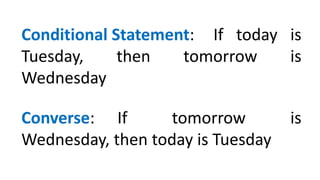
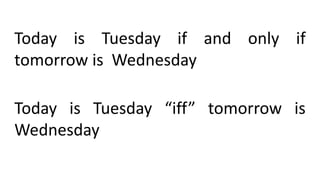
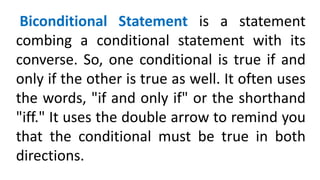
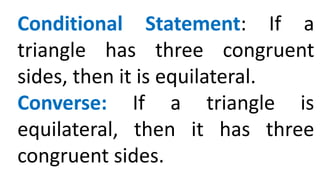
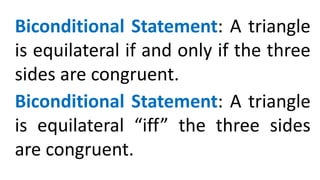
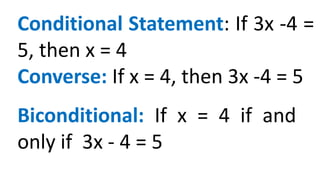
A biconditional statement combines a conditional statement with its converse by using "if and only if" or "iff" to connect them. This means that one conditional is true if and only if the other is also true. Biconditional statements use a double arrow to indicate the conditional must be true in both directions. Examples provided demonstrate biconditional statements for triangles being equilateral if and only if the three sides are congruent, and x equaling 4 if and only if 3x - 4 equals 5.


