ELECTRONIC TIMING
CIRCUIT
Timing circuits are used in a wide variety
of applications – from short time delays of a
few nanoseconds used in digital circuitry and
computers to long periods of hours used to
control household appliances and industrial
processes. Electronic timing circuits provide
this function reliably and accurately, without
any user input or monitoring once the time
has been set.
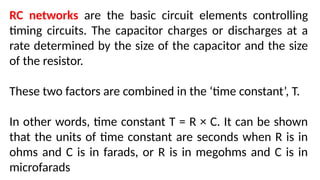
RC networks are the basic circuit elements controlling
timing circuits. The capacitor charges or discharges at a
rate determined by the size of the capacitor and the size
of the resistor.
These two factors are combined in the ‘time constant’, T.
In other words, time constant T = R × C. It can be shown
that the units of time constant are seconds when R is in
ohms and C is in farads, or R is in megohms and C is in
microfarads
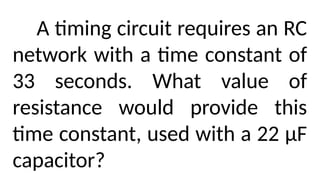
A timing circuit requires an RC
network with a time constant of
33 seconds. What value of
resistance would provide this
time constant, used with a 22 μF
capacitor?
What value of capacitance
provides a time constant of 30
seconds when used with a 10
kΩ resistor?
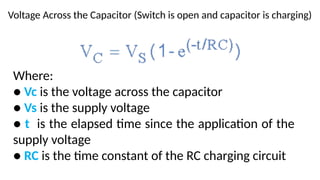
Voltage Across the Capacitor (Switch is open and capacitor is charging)
Where:
● Vc is the voltage across the capacitor
● Vs is the supply voltage
● t is the elapsed time since the application of the
supply voltage
● RC is the time constant of the RC charging circuit
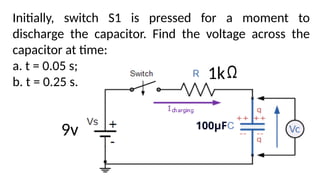
Initially, switch S1 is pressed for a moment to
discharge the capacitor. Find the voltage across the
capacitor at time:
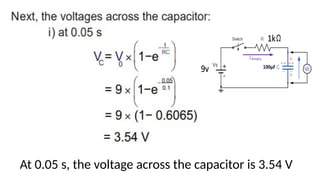
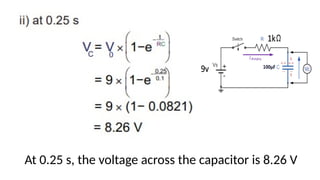
a. t = 0.05 s;
b. t = 0.25 s.
9v
1k
100µF
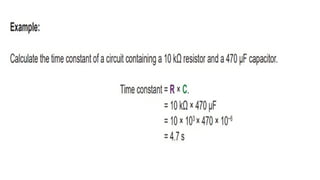
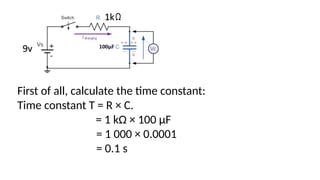
First of all, calculate the time constant:
Time constant T = R × C.
= 1 kΩ × 100 μF
= 1 000 × 0.0001
= 0.1 s
At 0.05 s, the voltage across the capacitor is 3.54 V
At 0.25 s, the voltage across the capacitor is 8.26 V
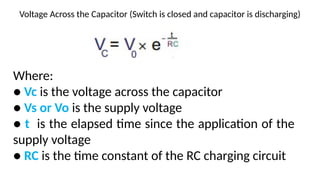
Voltage Across the Capacitor (Switch is closed and capacitor is discharging)
Where:
● Vc is the voltage across the capacitor
● Vs or Vo is the supply voltage
● t is the elapsed time since the application of the
supply voltage
● RC is the time constant of the RC charging circuit
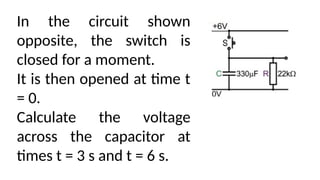
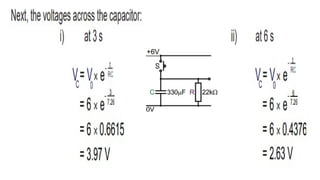
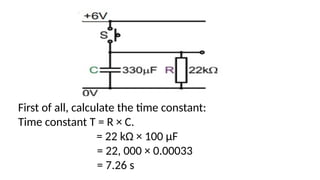
In the circuit shown
opposite, the switch is
closed for a moment.
It is then opened at time t
= 0.
Calculate the voltage
across the capacitor at
times t = 3 s and t = 6 s.
First of all, calculate the time constant:
Time constant T = R × C.
= 22 kΩ × 100 μF
= 22, 000 × 0.00033
= 7.26 s
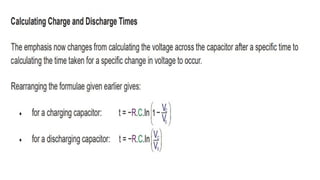
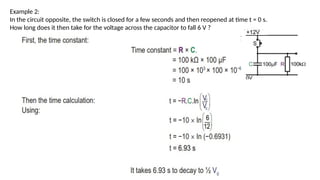
Example 1: The capacitor in the circuit opposite is initially uncharged. Switch S is closed at
time t = 0. Calculate the time taken for the capacitor to charge to 6 V.
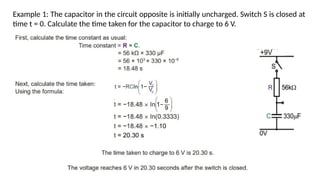
Example 2:
In the circuit opposite, the switch is closed for a few seconds and then reopened at time t = 0 s.
How long does it then take for the voltage across the capacitor to fall 6 V ?
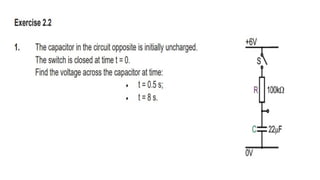
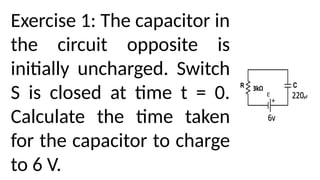
Exercise 1: The capacitor in
the circuit opposite is
initially uncharged. Switch
S is closed at time t = 0.
Calculate the time taken
for the capacitor to charge
to 6 V.
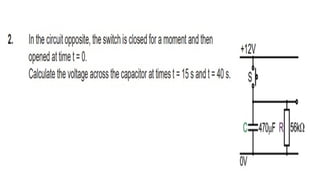
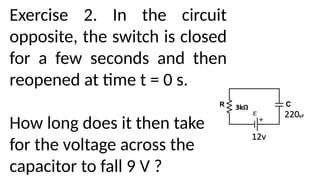
Exercise 2. In the circuit
opposite, the switch is closed
for a few seconds and then
reopened at time t = 0 s.
How long does it then take
for the voltage across the
capacitor to fall 9 V ?

ELECTRONIC TIMING CIRCUIT in electronics 10.pptx

  • 1.
  • 2.
    Timing circuits areused in a wide variety of applications – from short time delays of a few nanoseconds used in digital circuitry and computers to long periods of hours used to control household appliances and industrial processes. Electronic timing circuits provide this function reliably and accurately, without any user input or monitoring once the time has been set.
  • 3.
    RC networks arethe basic circuit elements controlling timing circuits. The capacitor charges or discharges at a rate determined by the size of the capacitor and the size of the resistor. These two factors are combined in the ‘time constant’, T. In other words, time constant T = R × C. It can be shown that the units of time constant are seconds when R is in ohms and C is in farads, or R is in megohms and C is in microfarads
  • 5.
    A timing circuitrequires an RC network with a time constant of 33 seconds. What value of resistance would provide this time constant, used with a 22 μF capacitor?
  • 6.
    What value ofcapacitance provides a time constant of 30 seconds when used with a 10 kΩ resistor?
  • 7.
    Voltage Across theCapacitor (Switch is open and capacitor is charging) Where: ● Vc is the voltage across the capacitor ● Vs is the supply voltage ● t is the elapsed time since the application of the supply voltage ● RC is the time constant of the RC charging circuit
  • 8.
    Initially, switch S1is pressed for a moment to discharge the capacitor. Find the voltage across the capacitor at time: a. t = 0.05 s; b. t = 0.25 s. 9v 1k 100µF
  • 9.
    First of all,calculate the time constant: Time constant T = R × C. = 1 kΩ × 100 μF = 1 000 × 0.0001 = 0.1 s
  • 10.
    At 0.05 s,the voltage across the capacitor is 3.54 V
  • 11.
    At 0.25 s,the voltage across the capacitor is 8.26 V
  • 12.
    Voltage Across theCapacitor (Switch is closed and capacitor is discharging) Where: ● Vc is the voltage across the capacitor ● Vs or Vo is the supply voltage ● t is the elapsed time since the application of the supply voltage ● RC is the time constant of the RC charging circuit
  • 13.
    In the circuitshown opposite, the switch is closed for a moment. It is then opened at time t = 0. Calculate the voltage across the capacitor at times t = 3 s and t = 6 s.
  • 17.
    First of all,calculate the time constant: Time constant T = R × C. = 22 kΩ × 100 μF = 22, 000 × 0.00033 = 7.26 s
  • 19.
    Example 1: Thecapacitor in the circuit opposite is initially uncharged. Switch S is closed at time t = 0. Calculate the time taken for the capacitor to charge to 6 V.
  • 20.
    Example 2: In thecircuit opposite, the switch is closed for a few seconds and then reopened at time t = 0 s. How long does it then take for the voltage across the capacitor to fall 6 V ?
  • 21.
    Exercise 1: Thecapacitor in the circuit opposite is initially uncharged. Switch S is closed at time t = 0. Calculate the time taken for the capacitor to charge to 6 V.
  • 22.
    Exercise 2. Inthe circuit opposite, the switch is closed for a few seconds and then reopened at time t = 0 s. How long does it then take for the voltage across the capacitor to fall 9 V ?

Editor's Notes

  • #3 TIME CONSTANT-amount of time to occur with the time taken for the capacitor to charge or discharge to within a certain percentage of its maximum supply value