Bicep femoris tendinitis
BY
Dr S.ZAFAR
PROFESSOR
DEPT OF PHYSIOTHERAPY
SMAS
GALGOTIAS UNIVERSITY
Biceps femoris tendinitis
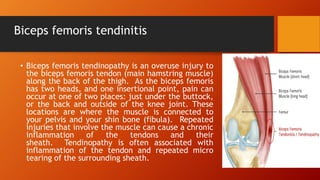
• Biceps femoris tendinopathy is an overuse injury to
the biceps femoris tendon (main hamstring muscle)
along the back of the thigh. As the biceps femoris
has two heads, and one insertional point, pain can
occur at one of two places: just under the buttock,
or the back and outside of the knee joint. These
locations are where the muscle is connected to
your pelvis and your shin bone (fibula). Repeated
injuries that involve the muscle can cause a chronic
inflammation of the tendons and their
sheath. Tendinopathy is often associated with
inflammation of the tendon and repeated micro
tearing of the surrounding sheath.
Biceps femoris tendinitis
Bicep femoris tendinitis :- it is a inflammation of biceps
muscles tendon of the femur bone .The muscles of the
biceps femoris are hamstring muscles .it has two muscle
ie semi membranous & semitendinosus'. Hamstring
tendinitis is inflammation of one of the hamstring
tendons at the point where it attaches to the back of
the knee. Most commonly it is the biceps femoris
tendon on the outside. Here we explain the
symptoms, causes and treatment of hamstring
tendonitis & tendinopathy. The majority of distal
biceps ruptures are associated with a combined
hyperextension and external rotation injury mechanism.
The LCL and PLC complex usually share loading during
combined hyperextension external rotation forces
Biceps femoris tendinopathy
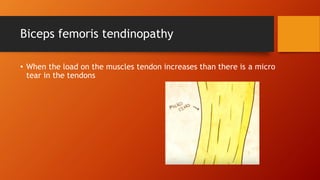
• When the load on the muscles tendon increases than there is a micro
tear in the tendons
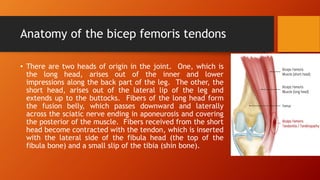
Anatomy of the bicep femoris tendons
• There are two heads of origin in the joint. One, which is
the long head, arises out of the inner and lower
impressions along the back part of the leg. The other, the
short head, arises out of the lateral lip of the leg and
extends up to the buttocks. Fibers of the long head form
the fusion belly, which passes downward and laterally
across the sciatic nerve ending in aponeurosis and covering
the posterior of the muscle. Fibers received from the short
head become contracted with the tendon, which is inserted
with the lateral side of the fibula head (the top of the
fibula bone) and a small slip of the tibia (shin bone).
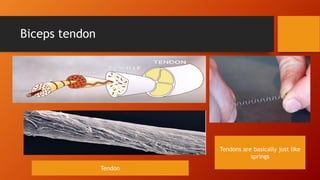
Biceps tendon
Tendons are basically just like
springs
Tendon
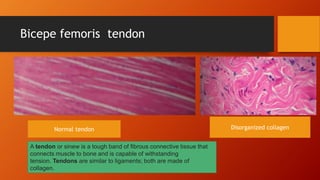
Bicepe femoris tendon
Normal tendon Disorganized collagen
A tendon or sinew is a tough band of fibrous connective tissue that
connects muscle to bone and is capable of withstanding
tension. Tendons are similar to ligaments; both are made of
collagen.
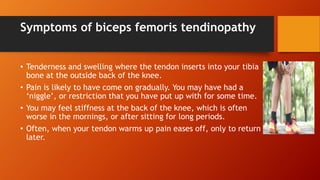
Symptoms of biceps femoris tendinopathy
• Tenderness and swelling where the tendon inserts into your tibia
bone at the outside back of the knee.
• Pain is likely to have come on gradually. You may have had a
‘niggle’, or restriction that you have put up with for some time.
• You may feel stiffness at the back of the knee, which is often
worse in the mornings, or after sitting for long periods.
• Often, when your tendon warms up pain eases off, only to return
later.
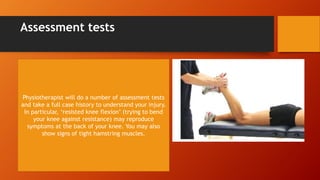
Assessment tests
Physiotherapist will do a number of assessment tests
and take a full case history to understand your injury.
In particular, ‘resisted knee flexion’ (trying to bend
your knee against resistance) may reproduce
symptoms at the back of your knee. You may also
show signs of tight hamstring muscles.
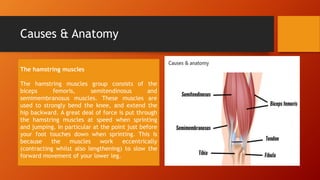
Causes & Anatomy
The hamstring muscles
The hamstring muscles group consists of the
biceps femoris, semitendinosus and
semimembranosus muscles. These muscles are
used to strongly bend the knee, and extend the
hip backward. A great deal of force is put through
the hamstring muscles at speed when sprinting
and jumping. In particular at the point just before
your foot touches down when sprinting. This is
because the muscles work eccentrically
(contracting whilst also lengthening) to slow the
forward movement of your lower leg.
Mechanism of injury
• Sports person who play fast games like football, lawn tennis, cricket,
Hockey etc. The predominant hamstring injury mechanism in football
occurs during high-speed running or acceleration efforts.
• Biomechanical and kinematic studies have demonstrated that the BF is
subject to the highest levels of muscle–tendon unit stretch throughout the
crucial terminal swing phase in (high speed) running.
Mechanism of injury
• Both the semitendinosus (ST) and the BF engage in maximal
eccentric activation throughout the swing phase of running
(middle swing to initial stance phase). These synergists work
alternatingly in complex neuromuscular coordination patterns,
where the BF is predominantly activated during the middle (to
late) swing phase and the ST is the leading player in the terminal
swing phase. This stresses the importance of sufficient
neuromuscular and intramuscular coordination between those two
muscle bellies. Altered muscle activation patterns have been
associated with prior hamstring injuries and an increased risk of
re-injury.
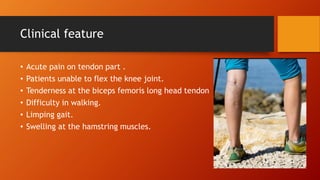
Clinical feature
• Acute pain on tendon part .
• Patients unable to flex the knee joint.
• Tenderness at the biceps femoris long head tendon
• Difficulty in walking.
• Limping gait.
• Swelling at the hamstring muscles.
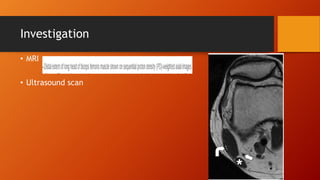
Investigation
• MRI
• Ultrasound scan
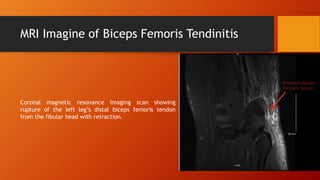
MRI Imagine of Biceps Femoris Tendinitis
Coronal magnetic resonance imaging scan showing
rupture of the left leg’s distal biceps femoris tendon
from the fibular head with retraction.
Treatment
• Conservative
• Drug therapy
• Physiotherapy
• Surgical
• Conservative management.
• Drug therapy :- analgesic Tab combiflam,muscles relaxant
Neucoxia MR ,Mobizox. 1B.D
• Antacid :- Tab zintac 150 Mg ,Tab acilock 150 mg, Tab digene 1 B.D
• Analgesic spray/analgesic gel application on the hamstring
muscles.
Physiotherapy treatment
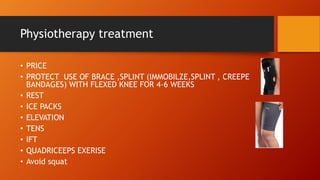
• PRICE
• PROTECT USE OF BRACE ,SPLINT (IMMOBILZE,SPLINT , CREEPE
BANDAGES) WITH FLEXED KNEE FOR 4-6 WEEKS
• REST
• ICE PACKS
• ELEVATION
• TENS
• IFT
• QUADRICEEPS EXERISE
• Avoid squat
Physiotherapy treatment
• Ultrasound therapy with 1Mhz for5-7 minutes for 7-10 days
• Shock wave Therapy at tender spot
• Laser therapy class 3B laser with intensity 904 , 2-3 joule of
energy for 5 minute at tender spot.
• Massage with analgesic oil (Bestogesic oil)
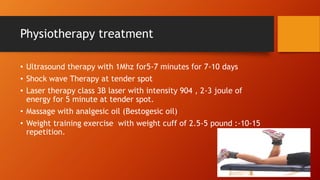
• Weight training exercise with weight cuff of 2.5-5 pound :-10-15
repetition.
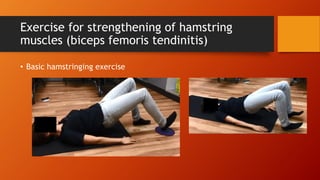
Exercise for strengthening of hamstring
muscles (biceps femoris tendinitis)
• Basic hamstringing exercise
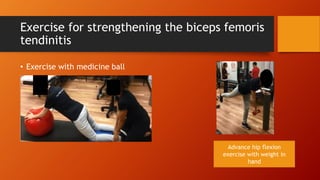
Exercise for strengthening the biceps femoris
tendinitis
• Exercise with medicine ball
Advance hip flexion
exercise with weight in
hand
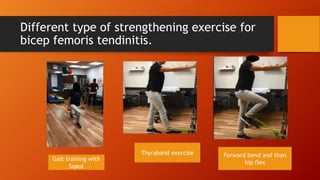
Different type of strengthening exercise for
bicep femoris tendinitis.
Thyraband exercise
Gait training with
Sqaut
Forward bend and than
hip flex
THANK YOU

Bicep Femoris Tendinitis

  • 1.
    Bicep femoris tendinitis BY DrS.ZAFAR PROFESSOR DEPT OF PHYSIOTHERAPY SMAS GALGOTIAS UNIVERSITY
  • 2.
    Biceps femoris tendinitis •Biceps femoris tendinopathy is an overuse injury to the biceps femoris tendon (main hamstring muscle) along the back of the thigh. As the biceps femoris has two heads, and one insertional point, pain can occur at one of two places: just under the buttock, or the back and outside of the knee joint. These locations are where the muscle is connected to your pelvis and your shin bone (fibula). Repeated injuries that involve the muscle can cause a chronic inflammation of the tendons and their sheath. Tendinopathy is often associated with inflammation of the tendon and repeated micro tearing of the surrounding sheath.
  • 3.
    Biceps femoris tendinitis Bicepfemoris tendinitis :- it is a inflammation of biceps muscles tendon of the femur bone .The muscles of the biceps femoris are hamstring muscles .it has two muscle ie semi membranous & semitendinosus'. Hamstring tendinitis is inflammation of one of the hamstring tendons at the point where it attaches to the back of the knee. Most commonly it is the biceps femoris tendon on the outside. Here we explain the symptoms, causes and treatment of hamstring tendonitis & tendinopathy. The majority of distal biceps ruptures are associated with a combined hyperextension and external rotation injury mechanism. The LCL and PLC complex usually share loading during combined hyperextension external rotation forces
  • 4.
    Biceps femoris tendinopathy •When the load on the muscles tendon increases than there is a micro tear in the tendons
  • 5.
    Anatomy of thebicep femoris tendons • There are two heads of origin in the joint. One, which is the long head, arises out of the inner and lower impressions along the back part of the leg. The other, the short head, arises out of the lateral lip of the leg and extends up to the buttocks. Fibers of the long head form the fusion belly, which passes downward and laterally across the sciatic nerve ending in aponeurosis and covering the posterior of the muscle. Fibers received from the short head become contracted with the tendon, which is inserted with the lateral side of the fibula head (the top of the fibula bone) and a small slip of the tibia (shin bone).
  • 6.
    Biceps tendon Tendons arebasically just like springs Tendon
  • 7.
    Bicepe femoris tendon Normaltendon Disorganized collagen A tendon or sinew is a tough band of fibrous connective tissue that connects muscle to bone and is capable of withstanding tension. Tendons are similar to ligaments; both are made of collagen.
  • 8.
    Symptoms of bicepsfemoris tendinopathy • Tenderness and swelling where the tendon inserts into your tibia bone at the outside back of the knee. • Pain is likely to have come on gradually. You may have had a ‘niggle’, or restriction that you have put up with for some time. • You may feel stiffness at the back of the knee, which is often worse in the mornings, or after sitting for long periods. • Often, when your tendon warms up pain eases off, only to return later.
  • 9.
    Assessment tests Physiotherapist willdo a number of assessment tests and take a full case history to understand your injury. In particular, ‘resisted knee flexion’ (trying to bend your knee against resistance) may reproduce symptoms at the back of your knee. You may also show signs of tight hamstring muscles.
  • 10.
    Causes & Anatomy Thehamstring muscles The hamstring muscles group consists of the biceps femoris, semitendinosus and semimembranosus muscles. These muscles are used to strongly bend the knee, and extend the hip backward. A great deal of force is put through the hamstring muscles at speed when sprinting and jumping. In particular at the point just before your foot touches down when sprinting. This is because the muscles work eccentrically (contracting whilst also lengthening) to slow the forward movement of your lower leg.
  • 11.
    Mechanism of injury •Sports person who play fast games like football, lawn tennis, cricket, Hockey etc. The predominant hamstring injury mechanism in football occurs during high-speed running or acceleration efforts. • Biomechanical and kinematic studies have demonstrated that the BF is subject to the highest levels of muscle–tendon unit stretch throughout the crucial terminal swing phase in (high speed) running.
  • 12.
    Mechanism of injury •Both the semitendinosus (ST) and the BF engage in maximal eccentric activation throughout the swing phase of running (middle swing to initial stance phase). These synergists work alternatingly in complex neuromuscular coordination patterns, where the BF is predominantly activated during the middle (to late) swing phase and the ST is the leading player in the terminal swing phase. This stresses the importance of sufficient neuromuscular and intramuscular coordination between those two muscle bellies. Altered muscle activation patterns have been associated with prior hamstring injuries and an increased risk of re-injury.
  • 13.
    Clinical feature • Acutepain on tendon part . • Patients unable to flex the knee joint. • Tenderness at the biceps femoris long head tendon • Difficulty in walking. • Limping gait. • Swelling at the hamstring muscles.
  • 14.
  • 15.
    MRI Imagine ofBiceps Femoris Tendinitis Coronal magnetic resonance imaging scan showing rupture of the left leg’s distal biceps femoris tendon from the fibular head with retraction.
  • 16.
    Treatment • Conservative • Drugtherapy • Physiotherapy • Surgical • Conservative management. • Drug therapy :- analgesic Tab combiflam,muscles relaxant Neucoxia MR ,Mobizox. 1B.D • Antacid :- Tab zintac 150 Mg ,Tab acilock 150 mg, Tab digene 1 B.D • Analgesic spray/analgesic gel application on the hamstring muscles.
  • 17.
    Physiotherapy treatment • PRICE •PROTECT USE OF BRACE ,SPLINT (IMMOBILZE,SPLINT , CREEPE BANDAGES) WITH FLEXED KNEE FOR 4-6 WEEKS • REST • ICE PACKS • ELEVATION • TENS • IFT • QUADRICEEPS EXERISE • Avoid squat
  • 18.
    Physiotherapy treatment • Ultrasoundtherapy with 1Mhz for5-7 minutes for 7-10 days • Shock wave Therapy at tender spot • Laser therapy class 3B laser with intensity 904 , 2-3 joule of energy for 5 minute at tender spot. • Massage with analgesic oil (Bestogesic oil) • Weight training exercise with weight cuff of 2.5-5 pound :-10-15 repetition.
  • 19.
    Exercise for strengtheningof hamstring muscles (biceps femoris tendinitis) • Basic hamstringing exercise
  • 20.
    Exercise for strengtheningthe biceps femoris tendinitis • Exercise with medicine ball Advance hip flexion exercise with weight in hand
  • 21.
    Different type ofstrengthening exercise for bicep femoris tendinitis. Thyraband exercise Gait training with Sqaut Forward bend and than hip flex
  • 22.