Andrew Fryer Microsoft UK


BI Tools and techniques that support better decision making Turns data into insight Performance Management: Process to set objectives and plans Expressed as goals, plans, metrics & KPIs Uses Rules and Workflows Is Organisation aware.
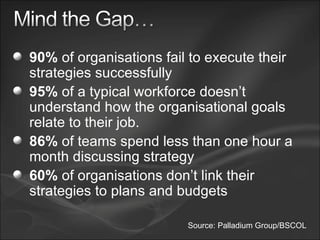
90%  of  organisations  fail to execute their strategies successfully 95%  of a typical workforce doesn’t understand how the organisational goals relate to their job. 86%  of teams spend less than one hour a month discussing strategy 60%  of organisations don’t link their strategies to plans and budgets Source: Palladium Group/BSCOL
 
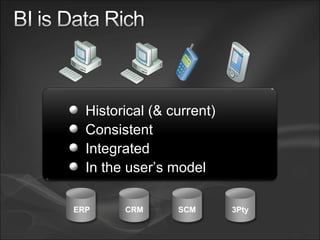
Historical (& current) Consistent Integrated In the user’s model ERP CRM 3Pty SCM
 
 
What happened? What is happening? Why? What will happen? What do I want to happen? Reporting Analyzing Forecasting Planning For sales Operational Financial  Statutory  Performance management  Business Activity Monitoring Sales analysis Campaign, Promotion analysis HR analysis Product mix Risk analysis Sensitivity analysis Volume and Sales forecasting Rates simulation Currency Hedging Stock portfolio management Store/ATM placement Promotion forecasting Supermarket queuing Routing Reorg simulation Budgeting  New Product launch planning …
Central Repository Designed & optimised for Reporting Comprises Dimensions and Facts Star Schema Built in modular form from Data Marts
Used by everyone in the business Web based delivery Some interaction Filters, sort, export to file & Excel Can be run direct from source systems to support operations
Based on work by Norton & Kaplan Top Down approach Performance should relate to rewards
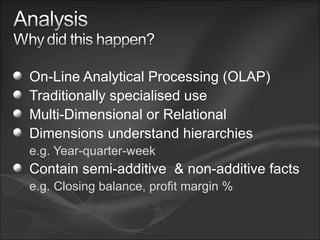
On-Line Analytical Processing (OLAP) Traditionally specialised use Multi-Dimensional or Relational Dimensions understand hierarchies e.g. Year-quarter-week Contain semi-additive  & non-additive facts e.g. Closing balance, profit margin %
Invariably Excel based Traditionally finance focused Consolidation across enterprise Should feed back into the reports & analysis
Traditionally Highly Specialised Used for: Basket Analysis Customer segmentation Three stage process: Model built in on sample data Tested on Test data Deployed on Live Data
 
Applications & Analytical  Clients Tools Platform
Compelling business need Strong business sponsor Good business / IT relationship Culture of analysis Infrastructure

Business Intelligence 101 for Business (BI 101)

  • 1.
  • 2.
  • 3.
  • 4.
  • 5.
    BI Tools andtechniques that support better decision making Turns data into insight Performance Management: Process to set objectives and plans Expressed as goals, plans, metrics & KPIs Uses Rules and Workflows Is Organisation aware.
  • 6.
    90% of organisations fail to execute their strategies successfully 95% of a typical workforce doesn’t understand how the organisational goals relate to their job. 86% of teams spend less than one hour a month discussing strategy 60% of organisations don’t link their strategies to plans and budgets Source: Palladium Group/BSCOL
  • 7.
  • 8.
    Historical (& current)Consistent Integrated In the user’s model ERP CRM 3Pty SCM
  • 9.
  • 10.
  • 11.
    What happened? Whatis happening? Why? What will happen? What do I want to happen? Reporting Analyzing Forecasting Planning For sales Operational Financial Statutory Performance management Business Activity Monitoring Sales analysis Campaign, Promotion analysis HR analysis Product mix Risk analysis Sensitivity analysis Volume and Sales forecasting Rates simulation Currency Hedging Stock portfolio management Store/ATM placement Promotion forecasting Supermarket queuing Routing Reorg simulation Budgeting New Product launch planning …
  • 12.
    Central Repository Designed& optimised for Reporting Comprises Dimensions and Facts Star Schema Built in modular form from Data Marts
  • 13.
    Used by everyonein the business Web based delivery Some interaction Filters, sort, export to file & Excel Can be run direct from source systems to support operations
  • 14.
    Based on workby Norton & Kaplan Top Down approach Performance should relate to rewards
  • 15.
    On-Line Analytical Processing(OLAP) Traditionally specialised use Multi-Dimensional or Relational Dimensions understand hierarchies e.g. Year-quarter-week Contain semi-additive & non-additive facts e.g. Closing balance, profit margin %
  • 16.
    Invariably Excel basedTraditionally finance focused Consolidation across enterprise Should feed back into the reports & analysis
  • 17.
    Traditionally Highly SpecialisedUsed for: Basket Analysis Customer segmentation Three stage process: Model built in on sample data Tested on Test data Deployed on Live Data
  • 18.
  • 19.
    Applications & Analytical Clients Tools Platform
  • 20.
    Compelling business needStrong business sponsor Good business / IT relationship Culture of analysis Infrastructure

Editor's Notes

  • #2 06/07/09 02:52 © 2007 Microsoft Corporation. All rights reserved. Microsoft, Windows, Windows Vista and other product names are or may be registered trademarks and/or trademarks in the U.S. and/or other countries. The information herein is for informational purposes only and represents the current view of Microsoft Corporation as of the date of this presentation. Because Microsoft must respond to changing market conditions, it should not be interpreted to be a commitment on the part of Microsoft, and Microsoft cannot guarantee the accuracy of any information provided after the date of this presentation. MICROSOFT MAKES NO WARRANTIES, EXPRESS, IMPLIED OR STATUTORY, AS TO THE INFORMATION IN THIS PRESENTATION.