Building a rural workforce:
Extending the work of a rural
teacher education curriculum -
Better preparing teacher educators
for a rural workforce
RRRTEC Extension project
OLT funded
Simone White
Monash University
Context
• In Australia (and internationally) rural,regional
and remote school communities find it hard to
recruit and retain quality teachers.
• How can we better prepare graduate
teachers for a rural career and for the
diversity of rural, regional and possible
remote ‘places’ they might work in?
ALTC Funded Project
• 2 year project
• Data collected
– Literature review
– Surveys – Teacher Educators and PST’s
– State and national base incentives/programs
• Conceptual model
• Curriculum and resource development
• Website and disemmination
www.rrrtec.net.au
The final deliverable
The RRRTEC extension project set out
to achieve three main goals:
• To improve and extend the use of the website
(www.rrrtec.net.au).
• To develop and implement the RRRTEC
professional experience package.
• To develop a set of professional learning tools
and package for teacher educators on how to
best use the website.
Reference group
• Professor Nan Bahr, Queensland University of Technology*
• Associate Professor Tania Broadley, Curtin University*
• Ms Kelly Carabott, Monash University*
• Ms Briony Carter, University of South Australia*
• Associate Professor Rosie Le Cornu, University of South Australia*
The reference group met face to face in February-March, 2013 (27th -1st) in
Melbourne and they have been the key Institutional contacts in: supporting
the analysis of the teacher educator in-depth interview data (collected as part
of the RRRTEC project); dissemination of this work; advising on the social
media strategies; providing feedback in regards to the professional
development workshop materials and in providing additional resources to the
website.
– Professor Marie Brennan (Victoria University)* also joined the
reference group meeting and advice was sought on a research strategy
as part of the professional learning material development
• Dr Jodie Kline was employed as the Research Assistant
• Mr Vi Lam was employed as the Social Media consultant
Developing a conceptual model for
RRRTEC Extension:
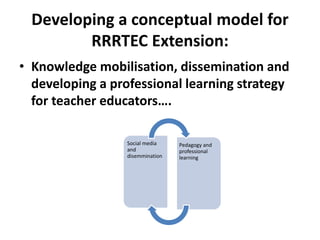
• Knowledge mobilisation, dissemination and
developing a professional learning strategy
for teacher educators….
Social media
and
disemmination
Pedagogy and
professional
learning
Teacher educators need to be better
equipped for the following reasons:
Workforce needs
• Teacher shortages exist in rural, regional and remote contexts in every State and Territory
across Australia. Rural, regional and remote schools deserve high quality teachers and
students urgently need teachers who are well prepared to commit to a rural teaching career
and stop the staffing churn.
Teacher’s work
• Teachers who work in rural, regional and remote contexts are more visible in the
communities in which they work. Teachers need to know about the places in which they are
employed and be prepared to build relationships beyond the classroom. Teachers need to be
classroom, school and community ready (White, 2010, White & Kline, 2012). Graduate and
beginning teachers in rural contexts are more likely to be asked to take up leadership roles
and are viewed by the communities they serve as leaders (Reid et. al, 2010). Teachers are
also more likely to have the emotional dimension of their work amplified (Le Cornu, 2011).
Multi-age teaching and teaching across stages is a skill that many teachers who work in rural,
regional and remote contexts need from the beginning of their career.
Program standards
• New AITSL Initial Teacher Education program standards 2.1 and 5.4 outline the needs for
teacher education curriculum to develop graduates who can work with parents/caregivers
and within their local communities. Teacher Professional Standard 7 outlines also the
importance of teachers’ work with communities. These national Standards demand teacher
educators take greater responsibility for preparing teachers for all diverse school contexts.
New PD tab inserted
Developing the Social Media tool
• Social media was identified as an effective tool to provide
the opportunity for teacher educators to share their own
professional learning and development with their peers;
create new resources and strategies; make suggestions and
to critically reflect on their teaching practice.
• After some investigation of the appropriate ethics and
suitability of different social media tools it was decided that
a facebook site would be the most appropriate platform to
compliment the website. It was envisioned that the
facebook site would become the tool to disseminate the
RRRTEC resources and broaden the audience participating
in the professional learning.
The facebook site was created in
February, 2013 and can be accessed
via the following link -
https://www.facebook.com/rrrtec .
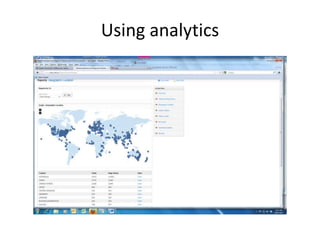
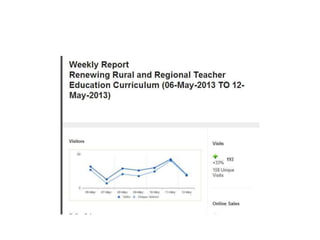
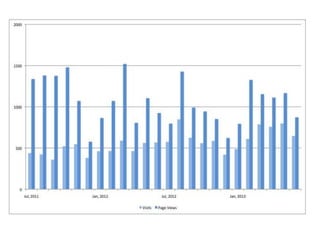
Using analytics
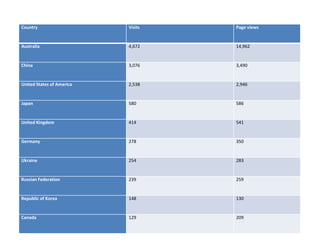
Country Visits Page views
Australia 4,672 14,962
China 3,076 3,490
United States of America 2,538 2,946
Japan 580 586
United Kingdom 414 541
Germany 278 350
Ukraine 254 283
Russian Federation 239 259
Republic of Korea 148 130
Canada 129 209
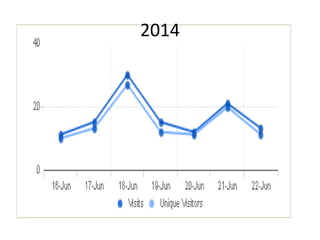
2014
• The RRRTEC website materials have been
embedded into two other completed
ALTC/OLT projects. Details of the other
websites can be found at:
• www.teacherevidence.net
• www.teacherassessment.net
Next phase?
Looking at developing PD ‘videos’ to
add to the site
Building the ECR/HDR community
Contact
simone.white@monash.edu
Questions?

Better preparing teacher educators for a rural workforce (1)

  • 1.
    Building a ruralworkforce: Extending the work of a rural teacher education curriculum - Better preparing teacher educators for a rural workforce RRRTEC Extension project OLT funded Simone White Monash University
  • 2.
    Context • In Australia(and internationally) rural,regional and remote school communities find it hard to recruit and retain quality teachers. • How can we better prepare graduate teachers for a rural career and for the diversity of rural, regional and possible remote ‘places’ they might work in?
  • 3.
    ALTC Funded Project •2 year project • Data collected – Literature review – Surveys – Teacher Educators and PST’s – State and national base incentives/programs • Conceptual model • Curriculum and resource development • Website and disemmination
  • 4.
  • 5.
    The RRRTEC extensionproject set out to achieve three main goals: • To improve and extend the use of the website (www.rrrtec.net.au). • To develop and implement the RRRTEC professional experience package. • To develop a set of professional learning tools and package for teacher educators on how to best use the website.
  • 6.
    Reference group • ProfessorNan Bahr, Queensland University of Technology* • Associate Professor Tania Broadley, Curtin University* • Ms Kelly Carabott, Monash University* • Ms Briony Carter, University of South Australia* • Associate Professor Rosie Le Cornu, University of South Australia* The reference group met face to face in February-March, 2013 (27th -1st) in Melbourne and they have been the key Institutional contacts in: supporting the analysis of the teacher educator in-depth interview data (collected as part of the RRRTEC project); dissemination of this work; advising on the social media strategies; providing feedback in regards to the professional development workshop materials and in providing additional resources to the website. – Professor Marie Brennan (Victoria University)* also joined the reference group meeting and advice was sought on a research strategy as part of the professional learning material development • Dr Jodie Kline was employed as the Research Assistant • Mr Vi Lam was employed as the Social Media consultant
  • 7.
    Developing a conceptualmodel for RRRTEC Extension: • Knowledge mobilisation, dissemination and developing a professional learning strategy for teacher educators…. Social media and disemmination Pedagogy and professional learning
  • 8.
    Teacher educators needto be better equipped for the following reasons: Workforce needs • Teacher shortages exist in rural, regional and remote contexts in every State and Territory across Australia. Rural, regional and remote schools deserve high quality teachers and students urgently need teachers who are well prepared to commit to a rural teaching career and stop the staffing churn. Teacher’s work • Teachers who work in rural, regional and remote contexts are more visible in the communities in which they work. Teachers need to know about the places in which they are employed and be prepared to build relationships beyond the classroom. Teachers need to be classroom, school and community ready (White, 2010, White & Kline, 2012). Graduate and beginning teachers in rural contexts are more likely to be asked to take up leadership roles and are viewed by the communities they serve as leaders (Reid et. al, 2010). Teachers are also more likely to have the emotional dimension of their work amplified (Le Cornu, 2011). Multi-age teaching and teaching across stages is a skill that many teachers who work in rural, regional and remote contexts need from the beginning of their career. Program standards • New AITSL Initial Teacher Education program standards 2.1 and 5.4 outline the needs for teacher education curriculum to develop graduates who can work with parents/caregivers and within their local communities. Teacher Professional Standard 7 outlines also the importance of teachers’ work with communities. These national Standards demand teacher educators take greater responsibility for preparing teachers for all diverse school contexts.
  • 9.
    New PD tabinserted
  • 10.
    Developing the SocialMedia tool • Social media was identified as an effective tool to provide the opportunity for teacher educators to share their own professional learning and development with their peers; create new resources and strategies; make suggestions and to critically reflect on their teaching practice. • After some investigation of the appropriate ethics and suitability of different social media tools it was decided that a facebook site would be the most appropriate platform to compliment the website. It was envisioned that the facebook site would become the tool to disseminate the RRRTEC resources and broaden the audience participating in the professional learning.
  • 11.
    The facebook sitewas created in February, 2013 and can be accessed via the following link - https://www.facebook.com/rrrtec .
  • 12.
  • 13.
    Country Visits Pageviews Australia 4,672 14,962 China 3,076 3,490 United States of America 2,538 2,946 Japan 580 586 United Kingdom 414 541 Germany 278 350 Ukraine 254 283 Russian Federation 239 259 Republic of Korea 148 130 Canada 129 209
  • 15.
  • 17.
    • The RRRTECwebsite materials have been embedded into two other completed ALTC/OLT projects. Details of the other websites can be found at: • www.teacherevidence.net • www.teacherassessment.net
  • 18.
    Next phase? Looking atdeveloping PD ‘videos’ to add to the site Building the ECR/HDR community
  • 19.