Better motion control using
accelerometer/gyroscope sensor fusion
               Gabor Paller
         gaborpaller@gmail.com
                Sfonge Ltd.
         http://www.sfonge.com
Where were we?
●   Droidcon 2011, London: Motion recognition on
    Android devices
    ●   http://mylifewithandroid.blogspot.com/2011/10/my-
        presentation-about-motion.html
●   Processing only the accelerometer for motion
    recognition
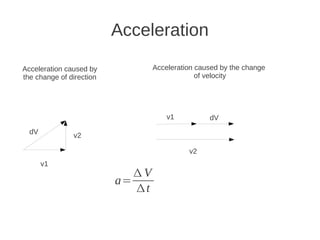
Acceleration

Acceleration caused by            Acceleration caused by the change
the change of direction                        of velocity


                                      v1          dV
  dV
               v2

                                            v2
       v1
                             ΔV
                          a=
                             Δt
Extract motion information from
              accelerometer data
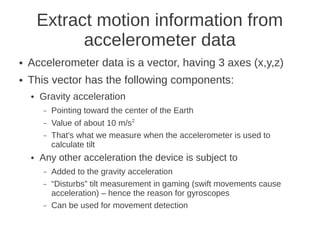
●   Accelerometer data is a vector, having 3 axes (x,y,z)
●   This vector has the following components:
    ●   Gravity acceleration
        –   Pointing toward the center of the Earth
        –   Value of about 10 m/s2
        –   That's what we measure when the accelerometer is used to
            calculate tilt
    ●   Any other acceleration the device is subject to
        –   Added to the gravity acceleration
        –   “Disturbs” tilt measurement in gaming (swift movements cause
            acceleration) – hence the reason for gyroscopes
        –   Can be used for movement detection
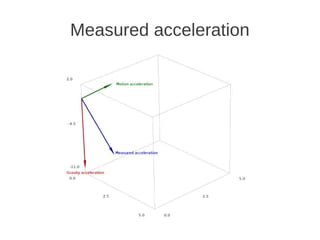
Measured acceleration
Absolute value
●   x, y, z: acceleration vector components
●   g – value of the gravity acceleration (can be
    approximated as 10)


             a= √ x +y +z −g
                     2     2    2
Snap – one way accelerating
         Movement starts:

                Movement ends: decelerating
Droidcon 2011 flashback
●   Conclusions:
    ●   Power consumption is a problem
    ●   Some neat functionality can be implemented by doing
        pattern recognition on the acceleration vector's absolute
        value
    ●   In general case the gravity and motion acceleration
        components cannot be separated
    ●   You can try to use an additional sensor like the gyro to help
        the separation
Gyroscope
●   Very new phenomenon as gyroscopes suitable for consumer
    electronic devices appeared very recently
●   First appearance: Wii Motion Plus accessory, 2009 June
●   First Android smart phone: Nexus S (end of 2010)
●   Pros:
    ●   Not sensitive to gravity
●   Cons:
    ●   Currently supported only by high-end Android phones
    ●   Drift problems (more about that later)
Compass
●   Measures the device orientation wrt. the magnetic vector of the Earth
    ●   This vector points toward the magnetic center of the Earth
         –   It has a component that points to the magnetic North pole – that's what we
             use for orientation
         –   Beware of the z component! (also called magnetic inclination). If the device
             is not held horizontally, the downward vector element influences the
             measurement
●   Pros:
    ●   Can be used to deduce gravity, not sensitive to motion acceleration
    ●   Widely available in Android devices
●   Cons:
    ●   Requires calibration
    ●   Sensitive to metal objects, magnetic fields (e.g. electric motors)
This time it is gyroscope only
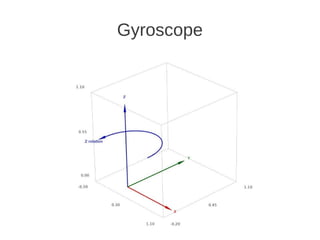
Gyroscope
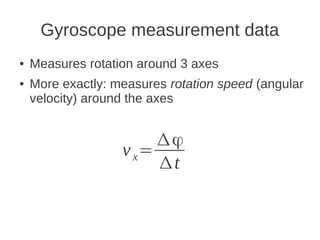
Gyroscope measurement data
●   Measures rotation around 3 axes
●   More exactly: measures rotation speed (angular
    velocity) around the axes


                        Δφ
                   v x=
                        Δt
Getting the rotation angle
●   Get the angle difference

               Δ φ=v x Δ t

●   Get the absolute angle
               φ ' =φ+Δ φ
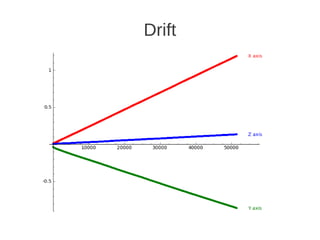
Drift
Noise
Gyro as support sensor
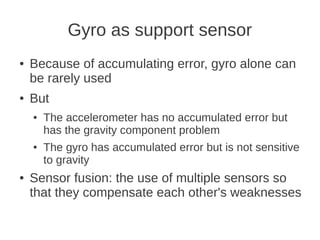
●   Because of accumulating error, gyro alone can
    be rarely used
●   But
    ●   The accelerometer has no accumulated error but
        has the gravity component problem
    ●   The gyro has accumulated error but is not sensitive
        to gravity
●   Sensor fusion: the use of multiple sensors so
    that they compensate each other's weaknesses
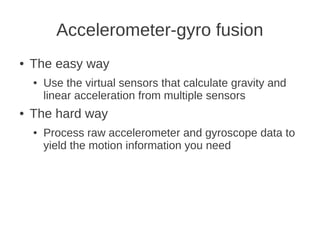
Accelerometer-gyro fusion
●   The easy way
    ●   Use the virtual sensors that calculate gravity and
        linear acceleration from multiple sensors
●   The hard way
    ●   Process raw accelerometer and gyroscope data to
        yield the motion information you need
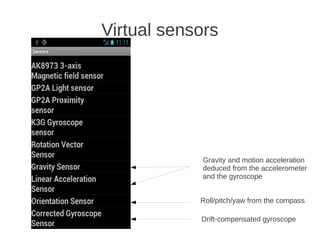
Virtual sensors


             Gravity and motion acceleration
             deduced from the accelerometer
             and the gyroscope


            Roll/pitch/yaw from the compass

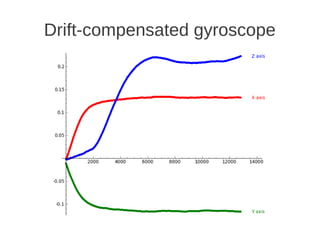
            Drift-compensated gyroscope
Drift-compensated gyroscope
The hard way
●   Why would you go the hard way?
    ●   Sensor fusion co-processing provided by the phone
        is not precise enough or can have undesirable
        properties (like auto-calibration in Nexus S)
    ●   Virtual sensors are not available (is there any such
        case with gyro-equipped phone?)
    ●   You would like to understand how it works and what
        to expect from built-in sensor fusion
    ●   Just for the fun of it :-)
What we want
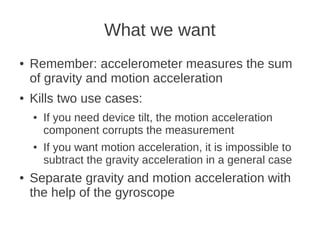
●   Remember: accelerometer measures the sum
    of gravity and motion acceleration
●   Kills two use cases:
    ●   If you need device tilt, the motion acceleration
        component corrupts the measurement
    ●   If you want motion acceleration, it is impossible to
        subtract the gravity acceleration in a general case
●   Separate gravity and motion acceleration with
    the help of the gyroscope
Idea
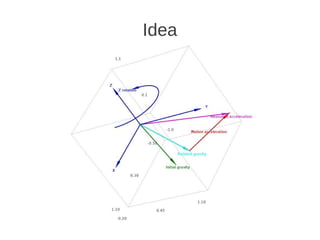
Idea in words
●   Pick a reliable gravity vector measurement
    (make sure that there's no motion then)
●   If you detect motion (more about later), rotate
    the previous gravity vector using the gyroscope
    data and use it as gravity vector estimation
●   Subtract this gravity vector estimation from the
    measured acceleration – this yields the motion
    acceleration
Updating the gravity vector
               estimation
●   The gravity vector estimation has to be updated
    time to time as rotation angle errors accumulate
●   If we detect an acceleration measurement
    where there is no motion acceleration, we can
    take it as new reliable gravity vector estimation
●   Remember slide #7: if the absolute value of the
    accelerometer output is close to the Earth's
    gravity, we can assume that there's no motion
    → the gravity vector estimation can be updated
    with the current accelerometer output
Implementation
●   Example program:
    http://www.sfonge.com/forum/topic/example-
    application-accelerometergyroscope-
    processing-android
Now what?


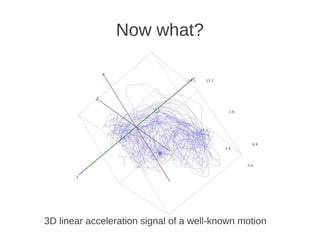
3D linear acceleration signal of a well-known motion
Recognizing motion
●   3D linear acceleration signals are not so
    intuitive
●   Motion recognition:
    ●   Record acceleration pattern of reference motion
        and compare with these references
    ●   Convert from acceleration domain to something
        more intuitive like velocity
        –   Accelerometer/gyroscope bias will become linearly
            growing drift after you integrate the acceleration signal!
Walking with swinging hand
Walking with steady hand
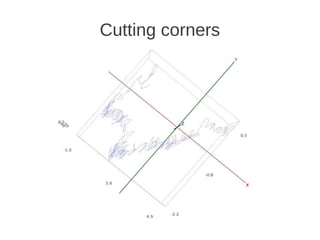
Cutting corners
Conclusions
●   Each sensor has strengths and weaknesses
●   Combine them and they compensate each
    other
●   Some sensor fusion is already built-in
●   If not → don't worry, come up with your own, it's
    fun!
●   Motion recognition based on 3D linear
    acceleration signal is much more exact than
    doing the same from 1D signal
Questions?

Better motion control using accelerometer/gyroscope sensor fusion

  • 1.
    Better motion controlusing accelerometer/gyroscope sensor fusion Gabor Paller gaborpaller@gmail.com Sfonge Ltd. http://www.sfonge.com
  • 2.
    Where were we? ● Droidcon 2011, London: Motion recognition on Android devices ● http://mylifewithandroid.blogspot.com/2011/10/my- presentation-about-motion.html ● Processing only the accelerometer for motion recognition
  • 3.
    Acceleration Acceleration caused by Acceleration caused by the change the change of direction of velocity v1 dV dV v2 v2 v1 ΔV a= Δt
  • 4.
    Extract motion informationfrom accelerometer data ● Accelerometer data is a vector, having 3 axes (x,y,z) ● This vector has the following components: ● Gravity acceleration – Pointing toward the center of the Earth – Value of about 10 m/s2 – That's what we measure when the accelerometer is used to calculate tilt ● Any other acceleration the device is subject to – Added to the gravity acceleration – “Disturbs” tilt measurement in gaming (swift movements cause acceleration) – hence the reason for gyroscopes – Can be used for movement detection
  • 5.
  • 6.
    Absolute value ● x, y, z: acceleration vector components ● g – value of the gravity acceleration (can be approximated as 10) a= √ x +y +z −g 2 2 2
  • 7.
    Snap – oneway accelerating Movement starts: Movement ends: decelerating
  • 8.
    Droidcon 2011 flashback ● Conclusions: ● Power consumption is a problem ● Some neat functionality can be implemented by doing pattern recognition on the acceleration vector's absolute value ● In general case the gravity and motion acceleration components cannot be separated ● You can try to use an additional sensor like the gyro to help the separation
  • 9.
    Gyroscope ● Very new phenomenon as gyroscopes suitable for consumer electronic devices appeared very recently ● First appearance: Wii Motion Plus accessory, 2009 June ● First Android smart phone: Nexus S (end of 2010) ● Pros: ● Not sensitive to gravity ● Cons: ● Currently supported only by high-end Android phones ● Drift problems (more about that later)
  • 10.
    Compass ● Measures the device orientation wrt. the magnetic vector of the Earth ● This vector points toward the magnetic center of the Earth – It has a component that points to the magnetic North pole – that's what we use for orientation – Beware of the z component! (also called magnetic inclination). If the device is not held horizontally, the downward vector element influences the measurement ● Pros: ● Can be used to deduce gravity, not sensitive to motion acceleration ● Widely available in Android devices ● Cons: ● Requires calibration ● Sensitive to metal objects, magnetic fields (e.g. electric motors)
  • 11.
    This time itis gyroscope only
  • 12.
  • 13.
    Gyroscope measurement data ● Measures rotation around 3 axes ● More exactly: measures rotation speed (angular velocity) around the axes Δφ v x= Δt
  • 14.
    Getting the rotationangle ● Get the angle difference Δ φ=v x Δ t ● Get the absolute angle φ ' =φ+Δ φ
  • 15.
  • 16.
  • 17.
    Gyro as supportsensor ● Because of accumulating error, gyro alone can be rarely used ● But ● The accelerometer has no accumulated error but has the gravity component problem ● The gyro has accumulated error but is not sensitive to gravity ● Sensor fusion: the use of multiple sensors so that they compensate each other's weaknesses
  • 18.
    Accelerometer-gyro fusion ● The easy way ● Use the virtual sensors that calculate gravity and linear acceleration from multiple sensors ● The hard way ● Process raw accelerometer and gyroscope data to yield the motion information you need
  • 19.
    Virtual sensors Gravity and motion acceleration deduced from the accelerometer and the gyroscope Roll/pitch/yaw from the compass Drift-compensated gyroscope
  • 20.
  • 21.
    The hard way ● Why would you go the hard way? ● Sensor fusion co-processing provided by the phone is not precise enough or can have undesirable properties (like auto-calibration in Nexus S) ● Virtual sensors are not available (is there any such case with gyro-equipped phone?) ● You would like to understand how it works and what to expect from built-in sensor fusion ● Just for the fun of it :-)
  • 22.
    What we want ● Remember: accelerometer measures the sum of gravity and motion acceleration ● Kills two use cases: ● If you need device tilt, the motion acceleration component corrupts the measurement ● If you want motion acceleration, it is impossible to subtract the gravity acceleration in a general case ● Separate gravity and motion acceleration with the help of the gyroscope
  • 23.
  • 24.
    Idea in words ● Pick a reliable gravity vector measurement (make sure that there's no motion then) ● If you detect motion (more about later), rotate the previous gravity vector using the gyroscope data and use it as gravity vector estimation ● Subtract this gravity vector estimation from the measured acceleration – this yields the motion acceleration
  • 25.
    Updating the gravityvector estimation ● The gravity vector estimation has to be updated time to time as rotation angle errors accumulate ● If we detect an acceleration measurement where there is no motion acceleration, we can take it as new reliable gravity vector estimation ● Remember slide #7: if the absolute value of the accelerometer output is close to the Earth's gravity, we can assume that there's no motion → the gravity vector estimation can be updated with the current accelerometer output
  • 26.
    Implementation ● Example program: http://www.sfonge.com/forum/topic/example- application-accelerometergyroscope- processing-android
  • 27.
    Now what? 3D linearacceleration signal of a well-known motion
  • 28.
    Recognizing motion ● 3D linear acceleration signals are not so intuitive ● Motion recognition: ● Record acceleration pattern of reference motion and compare with these references ● Convert from acceleration domain to something more intuitive like velocity – Accelerometer/gyroscope bias will become linearly growing drift after you integrate the acceleration signal!
  • 29.
  • 30.
  • 31.
  • 32.
    Conclusions ● Each sensor has strengths and weaknesses ● Combine them and they compensate each other ● Some sensor fusion is already built-in ● If not → don't worry, come up with your own, it's fun! ● Motion recognition based on 3D linear acceleration signal is much more exact than doing the same from 1D signal
  • 33.