Asset Management November, 2015| 1
Creating a robust asset management
strategy to optimise asset performance
and improve asset reliability
N o v e m b e r , 2 0 1 5
Nick Tompkins – Technical Manager
Asset Management November, 2015| 2
Objective:
• The objective of asset management is to achieve the best possible
match of physical assets with the requirements and goals of the
business that uses the assets .
Therefore addressing the costs in terms of:
• reduced demand for new assets by adoption of 'non-asset' solutions;
• maximising the service life of existing assets;
• lowering the overall cost of owning assets through the use of life-cycle
costing techniques; and
• ensuring a sharper focus on results by establishing clear accountability
and responsibility for assets.
Asset Management
Asset Management November, 2015| 3
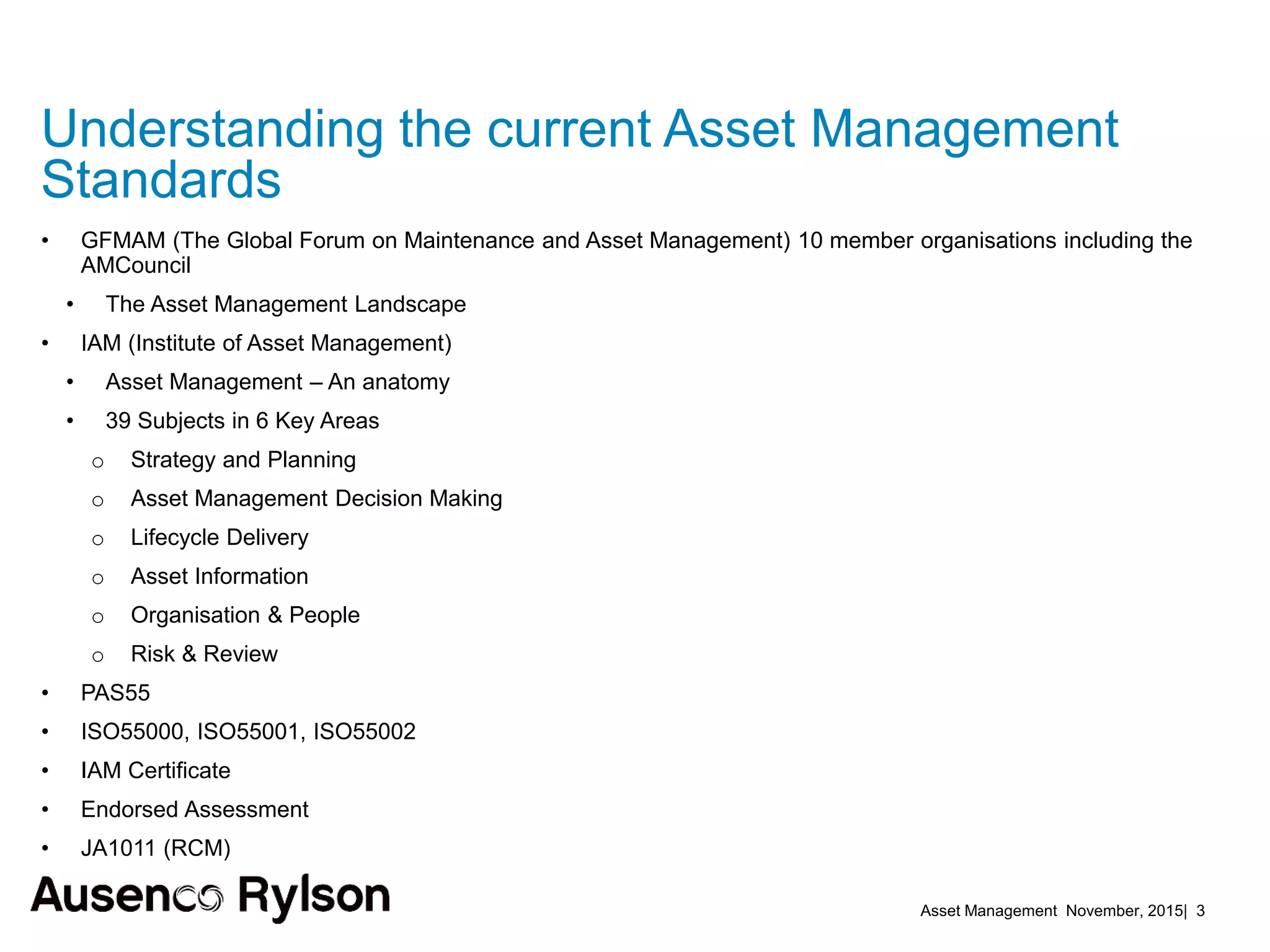
• GFMAM (The Global Forum on Maintenance and Asset Management) 10 member organisations including the
AMCouncil
• The Asset Management Landscape
• IAM (Institute of Asset Management)
• Asset Management – An anatomy
• 39 Subjects in 6 Key Areas
o Strategy and Planning
o Asset Management Decision Making
o Lifecycle Delivery
o Asset Information
o Organisation & People
o Risk & Review
• PAS55
• ISO55000, ISO55001, ISO55002
• IAM Certificate
• Endorsed Assessment
• JA1011 (RCM)
Understanding the current Asset Management
Standards
Asset Management November, 2015| 4
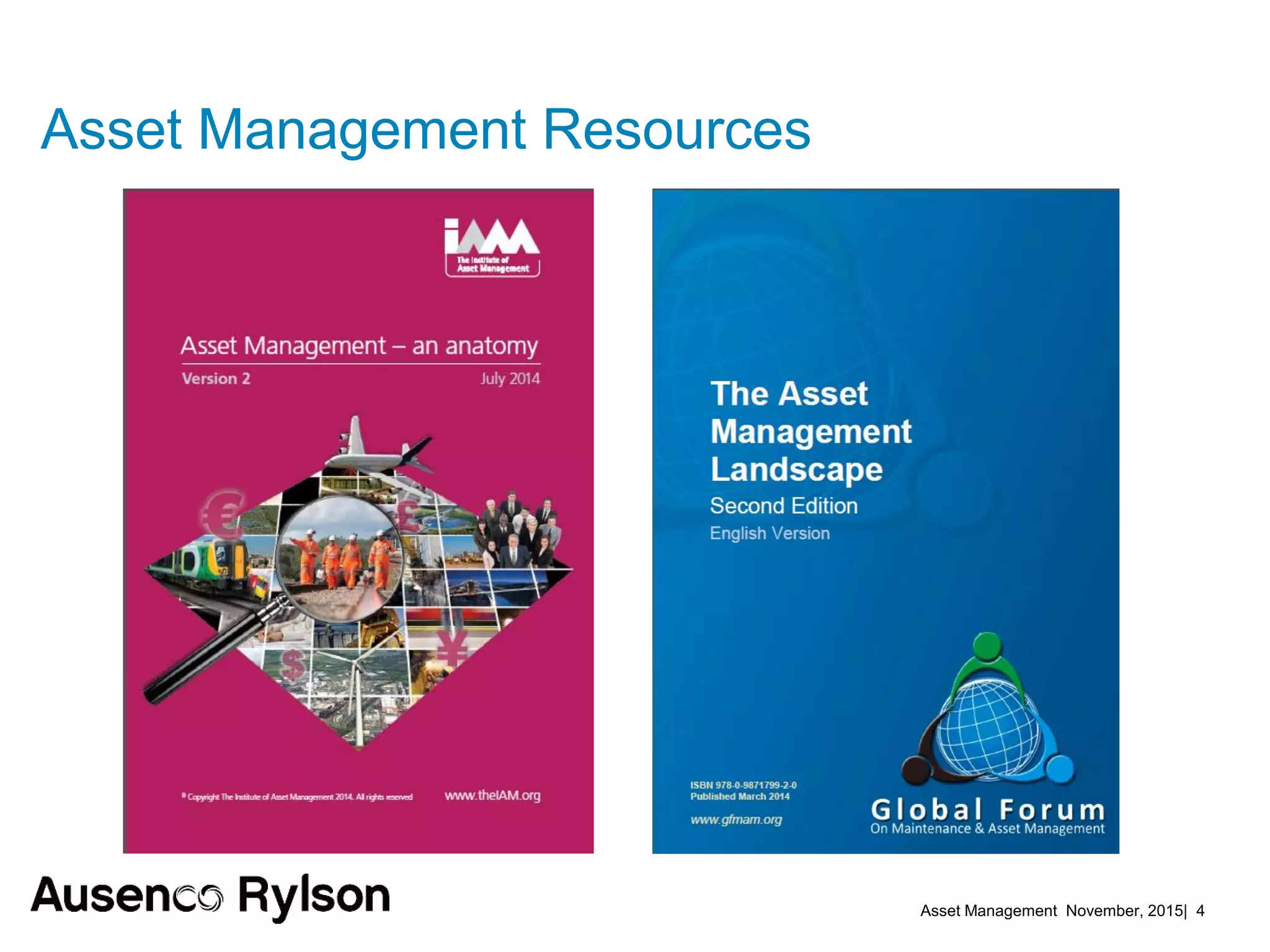
Asset Management Resources
Asset Management November, 2015| 5
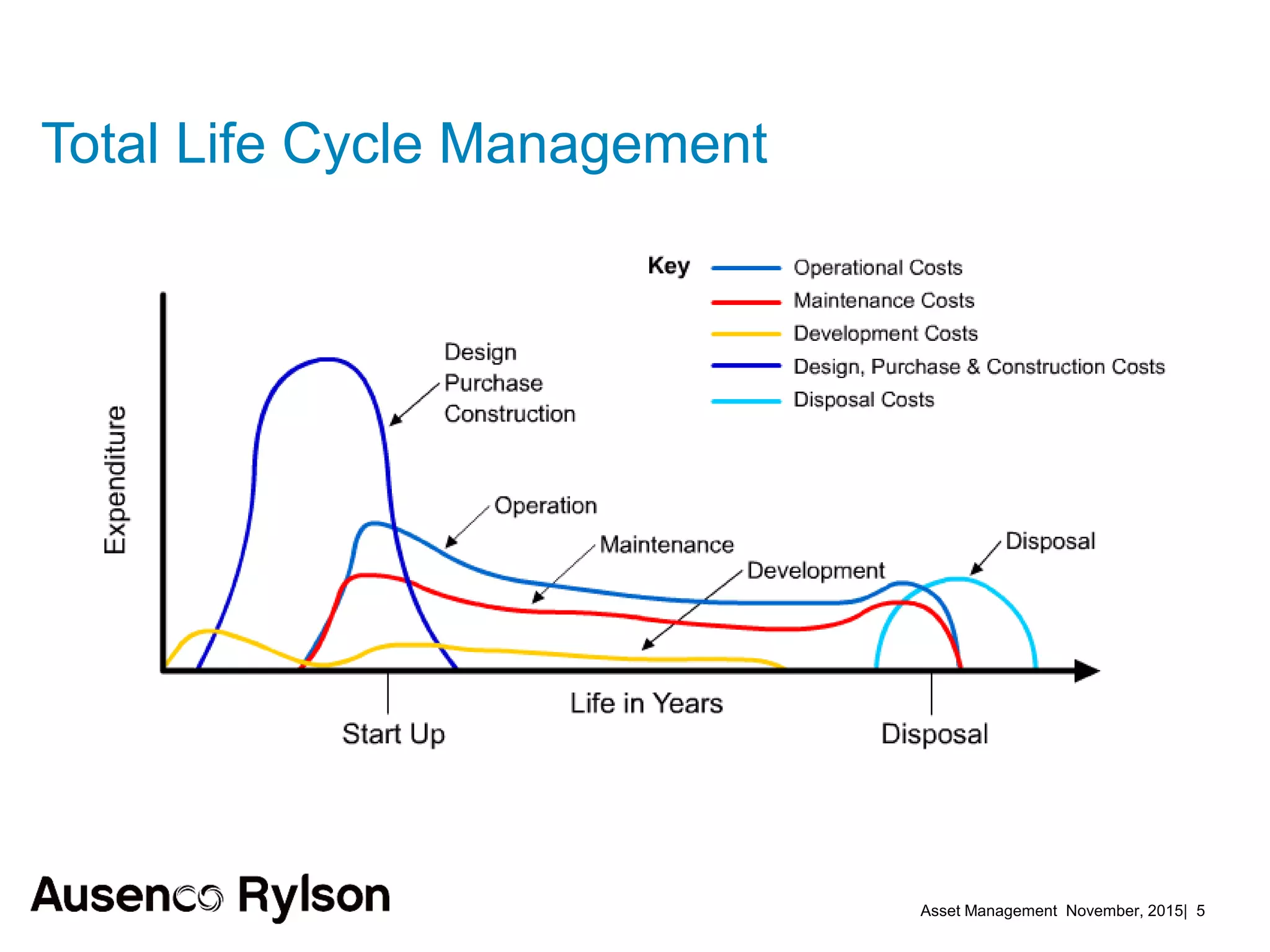
Total Life Cycle Management
Asset Management November, 2015| 6
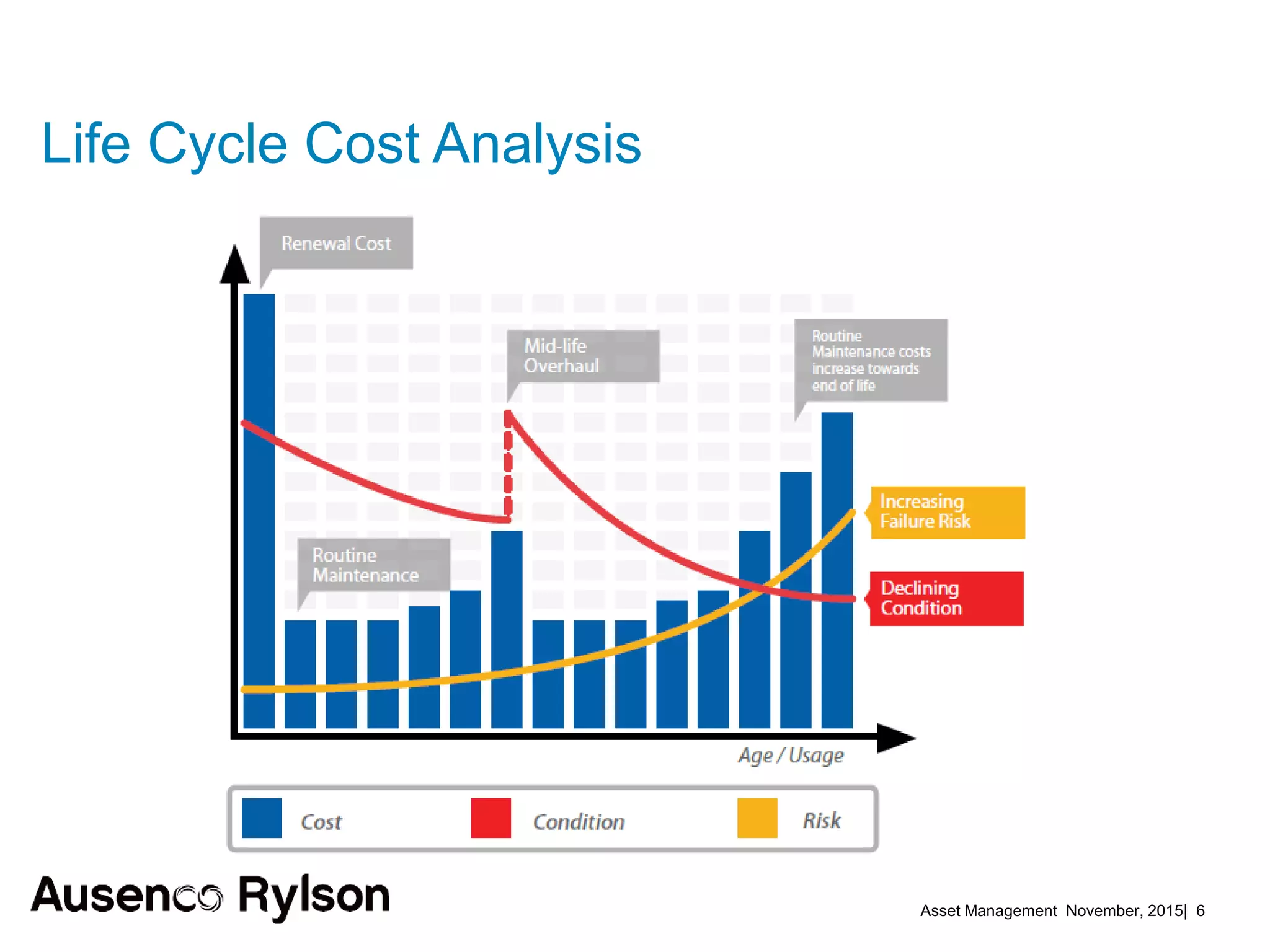
Life Cycle Cost Analysis
Asset Management November, 2015| 7
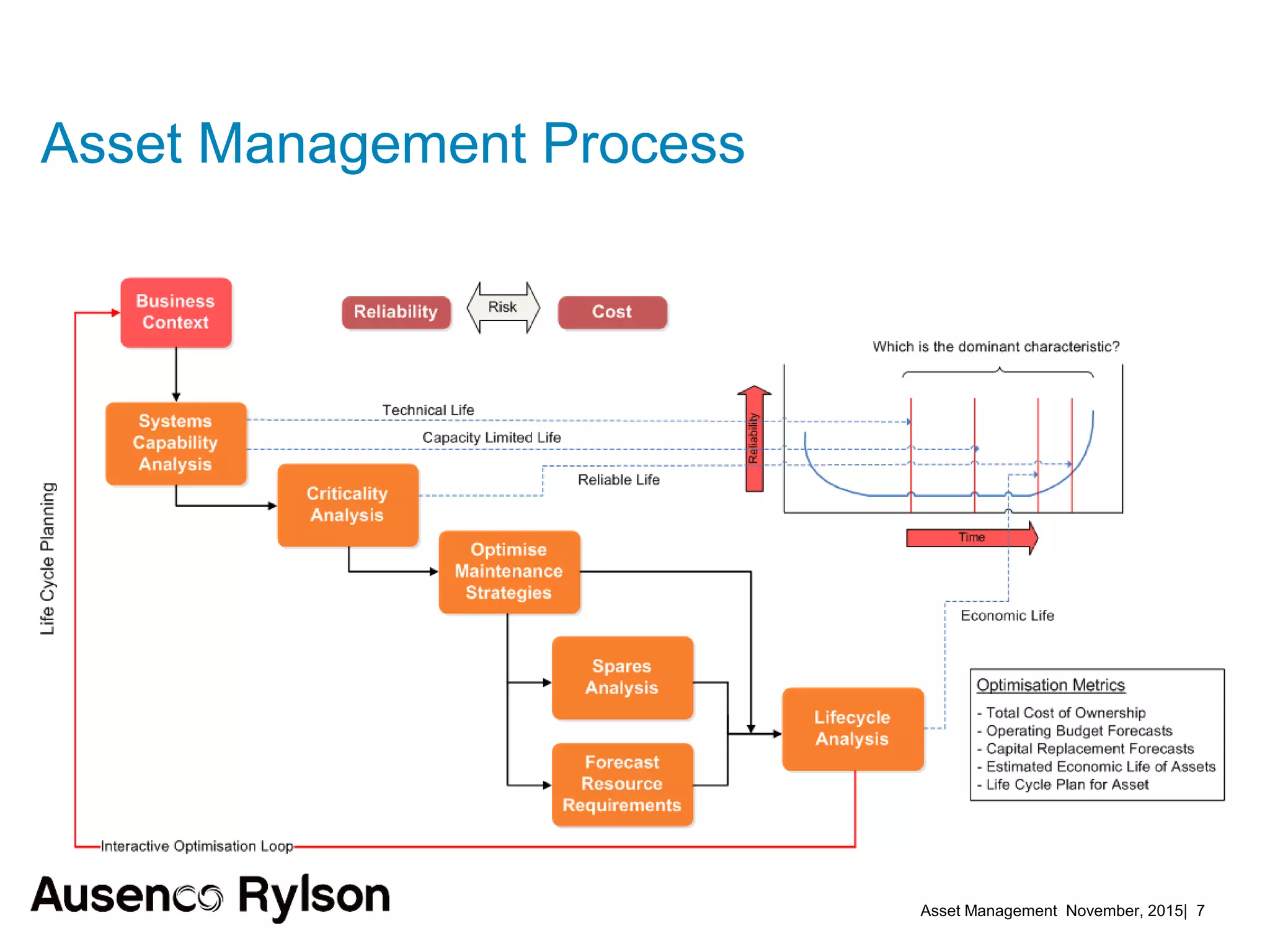
Asset Management Process
Asset Management November, 2015| 8
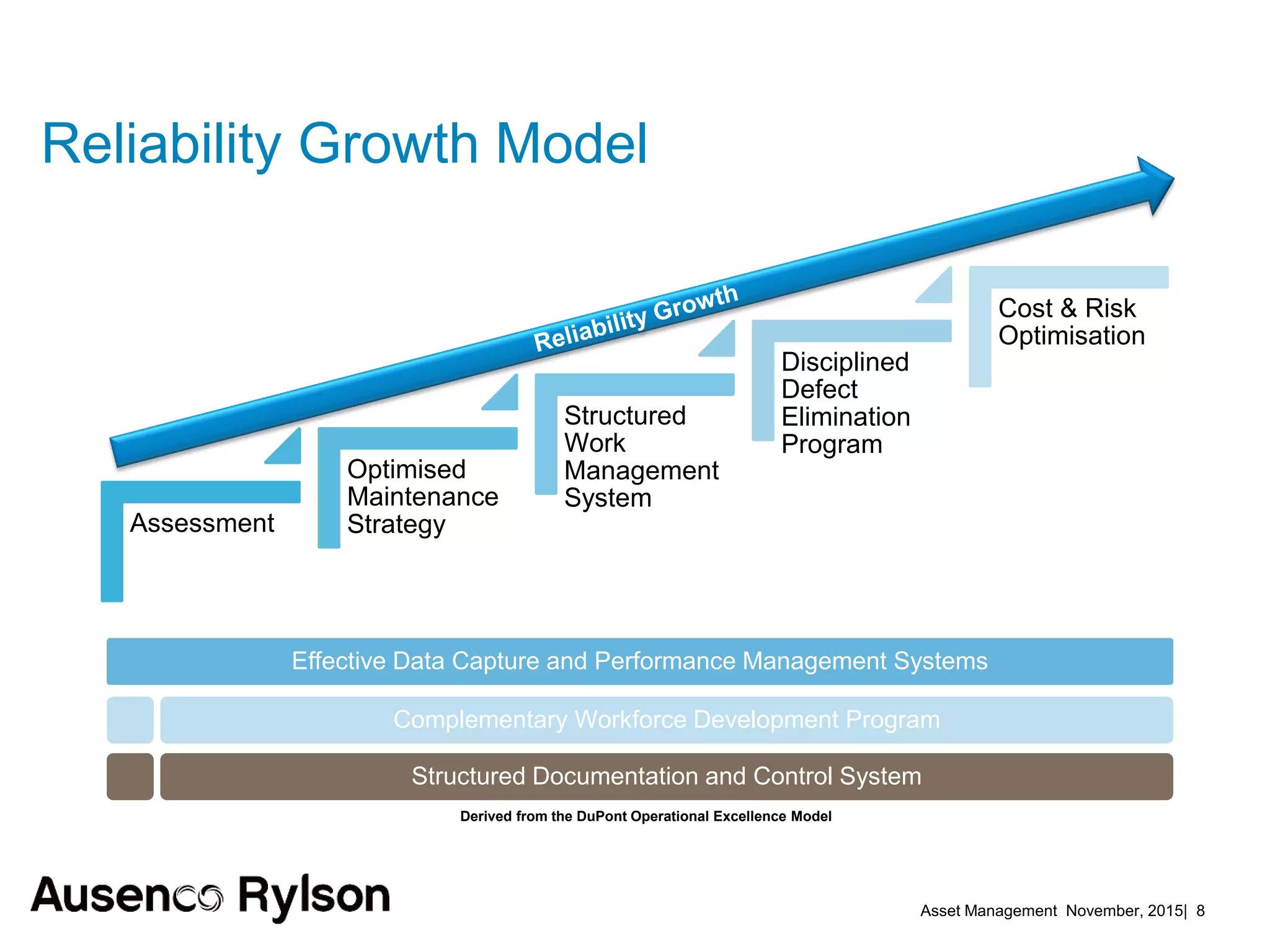
Reliability Growth Model
Derived from the DuPont Operational Excellence Model
Assessment
Optimised
Maintenance
Strategy
Structured
Work
Management
System
Disciplined
Defect
Elimination
Program
Cost & Risk
Optimisation
Effective Data Capture and Performance Management Systems
Complementary Workforce Development Program
Structured Documentation and Control System
Asset Management November, 2015| 9
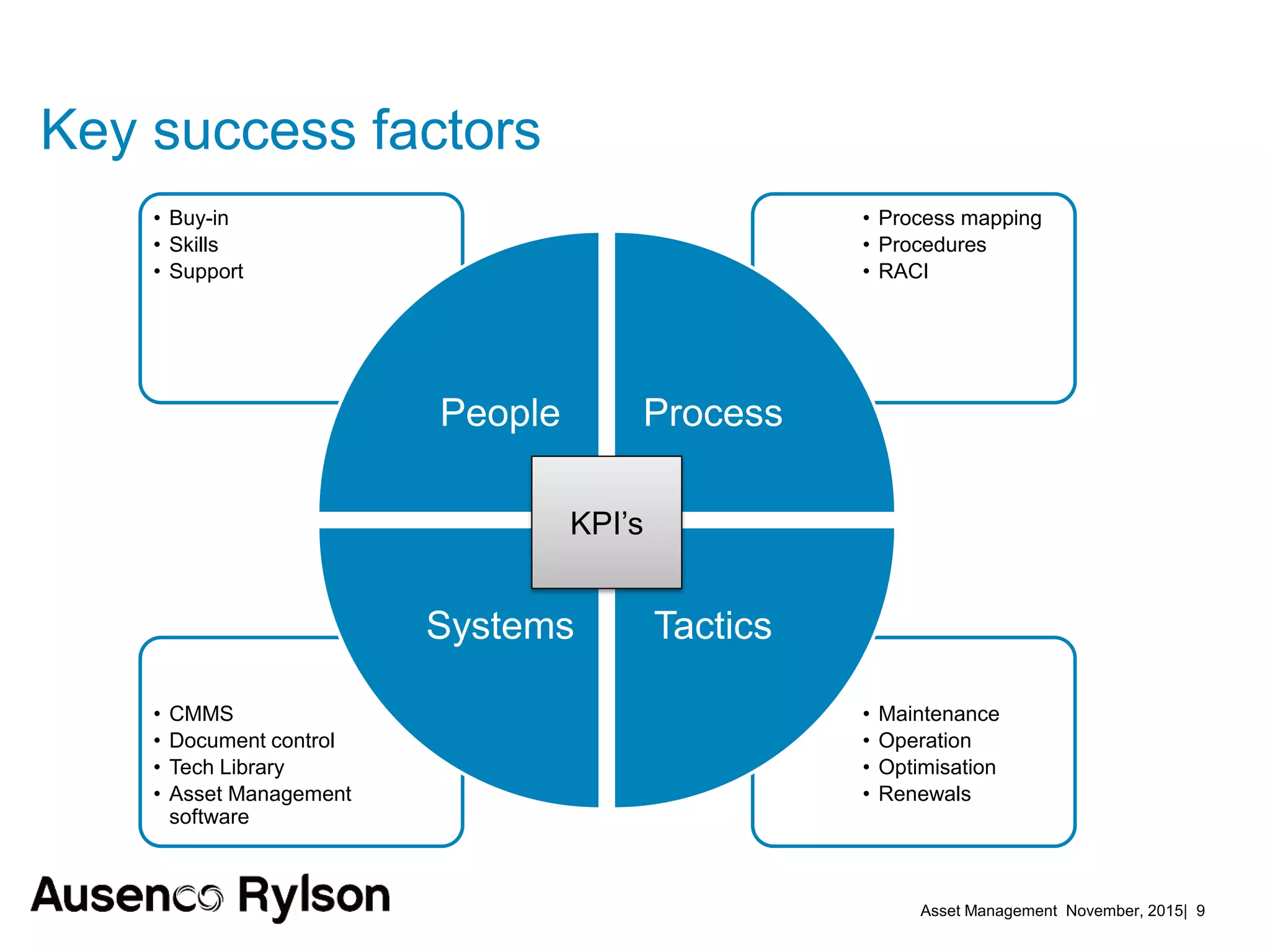
Key success factors
• Buy-in
• Skills
• Support
People
• Process mapping
• Procedures
• RACI
Process
• Maintenance
• Operation
• Optimisation
• Renewals
Tactics
• CMMS
• Document control
• Tech Library
• Asset Management
software
Systems
KPI’s
Asset Management November, 2015| 10
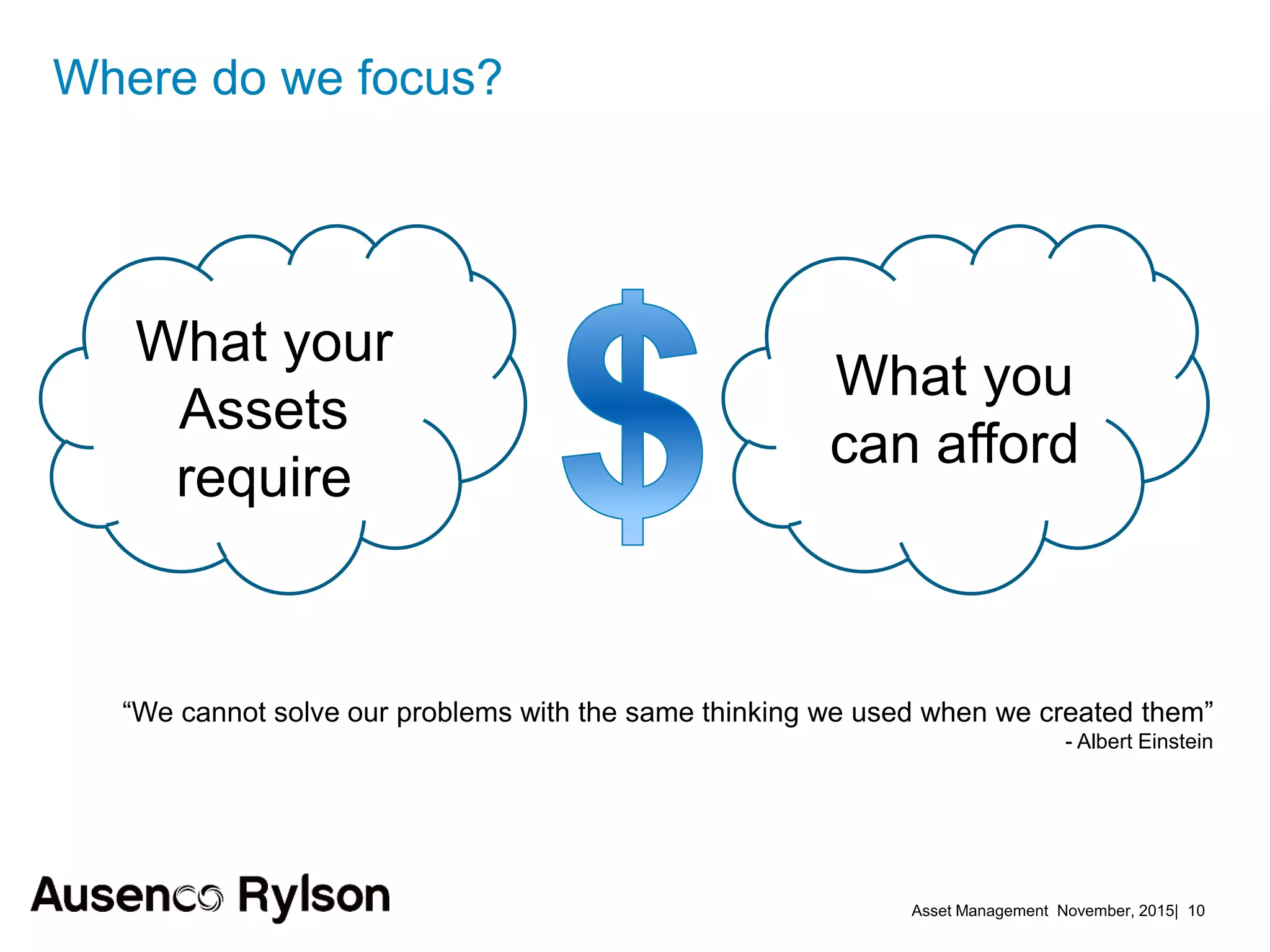
Where do we focus?
“We cannot solve our problems with the same thinking we used when we created them”
- Albert Einstein
What your
Assets
require
What you
can afford
Asset Management November, 2015| 11
• Continuing to do what you have always done will not provide the
outcomes you are looking for
• Best performers keep getting better
• Poor performers are falling further behind
Industry Benchmarks
Asset Management November, 2015| 12
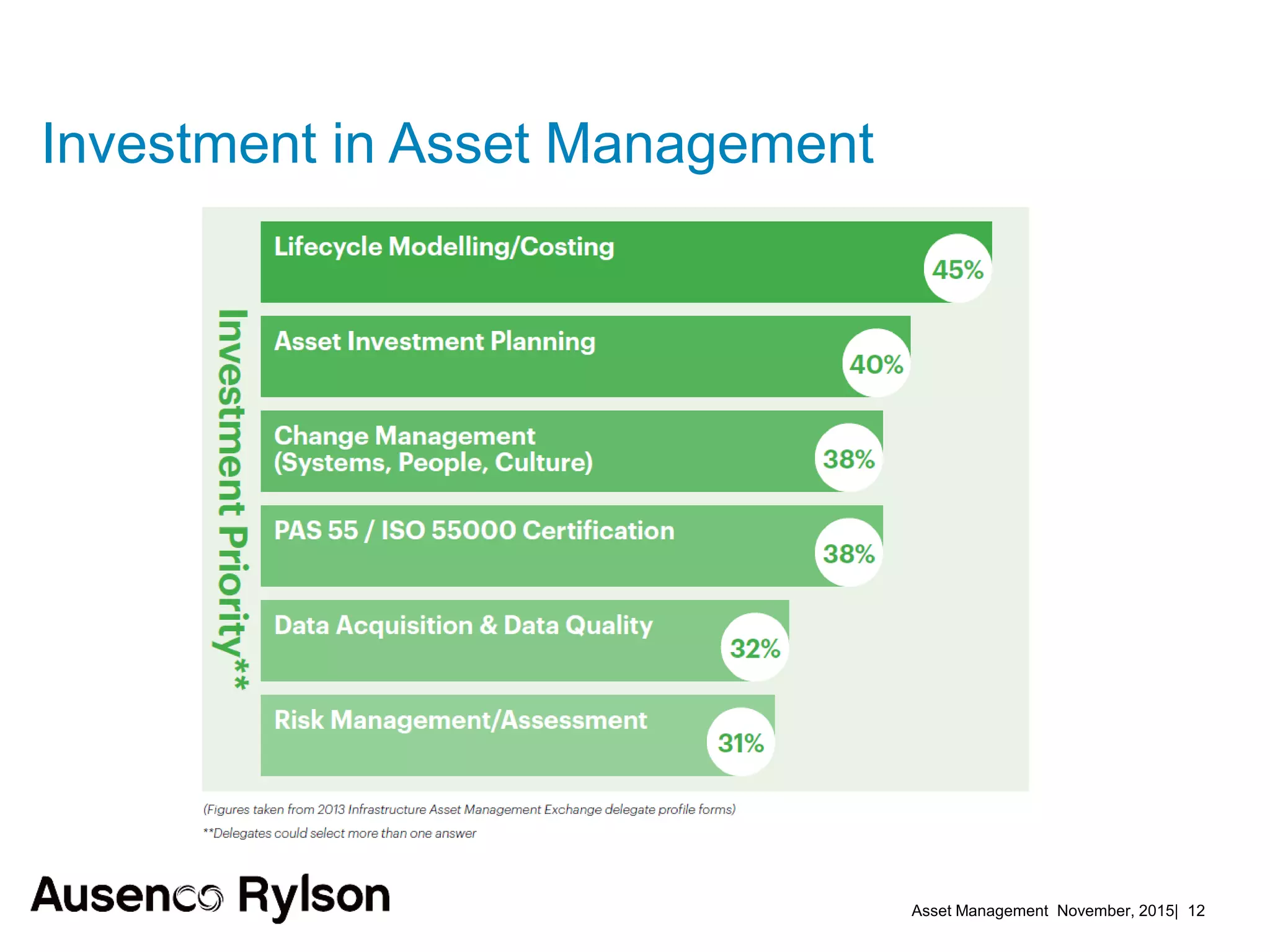
Investment in Asset Management
Asset Management November, 2015| 13
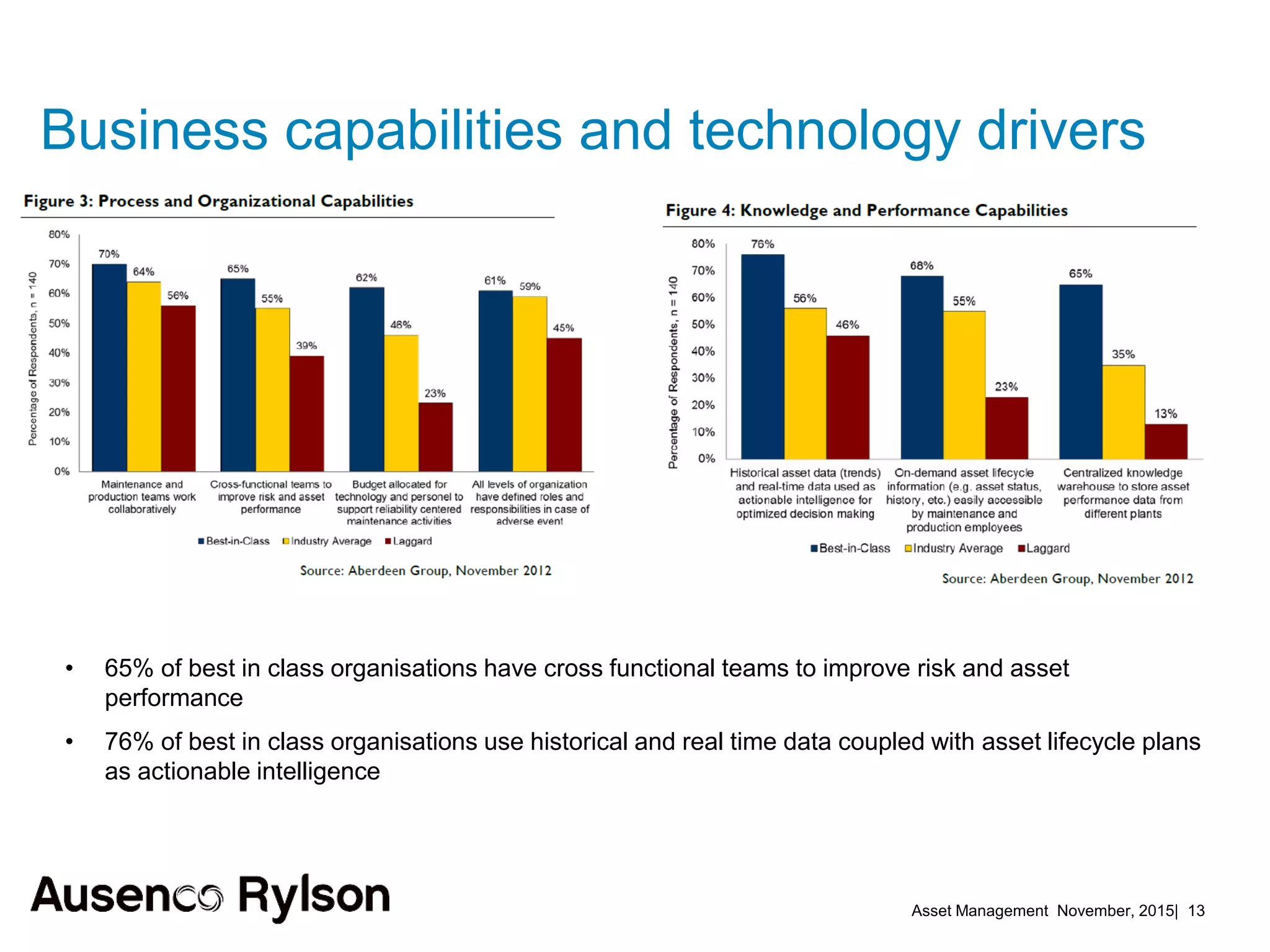
Business capabilities and technology drivers
• 65% of best in class organisations have cross functional teams to improve risk and asset
performance
• 76% of best in class organisations use historical and real time data coupled with asset lifecycle plans
as actionable intelligence
Asset Management November, 2015| 14
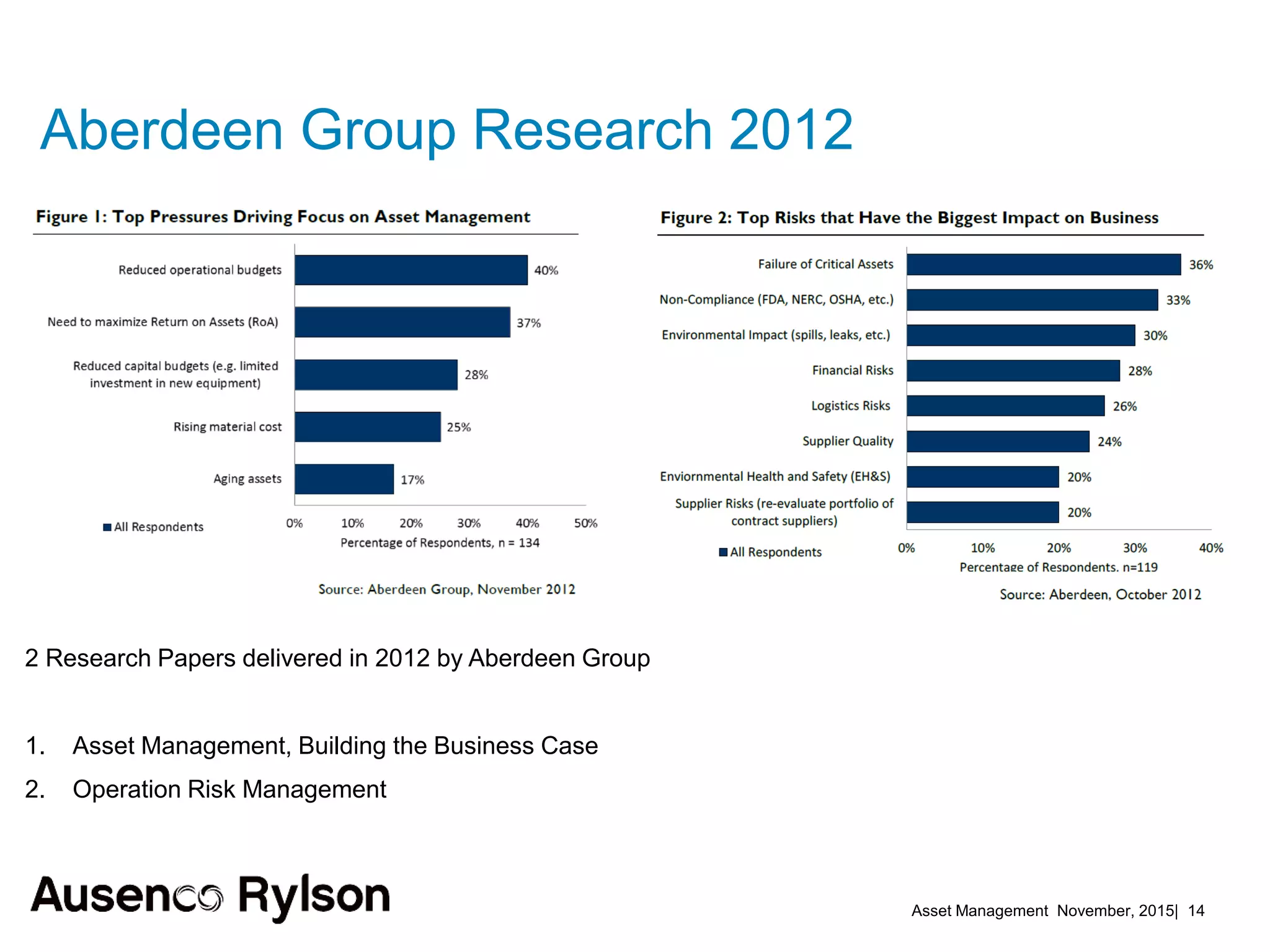
2 Research Papers delivered in 2012 by Aberdeen Group
1. Asset Management, Building the Business Case
2. Operation Risk Management
Aberdeen Group Research 2012
Asset Management November, 2015| 15
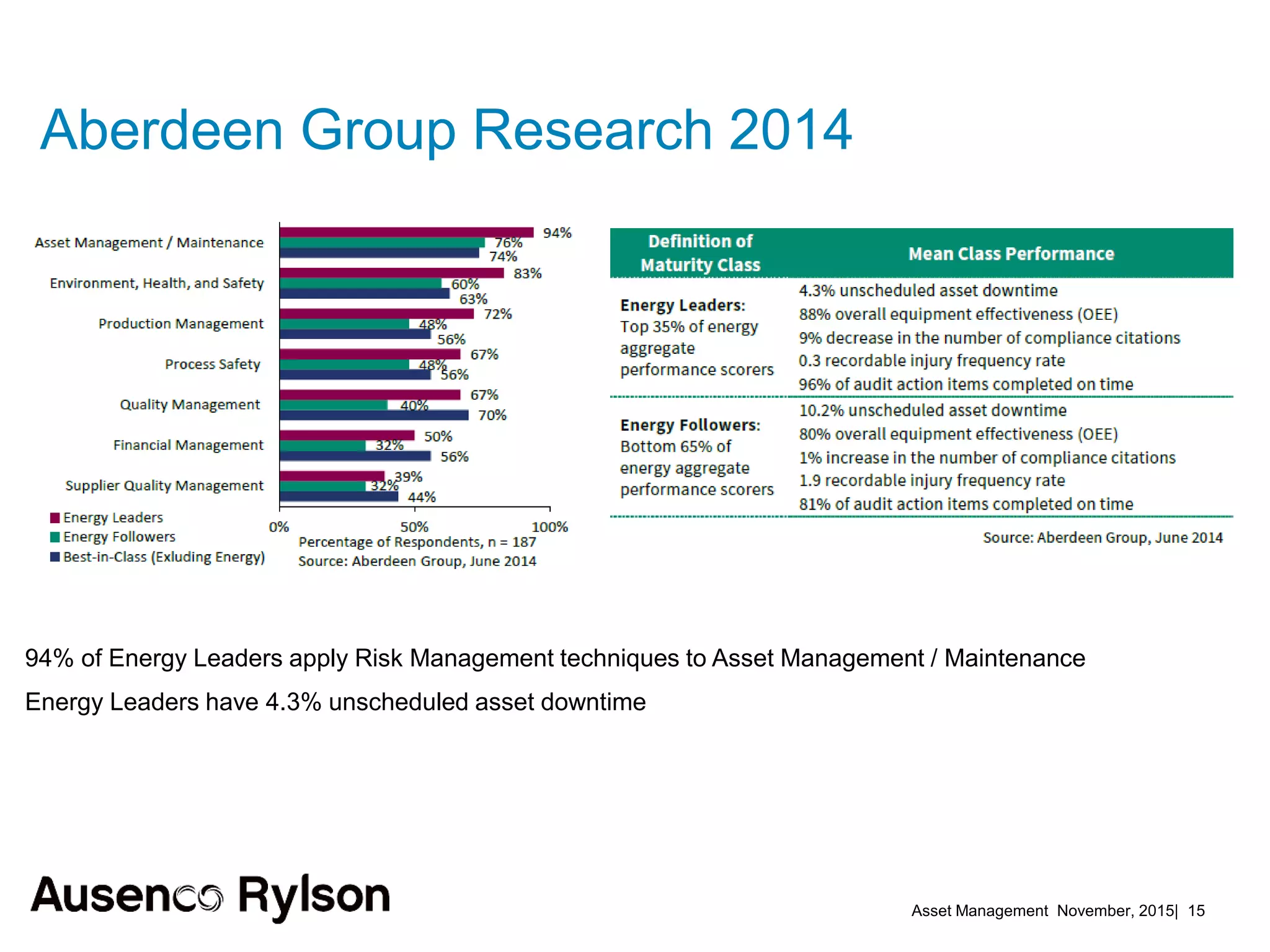
94% of Energy Leaders apply Risk Management techniques to Asset Management / Maintenance
Energy Leaders have 4.3% unscheduled asset downtime
Aberdeen Group Research 2014
Asset Management November, 2015| 16
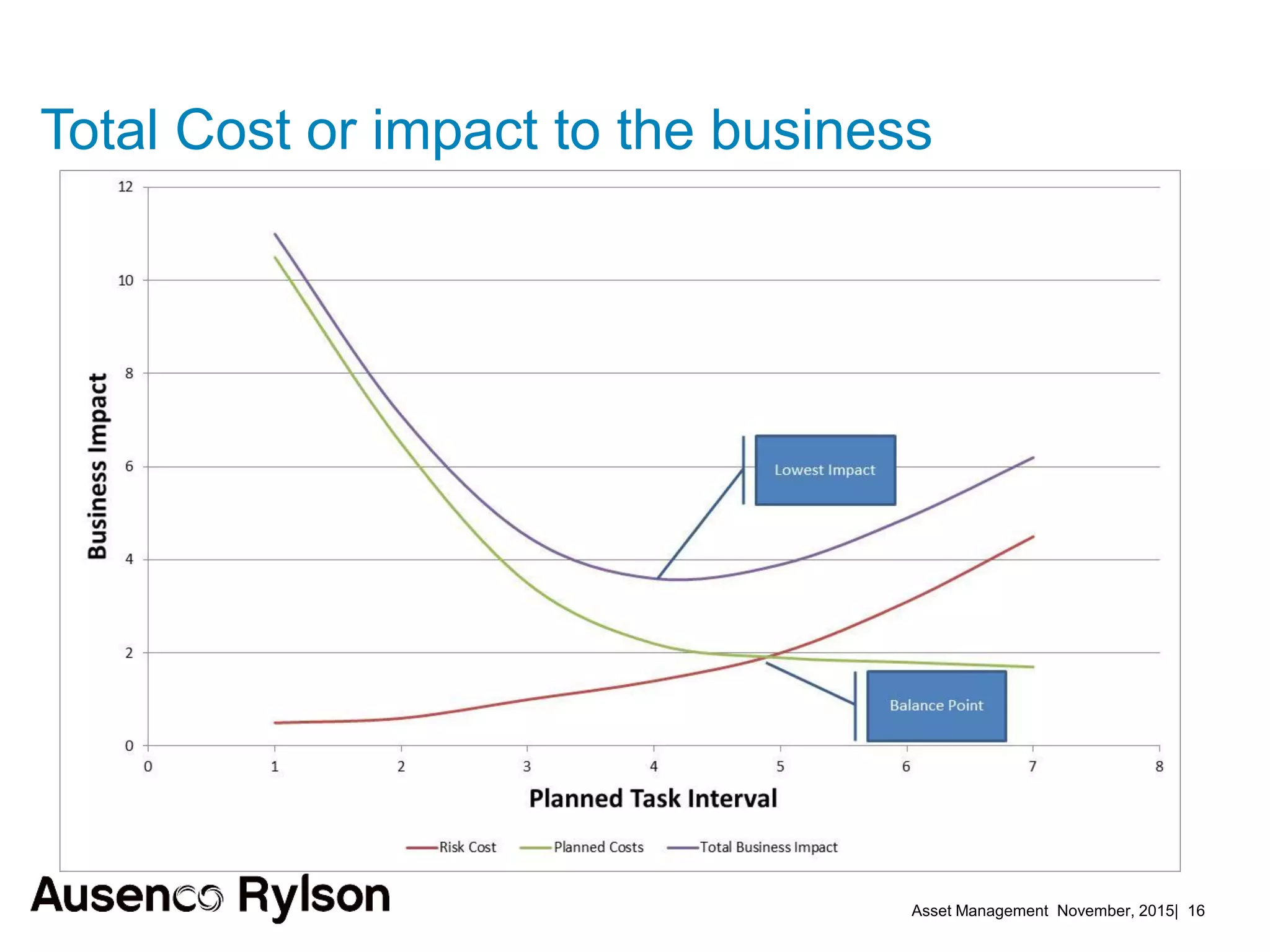
Total Cost or impact to the business
Asset Management November, 2015| 17
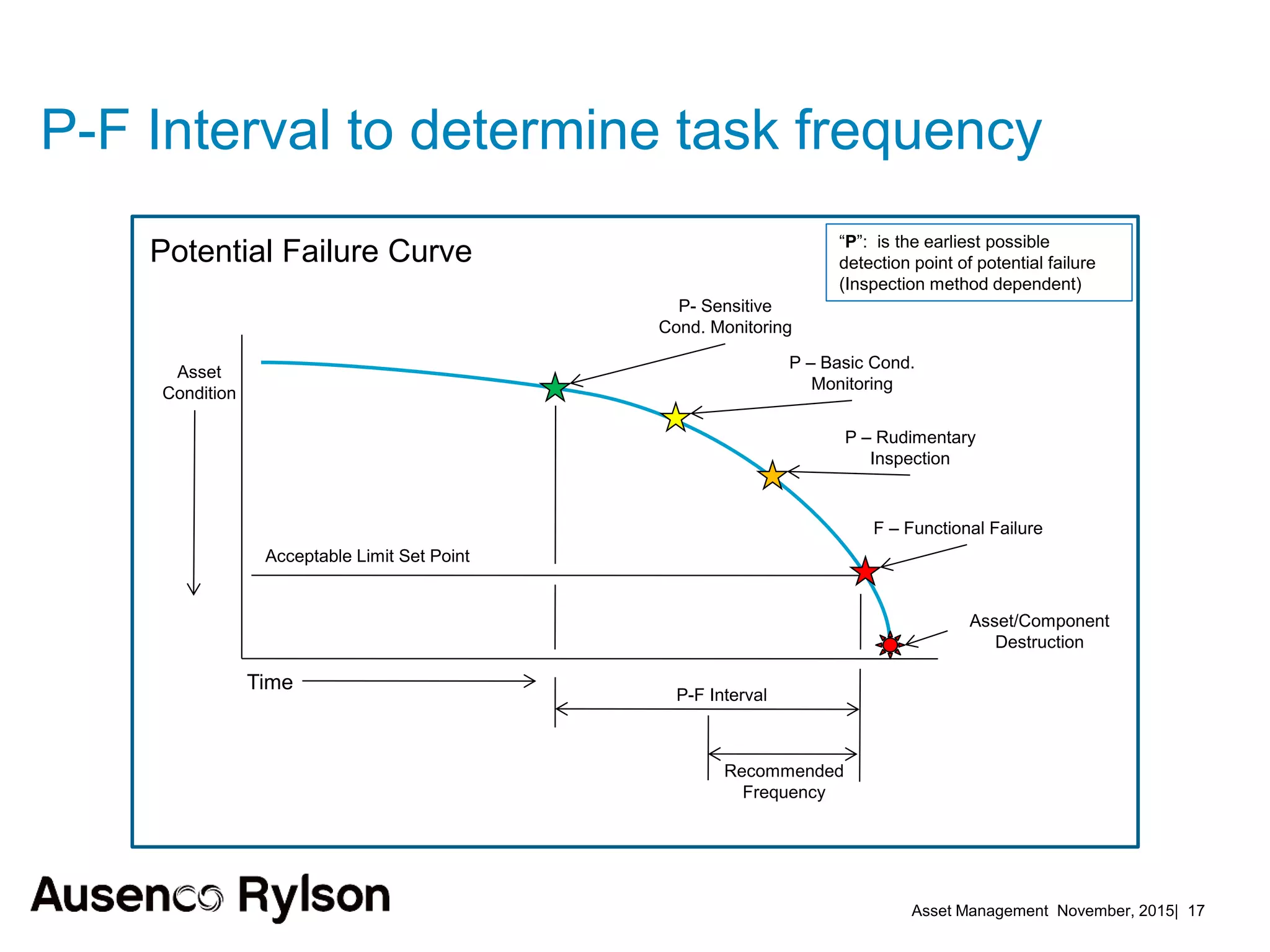
P-F Interval to determine task frequency
Acceptable Limit Set Point
P- Sensitive
Cond. Monitoring
P – Basic Cond.
Monitoring
P – Rudimentary
Inspection
F – Functional Failure
Asset/Component
Destruction
Time
Asset
Condition
P-F Interval
“P”: is the earliest possible
detection point of potential failure
(Inspection method dependent)
Recommended
Frequency
Potential Failure Curve
Asset Management November, 2015| 18
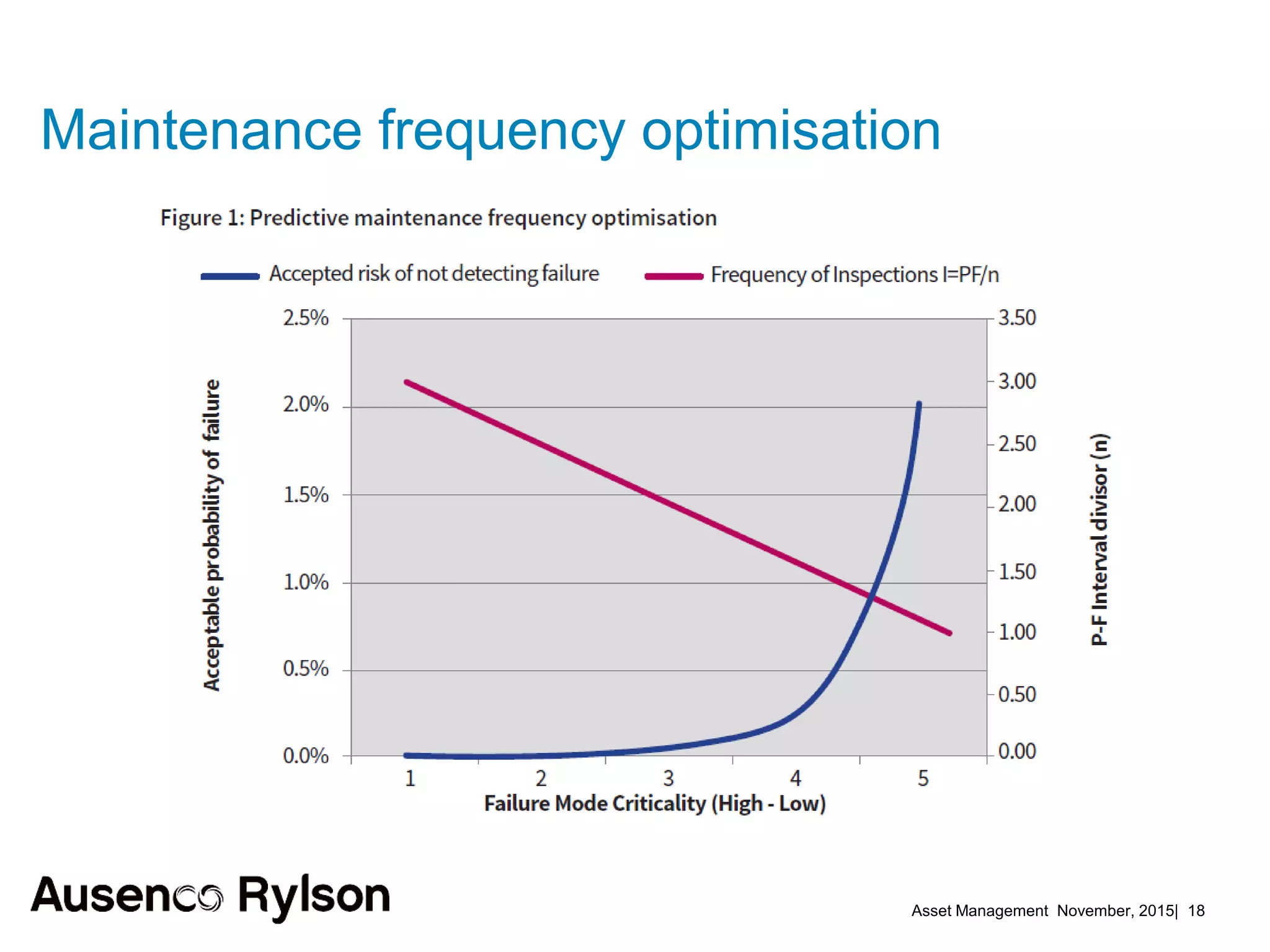
Maintenance frequency optimisation
Asset Management November, 2015| 19
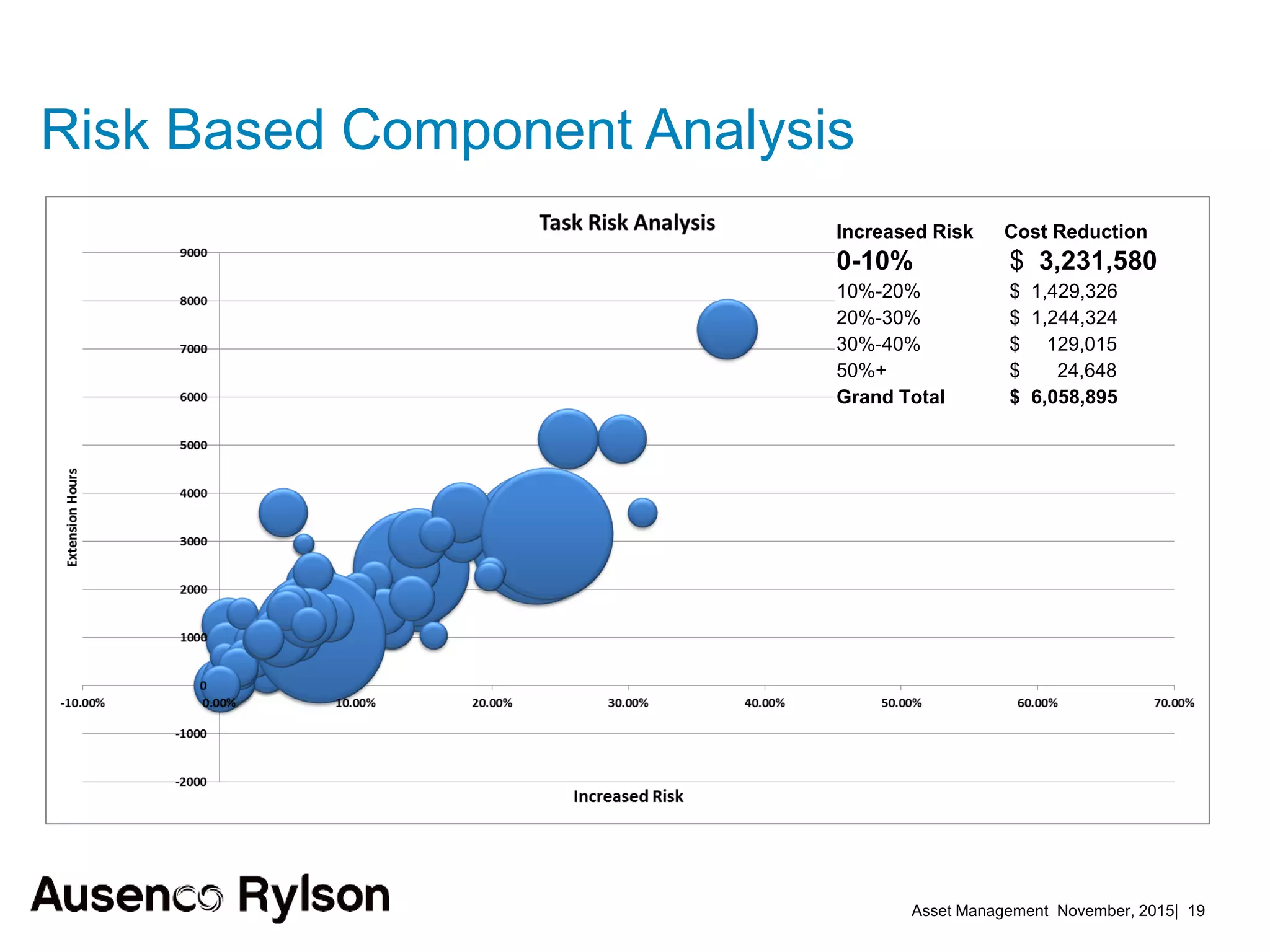
Risk Based Component Analysis
Increased Risk Cost Reduction
0-10% $ 3,231,580
10%-20% $ 1,429,326
20%-30% $ 1,244,324
30%-40% $ 129,015
50%+ $ 24,648
Grand Total $ 6,058,895
Asset Management November, 2015| 20
Asset Condition Assessment Methodology
• Mechanical, Electrical and Structural condition assessment
• Review existing major work lists including proposals for upgrades or refurbishments
• Review work order history focussing on completion of Preventative Maintenance
• Determine last repair/replace dates
• Review condition monitoring / test reports
• Determine Asset expected life based on operating context
• Determine remnant life based on production forecasts
• Visual inspections where required to determine obvious signs of structural distress
• Thickness / Crack testing (structural and pipeline)
• Corrosion analysis
• Estimate repair / replace capital estimate and timeline
• Determine upgrades where required
• Assign risk ratings to each asset / structure / equipment
Asset Management November, 2015| 21
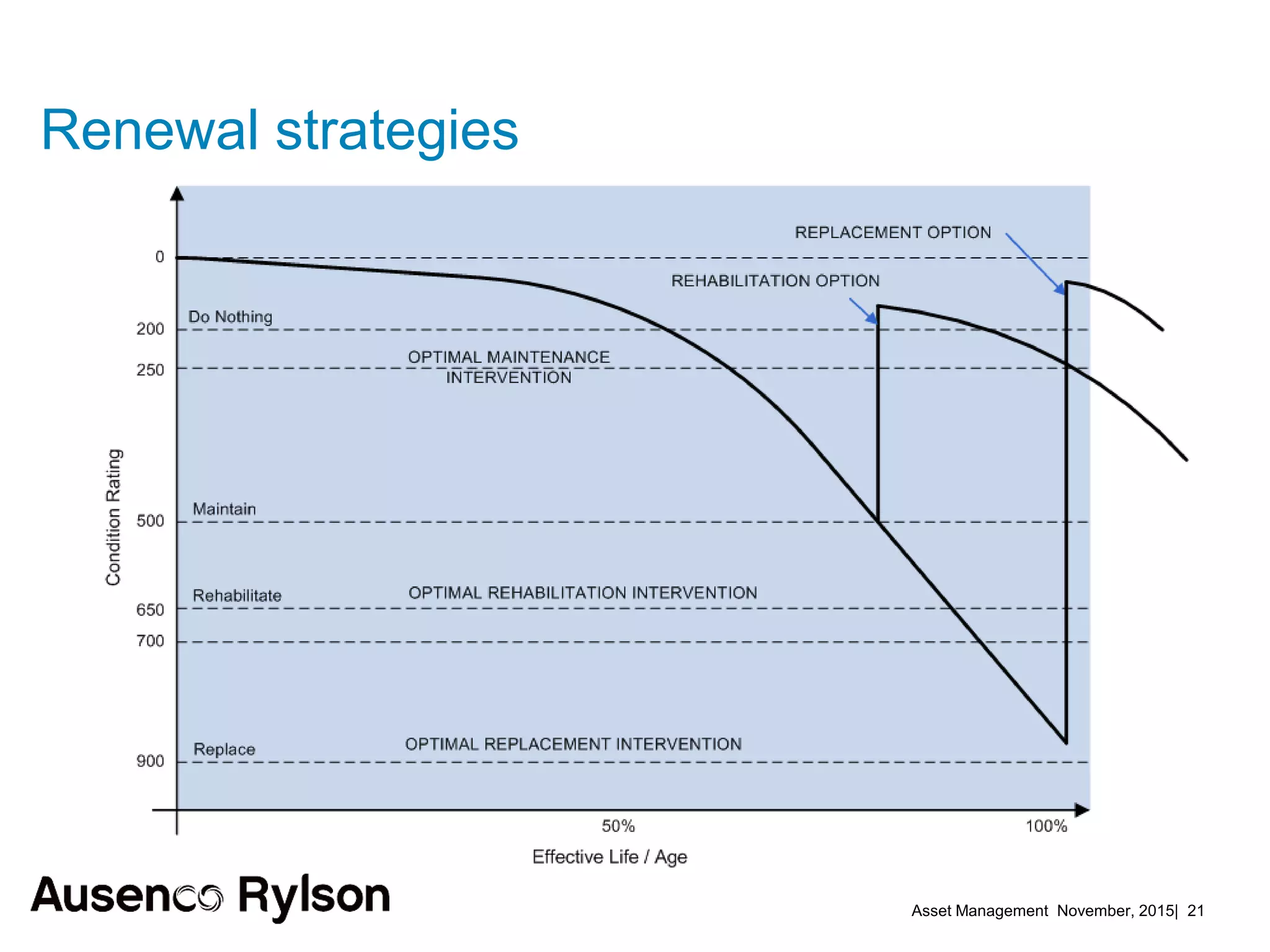
Renewal strategies
Asset Management November, 2015| 22
Risk with component extension
• What risk are we exposed to by extending component lives??
• Condition Monitoring Strategies
• Unaffected by component extensions as condition determines replacement
• Ensure PF interval exceeds planning horizon
• Critical Spares Analysis to reduce risk
• Fixed Time Replacement Strategies
• Glasser Graphs give good indication of optimum replacement interval
• Quantifies decision in terms of $
• Operate to Failure Strategies
• No impact
Asset Management November, 2015| 23
Condition monitoring
• Technique or technology determines the P-F interval (period of time between
detection and failure sometimes known as Remaining Useful Life RUL)
• P-F Interval must exceed the planning horizon (time to plan the corrective)
• If not, the failure will happen in an unscheduled fashion
• Having parts on hand will reduce the planning horizon HOWEVER holding parts
is expensive
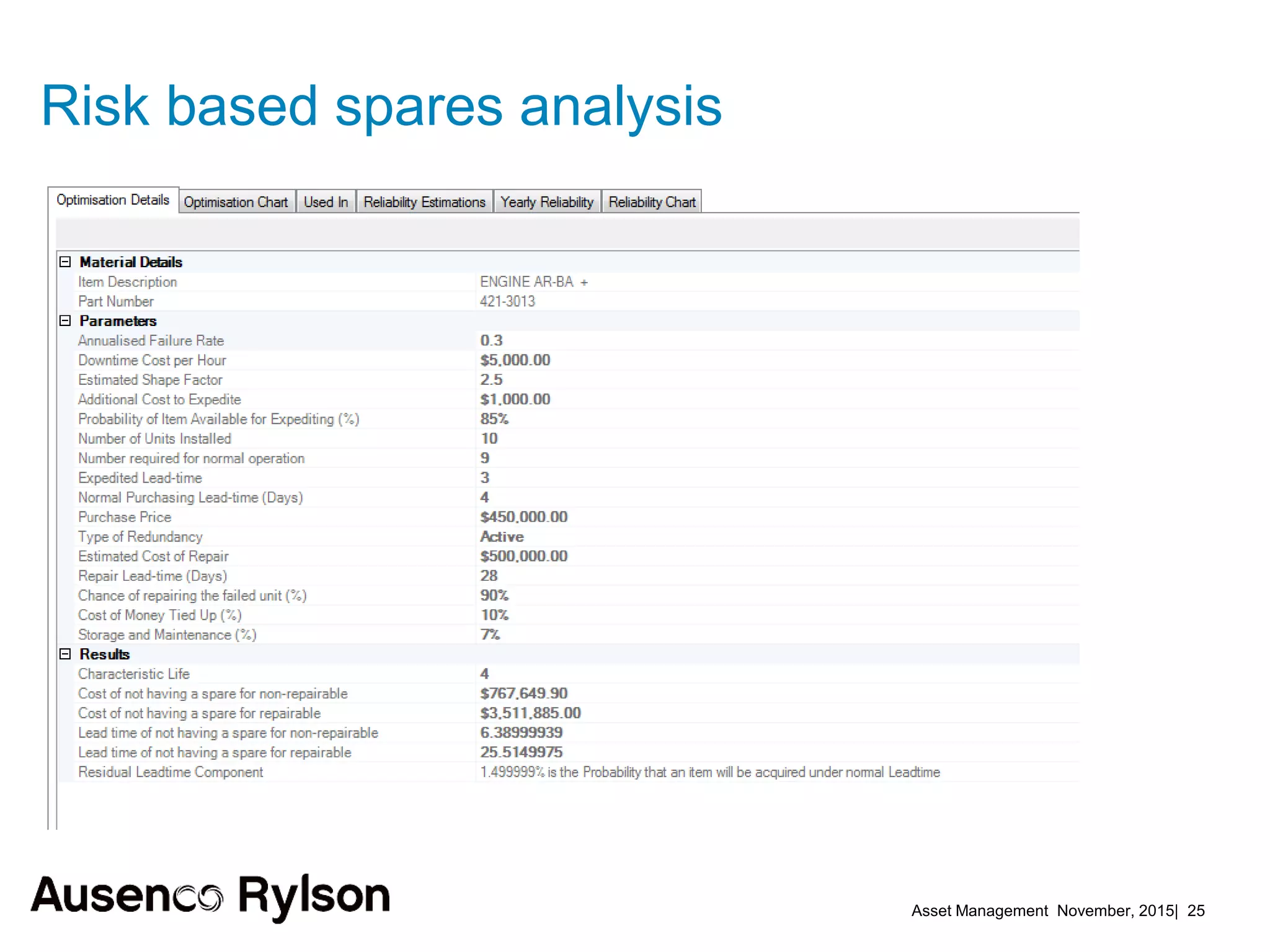
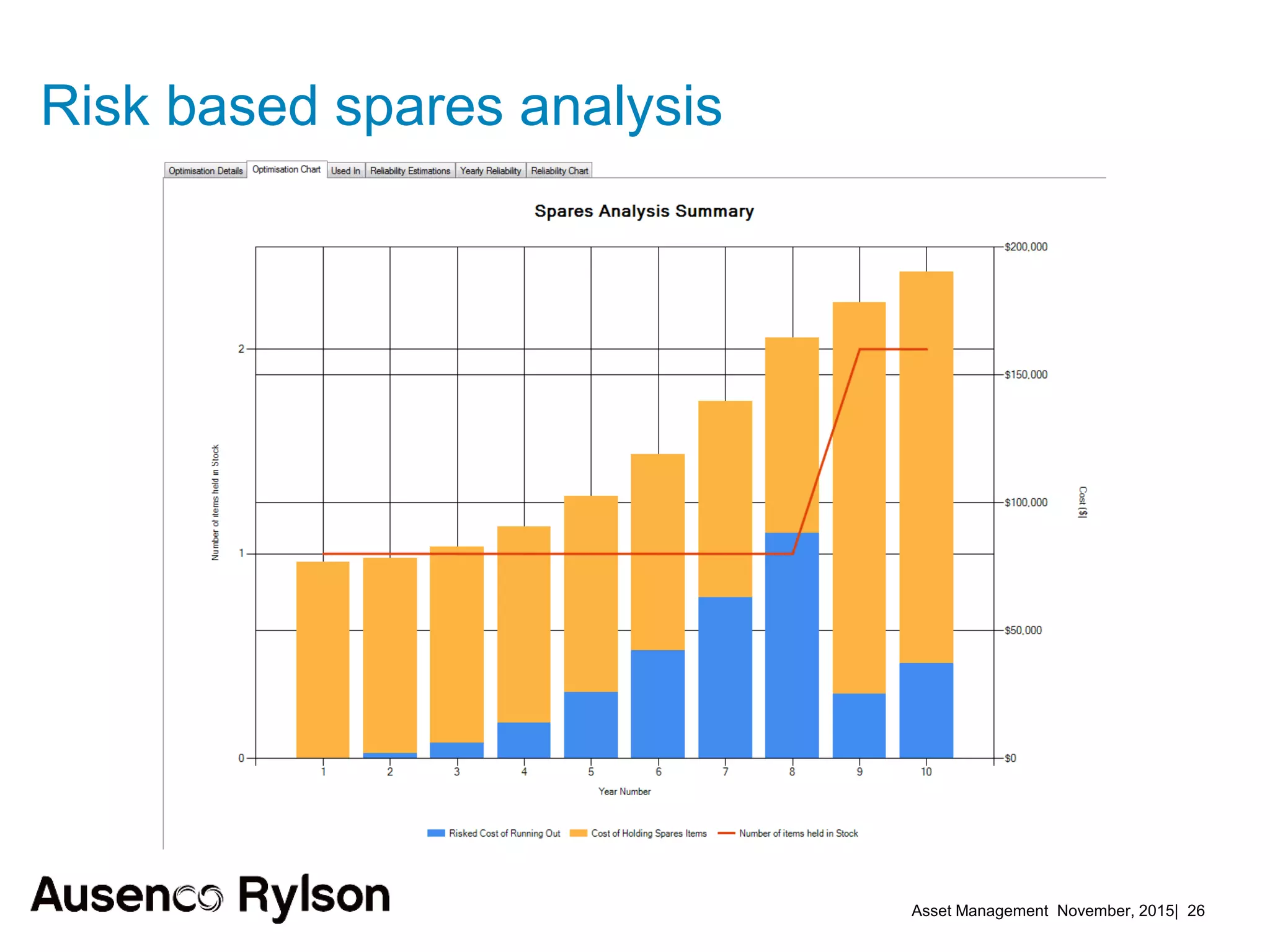
• Critical Spares Analysis assesses the COST of holding versus the RISK of
failure
• An optimum holding reduces the overall RISK to the business
Asset Management November, 2015| 24
Fixed time replacement
• Fixed time replacements are warranted when the cost or consequence of failure
overrides the cost of prediction, however
• The hazard rate must be increasing (risk), and
• The cost of doing the activity in an unscheduled fashion far exceeds that of
doing it in a scheduled fashion.
• Glasser’s graphs can be used to determine the optimum replacement interval
and the RISK cost to the business of extending component lives
Asset Management November, 2015| 25
Risk based spares analysis
Asset Management November, 2015| 26
Risk based spares analysis
Asset Management November, 2015| 27
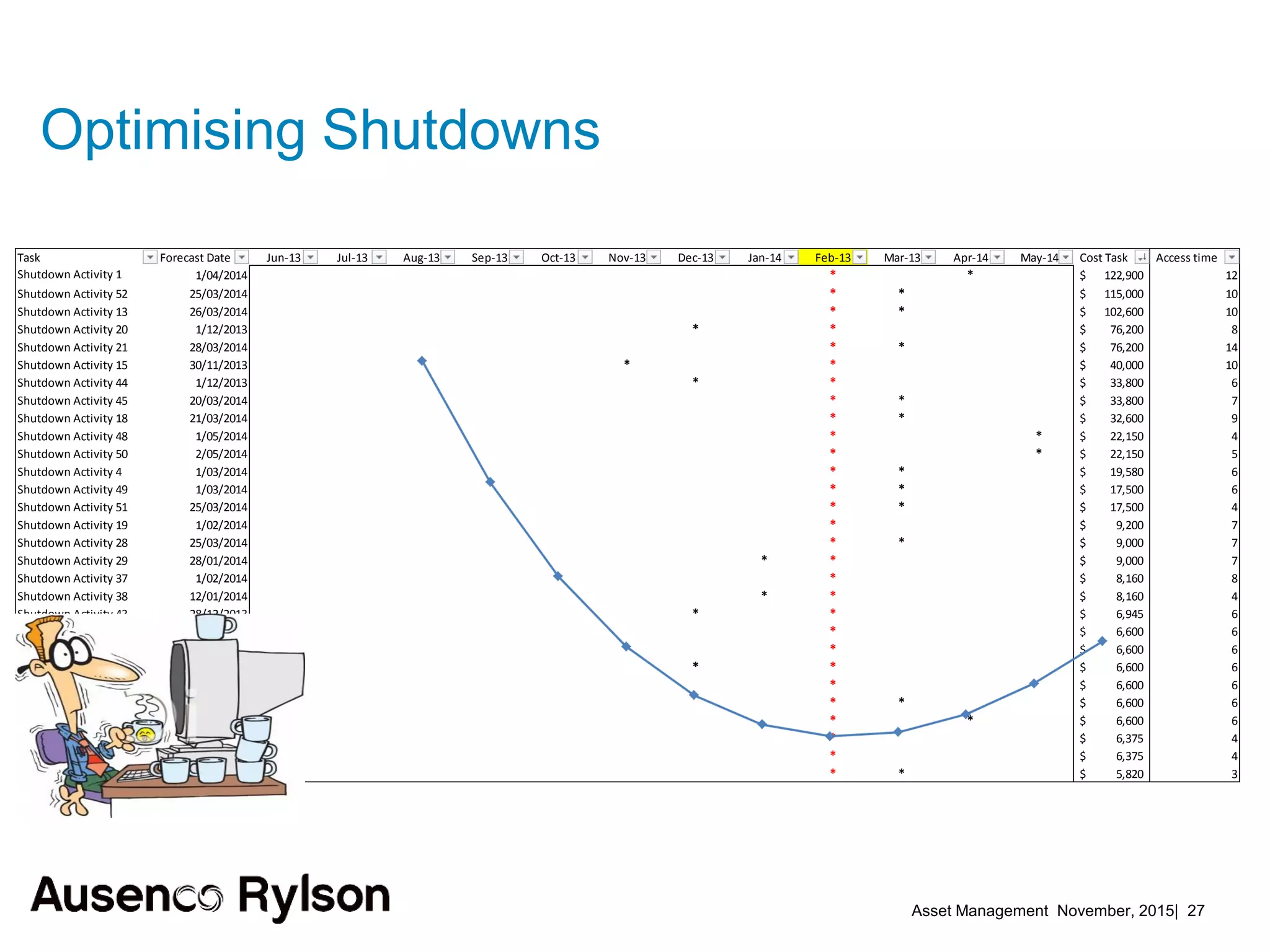
Optimising Shutdowns
Task Forecast Date Jun-13 Jul-13 Aug-13 Sep-13 Oct-13 Nov-13 Dec-13 Jan-14 Feb-13 Mar-13 Apr-14 May-14 Cost Task Access time
Shutdown Activity 1 1/04/2014 * * 122,900$ 12
Shutdown Activity 52 25/03/2014 * * 115,000$ 10
Shutdown Activity 13 26/03/2014 * * 102,600$ 10
Shutdown Activity 20 1/12/2013 * * 76,200$ 8
Shutdown Activity 21 28/03/2014 * * 76,200$ 14
Shutdown Activity 15 30/11/2013 * * 40,000$ 10
Shutdown Activity 44 1/12/2013 * * 33,800$ 6
Shutdown Activity 45 20/03/2014 * * 33,800$ 7
Shutdown Activity 18 21/03/2014 * * 32,600$ 9
Shutdown Activity 48 1/05/2014 * * 22,150$ 4
Shutdown Activity 50 2/05/2014 * * 22,150$ 5
Shutdown Activity 4 1/03/2014 * * 19,580$ 6
Shutdown Activity 49 1/03/2014 * * 17,500$ 6
Shutdown Activity 51 25/03/2014 * * 17,500$ 4
Shutdown Activity 19 1/02/2014 * 9,200$ 7
Shutdown Activity 28 25/03/2014 * * 9,000$ 7
Shutdown Activity 29 28/01/2014 * * 9,000$ 7
Shutdown Activity 37 1/02/2014 * 8,160$ 8
Shutdown Activity 38 12/01/2014 * * 8,160$ 4
Shutdown Activity 43 28/12/2013 * * 6,945$ 6
Shutdown Activity 22 25/02/2014 * 6,600$ 6
Shutdown Activity 23 26/02/2014 * 6,600$ 6
Shutdown Activity 24 27/12/2013 * * 6,600$ 6
Shutdown Activity 25 1/02/2014 * 6,600$ 6
Shutdown Activity 26 1/03/2014 * * 6,600$ 6
Shutdown Activity 27 2/04/2014 * * 6,600$ 6
Shutdown Activity 2 1/02/2014 * 6,375$ 4
Shutdown Activity 3 19/02/2014 * 6,375$ 4
Shutdown Activity 39 25/03/2014 * * 5,820$ 3
Asset Management November, 2015| 28
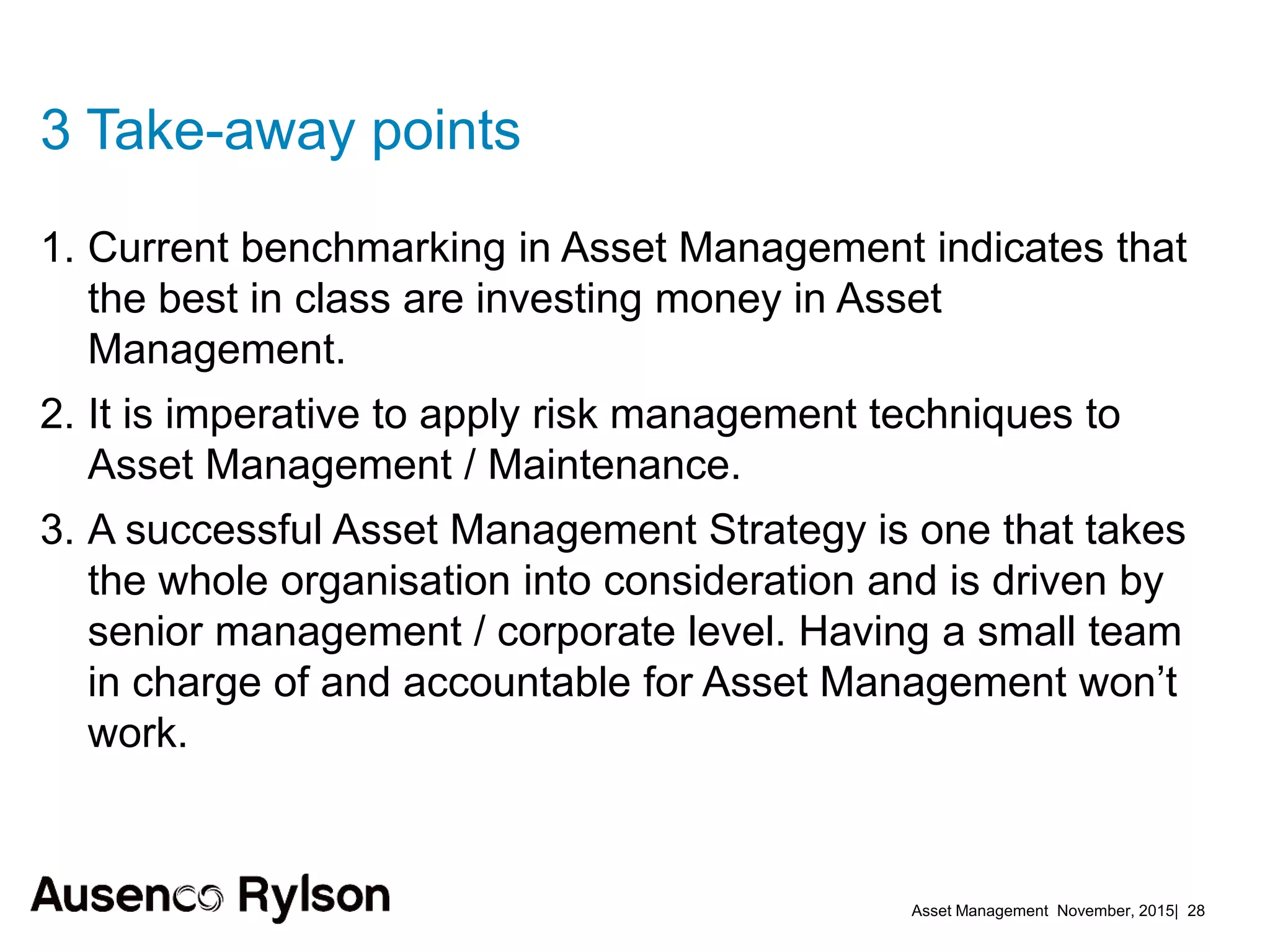
3 Take-away points
1. Current benchmarking in Asset Management indicates that
the best in class are investing money in Asset
Management.
2. It is imperative to apply risk management techniques to
Asset Management / Maintenance.
3. A successful Asset Management Strategy is one that takes
the whole organisation into consideration and is driven by
senior management / corporate level. Having a small team
in charge of and accountable for Asset Management won’t
work.
Asset Management November, 2015| 29
Questions?

Nick Tompkins QGC Presentation Nov2015

  • 1.
    Asset Management November,2015| 1 Creating a robust asset management strategy to optimise asset performance and improve asset reliability N o v e m b e r , 2 0 1 5 Nick Tompkins – Technical Manager
  • 2.
    Asset Management November,2015| 2 Objective: • The objective of asset management is to achieve the best possible match of physical assets with the requirements and goals of the business that uses the assets . Therefore addressing the costs in terms of: • reduced demand for new assets by adoption of 'non-asset' solutions; • maximising the service life of existing assets; • lowering the overall cost of owning assets through the use of life-cycle costing techniques; and • ensuring a sharper focus on results by establishing clear accountability and responsibility for assets. Asset Management
  • 3.
    Asset Management November,2015| 3 • GFMAM (The Global Forum on Maintenance and Asset Management) 10 member organisations including the AMCouncil • The Asset Management Landscape • IAM (Institute of Asset Management) • Asset Management – An anatomy • 39 Subjects in 6 Key Areas o Strategy and Planning o Asset Management Decision Making o Lifecycle Delivery o Asset Information o Organisation & People o Risk & Review • PAS55 • ISO55000, ISO55001, ISO55002 • IAM Certificate • Endorsed Assessment • JA1011 (RCM) Understanding the current Asset Management Standards
  • 4.
    Asset Management November,2015| 4 Asset Management Resources
  • 5.
    Asset Management November,2015| 5 Total Life Cycle Management
  • 6.
    Asset Management November,2015| 6 Life Cycle Cost Analysis
  • 7.
    Asset Management November,2015| 7 Asset Management Process
  • 8.
    Asset Management November,2015| 8 Reliability Growth Model Derived from the DuPont Operational Excellence Model Assessment Optimised Maintenance Strategy Structured Work Management System Disciplined Defect Elimination Program Cost & Risk Optimisation Effective Data Capture and Performance Management Systems Complementary Workforce Development Program Structured Documentation and Control System
  • 9.
    Asset Management November,2015| 9 Key success factors • Buy-in • Skills • Support People • Process mapping • Procedures • RACI Process • Maintenance • Operation • Optimisation • Renewals Tactics • CMMS • Document control • Tech Library • Asset Management software Systems KPI’s
  • 10.
    Asset Management November,2015| 10 Where do we focus? “We cannot solve our problems with the same thinking we used when we created them” - Albert Einstein What your Assets require What you can afford
  • 11.
    Asset Management November,2015| 11 • Continuing to do what you have always done will not provide the outcomes you are looking for • Best performers keep getting better • Poor performers are falling further behind Industry Benchmarks
  • 12.
    Asset Management November,2015| 12 Investment in Asset Management
  • 13.
    Asset Management November,2015| 13 Business capabilities and technology drivers • 65% of best in class organisations have cross functional teams to improve risk and asset performance • 76% of best in class organisations use historical and real time data coupled with asset lifecycle plans as actionable intelligence
  • 14.
    Asset Management November,2015| 14 2 Research Papers delivered in 2012 by Aberdeen Group 1. Asset Management, Building the Business Case 2. Operation Risk Management Aberdeen Group Research 2012
  • 15.
    Asset Management November,2015| 15 94% of Energy Leaders apply Risk Management techniques to Asset Management / Maintenance Energy Leaders have 4.3% unscheduled asset downtime Aberdeen Group Research 2014
  • 16.
    Asset Management November,2015| 16 Total Cost or impact to the business
  • 17.
    Asset Management November,2015| 17 P-F Interval to determine task frequency Acceptable Limit Set Point P- Sensitive Cond. Monitoring P – Basic Cond. Monitoring P – Rudimentary Inspection F – Functional Failure Asset/Component Destruction Time Asset Condition P-F Interval “P”: is the earliest possible detection point of potential failure (Inspection method dependent) Recommended Frequency Potential Failure Curve
  • 18.
    Asset Management November,2015| 18 Maintenance frequency optimisation
  • 19.
    Asset Management November,2015| 19 Risk Based Component Analysis Increased Risk Cost Reduction 0-10% $ 3,231,580 10%-20% $ 1,429,326 20%-30% $ 1,244,324 30%-40% $ 129,015 50%+ $ 24,648 Grand Total $ 6,058,895
  • 20.
    Asset Management November,2015| 20 Asset Condition Assessment Methodology • Mechanical, Electrical and Structural condition assessment • Review existing major work lists including proposals for upgrades or refurbishments • Review work order history focussing on completion of Preventative Maintenance • Determine last repair/replace dates • Review condition monitoring / test reports • Determine Asset expected life based on operating context • Determine remnant life based on production forecasts • Visual inspections where required to determine obvious signs of structural distress • Thickness / Crack testing (structural and pipeline) • Corrosion analysis • Estimate repair / replace capital estimate and timeline • Determine upgrades where required • Assign risk ratings to each asset / structure / equipment
  • 21.
    Asset Management November,2015| 21 Renewal strategies
  • 22.
    Asset Management November,2015| 22 Risk with component extension • What risk are we exposed to by extending component lives?? • Condition Monitoring Strategies • Unaffected by component extensions as condition determines replacement • Ensure PF interval exceeds planning horizon • Critical Spares Analysis to reduce risk • Fixed Time Replacement Strategies • Glasser Graphs give good indication of optimum replacement interval • Quantifies decision in terms of $ • Operate to Failure Strategies • No impact
  • 23.
    Asset Management November,2015| 23 Condition monitoring • Technique or technology determines the P-F interval (period of time between detection and failure sometimes known as Remaining Useful Life RUL) • P-F Interval must exceed the planning horizon (time to plan the corrective) • If not, the failure will happen in an unscheduled fashion • Having parts on hand will reduce the planning horizon HOWEVER holding parts is expensive • Critical Spares Analysis assesses the COST of holding versus the RISK of failure • An optimum holding reduces the overall RISK to the business
  • 24.
    Asset Management November,2015| 24 Fixed time replacement • Fixed time replacements are warranted when the cost or consequence of failure overrides the cost of prediction, however • The hazard rate must be increasing (risk), and • The cost of doing the activity in an unscheduled fashion far exceeds that of doing it in a scheduled fashion. • Glasser’s graphs can be used to determine the optimum replacement interval and the RISK cost to the business of extending component lives
  • 25.
    Asset Management November,2015| 25 Risk based spares analysis
  • 26.
    Asset Management November,2015| 26 Risk based spares analysis
  • 27.
    Asset Management November,2015| 27 Optimising Shutdowns Task Forecast Date Jun-13 Jul-13 Aug-13 Sep-13 Oct-13 Nov-13 Dec-13 Jan-14 Feb-13 Mar-13 Apr-14 May-14 Cost Task Access time Shutdown Activity 1 1/04/2014 * * 122,900$ 12 Shutdown Activity 52 25/03/2014 * * 115,000$ 10 Shutdown Activity 13 26/03/2014 * * 102,600$ 10 Shutdown Activity 20 1/12/2013 * * 76,200$ 8 Shutdown Activity 21 28/03/2014 * * 76,200$ 14 Shutdown Activity 15 30/11/2013 * * 40,000$ 10 Shutdown Activity 44 1/12/2013 * * 33,800$ 6 Shutdown Activity 45 20/03/2014 * * 33,800$ 7 Shutdown Activity 18 21/03/2014 * * 32,600$ 9 Shutdown Activity 48 1/05/2014 * * 22,150$ 4 Shutdown Activity 50 2/05/2014 * * 22,150$ 5 Shutdown Activity 4 1/03/2014 * * 19,580$ 6 Shutdown Activity 49 1/03/2014 * * 17,500$ 6 Shutdown Activity 51 25/03/2014 * * 17,500$ 4 Shutdown Activity 19 1/02/2014 * 9,200$ 7 Shutdown Activity 28 25/03/2014 * * 9,000$ 7 Shutdown Activity 29 28/01/2014 * * 9,000$ 7 Shutdown Activity 37 1/02/2014 * 8,160$ 8 Shutdown Activity 38 12/01/2014 * * 8,160$ 4 Shutdown Activity 43 28/12/2013 * * 6,945$ 6 Shutdown Activity 22 25/02/2014 * 6,600$ 6 Shutdown Activity 23 26/02/2014 * 6,600$ 6 Shutdown Activity 24 27/12/2013 * * 6,600$ 6 Shutdown Activity 25 1/02/2014 * 6,600$ 6 Shutdown Activity 26 1/03/2014 * * 6,600$ 6 Shutdown Activity 27 2/04/2014 * * 6,600$ 6 Shutdown Activity 2 1/02/2014 * 6,375$ 4 Shutdown Activity 3 19/02/2014 * 6,375$ 4 Shutdown Activity 39 25/03/2014 * * 5,820$ 3
  • 28.
    Asset Management November,2015| 28 3 Take-away points 1. Current benchmarking in Asset Management indicates that the best in class are investing money in Asset Management. 2. It is imperative to apply risk management techniques to Asset Management / Maintenance. 3. A successful Asset Management Strategy is one that takes the whole organisation into consideration and is driven by senior management / corporate level. Having a small team in charge of and accountable for Asset Management won’t work.
  • 29.
    Asset Management November,2015| 29 Questions?