Bereitschaftspotential
Ade Wijaya, MD – December 2019
Introduction
 Kornhuber and Deecke (1964) made the first report
of electroencephalographic (EEG) activity preceding
volitional movement in humans 
Bereitschaftspotential (BP) / Readiness Potential
 Part of Movement-related cortical potentials (MRCP)
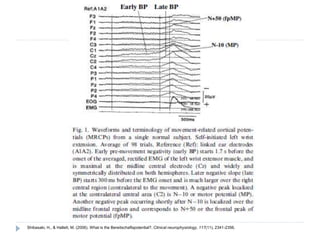
 BP starts about 2.0 s before the movement onset. It
is maximal at the midline centro-parietal area, and
symmetrically and widely distributed over the scalp
regardless of the site of movement.
Shibasaki, H., & Hallett, M. (2006). What is the Bereitschaftspotential?. Clinical neurophysiology, 117(11), 2341-2356.
Early vs Late BP
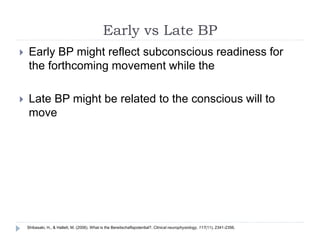
 Early BP might reflect subconscious readiness for
the forthcoming movement while the
 Late BP might be related to the conscious will to
move
Shibasaki, H., & Hallett, M. (2006). What is the Bereitschaftspotential?. Clinical neurophysiology, 117(11), 2341-2356.
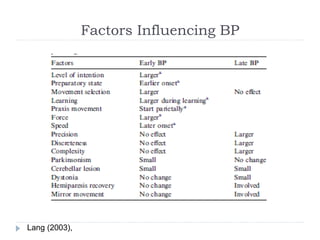
Factors Influencing BP
Lang (2003),
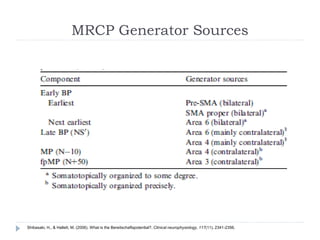
MRCP Generator Sources
Shibasaki, H., & Hallett, M. (2006). What is the Bereitschaftspotential?. Clinical neurophysiology, 117(11), 2341-2356.
BP in Movement Disorders
 Parkinson’s Disease
 Post-stroke recovery
 Focal Dystonia
 One of the most useful clinical application of BP is its
use for detecting the participation of the voluntary
motor system in the generation of ‘psychogenic
involuntary movements’.
Shibasaki, H., & Hallett, M. (2006). What is the Bereitschaftspotential?. Clinical neurophysiology, 117(11), 2341-2356.
Summary
 Pre-movement slow negativity
 Early vs Late BP
 Movement disorders
 One of the most useful clinical application of BP is its
use for detecting the participation of the voluntary
motor system in the generation of ‘psychogenic
involuntary movements’.
THANK YOU

Bereitschaftspotential

  • 1.
  • 2.
    Introduction  Kornhuber andDeecke (1964) made the first report of electroencephalographic (EEG) activity preceding volitional movement in humans  Bereitschaftspotential (BP) / Readiness Potential  Part of Movement-related cortical potentials (MRCP)  BP starts about 2.0 s before the movement onset. It is maximal at the midline centro-parietal area, and symmetrically and widely distributed over the scalp regardless of the site of movement. Shibasaki, H., & Hallett, M. (2006). What is the Bereitschaftspotential?. Clinical neurophysiology, 117(11), 2341-2356.
  • 3.
    Shibasaki, H., &Hallett, M. (2006). What is the Bereitschaftspotential?. Clinical neurophysiology, 117(11), 2341-2356.
  • 4.
    Early vs LateBP  Early BP might reflect subconscious readiness for the forthcoming movement while the  Late BP might be related to the conscious will to move Shibasaki, H., & Hallett, M. (2006). What is the Bereitschaftspotential?. Clinical neurophysiology, 117(11), 2341-2356.
  • 5.
  • 6.
    MRCP Generator Sources Shibasaki,H., & Hallett, M. (2006). What is the Bereitschaftspotential?. Clinical neurophysiology, 117(11), 2341-2356.
  • 7.
    BP in MovementDisorders  Parkinson’s Disease  Post-stroke recovery  Focal Dystonia  One of the most useful clinical application of BP is its use for detecting the participation of the voluntary motor system in the generation of ‘psychogenic involuntary movements’. Shibasaki, H., & Hallett, M. (2006). What is the Bereitschaftspotential?. Clinical neurophysiology, 117(11), 2341-2356.
  • 8.
    Summary  Pre-movement slownegativity  Early vs Late BP  Movement disorders  One of the most useful clinical application of BP is its use for detecting the participation of the voluntary motor system in the generation of ‘psychogenic involuntary movements’.
  • 9.