Lecture Series on
Strength of Materials-6
“Bending Stress”
www.engineersfirst.in
 The material of beam is homogeneous and
isotropic.
 Young’s Modulus is the same in tension as in
compression.
 Each layer is free to expand and contract
having no influence in the neighboring layer
for their expansion and contraction.
 The stress-strain relationship is linear and
elastic.
 Sections which are plane before bending
remain plane after bending.
 Beams are initially straight
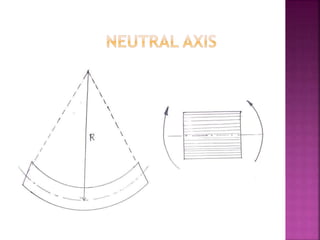
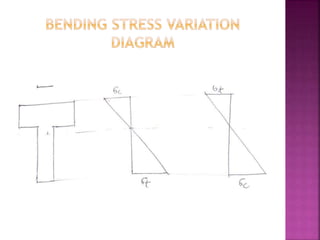
 (M/I= σb /Y=E/R)
 Where σb= Bending Stress
 M = Bending Moment
 I = Moment of Inertia
 E = Modulus of elasticity
 R = Radius of curvature
 y = Distance of the fiber from NA (Neutral
axis)
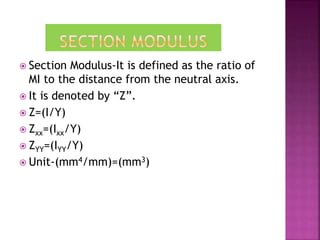
 Section Modulus-It is defined as the ratio of
MI to the distance from the neutral axis.
 It is denoted by “Z”.
 Z=(I/Y)
 Zxx=(Ixx/Y)
 ZYY=(IYY/Y)
 Unit-(mm4/mm)=(mm3)
Thank You

Bending stress

  • 1.
    Lecture Series on Strengthof Materials-6 “Bending Stress” www.engineersfirst.in
  • 2.
     The materialof beam is homogeneous and isotropic.  Young’s Modulus is the same in tension as in compression.  Each layer is free to expand and contract having no influence in the neighboring layer for their expansion and contraction.  The stress-strain relationship is linear and elastic.  Sections which are plane before bending remain plane after bending.  Beams are initially straight
  • 3.
     (M/I= σb/Y=E/R)  Where σb= Bending Stress  M = Bending Moment  I = Moment of Inertia  E = Modulus of elasticity  R = Radius of curvature  y = Distance of the fiber from NA (Neutral axis)
  • 5.
     Section Modulus-Itis defined as the ratio of MI to the distance from the neutral axis.  It is denoted by “Z”.  Z=(I/Y)  Zxx=(Ixx/Y)  ZYY=(IYY/Y)  Unit-(mm4/mm)=(mm3)
  • 9.